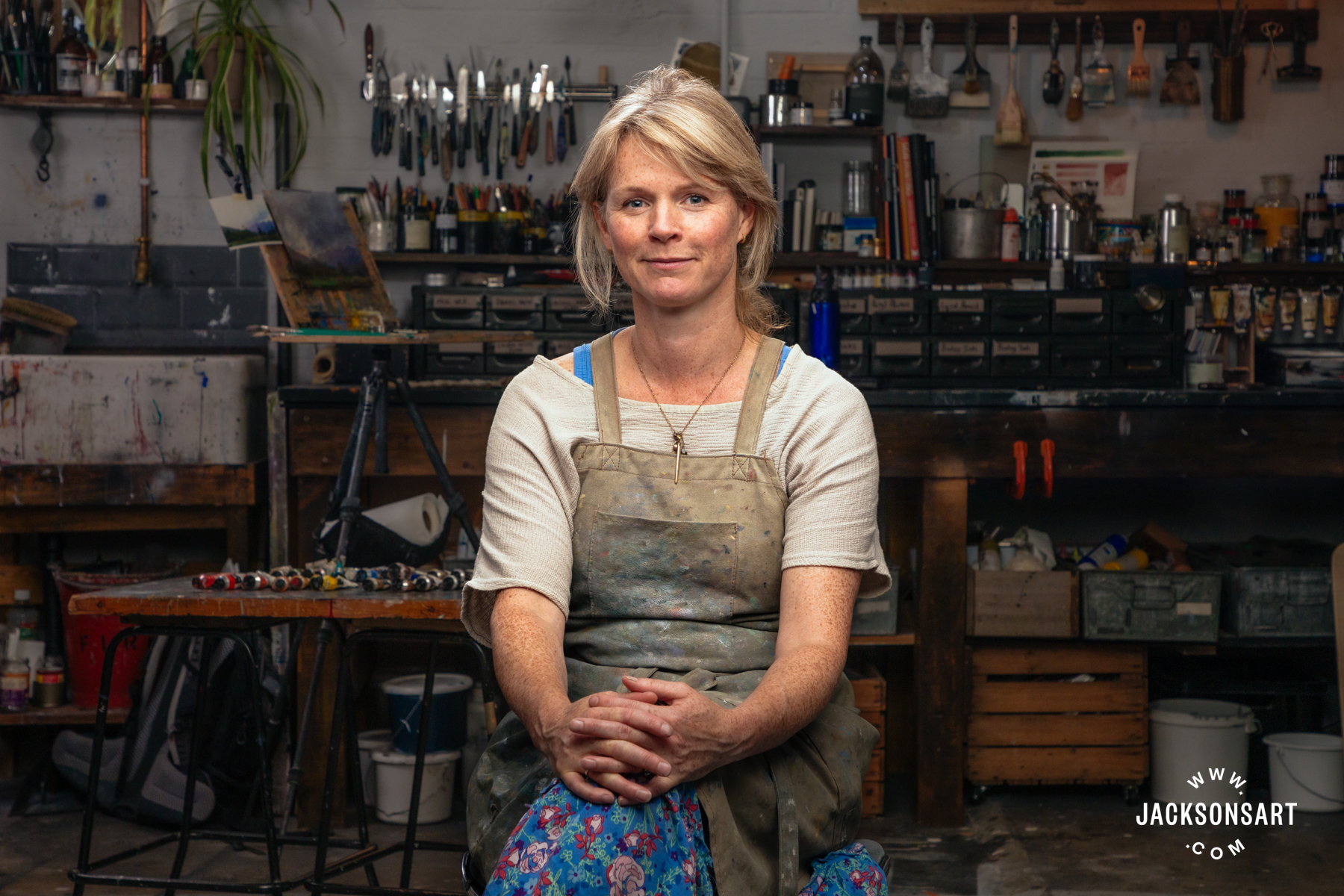
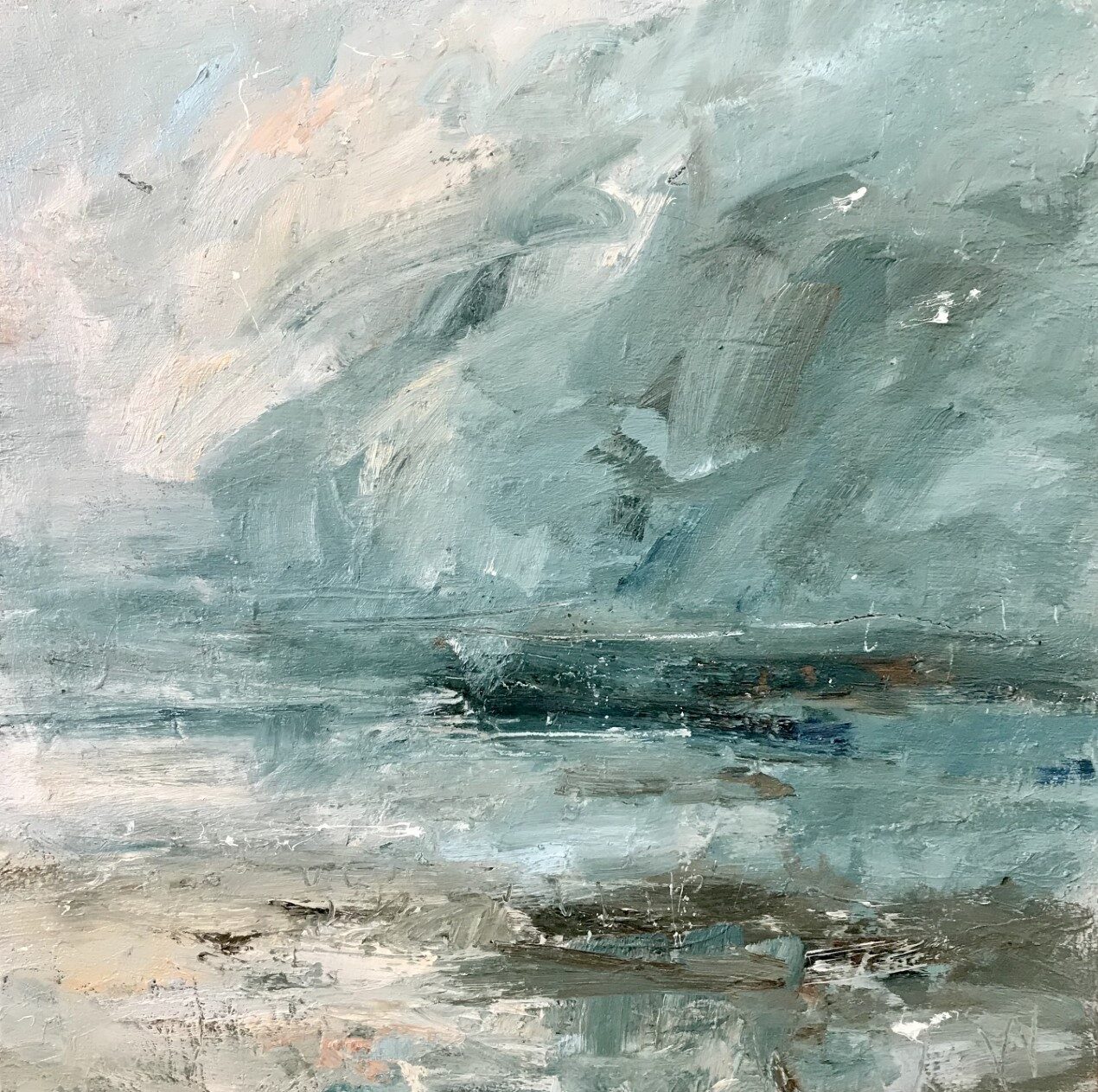
Jim Wright paints landscapes with huge skies and rolling hills, the drama of the crashing waves, the power of nature. He very generously shares his thoughts on painting out of doors in the passage below.
I have always been drawn to and inspired by the effects of light on the sea and the land, but in the last few years my work has focused far more on portraying the energy I experience. This change of focus is largely attributable to spending more time painting en plein air. Energy itself isn’t visible, but to witness huge waves roaring in, the explosions of spray, the wind carrying the spray, spume and spindrift and hear the sonic booms, this is what I find exciting. I respond to this energy by working in a more spontaneous way, and consequently I’ve found my painting is far more free flowing and satisfying.
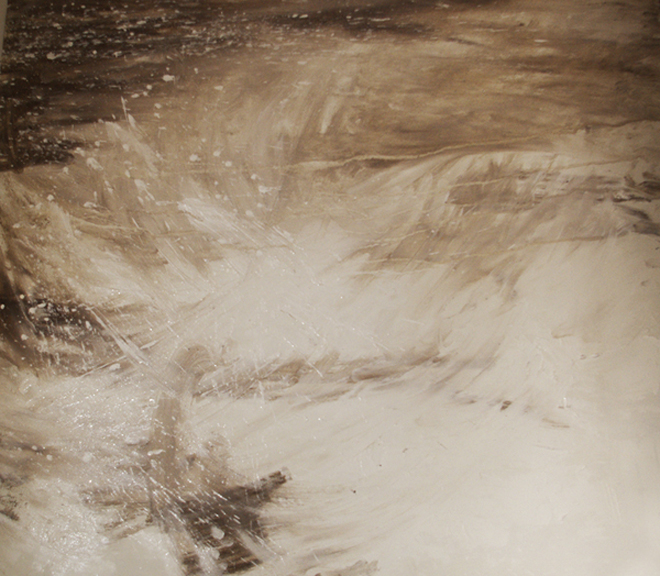
Understanding a place is particularly important in my practice, Ardnamurchan Point and Cape Cornwall are two places I return to again and again, because I know there are strong flows of energy at these points as well as a purity of light. I’ve spent time discovering the places I want to paint from and ways that I can do it safely. I do continue to extend my knowledge of the area and the differing conditions, but if the weather is inspiring, having done the groundwork, I can begin painting as soon as I arrive.
The longer I spend in a place, the more rewarding it becomes. I am lucky to have been given the opportunity to rent a fisherman’s hut at Cape Cornwall. Talking to the fishermen, ex-tin miners, other artists and musicians has provided me with a wealth of information. The weather and sea conditions can catch the most experienced sailor out, so sound advice from them is worth making note of. My enjoyment of surfing has meant I have spent a great deal of time over the years observing the waves, noting the tides and wind direction and looking for swells building up out at sea. The surfing website magicseaweed is my oracle for information and forecasts on the weather, tides and sea states. It’s a particularly useful tool when deciding in my studio, whether to travel North West or South West to paint in storm conditions.
This week I am beginning a reconnaissance of a new area not far from Cape Wrath. As I like to paint as close to the breaking waves as possible, my initial task is to find a place that has (i) lots of energy in the sea, such as heaving and crashing waves rolling in, or swirling white waters around the rocks, (ii) accessibility to sea level and an escape route from an advancing tide (iii) positions of shelter from strong wind conditions.
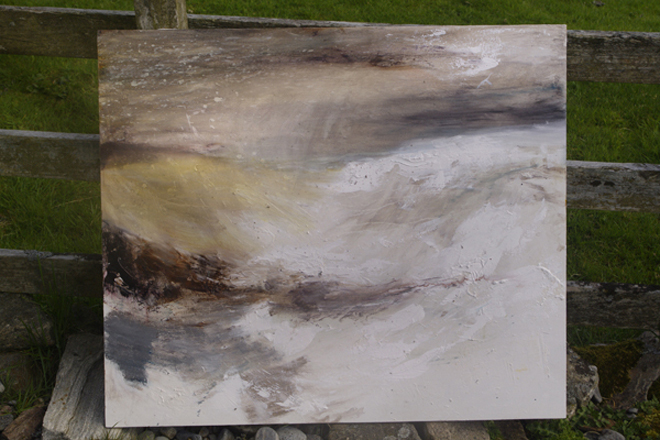
When working large scale in stormy weather, I like to paint directly either onto canvas, or more often prepared plyboard, this creates the additional problem of carrying something that almost becomes a sail in the wind. Once I get to where I’m going to work, it’s possible to wedge the board into rocks, but the journey getting there can be a bit hairy, and carrying it back with wet paint on it, even more of a challenge.
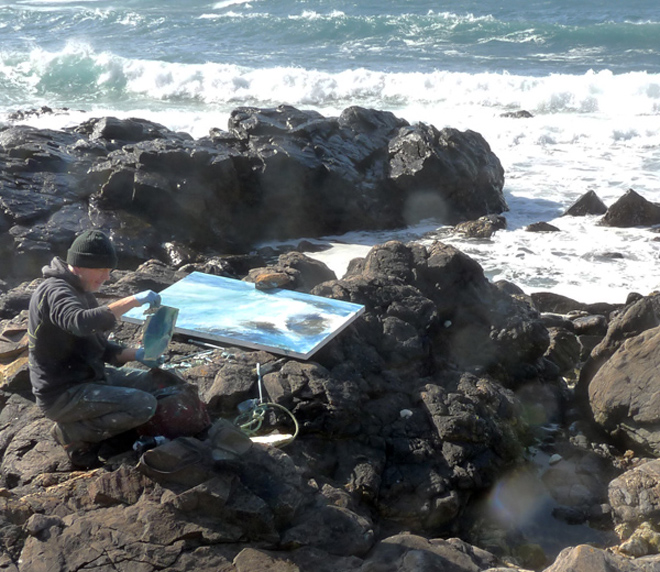
I enjoy working on plyboard, it offers a solid and stable surface, impenetrable on sharp rocks. I prepare boards by coating them with a couple of layers of gesso and then a final layer of gesso applied by flicking and brushing to create a textured surface. The texture flowing in the right direction adds a feeling of movement and energy in the work. I also find I can get some rewarding effects by scraping back the paint on the textured surface.
Using Winsor & Newton Griffin Alkyd quick drying oils, I apply them with rags and card to capture the movement, shadows and shapes. I use brushes to flick and spray the paint to create movement and energy. Painting en plein air I have to apply the oils a little more thickly than I used to do in my studio, as I don’t have the luxury of time to allow layers to dry. Working out on the rocks I work quite quickly and spontaneously, so when I am back in the studio I will look at the painting afresh and decide whether it is finished, or whether it needs any further work.
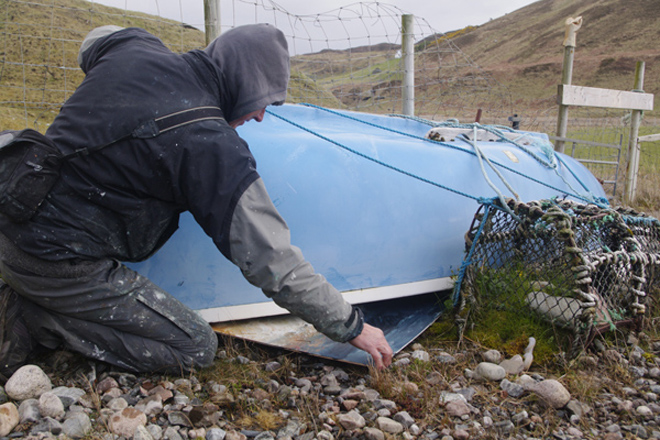
I can’t paint in continuous rain, but the elements often play a part in the painting. Oil paints and water repel with some pleasing results, rain, hail, spray and spume move or splatter the paint and I can turn the board to encourage a flow. It’s usually a lost cause if the wind takes it, and flings it into the sea or a rogue wave catches me out and washes the paint off. Despite all the challenges, I have never enjoyed painting as much as I do now, out in the elements.