




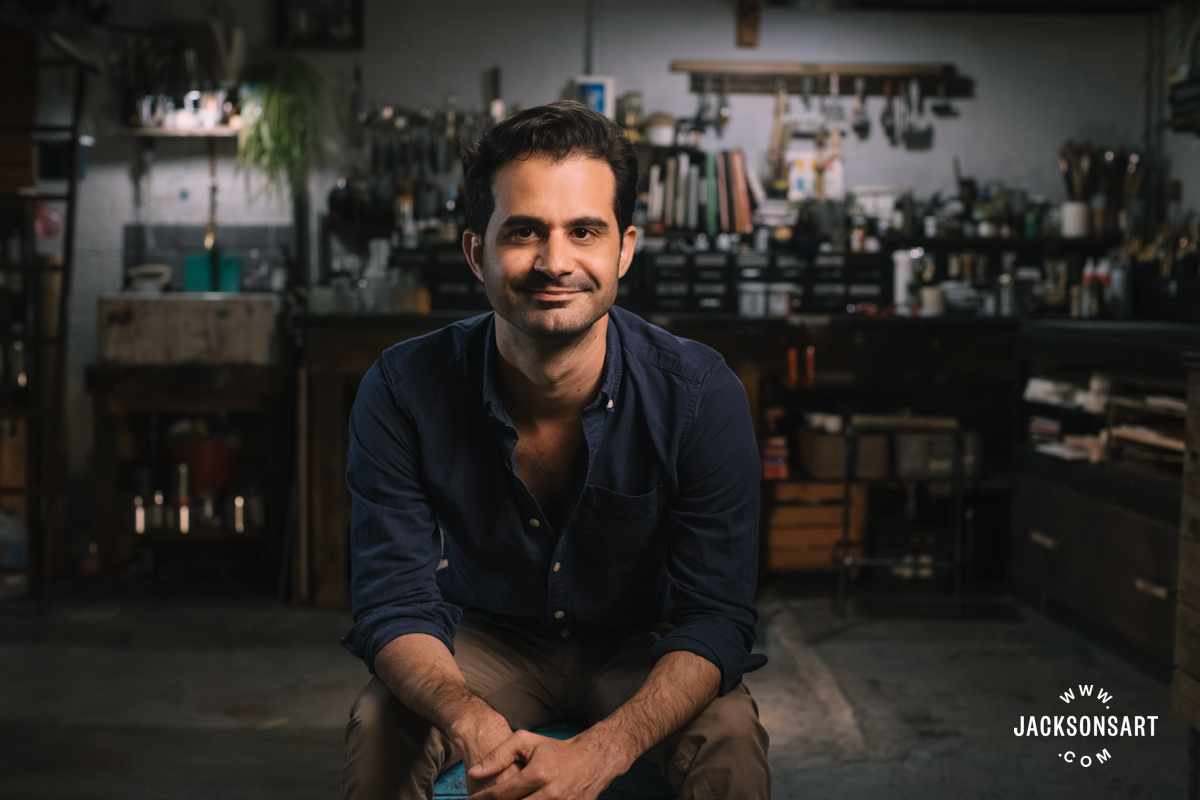
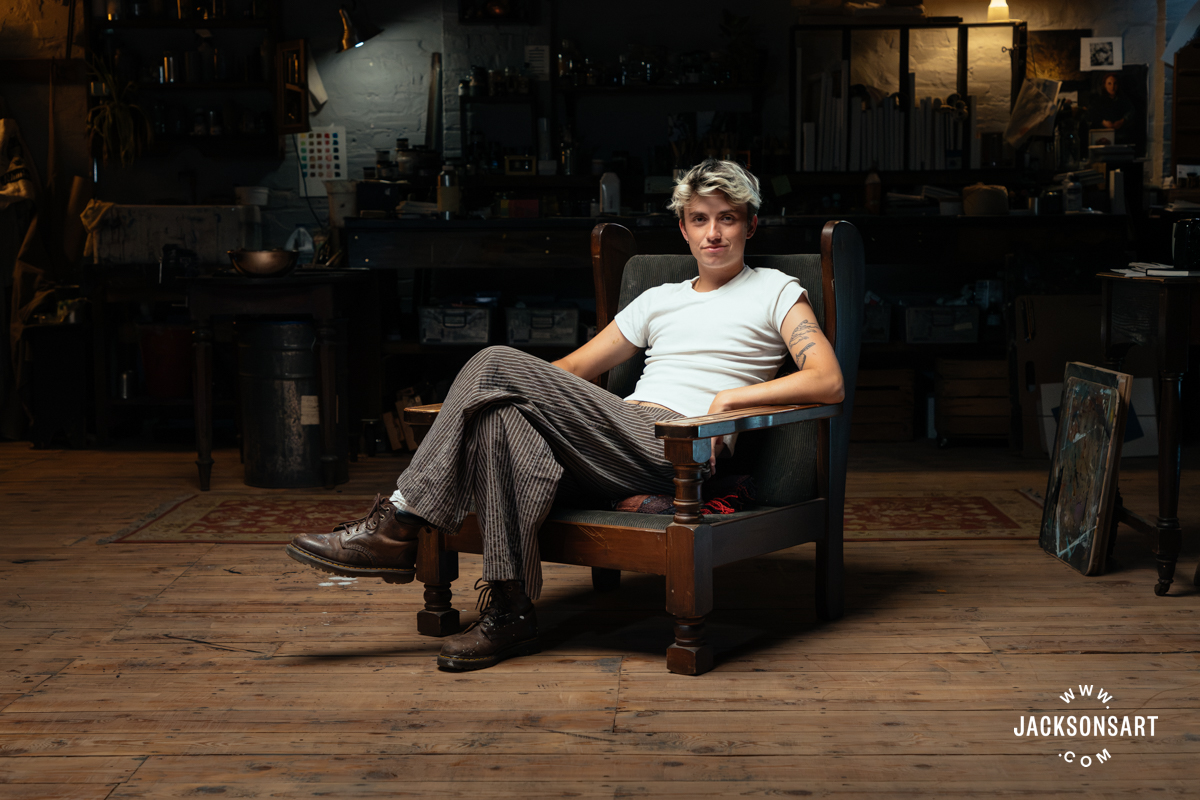
José Jun Martínez is a Puerto Rican-born, London-based painter whose work explores our emotional and sensory relationship with the natural world. He visits us in the Jackson’s Studio to discuss how his approach to painting resembles an organic process. Much like the verdant botanical world he depicts in his work, his practice reflects innate growth and change. José discusses his use of textural mark-making as a reflection of the environment, how he works with a reduced palette to create a full spectrum of colours, and how the scale of his paintings can create a sense of being swallowed by the work, fully immersed in his lush expression of nature.
Contents
0:00 “If I don’t feel that this painting is gonna eat me, it’s not good”
0:10 “That is how nature is, it’s always bigger than me”
0:40 “I am absorbed by it because I am a part of it, because I am a child of it”
1:15 Introduction
1:37 “Art was my thing”
3:04 “I use the word landscape to explain my painting because it’s the easiest, but I don’t consider myself a landscape painter”
3:27 “When I am painting a place, it is not just what I can perceive through light, colour, and texture; the place has a history, and painting is about that tension”
4:18 “If a painting is too pretty, I can’t live with it”
4:46 “It cannot be completely dark and sad. That’s not who I am. That’s what the Puerto Rican experience is for me, all this joy of living in this beautiful place, that goes through all these really heavy and hard experiences. It doesn’t stop being beautiful ever, but it’s hard”
5:14 “I use a lot of paint”
5:40 “I use oil bars. They come first in the beginning, the first stages of the painting, to kind of draw – but also paint”
6:30 “It either takes me 3 hours or 3 months to complete a painting”
7:22 “Some of my best professors were not even painters, they were print makers, or they were drafts people”
9:01 “I don’t just go there, put the canvas and just start painting, sometimes, I take an hour of just being in the place”
10:00 “How can I help whoever is looking at my painting, to feel something of what I am feeling in the language that I could? That’s when the impasto came in”
10:46 “What if I can also communicate intensity with a thin layer of diluted paint or a thin layer of an intense colour”
11:27 “Puerto Rico is a very fertile place for creativity”
13:23 “Cadmium Yellow, that’s my guy”
15:40 “I had to learn to paint in the studio”
19:52 “Once I have the initial starting point, then that’s when the other layer of immersion starts”
21:00 “A series of very white, snowy paintings came from that residency”
23:00 “Sometimes a painting comes out as something completely different from what I was expecting, and I respect that”
23:46 “I love a painting that is not easy”
23:54 “My work is growing, and I can see it is changing”
25:24 “I need to be able to feel that things are happening outside of the canvas”
26:13 “By the end of painting, I can’t see anything of what I did in the beginning”
27:32 “I love a brush that can hold a lot of use, and a lot of rubbing”
28:29 “It’s not just about putting more and more – what you remove is really important too”
28:40 “I do like the surface to resist the brush or the knife”
29:32 “You want the painting to go beyond the ‘wow'”
30:10 “I have to accept it and live with it”
31:27 “One way I know a painting is finished is that I can sleep at night”
32:36 “It’s a bit wild when I am painting because of the nature of what I am evoking”
34:40 “It’s both a physical and psychological thing you have to do to get ready to paint – painting is so alive”
36:44 “I’ve learned more from artists that I will never do anything that looks like them”
37:51 “You have to paint without fear”
40:00 Credits

Extract
If I don’t feel that this painting is going to eat me, it’s not good. I need to feel that it’s bigger than me. That’s how nature is; it’s always bigger than me – I look for immersion all the time.

José Jun Martínez
Oil on canvas, 200 x 160 cm | 78.7 x 63 in
It all comes from being there and from trying to make myself available to receive the information from the trees, the soil, the birds, the insects, the air, the temperature, and the humidity. I am absorbed by it because I am a part of it, because I am a child of it, because I am sometimes just like the little ant, or an insect, or a stray dog walking through the bushes. It’s about the land, but it’s about myself in that sense, myself as being part of it. That’s the statement of the painting. This is me existing in nature.

José Jun Martínez
Oil on canvas, 110 x 90 cm | 43.3 x 35.4 in
Hi, my name is José Jun Martínez. I’m a Puerto Rican, London-based artist, and I’m in the Jackson’s Studio. We’re going to be talking about painting.
My first memories of making art are very, very early. I have this cute photograph of me in my grandparents’ living room, my grandma is sitting, and I’m drawing her. I was a toddler, and I think, from a very young age, my family saw that I enjoyed it, and they started putting me in art classes.

When I was around the age of 12, I started studying at an art school in Puerto Rico called Central High School. And there I learned the love of art. And for anyone who studied there, it was like a magical place. Alongside normal classes, there was an art class every day. I studied for three years in the drawing and painting department. When it was time to go to college, I knew I needed to continue studying art, so I went to the University of Puerto Rico to study fine arts.

José Jun Martínez
Oil on paper, 46 x 60 cm | 18.1 x 23.6 in
Some of my best professors who taught me painting were not even painters; they were printmakers or they were draftsmen. It always gave me a sense of art not being an isolated thing, but existing among many other disciplines and ways of getting to know and study the world.

José Jun Martínez
Drypoint etching, 34 x 22 cm | 13.4 x 8.7 in
It was a very complete education in that sense that helped me form a strong sense of the traditions of art and art history. Also, it allowed me the liberty to experiment and find new ways of making my own language and my own practice.

Photo by Rafael Alejandro
Puerto Rico is a very fertile place for creativity. Not just in the visual arts, but in everything; the particular politics of being a small island, and not part of the United States. It’s a whole complex situation, a colonial relationship, actually.

José Jun Martínez
Oil on canvas, 30 x 22 cm | 11.8 x 8.7 in
And then there are the challenges with the weather, the hurricanes, all of that. That’s the challenge. How do you make something out of this? It might sound a bit romantic, but I think beauty helps us just to see things and find a way of making it all make sense.

José Jun Martínez
Oil on linen, 61 x 50.8 cm | 24 x 20 in
After I graduated from the University of Puerto Rico, before I came to London, I spent eight years of practice going outside and painting, immersed in the landscape. But then we had this really bad hurricane, and I couldn’t go outside for a while. And that’s when I had to learn to paint in the studio.

Photo by Raquel Perez Puig
I do believe that creativity comes out many times from necessity. Then I started implementing photography, and I painted outside, and at the same time, I took photographs of the place. And then I did larger paintings in the studios, and I had the smaller ones that I did outside.

Years later, I even started projecting images in the studio, photographs or videos and painting on top. And that was another way of bringing the outside into the studio – it’s another layer of immersion.

Studying for an MA was something that I wanted to do since the moment I graduated from the BA. I was researching schools, and I saw the Royal College of Art, and I thought “Hmm, I can see myself working among these people.” It did not disappoint. I’m still very interested in growing more here and seeing how my work has changed with new influences, including the influence of the different weather and the light or the lack of it.

When I was painting back home in Puerto Rico, I could only see what I had in front of me. But now new things are coming into the paintings, like some abstractions, some colours that are not the natural colours. Some things that look like a spirit, or just a race of light, or creatures.

José Jun Martínez
Oil on canvas, 80 x 60 cm | 31.5 x 23.6
I use the word ‘landscape’ to describe my painting because it’s the easiest term, but I don’t see myself as a landscape painter; I’m painting the experience of a relationship with the land. Even when I work from the memory of a place I’m no longer in, the place where I am now inevitably enters the work, because it reflects what my body, eyes, and mind are living in the moment. The painting becomes a new place – neither there nor here, but something uniquely created from my own experience.

José Jun Martínez
Oil on canvas, 150 x 250 cm | 59 x 98.4 in
“What’s my decision toward the subject I’m painting?” I remember reading the Brazilian philosopher and theologian Leonardo Boff, who wrote a book called Cry of the Earth, Cry of the Poor. That’s when I started thinking about the idea of shared experience. When I am painting a place, it is not just what I can perceive through light and colour and texture. That’s the immediate first layer of feeling or perception. The place has a history, and things have happened. It doesn’t exist without a context, but it does at the same time.

José Jun Martínez
Oil on canvas, 200 x 160 cm | 78.7 x 63 in
Because I find the experience of painting outside such an overwhelming sensory experience, it can become really intense. I’m receiving so much information from the lush, full landscapes, and I’m trying to put it into painting. Especially because I try to do it in a contemplative manner – sometimes I take an hour of just being in the place before starting to paint.

José Jun Martínez
Oil on canvas, 121.9 x 182.8 cm | 48 x 72 in
I talk a lot about my painting as a contemplative action. It’s that tension of “I am just here”, receiving, and painting is my way of processing what I am receiving. So, to communicate that experience, I use smudge textures and impasto. How can I help whoever is looking at my painting to feel something of what I am feeling in the language that I use? And that’s where the impasto came in. It’s tactile; you want to touch it, but you can’t. You need to react to it in a way.

José Jun Martínez
Oil on canvas
What I’ve worked towards through the years is how to achieve the same with fewer materials. In the beginning, the first approach was everything in impasto. Now, I am more interested in how I can achieve the same, but using less.

José Jun Martínez
Oil on canvas, 90 x 75 cm | 35.4 x 29.5 in
What if I can also communicate intensity with a thin layer of just, thin diluted paint, or a thin layer of intense colour? Or by leaving some spaces without paint, just a raw canvas. And that has given me more opportunity to say more things in one painting.

José Jun Martínez
Oil on canvas, 100 x 120 cm | 39.4 x 47.2 in
I’ve heard some people talk about my work as abstract painting. What I do know about my painting is that it resists being just one thing. I don’t think that that comes from a plan, from a predetermined idea of, okay, this is going to be an abstract painting, or this is going to be like a more detailed landscape.

José Jun Martínez
Oil on canvas
Every time it’s different. Sometimes a painting comes out as something completely different than what I was expecting. And sometimes people ask me, “How long do you take to make a painting?” And my answer is that it either takes me three hours or three months or something in between.

José Jun Martínez
182.8 x 121.9 cm | 72 x 48 in
I do think some decisions that I make in the studio come from the previous practice of painting outside all the time and going outside with only a few materials. What I have, that’s what I grab.

I used to go with a backpack and a few tubes and not even an easel, many times. So, sometimes in the studio, even though I’m making a large painting, I still have the mindset of a painter who goes outside and deals with what they have.

José Jun Martínez
Oil on canvas, 200 x 320 cm | 78.75 x 126 in
Obviously, you react differently, you approach it differently with your body, a larger painting compared to a smaller painting. Once, I had an exhibition with a really large painting on one side of the gallery. Then the other wall had this really small painting next to it. It was so interesting to see how people reacted to both of them. The large one is that people react to it because they’re like, “Oh, this is so good.” It has its competition with the small one, which is also calling you differently. It’s also immersive. It doesn’t have to be larger than your size to be immersive.

I paint with oils, and I use a lot of paint, so I try different brands and I keep just going to those that have a thicker consistency. I recently started using impasto mediums to make the paint thicker, but for me, two things that are really important are the thickness, the consistency of the paint, and then the colour. I have a quite reduced basic colour palette, and then I add some other colours around it. Sometimes I also use oil bars, and that adds another element to it.

I have a basic palette of Cadmium Yellow, Ultramarine Blue, Alizarin Crimson, and Titanium White. And then I add Magenta, Cerulean Blue, and Cadmium Yellow Deep. I usually don’t buy green colours in the tube; I like to mix the greens with different blues and yellows. And then there’s also the more earthy colours like Raw Sienna or Burnt Sienna or Umber, that I use mainly in the underpainting, like in the first layers. And then the bright colours come up after that.

I think that palette has come from years of practice and I’ve had my moments of trying for some other yellows, but now I stick with Cadmium Yellow. That’s probably my favourite colour. For the greens, I just love to not use the same green twice so I usually have a lot of cups in the studio with different shades or variations of green. That’s the most nuanced colour, the one that obviously comes from having this relationship to observing green landscapes for many years.

To apply colour, I usually start with more diluted layers. And sometimes, if I’m really deep into the painting, there’s a moment when I just grab the tube and apply the paint directly. The thick colour becomes part application, part scratching away. The same goes for the brush and the palette knife – I think the adding and the subtracting are both essential to the process.

I use Gamblin Gamsol to dissolve my paint. It’s one of the safest mediums I’ve found that I can use and that works well for me. And I do use linseed oil later in the process. The other thing is the use of the oil bars in the first stages of the painting; I use paint to kind of draw. And also later in the painting, I use the oil bars to maybe highlight some parts – it allows me to have this element of a sketch.

Most of the time, a painting only goes wrong when I have a fixed idea of what I want and it doesn’t match what appears on the canvas. When that happens, I have to accept that the painting will take longer, adjust my expectations, and step into a new state of mind, recognising that this painting is its own unknown world, and I need to explore it. One way I know that a painting is finished is that I can sleep at night. Not thinking that I have to go back to this studio tomorrow to take on this thing.

I make paintings that are more about light, and there are paintings that are more about earth or soil, but there’s always both things in them. The way I start a painting depends on what the intention is, whether I start with more earthy tones. I prefer a rough surface, so I try to gesso the canvas myself. I do like the surface to resist the brush or the knife.

I like a very open and clear studio space. The works are on the wall or leaning on the walls, and I have space to walk and to look at the paintings from a distance. I am not really a very organised person with a space, but there’s an order to it. It’s just a free space of paintings on the walls, and just, you know, brushes and the paint tubes are everywhere. And it’s kind of messy, to be honest.

Natural light is the most important element for me. Even when I was at the RCA, I needed to be moved from space because the first place that they assigned me, I couldn’t paint these three landscapes in a place where I couldn’t see the sky. So I was lucky to get another studio where I had a window, and I could at least look outside. The other approach that I have is to use the projector. But I am definitely a daylight painter – I make better paintings when the sun is still outside.

I would say the process of getting ready for a day at the studio starts in my flat. I have to get ready for the commute to the studio, even though it’s short. It’s just like when I used to paint outside, and I needed to spend some time in the place before I started painting, then it’s the same in the studio.

I spend some time looking at what I did the day before, maybe reading something to help my mind. I was spoiled with my studio when I was back in Puerto Rico. I had this huge space. When I came to London and to the RCA, I had these little corners where I had to make whatever I could in the space. And I think it’s not ideal, but it did teach me that I can do anything with whatever resources I have.

I have a few sketchbooks with mostly observational notes that I make outside. Then I have some photographs that I take, and I just have them around. I have a projector in my studio and I sometimes project a video on the wall. So, I live with these references for a while, and then the part of painting is mostly reacting to the reference or responding to the reference, but not in a tight way, but just as a sense of an initial starting point. That’s when the other layer of the immersion starts – what colour should come first, what texture this painting is asking for, what elements are gonna stand out, and what elements are going to disappear.

The first time I came to London was in 2010, on a trip after I graduated from high school. They took us to the National Gallery, and I remember seeing Van Gogh’s Chair – the first time I’d seen a painting in person that I’d only known from books. Not just his work, but pieces by the Impressionists and Post-Impressionists, who were hugely important to me early on. That visit was a key moment that opened the world of painting for me. Since then, I’ve learned to look more closely at more recent artists such as Carlos Raquel Rivera, whose work I’ve been spending a lot of time with lately.

José Jun Martínez
Oil on canvas, 182.8 x 121.9 cm | 72 x 48 in
There have been many times when I’ve had words from mentors, and they’ve just become good voices that come with me wherever I go. I remember one of my first art teachers when I was like 10 or 11 years old. I was doing this still life painting, and the tutor came to me, grabbed the brush, and did this in my painting. She gave me back the brush and said, “I have to paint without fear”. And I still hear that voice every time. I think that’s the first art advice I got and I still remember it.

José Jun Martínez
243.8 x 182.9 cm | 96 x 72 in
I met a lot of older artists in my formative years. I remember this one time when this artist, who I respect a lot, gave me some advice. He said, “If you can imagine yourself doing anything else, go and do that. If you can only think of yourself making art, then this is the thing for you.” And that was it for me. I cannot imagine myself doing anything else.

Further Reading
Tips for Setting up an Oil Painting Palette
Making Beeswax Impasto Medium for Oil Painting
Scumbling Techniques for Painting
Cadmium Yellow: The First Modern Yellow Pigment
Shop Art Materials on jacksonsart.com
4 thoughts on “Artist Insights: José Jun Martínez”
absolutely loved this – Thank You!
José Jun Martínez’s paintings are
beautiful and full of life. I love how he
shows nature through textures, colors, and
size, making you feel part of his work. His
approach feels natural and growing, just
like the plants he paints. Very inspiring
and calming to watch.
I think I learned more from this artist
and this interview then I have learned
from any other artist or interview prior to
this. His honesty and description of his
journey as a painter through time and
geography, as well as process in actual
painting, are completely invaluable.
Thank you so much for this!
Hello Mary,
You’re very welcome! Thank you for sharing your thoughts, it’s really wonderful to hear that you’ve found José’s story an inspiration.
Comments are closed.