



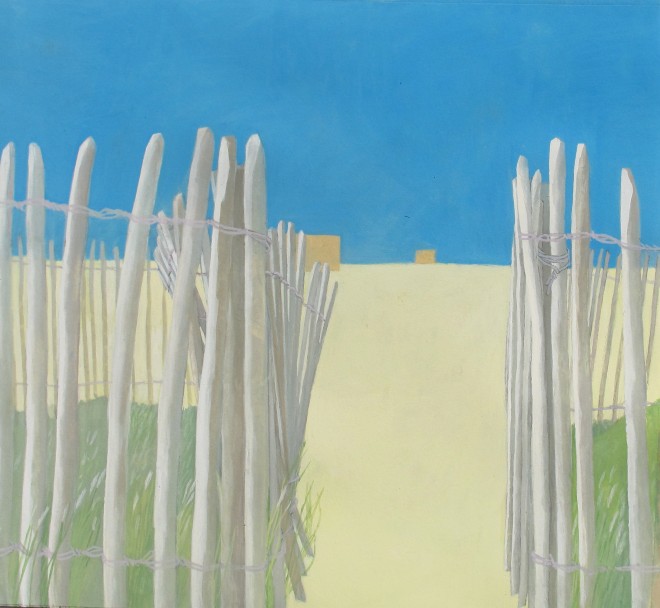
Although Wendy Jacob’s gouache paintings of landscapes and still lifes rarely if ever feature the human form, the compositions are full of character. Still life objects such as bowls and jugs appear with a real presence, animation suggested as they rest at jaunty angles in stacks, and vibrant contrasted painted patterns converse with one another. Wendy Jacob is known to flatten and distort perspective in order to create the right mood for each composition, and has a sophisticated sense of colour that utilises soft colour harmonies. In the past Wendy has exhibited at the Royal Academy Summer Exhibition, The Sunday Times Watercolour Competition, the New English Art Club, the Discerning Eye and the Royal Watercolour Society. She currently has work in the ‘Off The Wall’ exhibition at the Bankside Gallery.
Lisa: What do you love about gouache?
Wendy: It is a forgiving medium. Gouache is opaque with vibrant colours and the paint, mixed with water to a creamy consistency, easily covers a layer beneath very effectively, allowing changes to be made to your painting as it progresses. It does not require the technical skills of watercolour and allows you to forget technique and concentrate on what the painting is about.

Lisa: What surface do you enjoy painting on the most?
Wendy: I paint on smooth watercolour paper which I stretch. This is done by soaking some paper of the size you need for the painting in water for a few moments and, after shaking the off the surplus, placing on to a wooden board (offcuts of plywood are useful for this) and sticking the edges of the paper down using gummed brown sticky tape. As the paper dries the paper contracts and you have a wonderfully smooth stable surface on which to work. I love the unyielding surface this produces. But this is just my personal preference – and I know many excellent artists who never do this.
Lisa: How do you decide how you place objects for your still life compositions – what vital ingredients are you looking for?
Wendy: A good question – I take great care composing the objects for a painting. It is important to gather a collection of objects you love with strong simple shapes that can be arranged in relation to each other. I avoid great differences of scale. Each season of the year has paintable flowers, fruit and vegetables that regularly appear in still life paintings. I am waiting just now for my neighbour’s quinces to ripen.
I like to have the still life subject near to eye level and so arrange some sturdy wooden boxes on a small folding table placed so that light falls sideways from the window to help describe the form of the objects. I use a selection of coloured papers or fabrics to set off the objects. Having found a group of compatible objects I often make a small series of the same objects in slightly different arrangements before moving on to new subjects.

Lisa: Do you work away from or in front of the subject?
Wendy: Always in front of the subject for still life. I make preparatory drawings before starting a still life painting. For landscape I keep my eyes open for suitable subjects and carry a sketchbook with me for drawing anything which looks promising. If a subject seems to be possible I do a more intense drawing which makes me look really hard at the subject and help to work out the composition. I also carry a camera – but for only backing up the drawings.
Lisa: How do you feel being a member of the RWS helps with a painter’s career?
Wendy: As a very enthusiastic member of the RWS I have benefited from the opportunity to show work regularly in a well designed modern gallery which attracts many passing art lovers on their way to Tate Modern. A great joy are the other RWS members who are generous, supportive and encourage you to keep working when your paintings may not be turning out as you had hoped.
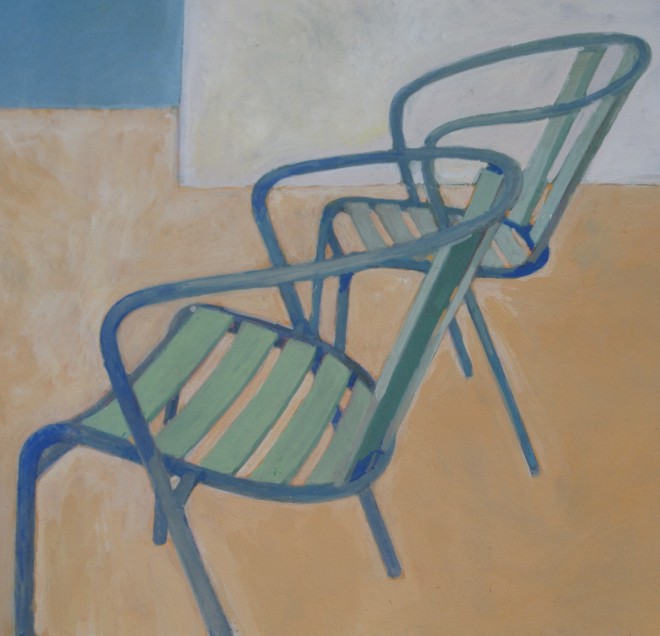
Lisa: You are currently showing 3 chair paintings at the RWS ‘Off The Wall’ exhibition at the Bankside Gallery. Can you tell me why you were drawn to painting chairs?
Wendy: This was a case of keeping my eyes open. Earlier this year I was staying in a small village in France which has an outdoor cafe furnished with a selection of unmatched, ancient, shabby chairs. They caught my attention and thinking about the Off the Wall exhibition coming up during July and August , I thought a few of these chairs might make a good subject. They are almost still life paintings.
Lisa: Did you particularly admire any of the other works in the show and if so, which and why?
Wendy: I love the mysterious paintings by Helga Chart and the small still life paintings by William Selby. As always Annie Williams is showing some beautiful still life paintings.
Lisa: How often do you find time to paint during the working week?
Wendy: Painting is my default activity – unless I have something else that really must be done urgently, I head for the studio after breakfast and work until about six in the evening – admittedly with many a break for coffee.
Lisa: What are you working on at the moment?
Wendy: I am preparing for the next RWS exhibition ‘Watercolour Journeys’ opening at Bankside in October. Perhaps there will be some more chair paintings as I am holidaying in the ‘chair village’.
Lisa: Where online or in the flesh can we view more of your work?
Wendy: At my website – wendyjacob.com and of course in the RWS ‘Watercolour Journeys’ exhibition showing at Bankside Gallery from October 2nd to November 2nd. For another week I have a painting called “February Hedges, Hyde Hall” at Llewellyn Alexander Gallery, at 124 -126 The Cut, Waterloo, London SE1 8LN.


2 thoughts on “Wendy Jacob on Painting with Gouache”
I have spells when I use gouache, then leave them for about 6 months, then when I fancy them again I get them out and find they have gone hard in the tube… Oh dear… But I do like them when I get to use them
Waste not want not – If you cut the tubes open of traditional gouache that has gone hard you can still paint with it! A bit of a fuss but better than throwing them away only half used! 🙂
Comments are closed.