




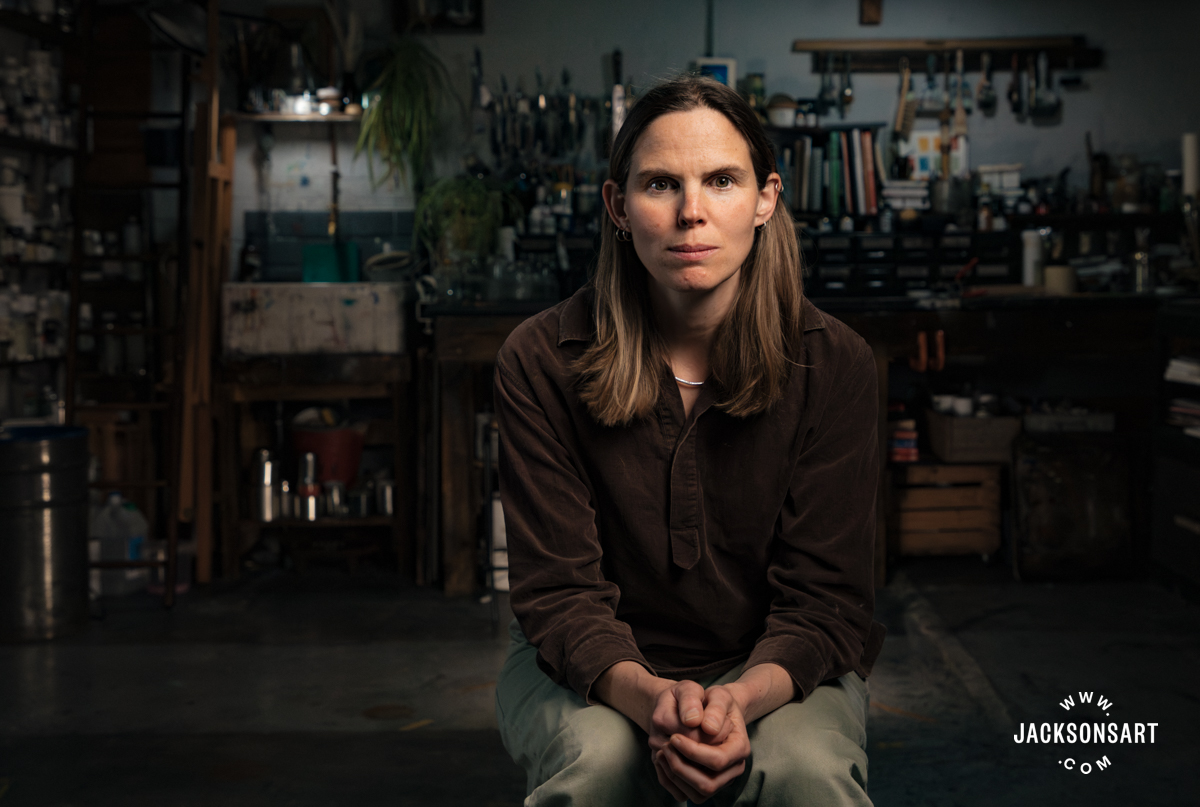
Meg Buick is a painter and printmaker based in East Lothian, Scotland. Her work, often depicting hazy landscapes and obscured figures, evokes a sense of ancientness and dreamlike solitude. In this article, Meg discusses how she employs a wide range of mediums, including egg tempera, monotype, oils, and pastels, as well as describing her constant reworking of these materials to evoke the ethereal atmospheres found in her work. Drawing inspiration from art history that spans prehistoric cave paintings, the Renaissance, and modern abstraction, Meg presents us with a sense of symbolic memory, where humans and animals merge quietly into her shrouded landscapes.
Contents
0:00 “People often say the work feels ancient”
0:20 “It feels natural to me to keep covering it, and destroying it someway, and bringing it back”
0:51 Introduction
1:06 “I wanted to really learn a practice and learn how to make physical things”
2:00 “I always had drawing on the back burner”
2:47 “A human figure has such a psychological pull for any viewer”
4:04 “It’s more of a landscape than a portrait essentially”
4:20 “I think I’ve always been quite intuitive about materials”
4:38 “Egg Tempera forces you to make the brush marks thoughtfully”
5:45 “Painting is all about the surface of something that you get, that’s so much your own personal stamp as a painter”
6:10 “Making images with some sort of feeling in them, some kind of energy”
7:00 “When I think of my practice in terms of painting and drawing, I don’t necessarily think of them as separate, I think of them as two practices that flow into each other”
8:37 “Sometimes I’ll start a drawing, just by scribbling for ages, quite hard, with a H pencil”
9:38 “I use Monotype as a starting point and work into it with pastel and other things”
10:43 “If you put a yellow down right at the beginning, that’s going to influence the whole painting”
11:48 “I think so much of painting is about finding out how you want the paint to handle”
13:04 “A lot of what I am doing is slightly nudging the mediums, experimenting with them, trying to make them do what I want for a particular painting”
13:36 “I’m interested in this slightly parallel landscape, our world that isn’t our world”
16:16 “Most artists are probably quite solidarity”
17:13 “It’s easy to get a bit lost in image making, and to spend time drawing, it feeds the image making and kind of grounds it”
18:53 “I tend to use a lot of earth colours”
21:17 “The palette is your mind for the colour, it’s got to be quite clear, quite empty”
22:14 “Some of my sketchbooks are sort of artist books in themselves, in the sense that very painted, and worked, I will spend a lot of time in them”
23:44 “I am quite a texture, surface person, I love paper, especially when paper has been slightly scratched back, or partially destroyed, and you are drawing back into it”
25:12 “Sometimes I stick with a drawing, until it works”
26:20 “I will work on something until it goes wrong”
28:36 “If there was a work on the wall, I would probably keep working at it”
30:26 “Best studio day I could have is when I can turn up, and I can start straight away”
33:00 “Sometimes, I even dream about the landscapes in Piero’s paintings, they are so vivid to me”
36:15 “Some artists, I won’t necessarily really connect to their work, or love their work, but there is something about their general spirit that I find inspiring”
36:35 “Don’t get sidetracked by things”
37:25 “Drawing and painting is quite a slow road in a world where everything is so fast”
39:37 Credits

Extract
People often say the work feels ancient, but that’s not something I set out to do. It’s more that, for example, I wouldn’t put a telegraph pole in a landscape – it just wouldn’t feel right to me. It would locate the image to a specific time period.

Meg Buick
Oil and acrylic on card, 70 x 110 cm | 27.6 x 39.4 in
I remember a tutor once said, “You can’t really bear to put a line around anything,” and I think that’s true. I always want to go over what I’ve drawn, even once it’s finished, then draw over it again. It’s like I’m constantly trying to place something behind a mist, or a curtain. Maybe that’s where the ethereal quality comes from – this impossibility of ever really pinning something down and saying, “That’s what it was.” It just feels natural to me to keep covering it, destroying it in some way, and then bringing it back.

Meg Buick
Etching, pigment and pastel on paper, 55 x 45 cm | 21.65 x 17.7 in
My name is Meg Buick. I’m a painter and printmaker, and I’m in the Jackson’s studio to talk about my practice. I’ve been painting and drawing since I was a child. My school didn’t have a particularly good art department, but it was always something I wanted to do, something I saw as part of my identity.

I went on to study at the Royal Central School of Speech and Drama, starting a degree in Theatre Practice, which included everything from set design and stage management to puppetry. I chose that path instead of art school because I wanted to learn a practice and learn how to make physical things.

Meg Buick
After that, I spent several years working. But drawing was always there in the background, something I knew I really wanted to pursue. I came across the Prince’s Drawing School, now the Royal Drawing School. So I spent a few years preparing a portfolio while continuing to work, taking more evening classes and some courses at the school itself.

I think I’m often trying to create a particular vision or atmosphere. I’ll often draw a figure, a child, or some kind of human form, placed quite far back in the painting, set within the landscape, among trees or other natural elements. One thing painters often face when putting figures into landscapes is that the human form has such a strong psychological pull – it’s the first thing a viewer’s eye is drawn to. Once you’ve got a face and a facial expression on a figure, that sets the kind of mood for the whole painting, you know, that’s the way we will read it.

Meg Buick
Monotype on paper, 60 x 80 cm | 23.6 x 31.5 in
It’s quite a common approach to place figures in ways where their faces aren’t fully visible, or where you can’t read too much about them psychologically. If you put two figures in a painting, suddenly there’s tension, an implied relationship or narrative. The paintings for me aren’t necessarily about that kind of human interaction, so this one figure is all you need to suggest human presence in the landscape.

Meg Buick
Etching, pastel and pencil on paper, 40 x 50 cm | 15.75 x 19.7 in
I’ve always been quite intuitive about materials. I’ve painted in egg tempera a lot recently which has been quite an interesting medium. It is just egg yolk mixed with pigment, so a really easy way for people to do it is just to take a tube of watercolour or gouache, and mix that straight from the tube into the egg yolk and then paint with it. That’s how I started doing it.

Recently, I’ve been using the traditional method and mixing dried pigment directly into the egg yolk. Once you put it down, it dries in seconds but it keeps all the marks.

I quite like egg tempera for that reason; it forces you to make the brushmarks thoughtfully. You can’t really do an underpainting that doesn’t relate to the image. That’s influenced how I paint with oils now – you’ve got to just go for it and layer colours and transparencies.

I’m quite a solitary person and I find it really hard being with people all the time. I think the only course that really worked for me was The Drawing Year at the Royal Drawing School because it was so much about drawing. And essentially, although we were taught together, it was very much like being on your own, developing your own practice. Tim Hyman and Catherine Goodman set it up, and the way they work is much more about making images which have some kind of feeling in them, some kind of energy. There is something about drawing that is about connecting with either something you are actually seeing or something you are imagining or remembering.

I often use graphite pencils sharpened to a point but on the side, so using the wide bit of the lead. And I quite like a H pencil just to scribble with because it has so little graphite in it that it hardly makes a mark at all. Sometimes I’ll start drawing by scribbling for ages quite hard. It’s very light, but it means you can really build up the marks.

And I’ll use a little bit of oils and things in my drawings, like poppy oil, it’s just like another medium. Sometimes I’ll use some of that on the surface of the paper and draw into it. It makes the pencil really dark or I’ll paint that into an existing drawing. And it becomes more like a painting.

Monotype is a printmaking process but it’s really much more related to painting because you only get one print. I roll up ink onto a big piece of clear perspex and then with a rag and a brush take it away. Then you put damp paper on top and it goes through the press and you then reveal it as a painting.

Meg Buick
Monotype and pigment on paper , 56 x 76 cm | 22 x 29.9 in
I use the monotype as a starting point and then I would sometimes work into it with pastel. In particular, I love Sennelier Oil Pastels and Soft Pastels. The soft pastels have a really buttery consistency.

Meg Buick
Monotype and Pastel on Paper, 61 x 49 cm | 24 x 19.3 in
As a printmaker, I’m also working with colour, but in a very different way. You have to conceive the image in three separate plates, each with its own colour, and the final image emerges through how those colours interact and overlay. Even though it’s a different process, it’s definitely influenced how I paint. It’s made me more aware of how early colour decisions shape the whole piece. Like, if you lay down a bright yellow at the start, and you’re working transparently, that yellow will shine through everything that comes after. The way light moves through those layers affects the entire painting. So it’s helped me understand how I’m doing it in the painting process and be more aware of it in a way.

When I write about my work I often say that it’s about memory but actually I don’t think it is really. It’s about something that’s quite close to memory but isn’t; it relates to the way we experience memories and the way we remember things and it also relates to the part of your mind that is imagining things or dreaming. Maybe I’m interested in this slightly parallel world that is our world but isn’t located in this exact time period. It’s much more to do with something subconscious, I think.

Meg Buick
Oil, pastel and pencil on paper, 60 x 80 cm | 23.6 x 31.5 in
In my work, there are often a few figures and horses, like a kind of journey. I must keep painting them because, in some way, they feel like part of that imagined landscape.

Meg Buick
Aquatint etching on paper, 38.5 x 35 cm | 15.2 x 13.8 in
There’s this very ancient relationship we have with animals, especially horses, the role they’ve played in travel and movement. I find something very peaceful in that.

Meg Buick
Monotype and pastel on paper, 50 x 60 cm | 19.7 x 23.6 in
I also have an interest in collective memory and the subconscious. A dog, for instance, is linked to death in many cultures, whether in ancient Egypt or through associations with bones and digging. I find it fascinating how certain animals or objects come to hold symbolic meaning.

Meg Buick
Lithograph on paper, 60 x 80 cm | 23.6 x 31.5 in
After I finished The Drawing Year, I was working as an artist on my own and naturally slipped back into a fairly solitary studio practice. While I’m quite a solitary person, I’m also sociable, and I started to look into artist residencies as a way to keep learning outside of a formal art school setting. I was awarded a scholarship with the Royal Society of British Artists to spend a month in Rome, and later selected for the Richard Ford Award, which meant two months studying in the Prado in Madrid.

Oil and gouache on paper
What I love about residencies is that they take you out of everyday life and give you focused time to make work. Sometimes that’s a direct response to the place you’re in, and sometimes it’s just about having the space to think and create without interruption.

Meg Buick
Watercolour and pencil on paper
I live in Scotland now, on the East Lothian coast, where there are some really beautiful beaches. You get pine trees coming right up to the edge of the sand, with dunes all along the coast, and as soon as I saw that, I thought, “I could paint this”. It just felt like my landscape. There’s something about trees meeting the beach – you don’t see it that often, and it really stayed with me.

Meg Buick
Aquatint Etching, 30 x 30 cm | 11.8 x 11.8 in
I probably organised my palette, at least initially, quite formally, in the way that I was taught to paint, which is a warm and a cool of each primary colour. I’m glad I was taught to paint in that way, because it’s really helped me understand colour mixing. You know, you need to understand warm and cool in order to get to the final secondary colour you’re trying to get to.

But over time, I tend to just use a lot of earth colours. I’ve always got Sienna, Burnt Sienna, Raw Umber, Burnt Umber, Yellow Ochre, and obviously white. And then for blue, I always have Ultramarine and then sometimes a few other different blues. But I find that with Ultramarine and those earth colours that I can get the colours I want.

For watercolour, I often use tubes of Schmincke Horadam. With oil painting, I always used to use Spectrum Artists’ Oil Paint, but I’d probably use a few different brands – maybe a good range and then a few tubes of very high quality like Old Holland Classic Oil Paint. I have bought a lot of pigment from Jackson’s. I love getting pigment, like opening the little pots, there’s something really magical about it.

I use sketchbooks a lot, they’re a big part of my practice. Some are years old but still active in the studio. Sometimes I sketch from life, my kids, little still lifes, but mostly they’re filled with ideas and notes. And I’ve always loved the idea of a book full of paintings. I’m really drawn to old painted manuscripts, the sense of discovery in turning the pages. Some of my sketchbooks are more like artists’ books – heavily painted and worked into. They’re central to both my studio life and how I keep the practice going day to day.

The ground of a painting or drawing surface is really important to me. I like it to be slightly off-white, especially in terms of paper. I’d always want to have a slightly warm ivory or beige paper. So, if I’ve got paper that’s quite white, then I will always put a wash on it. Sometimes I wipe it back with a rag so it’s just slightly off white. Or I put French button polish on it, which is like a shellac type of varnish that makes it this kind of golden colour. And sometimes I will prime the paper with acrylic with a bit of pigment in.

Meg Buick
Watercolour on paper, 60 x 80 cm | 23.6 x 31.5 in
I suppose the reason I’m working with so many different materials is that each one does or offers a different thing. I’m quite a textured surface person. I love paper, especially when the paper has been slightly scratched back or partially destroyed and you’re drawing back into it.

Meg Buick
Pigment, egg tempera, and pastel on paper
Because I layer a lot anyway, I’ll work on something until it sort of starts to go wrong in a way. And then I’ll start to try and cover up the bits I don’t like and, you know, paint over them or oil pastel or whatever. That’s when it starts to work for me, when something is not working and you have to kind of fight with it a little bit. That’s when I start to get interested in what’s happening.

Meg Buick
Egg tempera on paper, 60 x 80 cm | 23.6 x 31.5 in
I tend to have quite big brushes. I think I find it’s better to paint even quite small things with quite a big brush and use the edge of a big brush to make smaller marks. Then I always have a palette knife. I always mix my colours with a palette knife rather than the brush, which is just good practice and involves less washing of brushes. But I also use the palette knife sometimes to apply paint to the canvas or the paper, because I think it’s just quite nice to have a blunt tool, to have something that’s not that precise. You don’t get the mark you’re expecting and you have to work with what’s there.

My studio space right now is probably very messy, with drawers full of different materials like pastels and so on. Then I have another cupboard with lots of paint. There’s my easel and then a big stack of paintings in progress, and then a very big plan chest with a lot of different paper.

The best kind of studio day is when I can turn up and just start something straight away. Sometimes I’ll work quite loose and quite free to start, like a really kind of scribbly drawing before I start trying to make something more serious. I would much prefer to work in natural light as I think most painters would, but because I’ve got children, I’m often working in the evening. When I’m working, I listen to a lot of audiobooks – I think it helps me not to think too much about what I’m doing.

In my work, I draw a lot from various art movements and imagery from probably quite a wide range of art history. I’ve always been interested in prehistoric art and cave painting.

Meg Buick
Lithograph on paper, 45 x 33 cm | 17.7 x 13 in
And I really like a lot of the early Italian Renaissance or Gothic stuff, like the artist Piero della Francesca. It’s not like I saw his work straight away and was like, wow, these are the best things ever, but it kind of grew slowly. I started to understand there’s something about his paintings.

Attributed to Piero della Francesca
Tempera on poplar panel, 38.8 × 28 cm | 15.25 × 11 in
National Gallery of Art
Once you get into them, you realise there’s, you know, so many artists who have been obsessed with him in some way; Philip Guston has written a lot about him. There’s a whole kind of artistic pilgrimage around this artist. Sometimes I even dream about the landscapes in his paintings, they’re so vivid to me.

Meg Buick
I also look at a lot of contemporary artists, as well as 19th and 20th-century painters. Bonnard, Vuillard, the Nabis, and artists like Matisse have all played a big role. I also love Richard Diebenkorn – his balance of abstraction and figuration really resonates with me. And Susan Rothenberg’s way of representing animals in this raw, abstracted way is something I find fascinating. Sometimes it’s not even about loving the work itself, but more about the spirit of the artist, something in their approach that feels inspiring. I’ll come out of an exhibition and just want to run to the studio. It’s all part of the energy that feeds the work.

Meg Buick
If I was going to say something to my younger self about drawing or my work, I’d probably say don’t get sidetracked by things. It’s easy to say now with hindsight isn’t it. But I think it took me a little while to work out what I wanted to do.

The main advice I often hear about creative work is to have a consistent practice, to just keep showing up. I know that’s not always easy in real life, but that consistency does make a difference. I’ve got young kids and don’t get to do as much in the studio as I would like. But I still try to live by that idea of trying to do something, if not every day, as often as you can and at least keeping it regular. Even on the days when nothing works, that time still matters. You have to come back the next day and keep going. But I also think, if you’re not naturally driven to do that, it won’t work. You have to want to be there. I think Matisse said do not wait for inspiration, it will come while you’re working. And I find that to be so true.

Further Reading
Inside the Sketchbook of Meg Buick
Tonalist Techniques in Painting and Drawing
Monotype Printmaking for Beginners
A History of the Artist’s Book and How to Make Your Own
Shop Art Materials on jacksonsart.com



6 thoughts on “Artist Insights: Meg Buick”
Meg’s approach to her painting, her use of media, and her thoughts
on art really impressed me. There is something both tactile and
ethereal about her work that really resonates in me. Definitely one
of the most inspiring videos I’ve seen in some time.
Thank you. It’s wonderful to hear that you’ve drawn inspiration from Meg’s work. I find her work deeply evocative, and it’s fascinating to hear the philosophy behind her practice in her own words.
The insightful narrative in this video is
so inspirational. Meg’s work is so
authentic with elements of both history
and surface closely linked to make
something appear fresh. I find an edge
in her practice of drawing which directly
inspires her painting ethics. The raw
materials and juxtaposioning of
antiquity of her source images gives her
work a unique point of reference which
closely relates to the Renaissance
masters.
Thank you for your kind words. I’m glad to hear you find Meg’s work inspiring, I do as well – her work certainly has a timeless quality to it.
I really enjoyed watching this video and
looking through the article. It was
fascinating to see Meg draw with both
hands at the same time. Her quiet,
assured pursuit of her own artistic path,
drawing on exploration with various
materials and periods of art history, was
particularly inspirational to me. Thank
you.
Hi Anne,
Thank you very much. I love the varied techniques that Meg uses, including her transfixing process of drawing with both her hands – she’s very inspiring.
Comments are closed.