



Protecting your skin from toxic substances and staining paints can make for a more pleasant painting experience.

More and more now, painters are aware of health and safety issues in the studio and are taking care to protect their health. Solvents in the air and toxins absorbed through the skin are the most common things to be aware of. One of the most important things is to be sure your work area has good ventilation and airflow. Another thing is to minimize skin contact with paints and pigments. Some paints contain hazardous pigments like the chromium colours. It is also good to read all manufacturer warning labels carefully.
Many artists now paint wearing disposable gloves. If you want to protect yourself from toxic substances or dirt but don’t like wearing plastic gloves while painting we have two choices of creams that act as barriers. Latex gloves or barrier creams do not prevent the penetration of most solvents but will minimize contact with paint so they definitely reduce clean-up time. Cleaning your hands with solvents is a very bad idea. But using either gloves or protective cream means you will not have to resort to that.
Another thing to consider is the rough, painful, dry skin you can get from scrubbing your hands to get rid of paint. I am a messy painter. I forget to pay attention to my surroundings while I am immersed in the painting process and will grab a brush only to find the handle had paint on it and so often end up with quite a bit of paint on my hands. Scrubbing my hands clean dries them out badly and even after my skin is clean my cuticles can be stained for days. I find that oil and acrylic are both just as difficult to remove. I have trained myself to always put on gloves or apply barrier cream before I start painting. Using barrier cream means paint will wash off in a moment, very easily.
Even if you aren’t a messy painter you may find that you get paint all over your hands when opening paint tubes, so some artists will open paint tubes with gloves on even if they don’t keep them on to paint.
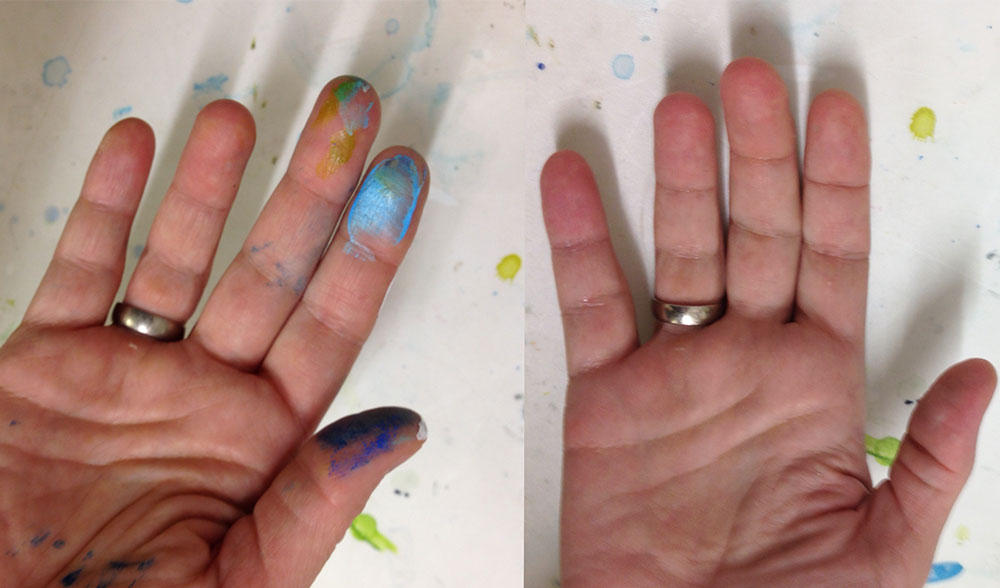
I got paint on my hands and since they were coated with barrier cream, the paint easily washed off with just water.
Barrier Cream
Barrier cream is sometimes called shielding lotion and before-work cream. While you are painting it doesn’t feel like you are wearing anything and when you wash your hands everything comes off very easily. If you wash your hands during a painting session, such as when washing brushes, you will need to reapply fresh cream.
The ingredients are those of normal moisturising hand cream plus paraffin (a petroleum wax or jelly). So there is a sort of waxy petroleum jelly film that you cannot feel, acting as a barrier to substances that you come into contact with and keeping the moisture in your hands. They contain no harsh or dangerous chemicals and clean up is easy, just wash with soap and water.
It only takes a small amount to coat your hands, similar to the amount that you would apply of a moisturising lotion.
Winsor & Newton Artguard Barrier Cream
250ml pot. Unscented. Creamy texture.
Liberon Liquid Glove
100ml and 1000ml pots
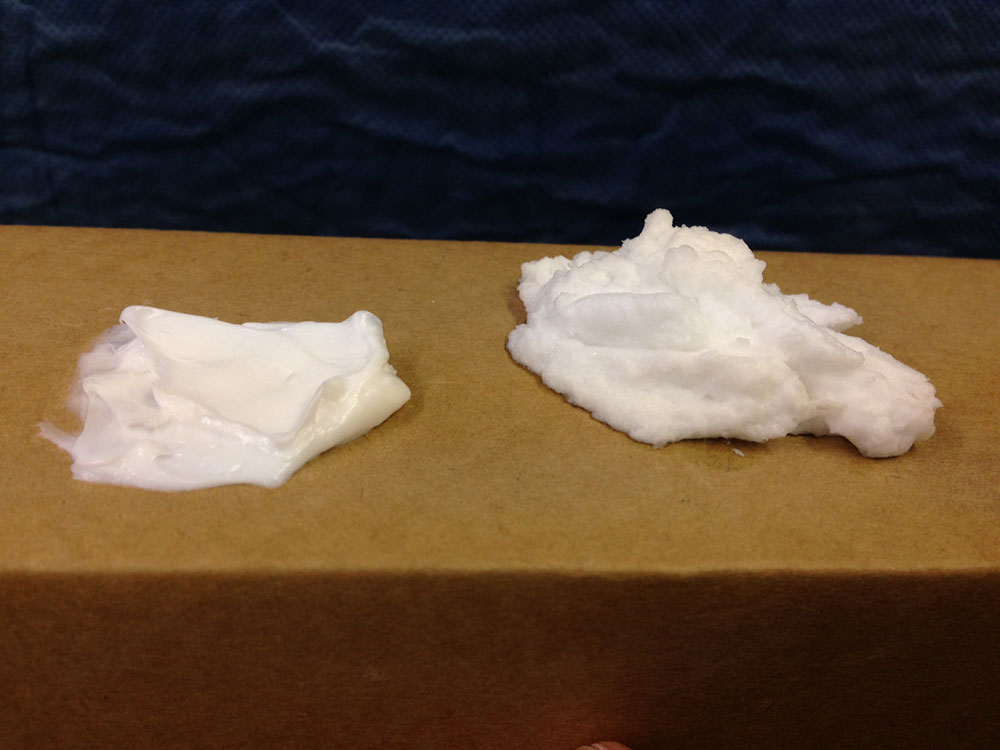
The texture is a bit like foam but it liquifies on contact with the warmth of your skin. It smells of a combination of vanilla and plasticine. When you apply it your hands feel sticky at first but that goes away quickly.

Disposable Gloves
Disposable gloves can be made of different materials- vinyl, latex, and nitrile.
Some people can develop a latex allergy so prefer vinyl gloves. Most vinyl gloves are powdered inside which makes them easier to get on if your hands are moist but could mean you get a bit of white dust in your paint if you aren’t careful. Nitrile gloves are not available at Jackson’s at the moment but may be in the future.
It takes a while to get used to remembering to always put on gloves or apply barrier cream before starting a painting session but since it creates a safer studio and treats your hands more kindly it is a good habit to get into.
Click on the underlined link to go to the current offers in the Vinyl gloves, Latex gloves, Liberon Liquid Glove and Winsor & Newton Artguard Barrier Cream on the Jackson’s Art Supplies website.
Postage on orders shipped standard to mainland UK addresses is free for orders of £39.




8 thoughts on “Getting Your Hands Dirty”
I have recently purchased a supply of Jacksons Aqua Oils,including several cadmium hues and a cerulean hue.There are no notices re toxicity on the tubes as there are on Winsor and Newton Artisan oils.
Can you please assure that, being hues, your Aqua Oils are not toxic.
Hi Peter
Thanks for trying the Aqua Oils, I hope you like them.
Hues do indeed have replacement pigments for the more expensive genuine pigments, which usually means they are also non-toxic versions.
The Aqua Oil labels have the pigment listed on the tube. The pigment will start with a P for pigment then a letter for the colour – Y for yellow and R for red, for example.
So PY3 is Pigment Yellow number 3. There are lists on the internet that tell you what the pigment number system colours are. I like this one http://www.handprint.com/HP/WCL/waterfs.html – you navigate through the pigment list on the Hand Print website by clicking on the row of colours at the top and then they are in numerical order on each colour page.
I hope this helps.
The Cerulean Blue Hue contains PB 15:3, PG 7, PW6, all non-toxic pigments.
Cadmium Yellow Lemon hue contains PY 3, a non-toxic pigment.
Hello. I am looking for something to
interleaf between acrylic paintings
on a variety of substrates (canvas,
paper, card) in order to protect each
painting. I am only an individual and
beginner ‘crafter’, and as such have
limited funds. Would be very grateful
indeed for your advice! Thank you so
much. Carla Reid Adam
Hi Carla,
If you just need to interleaf then I’d suggest a sheet of glassine – it shouldn’t stick to the dry paintings and will protect them.
https://www.jacksonsart.com/r-k-burt-glassine-paper-50x75cm-clear-for-interleaving-50-sheets
Could anyone advise me where to place arm
or hand of painter when drawing?
Hello
To prevent your hard or arm smearing your drawing there are two usual methods:
Put a sheet of paper over the drawing to protect it and rest your hand on it without moving the paper, then lift it carefully away.
Use a mahl stick or bridge to allow your hand to hover over the work while having support so your hand is steady.
Can you tell me how to find the opacity of
Dalner-Rowney Georgian oil paints on the
label.
Hi Christina
The front of the tube, under the colour name, has a row of asterisks, a square and a colour number.
The asterisks tell you how lightfast the colour is and the square tells you the opacity. If the square is an outline only then the colour is transparent. If it is half black on a diagonal then it is semi-opaque. If it is solid black then it is opaque.
You can see that Titanium White is opaque in this image: Georgian Titanium White.
I hope that helps.
Comments are closed.