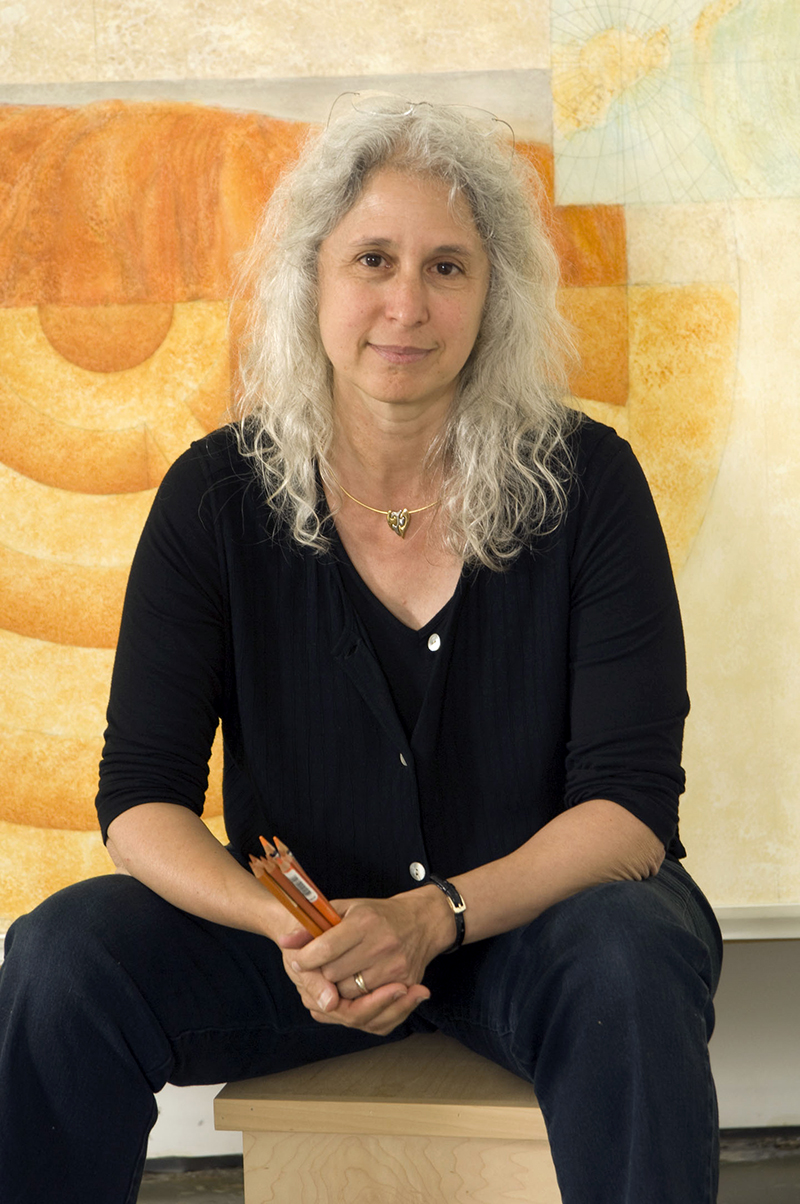
American artist, art professor and researcher Susan Groce is one of the pioneers of environmentally safer printmaking in the United States. After spending time at Edinburgh Printmakers at the birth of the non-toxic printmaking movement, Susan returned to the United States over a decade ago to lead the University of Maine’s Department of Art’s transition into safer printmaking processes. Internationally known for her large-scale drawings and prints of labyrinthian spaces and organic forms, Susan’s work reflects her deep involvement with themes of sustainability and the impacts of human activity on the environment. Here Susan shares with us her invaluable insight into safer printmaking processes and materials, and her thoughts on the growth of the movement and education.

Sophie: When did your interest in the environmental ethics of printmaking begin?
Susan: In the late Seventies, after graduating from the University of Michigan, I worked under Frank Cassara (White Ground inventor) to mix traditional etching grounds. The thinking was that by knowing what toxic materials these grounds contained, we could handle them appropriately with the right safety equipment. By the late Eighties, I felt increasingly in conflict between the hazardous (health and environment) materials I was using and the environmental themes of my work. In the early Nineties, I became aware of photopolymer film possibilities as a safer alternative, and by the mid-Nineties, after a year long stint working at the studio of Edinburgh Printmakers, I returned to the University of Maine and completely converted the studio over to environmentally safer materials and processes.
Sophie: Do you use the term ‘environmentally sound’, ‘safer’ or ‘non-toxic’?
Susan: I actually use the term ‘safer’ in hopes that we will continue to substitute environmentally safer and safer products as they become available with new technical discoveries, materials and processes.
Sophie: Can you talk about how the green printmaking movement has changed over time? Is it becoming more mainstream or would you still consider it to be niche?
Susan: From my perspective, I see more and more programs and individual artists becoming knowledgeable and well versed in incorporating greener materials. I do believe it is becoming more mainstream – as with anything – if greener product results are equal to or better than the more hazardous materials and the costs are either comparative or cheaper – why choose otherwise?

Sophie: What are some of the main challenges in order for environmentally minded practices to become the norm in printmaking?
Susan: First, for those who have spent significant time honing skills with traditional materials, the biggest shift is to become more open to embracing new materials and processes. Fortunately, from my own experience, the switchover is a fairly straightforward material substitution – all my years with traditional materials provided a solid foundation and support for my work with greener materials.

In running an active safer print studio (in all print media), my greatest challenge has been relying on constantly changing commercial or off-the-shelf products not made specifically for print processes to use or mix reliably for our specific purposes. I’m delighted to see dedicated green print products now entering the market (various acrylic-based etching grounds and aquatint, non-toxic inks, etc.)

Sophie: Can you talk about some of the key innovations in this field?
Susan: Since the early Nineties, there have been many important innovations that make for a wonderfully integrated system of possibilities. Key processes include the adaptation of Photopolymer films from the electronics industry; Acrylic Resist Etching; new etches such as the Edinburgh Etch, Saline Sulfate etch, Copper Sulfate mordant and Electro-etching; Water and Soy based Inks, Polyester litho plates… right up to easy incorporation of digital processes, laser cutting, CNC, and so on. I find that because of constant innovation and incorporation of more environmentally sound materials and practices, the print field continues to be not only a thriving medium but one that has capacity to demonstrate that an environmentally sound practice is compatible with quality results.

Sophie: What are some of your favourite (environmentally sound) processes & materials to work with?
Susan: My work tends to center around photopolymer films and acrylic resist etching (with the full complement of grounds). I’ve also had great fun this past year experimenting with laser cut wood blocks.

Sophie: What advice would you like to give to an artist or studio who is looking to explore safer & environmentally sound alternatives to traditional printmaking?
Susan: There are many programs, short courses, workshops and/or studios to visit, to learn about safer materials, processes, and set ups. Take at look at www.nontoxicprint.com – Friedhard Kiekeben has done a wonderful job organising this very comprehensive open source site, where safer materials, processes, schools, workshops, publications and artists are detailed. If you are considering converting a large multi- print media studio over to safer processes, consider hiring a consultant (an experienced safer print artist, or safer studio technician/manager) to help in the planning process. If hesitant, just try substituting one material at a time!

Sophie: Any upcoming projects or news (relating to your own art and/or the studio)?
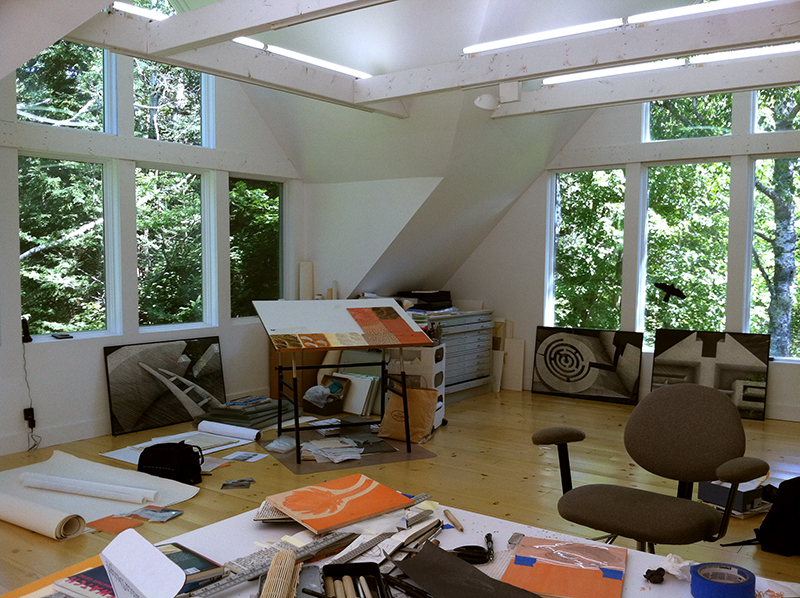
Susan: The big news on this end is that the new University of Maine Print Studio dedicated to safer printmaking is up and running beautifully – we’re thrilled! We’re set up for Acrylic Resist Etching, Photopolymer Films, Water Based Screen (photo and hand work), Polyester Plate Litho, Relief, Letter Press, Monoprinting, Collagraph, Digital applications, etc. and we’re also making use of the IMRC labs next door – laser cutters and CNC (wood and metal).

In addition our regular academic program, we’ve started Open Access and an Artist Residency program (offering 2-3, 1-week residencies during our academic term – if interested, see our website for more information). Consequently we have a steady stream of printmakers coming to work alongside our students and faculty.
Personally, in addition to running the UMaine print studio and print programs, I’ve got lots going on in my studio – a set of sixty tiled Intaglio-Type etchings entitled Compromised Lands to configure, some laser cut wood blocks in the proofing stage, and series of both large scale and small scale mixed media drawings in process.
Check out the University of Maine Printmaking Department:
Website: www.umaine.edu/art/printmaking
Facebook: www.facebook.com/UmainePrintShop

Image at the top:
Invasive Species (16 segment detail of 216 segment installation) by Susan Groce
Installation approx. 12′ x 10′
Photopolymer (Intaglio-type), 2008