



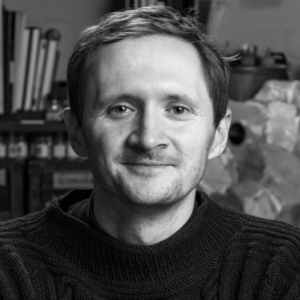
Alan Woollett is a well-known animal artist who primarily works in coloured pencil. He is also the author of a new Search Press manual, ‘Bird Art: Drawing Birds Using Graphite & Coloured Pencil‘. We got in touch with Alan to ask him a few questions about his book and his artistic process.

Duncan: Hi Alan, thanks for talking to us. Your book concentrates largely on photographs as reference materials, and only has a few pages on sketching birds in the field. Is this because the birds you depict are very difficult to sketch from life? Or would you say you are more of a bird watcher than a bird sketcher?
Alan Woollett: For a lot of the examples in the book, I opted either to base my work on a single photo, or to show how I go about combining photos to create a scene. It’s a technique I am often asked about and it made sense to show how it’s done. Sketching is something I rely on a little less these days, although I’m lucky enough to have a good range of older sketchbooks to use as a reference library. You never know when a sketch from a few years back may prove the inspiration for a drawing.
Another reason I think is the advances in digital photography. A modern camera can fetch a distant subject a lot closer. My current camera is almost as good as my spotting scope at bringing subjects closer, and it’s a lot less bulky to carry.

DM: I wonder whether you would be able to take us through the materials you use. (I notice that Fabriano papers and Faber Castell Polychromos are a favourite of yours.)
Alan: The materials I use now have been arrived at by trial and error over a long period. I had been given some Fabriano paper samples and I found the watercolour paper worked well for my style of drawing. I tend to be quite heavy handed with my pencils and the Fabriano can take that sort of punishment without buckling or tearing.
After trying several brands of pencil I settled on the Faber Castell Polychromos for several reasons; performance, range of colours and price. Although I do have quite a few pencils from other brands, it’s the Polychromos that I will reach for first.
It’s the same with other brands of paper. I use Strathmore 400 series paper and have been known to use Arches Hot Press watercolour paper too!

DM: Did you travel far to see the subjects for this book, or were reference photographs for some of the more exotic species picked up in zoos?
Alan: It’s a combination really. I have been fortunate to travel to Tanzania on safari and have visited several bird refuges in North America. These have supplied me with lots of great reference material and lasting memories.
Some of the more exotic subject matter has been drawn using photos from friends who have a keen interest in wildlife and photography (and much better cameras than mine!)

DM: How about domestic travel – do you often make trips around the UK to watch birds and gather reference material? Do you visit domestic hotspots for rarities and migrants, or nature reserves?
Alan: I’m fortunate that I have an in-law who lives on Islay which makes travel there more enjoyable, but I haven’t been for a while. A trip is long overdue.
I seldom visit rarity hotspots but am fortunate to have some great birding spots here in Kent that I can visit. They have proven to be an inspiration for my work on many occasions.
DM: Finally, do you have a favourite bird which you still haven’t been able to draw?
Alan: The bird I would really like to see, let alone draw, is the Harpy Eagle. It’s one of the world’s largest Eagles and can be found in the jungles of South America. Who knows, maybe I will get to see one and it will inspire a drawing.
DM: What are your number one tips for artists who are just starting to sketch birds?
Alan: Hmmm. Where to start? The best advice I can give is to enjoy yourself. Start by focusing on birds that are roosting; the fact they are still should give you time to sketch out the shapes and hopefully some detail too. Spend way more time looking at the birds than down at the sheet of paper, and focus on what you see, not what you think you see. Also, make written notes: weather conditions; time of day; date; what other birds are around. These can all help later to add information to any drawings you do from your sketches. Don’t be frustrated by your initial efforts. If all else fails, put down the pencils and just absorb the natural world before you.
‘Bird Art: Drawing Birds Using Graphite & Coloured Pencils‘ by Alan Woollett (Search Press, 2017) is now available at Jackson’s. The image at the top of this post is Alan Woollett, ‘Pelican study 3’, (Polychromos on Fabriano , 19″x 10″).

7 thoughts on “An interview with Alan Woollett, author of “Bird Art””
Looks like I should have this on my shelf!
Yup! A really helpful book.
This book looks amazing!
It’s certainly a very pretty thing!
Dear sir /madam..I was wondering if you could very
kindly tell me please,how long do you take to do a
drawing..thank you very much
Dear SIR/MADAM. Hello I’m trying to get into wildlife
coloured pencils and I was wondering if Alan uses a
fixiate for his drawing and what is the best paper to
start with,and is toned paper better than white for
wildlife,, as some seem to say toned paper makes it
more realistic..please help out..thank you very
much..yours sincerely Mr Desmond Townsend
Dear Desmond,
If you’re considering fixative then this article may be helpful: https://www.jacksonsart.com/blog/2014/08/29/fixatives-are-not-all-the-same/
I’m sure Alan will use fixative, however, which one is a bit of a mystery or if he necessarily does.
As working with coloured pencil isn’t my field you could look at the blogposts in this section which are all on the subject: https://www.jacksonsart.com/blog/tag/coloured-pencil/
I see you’ve read Bev Lewis’s article which has some interesting comments on paper and coloured pencils. I’d say experimenting is the best way to find out the right colour and texture for you to work with, as choosing which paper to use is super personal to your style. You can see all our pencil suitable papers here: https://www.jacksonsart.com/surface/paper-card/to-use-with/pencil-+-drawing
Comments are closed.