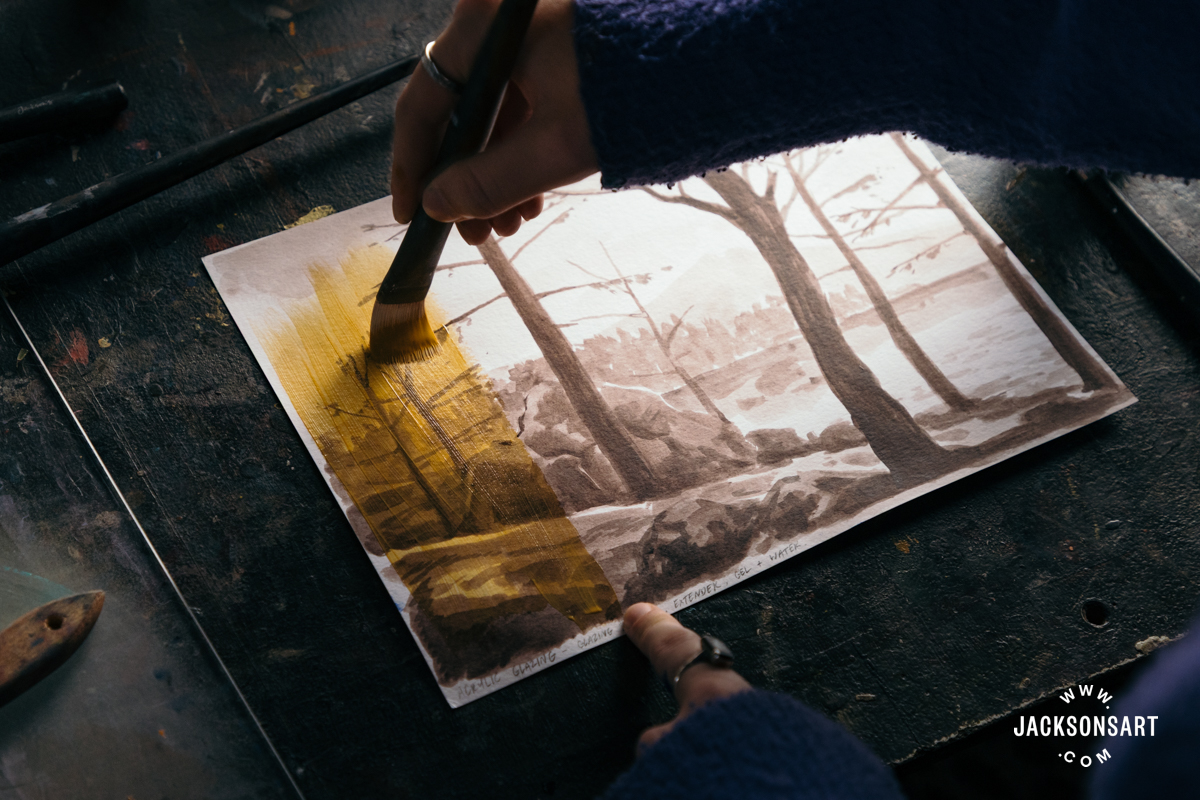
World Book Day is a yearly event started in 1995, organised by the United Nations Educational, Scientific and Cultural Organization (UNESCO), to promote reading, especially by children. In the United Kingdom, the day is recognized on the first Thursday in March – this year 7th March 2019.
Book Illustration, especially for children’s books, is a career path chosen by many artists, self-taught or with an illustration degree. The most common mediums used for illustration are gouache, watercolour, and marker pens. Many artists like painting to a brief, which is what differentiates illustration from other types of visual art. Most children’s book illustrators also enjoy adding their own bit to the story that expresses more than the words do alone.
To celebrate World Book Day Winsor & Newton asked Cornwall-based artist Glyn Macey to make paintings to illustrate a book of his own choosing. Glyn is a painter who uses watercolour and acrylic for paintings of animals and landscapes he makes both in his travels and in the studio.
Moby Dick – World Book Day
by Glyn Macey
As an artist and itinerant conservationist I have been extremely fortunate in having opportunities to paint many beautiful and endangered animals around the world. From painting majestic polar bears in the high Arctic to equally majestic red foxes in my own garden. But ever since watching one pass Lands End as a small child, one group of animals in particular has always fascinated and attracted me – the Whales.
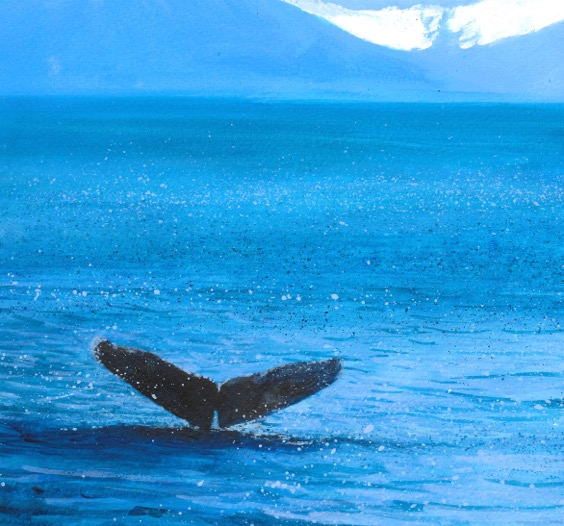
Fluke
24” x 24” acrylic on board
Glyn Macey
So when I was asked to produce an illustration for a classic book to celebrate World Book Day, the instant choice for me was the 1851 American classic by Herman Melville, Moby Dick. Largely ignored and a commercial disaster during Melville’s lifetime, Moby Dick found a major resurgence in popularity when DH Lawrence described the book as being “the greatest book ever to be written about the sea”. And being born and brewed by the sea myself, I would agree. There is a searing honesty to the way that Melville describes the sea, the way he captures the salt air, the movement of the waves. It’s unsentimental. It’s unforgiving.
The story tells the dramatic tale of a whaling ship captain intent on revenge after an albino sperm whale nicknamed Moby Dick rips off the captains leg below the knee on a disastrous previous whale hunt. So the scene is set for high drama on the high seas.
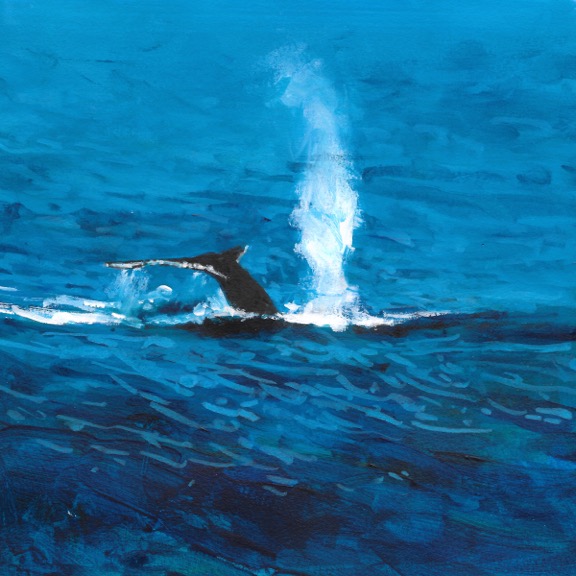
12” x 12” acrylic on board
Glyn Macey
Over the years this tale has been illustrated many times by some wonderful artists, but each has tended to focus attention on the dramatic, bloody final scenes of the whale pierced with harpoons, being attacked again and again by the ship’s crew. I chose instead to illustrate the whale before the hunt. To try to capture the fifty tonne majesty gliding effortlessly through its domain.
Using my sketchbooks full of Arctic and Cornish encounters, the reference drawings were combined to create the final composition using Winsor & Newton Professional Acrylic. I chose to use this composition to help create depth of colour and tone. These paints are able to give me incredible luminosity due to their completely clear binder formulation. This aspect alone makes a huge difference to my working capabilities and never more so than when painting the sea. And the glazing capabilities when using an acrylic with such strong pigment content coupled with the clear binder provides me with glazes unrivalled by any other.
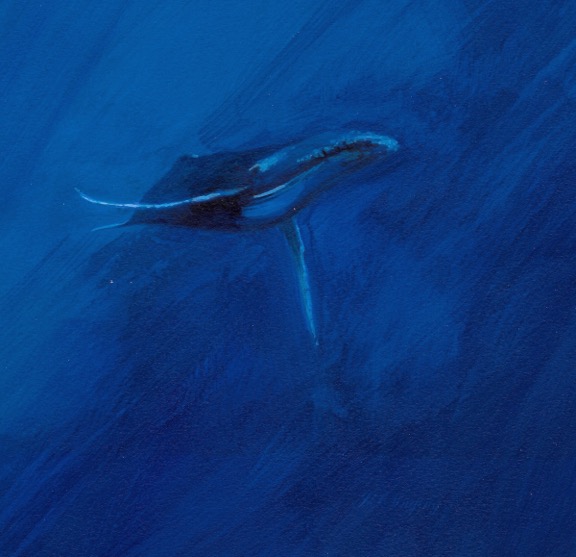
12” x 12” acrylic on board
Glyn Macey
When painting the deep, rich ocean I need deep, rich colours and I often find that when I’m trying to create the essence of drama in my artworks a limited palette works best. So for this artwork I chose a combination of Winsor & Newton Professional Acrylic Phthalo Blue, Phthalo Green, Titanium White and good old Prussian Blue for those all-important glazed depths. I built up the first part of the painting using translucent layers, one glazed over another until I was happy with the depth and richness. Using Winsor & Newton acrylics in this way is a similar process to making a traditional watercolour painting, however, once the rich, deep areas have been established I am able to add additional opaque pale coloured areas to help define the shape of the whale by painting the ‘negative space’ of light filled water.
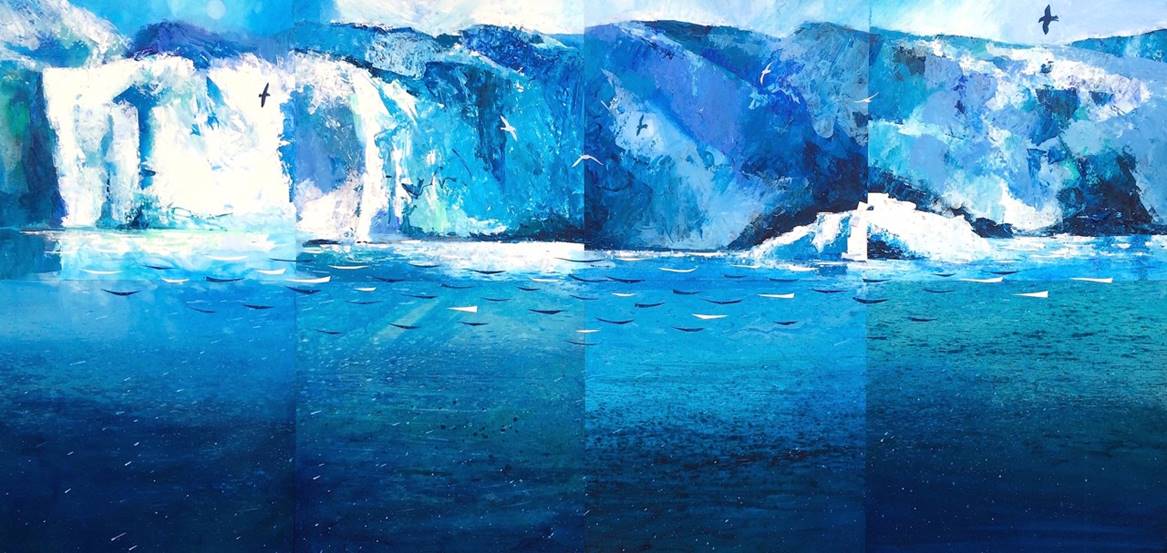
24” x 36” acrylic and collage on board
Glyn Macey
I love to use collage in my work, helping to build up layers of interest, and after re-reading Moby Dick I once again found one of the best quotes in literature “It is not down on any map; true places never are” which I chose to use in my original illustration to create extra interest and mystery. I used a similar technique in my painting of an Arctic Humpback ‘Dreams on the High Seas’, this time the words were added using a size 1 round acrylic brush and a whole lot of patience!
This painting is part of a collection of my Whale paintings available as signed, limited edition prints helping to raise funds for Whale Conservation Projects. They can be found at www.glynmaceystudio.com

24” x 24” acrylic on board
Glyn Macey