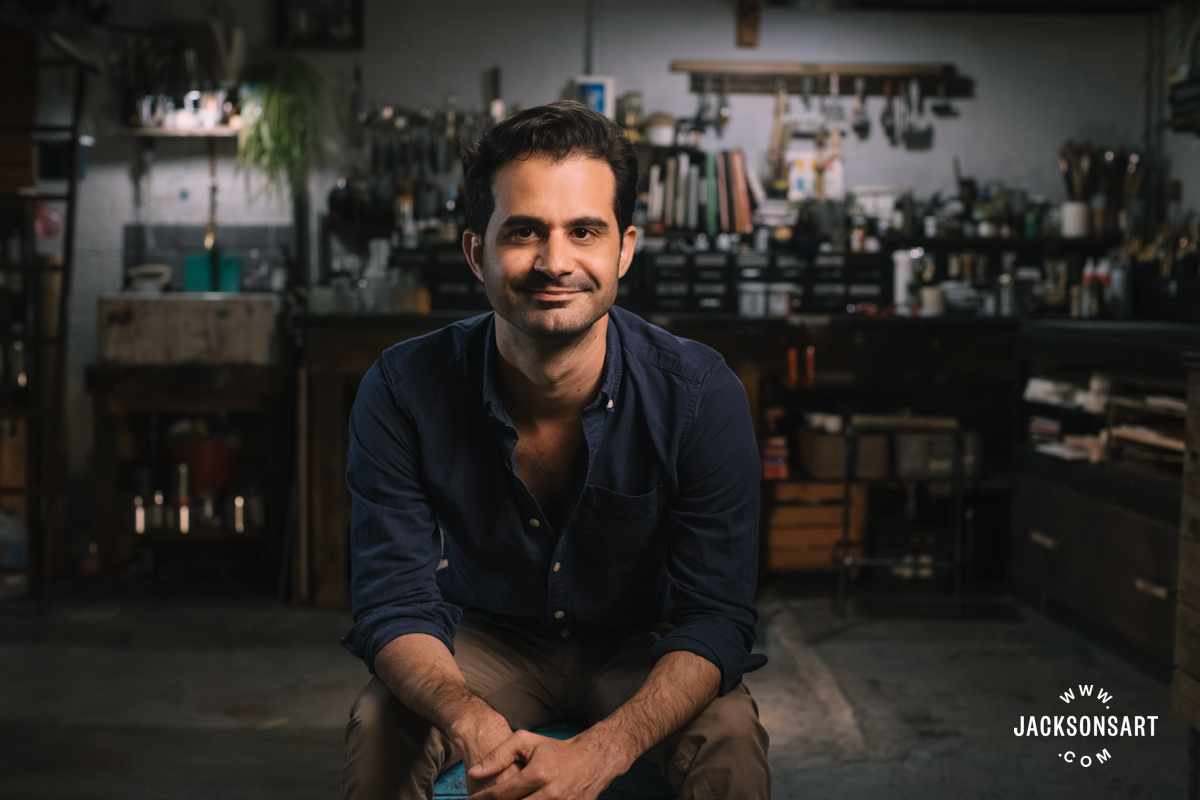
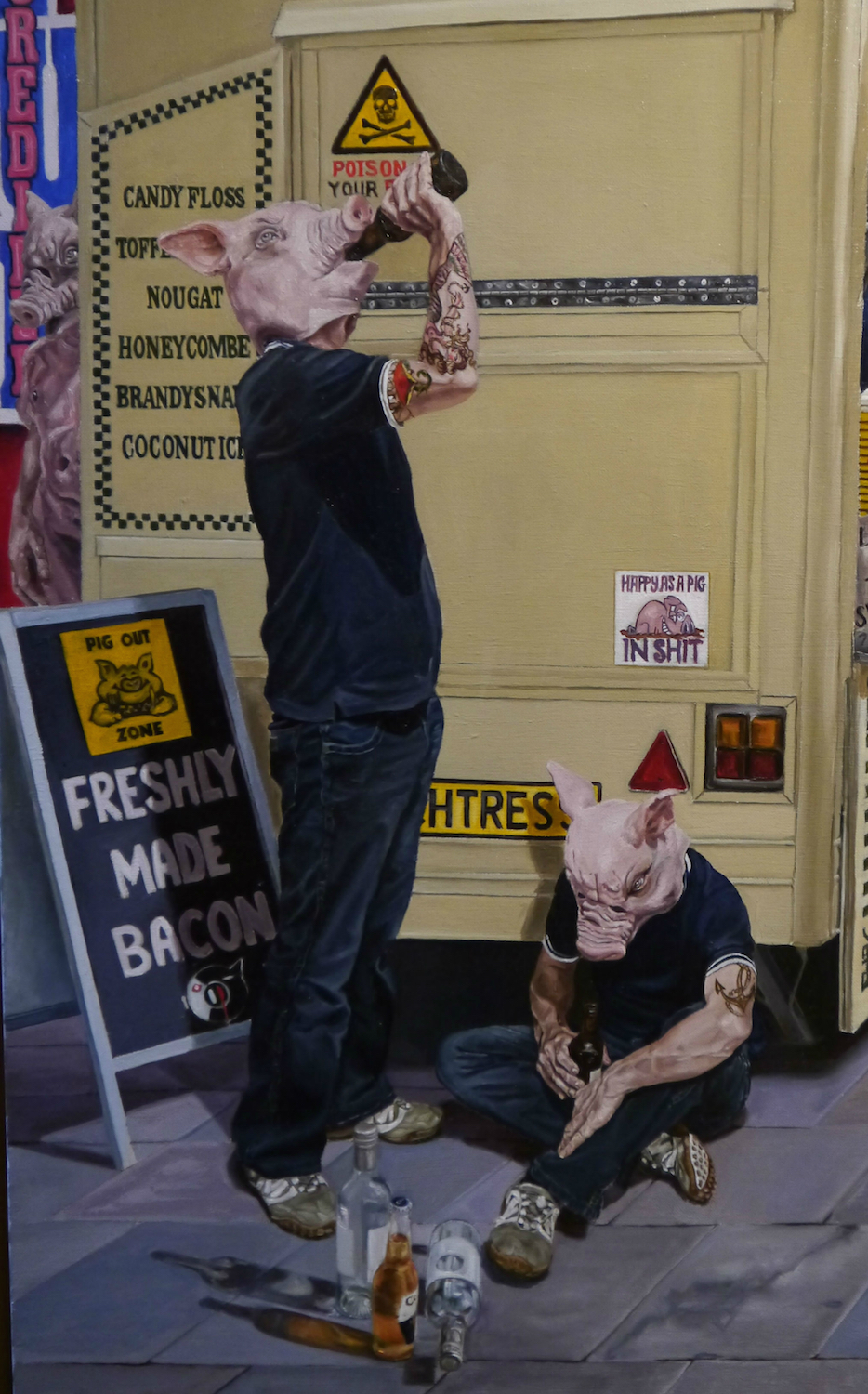
Mark Finch won the Scenes of Everyday Life category award in Jackson’s Open Painting Prize 2019. His disturbing painting, Circean Poisons, depicts the Greek myth of Circe, who, in The Odyssey, uses food to transform Odysseus’s greedy crewmen into swine on her island of Aeaea. In Mark Finch’s retelling, Aeaea takes the shape of a colourful English fairground and Circe, a vendor, doles out the transformative fast food from her truck. The winning painting is one in a series of works that reimagines Greek tragedies to expose the omnipresent themes of human nature, with details from the original myths, embedded in the British landscape. We caught up with Mark about his palette, perspective and production of a myth.
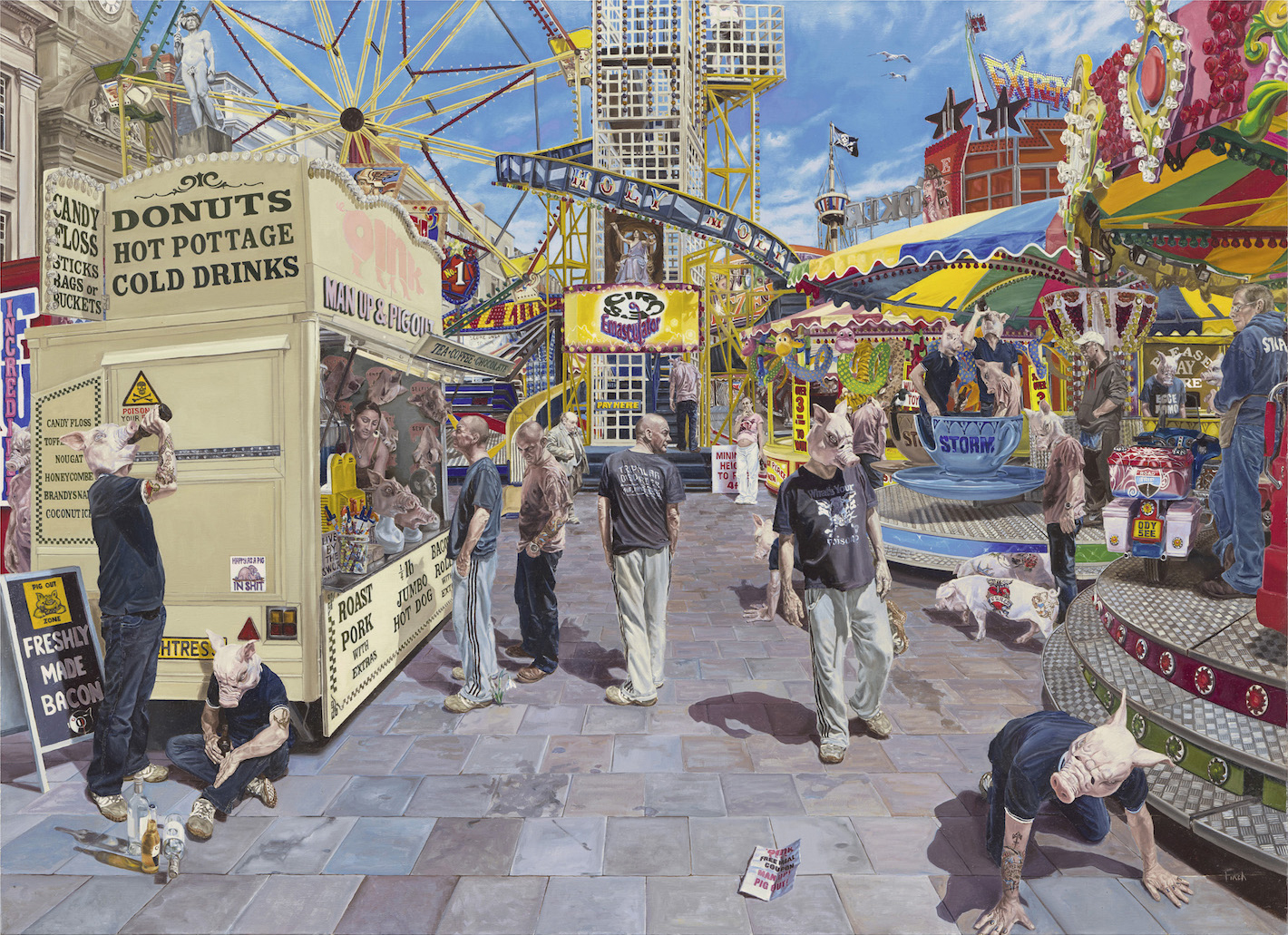
Mark Finch
Oil on linen, 135 x 100 cm
Clare: Tell us a little bit about your artistic background/education.
Mark: I am essentially self-taught. I began painting in my twenties by first familiarising myself with the colour wheel and the basic properties of the paints I chose to use. I selected a warm and cool colour of each primary and a couple of earth colours and developed this basic knowledge through a lot of trial and error.
Mark Finch
Clare: How would you describe your practice?
Mark: I am first and foremost an oil painter. Oil painting provides the flexibility I require in my painting processes as although the initial stages of my painting are carefully planned, later stages can be fairly organic in their development and oil paint allows me to manipulate the painted surface with a minimum of fuss, wiping back or over-painting where necessary.

Mark Finch
Oil on linen, 135 x 100 cm
Clare: There appears to be a lot of preparation that goes into each painting in the Greek Myths series, especially in regards to research. In terms of the painting itself, how do you plan your compositions? Are these events staged at locations in your area?
Mark: I start with detailed research into the myth and this offers up clues as to the kind of location it is best suited to. Once I have decided on the setting for my composition I usually take numerous photos, as at this stage observational sketching would not provide me with all the information necessary for my decision making. The photos are then used to create thumbnail sketches of possible compositions- a lot of time is spent at this stage. None of my scenes actually exist as a single location in reality, but every element in them is drawn from real life. These first stages are vital to get right as they determine the horizon line and the vanishing point which in turn informs every element of the painting through my attempts to establish a strong perspective. I always consider this stage of the painting as the ‘set’ design, after which I dress and stage it with the characters.

Mark Finch
Oil on linen, 135 x 100 cm
Clare: The figures in your paintings are integral to your retelling of the Greek myths. Do you attend figure drawing classes? How do you develop your characters?
Mark: From time to time, I will enrol on a 5 or 10 week figure drawing course at the local art college. These two-hour sessions are an ideal opportunity to do quick charcoal or acrylic sketches and can often be a welcome relief from the tighter figurative style of my paintings. These sketches are only ever done for their own sake and are not used in subsequent studio paintings. The figures in my paintings are painted from people I know, and although their poses are staged, they are always staged independently of the setting, which is another key reason for establishing vanishing points right from the beginning.
Mark Finch
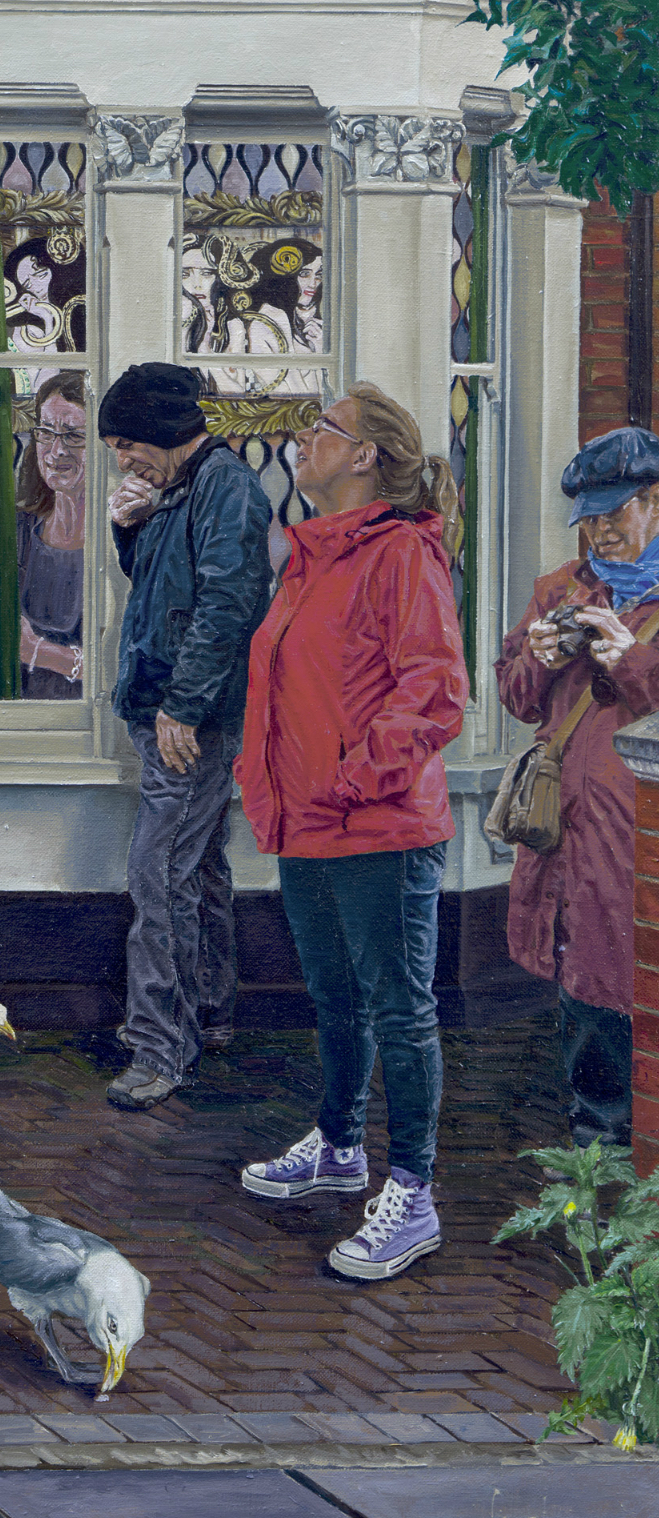
Clare: In your paintings, you weave all these fascinating narrative details into objects and signs, seen in everyday life. Do you maintain a practice of observational sketching from life? If so, what materials do you use, how often do you sketch?
Mark: I doodle a lot using scraps of paper and whatever is to hand, usually a biro or pencil. These sketches are seldom kept. More considered observational sketches are done in paint, charcoal or pencil. I am currently developing an interest in plein air landscape painting and have tried several approaches from a three colour limited palette in oil ( Alizarin Crimson, Cadmium Yellow Pale and French Ultramarine) through to watercolour sketches ( a medium which is brand new to me) and acrylic. Each medium presents its own unique challenge.
Mark Finch
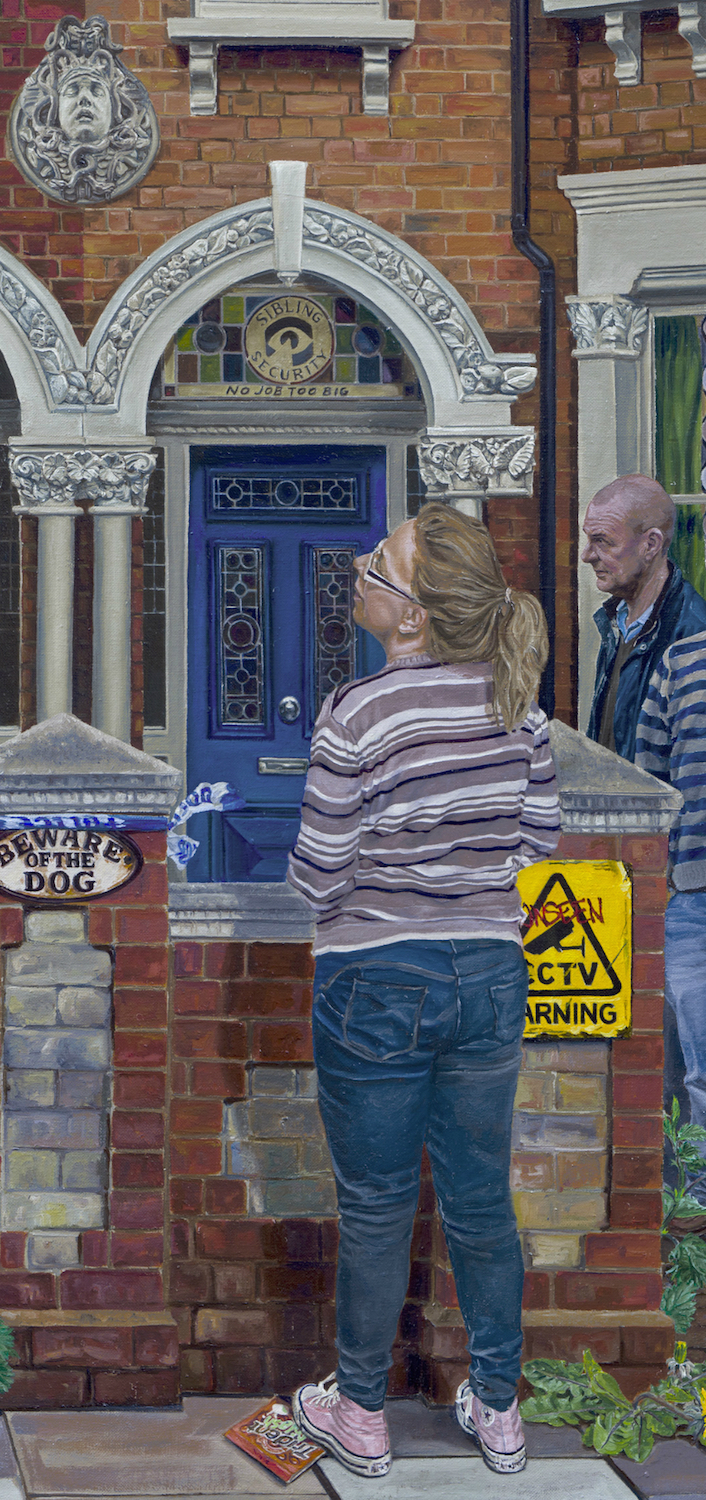
Clare: Most of your Greek myth paintings have one point perspective, illustrated by a tiled grid. Why do you choose to do this and how does this inform your work?
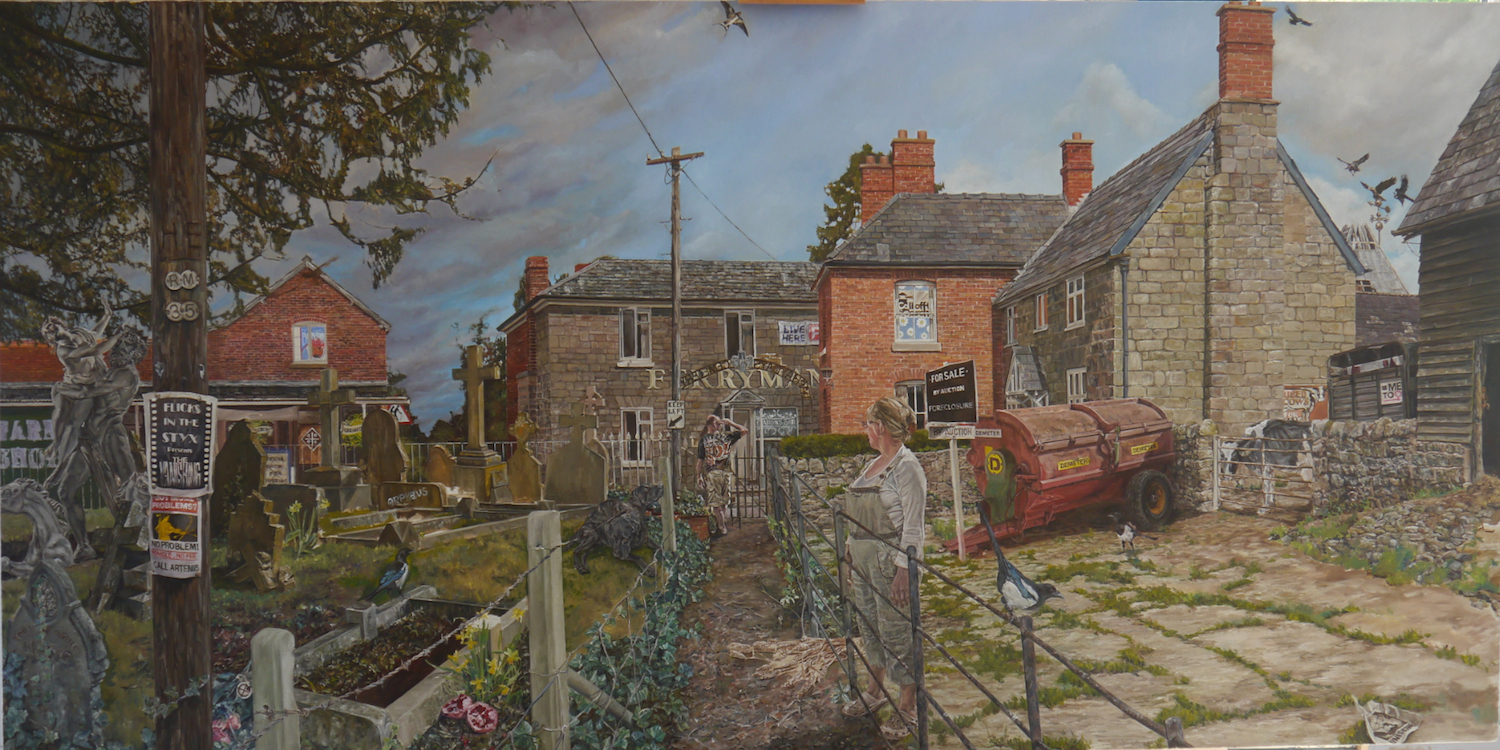
Mark: In this series of paintings I have used single point perspective as a means to create a strong sense of depth; I believe this invites the viewer to enter the painting and engage with it more. I try to build on this illusion of depth by using spatial and atmospheric perspective, and by using counterpoint tones. All of my paintings have a dark underbelly and explore issues which are a concern to many of us. The Abduction of Persephone has a single point perspective almost in the middle of the painting and is at the end of a path which divides the living world on the right of the painting from the funereal world on the left. We are all walking that same path to its inevitable conclusion
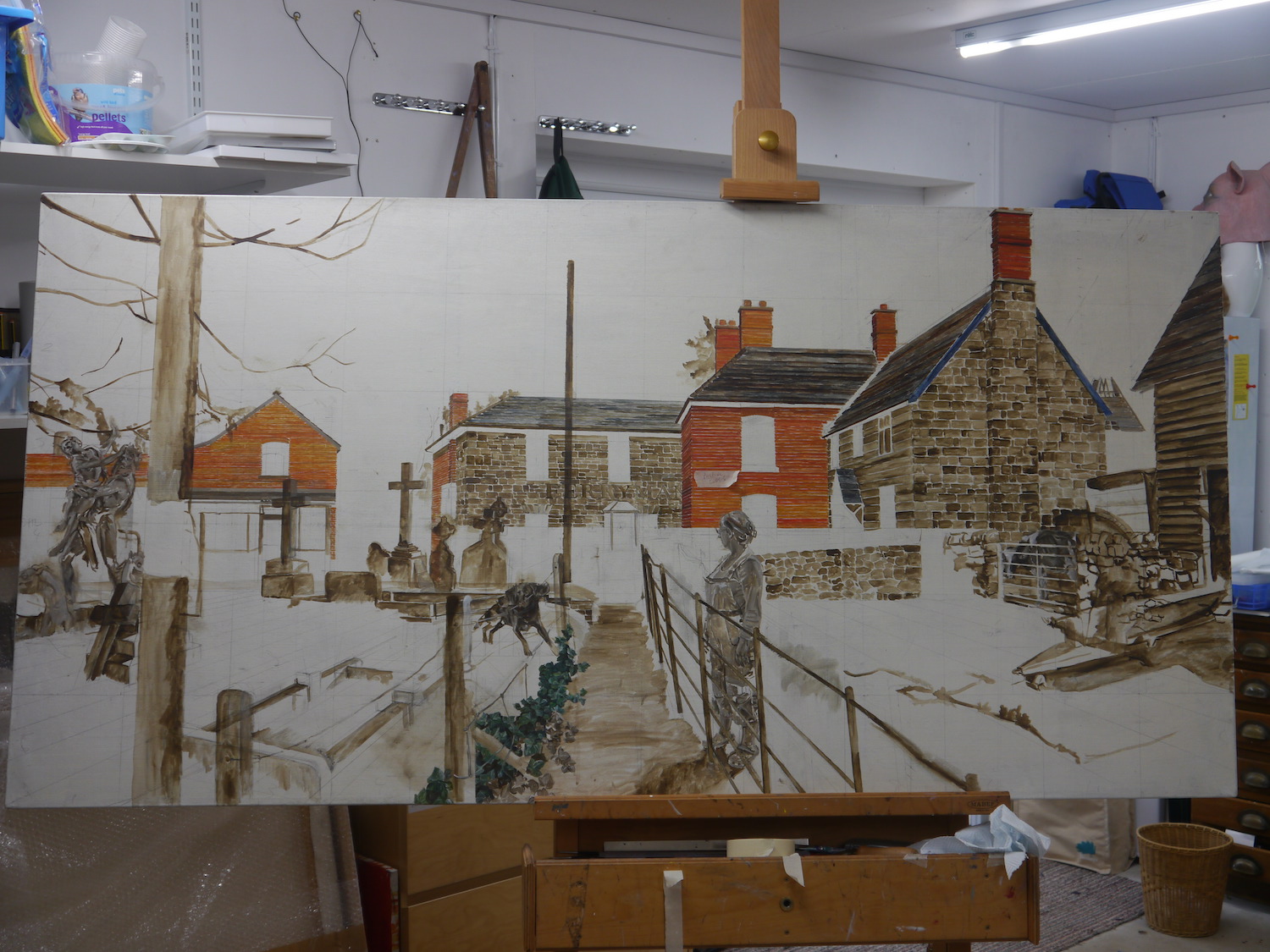
Clare: I am interested in the dimensions you are working with for The Abduction of Persephone. It’s as if you have adapted a stage play for the widescreen. Are your canvases custom made? Can you talk about how you prepare your surface?
Mark: I buy professional pre-cut stretchers to the sizes I want and construct them in the studio. I stretch my own canvases preferring to use medium/fine linen. In the past, I have sized these canvases using rabbit skin glue but I am beginning to use acrylic alternatives as a sizing agent (Golden’s GAC100-two coats). I then use two coats of primer, which traditionally has been lead white paint, but again I am beginning to use an acrylic gesso as an alternative.
Mark Finch
Oil on linen, 91 x 183 cm
Clare: What are your most important artist’s tools? Do you have any favourites?
Mark: Winsor and Newton artist quality paints. I use a fairly limited colour palette of a warm and cool of each primary and a couple of earth colours for convenience (Cadmium red, Crimson Alizarin, French Ultramarine, Cobalt Blue, Cadmium Yellow, Lemon Yellow, Burnt Umber and Yellow Ochre) I occasionally use Winsor Blue Red Shade and Cadmium Yellow Pale, especially when painting foliage. For the narrative paintings, I have got myself into the bad habit of using small fine brushes for nearly all or the painting. Therefore, I buy packs of cheap synthetic brushes (0 size) and merely throw them away when the point is gone. For my plein air painting, I have a much larger range of brushes. I could not do without a mirror, as I frequently use it to check for errors in my work–looking at your painting reflected in a mirror, any errors in proportion etc. will be immediately noticeable.

Clare: What makes a good day in the studio for you?
Mark: An early start. Beginning a new part of a painting or consolidating something which you’ve been working on for months. There are occasions when you can do no wrong–every brush stroke hits the mark and you just seem to be with the muses. Such occasions are rare but fantastic when they happen.

Clare: What are your art influences? Who are your favourite contemporary or mythological artists?
Mark: Caravaggio is an obvious influence but I love all of those Renaissance painters. Otto Dix, George Grosz and The New Objectivity Movement artists are also favourites, along with Stanley Spencer. There really are too many to mention. I rarely sit and look at art books, despite having hundreds, but I will go and visit art galleries if I have the opportunity.

Mark Finch
Oil on linen, 135 x 100 cm
Clare: In the studio – music, audiobook, podcast, Radio 4 or silence?
Mark: Music is usually the order of the day but it really does depend on the tempo of the painting. If things are going well it’s definitely music; if I am attempting to get to grips with something new it will usually be silence and I do on occasion listened to audiobooks.

Mark Finch
Clare: What is coming up next for you and where can we see more of your art in the flesh or online?
Mark: No immediate plans at the moment for 2019. I will probably finish working on my narrative paintings this year and dedicate some time to developing my watercolour practices and plein air painting, with a view to exhibiting in 2020. I will also continue to submit paintings into open exhibitions as it’s an excellent way to get your work out there and seen.
View more of Mark’s work on his website here