

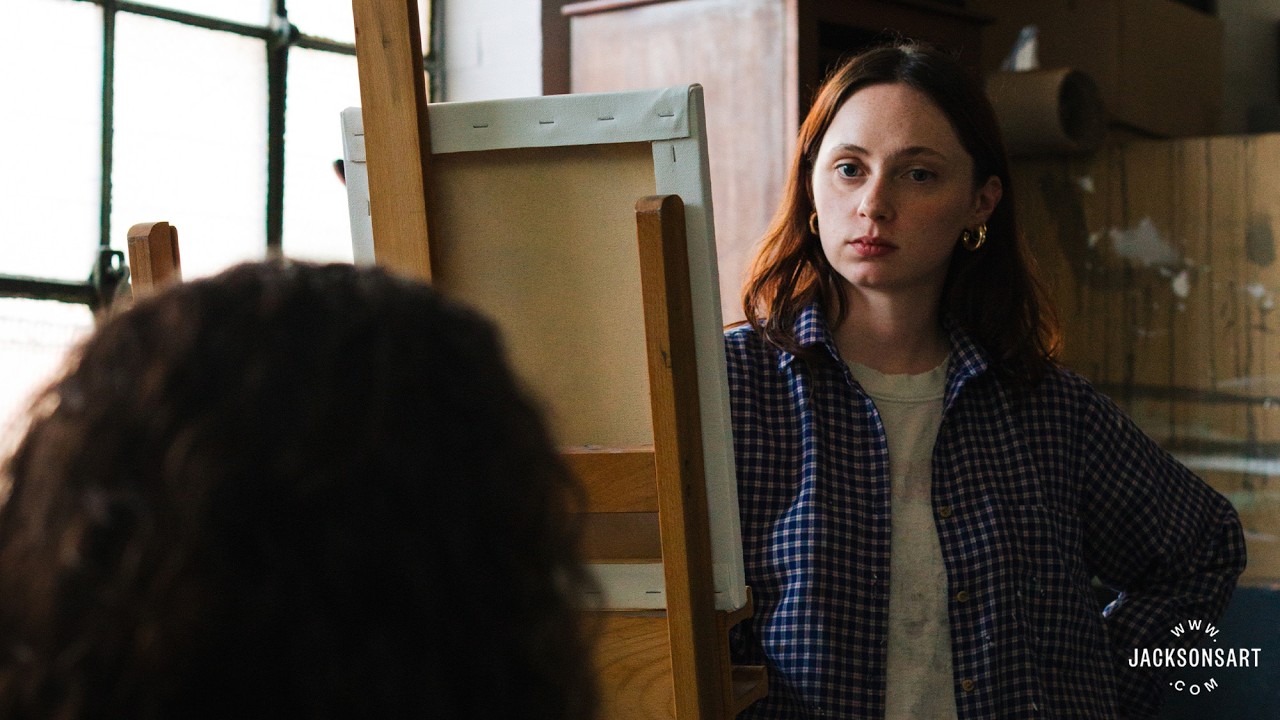


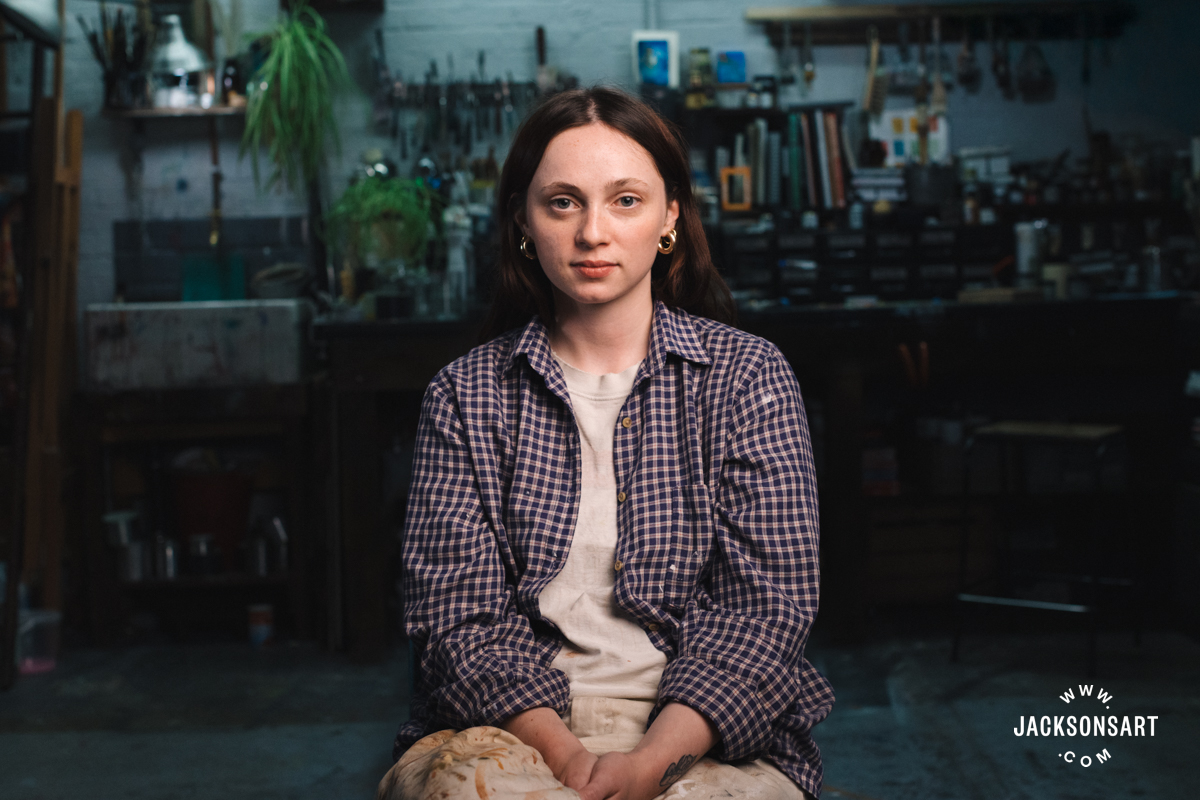
Lily Rose Fine is a British-Canadian Painter based in Vancouver. Her work explores emotional intimacy and mythic symbolism through the depiction of collected ephemera and the familiar faces of loved ones. She visits us in the Jackson’s Studio to speak about her practice – which blends influences like mid-century horror films, modern art, and folklore to create haunting and otherworldly artworks.
Contents
0:00 “I do think about this sort of middle ground, this kind of threshold between the dream world and reality”
0:24 “I’m interested in the kind of spirit that objects hold, also paintings hold”
0:58 “Colour is my main love in painting”
1:33 Introduction
1:55 “I think the National Portrait Gallery, particularly, was the one that I went in, and I was like, this is what I have to do”
3:43 “With oil paint, it’s a little bit like ‘I’m a real artist’”
4:29 “I do the under layers in acrylic, because I feel like I can think through the image faster”
5:06 ““I wanted the texture of icing”
6:02 “One of the teachers, Lauchie Reid, was someone who just made oil painting seem like no big deal”
7:55 “I really felt like I needed to give my painting, this thing that I loved my whole life, and kind of put on the back burner, a real shot”
8:42 “I love things that possess a lot of power”
9:58 ““I like using images that, for me, hold a lot of potent feelings, but could be completely articulated differently by somebody else”
10:32 “I’ve started really focusing in on Eryn, because I know her so deeply, more than most people, but there’s still this level of distance, in that we’re platonic best friends”
11:45 “You’ll never feel good enough, you shouldn’t feel good enough, because you probably got, hopefully, another like 70 years of painting in your life”
13:35 “I cannot live without a giant tube of Indian yellow…it’s like working with caramel”
15:35 “It was just an intense program that meant that I was constantly drawing”
17:20 “There is a strange ambiguity in the desire to know”
19:21 “I want to try to get better at responding to what the painting really needs”
20:06 “Drawing is a really fundamental thing”
21:37 “Some of my favourite paintings that I’ve ever done, the surface of them have been paintings that I have done over old paintings”
23:24 “I love a disgusting old brush”
24:26 “If things are going wrong, it might just be that I need to go home, or eat a meal, or hang out with friends”
25:22 “Partly the strategy for not overworking something is that I try to have a surface that isn’t blank”
26:37 “I’m making them into this object that is just to be observed and not touched”
29:05 “I like to force myself to not look at things or consume anything in the studio that is not going to feel related”
33:11 “I think I’m most inspired by film”
34:40 “I am very inspired by vintage photography and some of the tricks that you can do with that medium”
35:14 “Painters that have particularly stuck with me over time, Paula Modersohn-Becker and Ben Shahn”
36:58 “You don’t have to overthink trying to be authentic”
38:59 Credits

Lily Rose Fine
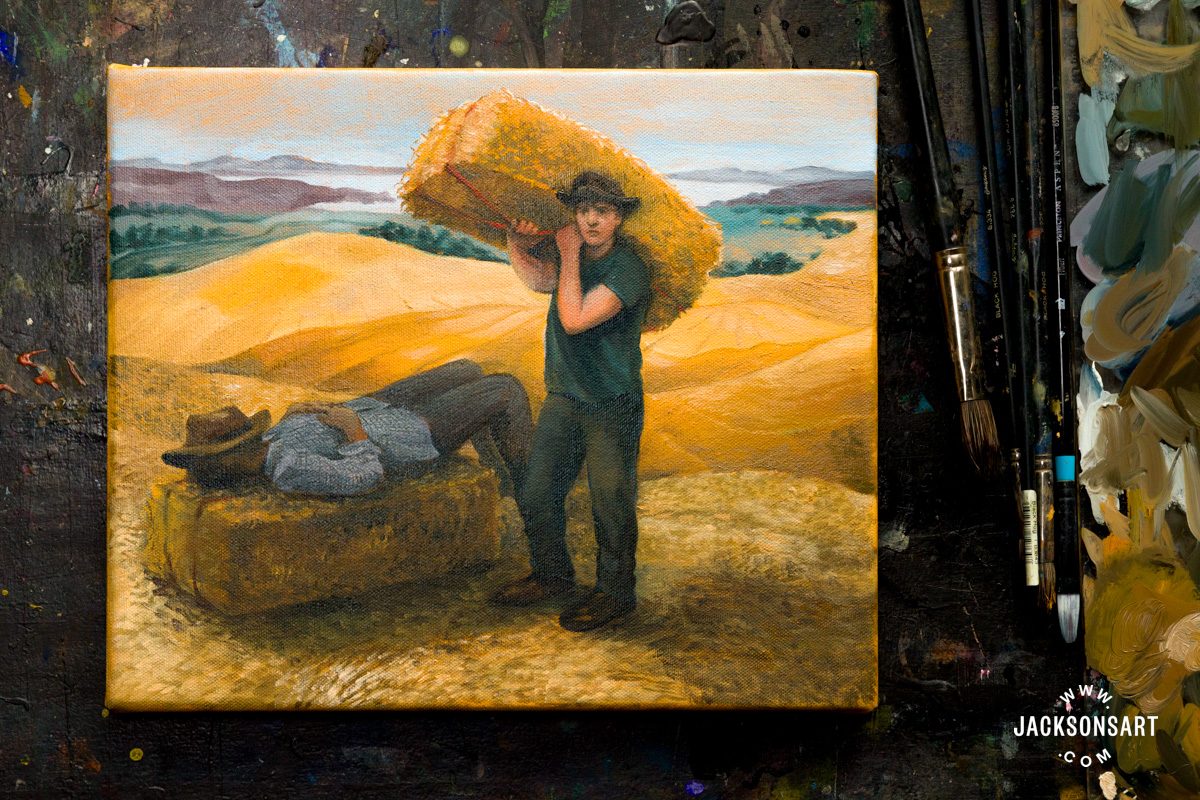
Oil on canvas, 76 x 102 cm | 29.9 x 40.2 in
Extract
I’m interested in the kind of spirit that objects and paintings hold. A lot of that comes from visits to galleries as a kid – on trips to London we’d go to the National Gallery, the Tate, the Portrait Gallery. I also love vintage shops and antiques, places where you find these works of art or somebody’s old box that they used to keep their jewellery in. But there’s something so magical about how many hands have touched those things or how many eyes have seen them, how many stories these things hold. I think I’m interested in trying to articulate whatever that feeling is that feels like the spirit imbued in those objects.

Lily Rose Fine
Acrylic on found wooden box and human hair
20.5 x 13.5 x 17.5 cm | 8.1 x 5.3 x
6.9 in
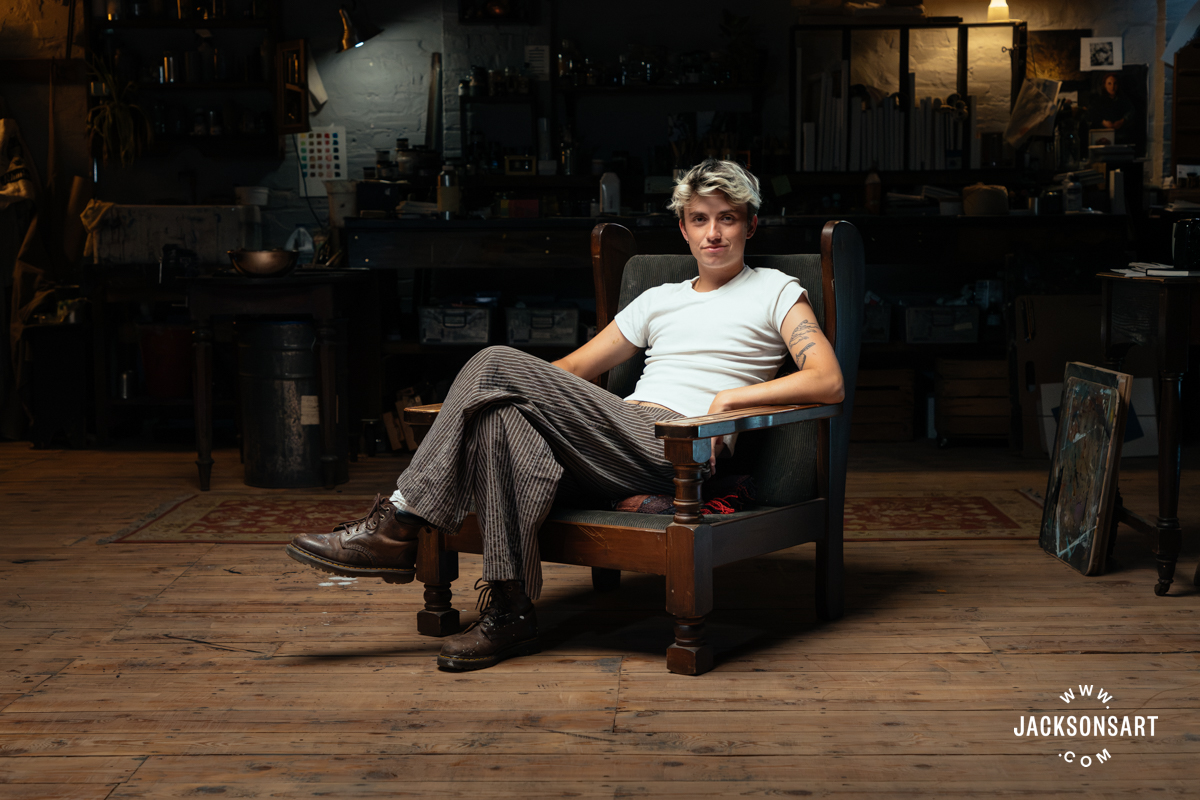
My name is Lily Rose Fine. I’m an oil painter, and I’m in the Jackson’s studio to talk about my practice.

I don’t think I have just one early memory of making art, because I grew up surrounded by it. My parents are animators, and all of their friends are artists. I didn’t really think too much about that not being a normal childhood, and I was always drawing. So it was just an integral part of my life.

When I was living in Vancouver, I applied to an art high school that had a program called the Byng Arts Mini School. It was visual-arts focused, though there were drama and music streams too. The education was so in-depth that the path felt obvious; I never really questioned doing anything else.

My style developed from visiting galleries in London when I was a kid. We went to London often because that’s where my mum was from – well, she’s actually from Nottingham, but they lived in London for about 25 years. So we’d come back, and I’d see my uncle and the rest of my family here. My uncle used to take me to the Henry Moore Sculpture Studio House, and I was really inspired by that space. I was also inspired by Tate Modern, Tate Britain, the National Gallery, and the Portrait Gallery. The Portrait Gallery especially, was the one where I walked in and thought, “This is what I have to do” – all those faces staring at me from across history.

Photo by Samuel Duarte
After high school, I applied to the Ontario College of Art and Design University, specifically for illustration. They had a fine art program, but I was really interested in illustration at the time. I loved comics and graphic novels. I was not the strongest reader, and so I think graphic novels were my way into really appreciating stories and language.

Lily Rose Fine
Oil on wood in handmade hinged frame, 150 x 122 cm | 59.1 x 48.0 in
I think I was really lucky to have chosen the illustration program at OCAD because we shared a lot of classes with the fine art program. We had really in-depth painting and drawing classes that were of such a high standard, and I think that just guided me towards painting even further. There were a few teachers, in particular, who taught the painting classes and were really obsessed with pigments and colour relationships and how to oil paint. It felt a bit intimidating, but one of the teachers, Lauchie Reid, was someone who just made oil painting seem like no big deal, and there was a really easy way in and just kind of convinced me that it was not an intimidating pursuit.

Lily Rose Fine
Oil on found frame, 48 x 52 cm | 18.9 x 20.5 in
In Toronto, I was mostly focused on illustration and comics. There’s a great comics community there, and I spent a lot of time at a bookstore called The Beguiling. I drew a lot of inspiration from people’s zines and DIY projects, and they supported local artists by taking in our books – when I made a comic, they sold copies for me. It made me feel part of the local art world. At the time, though, I was pretty unaware of the broader painting and fine art scene. Now, after being in London and then moving back to Vancouver, I’m finally connecting with the Canadian art world. There are some galleries I really admire, like Pangée in Montreal and Towards Gallery in Toronto.

After university, I worked in children’s books and editorial illustration, which I really enjoyed. Most of that happened during Covid. So, the kids’ books were all made during that time. I felt quite removed from the career aspect of it, and I was at home, oil painting, doing portraits of my friends. I had that realisation many people seemed to have during Covid: you either return to what you were doing before, or you start something new. It became clear I needed to give my painting a real shot.

Lily Rose Fine
Oil on wood, 30 x 42 | 11.8 x 16.5 in
Photo by Elena Bazu | Exhibition: Emblems, Partnership Editions
For me, focusing on painting began when I applied to The Drawing Year at the Royal Drawing School. It was just after Covid, and I felt I needed a major shift – something that would let me give real attention to my own practice, separate from work or outside pressures. Studying again felt essential, and the Drawing School in particular stood out. I’d always wanted to live in London – I was born there but away for most of my life – so the program became both a way back and an excuse to immerse myself in a city I love and find inspiring.

Lily Rose Fine
Acrylic on paper clay, 33 x 30 x 22 cm | 13 x 11.8 x 8.7 in
Photo by Elena Bazu | Exhibition: Emblems, Partnership Editions
Through the course, with classes at the National Gallery and outdoor sessions all over London, I engaged with the city in ways I’d never have pushed myself to do alone. The tutors all had very different approaches. So many different classes, a really intense workload, and a lot of studio time meant that I was constantly drawing. That really pushed my work ethic, and my instincts, and helped me to look at things and interpret them.

For me, drawing is fundamental to painting. There are always charcoal underdrawings – having the skeleton of the drawing has really helped me to have an immediacy to the paintings. It really does come down to a confidence in drawing and looking at something and doing things quickly.

I’m not really a slow builder kind of worker, and I’m more of a kind of immediate, let’s see if this works. I think that quick way of working helped me build my own hand that became very intuitive, and I think I rely on that intuitive language in my painting now.

In most of my work, I paint my best friend, Eryn, as well as myself and some other people who are really close to me. But I think that I’ve started really focusing on Eryn because I know her so deeply, more than most people, but there’s still this level of distance in that we’re platonic best friends. But I also think intense friendship is a really interesting space because there is this tension between being incredibly intimate but also being kept at a distance.

Lily Rose Fine
Oil on wood in artist-made obeche frame, 46 x 83 cm | 18.1 x 32.7 in
But also just my relationship with her face. I mean, I know it so well, and I see it all the time, but painting it makes me feel like I can know her better. I’m almost unveiling things, even though I’ve known her for almost 10 years now. I still paint her and see new shapes and little details in the structure of her. And when I’m painting somebody, I don’t think I’m really trying to get them so accurate; it’s more about the topography of their face. It becomes inanimate, but also there’s this deep, real emotion with the person.

Lily Rose Fine
Oil on canvas, 44.5 x 70 cm | 17.5 x 27.6 in
By exploring a face I know so intimately, I feel I can reach another level with it – almost like speaking to her in a language I don’t have otherwise. It reminds me of double-exposure photography. I once read a book on ghost photography and found it fascinating: people would create the illusion of a ghost by superimposing another figure onto the image, often someone they knew or an actor draped in a cloak. Sometimes it appeared as just a blur of light, but other times it formed a clear face beneath a sheet.

Lily Rose Fine
Oil on jute and jute braid, 91 x 115 cm | 35.8 x 45.3 in
I am really inspired by vintage photography and the sort of strange tricks that you can do with that medium. I think also in terms of my style, I am really inspired by film. I love looking at paintings to learn how to paint, but the content that really inspires me comes from people like David Lynch and Talking Heads’ David Byrne. Their slightly strange, funny, naive humour, and that touch of absurd, campy energy, is something I’m trying to bring into my own work now.

Lily Rose Fine
Oil on canvas and papier mâché, 23 x 9 x 12 cm | 9.1 x 3.5 x 4.7 in
I also love 60s and 70s horror films, not just the aesthetics of the film, but also that kind of pleasurable and gross experience of watching something with a lot of interesting symbolism and concepts. Something that makes you feel emotions very intensely to get an idea across, as opposed to just being very conceptual. It’s more like getting to a really raw human intake of the information and then tricking you into learning a lot about yourself, but also about the concepts in the films.

Lily Rose Fine
Oil on canvas, 80 x 115 cm | 31.5 x 45.3 in
I’m really interested in using symbols within my work because I think that it brings a language that can be interpreted. I come to my paintings with a sense of what they’re about and where they come from, but I don’t always feel that anyone else needs to know all of that. I think there is something much more interesting in the miscommunication, in the reinterpretation of whatever I’m sort of presenting. Somebody else could reflect their own ideas onto that.

Lily Rose Fine
Oil on found cabinet and wood, 90 x 154 cm | 35.4 x 60.6 in
I think I do have a certain palette of symbols, because they come from my interests. They come from the things that I’m inspired by and the things that hold meaning to me. I think repeating them also sort of intensifies their meaning.

Lily Rose Fine
Oil on found cabinet and wood, 90 x 154 cm | 35.4 x 60.6 in
A lot of the symbols that I think about come from objects that I love or things I’ve collected. I’m a huge antique collector. I have a lot of little, strange-looking dice and playing cards – I get really wrapped up in these tiny objects. And I think for me, they almost feel like good luck charms or sometimes the things that are stereotypically bad luck charms. I love things that possess a lot of power, like a black cat walking across the street. People sort of hold so much meaning in that. They’re very potent images that I think when you look at them, you can’t help but feel like there is something more about them.

I also get a lot of symbols from old cinema and from books, as well as fairy tales and Greek myths. I also take them from vintage tattoo archives. I think it’s really interesting – they’re quite literally symbols that people will use to say something about themselves or to remember somebody. And the intensity of adorning yourself with these images, is really potent in a painting.

Lily Rose Fine
Oil on jute and jute braid, 91 x 115 cm | 35.8 x 45.3 in
My studio is in Vancouver. I try to set it up so that I paint both on the wall and also on an easel – I have multiple spaces where I can work on different paintings throughout the day. I also have a cart where I keep all of my paint so I can wheel it around next to me, and a beautiful old desk that I found has drawers that are impossible to open. I have a little, ugly couch that I will sit on and read books and watch art videos. I like to force myself not to look at things or consume anything in the studio that is not going to feel related to or keep me in that headspace.

Natural light is essential for my workspace. But I haven’t always been lucky enough to have that in my studio. My current studio is beautifully bright. I do use artificial light at night or when it’s really cloudy, but I have to force myself to use it. It’s not about perfect accuracy, it’s more that I’m trying to create an atmosphere that really gets me into a certain mode. Natural light or maybe dappled light or a candle really gets me into the right headspace where I can just flow, and I’m not watching the time, and I’m not thinking about where this is going to end up.

Photo by Annana Rafa
My typical day in the studio begins with a walk. Now that I live in Vancouver, I’m a five-minute walk from my studio. I usually start by organising my space, getting the paintings that I want to work on first up on the wall and stepping back. I make a cup of tea right away, and I might play some music or podcasts to just kind of set an atmosphere. After that, I will get into painting.

I work with oil paints and specific colours that I love. I’m not loyal to one brand. I mostly paint in oil paint, but I do the under layers in acrylic because I feel like I can think through the image faster when it can dry and I can go over it, you know, cover something, fix it, move something over. It’s a little bit more immediate. And I kind of create more texture and layers under the painting that way, very quickly. And then when I go to my oil layer, I can start kind of glazing over what I’ve done.

There is basically this foundation, this structure that I can work within, and then just play around with the textures and the colours and how they overlay and how the light goes through them. And it kind of becomes more abstract at that point.

I used to work really thick all in one go, kind of doing a painting from beginning to end, stop, next painting. And that was just the only way I could figure out how to work. But recently, I think it’s having more space in my studio, and also having a bit more time, I’ve started to work on multiple things at once. I’ve started glazing more. And so I will be able to do layers over a period of days; I can keep coming back to it or leave something for a while and then do another pass at it. And I think it’s producing something more interesting. I want to maintain that immediacy, but I think the combination is useful.

Colour is my main love in painting. I think that the texture of how it goes on, but also the colours themselves, I think, really pull me in. And I’m very particular about the combos that I like and the colours that I buy. And I think for my palette, I tend to work with a lot of warm tones, a lot of umbers and earth tones because I feel like there’s something that is a bit timeless about those colours. I like ones that don’t feel too modern and things that feel like they could have existed in any period.

I’m cliquey with my colours. I cannot live without a giant tube of Indian Yellow. And specifically Winsor & Newton Indian Yellow because I’ve tried ones in some very fancy brands, but they somehow are not the same kind of deep and transparent colour. It’s like working with caramel. It’s the best colour ever. And then the other one is Burnt Sienna. I use those in my glazes. Whenever there’s a painting that’s not super cohesive, or I need to kind of pull it back, I will just do a wash of Burnt Sienna or Indian Yellow. And Sap Green is another one. Those three are basically the core of all of my paintings.

I don’t like purple, but I also don’t like working with any colours that I can mix really easily. And I think that creates a lot more interest in a more personal style within my painting, rather than using the colour straight from the tube. I also avoid buying black. And that’s actually from my tutor in university, who gave me a palette of just six colours when I was scared of oil painting and was like, you don’t need anything else. You can mix everything with these.

I’m using Sennelier Abstract Acrylic Paint for the underpaintings. I like that they’re in little pouches because they’re a lot lighter to take with me when I’m travelling or to keep in the studio. I feel like I can really squeeze the most out of them.

Lily Rose Fine
Oil on canvas, 115 x 90 cm | 45.3 x 35.4 in
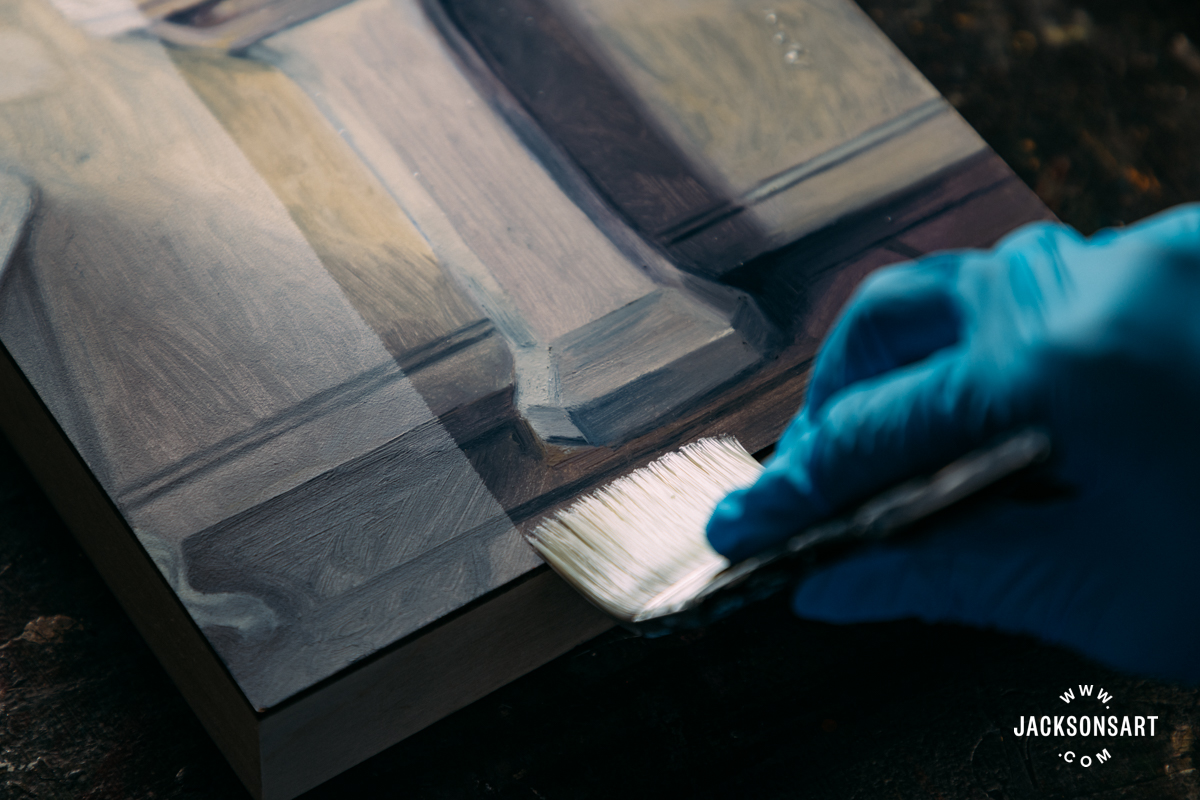
I’ve recently been changing up what I’m using for the glazing. Previously, I would use beeswax in my paints to work thickly. I wanted the texture of icing. I think Philip Gustin said that in his show that he wanted his paintings to look like cake icing, and that stuck with me. But I’ve been trying new combinations for my glazing liquid – I’m using stand oil so that it dries faster.

Lily Rose Fine
Found chair, oil and acrylic on canvas, pinecone, 41 x 92 x 40 cm | 16.1 x 36.2
x 15.7 in
For canvas, I will prime it with an acrylic gesso and then slowly add a warm tone into the gesso so that it’s kind of a glowing warm tone from within. My painting tools are mostly pretty classic, just paint brushes and a palette knife. I use mostly pointed round brushes. I also love a disgusting old brush. I’ve had brushes since my high school years, and they’re my favourite brushes because they’re so ruined, and they do a great dry brush effect. I will use both synthetic and hog hair.

Lily Rose Fine
Found chair, oil and acrylic on canvas, pinecone, 41 x 92 x 40 cm | 16.1 x 36.2
x 15.7 in
I draw inspiration from film, music, books, and sculpture. Two painters who’ve stayed with me are Paula Modersohn-Becker, whose full exhibition I was lucky to see in London, and Ben Shahn. With Shahn, it’s not just his style but the surreal way he constructs space: pushing reality into inventive compositions, using lines and structure to build something that could almost be an abstract image, yet remains rooted in real things. There’s one piece of a band where the legs of the music stands form this wild, tangled pattern – almost like tall grass. It’s beautiful.

Lily Rose Fine
Oil on wood and antique washboard, 35 x 60 cm | 13.8 x 23.6 in
Another artist that I really love is Darby Milbrath, who is from Vancouver Island. I’ve been looking at her paintings since high school. She’s brilliant with colour, creating these warm, absorbing images of flowers and figures – abstract but rooted in her background as a dancer. And so all of the paintings feel like they have all this movement and almost like a wind in them that’s bringing you through them. So I’ve always gone back and looked at her work.

Further Reading
Tonalist Techniques in Painting and Drawing
Chromatic Black: Mixing Nuanced Dark Values
A Guide to Drawing in Galleries and Museums
Underpainting in Oil and Acrylic
Shop Art Materials on jacksonsart.com
2 thoughts on “Artist Insights: Lily Rose Fine”
What a beautiful exploration of emotional
intimacy through art! Lily’s approach to
painting familiar faces while discovering
new depths resonates deeply. The way she
blends vintage photography, film
influences, and personal symbolism
creates such hauntingly atmospheric
work. I’m particularly drawn to her use of
warm tones and glazing techniques – the
comparison to caramel when describing
Indian Yellow is so evocative. Thanks for
sharing this inspiring interview!
Thank you so much for your kind words about this article and Lily’s work. I’m glad you enjoyed delving into the symbolism and influences within Lily’s practice.
Comments are closed.