



Canvas has been the most popular painting surface for hundreds of years and has a range of benefits – it’s lightweight and has excellent absorbency, as well as a woven texture which artists love. For some painters, however, the rigidity of a board or panel offers the perfect surface.
Aluminium panels have a number of great benefits, namely that they are very strong and are less susceptible to shifts in the surrounding environment than MDF, for example. Jackson’s aluminium panels have a smooth and archival anodised aluminium surface, which is widely considered the best process for preparing an aluminium surface for the application of paint.
We recently interviewed British artist Michael Sheldon, who mentioned he almost exclusively paints his portraits on our aluminium panels. We thought it would be insightful if he expanded on this and shared his thoughts about the panels.
By Michael Sheldon
I first started taking painting seriously at the start of 2018 when I received a box of artist quality oil paints as a Christmas present. I was fascinated by the Old Masters painting techniques, particularly glazing, and decided I would give it a go myself. I began to paint on canvas like most artists, but I quickly realised that due to the way I paint I wasn’t a fan of the canvas texture. I was looking for a canvas substitute and came across Jackson’s Aluminium Panels, and I’ve not looked back since.
In this article I’ll talk about the advantages and disadvantages I’ve found using aluminium panels, and a little insight into my painting practice showing you how I prepare, use, and hang the panels.
One of the benefits of using aluminium panels is that there is no priming required, you can paint straight onto the surface! The archival properties are far greater than canvas or wood and the surface is super smooth. I also found the paint drying time to be slightly quicker than using canvas. You can find out more about the panels by looking on the Jackson’s shop website – it goes more in-depth about how the surface is treated and the archival properties.
As with most of my paintings, I start with a sketch and outline the basic composition. For the purpose of demonstration, I have drawn a quick sketch using charcoal and graphite. Although the image appears permanent (and possibly will be as long as you don’t touch it) you can rub out the pencil marks using a basic/putty eraser and leave no visible trace. This helps me to refine a sketch into a more basic outline for when I start to paint, or if I change things during the painting process.

The majority of the time I would then paint straight onto the surface without any priming, especially if I’m glazing layers. If you would like to lock in the underdrawing and you are worried about the theory of graphite eventually finding its way to the surface of the painting (I’m not convinced), then you can use a clear gesso over the top of the pencil marks or use a fixative. I would advise you use a brush to wipe down any excess graphite/charcoal dust on the surface as this will blend in with the gesso and ruin your sketch. Charcoal has a tendency to smudge on aluminium and is more likely to blend in with the gesso, so another option is using a fixative.
After the gesso is dry you can then sand it down and repeat if necessary. An advantage of this method is that the first paint layer sticks better to the surface, which is useful when, for example, painting alla prima.

Over the next few images I have drawn a basic outline of two eyes with a pencil. The right eye I have painted a basic grisaille directly onto the surface and the left eye I have primed with a couple layers of clear gesso, sanding in between layers. You can see how the first paint layer takes to the gesso a lot easier.
Another great advantage I have found is that when I’m glazing layers over the aluminium, because the surface is so smooth I don’t tend to use a medium. This has a faster drying time and feels more pigment-rich, and as I mentioned earlier I’ve found that the paint seems to dry quicker on aluminium than canvas. If you would like your paint to dry even quicker then you can always mix some fast-drying pigments i.e. raw umber into your paint. The dry brush technique also works really well when using the paint from the tube.
When glazing over a grisaille using a medium, you would need to be more exact with the underpainting and many layers are glazed over the top to produce a more luminous quality, similar to the Old Masters. It’s a very time-consuming process, as each layer needs to be dry before you add the next layer.
Consideration needs to be taken for choosing transparent colours and mixing the colour through layers of different colour to get the final colour you require, rather than pre-mix the colour you want then glaze. I would also do some research on lightfast pigments as some can fade over time, there are a lot of fancy paint names out there too that can be made from basic colours.
Towards the later stages of a painting I may use the fat over lean rule and add some medium to the paint on the final layer to fix some hue, value or chroma problems. In the next image I am adding a glaze to both eyes, without using a medium. You can see how smooth the glaze is when applied on the right eye, however, on the left eye the tooth of the gesso holds onto the paint and I have had to scrub the brush into the surface.

Below is a shot of the grisaille of my latest self-portrait work in progress. I have decided to go for a more painterly approach so I can shave some time on my progress and hopefully show, in my opinion, the benefits of using aluminium panels.
It can be quite interesting to leave bits of the panel unpainted and let the natural reflective properties come through. I have purposely chosen not to paint the background and it looks really effective in this one.
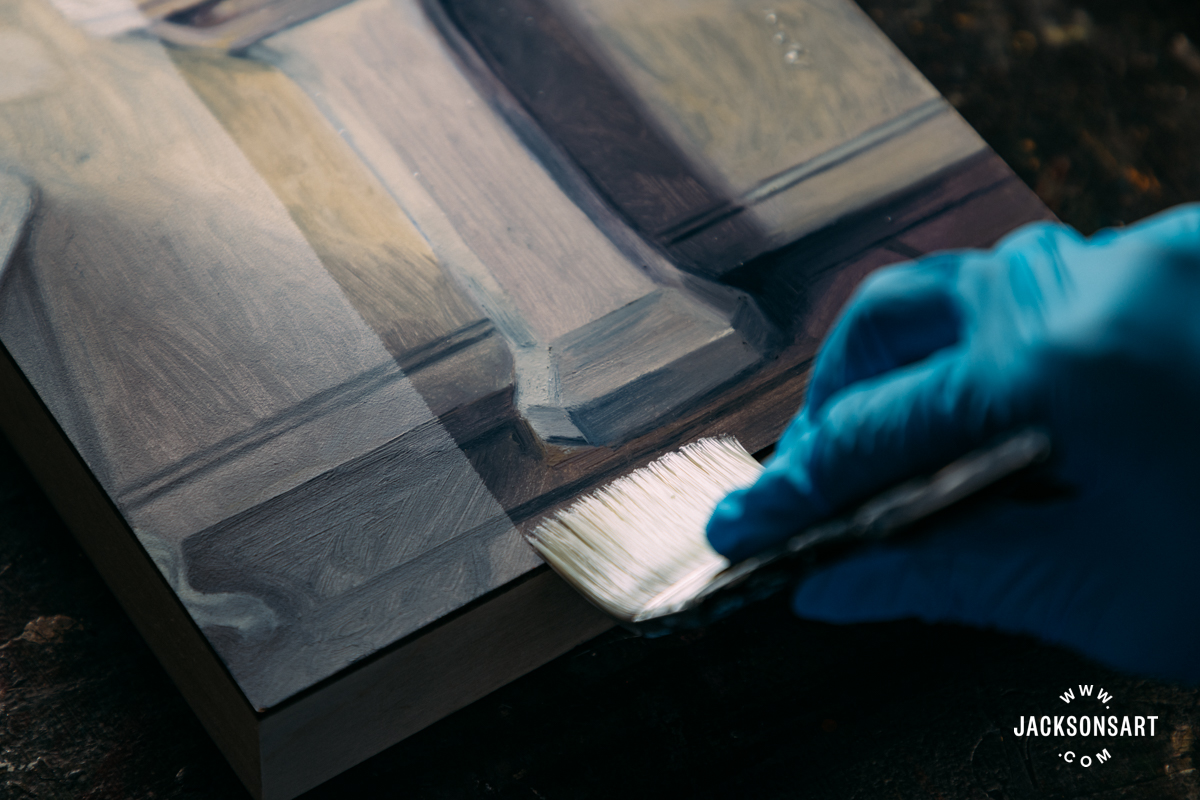
Similar to when I explained about the pencil being easily rubbed out, the same applies to wet paint on the panel. You can easily erase it with mineral spirits/turpentine and it leaves no trace or stain. Once the paint becomes dry it is then bonded to the surface.
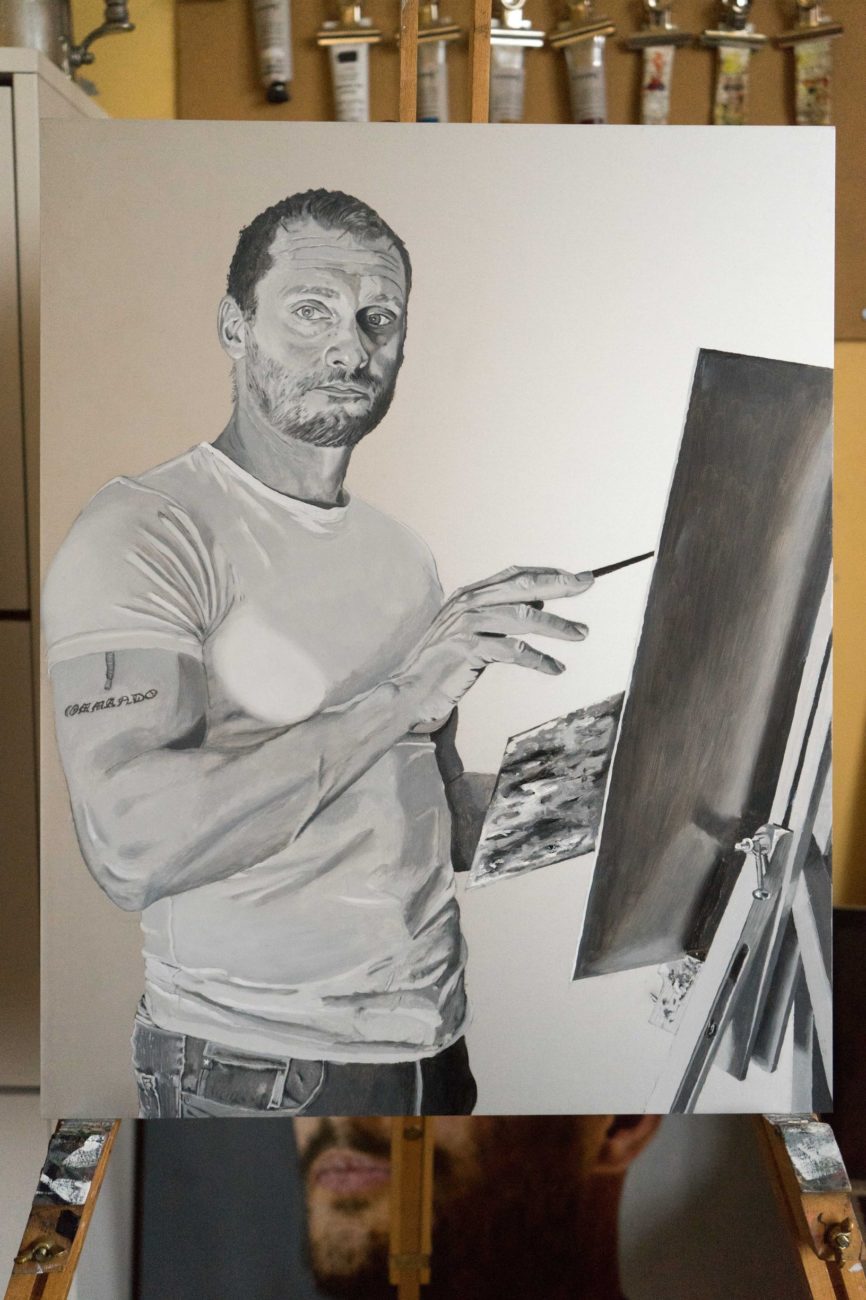
You can also see the progress shots of a detail section from a grisaille, through the smooth layering to the finished work. I often use a grisaille, using titanium white and ivory black mixed with a bit of liquin to speed up the drying process. Some use a brunaille as umber is a fast drier, while a verdaille is meant to help with painting skin tones.

I paint in very thin layers and the aluminium panel is perfect for this method. In these images I am slowly building the layers up. With the jeans I used one thin glaze consisting mainly of ultramarine blue. It’s hard to show on a photo but it really brings out a luminous quality. I believe it has something to do with the glare of the aluminium, which is more effective than canvas.

On the arm I am building up the skin tone, which will take many more layers. You can see its slowly getting towards flesh colour. On the ear I am adding some highlights and after painting all the layers I will then do some scumbling, as you can see with the highlight on the nose.


One disadvantage that I have experienced is that when the panel arrives sometimes there are slight imperfections on the surface. I have only ever witnessed this on one side of the panel so the other side is perfectly useable. I believe this may be from the factory where it was cut.
The other thing is that once painted you need to be careful not to lean anything against it and scratch the paint off it, which can happen if it’s sharp, like a screw. I handed my painting into the BP Portrait Award last year for the second round of judging and when it came back it had a scratch where another painting had lent on it, so I would advise getting it framed straight away.

Michael Sheldon
Oil on aluminium panel, 51 x 41 cm
That brings me on to hanging. A cost-effective way of hanging is to use two pieces of MDF (or any suitable wood). I use gorilla glue to stick them to the back of the panel and put weights on top until it dries and then screw on framing hooks and a attach cord. It almost gives it a 3D look on the wall.


Below is the painting I’ve been working on. It’s about halfway complete at the moment and requires more layers and scumbling. If you have not tried painting on the super-smooth surface of aluminium then I urge you to give it a go.
One thing I have not quite mastered is taking a photograph of the finished painting. The panel gives off a bit of glare so my paintings always look better in the flesh. If you would like to see how this painting ends up then you can follow me on Instagram where I am most active.

About Michael Sheldon
Michael Sheldon is a British artist and former Royal Marines Commando who paints in oil and pastel. Michael won the Oil Prize in Jackson’s Amateur Artist Prize in 2018, and in the same competition won two People’s Choice Awards for his pastel drawings, Reflection and Milo. In 2019, his work was commended by the judges at the Ruth Borchard Self-Portrait Prize Exhibition and his painting Pain or Relief was shortlisted for the Jackson’s Painting Prize 2019. To find out more about Michael, visit his website or read our interview about his painting practice.
Michael is also a member of The Royal Marines Arts Society, which is set up with the view of helping artists to connect within the military and to use the power of creativity to overcome adversity.

6 thoughts on “Portrait Painting on Jackson’s Aluminium Panels”
A very interesting web-site and I would very much like some more
information please.
Great stuff, thanks Michael. I love your
mounting method too!
This was something new for me. As I didn’t know about aluminium panels before reading this but now I want to try it.
Really interesting!
I’m going give these a try out. Although I
prefer a heavy gessoed surface the rigidity
of the panel appeals to me.
The artist mentioned using a clear gesso for
sealing in a pencil under drawing. I use a
scent free hair spray which works well.
Would this have any effect on the aluminum
panel?
Hi Gary
That should be fine. Hairspray is a water-soluble resin, so if it doesn’t have scent and conditioners it shouldn’t have anything that could affect the aluminium. If you are covering over it with paint then any yellowing that might occur won’t be visible.
Comments are closed.