



Signing paintings is a way to mark the authorship of a work and often a gesture made by the artist to signify that a work is complete. An artist’s signature is also essentially a form of branding. It shows the viewer of the work who made the painting, and sometimes, when the work was made. Signing your painting will help future generations to identify who created the work. However, just like any other brush mark made on the canvas, careful consideration of how the signature is applied will help to avoid it sticking out like a sore thumb. This article outlines several approaches to signing your paintings.

Danae, after 1554
Titian
Oil on canvas, 135 × 152 cm | 53.1 × 59.8 in
When Did Artists Start Signing Paintings?
Signing finished paintings is thought to have become a familiar practice during the Renaissance, when the creation of art moved away from the co-operative guild system (that would have worked to create paintings that followed a rigid set of aesthetic rules – such as those adhered to when medieval religious icons were painted, for example), to the practice of painting as a celebration of creative individuality. In Western art history, the Renaissance (14th – 17th Century AD) is when you can start to see styles and preferences favoured by individual artists emerging. Titian with his loose, dramatically expressive handling of paint to depict movement and grand gestures; Botticelli and his elegant and soulful compositions of human emotion, Caravaggio’s penchant of the dramatic light and dark of chiaroscuro. Admittedly, this is an oversimplification of the oeuvre of these Renaissance masters. But the paintings produced during this period indeed reflect a time when individual painters were breaking free from artistic conventions to create a wider range of works with a variety of subject matter, palettes and paint handling. The artist’s signature therefore added a stamp of authenticity to the work and proved to the world who made it; the distinctive mark also helps to distinguish the work from imitators.

Some artists signatures are as famous as the paintings themselves. Claude Monet, Vincent Van Gogh and Pablo Picasso are three artists that immediately spring to mind as having highly recognisable signatures. These examples illustrate the benefit of keeping the appearance of your signature constant for building your reputation. A recognisable signature also helps to add cohesion to an ever-growing and developing body of work.

Should I Sign My Painting?
Having set out to write this article, I went through hundreds of photographs I have taken in galleries to see how artists I admire sign their work. I was surprised to discover more paintings than I would have predicted are left unsigned. Indeed one of my favourite painters, Stanley Spencer, is thought never to have signed his works. A Vincent Van Gogh portrait unexpectedly did not bear the famous signature. Many of Lucien Freud’s are signature-less, too. Indeed the finality of signing a work may feel uncomfortable, as if you’ve reached a point of no return with a work. Or if you’ve painted a quick study, the painting may not feel that it warrants the status of a signature. Or perhaps maybe, you’re worried that an artist’s signature will simply be too much of an imposition on your painting.
If any of the above rings true, you do not have to sign your painting on the front. If you are working on a primed stretched canvas and want to sign the work on the reverse, it’s a good idea to do so on the edge of the canvas where it is fixed to the stretcher, rather than on any raw unprimed canvas on the reverse of the painting itself. This is because it will be as impenetrable as the front of the primed canvas that the painting is made on, and will guarantee the signing once dry will not change in its appearance. If the signature is applied directly to the underside of the canvas and that canvas is raw, it may sink into the fibres of the canvas and become less prominent. Painting labels look neat and can be signed and placed on the back of the canvas, but it’s always a good idea to sign the canvas directly somewhere as well so that you’re not relying on the label staying on forever.
Whether you’re signing your work on the front or back, always use a permanent material that is light fast and not likely to disappear over a few years. Put that fugitive felt tip pen away!
The Size of Your Artist Signature
Even if you are a seasoned signer of your paintings, I would always practise on a separate piece of board or canvas, preferably using the same material that the work is painted on so that the paint adheres in the same way. A dummy run is less vital for oil painters, as the paint usually dries slowly enough to rub the signature off with a rag straight after any mistakes.
Ask yourself whether you want the signature to be an active part of the work, prominent and unmistakable, or tiny and discreet. If you paint your signature on a scrap of canvas you can place it on the painting to get an idea of what size would work.
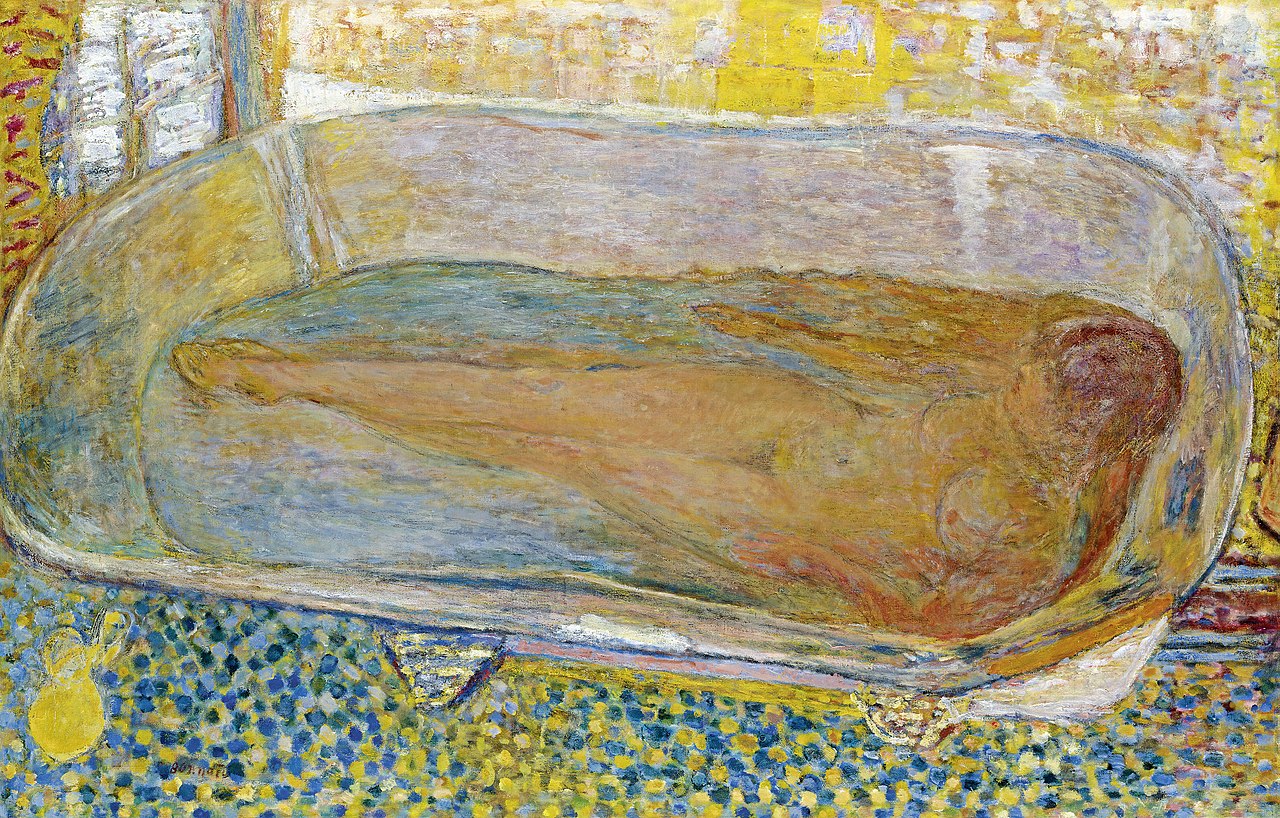
La Grande Baignoire, c.1937-9
Pierre Bonnard
Oil on canvas, 94 × 144 cm | 27 x 57 in.
Private Collection
Spot the signature on this painting by Pierre Bonnard!
The Colour of Your Artist Signature
Colour is equally important. If you want your signature to appear discreet and barely-there, use a slightly lighter or darker shade than the colour you are applying your artist’s signature to. Alternatively, if your artist’s signature is small, you might like to use a contrasting colour so that it is visible. It’s a good idea to stay within the palette of colours you have worked with for the painting so that the signature does not jar with the rest of the work.

Placement of Your Artist Signature
Typically, artist signatures are placed at the bottom of a work, in the right or left-hand corner, and between a couple of centimetres up from the bottom edge, to a couple of inches. If you intend to frame the work you might consider applying your signature after the framing, so that you can make sure the lip of the frame does not partially cover up the signature. You can also position your signature within a shape on your composition, following an outline of part of the composition for example.
Technique and Materials for a Professional Artist Signature
Here’s a list of suggestions of how to apply your artist signature to a painting:
- Scratch your name into the wet paint with the end of your paintbrush.
- Scratch your name into wet paint with a pencil (so graphite is applied as well as the name being etched into the surface of the painting).
- For acrylic painters: use an acrylic paint marker or fluid acrylic paint and a fine round or rigger brush to achieve thin flowing lines.
- For watercolour painters: if not using watercolour paint, use a pencil or pigment fine liner pen.
- For oil painters: Increase the fluidity of your paint by mixing the colour with glaze medium (a mix of linseed oil, dammar varnish and solvent), and apply with a fine round or rigger brush for flowing, even, unbroken lines.
When signing paintings, your artist signature needn’t be your whole name; it can simply be your initials or your surname. You may turn the lettering into a decorative emblem or motif. There are also varying schools of thought for adding the date of the painting. While it’s interesting to see the date inscribed on a historical painting, it may be detrimental to your efforts in selling older work if the buying market is keen to invest in works hot off the easel.
What are your preferences when signing your paintings, and do you have any pet hates for approaches to signing paintings that you’ve noticed in a gallery. Let us know in the comments.

Symphony in White No III, 1865
James Abbott McNeill Whistler
Oil on canvas, 51.4 × 76.9 cm | 20.2 × 30.3 in
Further Reading
How to Write an Artist Biography and Statement
Getting the Best Inkjet Prints on Digital Fine Art Paper
How to Stretch Canvas: A Visual Guide
Recreating the Colour Palette of Winifred Nicholson
Shop Art Materials at jacksonsart.com




32 thoughts on “Ways to Sign Your Paintings”
I sign with a monogram made up of
my initials, as I have a double
barrelled surname so I sign IWP. I
also add month and year (e.g. 05/22
for May 2022) after the monogram,
and that is when I’m happy with the
painting and it feels complete.
hi Ian,
That’s really interesting – signing definitely can feel like the final gesture with a work.
Thanks for sharing.
Best wishes
Lisa
Thank you Lisa!
I enjoyed reading that
Thanks for letting us know Sue!
Good information – thank you.
I use my full name if I have the space and I
just use initials if I haven’t or if I don’t want
it looking too prominent on the painting –
especially if it is on the small side.
Hi Peter
Thanks for reading. Yes I think that’s a good idea – to adapt how you sign according to the size and appearance of the work. Always sign in a way that will complement and not distract from the work itself!
All the best
Lisa
Great article, thank you! I would like some
suggestions for signing monotypes if
possible – do you know if there any oil
based pencils which would work over
printmaking inks at all? Graphite doesn’t feel
right to me! Thank you, Sarah
Hi Sarah,
Thanks for reading the article!
Pitt Oil based pencils are capable of a lovely smudgy mark which could complement a monotype very well – https://www.jacksonsart.com/faber-castell-pitt-oil-base-pencils/
Alternatively, if you’re after a colour that isn’t black or Sanguine, you could try an All Surface Pencil, which is essentially a Chinagraph pencil – https://www.jacksonsart.com/swan-stabilo-chinagraph-all-surface-pencils/
My final suggestion is to use a craft knife to make a fine point on an oil pastel, although the oil pastel may prove to be a little too soft for signing, it depends on what size you’ll be writing at.
All the best
Lisa
Very interesting article. Thanks
Thank you for reading, Christine!
Best wishes
Lisa
Very helpful article! Thank you very
much.
Thank you Mary!
I enjoyed the article too but I failed to spot
Bonnard’s signature. I hope you can
enlighten me!
Hi Susan,
Thank you for reading! The Bonnard signature is about a third in from the left on the bottom edge. If you click the image to enlargen it it’s marginally more apparent, but it’s very hidden among the bathroom tiles!
All the best
Lisa
Me too . I will go look again
I have my first exhibition in September
and where to sign has changed on
many occasions. Great article,
thankyou
Sarah
Thanks so much Sarah, and best of luck with your exhibition.
Best wishes
Lisa
As I am about to put my first picture into an exhibition this is something I’ve been puzzling over. I find it hard to put a nice signature on a pastel picture, so I’m pleased to learn that many don’t sign their works. I am thinking instead of something on the back. There will be a notice next to the piece in the exhibition anyway.
Hi Ali, yes exactly; it is absolutely not essential to sign a painting on the front, and I get the impression many people feel obliged to!
Thanks for reading the article.
Hello Lisa,
Your articles are always interesting. I sign
my work if I’m hoping to sell it, with ‘M
Harris’ plus two digits of the year. I use a
slight variation of the background colour, as
you suggest, and if it would look clumsy
along the bottom edge, I sign vertically up
the right hand edge.
Hi Martin,
Thanks so much for your kind comment. I like the idea of signing vertically!
All the best
Lisa
Great article! It’s always interesting to see how people sign an artwork if they chose to sign. Someone mentioned pastels above in the comments. I have seen some artists use a charcoal pencil to sign their pastels. Also, a white charcoal/pastel pencil if the foreground is dark.
Hi Cindy
These are really good suggestions, thank you!!
Best wishes
Lisa
Thank you for a really interesting article. My
art work is in textiles and this is a
challenging issue sometimes as especially
with weaving, you can’t just add a signature
or a mark over the top at the end (unless you
sew it on). The mark or signature has to be
planned right from the beginning. This
article has helped me with some ideas, thank
you again.
Hi Sue,
That’s great to hear, thank you for reading.
Best wishes
Lisa
Hi Cindy
Interesting ‘how to’ I sometimes write my
signature on a piece of tracing paper and
place over the painting to see how it looks
Geraldine
Hi Geraldine,
Thanks for reading – that is a really good tip!
All the best
Lisa
As a child, I was influenced by Albrecht
Durer and thus employed his monograph
but with my own initials and the year
underneath as part of the monograph.
Then On the back, I put my signature as
well as spell out my name.
Hi Miles,
That’s a really nice approach, as well as a beautiful nod to Durer! Thanks for sharing.
Best wishes
Lisa
I dread signing work, and often erase my
signature and start again. I’m confident in
the work at this stage, but not in my
signature. One does not fit all! As you say,
iI suppose i consider it part of the picture
if i must use one.
Hi Pat,
Yes the signing can be quite daunting. But really, in most scenarios it isn’t necessary to sign on the front if you prefer not to.
All the best
Lisa
Thank you for the article. Very good
points. I like, if possible, to sign a still life
by incorporating my name into one of the
objects–for instance, making my name the
addressee on an envelope or using my
name as a brand name on a label.
Hi Rhoda
Thank you for your comment, I really like your idea! A nice discreet way to add your signature.
All the best
Lisa
Comments are closed.