Whether you’re looking for some fresh new paint brushes for your collection, or wanting to experiment with another medium or tool, Princeton Brushes are for you. Princeton Brush Company has synthetic bristle paint brushes for every medium, as well as Catalyst Blades and Wedges, a new kind of tool made of engineered silicone. I primarily work in heavy body acrylics, so my interest was immediately piqued when I saw these big handheld silicone tools. In this article I share my thoughts on the products.

Testing the Princeton Aqua Elite Round Size 2 Brush with Watercolour Paint
I tested the Princeton Aqua Elite Round Size 2 Brush using Jackson’s Artist Watercolours, Indigo and Naples Yellow on Global Fluid Cold Press Watercolour Paper.

The first thing I noticed about the paint brush was how lightweight it was, so immediately I knew that this would make some beautiful sweeping lines. The brush handle is also very smooth and is not very plump so it feels even more free flowing in your grasp. The brush also lends itself to very delicate small markings, due to its short handle and brush hairs, making it perfect if you want to have more control over the brush. When painting with this brush, I found that it had a great bounce to it and held the water well. For me, this is very important as it means you don’t have to dip into your water pot every few seconds, but you can focus on the artwork instead. Other than the soft nature of this brush, it is somewhat reminiscent of Jackson’s Synthetic Kolinsky. I think this brush would suit any art style within watercolour, from high detail to flowing shapes.

This brush is also compatible with oil paint, though this was a dramatically different experience as I personally think it is a little soft for oils. It would be great for an artist who wants an ultra-smooth finish to their artwork, but if you’re making artwork that is more impasto I would test out the Catalyst Blade Painting Tool No.6, which I also tested here and you can read about below.
Testing the Princeton Velvetouch Flat Shader Size 10 Brush with Oil Paint
The Princeton Velvetouch Flat Shader Size 10 can be used with any medium, so if you’re looking for a brush for a mixed media work, or purely just so you can save a bit of money and get an all-in-one paint brush, this is the one for you. Immediately I could tell it would be perfect for using with watercolours as it has some very similar qualities to the Princeton Aqua Elite Round Size 2 Brush. For this reason, I wanted to try this brush with what I think it would be the least compatible with, oil paints. I find this the best way to test a mixed media brush, by testing it against what I think might be its weakest medium and seeing how it fares. I used this brush with Jackson’s Professional Oil Paint on a Jackson’s Canvas Pad 10” x 12”.
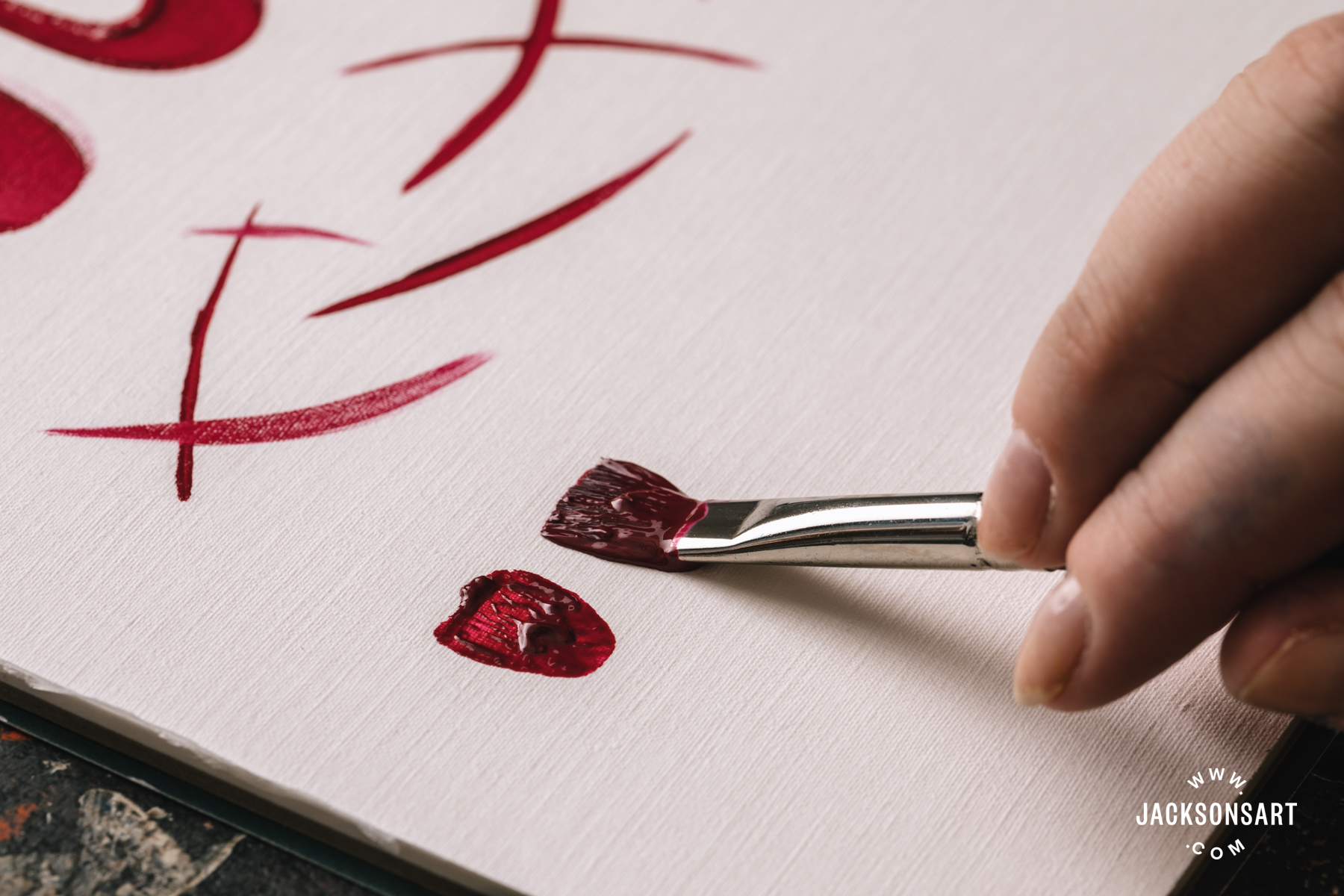
At first glance, I noticed how gorgeous the handle is, with a reddish tone and a slick matte satin finish. Similar to the Princeton Aqua Elite Round Size 2 Brush, its handle is lightweight and easy to clean, although to be expected, it is plumper in body as it is a bigger brush. The brush has an average stiffness, so it may be a little soft for a heavy body impasto technique. However, I think a long handled version of this would aid this small issue as it would take some of the weight off of the tip. Though this brush may not be equipped for some impasto techniques with heavy body paints, I am very impressed with how compatible it was with oil paints. This leads me to believe that this brush has the ability to be a suitable fit with every medium.

Testing the Princeton Aspen Synthetic Bristle Brush Long Handle Filbert Size 4 with Acrylic Paint
Next, I tried my favourite of all the brush shapes – a classic filbert. Princeton Aspen Synthetic Bristle Brush Long Handle Filbert Size 4 is compatible with oils and acrylics, so I tested it using Jackson’s Studio Acrylic in Raw Sienna. I seem to only use long handled paint brushes when I am painting outside or painting a large artwork with sweeping markings, or both. One of the things that enticed me to this range in particular was the non-glare ferrule. It is like Princeton knew I wanted this brush for painting a large artwork outside! The stiffness of the brush also makes it perfect for big sweeping motions, but equally small delicate markings. The brush also holds water and bounces back into shape very well, which I find very helpful when you’re in the midst of your creative flow and you don’t have to worry about water or the disconfigured shape of the brush.

You may have already guessed it, but I think this brush is excellent for working in acrylic or oils, indoors or out, creating big or small mark makings. All in all, I am yet to find a filbert brush I don’t love – I am adding this Princeton Brush to my collection.

Princeton Catalyst Blade Painting Tool No.6 with Acrylic Paint
The silicone tools are designed for use with heavy-bodied oils, acrylics, and water-miscible oils. Because they are heat-resistant, they also excel with encaustics and artists are even using them with plaster and clay. I tried the Princeton Catalyst Blade Painting No.6 Tool out using Jackson’s Studio Acrylic in Raw Sienna on an acrylic paper pad.

My first thought when looking at this tool was whether it would be able to spread the paint equally across the surface. It is also noticeably top heavy towards the silicone tip, which felt unusual. However, the tool manages to spread the paint incredibly well, and I loved the weight of the brush as its robust nature allows for very thin coats of paint or thick impasto marks based on how much pressure you put on it. The shape of the tool allows for a variety of different shapes and textures to be made. When making a curved stroke, I found it easier to get a clear-cut line with this tool than I do with bristle paint brushes. I was also expecting the tool to be stiff, but was pleasantly surprised to find that it was quite soft at the tip and stiffer as you moved closer to the handle.

I then started playing around with the edges and sides of the brush a bit more. My favourite mark making was using the side to tap it against the thick paint, making a texture that evoked thick foliage. The silicone tip is also detachable for washing, which I thought was a very simple but innovative feature for this type of brush. I was concerned that it would feel looser in my hand, but it did not. The only thing I would be conscious of when taking it off to wash it, is making sure there is no moisture left on it when reattaching it, as it could cause the wood underneath to mould. Prior to testing the tool, I was a little nervous as I am used to using paint brushes, but when I started painting with it, it felt so natural and comfortable. I have now ordered my first batch of silicone tools.

Princeton Catalyst Wedge Silicon Painting Tool No.2 with Acrylic Paint
Similar to the Princeton Catalyst Blade Painting Tool No.6, the Princeton Catalyst Wedge Silicon Painting Tool No.2 is at home with heavy bodied oils, acrylics, and water-miscible oils. Therefore, I tested this tool with Jackson’s Studio Acrylic in Ultramarine Blue on a Jackson’s Canvas Pad 10” x 12”.

There was a stark difference in using this tool compared to the previous art materials I tested. I noticed that my hands have gotten used to painting with paint brushes as when first holding the tool, it felt odd as rather than holding a long brush, I was grasping onto a big wedge of silicon. The tool is expectedly quite heavy and thick, but has clearly been well engineered to fit comfortably in your hand. It is also more resilient than I expected, and the plastic is quite stiff. I enjoyed both of these qualities, because it allowed me to make bigger and expressive markings. I really enjoyed using the sides of it to make different shapes. As you can see in the painting, I made these petal shapes by using the handheld part of the tool. It was a little odd to clean this tool due to all the sharp edges, so I would recommend using some sort of sponge or brush to get into the edges and make sure it’s thoroughly clean to avoid cross-contamination with your colours. Overall, I thoroughly enjoyed using the Catalyst Wedge as not only was it a fun experiment, but the tool is physically the whole brush and the ideas for its usage are endless.

Though I was apprehensive about the use for some of these paint brushes, I quickly realised there was no need to be, as all these brushes and tools really do live up to their name. I particularly enjoyed painting with the Princeton Velvetouch Flat Shader Size 10 as I felt that it was true to its ‘mixed media’ title as it did not lean towards one medium in particular. This really impressed me. The Princeton Catalyst Blade Painting No.6 Tool also deserves an honourable mention because as soon as the blade touched the paper my apprehension turned to pure enjoyment. The slick look and feel of the tool, as well as the number of textures you can make with it, makes this one of my favourites. Overall, Princeton Brushes and Tools I tested were innovative, stylish, affordable and let’s not forget, fun to use. I can’t wait to add more of their products to my collection.

Further Reading
Understanding Brush Shape Names, Hair and Applications
A Family Matter: Handcrafting Brushes
The Development of Synthetic Brushes