



Holbein’s Watercolour range was first brought to sale over a hundred years ago and this legacy has developed to a current collection of 108 colours. The paints are manufactured in Japan, so are formulated with the brush handling qualities of a traditional Japanese watercolour, where they dry with brush stroke marks and are very slow moving. They are made to be placed with intention, but still have the European quality of transparency in their formulation. I was glad to test the Holbein Artists’ Watercolour Set of 30 to see how this paint handles with its unique ingredients.

Packaging and Labelling of Holbein Artists’ Watercolour Set of 30
The set comes in a long cardboard box with a plastic slip holding it together, which is aesthetically pleasing, but perhaps not so practical for carrying these tubes on the go. They’ll need to be decanted into another container for outdoor use. I liked that the paints are divided into little removable cardboard trays in groups of six. I could see this being useful in the studio for curating the palette you want to work with.

Inside the box there’s a small leaflet explaining the labelling system on the tubes which I think is a helpful addition if you’re unsure how to read the various symbols on paint packaging. The transparency and lightfastness varies between colours, and I have noted these in the following swatches.

Swatching the Paints
In these first three sheets I swatched all of the colours in the Holbein Watercolour Set of 30, to show how they appear when applied in a gradient, and then painted more strongly with just a dab of water on the column down the side. I tested all of my swatches on the Jackson’s Watercolour Paper Block 300 gsm. This paper is smooth and hot pressed so the finish of these paints may appear slightly differently on a cold pressed, rough paper for example. The tubes are 5 ml which is fairly standard for watercolour tubes, but are also available individually as 15 ml tubes.

I found the colours overall to be high quality in their saturation and finish. The only colours that I was disappointed by were the Cobalt Violet and the Ivory Black. In terms of consistency and handling the Cobalt Violet was tackier to move around than the other colours, and I found it hard to disperse without streakiness. The Ivory Black doesn’t have a very strong pay-off when diluted with water, and very quickly turns into a light grey. To achieve a strong black you’d have to use it mostly straight from the tube with a little water, which would use it up very quickly. It’s much better used mixed with the other colours in the set to create shades.

The set also contains a lot of greens which may not be necessary for every artist. I find seven greens to be excessive when there are just five blues, five yellows and three reds. Also with the five blues and yellows available, this allows for plenty of options for mixing interesting greens anyway. However if you are a landscape painter, or particularly fond of green, this may not be a drawback for you. Individual colours, and smaller sets of 12 and 24 are also available if a more specific palette appeals to you more, though I think this broad range does give you a lot to work with.

Considering the Colour Range and Value of the Holbein Artists’ Watercolour Set
The majority of the paints in the set are from Series A (the most affordable in their collection), with eight exceptions: Aureolin (D), Cobalt Green (D), Emerald Green Nova (B), Sap Green (B), Cerulean Blue (D), Mineral Violet (B), Cobalt Violet Light (F), and Opera (B). It’s especially nice for any sets like this to contain higher Series paints so they can be accessible to a greater number of people to try out. In terms of value for money, the Holbein Watercolour Set is on the expensive side altogether, but I think this is justified by the number of paints, quality of pigment and control you’re getting. At its usual retail price, the set works out to be £3.43 per tube, but to buy the same colours individually would cost between £4.60 to £11.10 each. Overall this makes this particular set a great deal on high quality materials.

There are also a few ‘hue’ colours in this set, where their genuine counterparts are included within the expanded Holbein Watercolour range available as individual tubes, for instance – Vermillion Hue (Series A) as opposed to Vermillion (Series F). If you enjoy using the Hue versions of these colours, I’d recommend trying the genuine article, as the pigment quality and payoff will be even greater.

Ingredients and Dispersion
Holbein Watercolours contain gum arabic, high quality pigments, and a small amount of surfactants, without synthetic polymers. They intend this to give the artist greater control over the movement of the paint, with high colour intensity and permanency ratings. Many watercolour products contain an ingredient called ox-gall which is an animal byproduct, taken from bile and mixed with alcohol. Holbein Watercolours do not contain this agent, which makes the majority of their colours in this set cruelty-free apart from the Ivory Black which contains the traditional ingredient of carbonised bone. This is something to be aware of with watercolours if it concerns you, for example, Sennelier and Michael Harding Watercolour Paint contain honey making them non-vegan.

Including ox-gall, Holbein Watercolours contain no dispersing agents. Dispersion overall is of course affected by having no dispersing agent present, but it is the purpose of this product to be more difficult to move. I also find that without these ingredients the brushstrokes are more evident than in some other watercolours. This allows for greater control over brushstroke effect and placement. The paints can still be used in washes, but are lighter as a consequence. I found that they are best used in a more concentrated form. If you wanted to add extra fluidity back into this paint, you could try adding watercolour mediums.

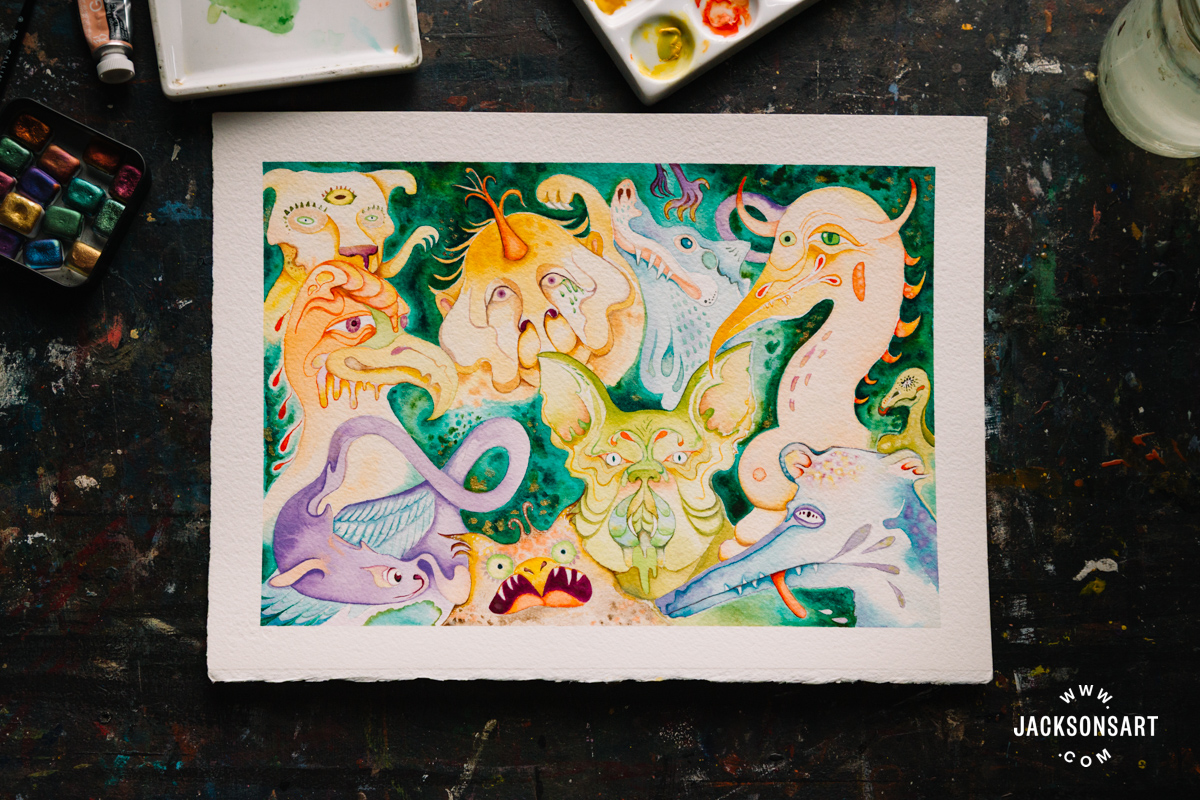
These paints contain a lot of subtle variation, even when a flat wash application is used, but they don’t bleed outside of where they’re placed unless filled with a lot of water. In all of my tests I found that none of the colours had granulation. I have made a test sheet here which demonstrates an attempted “flat” application, the control and effect you can make with a variety of paintbrushes, versus loosely dropping the pigment onto wet paper to show how it disperses.

Mixing and Layering the Holbein Artists’ Watercolour Set Colours
In this test sheet I tried layering and combining two of the colours – WO13 Opera (Quinacridone Opera) and WO94 Ultramarine Deep – to test their colour mixing quality. The range of purples you can achieve with these two is beautiful, and they blended seamlessly. Layered on top of each other I did find that the colour below lifts even when fully dry when you wash over it, which is because these paints are so easily reactivated. Therefore layering different colours doesn’t just work for optical mixing, but physically mixes to a degree too. I next did swatches of the tints and shades you can make with both of these colours mixed with the white and black from the set (W138 Ivory Black and W002 Chinese White). The colours weren’t easily diluted by the white, and you need just a very tiny dab of colour to create a strong pale tint.


In this next test sheet I dabbed together a variety of colours on wetted paper to allow them to bleed together with lots of water. This more flushed effect is very nice but from my testing you need much more paint on the brush to achieve it than you would with a watercolour that contains dispersing agents.

Rewetting the Paint on the Paper and Palette
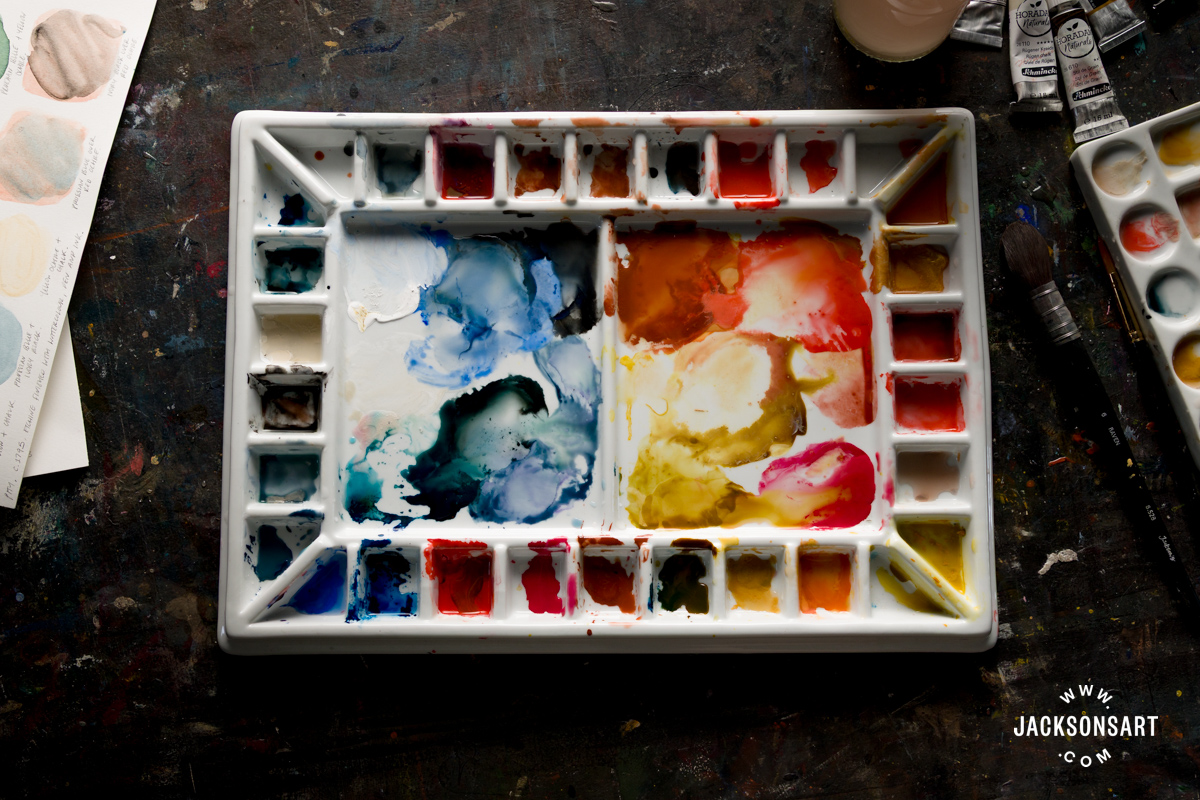
For this test sheet, I tried rewetting the paint at different stages, on the paper and from the palette. I did this with three colours: WO66 Permanent Green No. 1, WO34 Yellow Ochre and W122 Mineral Violet. For the first stage, I painted small rectangles of the colours and allowed them to dry down for 15 minutes before reactivating them. They were completely touch dry at this stage, but immediately rewetted with very little effort, and spread out easily. For the next test I left the same colours to dry for an hour before reactivating them on the page. The colour pay off was slightly lower but still spread out.

Next I tested rewetting the dried colours on my palette instead of on the page. I left the first swatch of the dried palette for an hour, for a whole day, and then three days. As you can see there is no difference between these swatches, as this paint is so easily rewetted you can almost happily abandon your palette without the fear of wasting paint knowing that it’s versatile enough to work with in the future. In this way, the Holbein Watercolours can be used much like pan watercolour paints. You could even use these paints to fill the pans of a palette, allow them to dry, and treat them as material for a customisable, refillable pan watercolour set.
I also wanted to test wiping a dry painting made with a variety of mixed colours with a wet cloth to see how much I could remove without damaging the paper below. As you can see the majority of the paint lifted off completely, leaving just a ghost impression of the tree below. This would be so useful for altering mistakes or completely reworking a painting.

The Holbein Watercolour Set of 30 is high quality, versatile, and good value for money. I would recommend it to both beginners and experts of the medium alike looking for a broad range of paints to try out. The Holbein Company states that these watercolours are “more finely ground than any other artist watercolour” and whilst I can’t verify this claim globally, it is true that in all of my swatches I found the paints to be very easy to apply, wash, mix, layer and blend, with high colour pay-off. I think this particular palette of colours makes the most sense for observational en plein air painting, with the small tubes being easy to carry and largely natural colour selection. Overall I would recommend Holbein to any painter looking to add high quality watercolours to their collection.

Further Reading
Art Terms Explained: Watercolour Painting
A Guide to Watercolour Painting
Is Watercolour Better in Pans or Tubes?
Your Comprehensive Guide to Watercolour Mediums
Shop Holbein Watercolour Sets on jacksonsart.com

2 thoughts on “Review of Holbein Artists’ Watercolour Paint Set of 30”
I appreciate the large amount of greens,
makes things easier when painting nature.
I’d love to see softer/subtler colours as well,
but overall I’m going they seem nice. Thanks
for the article! I’m going to try them myself.
Terrific article! Very thorough and
informative! Thanks!
Comments are closed.