



For hundreds of years, Lead White (pigment colour index PW1) was the most important white pigment on the European artist’s oil paint palette. This article looks at the history of Lead White, why it has fallen out of use in the last century, and compares the lead-free imitations available today.

The History of Lead White Oil Paint and its Modern Alternatives
The Early History of Lead White
Lead White is basic lead carbonate, a chemical compound that occurs naturally in the mineral hydrocerussite. Hydrocerussite was mined in southern Europe, Mesopotamia, and Egypt as early as 4000 BCE. The pigment can also be prepared synthetically by corroding lead shavings with vinegar to produce lead acetate and then introducing carbon dioxide to produce basic lead carbonate. Exactly where or when this was first produced is debated, but the earliest known example of man-made Lead White was found in north-eastern China, dated around the 7th century BCE. From the 5th century BCE, synthetic Lead White was being produced in large quantities by Egyptian, Greek, and Roman craftsmen.
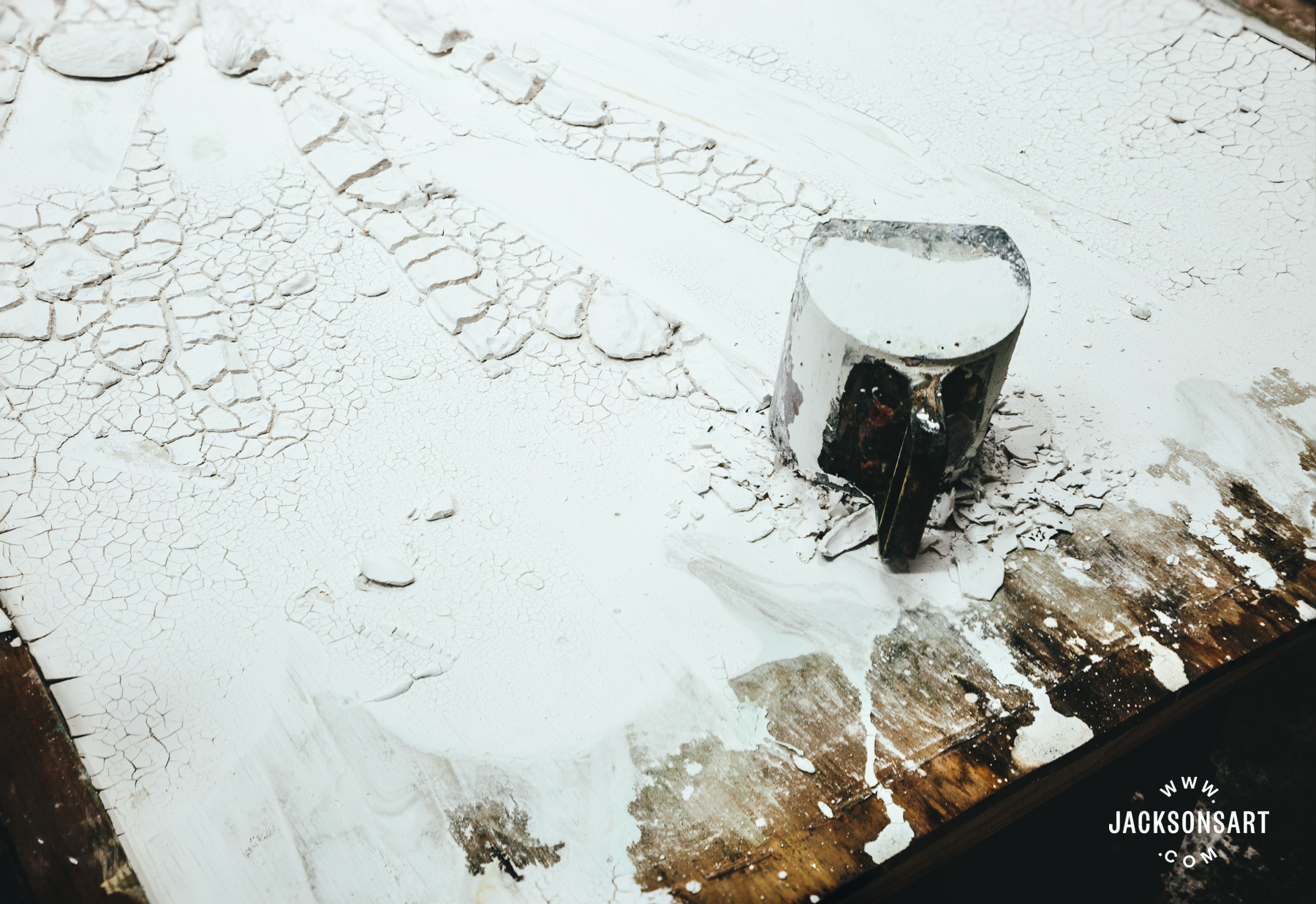
Lead White Oil Paint in Early Modern Painting
Lead White was probably initially produced synthetically for cosmetics, but it has also been used as an artist pigment since ancient times in frescoes, manuscripts, and paintings. It is a common misconception that Lead White was the only white pigment in the artist palette before the development of modern white pigments; chalk, powdered eggshells, oyster shells, and calcined deer horn were all used to provide white.
It was with the rise of oil painting in the 15th century that Lead White really came into its own. In an oil binder, the pigment is a fast drier, making it useful for underpainting. Its opacity, too, made it excellent for adding highlights. It was also used to prime canvases and panels. This versatility gave Lead White a primary place on the artist palette. It was known by many names, many of which referred to places in which it was made, including French White, Nottingham White, and Berlin White. Another name was Flake White, first recorded in the 17th century, which referred to how lead carbonate forms in flake-formations during its manufacture. This name is still used to refer to Lead White paints.
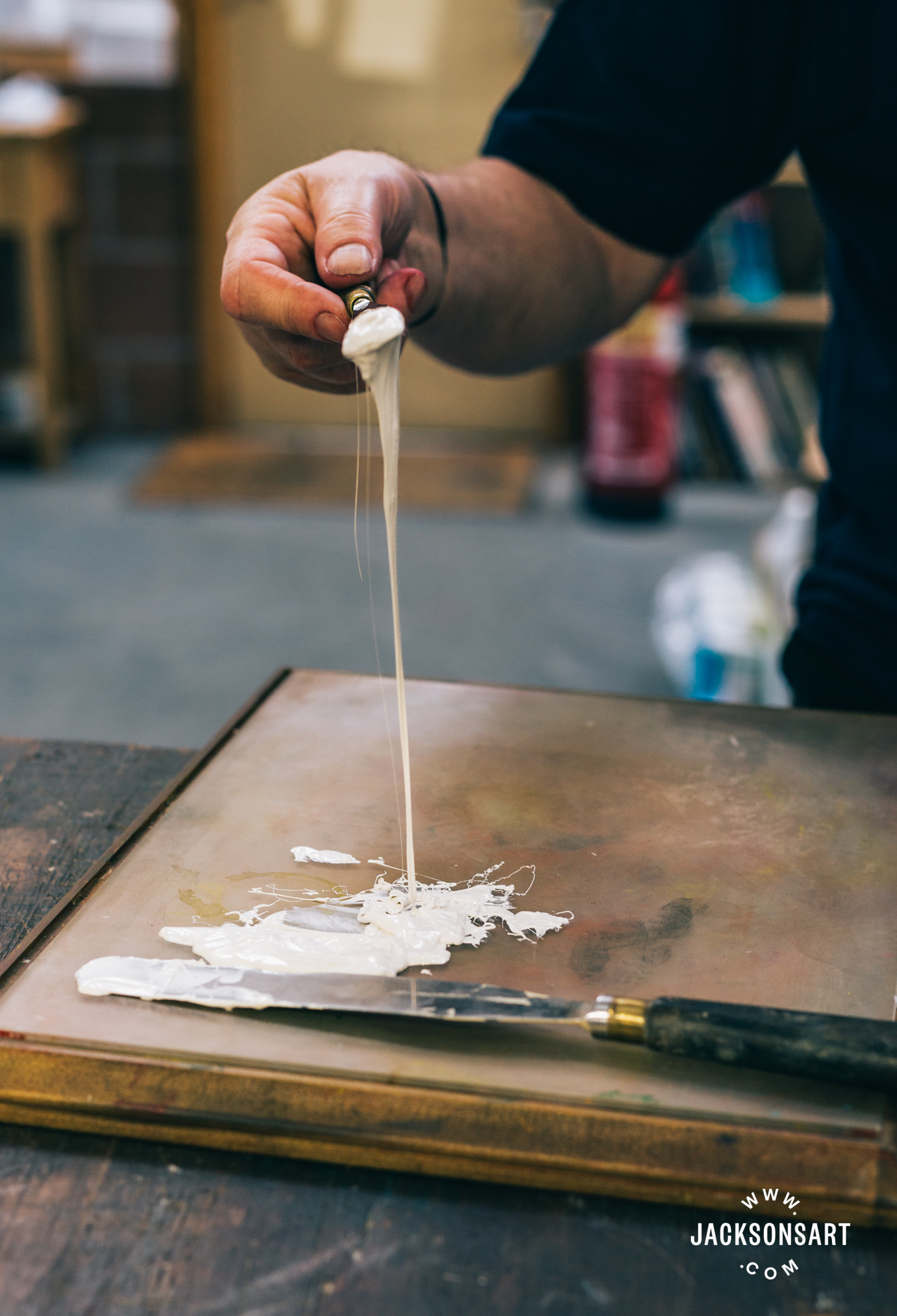
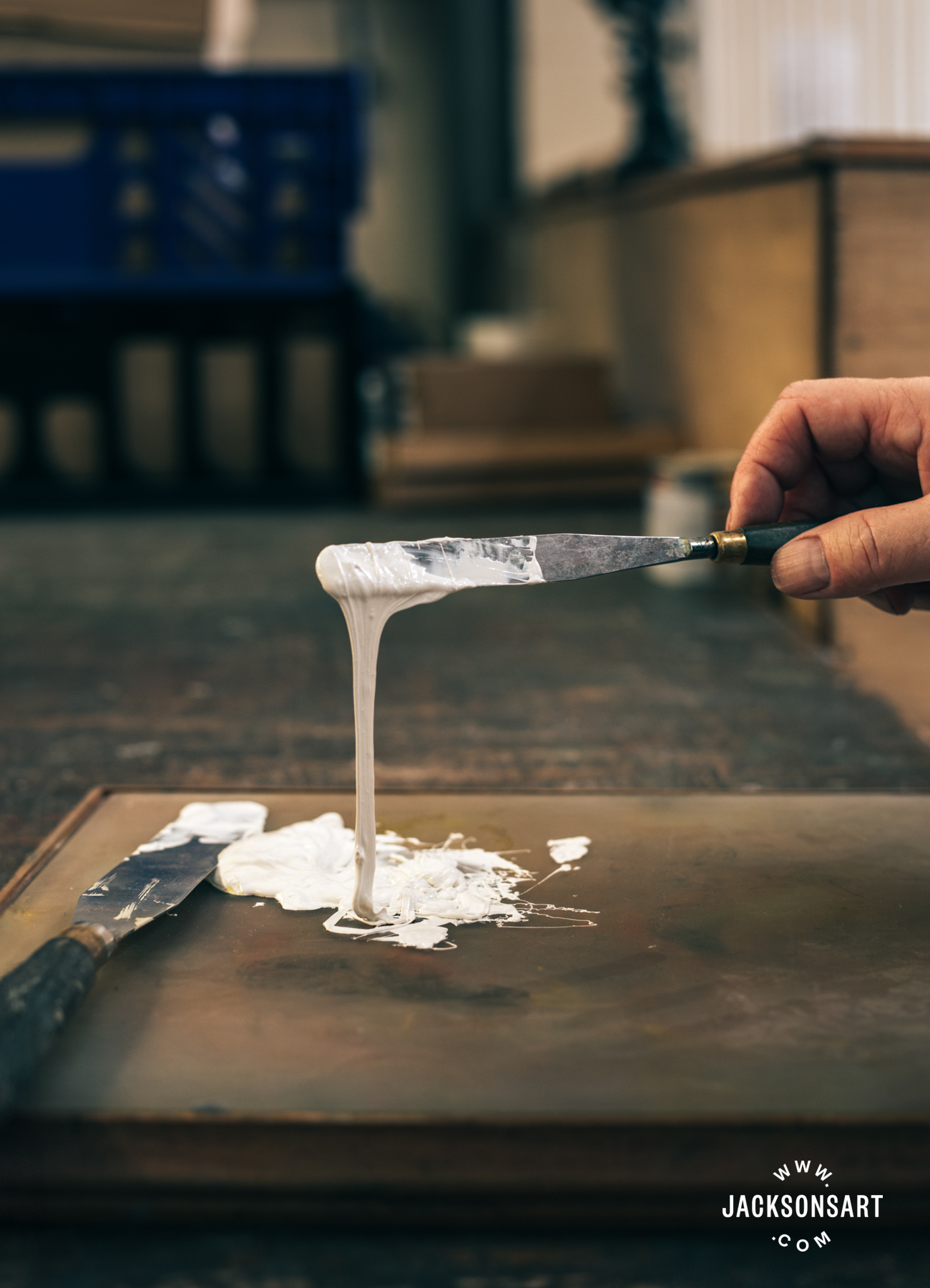
Rembrandt van Rijn’s use of Lead White oil paint is often held up as the most admirable example of the pigment’s particular qualities. Rembrandt used Lead White made by the Dutch Stack method, which involved suspending coils of lead in containers above vinegar and stacking them above fresh horse manure. The manure provided warmth and carbonic acid, which converted the lead acetate into flakes of basic lead carbonate, which could then be shaved off and ground to make the pigment. This process made a pigment that imparted a uniquely thixotropic character to the oil paint. This means that, when agitated with a brush or knife, it was liquid and stringy (as in the image above), but when it was at rest it held its shape. This gave the paint a syrupy, sculptural quality, which Rembrandt used to great effect in his impasto white highlights and gestures, and the Dutch Stack method is still widely considered to produce the best, most painterly, type of Lead White. Click on the image below to look at the textural details of the sitter’s collar, cuffs, and book. The stringy quality of the paint is particularly evident in the highlighted edges of the book.

Rembrandt van Rijn
Oil on canvas, 112.7 x 87.6 cm | 44.3 x 34.5 in
Metropolitan Museum of Art, New York
How Toxic is Lead White Oil Paint?
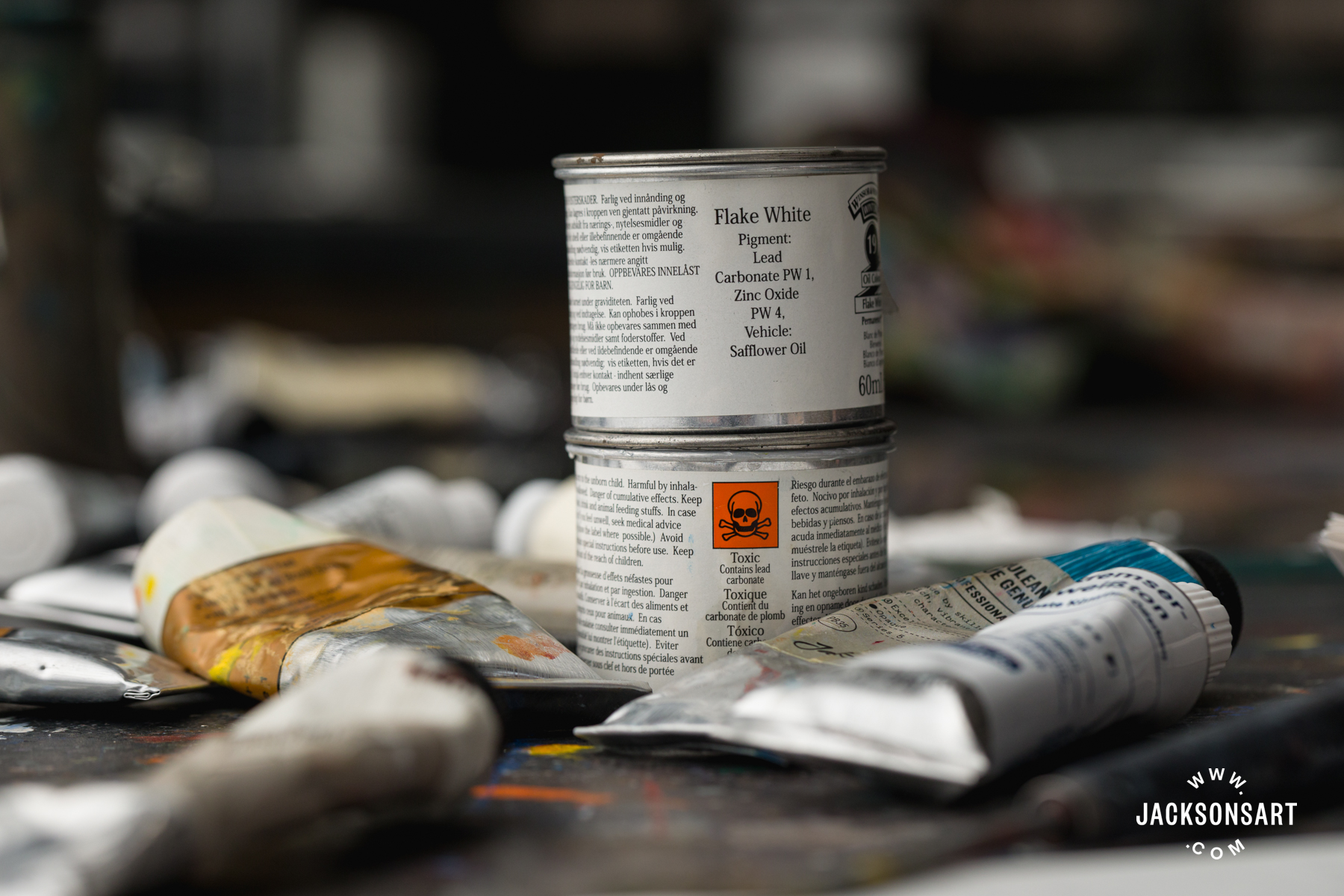
Lead is a very poisonous metal which, if inhaled, ingested, or introduced to the blood through cuts in the skin, builds up in the body and can affect multiple parts of the body, including the digestive and nervous systems. Even if the toxicology of lead poisoning hasn’t always been known, its effects have been recorded since antiquity, and it wasn’t a danger unique to painters. In the Roman period, exposure came from lead pipes and cooking vessels, as well as from food. Lead has a sugary taste and was used as a sweetener.
For painters of the past using Lead White oil paint, lead poisoning wasn’t an inevitable occupational hazard. Many artists lived long lives without any recorded evidence of lead-related illnesses. However, you have to wonder about the apprentices who were grinding the pigment for the artists, where the chances of inhaling particles of lead must have been high. Once the particles are encapsulated in the paint binder, there is no danger of inhaling them, but there are other ways that lead can enter the body. While the risk of absorbing lead through the skin is low, when paint gets on your hands or under your nails it is quite easy to inadvertently digest it. Many painters had the habit of licking their paint brushes to get a sharp point, another way in which lead could be swallowed. Michelangelo, Caravaggio, and Goya are all known to, or suspected to, have suffered from lead poisoning. In the 19th century, the term ‘painter’s colic’ was coined, which referred specifically to chronic constipation caused by lead poisoning.
Lead White Oil Paint’s Replacement
The need for a good replacement for Lead White became urgent in Europe in the 19th century. But concern wasn’t for artists in particular, it was for the general public. Cases of lead poisoning among workers at Lead White factories were being widely publicised, and people were becoming aware of the danger presented by peeling Lead White house paint. Alternatives were being investigated. Zinc White, composed of zinc oxide, was introduced in the 1790s, but it didn’t immediately take off in popularity as an industrial or artist oil pigment because of its long drying time, low covering power, and thin consistency. These characteristics were improved by the mid-19th century.
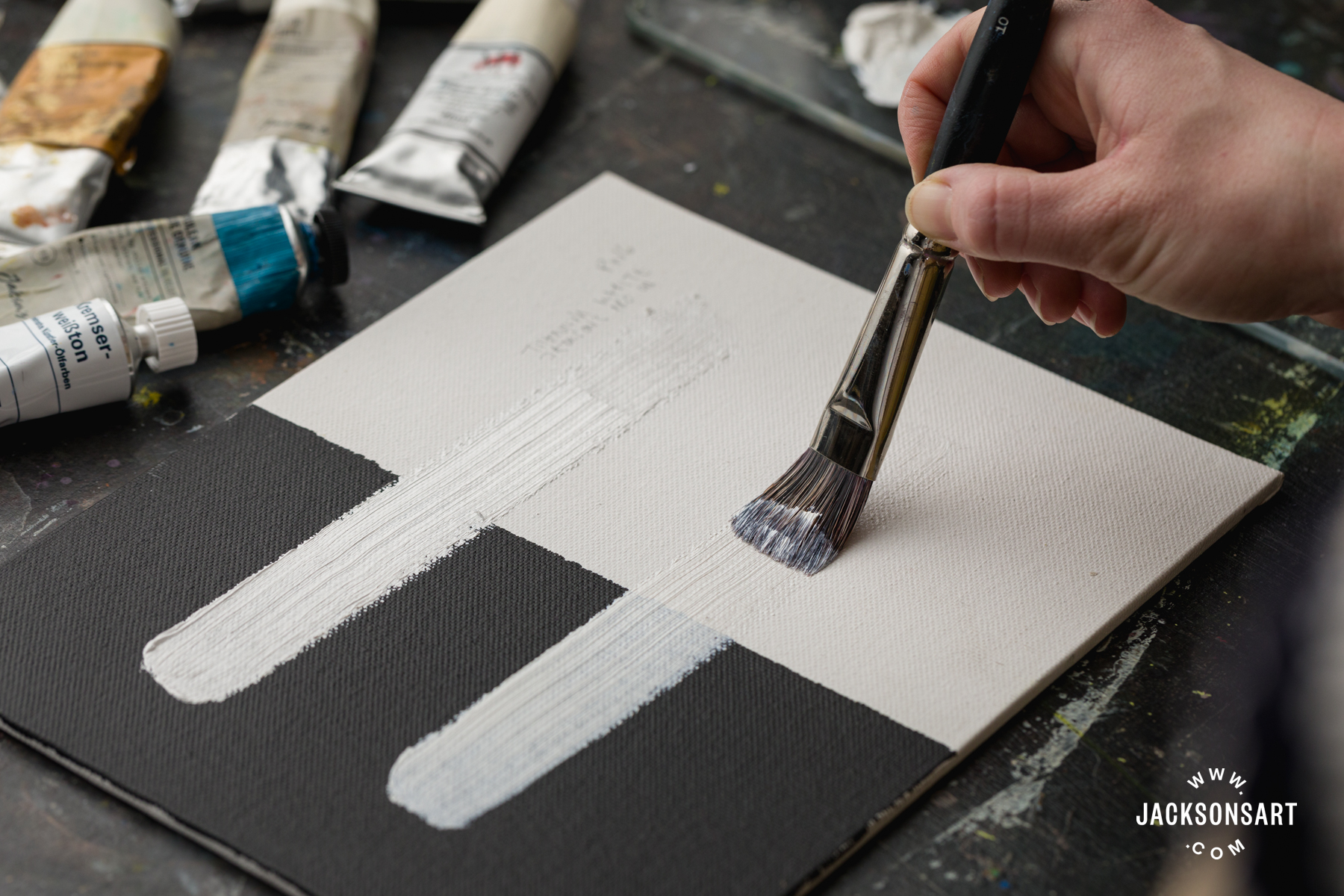
Jackson’s Zinc White Artist Oil paint (PW4)
Note the transparency of Zinc White compared to Titanium White.
At the turn of the 20th century, titanium dioxide was being explored as a potential white pigment. The result, Titanium White, was the most opaque, brightest white pigment ever made, and by the 1930s it had replaced Lead White as the most widely produced white pigment in the European and American markets. The introduction of Titanium White is widely considered to be the final nail in the coffin for Lead White, but Lead White house paint continued to be produced and used well into the 20th century. By 1950, many European nations had banned the use of Lead White in paint, but other countries took longer to legislate. In the US it was banned in 1977, and the UK followed suit in 1991.
While Lead White house paints are now banned in most countries around the world, Lead White artist paints are still produced. However, the dwindling commercial production of the pigment has made it increasingly expensive. The EU and the UK have restrictions on the sale of Lead White to artists, and it is only available to conservators.
Modern Lead White Oil Paint Alternatives
Titanium White and Zinc White have very different qualities to the historic lead-based white. Lead White is a semi-opaque to semi-transparent warm white with a fast drying time and a long, stringy consistency. Both Titanium and Zinc White are slow drying and cool in temperature. Zinc White has a similar tinting strength to Lead White, but Titanium White has far greater opacity and tinting strength than both, making it the most powerful in mixtures.
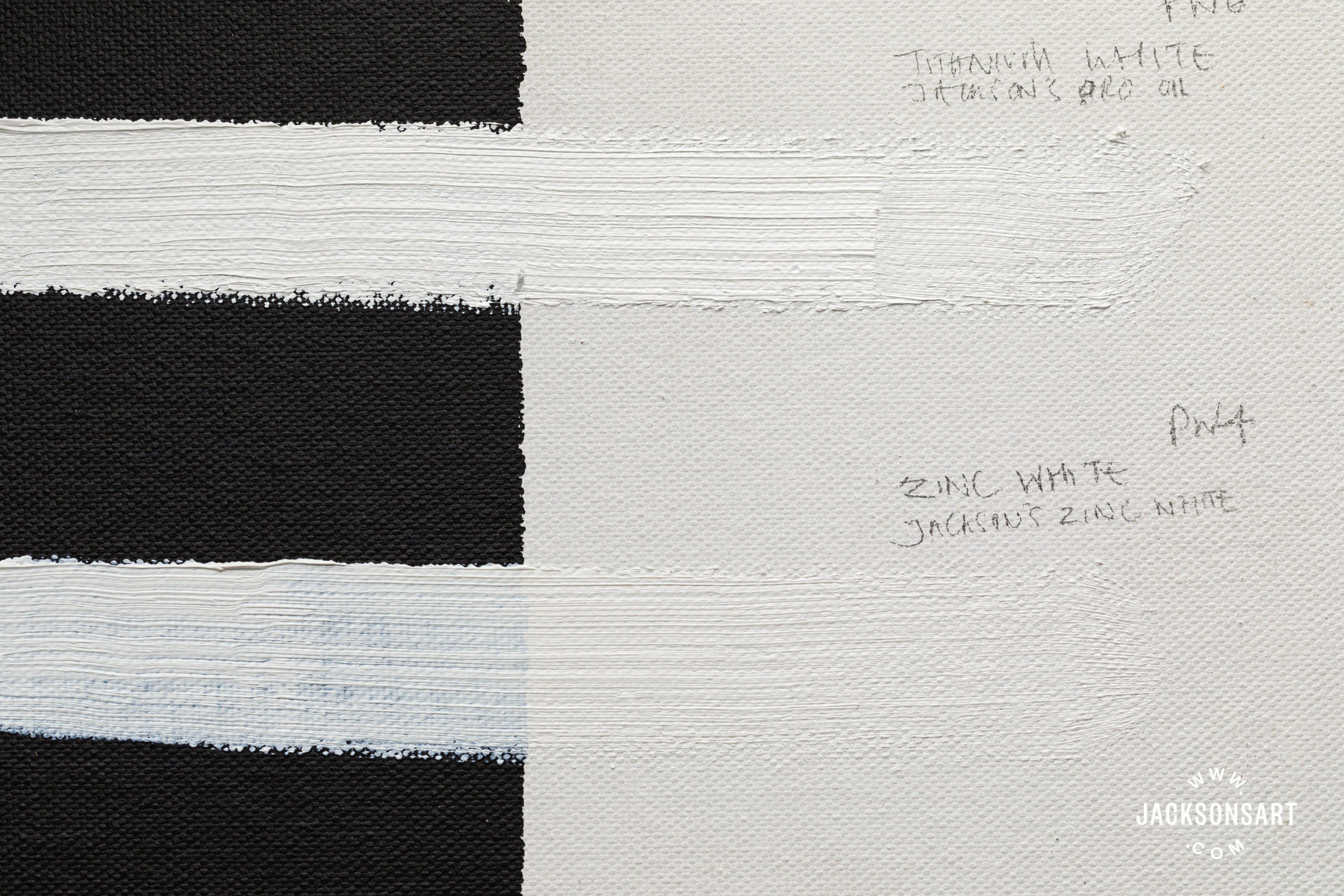
Jackson’s Zinc White Artist Oil paint (PW4)
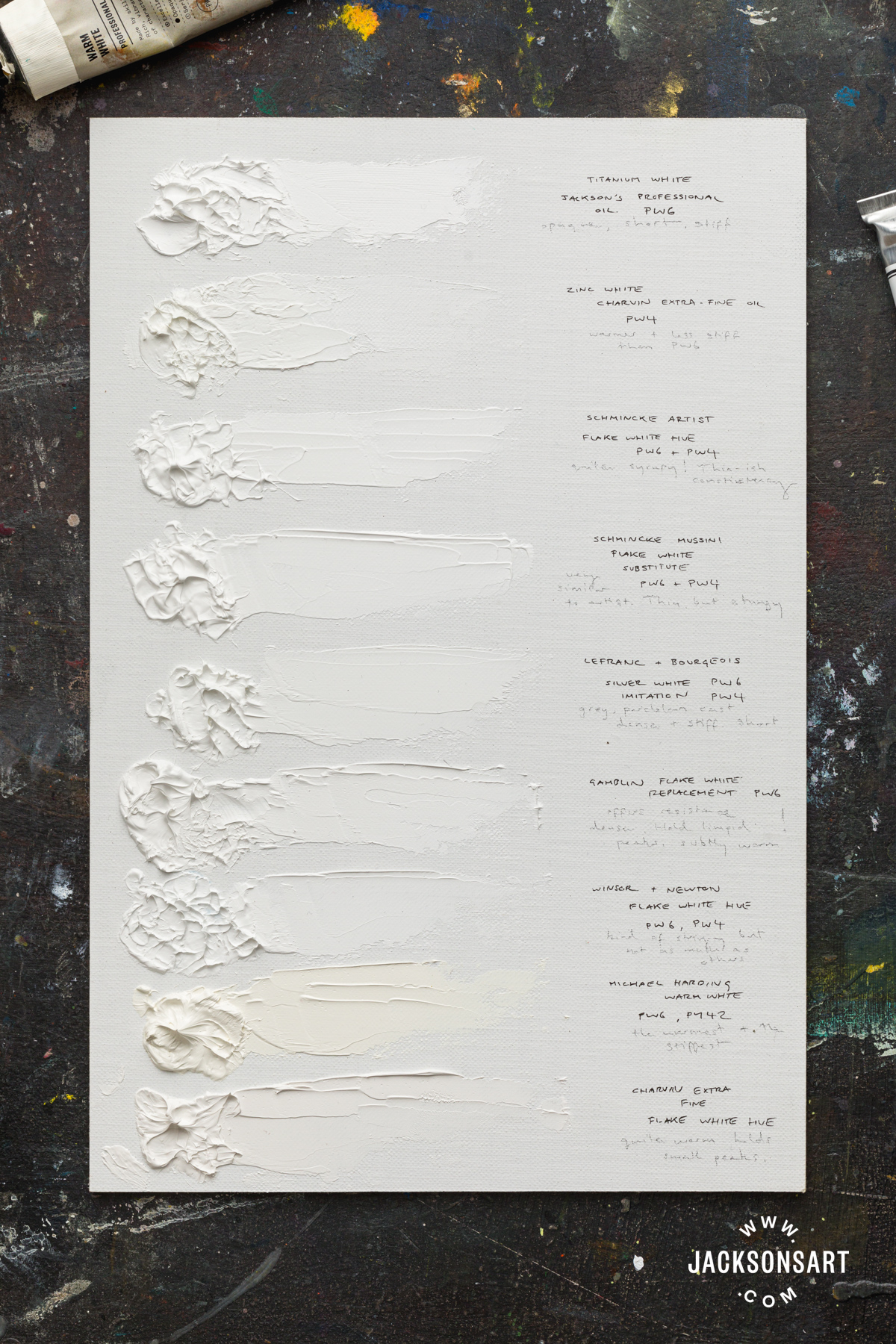
There is a demand for paints that behave like Lead White without actually containing lead. Accordingly, a few oil ranges offer paints that they explicitly market as Lead White alternatives. The following is a comparison between them, testing their consistency, tinting strength, colour temperature, opacity, and drying time.
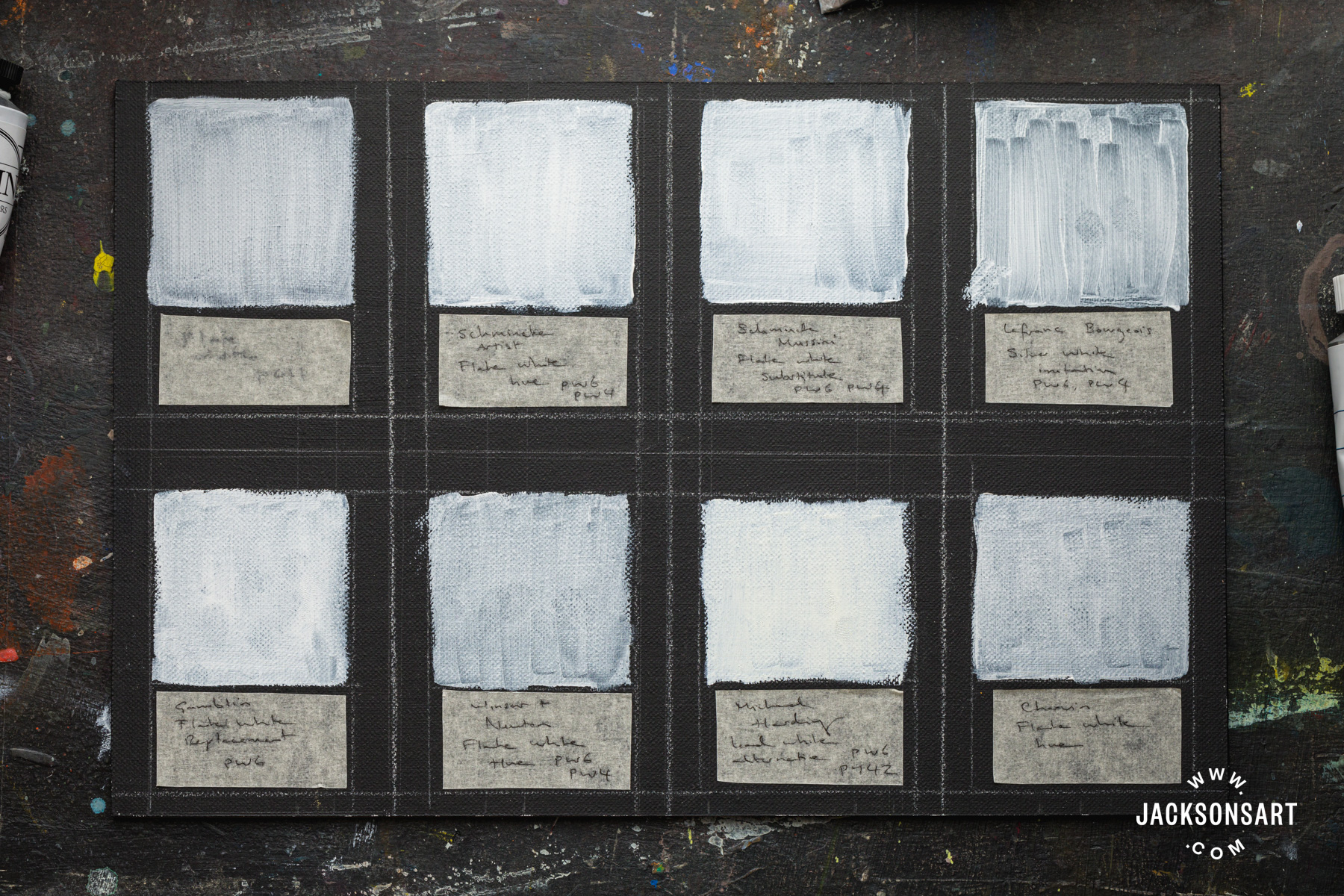
Paints were applied in a thin layer, without extenders like solvents of mediums, on Jackson’s Universal Primed Linen Canvas Board prepared with Michael Harding Black Acrylic Primer to reduce absorbency.
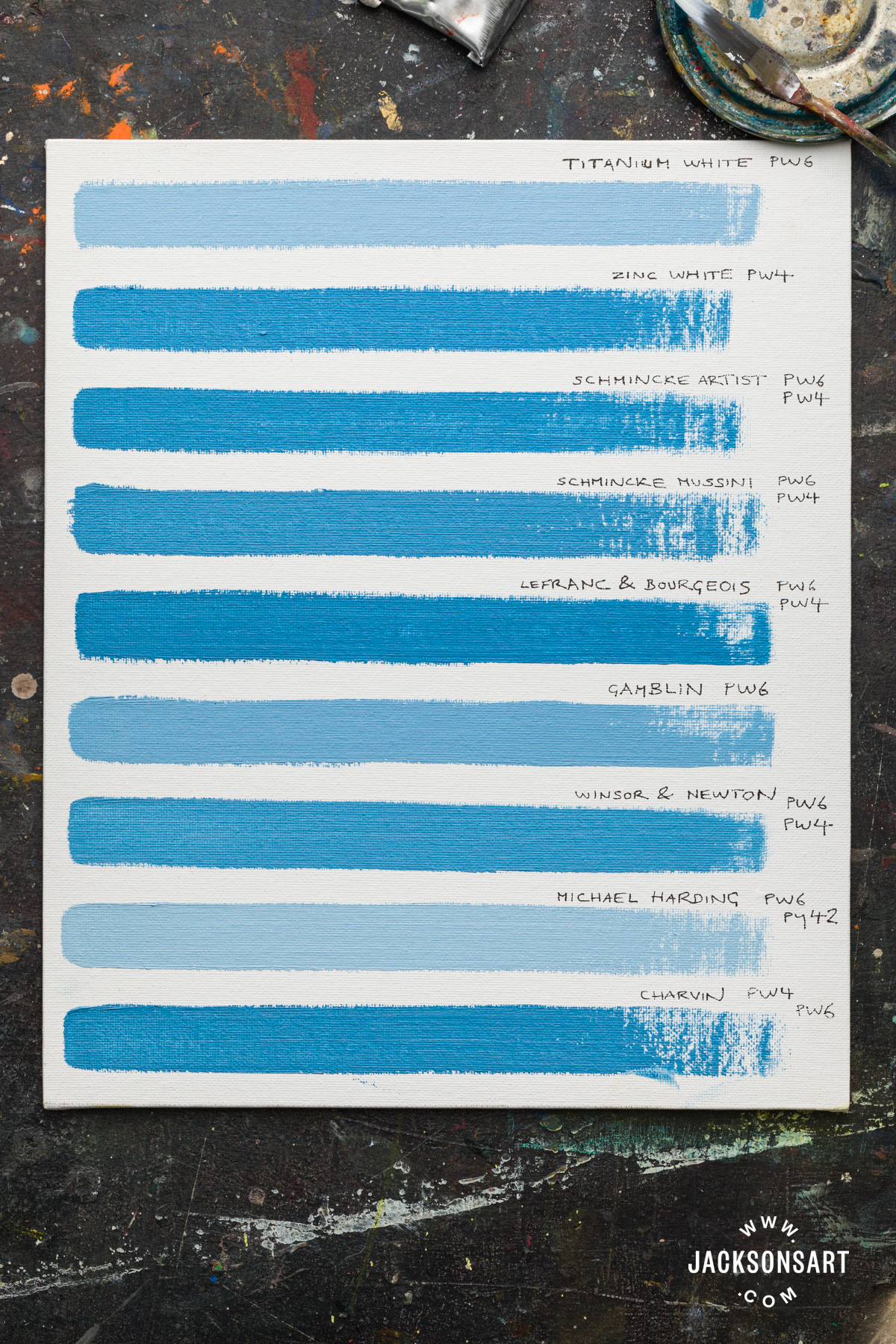
From top:Jackson’s Titanium White Professional Oil
Jackson’s Zinc White Artist Oil
Schmincke Artist Flake White Hue
Schmincke Mussini Flake White Substitute
Lefranc Bourgeois Flake White Hue
Gamblin Artist Flake White Replacement
Winsor & Newton Flake White Hue
Michael Harding Warm White (Lead White Alternative)
Charvin Flake White Hue
Schmincke Artist Flake White Hue
Pigment: PW4, PW6 (Zinc White and Titanium White)
Binder: Safflower oil
Schmincke Artist Flake White Hue is quite fluid in consistency, so it applies very smoothly. It has a slight syrupy quality and produces small strings when it is agitated, but it doesn’t have enough body to hold stiff peaks. It is bound in safflower oil, which reduces age-related yellowing.
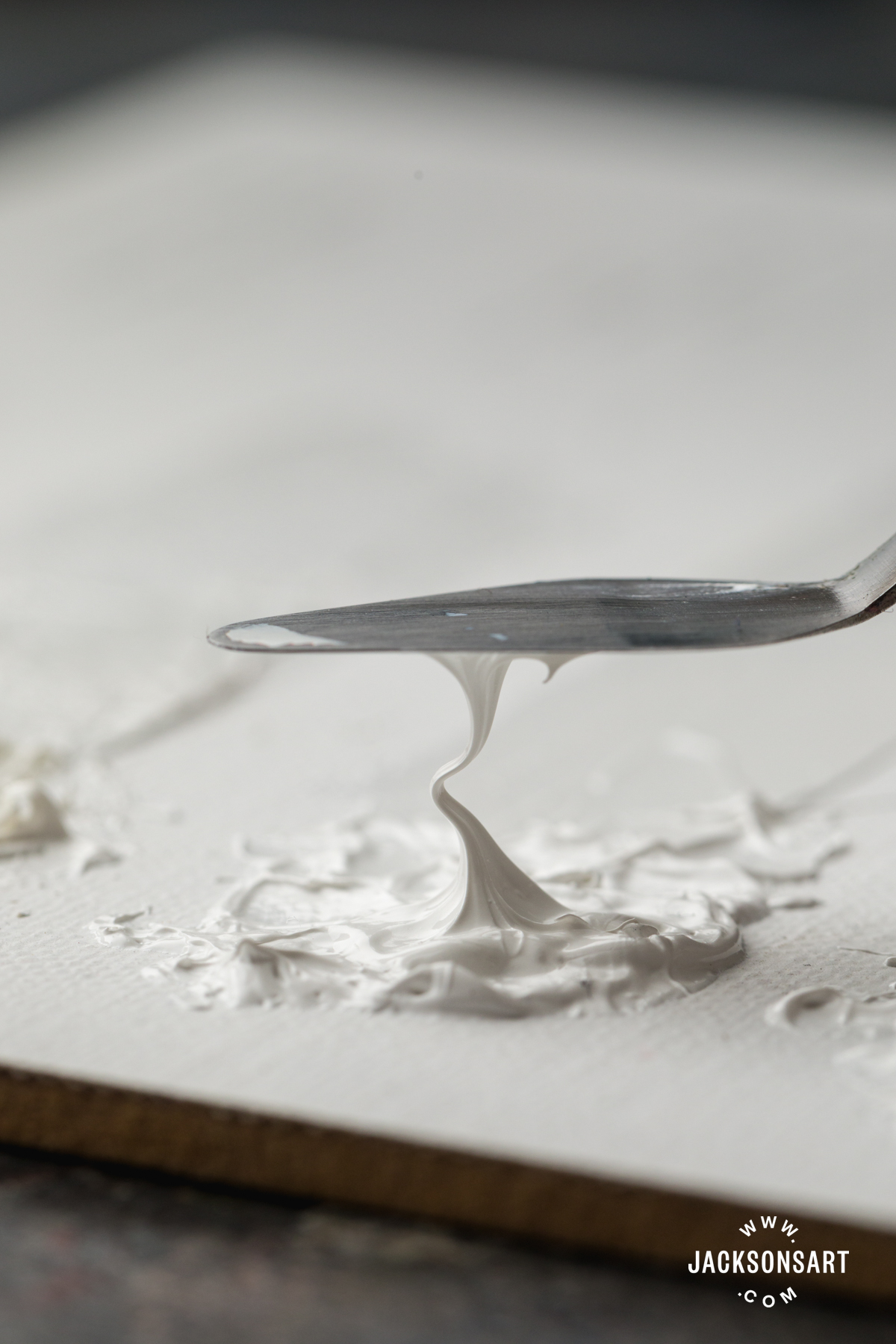
It has quite a fast drying time, faster than would be expected from most safflower oil-bound paints. In the drying test, it dried to a slightly tacky, shiny film in only a couple of days. The colour has a slight warmth, but it is one of the coolest Lead White alternatives tested here.
Schmincke Mussini Flake White Substitute
Pigment: PW4, PW6 (Zinc White and Titanium White)
Binder: Resin
This Flake White alternative has very similar qualities to Schmincke’s Artist Oil version, but it uses a combination of oils and dammar resin as a binder instead of a regular drying oil. The paint is semi-opaque and relatively fluid, with very little drag. It has quite a soft body, and when it is pulled up with a palette knife it holds only very soft peaks, but it does have a subtly stringy quality.
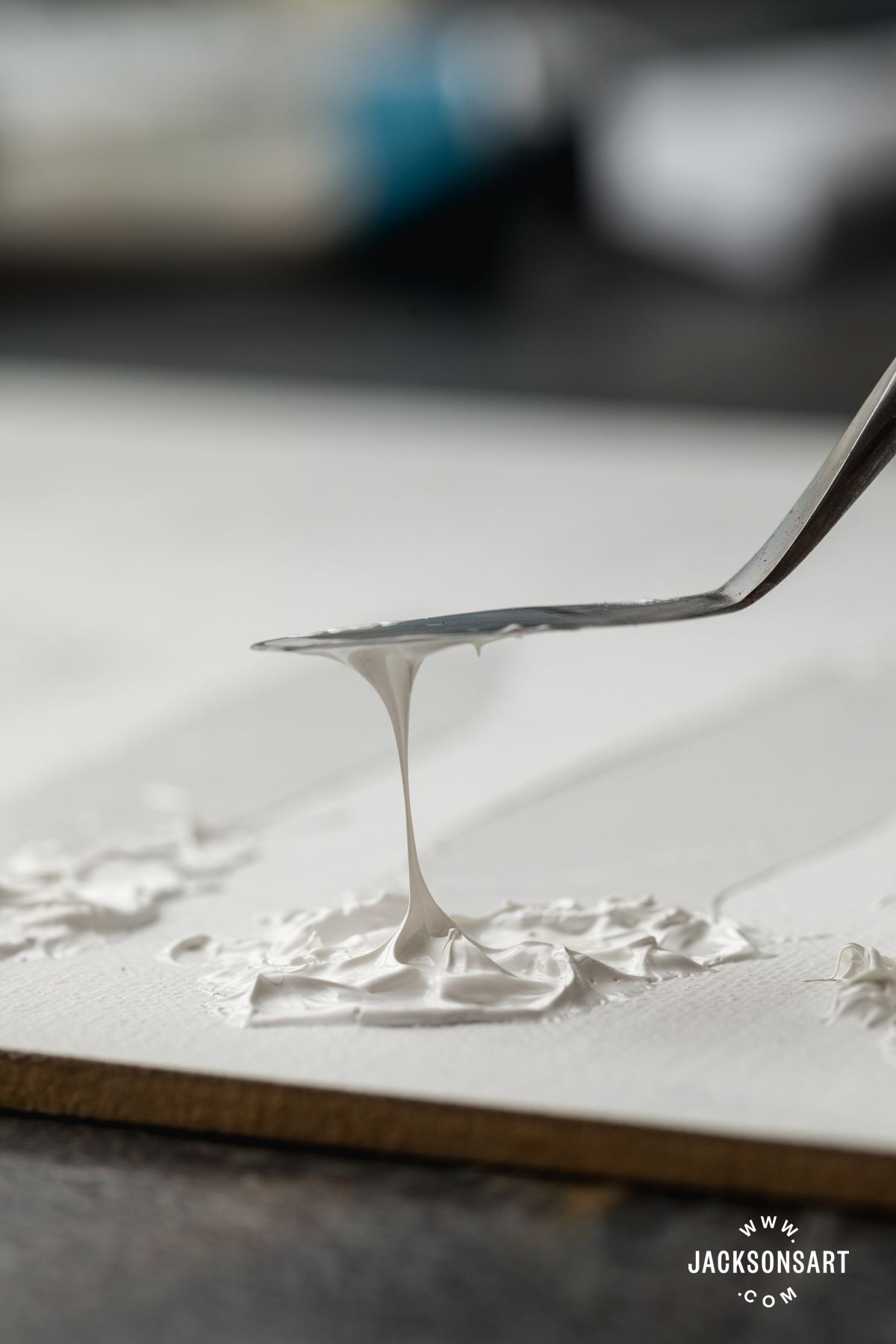
Again, like Schmincke’s Artist Flake White Hue oil paint, it is slightly warm in hue but is not significantly warmer than a Titanium White. It dried even faster than the Artist Oil, with a thin layer drying to a completely non-tacky film within two days. It would be really useful for underpainting layers.
Lefranc Bourgeois Flake White Hue
Pigment: PW6, PW4 (Titanium White and Zinc White)
Binder: Safflower oil
Much stiffer than both of the Schmincke Lead White alternatives, it holds straight, stiff peaks. It is quite a ‘short’ paint (meaning that it doesn’t stretch much when lifted with a palette knife or squeezed from the tube). It is a subtle, warm grey shade of white, and has a creamy satin sheen.
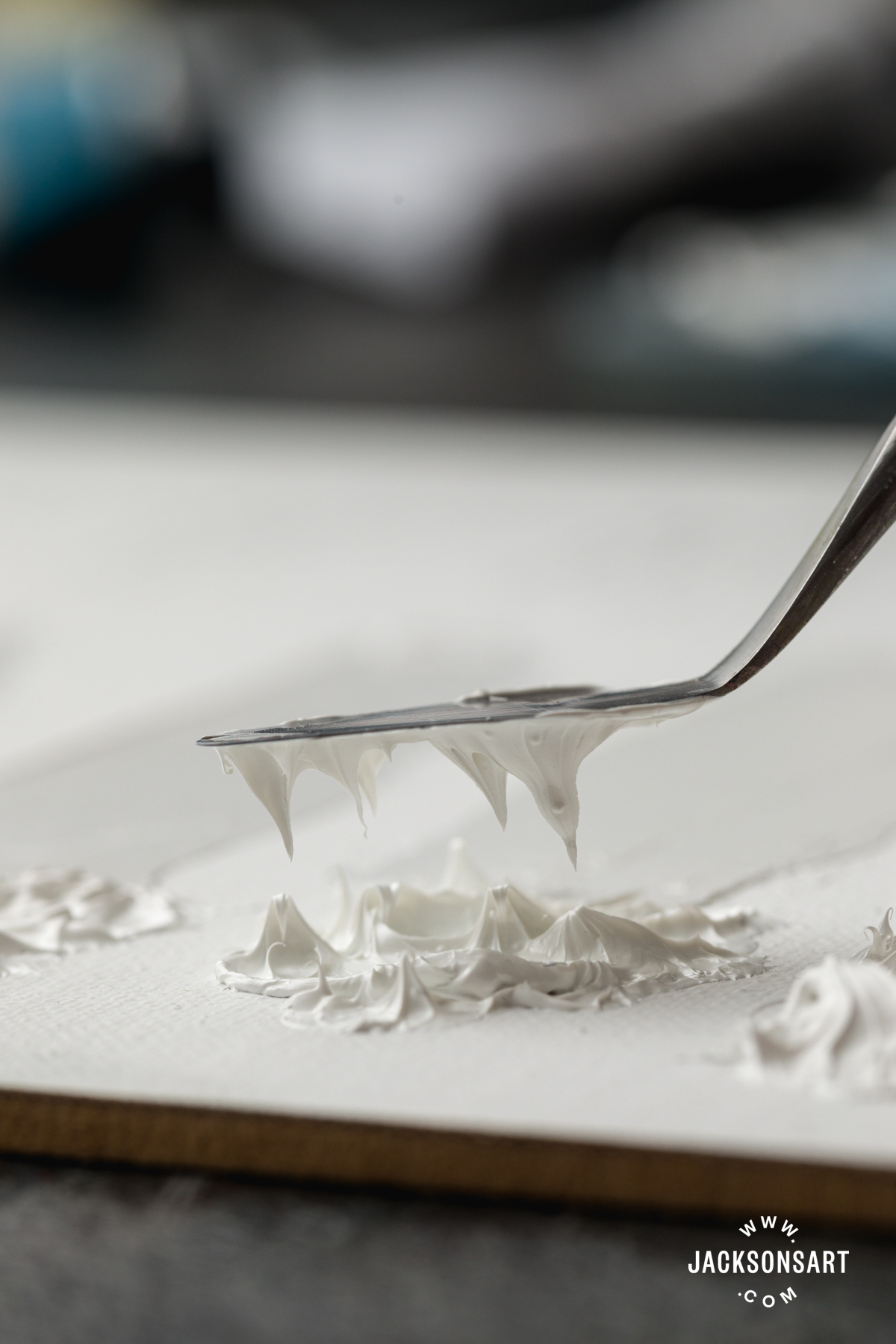
The drying time is longer than Schmincke’s versions. After two days it was well on its way to drying but remained sticky. It has a modest tinting strength, similar to a Zinc White, and in a 1:1 mixture with Cerulean Blue the richness and depth of the blue were maintained, unlike the pale, chalky tints typical of a Titanium White.
Gamblin Artist Flake White Replacement
Pigment: PW6 (Titanium White)
Binder: Linseed oil
Gamblin has obviously worked hard to imitate Lead White’s ropiness in this paint formulation. Flake White Replacement is one of the most stringy of the alternatives tested for this article. While it doesn’t give long ropes of paint like the Dutch Stack Lead White, it has a kind of long, languid ‘pull’. When pulled up to a peak the paint falls back into delicate curls. It’s a quality that you don’t get with regular Titanium and Zinc Whites.
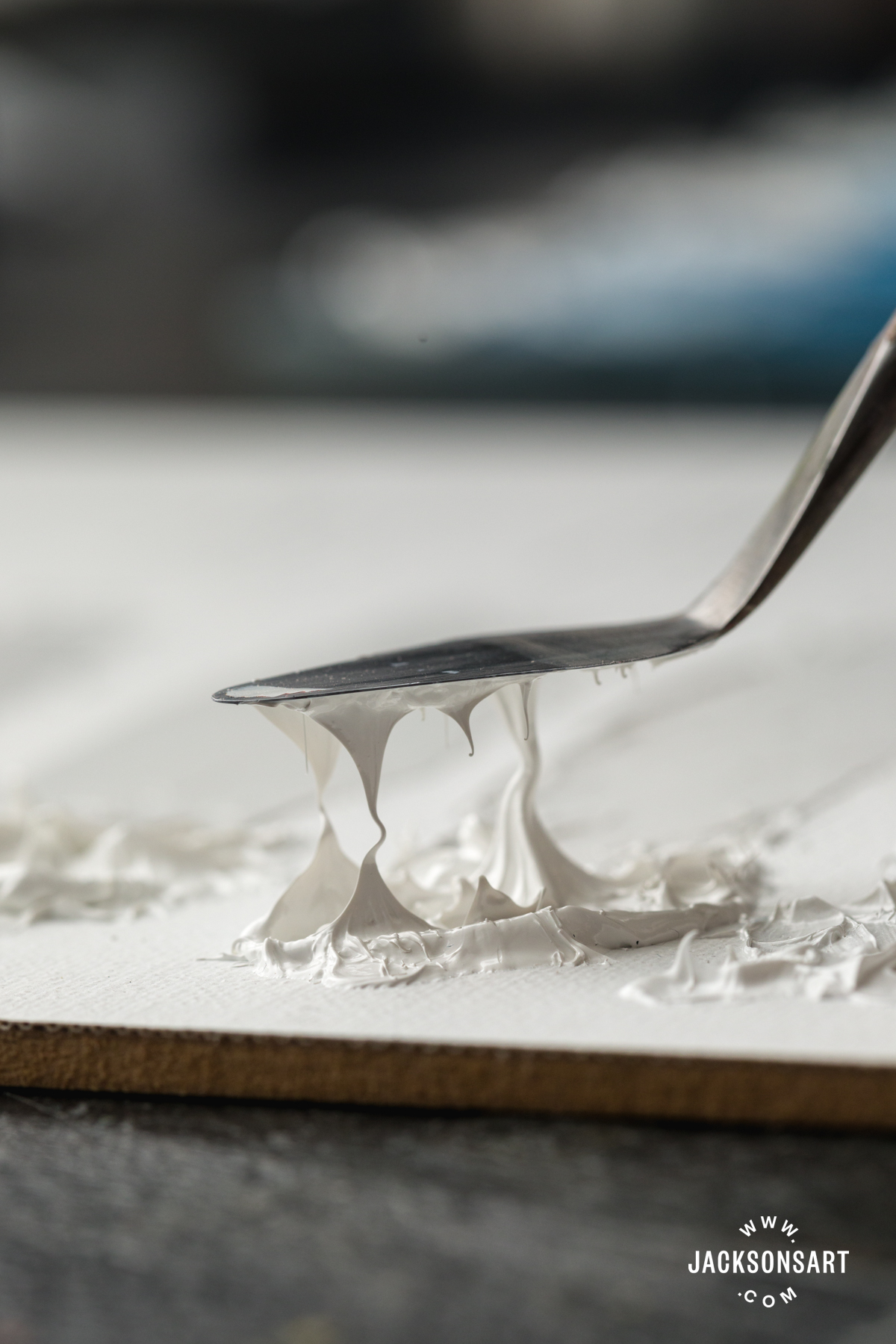
It has relatively high covering power and it has a subtle greyish warmth, similar to porcelain, which makes it more subtle than Titanium White. Its tinting strength is less than standard Titanium White, but it is more overpowering in tints than most of the other Lead White replacements covered here. Gamblin says that this is the leanest of their white oil paints (i.e. contains the least oil) so you might expect the drying time to be fast, however after a couple of days the paint film was still quite wet. Its tinting strength is relatively high (more than a standard Zinc White) and it imparted an ever-so-slight chalkiness to the tint.
Winsor & Newton Flake White Hue
Pigment: PW6, PW4 (Titanium White and Zinc White)
Binder: Linseed oil
Flake White Hue is relatively stiff, dense, and very opaque. It can be pulled into soft peaks which hold their form. It is ever so slightly warmer than Titanium White and has a soft, grey hue. It is the most matt of all of the Lead White alternatives in this comparison.
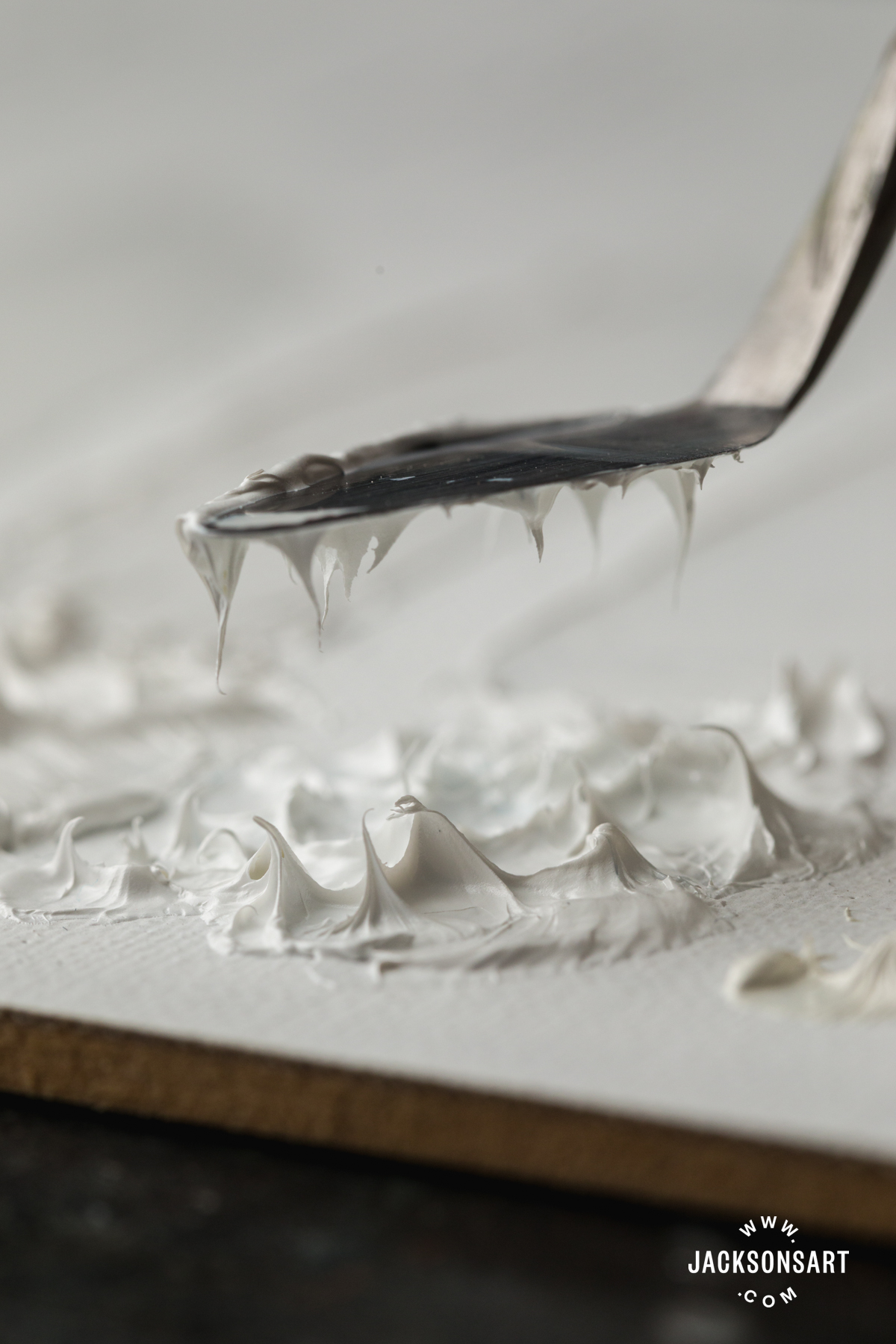
This is a very popular Lead White alternative, and it’s easy to see why. It has a satisfyingly thick, paste-like consistency. It is a short paint, not long and stringy, but it is very textural and would be good for adding impasto highlights. Winsor & Newton state that the paint is opaque but, while it is capable of high opacity when used thickly, it is definitely semi-opaque when applied in a thin layer. Its drying time is faster than Titanium or Zinc White. After a couple of days, a thin film was about 70% dry but still sticky. For a faster-drying white, Winsor & Newton offer an Underpainting White, which is specifically formulated for the first layers of a painting.
Michael Harding Warm White (Lead White Alternative)
Pigment: PW6, PY42 (Titanium White and Synthetic Yellow Iron Oxide)
Binder: Linseed oil
This is the warmest of the Lead White alternatives – it has a little synthetic iron oxide added, which contributes a creamy yellow hue. In terms of its consistency, it is very stiff and holds high peaks when agitated with a palette knife.
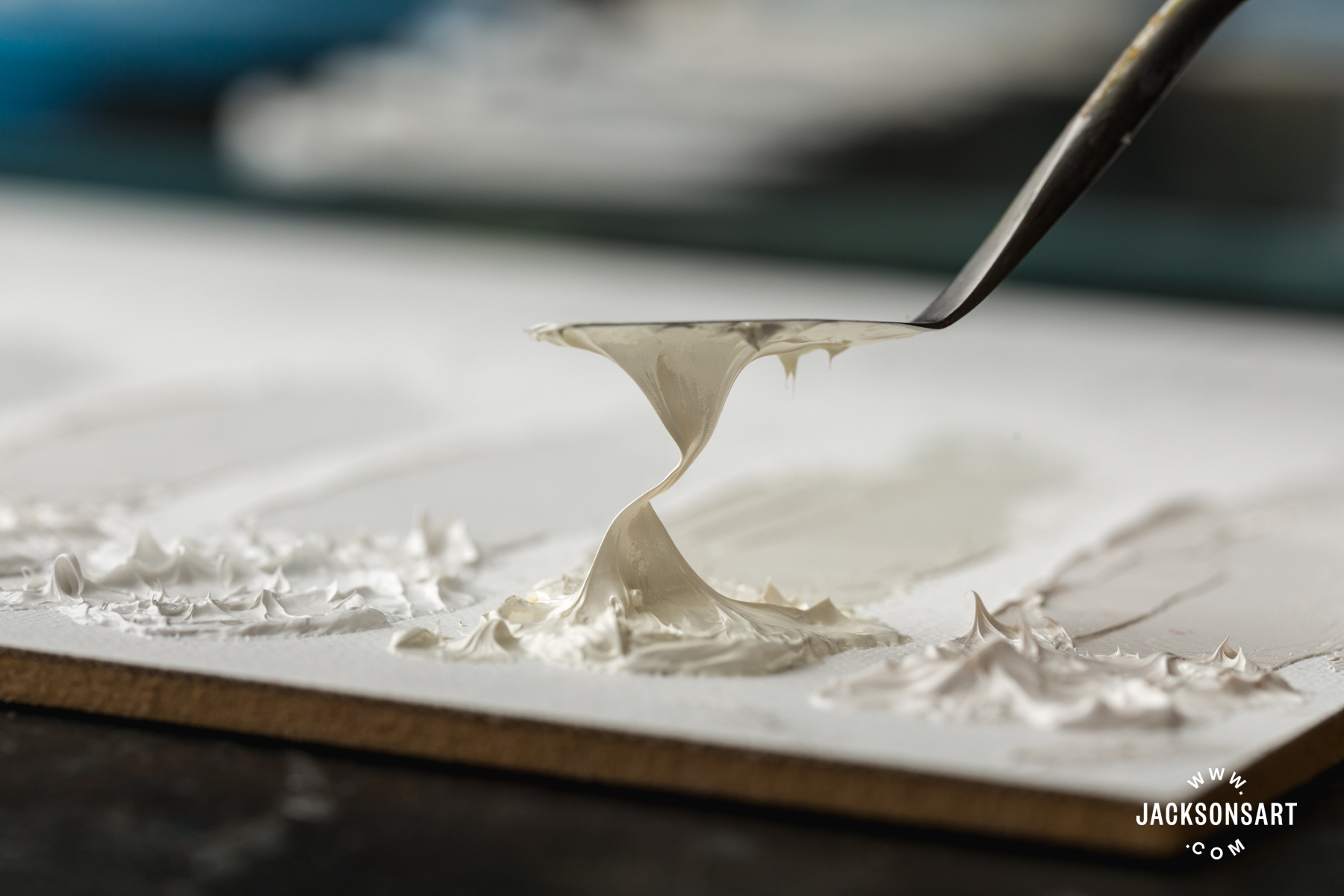
It has many qualities that are expected in a regular Titanium White – it has a very high tinting strength and very high opacity (by far the most opaque of the Lead White alternatives tested here). Its drying time is quicker than standard Titanium White, which could be the fast-drying effect of the yellow synthetic iron oxide.
Charvin Flake White Hue
Pigment: PW4, PW6 (Zinc White and Titanium White)
Binder: Poppy oil
Charvin’s Flake White Hue is the second warmest of these Lead White alternatives, although it is much less yellow than the Michael Harding Warm White, and the hue has a subtle edge of pink. Its consistency is extremely creamy and it holds short, sharp peaks.
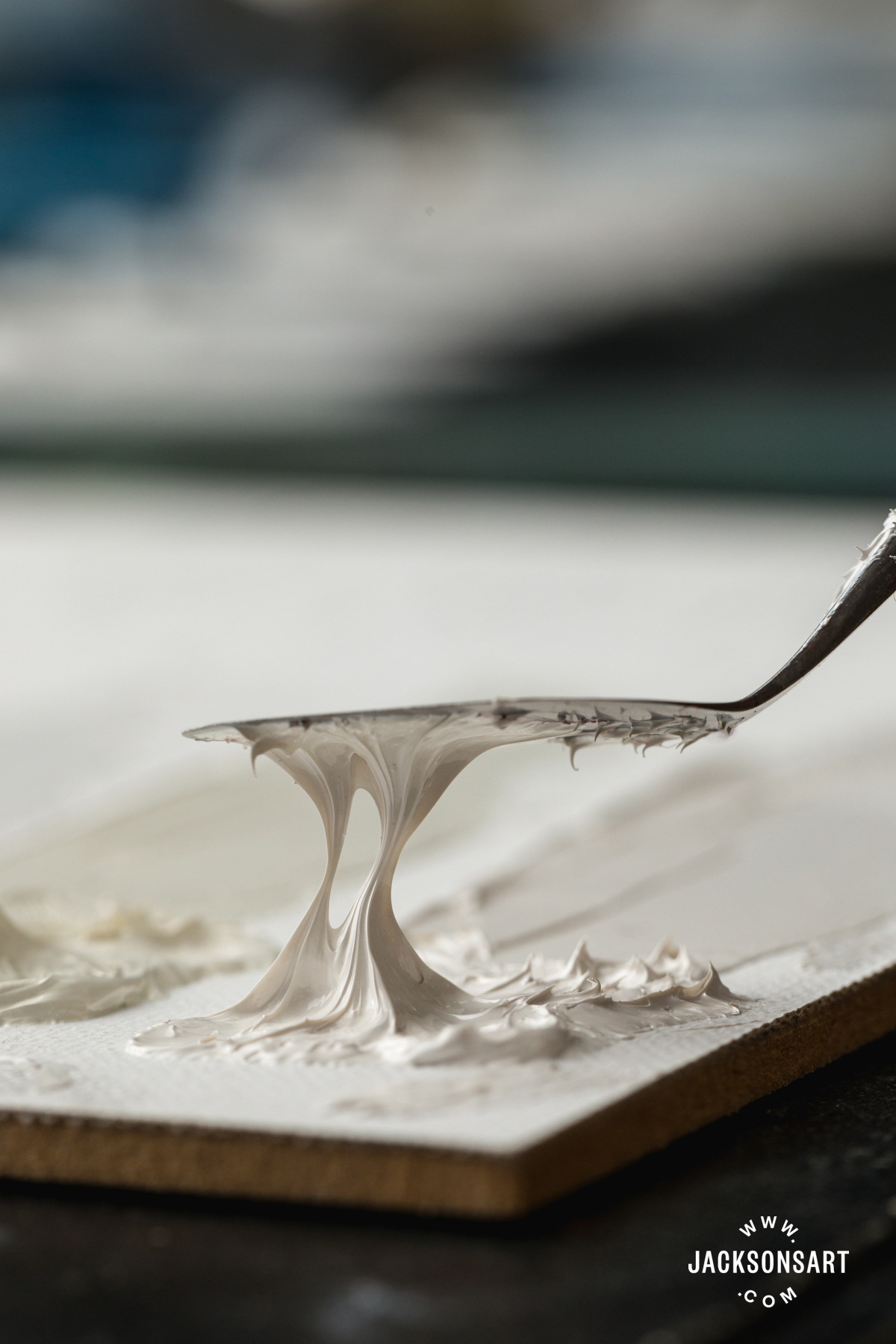
Its tinting strength is moderate, similar to a regular Zinc White, and tints retain their depth and saturation. It is a slow dryer, which is understandable because poppy oil, which Charvin uses to bind all of their oils, has a much longer open time than both Linseed and Safflower oil.
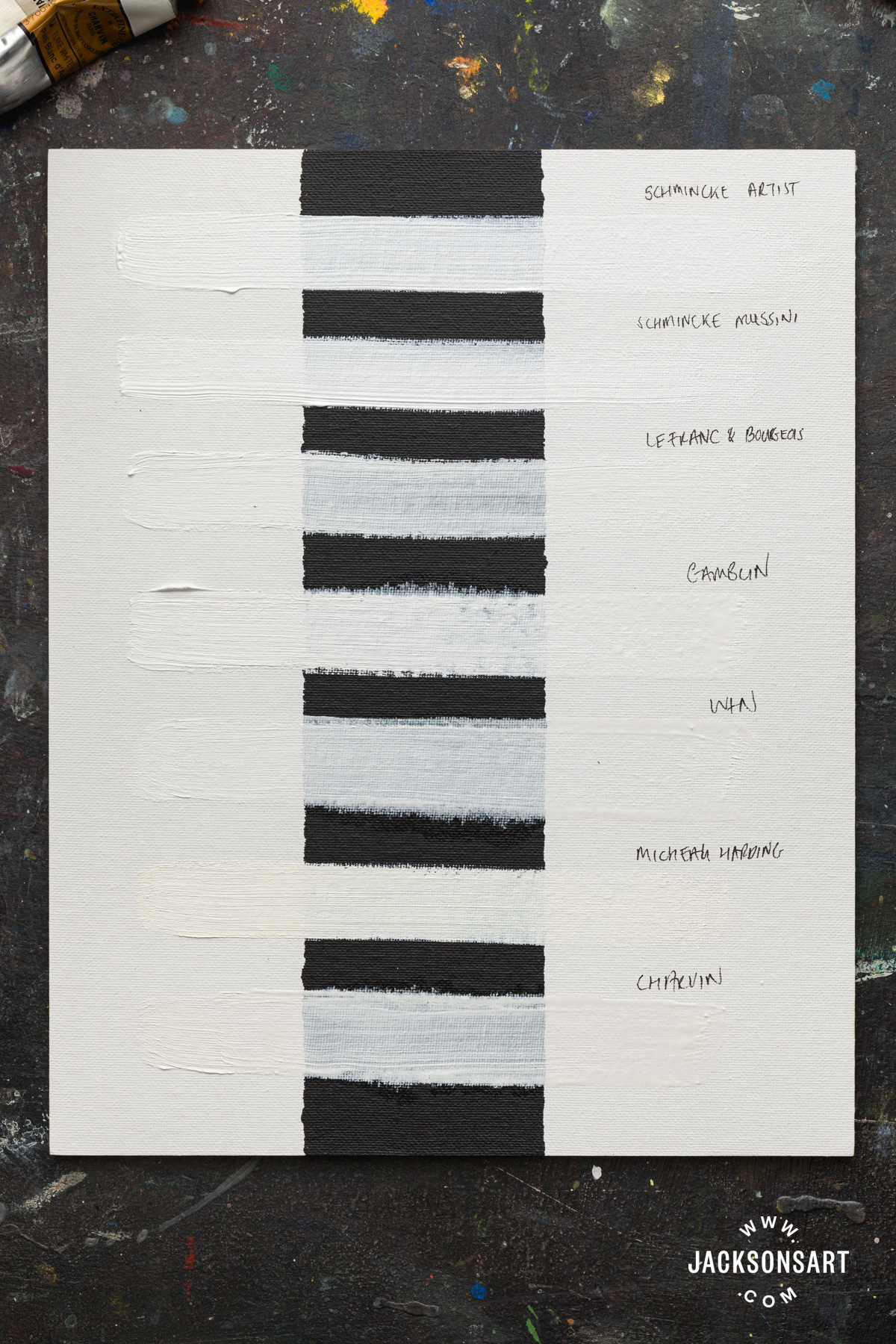
From top: Schmincke Artist Flake White Hue
Schmincke Mussini Flake White Substitute
Lefranc Bourgeois Flake White Hue
Gamblin Artist Flake White Replacement
Winsor & Newton Flake White Hue
Michael Harding Warm White (Lead White Alternative)
Charvin Flake White Hue
It’s clear that the lead-free alternatives don’t exactly replicate the characteristics of the historic pigment, especially the thixotropic, ropey qualities of the coveted Dutch Stack Lead White. However, many of the paints tested above have a lot to offer to a painter, so perhaps it’s best to judge the alternatives not on how well they can mimic Lead White, but as distinct options in their own right.
From top: Schmincke Artist Flake White Hue
Schmincke Mussini Flake White Substitute
Lefranc Bourgeois Flake White Hue
Gamblin Artist Flake White Replacement
Winsor & Newton Flake White Hue
Michael Harding Warm White (Lead White Alternative)
Charvin Flake White Hue
The fact that so many lead-free Lead White alternatives are being produced shows how much of a hold the genuine pigment still has on artists. Considering that it was the most important white pigment on the artist’s palette for centuries and that it was used in many of the most well-loved paintings in art history, this is hardly surprising. The question of whether modern pigments can ever compare will remain a topic of discussion for a long time yet.
Further Reading
Which Titanium White Oil Paint Dries the Fastest?
The Zinc White Debate (And Why We’re Keeping It in Our Oil Ranges)
What Unbleached Titanium Can Add to Your Palette
Shop Oil Painting on jacksonsart.com



10 thoughts on “The History of Lead White Oil Paint and its Modern Alternatives”
Hi Evie,
Another excellent article, thank you. As a
big fan of W&N fast curing oils, mainly
due, I admit, to my impatience and
unwillingness to wait six months for the
d**n thing to dry, I am nevertheless
disappointed by the whiteness of their
Titanium White. When I paint pure white
I do so to make it stand out in stark
contrast to the rest of the palette, but
this white, despite additional layers,
remains quite dull.
So my question is, what makes a white
really stand out, and why does my
choice come up short?
Rob
Hi Rob, I’m glad you enjoyed the article! I haven’t tried that particular Titanium White, but I would say that the brightness of highlights has as much to do with the surrounding colours as the brightness of the highlighting pigment. If you look at Rembrandt’s work, his white highlights really stand out despite the fact that Lead White is less bright than modern pigments. If you play around with the colours around the highlight, it should help to make it really pop.
The prohibition on lead white – properly made, under appropriate
supervision to protect the health of those who make it – is an
affront to the whole tradition of European oil painting; none of the
“alternatives” is or could be equivalent to its weight, strength,
durability, or texture. All they do – I have not tried every last one
of them, but I’ve used several – is mimic: and I’ve no use for
mimickry. Averting risk can be very sensible: no one wants too
much of it, with the exception of those who are addicted to risk
for its own sake; but risk can be managed – the ban on lead white
is the mark of nannying philistinism.
Thank you for your comment! I agree that the alternatives are nothing like the original pigment, its qualities are impossible to recreate.
I agree, each lead white
replacement has a role to play
and can be effective in multiple
ways. I use Flake white
replacement for exercises. Lead
white cannot be replaced
because of its inherent qualities
in artist’s painting, certainly for
wall painting Europe did well.
Zinc should be avoided in final
work, its reduces longevity due to
being brittle.
Thanks for your comment- you’re right that Lead White’s qualities can’t be replicated in the replacements! It’s a good point regarding Zinc White- you might enjoy our discussion of its pros and cons here.
Thank you, your comparisons are
appreciated.
Marc.
Thank you Marc, I’m glad you’ve found it helpful!
Another awesome post, Evie. Also, I will say
for anyone who has yet to try the Flake
White alternative by Wallace Seymour, really
should give it a go. It’s the first single
pigment lead white alternative that holds up
to many of the qualities of the old stuff.
You could say it’s a little gritty under the
knife compared to the buttery PW6, but it
handles so well. Hope this helps!
Thank you for the suggestion, Oliver. I’ll give it a try!
Comments are closed.