




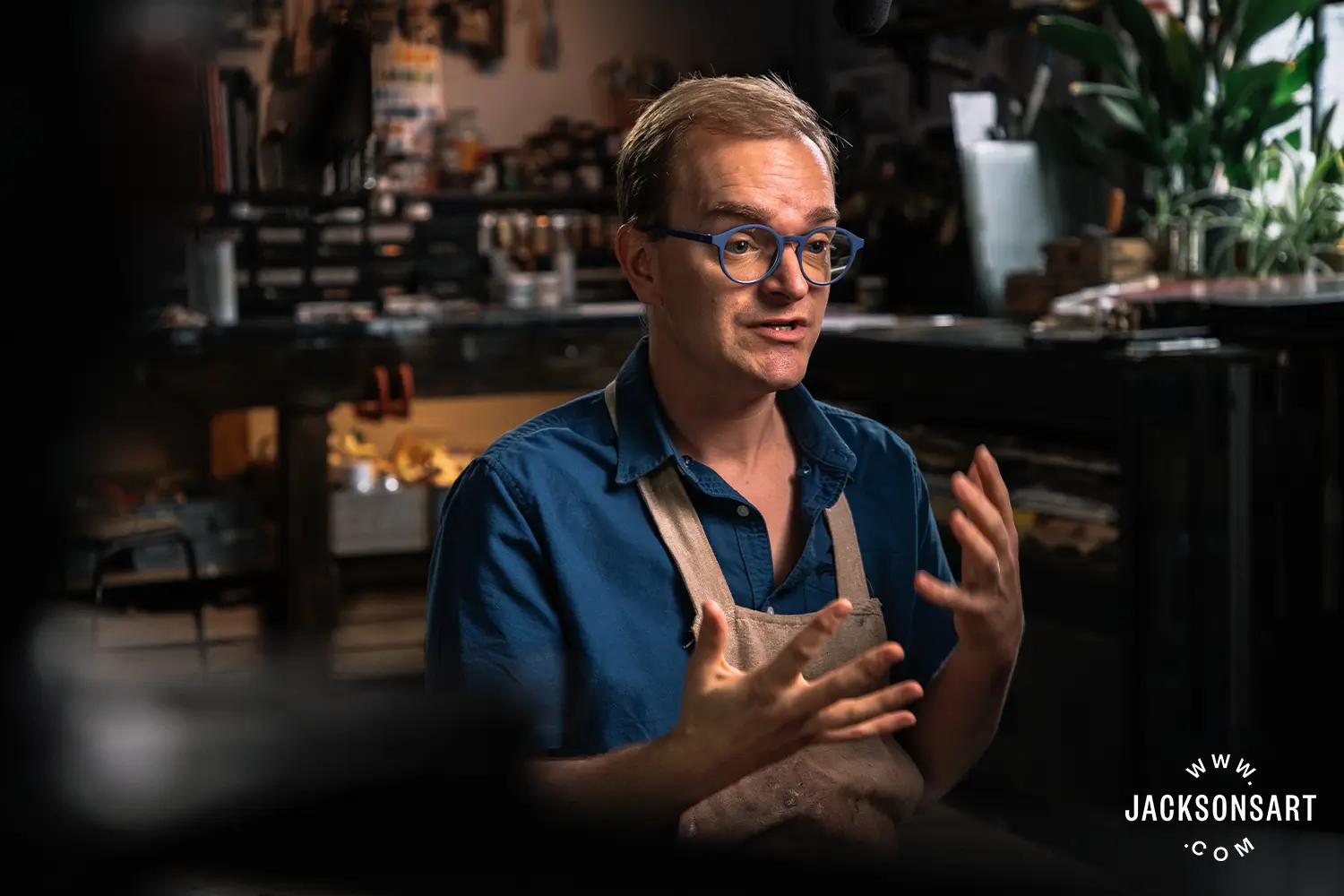
Peter Keegan is an oil painter and the co-host of the art advice podcast, Ask an Artist. In this film, he shares his insights on portrait painting, colour, his palette set-up, and the relationship between the artist and their subject.
Contents
0:00 Introduction
0:40 “For me, it’s always been paint”
1:51 “I enjoy leaning into colours that are not found in the face at all”
2:27 “I decided to make my palette myself”
3:30 “Simplify the complexity of the face”
4:25 “Paint should be good enough to not add any mediums to it”
4:47 “I love paintings that have an almost unfinished quality”
5:13 “I’m working in simple, strong structural shapes”
6:23 “Look at a scene in terms of its tonal values”
6:57 “I always paint with my glasses off”
8:08 “I love to see how my hand has moved across the canvas”
9:11 “Get to know the subject”
9:33 “I don’t try to get something 100% right at the very beginning”
10:41 “The relationship between the artist and the sitter”
11:22 “Take a step back”
12:00 “Adopt the ‘phone a friend’ technique”
12:39 “Filbert brushes allow me to be precise but also gestural”
13:31 “I have what I call ‘guest colours’”
14:01 “Artist quality paints are full of joy and richness”
14:32 “Give the face just a little more structure”
15:10 “Art has always been part of me and what I do”
15:32 “Defining the darker parts of the portrait”
16:14 “Paintings are never fixed or finite”
16:45 “I realised that art was something that I could have a career in”
17:19 “Make every stroke count”
18:18 “Going to a museum is like going to the doctors”
18:55 “I take as much enjoyment in looking at other people’s paintings”
19:33 “The way I hold the brush is such an important thing”
20:19 “When things don’t go according to plan I’m okay with that”
21:02 “As I move towards lighter values I use the paint a little thicker”
21:54 “Self-portraiture is a wonderful learning experience”
23:00 “Diversity in a picture will make it so much more compelling”
24:21 “When I lean too heavily on photography the paintings look a little stifled”
24:50 “Knock back parts of the painting that have become too busy”
25:22 “Final small lines and marks”
25:53 “The most exciting part of starting any painting is the beginning”
27:52 Credits
Extract
I’ve always been very determined in the approach and direction that I’ve wanted to take as an artist. For me, it’s always been paint. Paint is a very visceral, expressive medium that for me translated wonderfully to the way I wanted to express myself. I like there to be an element of exploration and the medium of oil paint is, I think, the most versatile and exciting medium to allow me to do that.
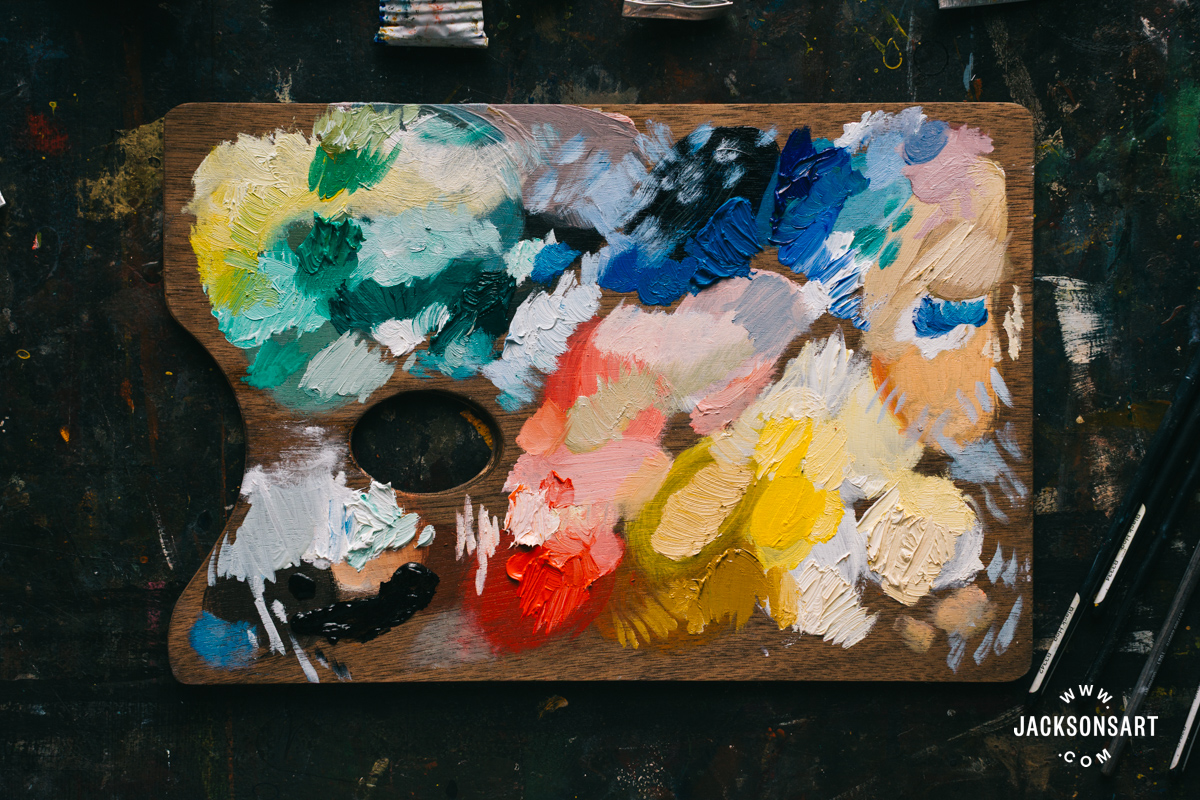
If I’m working on a portrait in a relatively traditional fashion, I’ll tend to lean more toward the earth-based colours and pigments that have been around for centuries. So colours like Yellow Ochre, Alizarin Crimson, Raw Umber, Ivory Black, and so on.
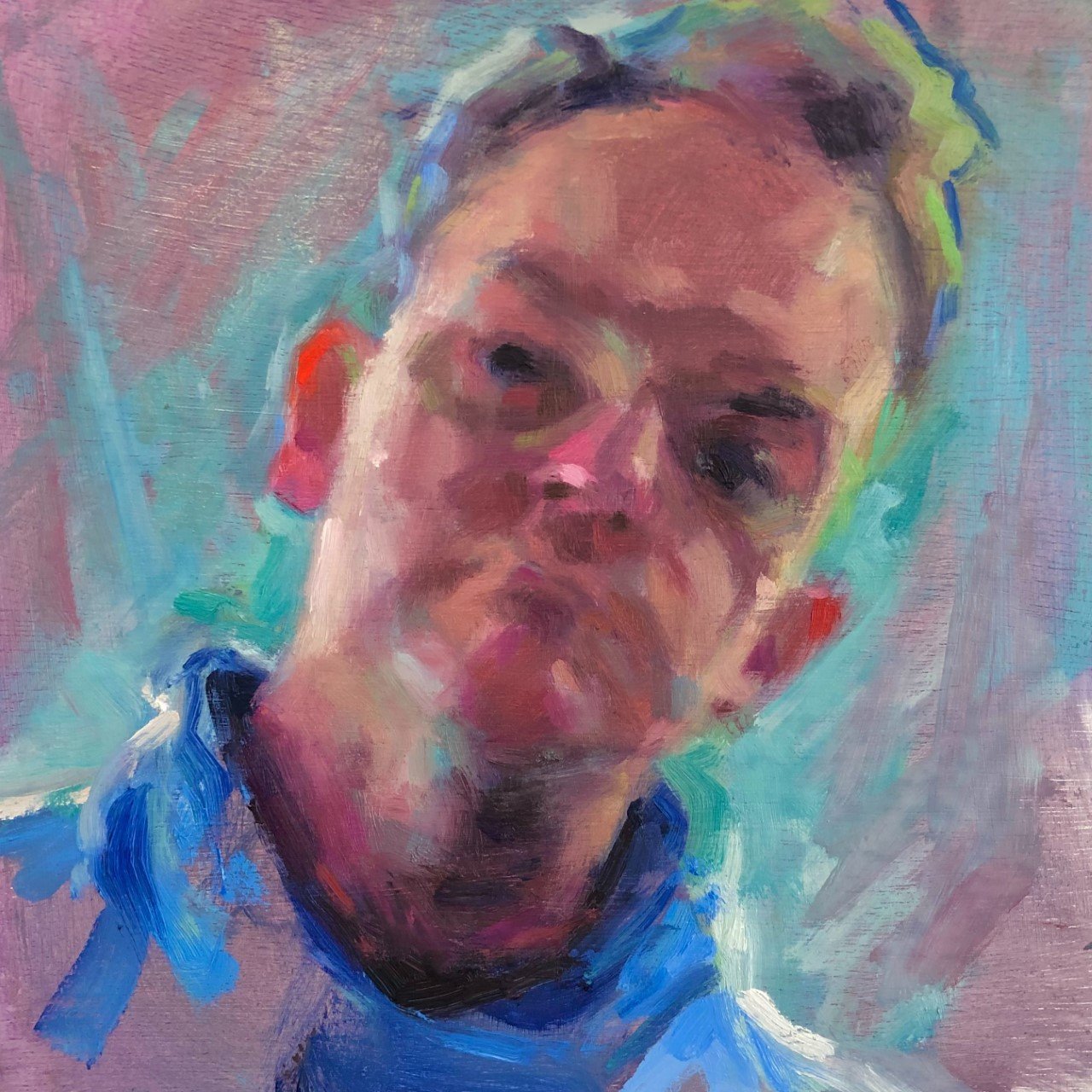
I have what I call ‘guest colours’, colours that come in only if it is particularly relevant to the scene that I’m trying to create, or the feeling that I’m trying to evoke. Some of my favourite guest colours would include Cadmium Orange, Amethyst, which is a lovely fruity purple colour, and Phthalocyanine Turquoise which is a wonderful colour that balances against the warmth of skin colours.
Peter Keegan
Oil paint, 30 x 30 cm | 11.8 x 11.8 in
My favourite brand of oil paint is Michael Harding, I love working with the high pigment and high density of the oils that Michael produces. When I compare a painting that’s been produced with student quality paint compared to professional artist quality paint you can see the difference. The student quality paint, although nice and confident, has a slight grey tinge to it, whereas artist quality paints sing. They’re full of joy and richness and as a colourist that’s something I really look for in my paints.
After trying lots of other palettes, I decided to make one myself. I started off with a cardboard template, which eventually turned into a wooden palette. I’ll have it in my left hand, but I’m not really holding it at all. It’s balanced beautifully on my arm, so I don’t get any cramp in my hand from physically holding the palette.
When I start painting, I think about the overall design that I’m trying to create. I look at a scene in terms of its tonal values, how light and dark the aspects are. I start off by asking where the darkest darks are and where the lightest lights are. Then I look at the colours; are there any key colours that I’m going to need to lean into that really capture that scene before me?
I use medium just to thin the paint in the initial blocking stages and washes, and then I try to work with the paint itself. I think paint should be good enough to not add any mediums to it. It should have a lovely fluidity, it should feel like toothpaste. It should be able to move around but still have a good sense of body to it.

Peter Keegan
Oil paint, 50 x 40 cm | 19.7 x 15.7 in
I always paint with my glasses off. I utilise my relatively poor vision which simplifies the subject before me. It can be incredibly overwhelming when you’re working from life or a photograph and you have all this information, so by taking off my glasses it takes away all that detail and I’m working from a very fuzzy starting point. But I always remember to put my glasses back on at the end to assess how the painting is looking because I have to remember not everyone looks at the world in the same way as me!
My favourite brushes are Rosemary & Co brushes. I love a hog brush because it shows the grain of the brush stroke. The bristles put the paint down but also scrape and move it. It leans into that sculptural quality and shows how my hand has moved across the canvas. I love filbert brushes because the ferrule kind of pinches the brush flat but then it has a lovely kind of curve, so I can still be very precise with the marks but also very broad and very gestural. I hold the brush right at the bottom, at a good distance, which pushes me slightly away. That helps me take in the painting as a whole and stops me getting into fuss and fiddling territory which we don’t want. We don’t want to kill the life and energy of the painting.
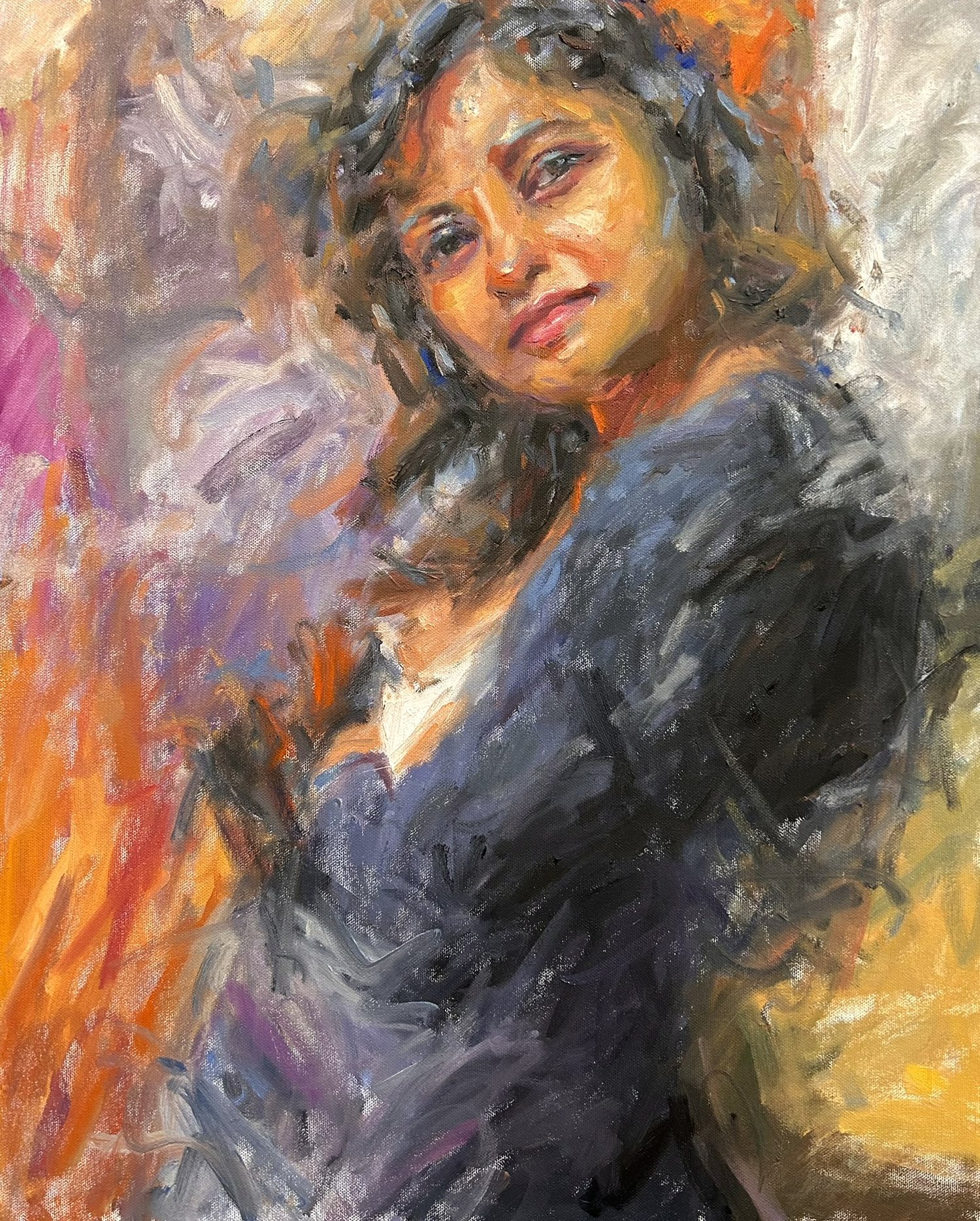
For me, a fantastic portrait needs to not just look like the subject but it needs to feel like them, it needs to capture something of them, that character and that personality and I feel you can only really achieve that by getting to know the person you’re painting.
The genre of portraiture has always been the main interest for me in my art practice. I do other things as well, but my main preoccupation, fascination, dare I say even obsession, is capturing that person, the character, the spirit of that person that’s sat in front of you. The relationship between the artist and the sitter, I find that a beguiling, exciting, captivating experience that keeps me motivated to this day.
Peter Keegan
Oil paint, 60 x 50 cm | 23.6 x 19.7 in
If you’re not quite sure what you’re doing then sometimes it’s an easy tendency to pick up the brushes and keep fiddling. Take a step back and get a little bit of physical and emotional distance from it. Sometimes when you’re so involved in a project you can’t see the wood for the trees.
Other tricks I use include looking at a painting in a mirror, so you’re looking at something that’s very familiar but you’re flipping it around. I often adopt the ‘phone a friend’ technique, so I lean on people whose opinion I greatly admire. Another helpful thing is to photograph your painting or drawing. If the painting is looking quite strong on a small scale then I’ll leave it, it doesn’t need any fussing or working on.
I often treat going to a museum a little bit like going to the doctors. When I have a problem that I’m not quite sure about, there’s always the answer there before me in some of the great paintings of the past. I draw an enormous amount of inspiration from artists, particularly very painterly artists who really perfected the alla prima way of painting, working wet into wet.

Peter Keegan
Oil paint, 50 x 40 cm | 19.7 x 15.7 in
I take as much inspiration as well from artists that are painting with us today, how they lean on colour, texture, and mark-making. This is where social media is wonderful because it opens up doors and avenues to artists. It’s wonderful to see what they’re doing and look at how they are depicting a certain quality of light, a certain facial feature, or a certain skin colour. I’m always like a magpie taking in all this information.
In terms of how I approach all aspects of painting, I try to approach it as seriously as possible, but at the same time not in a serious way. I am lucky that what I do is produce pictures, and if things go wrong and there are paintings that don’t work that’s fine. It’s actually part of the creative process. It’s always interesting to discover which things work and which things don’t, so when things don’t go according to plan I’m okay with that. I take it on the chin and move on to the next piece.
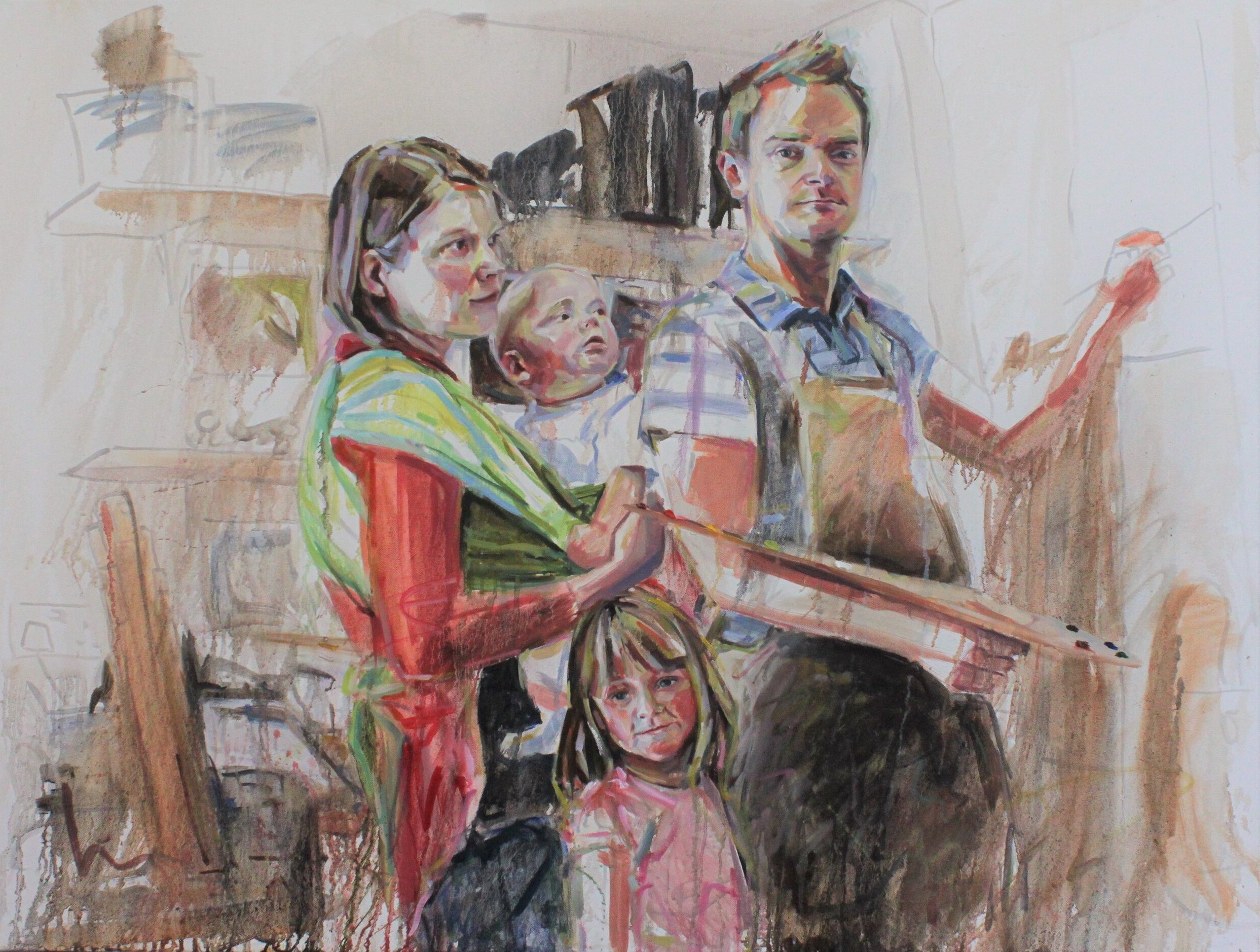
Self-portraiture is an incredibly fascinating subject within portraiture, so much so that I paint a self-portrait every year. I think everyone should do it because you can get a lot out of it. It’s a wonderful learning experience. I painted a portrait with myself but surrounded by my wife and my two young children. That self-portrait was about balancing life as an artist and also trying to be a father at the same time. The painting is quite chaotic, very splashy, very messy and it has an unfinished look and quality to it which sort of sums up what my creative practice was like at that time.
Peter Keegan
Oil paint, 90 x 120 cm | 35.4 x 47.2 in
For me when I lean too heavily on photography the paintings look a little stifled. They take away that connection and that resonance I had with the subject. I’m trying to replicate not just what something looks like, but more importantly what something feels like. If I can get that across on my work then I know I’ve done the job right.
I find finishing and clarifying a picture enormously difficult. There are a few tricks that I do to get around that. Sometimes I will sign a painting halfway through the picture execution, sometimes I feel signing it is a little bit too finite and finalised. The other trick is a psychological one; I try not to finish any of my paintings anymore. I don’t finish my paintings but I do what da Vinci said, which is that you should abandon your work. There is a psychological shift there because when you finish something it’s like this rubber seal and you cannot touch it. Whereas if you abandon something you can step away from it and you can always return and go back to it. So all my paintings are abandoned. Suddenly that burden of trying to finish something is no longer there on my shoulders, and it becomes a much more flexible, relaxed process.
To this day I still find it utterly magical and captivating how you can take a blank canvas and some squishy material, move it around, and this optical illusion of a face or a landscape starts popping from those placed brush strokes. I still find it enormously exciting.
About Peter Keegan
Peter Keegan is a professional artist living and working in Buckinghamshire, UK, specialising in portraiture. Trained at Cardiff School of Art and working in oils, Peter follows traditional techniques but uses them in a way to depict the people he meets in a modern and original style. His aim in portraiture is to always create a painting or drawing that reflects the subject’s likeness and personality, as well as capturing those special elements which make the subject truly “them”. Peter also paints and exhibits figure paintings, local landscape, and still life paintings.
Peter co-presents the podcast Ask an Artist: the podcast dedicated to offering free advice and guidance about the business side of being an artist.
In Conversation with Peter Keegan and Tom Shepherd, Ask an Artist
Further Reading
Interview With Gary Thompson, Director of Jackson’s Art Supplies
Recreating the Colour Palette of Claude Monet
The Making of ‘The Peasants’, a Painted Film
A Guide to Painting a Self-Portrait From Life
Shop Oil Painting on jacksonsart.com
1 thought on “Artist Insights: Peter Keegan”
Absolutely brilliant! Peter is a natural
teacher and listening to his thinking
process and choices was fascinating! I
enjoy water-based media and pencil and
I don’t paint portraiture; but, I could
watch, and listen to, artists like Peter all
day. Thank you for sharing your work
with us, Peter!!
Comments are closed.