




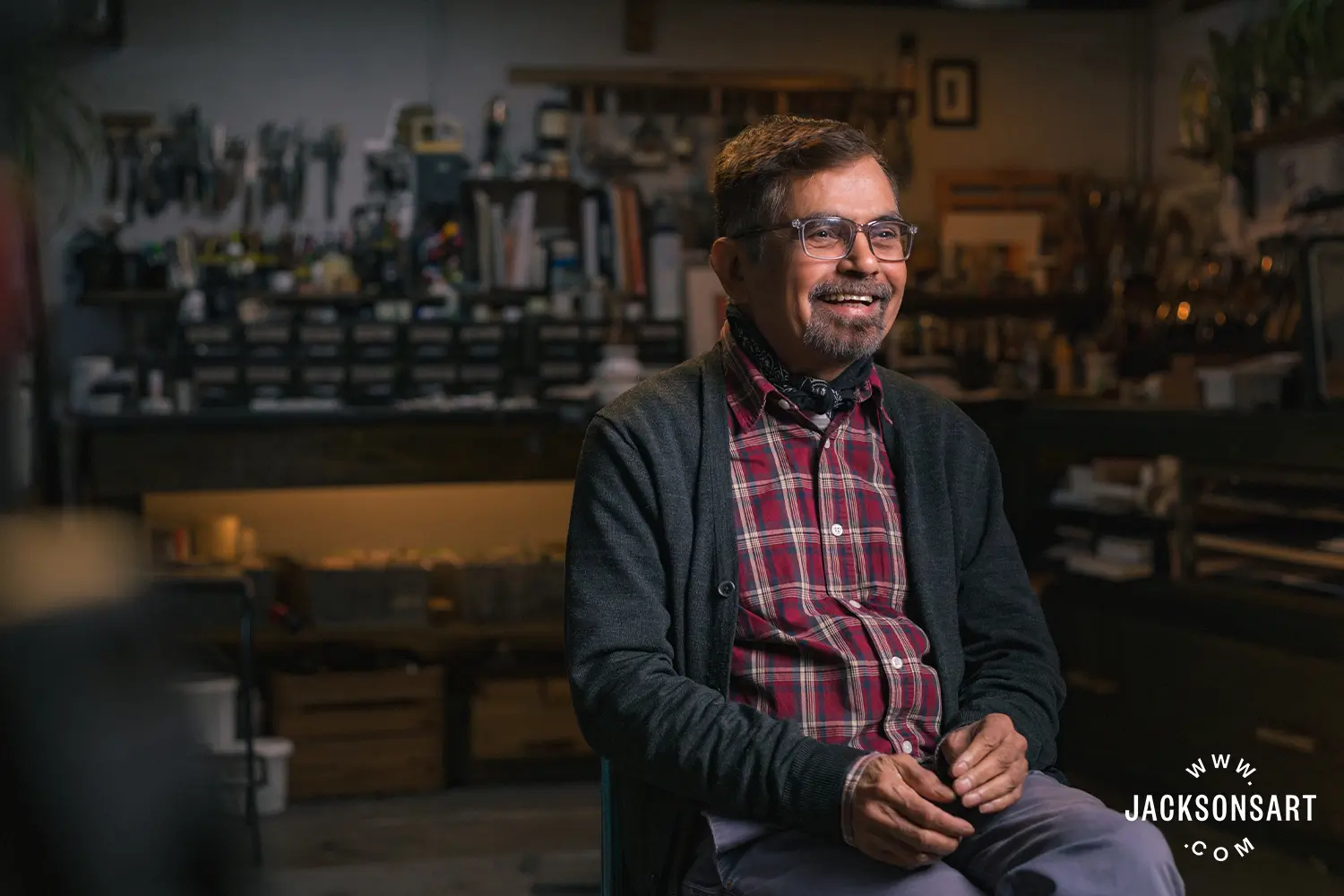
Shanti Panchal is a watercolour artist who grew up in Gujarat, India and is now based in London. In this Artist Insights film, Shanti shares his story, and how childhood memories of sleeping under starry skies, dark nights illuminated with oil lamps, an early fascination with Indian miniatures, and the works of William Blake all inspire his work today. Shanti also explains how he has gone beyond the boundaries of traditional watercolour painting techniques, to develop his unique method with the medium that allows for depth of texture, colour luminosity, and simplicity, to convey a sense of mystery and spirituality in his autobiographical paintings.
Contents
0:00 Introduction
0:50 “I grew up in a remote village in Gujarat, Western India”
1:13 “Since I was ten years old I wanted to be an artist”
2:03 “My earliest creative memory is using red clay to decorate our house”
2:58 “We slept under a starry sky”
3:32 “I wanted to study, so I ran away from home”
4:54 “Jain miniatures are very rich and very beautiful”
5:23 “Eyes are windows to the soul”
5:39 “I’m not interested in what it looks like, I’m interested in what it feels like”
6:10 “When I applied for British Council Scholarship I didn’t think I’d get an interview”
7:12 “Being in London, I saw paintings I’d only seen in books”
7:29 “The space and clarity of Vermeer’s work is amazing”
9:04 “I wanted more from the medium of watercolour”
10:00 “Only Arches Watercolour Paper can take how I work”
10:57 “I spend a lot of time staring at white paper”
11:14 “It’s very important to get the drawings correct”
12:01 “I don’t use too much water”
12:58 “Mixing colour on the paper gives tremendous depth”
13:29 “I don’t mind having ruined brushes”
13:59 “From my own mistakes I have developed this way of working”
14:08 “When you’re looking at my paintings on a screen, you can’t see the texture”
14:29 “I use blotting paper to remove excess paint and water”
14:40 “When I’m doing very detailed work I stop breathing for a few seconds”
14:55 “Watercolour is not explored in the way oil and acrylic is”
15:44 “I’m not in a hurry”
16:10 “My colour palette is limited”
16:46 “It’s important to find a material that suits your temperament”
17:14 “I work in natural light”
17:44 “My work is quite autobiographical”
18:21 “I enjoyed every moment of working on the Brixton station mural”
19:39 “Being an artist you have to face yourself every day”
21:00 “If the work doesn’t touch people, I’ve failed as an artist”
21:59 “You have to believe in what you practice”
22:28 Credits

Shanti Panchal
Watercolour on paper
Extract
I think human beings are the most profound thing on this planet, whatever experiences, whatever background, whatever kind of world they come from. For me, the figure is fundamental, but I’m not really too keen in terms of the likeness. In my work, the simplicity of images and the spiritual content is fundamental to my own journey and my own being. That’s what fascinates me and that’s what makes me get up every day and want to paint.

Shanti Panchal
Watercolour on paper
I grew up mainly in a remote village in Gujarat in Western India. In the village, we had no school, but we had studies under a tree. We had a textbook full of illustrations, which I used to copy and enjoy very much. I always found making art to be fascinating. Since I was ten years old, I thought I wanted to be an artist. Most people in the village were illiterate. My parents could not read or write. The teacher had to record everybody’s date of birth, but nobody had a date of birth. The day the school started was the 1st of June, so all the kids had that date of birth. When I go to the village now, everybody celebrates on the same day. This is part of the world where I grew up. It’s a small village made of mud wall houses, there are no bricks and mortar. Annually my mother would mix cow dung soil in order to cover the walls to kind of refresh it. My earliest creative memory was when there would be a wedding, or a festival, like Diwali, they used to whitewash all the mud wall houses. And then my mother would ask me to decorate ours. We had no colours or brushes. I used red clay from my uncle’s carpentry workshop, which they used to mark the wood, and cut a straight line. I would cut a thin branch from a neem tree, and then hammer it one end to make a brush. I would paint very simple images like birds, animals, and trees. Growing up in the village there would be monsoons where everything flooded, and we would swim through the mud. You almost become part of nature. And because of that, I was exposed to totally raw natural forces. We slept under a starry sky and when you look up, it almost feels like the sky is sitting on your head, like you can almost touch the stars. So you can imagine going through these kinds of experiences, growing up connected with the organic world.

Shanti Panchal
Watercolour on paper
We had only primary school and I always wanted to study, so I had to run away from home when my parents were in another village. I came to Mumbai where my oldest brother lived.
I studied at high school for three years, in a school that was run by a spiritual teacher, and where I had an opportunity to study Indian scriptures. The oldest ones were Upanishads and Vedas, and of course, Bhagavad Gita as part of the Mahabharata, and Ramayana. After high school, I wanted to go to art college, but I didn’t have the funds. My high school art teacher saw that I was really interested and that I was good at art as well, so he said, ‘Look, I can pay your fee and you can stay and sleep in my office’ and I learned office jobs as a payment to his fee, and made my way through the first year of college at Sir J.J. School of Art in Mumbai.

Shanti Panchal
Watercolour on paper
I was mainly working with oil on canvas, and I very much enjoyed it. I also did a lot of figurative painting and portrait painting. We had to copy Indian miniatures. I chose to copy one of the Jain miniatures, which are the earliest Jain miniatures known in India. They are very primitive in a sense, but they’re still very rich and beautiful. If they’re showing a figure, for example, in profile, they will show both eyes, one in the background and one in the face. It fascinated me because it was not like what it should look like, but what it feels like. If you look at the eyes on my paintings, even in the profile, you see the full eye.

Shanti Panchal
Watercolour on paper
One of my shows was called Windows of the Soul. I think we are able to express all emotions through our eyes. I’m not really interested in how they should look, I’m interested in how they feel, and how I can express emotions and feelings about images. That is why the eyes are the windows of the soul. I also copied a Rembrandt self-portrait, and it was fascinating for me to experience how Indian and Western artists made paintings. Those experiences were very important and eye-opening. I then trained as a teacher and worked in a high school while also going to art college. I also did private tuition in the evening, and that’s how I supported my education.

Shanti Panchal
Watercolour on paper
After I finished college, I got a fellowship in the same college so I could teach there. During those two years, I applied for a British Council Scholarship and I didn’t think I would get even an interview. To my surprise, I was awarded the scholarship. Of course, I was pretty nervous and I’d never been anywhere outside India, but I came to London, and I went to the Byam Shaw School of Art. Being in London, and being able to go to museums and art galleries like Tate Gallery and National Gallery, I could see all those paintings which I only used to see in books, and it was an amazing experience and this is where I found true learning. I also went to Amsterdam, where I saw the paintings by Vermeer, and I was fascinated because I thought they were massive in scale, but they were not that big. The kind of space and clarity they evoke is amazing and they look so vast. Studying in the East and the West was amazing.

Shanti Panchal
Watercolour on paper
I was also fascinated by William Blake’s work and his use of watercolour, which I found profoundly moving. Even today, I think William Blake has influenced a generation of artists in many different ways. I feel that watercolour never really evolved in the same way oil and acrylic mediums shifted over time. If you look at watercolour subjects and techniques, they still remain to be pretty flowers and sweet landscapes.
I was taught that you wet your paper, tape it on a board, and work while it’s still damp, so you can get the very fast-moving, atmospheric landscapes, but that wasn’t enough for me. I wanted more out of it.

Shanti Panchal
Watercolour on paper
So I started experimenting with watercolour painting. I used to make holes in paper because I was overworking on it, and then eventually I found this beautiful Arches 640 gsm paper. I’ve used every manufacturer who ever produced watercolour paper. None of them really stand the way I work, but with Arches watercolour paper, I found it really gives you more, almost like working with leather.
It’s such a pleasure to work on a paper that enhances your work. It’s almost like having a conversation with the paper. I initially start drawing on the paper and try to get the composition the way I want, or the narrative of the painting, or sometimes I’m not really aware of what I’m going to do and I spend a lot of time staring at white paper. I work flat when I’m painting, but also have an easel in order to understand and see the proportion of the figures.

Shanti Panchal
Watercolour on paper
If I do an initial sketchbook drawing, and transfer that drawing onto the paper to paint, I find it difficult. It doesn’t really work because my thought process is constantly changing. If you’re breathing, you can look at your pulse, so when I’m doing very detailed work, then I stop breathing for a few seconds in order to get the things that I want within the painting. It’s very important for me to get the drawings correct. I go through several days of really working the composition, and if I look at the drawings underneath, several drawings have been erased and drawn many times. When I start painting, I initially have a vague idea, although it’s impossible to really know what colour I’m going to do. The watercolours I use are very watery, like running colour.

Shanti Panchal
Watercolour on paper
I load pigment in the brush, rather than just simply doing washes of colour. The first layering of colour is never enough. It doesn’t have the kind of strength I want for the painting. I make sure to let each layer dry, otherwise the colours will just bleed into the next layer. I use a hair dryer to speed it up, otherwise it will take months.
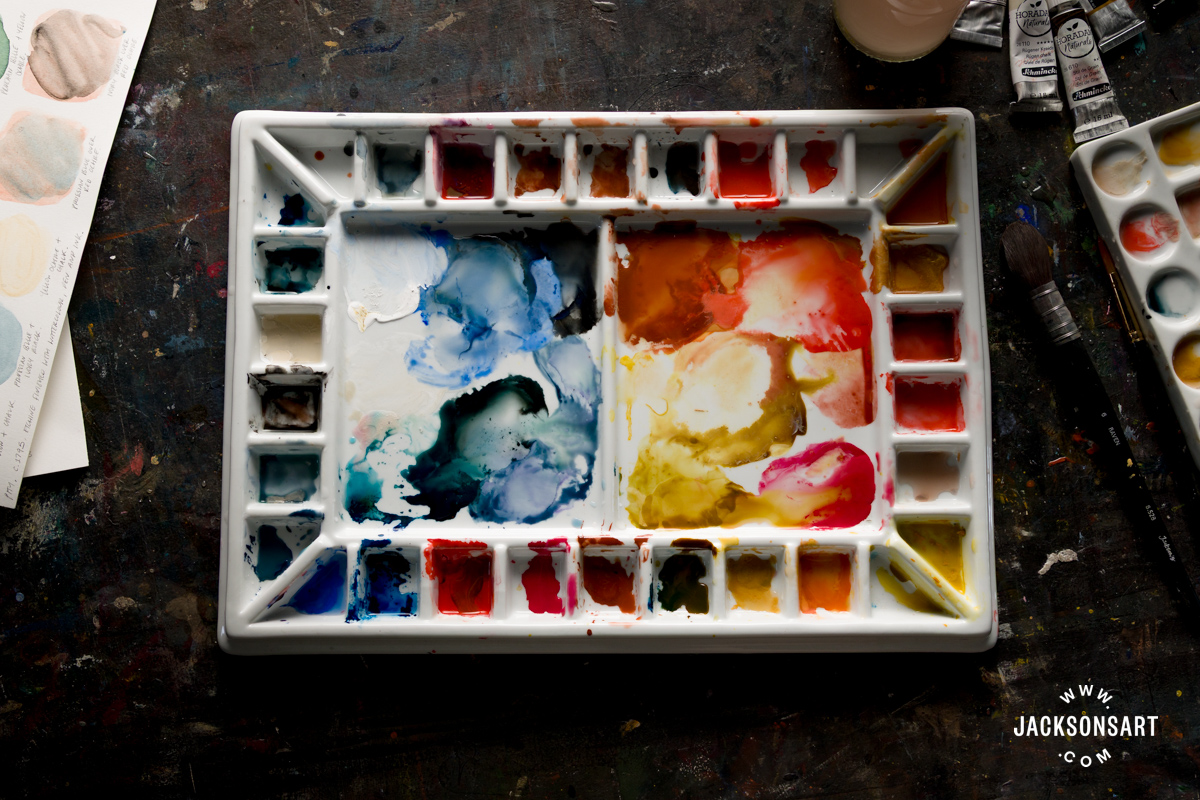
Painting and mixing colour onto the paper, rather than on a palette, also gives tremendous depth. It totally ruins my watercolour brushes when mixing though, but then I use those damaged brushes regularly, so I don’t mind. I also use oil brushes, because they’re harder than watercolour brushes. I mix colour on the paper, rather than on the palette. For example, if I want an orange colour, I paint yellow first, let it dry, and then paint red over it. By doing this, the colour goes deeper into the fibre of the paper and this is why I use a very thick paper. Through my own mistakes, I developed this way of working and it gave me beautiful textured surfaces.

Shanti Panchal
Watercolour on paper
Layering colour really is fascinating because it gives a tremendous depth to the colour and surface, which you rarely see in watercolour. It has a tremendous kind of luminosity which some people say is like a stained glass window. Many people don’t believe it’s watercolour and say they look like oils, pastels, or acrylic. A painting of about four or five feet will take me about four or five months, and nobody has that much time to spend on one painting these days. What some artists produce in six months would take me six years to do, because that’s just the pace I work. But I’m not in a hurry and I do not believe in producing quantity. I’m interested in the quality of my work.
My colour palette is quite limited in a sense, and you will see a handful of colours dominating many paintings. I think that has a lot to do with where I grew up. The brown and ochre mud wall houses, red roof tiles, brilliant blue skies, and mainly earth colours. I really find it hard to deal with blues and greens. I managed to use Ultramarine Blue mixed with red to create a warm blue.

Shanti Panchal
Watercolour on paper
I work in natural light. I actually tried to work in artificial light but the next day I had to change everything because the colours were off, so the light is very important to me.
My work is quite autobiographical, drawn from the experiences that have inspired me or triggered things I would like to paint. I often paint friends and family because they are always inspirational, even doing daily things.
For me, I think human beings are the most profound thing on this planet. Each person is so unique. You could make a film or write a big book about each individual because they are unique in themselves, whatever experiences, whatever background, whatever kind of world they come from. For me, the figure is fundamental. The simplicity of images and the spiritual content are fundamental to my own journey and my own being. That’s what fascinates me, and that’s what makes me get up every day wanting to paint.

Shanti Panchal
Watercolour on paper
TFL (Transport for London) saw my mural in East London, which I painted in 1985 and asked whether I was interested in doing a mural in Brixton. That was fascinating because I always find murals challenging in terms of what I want to say. Many people do not go to museums and art galleries and the role of the mural is bringing art into the community which I think is fantastic. I wasn’t able to paint the mural on the site. I had to do it on a scaled watercolour in my studio and I really enjoyed every moment of working on it. And when it was enlarged on vinyl, I was worried about how the reproduction would be, and whether they would be able to do justice to the colour and the figures. But I was really surprised to see such fantastic results. You could even see that it was a watercolour.

Shanti Panchal
Listen to your own voice, and how you feel about things, what feels comfortable, and what is important to you. I’m never really interested in the sense that I should fit into the system or the current fashion. I believe in just working your own way and looking at art from your own standpoint. Look at your journey as an artist and the colours and images that dominate your practice. Being an artist, you have to face yourself every day and it’s not easy, it’s very daunting to look deeper into yourself. Getting where you want to go in your painting journey is like agony and ecstasy simultaneously but when your painting works the way you want it to, it’s a very uplifting feeling. But when it doesn’t work, you question why the hell you want to paint.

Shanti Panchal
Watercolour on paper
Art should touch people, and I believe that if my art doesn’t touch people, I fail as an artist. Painting draws you in, and sometimes when I’m working on a painting, I don’t want to go anywhere or do anything else. There’s really so much focus in that work. You have to believe in yourself and what you practise. Other people will only believe you if you believe in yourself. Focus on yourself in order to achieve what you want to achieve.
About Shanti Panchal
Shanti Panchal was born in Western India in 1951 and he has been living and painting in London since 1978. Deeply influenced by the country of his birth, Panchal’s work is connected to his childhood years in Mesar North Gujarat- the colours of his village, the embodied spirituality of family life and the intensity of a small farming community. The figures in Panchal’s work carry this interior world with them.
Further Reading
Review of Jackson’s Studio Synthetic Watercolour Brush Series 505
Inside the Sketchbook of Lisa Takahashi
Recreating the Colour Palette of Eric Ravilious
Shop Watercolour Painting on jacksonsart.com
6 thoughts on “Artist Insights: Shanti Panchal”
Wonderful perspective on living as an
artist and being true to oneself
We couldn’t agree more! Thanks for sharing Nina.
He’s so great! He’s given me a lot of ideas
and I love how he didn’t want to stick to
the boundaries of traditional watercolours
– I find that I also rip the paper because I
want more out of it and it’s bit restricting,
definitely think I should also start working
on thicker paper and maybe I’ll finally
enjoy watercolours!
Thanks for sharing your thoughts Nancy!
Thank you so much Shanti for showing
your painting method and philosophy.
The paintings are beautiful and the
quality of the colours that you achieve
are revelatory. May I ask what brand of
paints are you using?
Hi Moira, in this film Shanti is using Winsor & Newton Professional Watercolour Paint. Thanks!
Comments are closed.