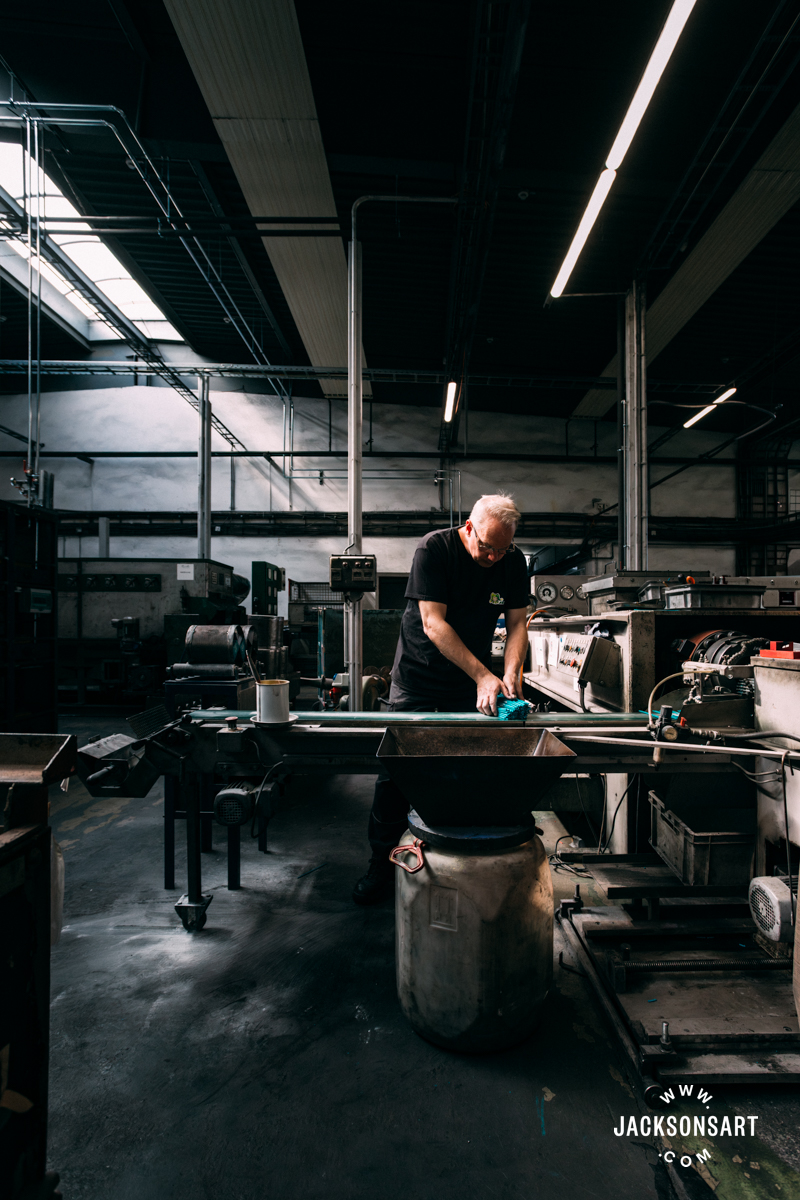
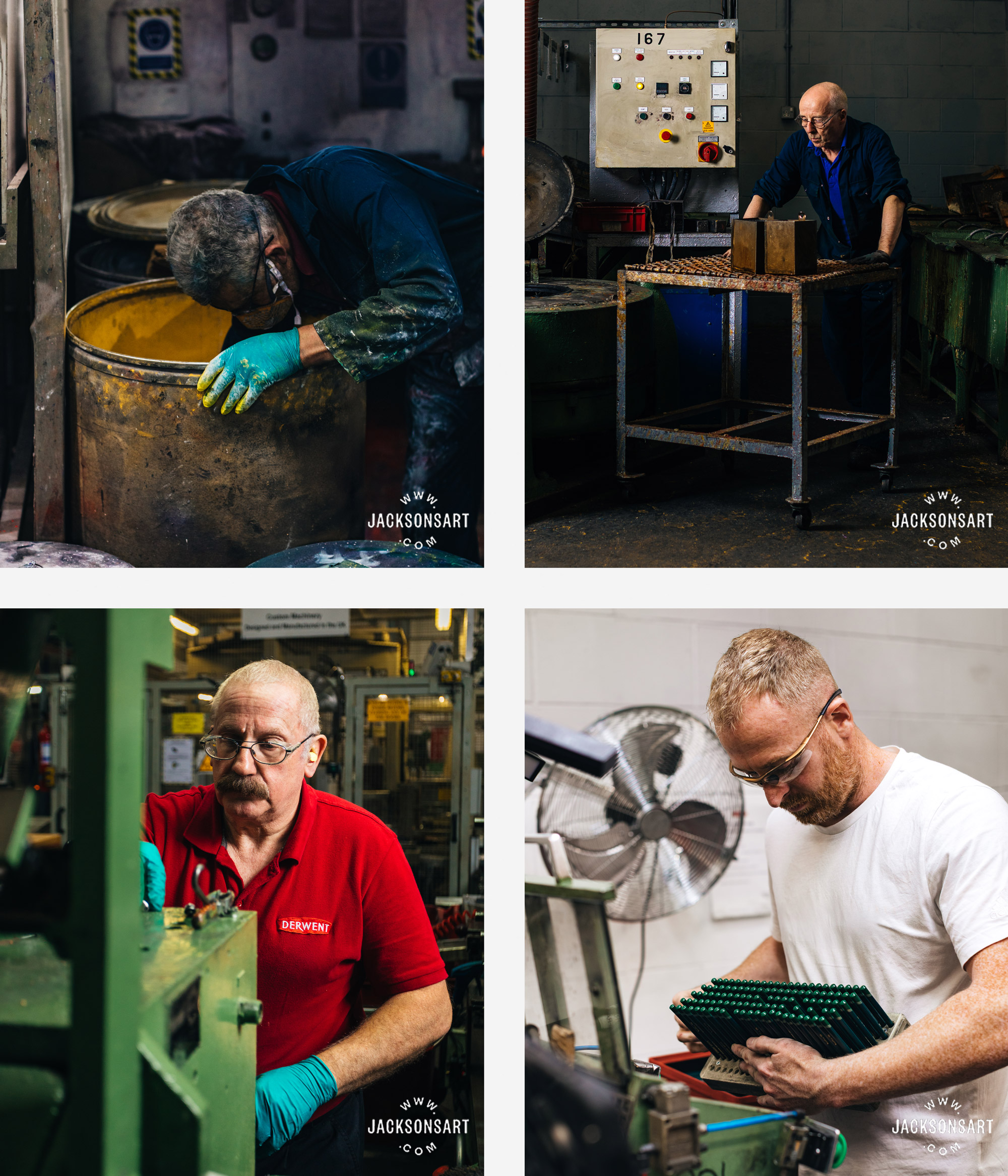
Our On Location series reveals where some of the best-loved art materials are made, and provides insight into the working methods of the people who make them. This time, we travelled to England’s beautiful Lake District in Cumbria to visit the Derwent pencil factory. Here, highly experienced workers produce a wide range of artists’ pencils, drawing tools, and accessories, from their heritage Artists coloured pencil range and innovative Inktense collections to their premium Lightfast pencils.
On Location at Derwent
A Brief History of Derwent
The original Derwent factory was based in Keswick, close to the historic Seathwaite graphite mine in the Borrowdale Valley. This site, discovered in the 1500s, after a tree was upturned in a storm, was found to be rich in deposits of the purest graphite. At first, its potential was not realised, and local farmers, calling it ‘wad’, used it to mark their sheep. But gradually, its unique mark-making qualities began to be realised.

The pencil only became a commercial venture from the 1790s, and by the early 1800s, there were thirteen manufacturers in Keswick, building a reputation for the finest pencils in the world. Derwent outlived them all, having its roots in one of the first pencil factories established by Banks, Son & Co. in 1832. This became the Cumberland Pencil Company in 1916 and was renamed Derwent (after one of its branded products) in the 1980s.
Relocation to Lillyhall, Workington
Derwent’s factory can now be found in Workington, nestled on the edge of the dramatic, awe-inspiring landscape that is the Lake District. A short distance from Keswick, the relocation to a vast, super-efficient modern space was designed to assimilate their expanded product range, a more eco-friendly production process, and cope with the company’s ever-growing popularity with artists around the world. The aircraft hangar-style premises comprise busy administrative offices, a state-of-the-art laboratory, and at its beating heart, the expansive factory floor.

How a Derwent Pencil is Made – From Colour Mixing to Packing
Entering from the reception area, a small entrance does not prepare you for the high halls of the industrious factory floor. Along with the sound of machines and staff busy at work comes an aroma not dissimilar to a bakery. As we made our way to the first stage of production, we passed the packing area where forklift trucks load and unload finished products from and onto banks of metal shelving units that reach into the rafters.

Mixing
Each product goes through a sequence of stages before it finally arrives in the packing area. The first is to prepare the correct mix, whether it be adding clays to pure graphite, pigments and waxes for colour leads, or pigments and binders for paint pans. An expert colour mixer consults a recipe form, known as a ‘works order’. This form lists the correct ratio of each part. A scoop is used to attain the right weight and proportion of the separate ingredients as they are tipped into a paper sack.

Once this batch preparation is complete, the sack is taken to a bank of mixing machines. A particular machine will be selected based on the colour to be mixed. This avoids contamination of colours, so yellows are not mixed in the same machine as blues, for example. The mix is poured into the machine, and water is added to make a paste.
The machine churns and heats the paste to achieve the right moisture content, a crucial factor that allows for the manipulation and crafting of a particular range. The person who is mixing will check the moisture content on a moisture balance. They will also check the colour using what are known as ‘standards’ – archived examples of the original product, some of which date as far back as the 1930s when they were first conceived.

Billeting and Pressing
With the colour mix completed, it can go one of two ways, depending on the type of product. Mixes intended for pencils are put through a Loader. This machine begins the process of turning the mix into the ‘strips’ that form the colour core of a Derwent pencil. It does this by compressing the mix together and using a vacuum system, removing any pockets of air and then squeezing out large rolls of pigment called billets.

The billets are loaded into the Press. The Press can be fitted with dies of varying diameters appropriate to the product being produced. Thus, the larger core of a Coloursoft pencil will require a larger diameter of strip compared to the slimmer core of a Chromaflow pencil. The machine pushes out the strips and cuts them at the same time.

These are loaded into Rolling Cans, which continuously roll the strips. This rolling motion ensures they remain straight and prevents warping. The strips are then placed in an oven and kept turning while they are baked for between two and four hours, until fully dry. Once again, they are checked for the correct moisture content once they have left the oven.

In the case of graphite products, such as the iconic Graphic range, they are placed in a furnace overnight at up to 1000 degrees centigrade. The ball clay used in graphite products is crucially altered by the intense heat, giving it its key writing properties.

Another route is taken by more painterly products, including Inktense blocks and paint pans, once the colour mix has passed through the same billeting stage. Before the billets are pressed, an imprint template must be selected, which embosses the batch with the appropriate branding and relevant product information. These products are baked overnight to attain the correct moisture content (below 0.5% as a rule) before being sent for packing via quality control.

Wax Preparation
With the exception of pastel and charcoal pencils, which are now ready for Woodwork, all other pencil strips are loaded into tins for wax preparation. The strips are marinated in vats of wax for between two and 24 hours. Different types of waxes are used for each range, including watersoluble, soft, and hard waxes. The waxing process gives the strips their unique texture, integrity, and character. This includes balancing hardness for point retention with softness for smooth colour application and blendability. The specific wax combination contributes to each pencil line’s distinctive feel and performance.

If a strip has not absorbed the required amount of wax, it will reveal a ring in the centre. Once this is checked, the tins are loaded into a centrifuge, which, as it spins, removes any excess wax solution. At this stage, samples are sent to the laboratory where checks are performed for diameter, breaking strain, and texture, as well as colour and degree grade integrity.

Woodwork
The Derwent professional range of pencils is made using Californian cedar wood. Its qualities, including the lack of knots and the ease with which it sharpens, make it the perfect wood for the crafting of artists’ pencils. The cedar wood comes in slats, thin strips of wood which are sent through a Grooving Machine. This applies eight or nine grooves to each slat. A special, customised PVA glue is applied, and the slats are then sandwiched together with the pencil strips inside. These are then sent along a conveyor belt to the Clamping Machine, which firmly compresses them together.

Shaping
The glued slats are now ready for shaping, where they will either be cut into a round or hexagonal shape. A machine planes the slats one side at a time into the desired shape. The sawdust created from the woodworking phase is not discarded. Rather, it is gathered together and recycled as an energy source to heat the factory. Astonishingly, this provides two-thirds of the factory’s heating in winter and all of it in summer.

Barrel Painting
Now that the pencils have been cut to shape, the barrels are ready for painting. A Works Order specifies the appropriate branding colour mix, which is made using colour chips in lacquer to achieve a durable paint. A colour match is sent to the laboratory for approval before the full batch is painted.
The barrels are placed in a Hopper, which pushes them through cylinders where the pre-mixed lacquer is applied. Each coat is deliberately thin to achieve a smooth finish, and a long conveyor belt allows for drying between each of the four coats of lacquer needed.

End Rounding, Stamping, and Sanding
The painted pencils are now loaded onto a machine that gently rounds off the ends. Information unique to each brand of pencil is then stamped onto the barrels using heat and force to apply the hot foil. To complete this stage, a sanding belt shapes and sharpens the pencil tips.

Dipping
Each pencil must now be vat-dipped with two-colour end-tips applied at a slant – the slant being a signature of the Derwent brand. The first colour denotes a particular range, while the second indicates the pencil’s colour.
Pencils are loaded onto angled dipping boards and queued for the Dipping Machine. The machine slowly lowers the tips into the dipping lacquer to avoid any sloshing or waves, left submerged for a short time, and lifted out again. Once the second colour band has been applied in the same way, the racked-up pencils are rolled into a Hot Box (a large metal cupboard), which fully dries the lacquer.

Unloading
Before packing, the pencil racks are removed from the Hot Box, and a machine is used to transfer the pencils from the dipping racks into cartons that create a ‘gross’ (approximately 144 pencils per gross). This is also the chance for one more quality check before they are stacked on shelves in the packing area.

Packing
This is the area where staff box, shrink wrap, and label all the products before they make their way across the world. All the machines mentioned previously are carefully manned and monitored by specialised staff, and it was good to discover that the packing department is the same, with minimal reliance on automation. Derwent describe this as a further extension of their quality control and a testament to the attentiveness and diligence of their packing team.

When assembling a set of colour pencils, for example, each team member is assigned six or more colours from the set’s sequence of colours. The team works in tandem, hand-loading their quota as each tin passes along a conveyor belt, picking the pencils from an angled shelf in front of them. The bank of shelves and conveyor belt is in a horseshoe shape, allowing up to 12 people to work in this way.

The Lab
An integral part of the pencil-making process as well as a place of innovation, Derwent’s Laboratory is a clean, modest space comprising three compact rooms with workbenches, cupboards, and scientific-looking apparatus. The main room is where regular tests are conducted on current batches of art materials as they pass through the different stages of their production journey.
In the case of pigments, each batch is tested by taking a sample, which is mixed with a little oil using a muller. A shade testing book allows staff to compare the mix with examples against the standards mentioned earlier. The colour chips used for colouring the pencil barrels are tested similarly, except they are mixed with a lacquer binder.
When it comes to Graphite pencils and their various degrees, this is checked by examining their colour, texture, and even their sound. All sample cores, whether graphite or colour, are tested on a Force Gauge, which breaks the strip and reports the breaking strain. Paint pans are tested by their weight.

A second room is devoted to lightfast testing. Derwent uses one of two methods, depending on the type of product. The first is based on the Blue Wool Scale. This is literally a wool swatch, which is used to compare a colour’s lightfastness once it has been exposed to light using a special Light Machine, not dissimilar to a standard-sized fridge. Swatches are prepared on strips and exposed to light in increments of 25, 50, 100, and 200 hours. These are then compared against the wool swatch.
Derwent’s Lightfast pencil range requires a more rigorous test due to its ASTM D-6901 rating, which is the ultimate standard for lightfast integrity. For this, colour batches are sent to a US company that exposes them to the fierce desert sun in Arizona. An accelerated Light Machine is then used for in-depth comparison.
The third room has a more experimental feel. This is where new products are explored, developed, and tested. Derwent are constantly innovating, and this is where the magic happens and new ideas are born. Ad hoc product testing and random checks are also conducted here. Additionally, this space is where new or replacement pigments are taken through their paces.

A Visit to the Derwent Museum
Derwent’s long presence in the Lake District has made them an icon of the community, and this is reflected not only in the loyalty of its locally employed staff (many of whom reach down the generations) but also by the popular Derwent Museum. Based in a modest outbuilding on the original factory site in Keswick, it was opened in 1981 and now receives well over 70,000 visitors a year. Notable visitors have included Chris Evans and John Craven, and it was even used as a location in the 2012 Ben Wheatley film Sightseers.

The museum not only tells the story of Derwent’s history and evolution, but it also documents the history of the pencil through the ages. You enter through a replica of the Seathwaite graphite mine with its dark, twisting tunnels and life-size models of mine workers to emerge into a brightly lit space where information panels, display cases, and artefacts take you on a journey of all things pencil-related. This includes two of the oldest colour pencils (one in red, the other blue), which were made between 1820 and 1887 by stationery company Smith & Warner. Original Banks, Son & Co. pencils from 1834 can also be viewed, along with examples of Derwent’s Lake District-inspired packaging from the 1930s onwards.

At the heart of the museum is one of the world’s longest pencils. Measuring nearly 8 metres long and weighing almost 450 kilograms, this fully working Derwent Studio Pencil only lacks a giant sharpener to go with it. Other highlights include one of two specially crafted Derwent pencils topped with a crown decorated with 60 diamonds – the other gifted to the Queen to commemorate her Diamond Jubilee. Another is Derwent’s intriguing WW2 Pencil. MI9 secret service agent Charles Fraser-Smith (rumoured to be the inspiration for Ian Fleming’s James Bond gadget-master, Q) commissioned the pencil in 1942. It was requested that the pencil was to conceal a compass and a map for airmen during the war. Derwent’s finest technicians worked long hours to come up with a solution, and the result was so ingenious that later attempts to remake it were never quite as good.

We left the museum fully sated with the history of the pencil and Derwent’s crucial role in how this deceptively simple but essential artist’s tool has been crafted and improved over the centuries. We headed out along the beautiful banks of Derwentwater in search of the old Seathwaite mines, where it all began, all those years ago.

Watch our On Location film to see how Derwent pencils are made:
Further Reading
The Dark History of the Pencil
Artist Review: Derwent Drawing Pencils
Preparatory Drawing Methods for Painting
Shop Derwent on jacksonsart.com