




We sit down in the Jackson’s Studio with Tom Lewington, Global Sales Director, and Adam Gaskell, Technical Manager at Derwent, to hear the story behind the brand. From its roots in England’s Lake District, the historical source of the world’s richest graphite, to its modern innovations in pencil making, Derwent’s journey spans nearly two centuries of craftsmanship. In this interview, Tom and Adam share how the company’s heritage and deep connection to artists continue to shape every product they make – from raw materials to the finished pencil.
Above image: Tom Lewington and Adam Gaskell of Derwent
Contents
0:00 Introduction
1:38 Can you tell us about the very beginnings of Derwent?
2:59 What was the first Derwent product made, and who was it aimed at?
3:55 Derwent are a world-renowned manufacturer of artist pencils. Tell us more about how your brand achieved this.
6:50 Can you tell us about Derwent’s production? Walk us through the steps in producing a pencil.
12:41 How do you colour the outside of a pencil?
14:57 Can you tell us about the wood used for your pencils?
16:15 What is mixed with graphite to make a pencil lead, and how do you achieve the different degrees of hardness?
16:57 You have a laboratory on site at Workington. Can you tell us about the research and tests that are carried out in the lab?
18:41 Tell us about the quality of your products and the test used to ensure their lightfastness under museum conditions.
20:14 Do you have any inside hints and tips on how artists can make the most of your products?
21:24 Can you tell us how the company operates in terms of teamwork? What is the general atmosphere at Derwent?
23:57 What are the values that you hope to portray?
24:43 The Derwent Museum is located in the original factory grounds. Can you tell us about the museum and its history?
27:28 The Museum also includes a specially designed secret pencil that was used in WW2. Can you share this story?
29:18 One of the world’s longest pencils is displayed in the Museum. Can you tell us what went into the making of this pencil?
31:00 Tell us about the relocation to Workington, not far from Keswick, and how it came to be opened by the Queen.
31:23 Derwent’s legacy
32:56 Credits

Film Extract
The name Derwent actually comes from the River Derwent, which flows through the Lake District. And it was how we transported the wood through the countryside to get from the port all the way to the original factories in Keswick. So the Derwent water is how we’ve got our name.
Here at Derwent, we’re all about innovation. So when you have a look at our range, you’ll see that we have a pencil for every different type of art, basically. And the thing to appreciate here is that every artist is different.
I’m Tom Lewington, Global Sales Director from Derwent. I’m here in the Jackson studio to talk about Derwent. And I’m Adam Gaskell, I’m the technical manager at Derwent, and we’re also going to talk about how pencils are made.

Can you tell us about the very beginnings of Derwent? Who founded the company, and when did the production of Derwent pencils begin?
The Derwent business really began all the way back in 1832, and it was the Banks family that set up the first mill in the Keswick area. The Banks family set up the mill in that area on purpose because the world’s richest and purest quality graphite is actually from the Borrowdale Valley just around the corner. And that’s where the very first pencil was actually created. Literally, underneath the roots of a tree, a farmer picked up some graphite, wrapped it in sheep’s wool and marked his sheep. That’s the beginning of the first pencil, as it were.
And that remains, even today, the richest graphite source in the world. The mine actually closed back in the late 1800s. Ann Banks was the last of the Banks family that owned the graphite mine in Borrowdale. And when she passed away, she handed over the mine to the National Trust.

Image courtesy of Derwent
Originally, the company was called The Cumberland Pencil Company. Tell us how the company has evolved and how it came to be renamed Derwent.
The original Cumberland Pencil Company products were all graphite pencils, and they were literally designed for any pencil user who needed a graphite pencil. They evolved and took form in several different ways, including the development of products such as black-edged pencils used by carpenters with different wooden barrel inserts. And that carried on for several years, all the way through to the beginning of the 20th century, where we actually launched the Lakeland Ranger pencils under the Derwent brand, which was still a part of the Cumberland Pencil Company at that time. And now, the Derwent brand is actually what we’re known as.
Technically, we’re still known as the Cumberland Pencil Company to Her Majesty’s Companies House. But actually, everybody will know us as Derwent, the brand that is now sold in over 120 countries worldwide and has the largest range of expert pencil solutions in the art industry.

Image courtesy of Derwent
Derwent are a world-renowned manufacturer of artist pencils. Tell us more about how your brand has achieved this and your values in terms of look, quality, and your relationship to your customers.
Our artists, our customers, are at the forefront of everything we do. We only create solutions and artist materials that solve the needs they truly have. So every aspect of design and testing is with them in mind. And what that meant through our years is that we realised through their help that we needed different solutions to solve different problems. Whether that be a need for softer pencils or harder pencils or with higher colour intensity pencils, some that were dry, some of the watersoluble, we would make it with them in mind.

As artists’ needs and tastes have changed, Derwent has very much been at the forefront of innovating and making sure that what we bring to market really solves the needs of today. That means we’ve extended outside of pencils into mixed media. So we now have a very good range of paint pans, pastels and all of the accessories you would need to get the most out of those artist materials.

I’ve worked in the lab for 25 years. I started as a quality technician, then I moved into research and development. Every batch that is made is tested against a set of standards in the lab. And for our Graphic range, the oldest in our collection, those standards date back to 1938. So every Graphic pencil that you use will have the same quality as the first production that was made back then.

Can you tell us about Derwent’s production? Walk us through the steps in producing a pencil.
To make a pencil, the first thing we need is a set of ingredients. The mixes will contain French chalk, a gum binder, and pigment. That’s very basic. And then as we go through the ranges, others will have ingredients added to give it such and such a property. The ingredients are weighed up into a big sack. That sack will get added to the mixer. The mixer will churn it up along with water. What you’re doing with that is you’re making it into a big paste, which will disperse all of the colour pigments in there. We’ll then add heat to that mix, and we’ll take it to a set temperature.
So, when the mix is at its set moisture content, it can go either one of two ways. It can either go over to be extruded in the block and paint pan machine, or it can go another way to make a pencil.

A billet is effectively a big cylinder of compressed mix. We put the mix in a big tube, and then it’s compressed together to make a giant billet. What we’re doing here is getting rid of all the air pockets. So, that billet will now move into the machine, which is called the press. What this is doing is you have a big piston coming from one side and pushing that billet through a small hole, which will tell you the size of your pencil. This is forming the inside of the pencil that we in the factory call the strip.

Once the strip is pressed out, it will still have moisture in it, so it’ll be quite wobbly. We’ll then put the strips into cans and put them onto a roller to straighten them up. When we’re happy that they’re nice and straight, we’ll take the strips and put them in the oven. The oven is rotating constantly at a set temperature, and they tend to be in there between two and four hours.

Once the strips are fully dried, they will then go on to the next stage. If it’s graphite, it needs to go into a furnace. The furnace will heat the graphite strips up to upwards of 1000 degrees. This will vitrify the strips and turn them more glass-like.
If it’s a pastel or a charcoal pencil, it is now ready to go. If it’s a colouring pencil or a watersoluble pencil, it will need to go into wax. Once they’ve been in the wax for the desired amount of time, they then go into the centrifuge, which basically means that they’ll spin very fast, and all the excess wax will go to the outside and drain out of the centrifuge.

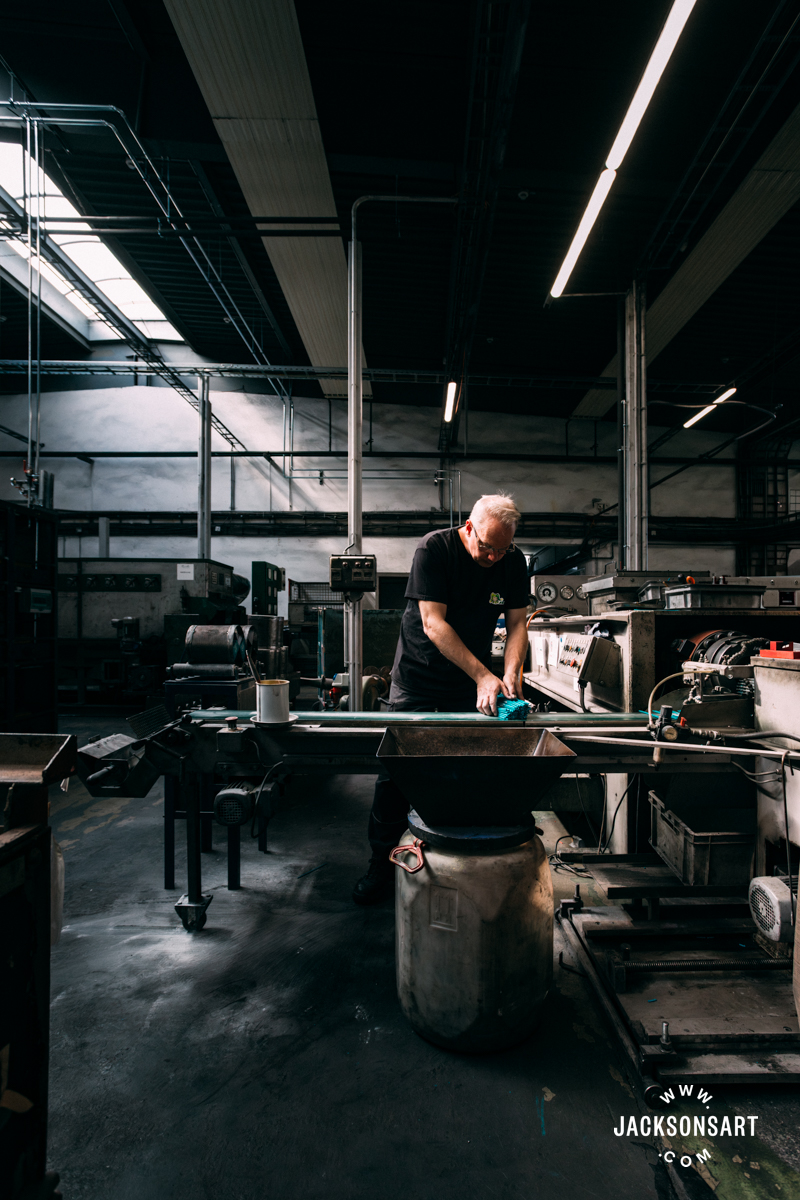
Once the strips have all been passed off for colour checks and strength, they move on to woodwork. This is where we put the strip into the wood. The woodwork machine needs to be set before we set it off. So what they’ll do is take the diameter of each strip that comes through. Because what you’ll find is, even if, say, all the strips are 3.45 millimetres, depending on what colour is in there, it might shrink a little bit more, it might expand a little bit. So the machine is calibrated so that it’s ready for that particular size of pencil going through. What we’ll have is two different slats, and both slats will have glue applied. One side will have the strip actually placed in it. They’ll go along the machine, and then one side gets turned over and put on top. This is what we call a sandwich.

The sandwich then goes into a stack. The slats will all stack up in a row, and then they’ll be compressed together, and they’ll be set there whilst the glue sets. That then goes through the shaping machine that has blades which will spin really quickly and shape it either into a hexagon or a round pencil.
When the machine’s being set, you’ll have one person on one side setting off the machine, and they’ll send it right through until the pencils come out the other end. So it starts with slats, comes out the other end as pencils, and we push the button on full production until the person on the other side is happy and gives the thumbs up.

So now we have our finished pencil, but there’s no livery on it. The staff in the paint room will come and collect the pencils to be painted. We have a small pot of paint, and the pencil is pushed through that little pot, and a very light layer is painted on. That will then go down a conveyor slowly, and when it gets to the end, it’s touch dry, will drop onto the bottom, go back, and start again. The pencil will have between four and six coats on it.
So once the pencil is painted, they are put through the finishing machine. The finishing machine will stamp on what the product is and the name of the colour inside it, and it will also sharpen the pencil. Now the pencils need to be dipped to give them the end colour. When the pencils are loaded onto the dipping machines, they’re tilted to a certain angle to get our signature angle dip, dropped into the machine and slowly brought back out of the paint so you don’t get any bubbles or anything like that on the ends of the pencil. Once it’s been dipped and dried, it can then move through as a finished pencil.

In the packaging department, we have racks of finished products. We then have different stations set up throughout the boxing department where pencils can be set into tins. It takes up most of the room to sit around a big horseshoe with each person putting in four pencils at a time. We use people over machines because we have found no machine can replicate the speed and precision of humans, plus we are the last line of defence for the quality of the products. Once all the sets have been completed and everything’s packaged, they’re then sent out around the world.

What is mixed with graphite to make a pencil lead, and how do you achieve the different degrees of hardness?
We now have the largest selection of graphite pencils called our Graphic range, and it ranges from 13B to 9H. What that means is the 9H, the H stands for hardness, and the B stands for blackness. So, the 13 is very, very dark, which means there’s more graphite in it, and the H stands for hardness, which means there’s more clay in it.

The makeup of a graphic pencil is effectively both clay and graphite. The more graphite you put in, the blacker the pencil becomes. The more clay you put in, the lighter it becomes and the harder the texture is.
Can you tell us about the wood used for your pencils?
The Derwent range uses several types of wood, and they’re all specific to what we need from that particular pencil. For our professional ranges, we use California Cedarwood, which is sourced purely for its qualities. It’s very robust, very lightweight, very, very consistent quality.

Tell us about the lightfastness of your products and the tests used to ensure their quality.
We launched the Lightfast range of pencils in 2018. Our Lightfast pencils are tested to the D6901 lightfast standard. To ensure accuracy, we create a block of colour and send it to an external company for testing. They assess it in two ways – first, using a specialised machine that simulates sunlight exposure. A delta-E reading is taken before and after to measure any colour shift or fading. The samples are also placed outside in the Arizona sunshine, where they’re exposed to intense natural light and tested in the same way.

The Lightfast range consists of 100 colours of 100% lightfast, truly lightfast, LF grade 1, and LF grade 2 pencils. And the consistency through that range is absolutely magnificent.
There is a range of how-to guides designed to help artists get the most out of each collection, whether it’s the Lightfast range, where you can see how Jesse Lane created his commissioned pieces, or the Inktense range of pencils and paints, where Jake Spicer demonstrates how he created the pieces he did for those commissions. There’s a lot of educational material available for everyone to explore.

Derwent runs an annual international art prize. Can you tell us more?
The Derwent Art Prize, now in its eighth instalment, began back in 2012 and has grown into a truly global art prize. Anyone from around the world can enter, as long as their work is created using graphite, watercolour, coloured, or pastel pencils — it really doesn’t matter which. With a significant prize fund designed to support artists in their creative journey, it’s a fantastic opportunity to showcase the talent and quality of emerging and ambitious artists.

The Derwent Museum is located in the original factory grounds in Keswick. Can you tell us about the museum and its history?
Our museum in Keswick, set among some of the most beautiful scenery in the world, welcomes around 70,000 visitors each year. Inside, you’ll find interactive displays exploring the history of our industry, company, and products, along with opportunities to try our materials through art classes and workshops. The original factory building still stands beside the museum, fully renovated and beautifully preserved, a proud reminder of our heritage.
On weekends, during half terms, and throughout the summer, we run artist-led workshops for junior artists and anyone keen to join in, no booking required. These sessions focus on developing techniques and getting the most from the Derwent range.

One of world’s longest pencil is displayed at the heart of the museum. Can you tell us what went into the making of this pencil?
One of the world’s longest colour pencils was actually 25 feet or 7.91 metres long. It was created by shaping two very, very long pieces of wood, two very heavy pieces of wood, and making sure that they were bored out and the pencil strip mixture was poured in the middle. They were then closed together and glued up. They were then spray-painted and stencilled so that it looked like a fully operational studio pencil, and then the end was sharpened with chainsaws. Importantly, for it to be recognised as the world’s longest colour pencil, we had to make a proper mark on a surface.

Much of the branding reflects the English countryside and the Lake District in particular. What are the values that you hope to portray
The Derwent business is very much one of family. When we were in Keswick at the original factory site, it really was a series of families that were running the particular business and production unit. When the old site could no longer support modern manufacturing, we built a new factory just 20 minutes away in Workington, moving not only the traditional pencil machines but also the skilled teams who know them best. Staying local was essential – it’s the people that make the particular brands and pencils what they are, their quality, their expertise.
So the Derwent brand is all about legacy, and that family knowledge that’s passed out from generation to generation is so important in making sure that the very involved process of making a pencil delivers the right outcome.

Further Reading
The Dark History of the Pencil
Artist Review: Derwent Drawing Pencils
Shop Derwent on jacksonsart.com

7 thoughts on “In Conversation with Derwent”
What a fascinating & beautifully curated
& shot film. I’ll look at the humble pencil
with new admiration! The attention to
detail in making these pencils is so
impressive & seeing the expertise of the
technicians & the whole process
involved – fascinating
Thank you, we’re so glad you enjoyed the film. There’s so much history, care, and craftsmanship behind pencils that often goes unnoticed. Learning more about the background of pencil making at Derwent has certainly made me look at this all-important tool with fresh eyes.
Even if I wasn’t a fan of the Derwent brand,
this was wonderful; you truly realize what
little miracles of engineering simple pencils
can be.
Absolutely fascinating to get an insight
into the history and production of
derwent pencils. It is inspiring to learn
as an artist behind the scenes and how
an end product is made. I am so proud to
be using the pencils with the historic
significance and rooted in England.
Fascinating. I remember using
Cumberland colouring pencils as a child
in the 60s, and “lakeland” I think.
That was the best, most interesting video
I’ve ever seen . Thankyou so much. At one
point pencil sharpener was mentioned.
Which sharpener does Derwent recommend?.
We have limited access here.
Hello June,
Thank you very much for the kind words, it’s so lovely to hear that you enjoyed the film.
Derwent produce a number of pencil sharpeners, which can be found on our website here.
Comments are closed.