



Qīnglǜ Shānshuǐ (青綠山水), often translated as Blue-Green landscape painting, is a style of Chinese landscape painting characterised by the use of the mineral pigments Azurite (blue) and Malachite (green). This article explores the historical development of the Blue-Green style, the cultural and philosophical meanings of landscape painting in China, and the material and spiritual significance of the pigments themselves.
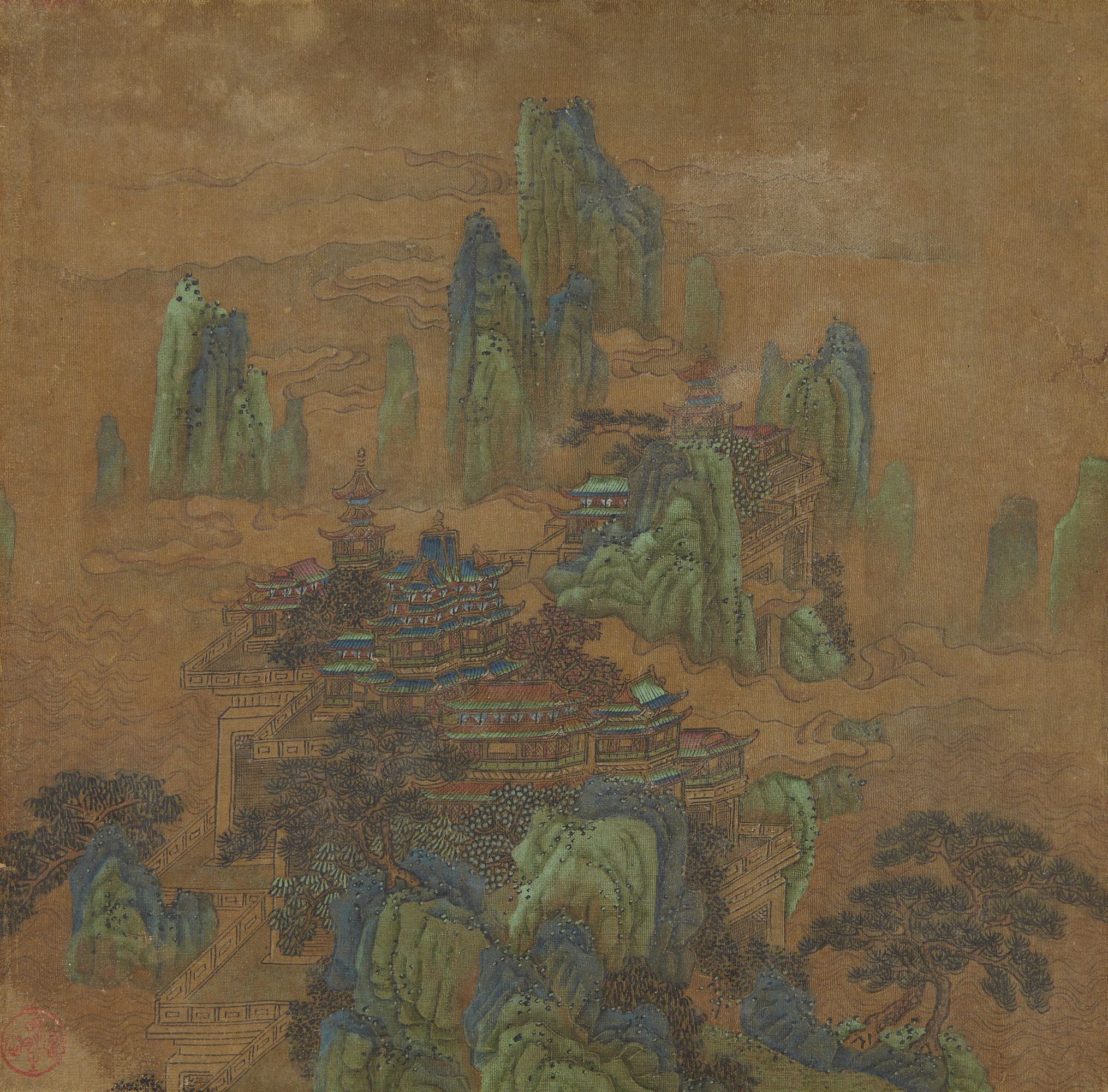
Unknown Artist
Album leaf; ink and colour on silk, 26.4 x 26.7 cm | 10.4 × 10.5 in
Princeton University Art Museum
Gift of DuBois Schanck Morris, Class of 1893
Mineral Pigments in Chinese Blue-Green Landscape Painting
The Emergence of Chinese Landscape Painting
By the Tang dynasty (618-907), landscape painting was firmly established as an independent genre in Chinese art. Influenced by Daoist thought, the natural world was understood as a site of spiritual refuge from the pressures of everyday life. For scholar-officials (the literati), withdrawal into nature was an aspirational ideal, explored through painting, calligraphy, and poetry. A Daoist poem expressed this concept:
“To tranquilize one’s mind is to nourish one’s spirit;
To nourish the spirit is to return to Nature.”
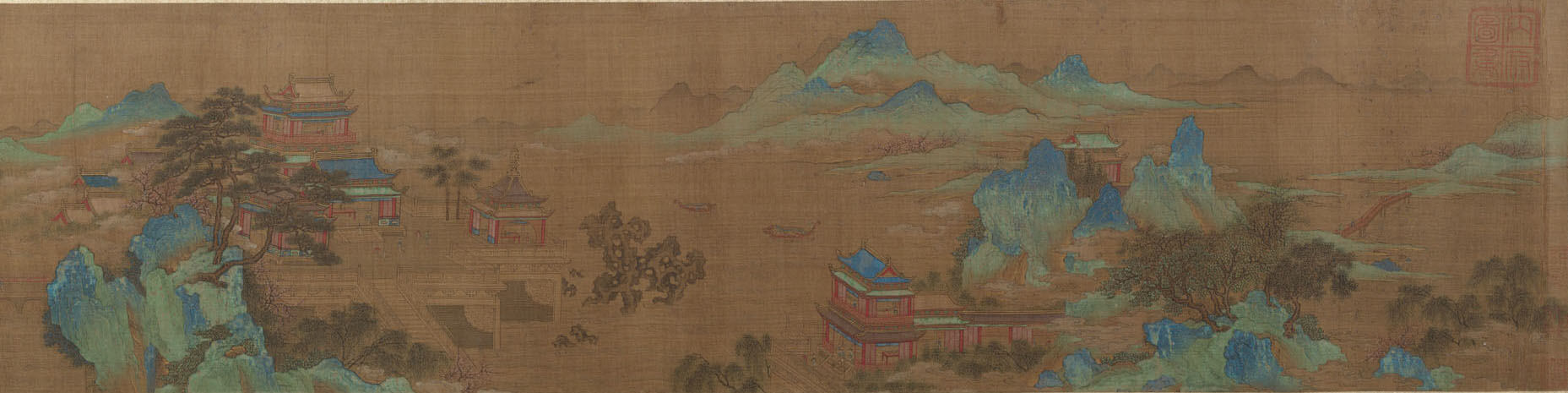
Unknown Artist, Formerly Attributed to Zhao Boju
Handscroll; ink and colour on silk, 16.2 × 87.6 cm | 6.4 × 34.5 in
The Metropolitan Museum of Art
From the Collection of A. W. Bahr, Purchase, Fletcher Fund, 1947
The Tang dynasty painter Li Sixun is widely credited with establishing the Blue-Green style, although Azurite and Malachite were used to paint landscapes long before, with an early example found in 6th-century Buddhist wall paintings in Dunhuang.
Landscape and the Imagination
Viewing a landscape painting was thought to be a form of mental travel – the viewer’s eye moves through shifting perspectives as if journeying through the terrain itself. For an artist, too, the act of painting could be an imaginative journey. The famous landscape painter and musician Zong Bing (375-443) wrote:
“And so by living in leisure
By nourishing the spirit
By cleansing the wine-glass
By playing the lute
And by contemplating in silence
Before taking up the brush to paint
Although remaining seated
I travel to the four corners of the world…”
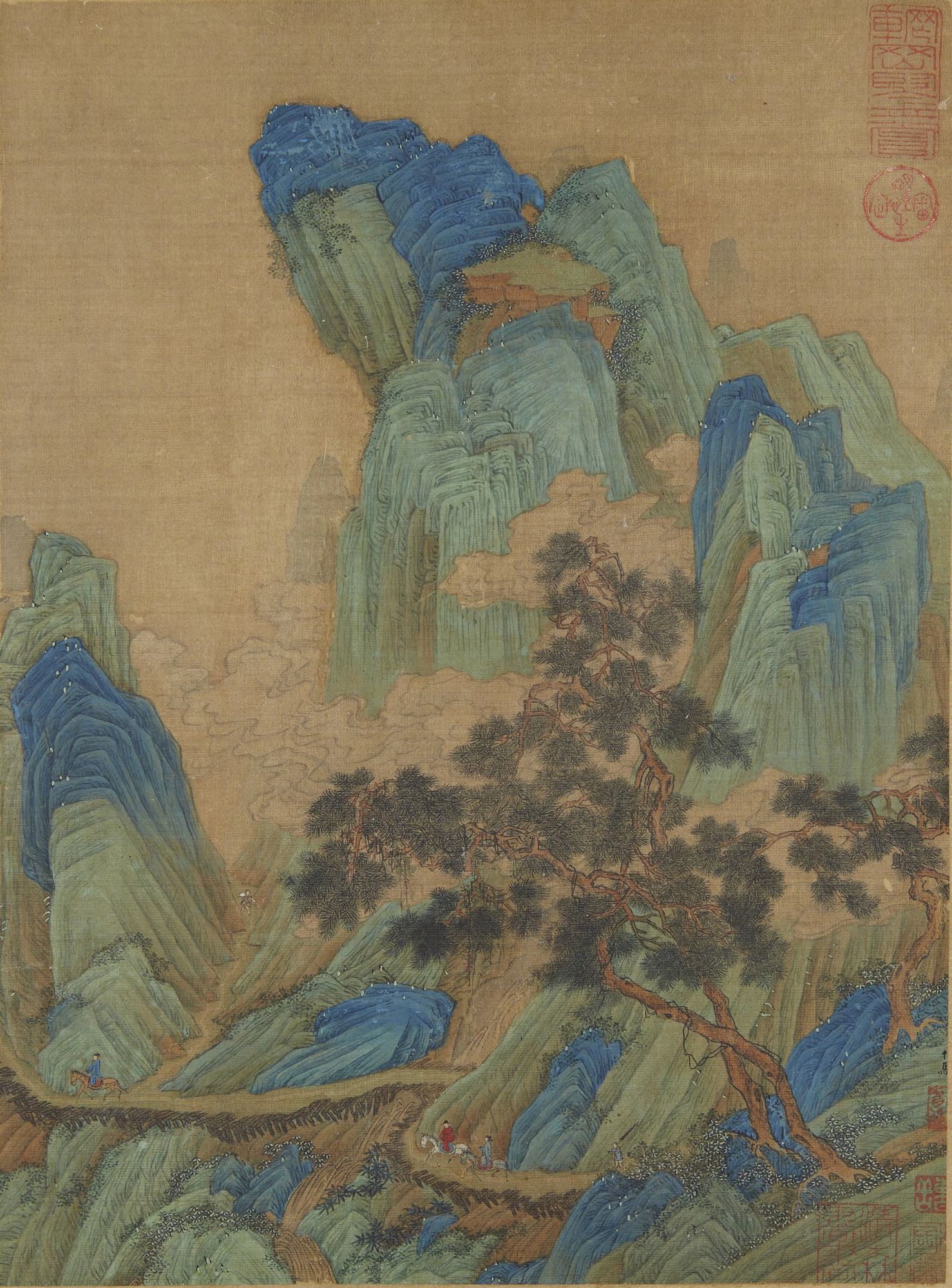
Unknown Artist
Album leaf; ink and colour on silk, 27.2 x 20.2 cm | 10.7 × 8 in
Princeton University Art Museum
Gift of DuBois Schanck Morris, Class of 1893
Chinese landscape painting was concerned as much with representing an inner landscape of the mind as with physical geography. The natural world became a vehicle for expressing the painter’s emotional state, philosophical outlook, and cultural identity. This introspective approach became particularly prominent during the Yuan dynasty (1271–1368), when many literati painters turned to landscape as a means of personal and political expression under Mongol rule.
A key aspect of Chinese painting was cultivating a relationship with the past. By adopting archaic styles or copying the compositions of earlier masters, artists could align themselves with an established creative lineage. The Ming dynasty (1368–1644) and Qing dynasty (1644–1912) saw a significant revival of antique modes of landscape painting, and many surviving Blue-Green paintings date from these later periods.
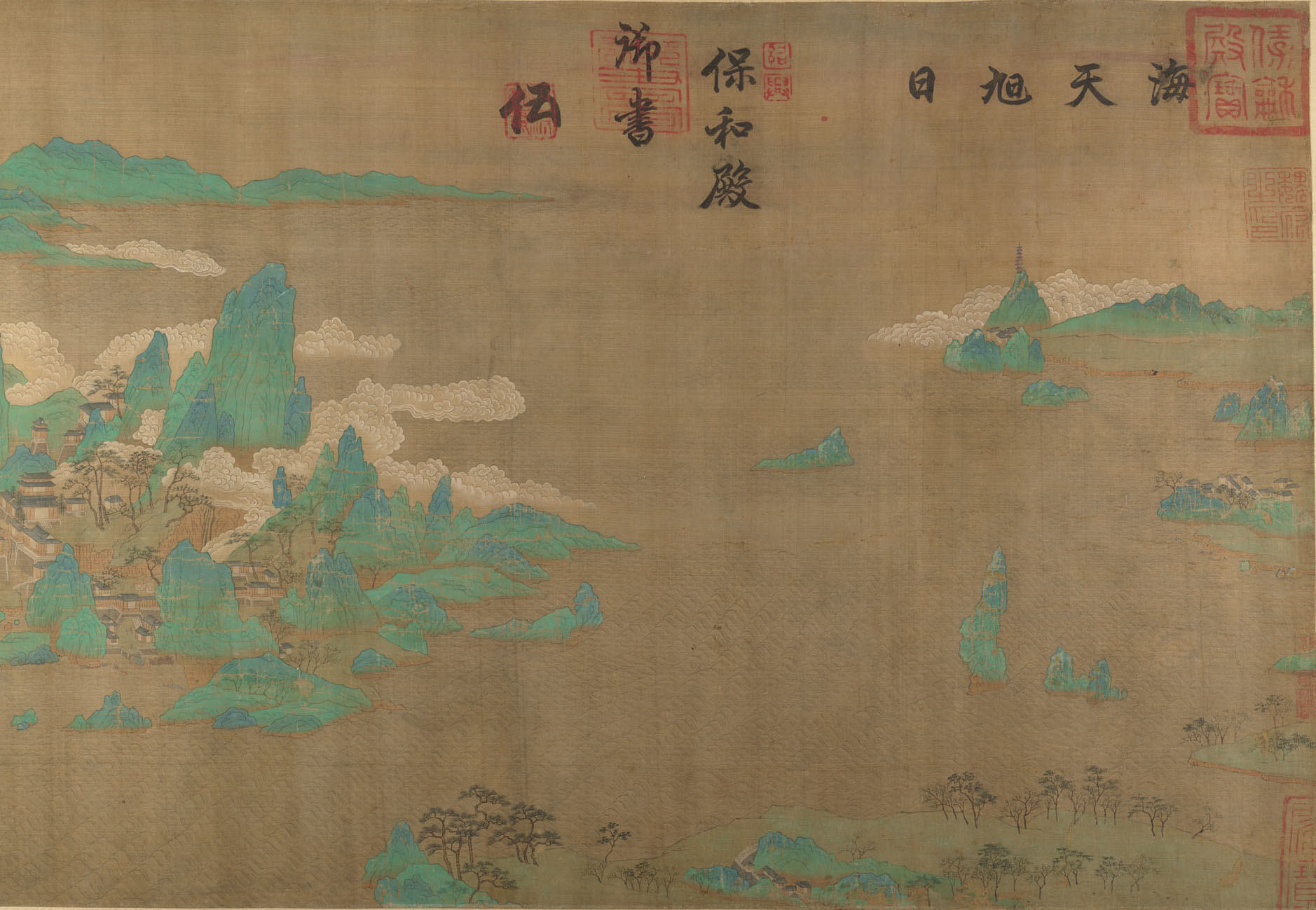
Unknown Artist
Handscroll; ink and colour on silk, 51.4 x 211.5 cm | 20.2 × 83.3 in
The Metropolitan Museum of Art
H. O. Havemeyer Collection, Bequest of Mrs. H. O. Havemeyer, 1929
Geography, Mythology, and the Peach Blossom Spring
At the heart of the tradition of Chinese landscape painting is the relationship between geography and mythology. The natural world was the site of many well-known fables. The tale of The Peach Blossom Spring, a 5th-century story about a fisherman who discovers a hidden utopia beyond a grove of blossoming peach trees, became a recurring subject in art. The story symbolised escape from political turmoil and the possibility of an untouched, harmonious realm.
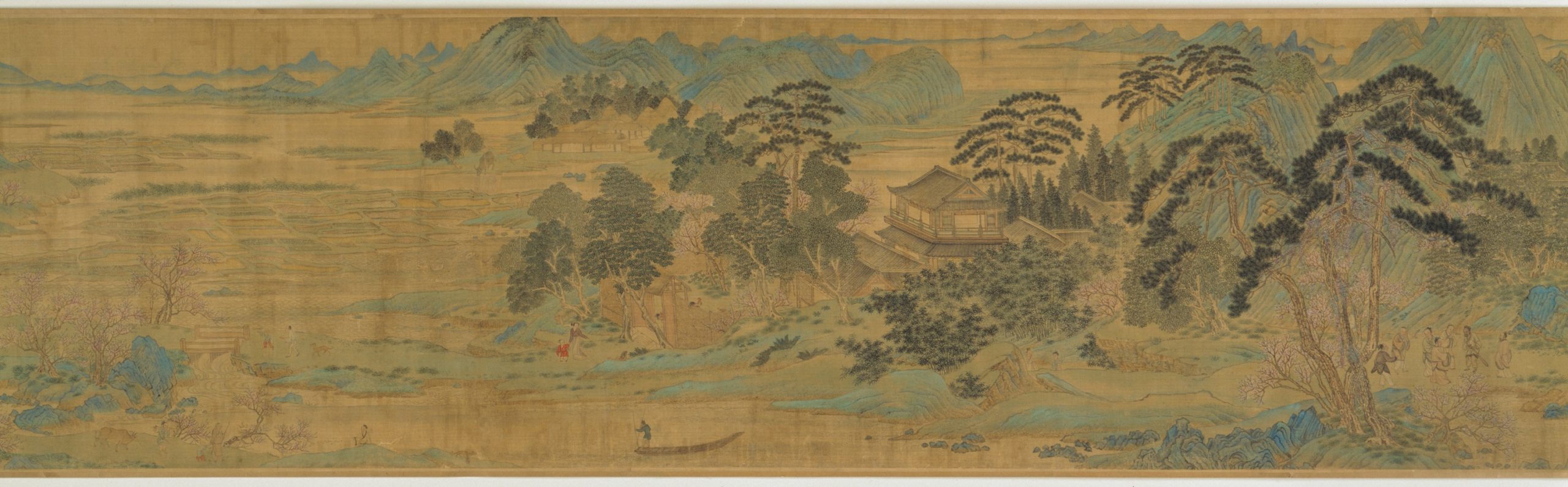
Unknown Artist
Handscroll; ink and colour on silk, 32.5 × 558.2 cm | 12.8 × 219.8 in
Art Institute Chicago
Kate S. Buckingham Endowment
China’s mountainous terrain has profoundly shaped its artistic imagination. Mountains were believed to be the dwelling places of immortals, and thus became a principal subject of landscape painting. Their towering, expansive forms were emphasised, sometimes accompanied by a diminutive human figure to provide scale.
The Blue-Green palette itself became associated with mythological and transcendent spaces. Its brilliant mineral hues could elevate real landscapes or historical events into the realm of the extraordinary. In the 17th century, the painter Wang Hui commemorated the Kangxi Emperor’s Southern Tour in a series of large handscrolls. The subtly shaded blue and green mountains lend the imperial journey an aura of grandeur, reinforcing the emperor’s authority through visual association with mythic landscapes.
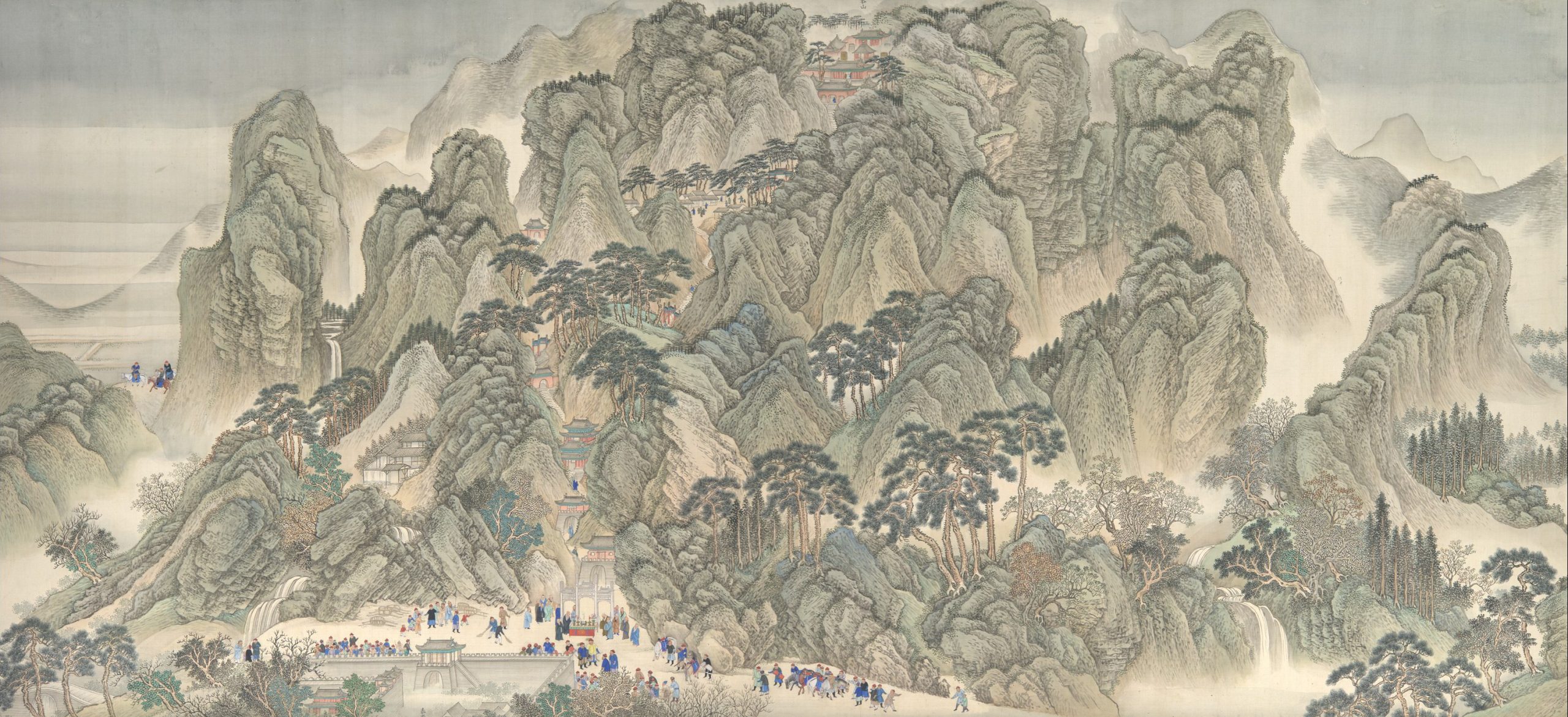
Wang Hui
Handscroll; ink and colour on silk, 67.9 x 1393.8 cm | 26.7 × 548.7 in
The Metropolitan Museum of Art
Purchase, The Dillon Fund Gift, 1979
Azurite and Malachite: Material and Meaning
The significance of Blue-Green landscape painting lies not only in its visual brilliance but also in the cultural meaning attached to the Azurite and Malachite pigments themselves. Both are copper carbonate minerals formed through the weathering of copper ores. Malachite is relatively stable and more abundant, while Azurite is rarer and can gradually convert into malachite over time. Yet to premodern viewers, these minerals were not understood simply as geological substances.
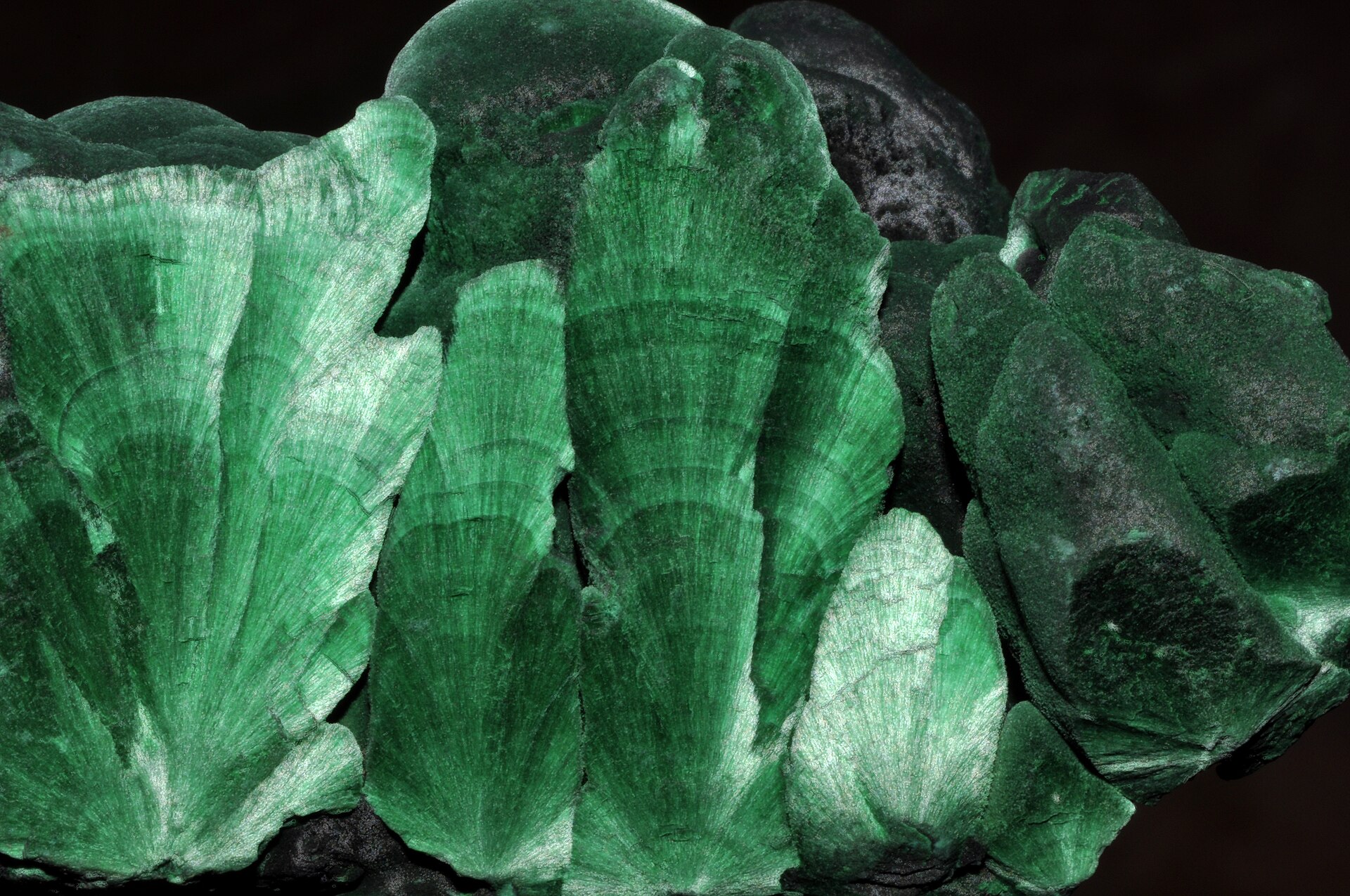
Early Chinese texts often described Azurite as a wondrous material associated with remote mountains and paradises populated by immortals, mythical animals, and precious stones. The ancient geographical compendium The Classic of Mountains and Seas (4th century BCE), for instance, links minerals to mythical landscapes, reinforcing the idea that certain colours belonged to realms beyond the ordinary world.
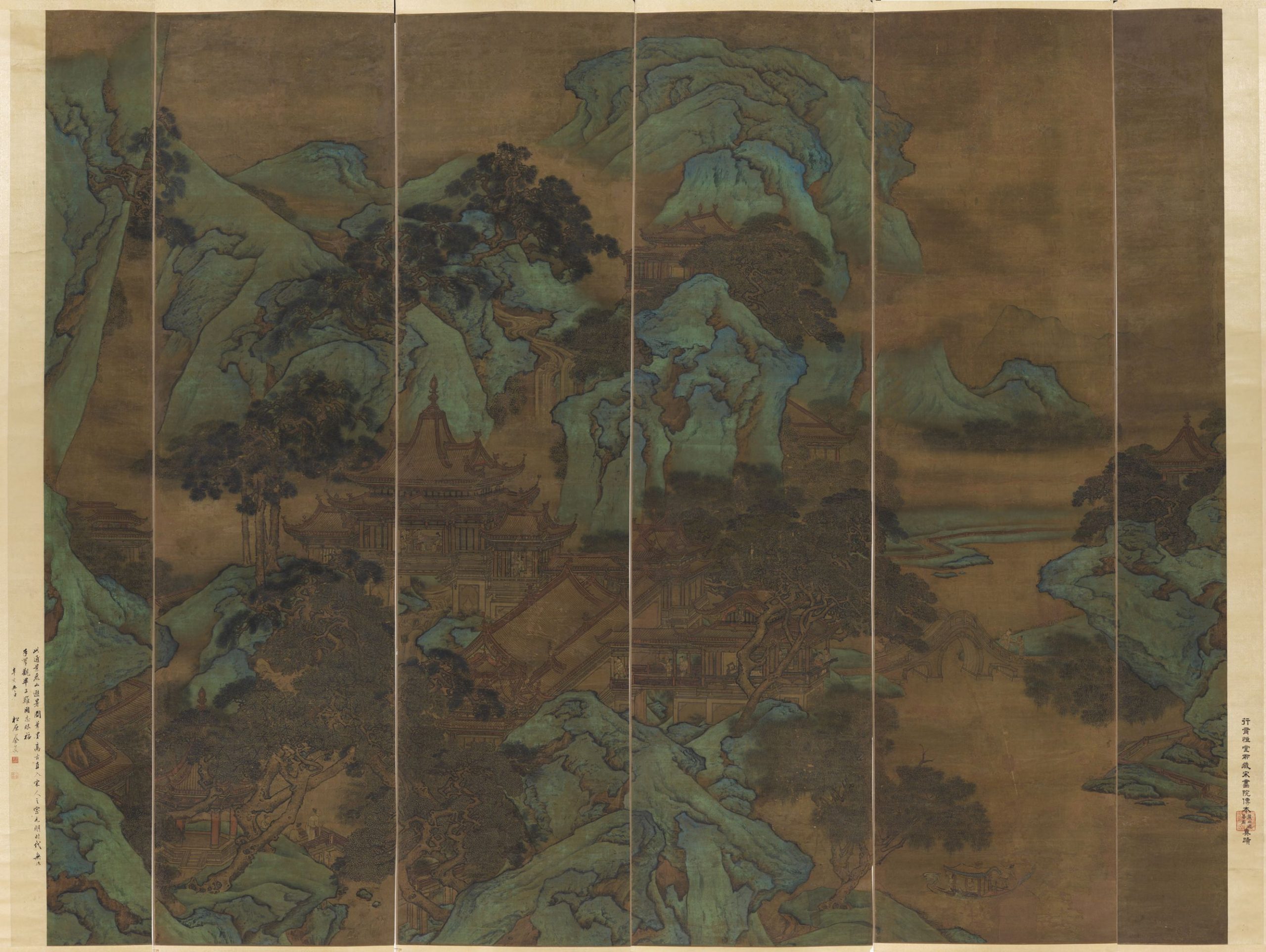
School of Yuan Jiang
Six hanging scrolls; ink and colour on silk, 223.5 x 26.3 cm | 88 × 10.4 in
Princeton University Art Museum
Gift of DuBois Schanck Morris, Class of 1893
By the Tang and Song periods, mining sites for Azurite and Malachite were recorded in official documents and painting treatises. Nevertheless, poetic and artistic traditions continued to emphasise the pigments’ fabled character. Writers, as well as painters, drew upon their transcendent associations. Southern Song scholar Yu Ji (1272–1348) wrote a poem in response to a painting, imagining a search for a reclusive man in the mountains:
“Alone, I approach the mountain and visit the gentleman of reclusion
I walk past a thousand streams; water billows.
Even the immortals exist beyond kongqing
-
- (azurite blue)
They only allow
-
- [the folk]
in the human realm to pay
tribute to white clouds.”
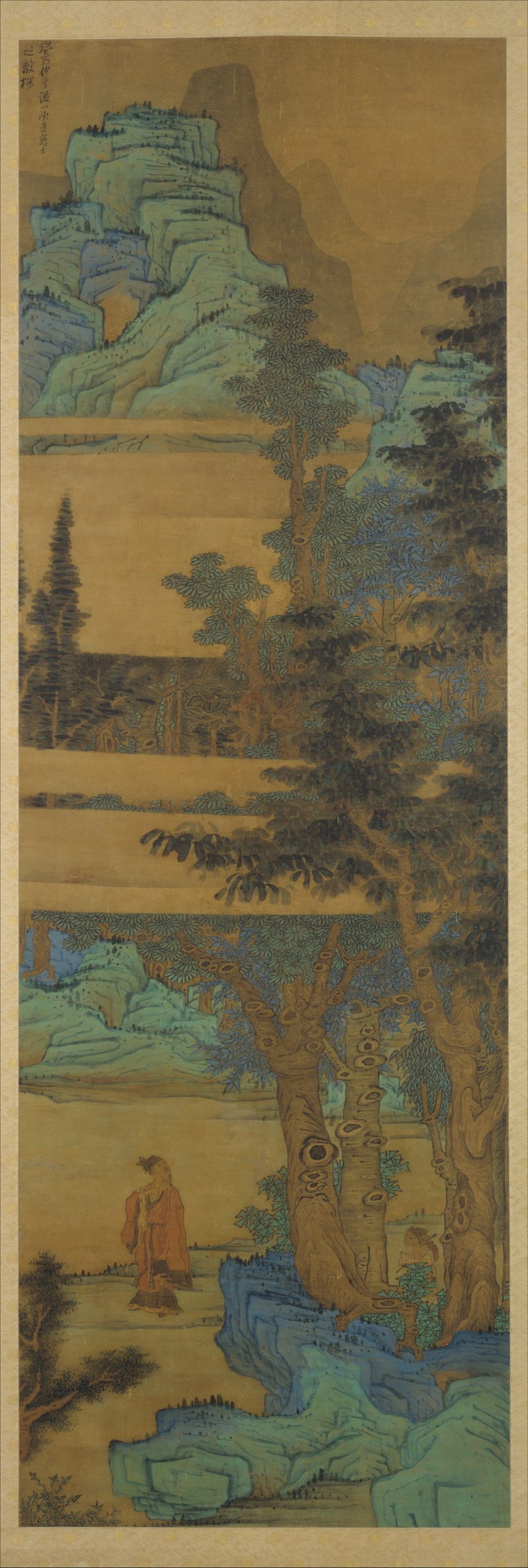
Chen Hongshou
Hanging scroll; ink and colour on silk, 235.6 x 77.8 cm | 92.8 × 30.6 in
The Metropolitan Museum of Art
Gift of Mr. and Mrs. Earl Morse, 1972
Philosophical and medical writings further enriched the symbolism of Azurite and Malachite. The 16th-century physician and naturalist Li Shizhen described the blue and green minerals as products of vital vapours (qi) within the depths of mountains.
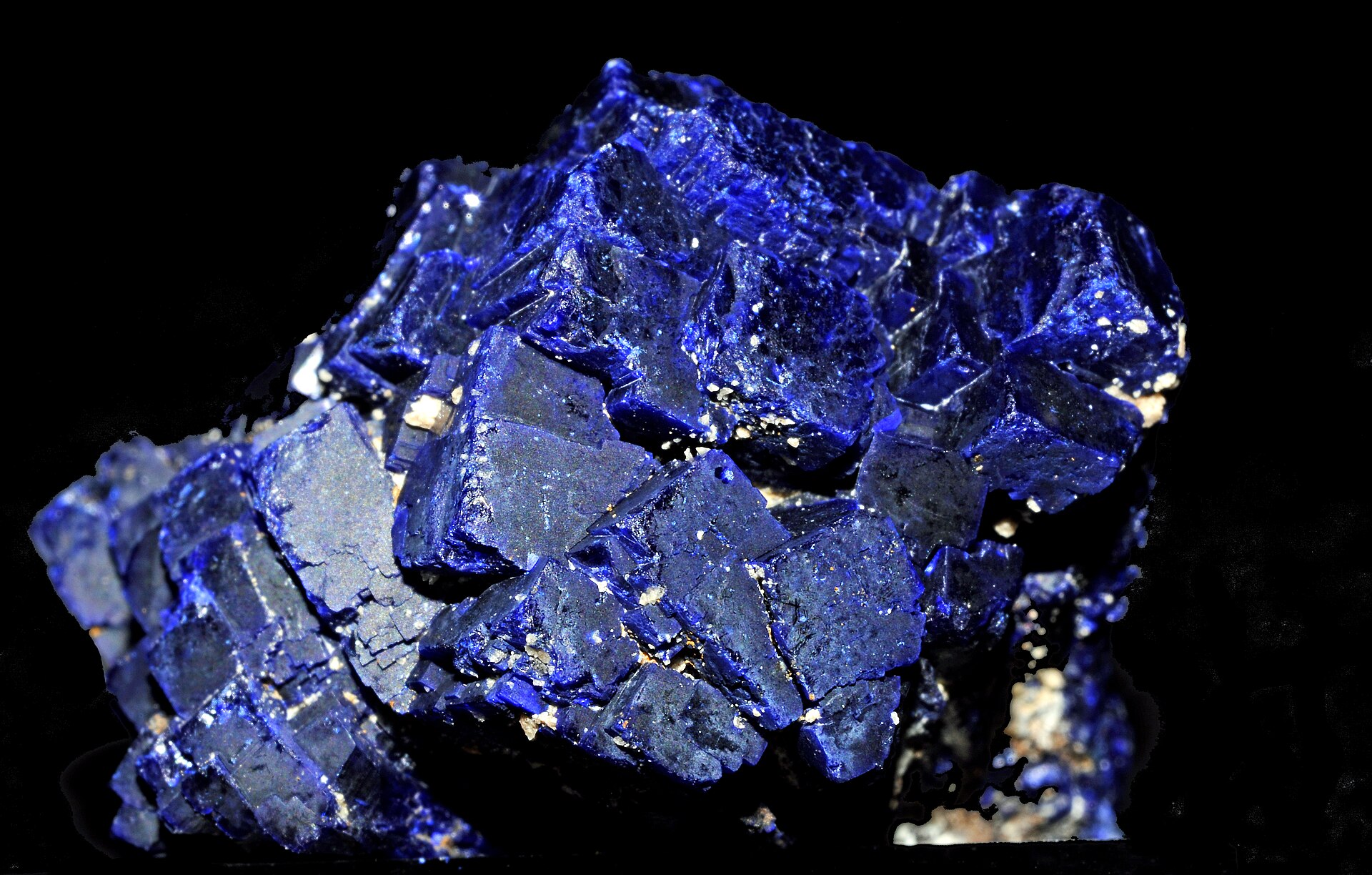
Mineral substances were widely used in traditional medicine, and Azurite was believed to possess therapeutic properties, especially in the treatment of eye disorders and liver ailments. Both Azurite and Malachite were ingredients in elixirs believed to grant immortality, deepening the resonance of their application in paintings that depict realms believed to be inhabited by immortal beings.
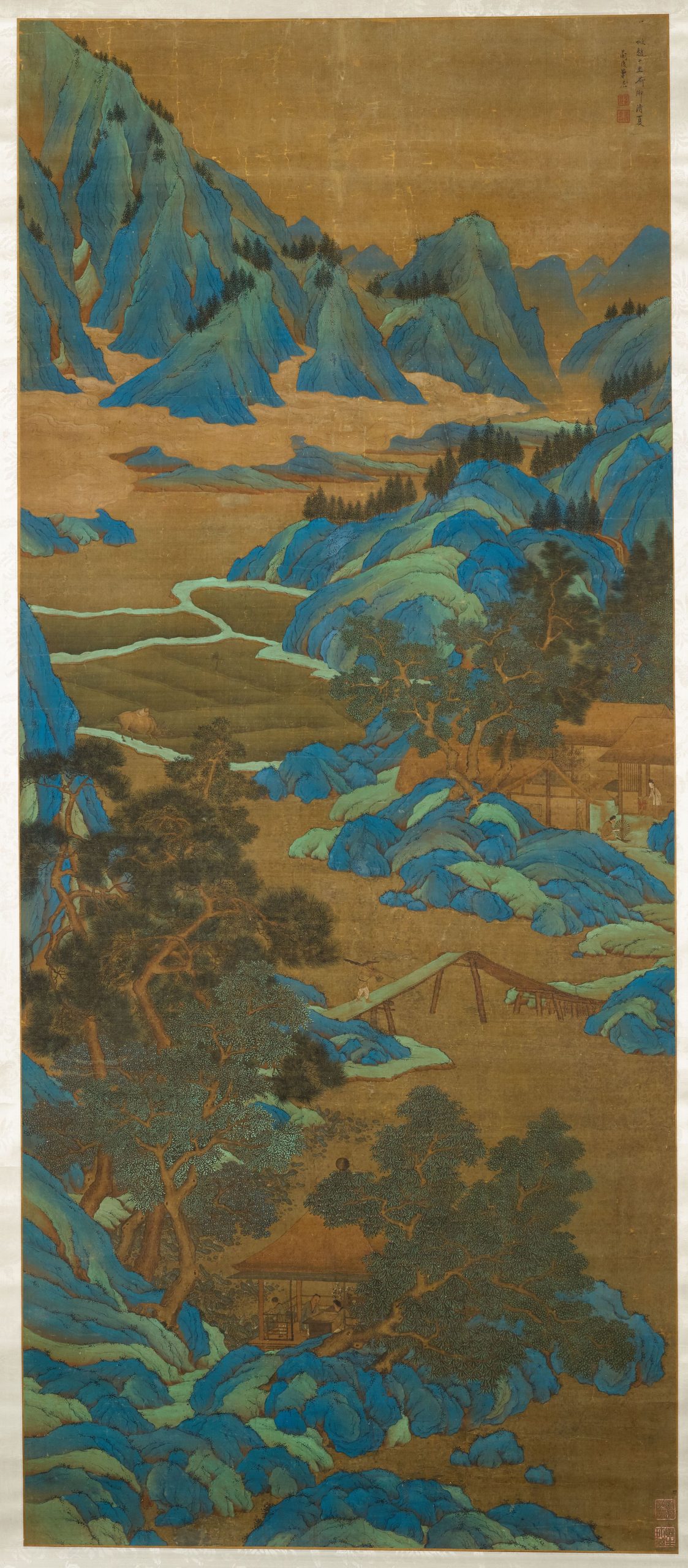
Xiao Chen
Hanging scroll; ink and colour on silk, 222.1 × 94.6 cm | 87.4 × 37.2 in
Princeton University Art Museum
Gift of DuBois Schanck Morris, Class of 1893
These layers of meaning shaped how viewers experienced Blue-Green landscapes. The pigments suggested a world infused with cosmic energy, spiritual possibility, and poetic imagination. In these paintings, Azurite and Malachite aren’t only colouring agents, but they literally imbue the landscape with a quality of timelessness and transcendence.
The use of Azurite and Malachite was not unique to Chinese painting – both minerals have been used as pigments across the world for thousands of years, from Ancient Egyptian wall paintings to medieval European manuscripts. However, like other natural mineral colours, Malachite and Azurite gradually fell out of common use as synthetic pigment technology progressed. Today, they serve as reminders of the ways colour was intertwined with material and belief.
Further Reading
Introducing Jackson’s Pigment Stories Book
The Shimmering Story of Mica in Art
Painting in Black: Working with Pure Pigment Powders
Indigo: The Story of Blue Gold
Shop Art Materials on jacksonsart.com


10 thoughts on “Mineral Pigments in Chinese Blue-Green Landscape Painting”
my goodness… what a deeply
considered piece … colour in context.
Looking at Chinese painting through my
European/ Christian lens is a limiting
lens. Difficult to find access. This is so
helpful. Thank you Evie
So glad you enjoyed it!
Many kudos to Evie Hatch for this
fascinating look at the pigments and
their role in Chinese art! I greatly
enjoyed reading it.
Also, this is the inspiration I’ve been
looking for yards and yards of gorgeous
natural silk I bought.
So glad you enjoyed the article, Rose!
I’m new to watercolors and making
art. I found Evie’s articles on
Jackson and have been eagerly reading
back through your archives because
there is so much amazing information
here! Thank you for sharing your
knowledge. There is so much to learn
in this new world of art (to me) and
I’m so excited!
What an honour to be part of your journey, Steph!
These are wonderful paintings full of space and subtle colours
They are beautiful aren’t they!
Fascinating! I have a couple of questions:
First, the background of all of these is +/-
brown. However, these are all on silk, and
very old. What color was the
silk/background originally? Was is always
brown, or has the silk deteriorated with
age? Second, what sort of medium was
made withthe malachite and azurite?
Watercolor, gouache, oil paint, or
something else? Thank you.
Hi Jan, I believe that the silk has browned with age, and the colours would have once stood out more. As for your second question, the paints were often bound with animal-size glue, which is very flexible so allows the painting to be rolled without cracking
Comments are closed.