



We tend to have a natural aversion to being caught unawares in a sudden downpour, yet we still relish the promise of fresh spring rain welcoming new life. The symbolism of rain in art pulls between joy and suffering, with generous washes of romance and a splash of humour in between. Each interpretation is rooted in place and culture, and the inherent knowledge that life couldn’t endure without it.
The Art Through Symbols series explores the interpretation of symbols throughout art history – whether cultural, religious, folkloric, or personal. Each article analyses a selection of artworks before offering an art-making tutorial inspired by the symbol for you to try.
Interpreting Rain

Vincent Van Gogh
Oil on canvas, 73.3 × 92.4 cm | 28.9 x 36.4 in
Philadelphia Museum of Art
- “How beautiful it is outside when everything is wet from the rain – before – in – and after the rain. I oughtn’t to let a single shower pass.” – Vincent van Gogh (Letter to Theo, 1882)
All living beings need water to survive, so it’s unsurprising that rain recurs in art history across cultures as a powerful symbol for our survival. Rainfall feeds the land to sustain us, yet also has the potential to wipe it away in one terrible storm. From the Biblical deluge wiping out all of humanity to start again, to romantic proclamations made in the rain by lovers, we see it as an opportunity for cleansing and new beginnings.

Pathetic fallacy would have us believe rain is always an indicator of misery, besetting characters in times of misfortune. But for Ukiyo-e printmakers and the Impressionists, rain is a great equaliser that embodies the fleeting yet enduring passages of nature, rather than personifying the mood of the individual.
The symbolism of rain shifts depending on the place, culture, and circumstances of the people it lands upon. People bracing against the rain with umbrellas suggest resilience and preparedness for the uncertainties of life, whereas the drenched figure garners our sympathy. The empty landscape beset by a storm reminds us to approach the natural world with wonder and to appreciate the phenomena that may seem unpleasant. In wet countries like the UK, it’s easy to ‘hate’ the rain, whilst dry countries around the world need it desperately. This inherently shifts the symbolic meaning of rain, depending on scarcity.

Nature’s Endurance
Hiroshige was incredibly skilled at capturing rainfall in his landscape series of woodblock Ukiyo-e prints, applying vertical or slanted lines in a separate layer to each print. Ukiyo-e, meaning ‘pictures of the floating world,’ depicts scenes from everyday life, alongside the beauty of nature – often in fleeting moments such as a sudden downpour, the shift of the seasons, or the crashing of a wave. Rain, in particular, serves as an evocative device, sending people to seek shelter or hurry along their way through both natural landscapes and man-made environments. Wherever or whoever the people are, the unpredictability of the rain is an equaliser – and a reminder of the enduring forces of nature despite human intervention.
Hiroshige’s technique of adding a layer of rain on top of his prints is undeniably referenced in Rousseau’s famous work Surprised!, where a tiger bristles amid thick jungle foliage, with the rain cascading in transparent strokes.

Utagawa Hiroshige
Woodblock print on paper, 24.8 x 36.2 cm | 9.8 x 14.3 in
The Metropolitan Museum of Art
Social Dynamics and Transience
In the late 19th century, Paris was undergoing a transformation. The rapid acceleration of industrialisation led to large areas of the city being rebuilt, and the gap between the bourgeoisie and the working class broadened. Gustave Caillebotte was both a key patron and artist of the Impressionist movement, although his paintings stylistically lean more towards realism. Paris Street; Rainy Day is a monumental mise-en-scène painting, placing the viewer against the stage of the street with the foreground figures painted at life-sized scale. The asymmetrical perspectival composition creates a cityscape that we could easily step into, dashing alongside the wealthy of the city, sheltering from the rain under their umbrellas.

Gustave Caillebotte
Oil on canvas, 212.2 × 276.2 cm | 83.5 x 108.7 in
Art Institute of Chicago
This work precedes Seurat’s Sunday on La Grande Jatte, which famously also examines class dynamics and industrialisation in Paris. It also predates Renoir’s The Umbrellas, which he worked on in two stages in the 1880’s. In it, we see a milliner’s assistant carrying a hat basket break through the crowd, caught without an umbrella. She’s adjacent to a wealthy woman and her richly dressed daughters, all adorned with fancy hats in contrast. The rain in both The Umbrellas and Paris Street; Rainy Day provided the perfect thematic situation for the Impressionists’ desire to capture transient moments in time. These artists also undoubtedly looked to Japanese artworks of rain for inspiration, like Hiroshige’s prints in the previous section.
Humour
The saying ‘It’s raining cats and dogs’ didn’t just fall from the sky. The etymology of the phrase hasn’t been proven, but it’s theorised that heavy rains would wash dead animals through the streets that had accumulated because of poor sanitation. Another idea suggests that because people kept domestic animals in their rafters, in areas with thatched roofs, the animals would be brought to the ground by the rain. It also may have derived from a bastardisation of the Greek word ‘katadoupoi’, which refers to the waterfalls of the Nile. Regardless of its origin, the phrase has been a source of nonsensical good humour. The phrase is rich in imagery for satirists, giving levity to unpleasant conditions.

George Cruikshank
Hand coloured etching, 27.1 x 41.4 cm | 10.7 x 16.2 in
Yale Center for British Art
Punishment and Renewal
The word deluge derives from the Latin word diluere, meaning ‘to wash away’. It describes a severe and deadly flood, often made in reference to the Great Flood in The Book of Genesis. Imagery of people struck by the horror of the deluge appears throughout art history as a potent visual warning of the consequences of Sin. The subject became especially popular with the Romantic artists of the 1800s, for its pictorial drama and potential for tragic figuration. In these artworks, rain is a symbol for punishment and the destruction of evil, scouring the entire population of Earth so that Noah and the inhabitants of his Ark could begin again. This particularly haunting example by Melchior Lorck sees a writhing mass of people scrambling up a structure to try to escape the deadly waters under the pelting rain.

Melchior Lorck
Woodcut in two blocks, 32.4 × 50.2 cm | 12.8 x 19.8 in
Art Institute of Chicago
Romance
Monsoon season in South Asia brings the majority of the rainfall that the region experiences for the year, which is crucial for agriculture, the ecosystem and subsequently the population’s wellbeing. In Indian art, the monsoon was historically tied to romance, reflecting the lush renewal of the landscape during this season. Indian miniature paintings feature couples amongst the flora and fauna refreshed by water, or women on swings set against gathering storm clouds in celebration of their arrival. This may seem unusual to the contemporary mind since we may associate the monsoon with danger. Global warming has steadily heightened the intensity and impact of the monsoon season, with greater risk to life because of landslides and flooding. These historical artworks endure as reminders that the monsoon was once a positive symbol of romance, love and rebirth – as well as of the detrimental effects of human-caused environmental decline.

Northern India, Pahari Kingdoms
Gum tempera, ink and gold on paper, 20.7 x 15.2 cm | 8.15 x 6 in
The Cleveland Museum of Art
Pathetic Fallacy and Sadness
Pathetic fallacy, meaning ‘emotional falseness’, is the attribution of human emotions to non-human nature and phenomena. It was coined by John Ruskin in 1856 in the third volume of his work Modern Painters, to critique the sentimentality of the trope used by poets in the late 18th century. In Western art, rain has been attributed to sadness, as if the clouds themselves produce tears to mirror or emphasise a character’s mood.
William Blake created this downtrodden figure for Water as part of a series of 18 prints called For Children: The Gates of Paradise. Unlike his most famed engravings, this series relies on imagery alone, rather than being supported by long text. The series charts a visionary progress from birth – being uprooted from the ground like a vegetable – to death – walking alone through a dark doorway. He personifies the four elements as characters. ‘Water’ is hunched over and cast by rain, using pathetic fallacy to reinforce his misery.

William Blake
Etching, 8.3 x 7.3 cm | 3.3 x 2.9 in
Yale Center for British Art
Wonder
It’s impossible to write about rain without mentioning the great Romantic artists who strove to capture stormy skies by working in the landscape – JMW Turner and John Constable. Both artists were determined to transform the genre with grit, making them direct rivals who clashed on both artistic and personal matters. Amongst the tension, both made incredible paintings of the rain, which convey a sense of wonder and terror in nature.
Rainstorm Over the Sea by Constable has a dramatic sky of expressive swipes, painted in Brighton, which he visited over several years. Turner also sought to capture the rain en plein air in his work A Paddle-Steamer in a Storm on Lake Lucerne. This light watercolour doesn’t rely on dark tone to convey the ferocity of the weather, but shows us the context of a steamboat approaching the downpour. A single bolt of lightning jumps from the rain clouds, created in one scratch to reveal the white of the paper, to ingeniously suggest violence.

J.M.W. Turner
Watercolour, graphite, and scratching on paper, 23.2 x 28.9 cm | 9.1 x 11.4 in
Yale Center for British Art
Rain – Art Prompt
For this art prompt, I was inspired by the expressive paintwork in Constable’s Rainstorm Over the Sea, combined with the devastating drama of the deluge. We will paint a stormy sky, complete with lashings of rain.

For this art prompt, you’ll need:
Michael Harding Oil Paints in Turners Yellow, Madder Brown, Raw Sienna, and Manganese Violet, and Jackson’s Professional Oil Paints in Zinc White, Indigo, and Ivory Black.
Jackson’s Cotton Canvas Art Board 14 x 18 in
Jackson’s Hog Bristle Brushes and Roman Szmal Palette Knives
A jar to put your medium in – for mediums I used Jackson’s English Distilled Turpentine and Jackson’s Refined Linseed Oil
A rag to wipe your palette knives as you work

To begin my work I made a light underpainting with thinned Raw Sienna and Madder Brown to establish the composition and size of the forms in my cloudscape. This warm underpainting created visual contrast with the cool blues applied on top.

Next I mixed a tonal palette of blue-greys, ready to be scooped and scraped onto the surface with my palette knives at volume, to save remixing.

I painted with a combination of hog brushes and palette knives – alternating my tools depending on the desired thickness of paint.

I made the sky beyond thinner by using a brush, which balances out the thick impasto application of the clouds with palette knives.

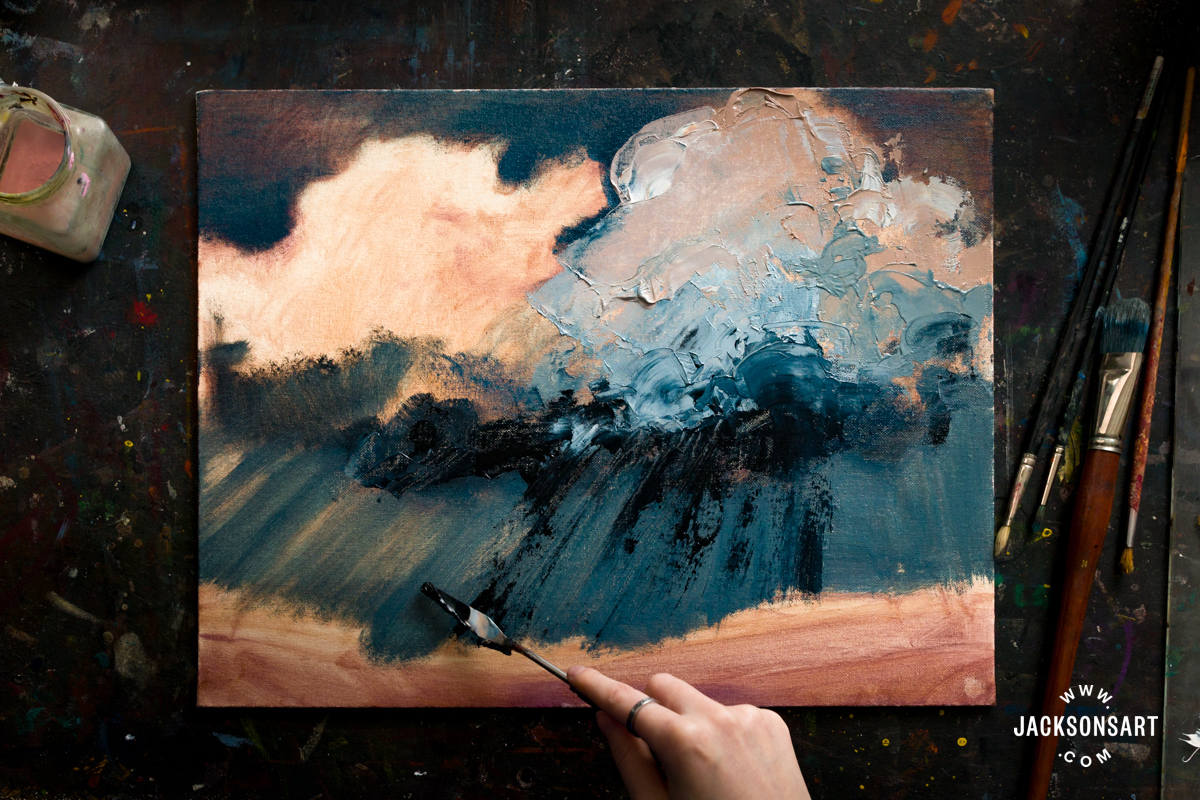
I wiped my palette knives clean between building up different colours, being careful to separate the sky from the land.

I added a mixture of Madder Brown, Indigo, Turners Yellow and Warm White to the landscape below the formidable cloud, and added a touch to the cloud itself to unify the overall palette of the painting.


To finish, I added some sgraffito scratches to the thick paintwork to emulate the rain pelting down, and to exaggerate the form of the clouds.

Further Reading
Recreating the Palette of J.M.W. Turner
Painting and Printmaking Techniques of the Brotherhood of ‘the Ancients’
A Guide to Oil Painting Mediums
Shop Art Materials on jacksonsart.com



3 thoughts on “Art Through Symbols: Rain”
Thank you!
Nice little piece of writing, thank you. Another visual analogy like ‘cats and dogs’ was for straight heavy rain,, ‘Coming down like stair rods.’
Glad you liked it Colin, that’s a great phrase!
Comments are closed.