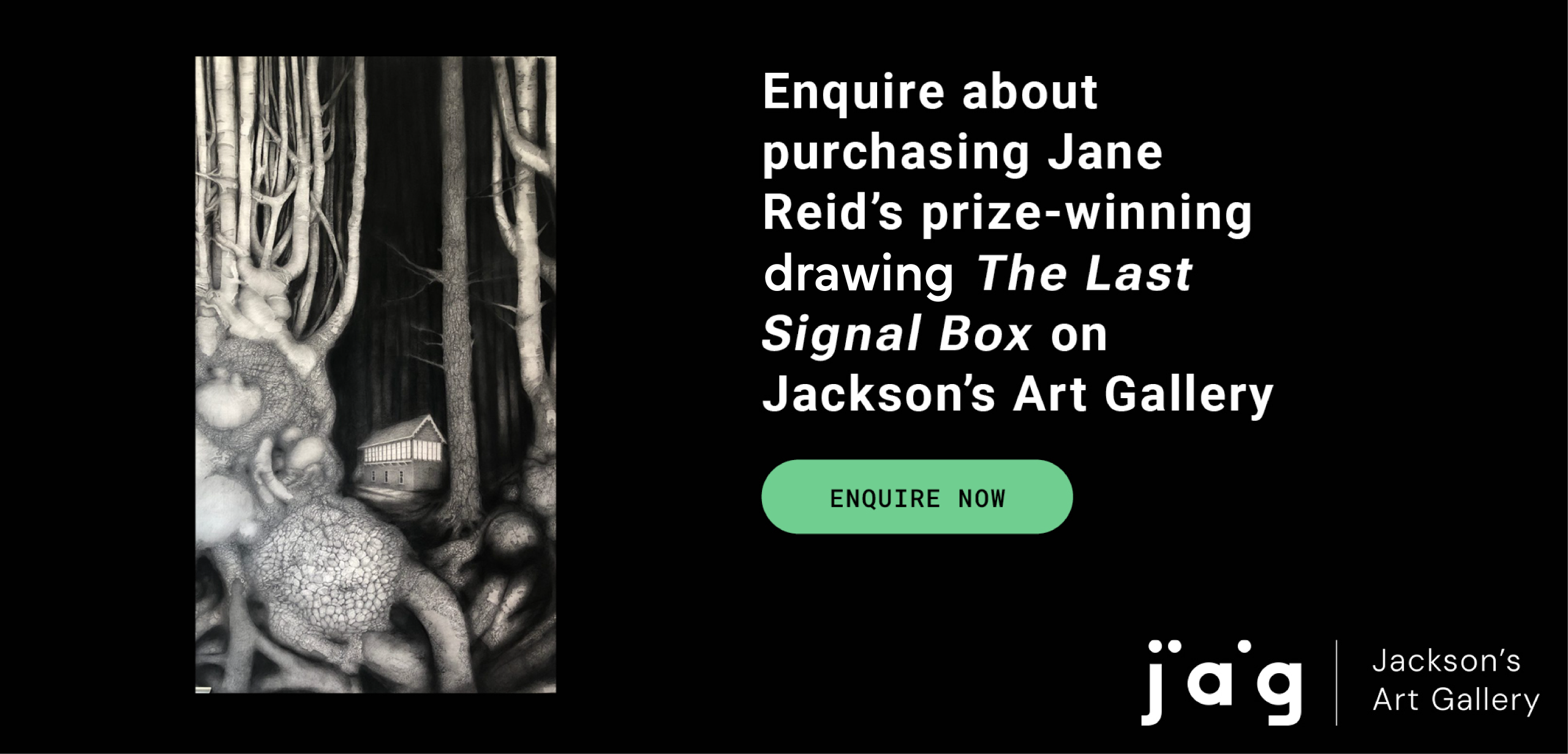
Jane Reid won the Drawing Award in Jackson’s Art Prize this year with her work The Last Signal Box. In this interview, she discusses how charting the sun, wind, and lichen informs her practice, keeping a studio diary, and the nativity drawing that started it all.
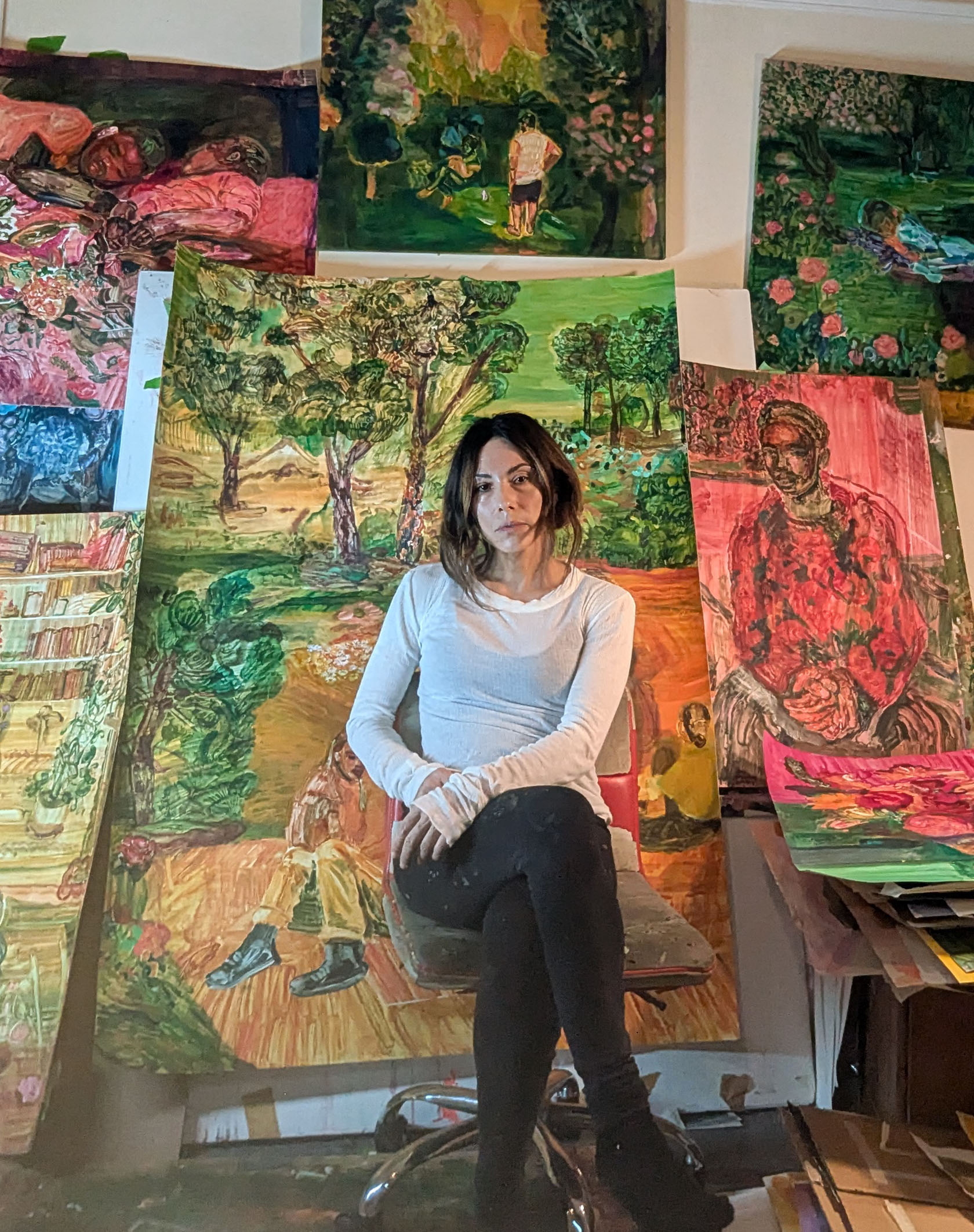
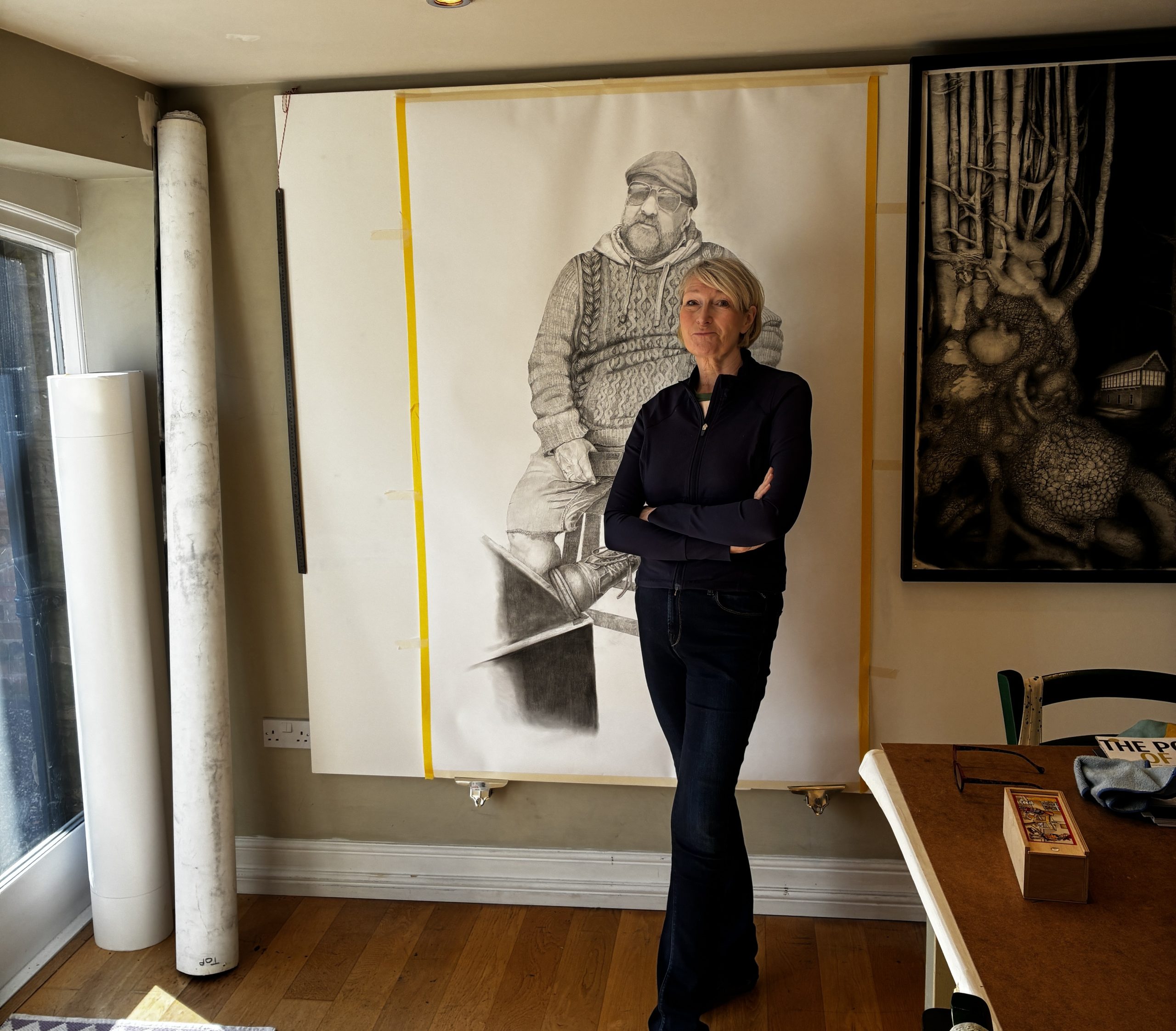
Above image: Jane with a selection of drawings in her studio
Jane Reid
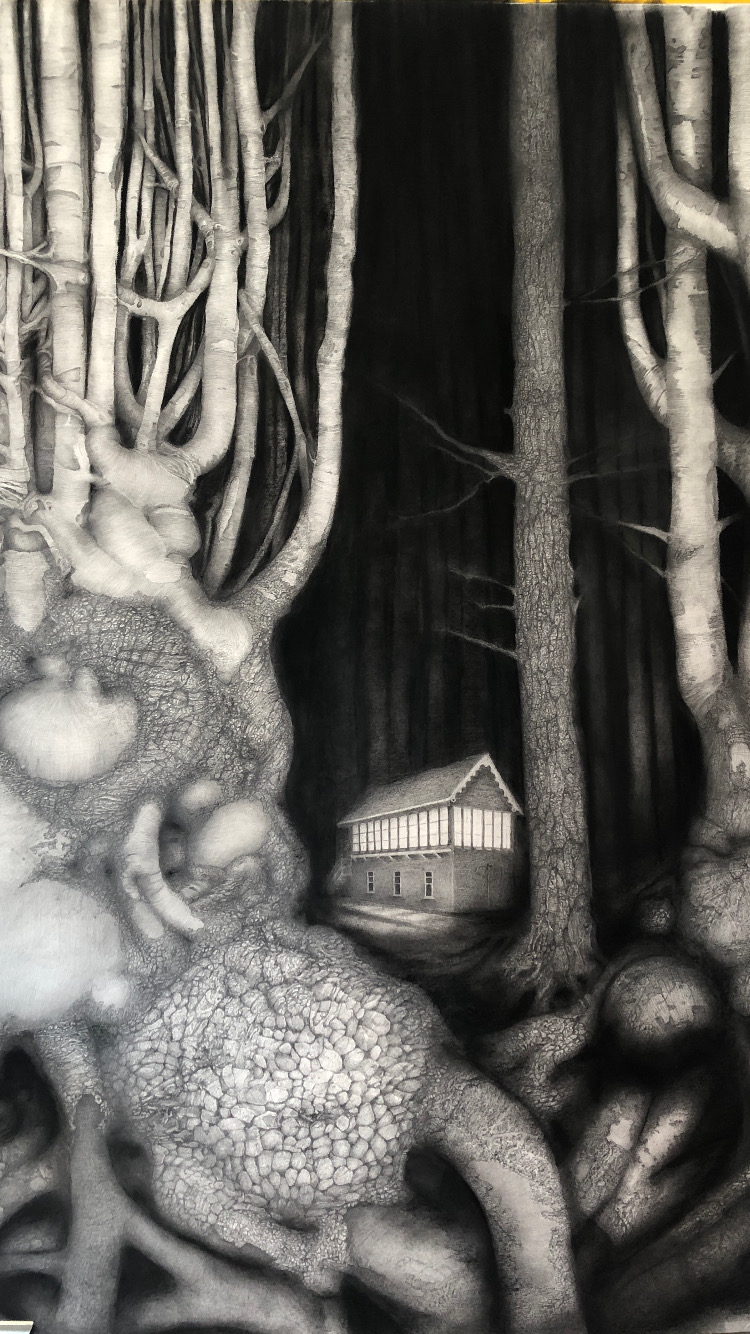
Charcoal and pencil on paper, 120 x 90 cm | 47.2 x 35.4 in
Josephine: Could you share the story of how you became an artist and tell us more about your artistic background?
Jane: I clearly remember the day I knew I was going to become an artist. I was six years old, and at school, everyone had drawn a nativity picture which was to be put up on the classroom wall. I remember walking back into the classroom and seeing all the drawings displayed in a long line around the room, but all the children were laughing and pointing at one drawing in particular. It was mine. When I looked at all the other drawings and then mine, I was overwhelmed and felt a burning sensation of shame. All the other drawings portrayed a typical, neat nativity scene set within a stable. My drawing depicted the head of a large, bright red, smiling donkey, all contained within a solid, thickly crayoned black background.
I remember explaining to the teacher that I made the donkey red because it was so important as it had made a long journey laden with a heavy load, and without the donkey, no one would have arrived at the stable. This memory is deeply etched in my mind, and although I wasn’t old enough to understand the complexities of what a drawing can be and do, this moment firmly cemented an understanding that a drawing is more than what is illustrated.
My need to explore drawing has driven me all my life. I didn’t have the luxury of a formal art education until I was 40 due to financial and family constraints. However, when I did finally get to study Fine Art, I focused on all things connected to drawing and mark-making. I was very fortunate to be offered a chance to study on a fully funded studio practice MA at Loughborough University. Afterwards, I began teaching on the Fine Art Undergraduate programme, which was just fantastic. During this time, my thirst for both the drawing process and taking a deeper dive into drawing research led me to undertake a practice-led PhD, which, of course, was all about drawing and was completed in 2023. Last year, I decided to leave teaching and focus fully on my drawing practice, which I had never been able to do before. This was a huge step, and now I am right at the start of being a full-time artist.
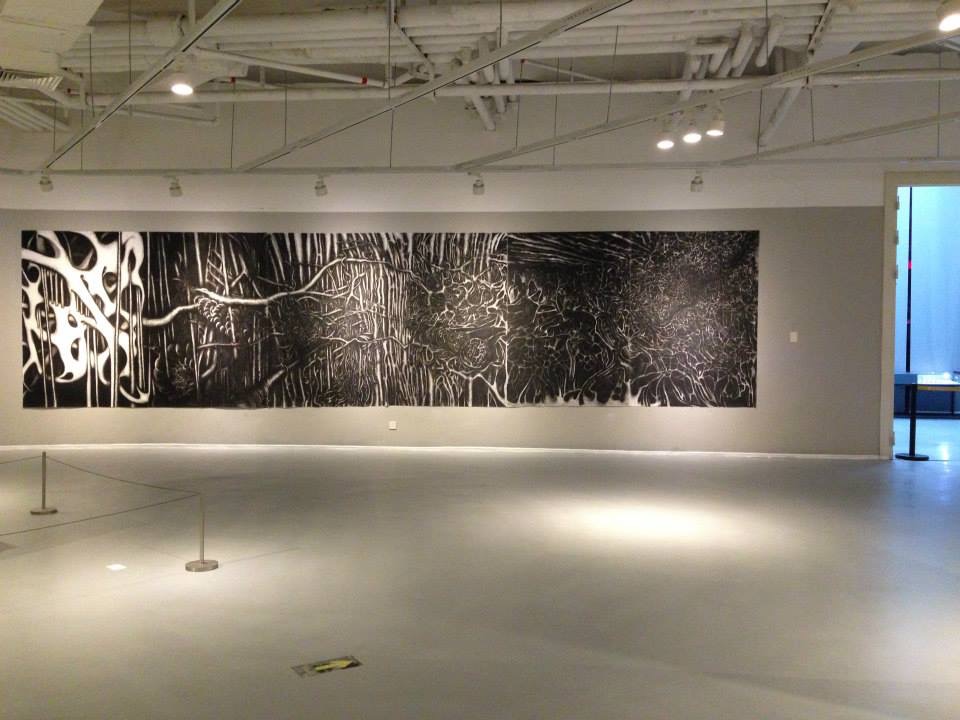
Charcoal on paper
Exhibited in Suzhou, China
210 X 1080 cm | 83 x 425 in
Josephine: What does a typical working day in the studio look like for you? Do you have any important routines or rituals?
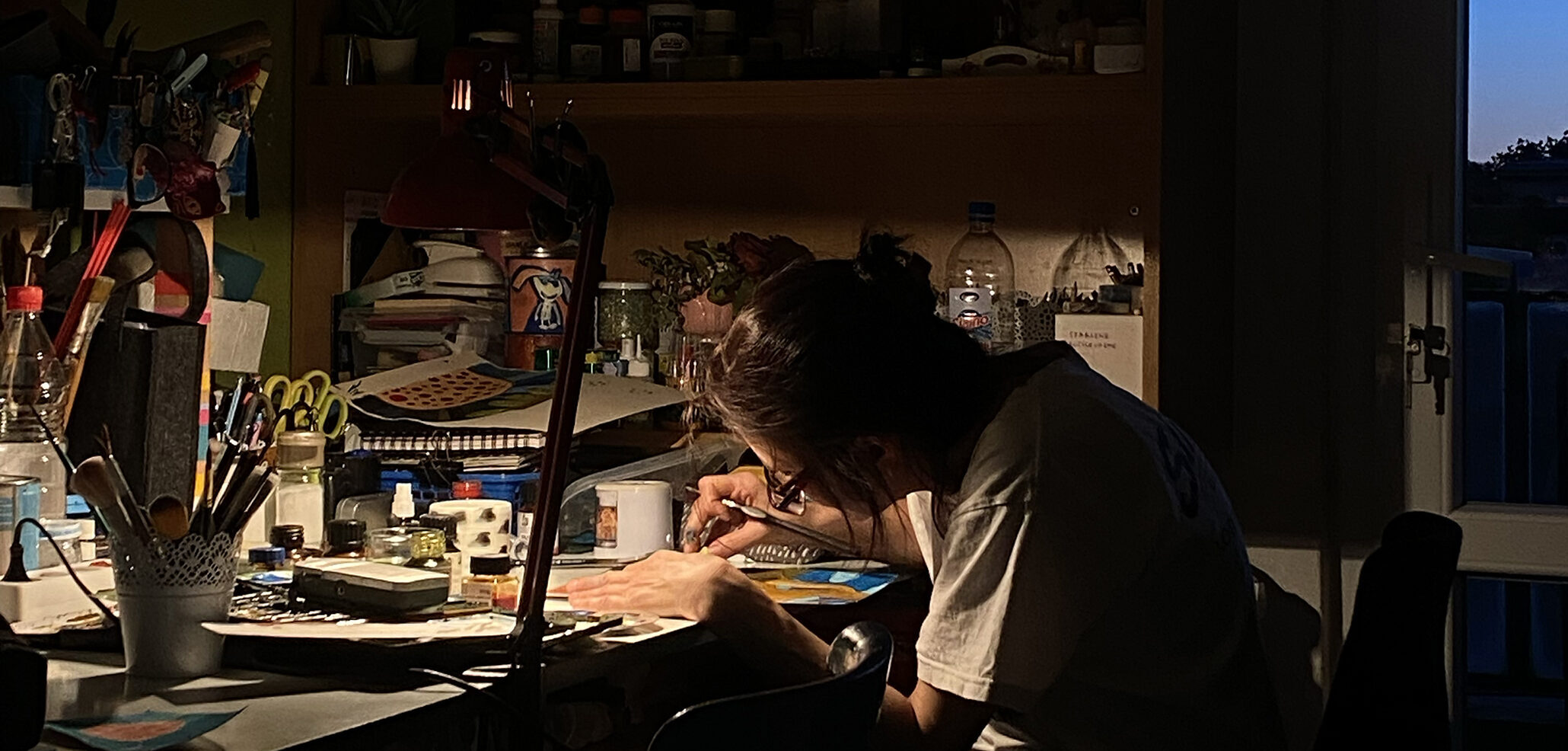
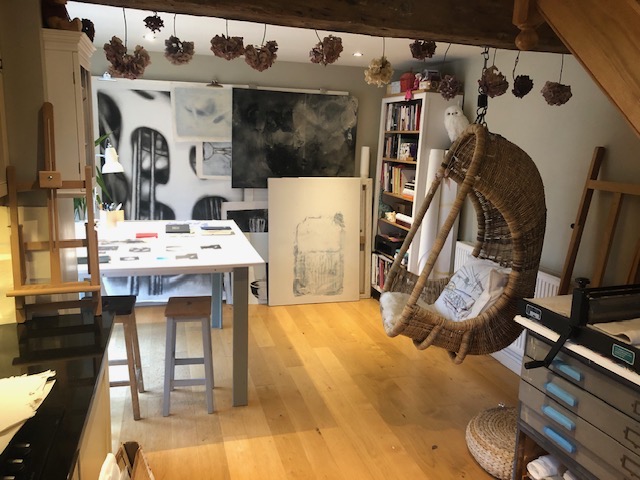
Jane: I am a really slow starter in the morning and most definitely like to ease myself gently into the studio, which is usually late morning. I am a night owl and often work from 8pm until 1am or longer. I think this habit is due to many years of making artwork when my children were in bed, or I wasn’t at work. I really enjoy the late-night solitude, especially when working on my large-scale drawings such as The Last Signal Box. When drawing, I use an ancient Anglepoise lamp to focus the light directly where I am working, but I like the rest of the studio low lit, which makes the studio moody and atmospheric. Over the years, I have found that by creating an atmosphere around me that is like the drawing I am working on, it really helps me achieve the feeling and mood I want to convey in my drawing.
Another important routine for me is to use a studio diary so I can write down what I did, how it went and what I can do next. Throughout the day/evening, I also jot down things like a piece of music I enjoyed or something on the radio that I found interesting. Included in these entries are also thoughts relating to what I am reading or an artist I am looking at. In the past, I have tried to keep separate diaries which relate to a specific piece of work, but this just didn’t work at all, so now I keep one studio diary which contains everything. I always finish the day off by writing about the practical elements of the day’s work. And I start a studio session reading about what I did the previous day.
Josephine: Which materials or tools could you not live without?
Jane: I could not live without large rolls of paper, plain newsprint, and a range of pencils, including mechanical pencils, which allow for a smaller diameter of lead, as well as various types and sizes of sketchbooks. Paper is so important to my work, especially the tactility and the fragility of it. I never work to a standard size of paper because I want the idea or concept of what I am doing to dictate the size of the paper; that way, I don’t feel constrained by having to fit my drawing into a size-specific template. In The Last Signal Box, the immensity of the trees was very important, as I wanted the viewer, when standing in front of the drawing, to feel encapsulated and surrounded. This meant the trees needed to be as tall as possible to achieve the effect I was after.
In the initial planning stages of how I want my drawing to appear, I always attach sheets of plain newsprint with masking tape to the drawing board of my studio to help me work out and plan the scale and layout of the drawing. When I feel happy with the composition, I then finalise sizing, and cut to size the paper I will use.
Josephine: Do you work from a reference? Tell us more about your process.
Jane: My work is always connected to notions of home, space/place and dwelling; this might be a place I have lived in or somewhere that I feel connected, which then evolves within my imagination. The signal box in the drawing is the exact signal box I used to live opposite as a child, (Postland near Crowland, Peterborough). I’ve visited the signal box and cottage over the past 40 years, watching them slowly decay and fall apart. Yet in my mind, the image of the glowing signal box always remains the same – solid and comforting.
My drawings always start with a visit to a real place/space. I usually drive to the location as this means I can fill the car up with art materials. I tend to overpack as you never know what might be needed or what the weather might be like. I always spend a whole day and sometimes longer at a specific location.
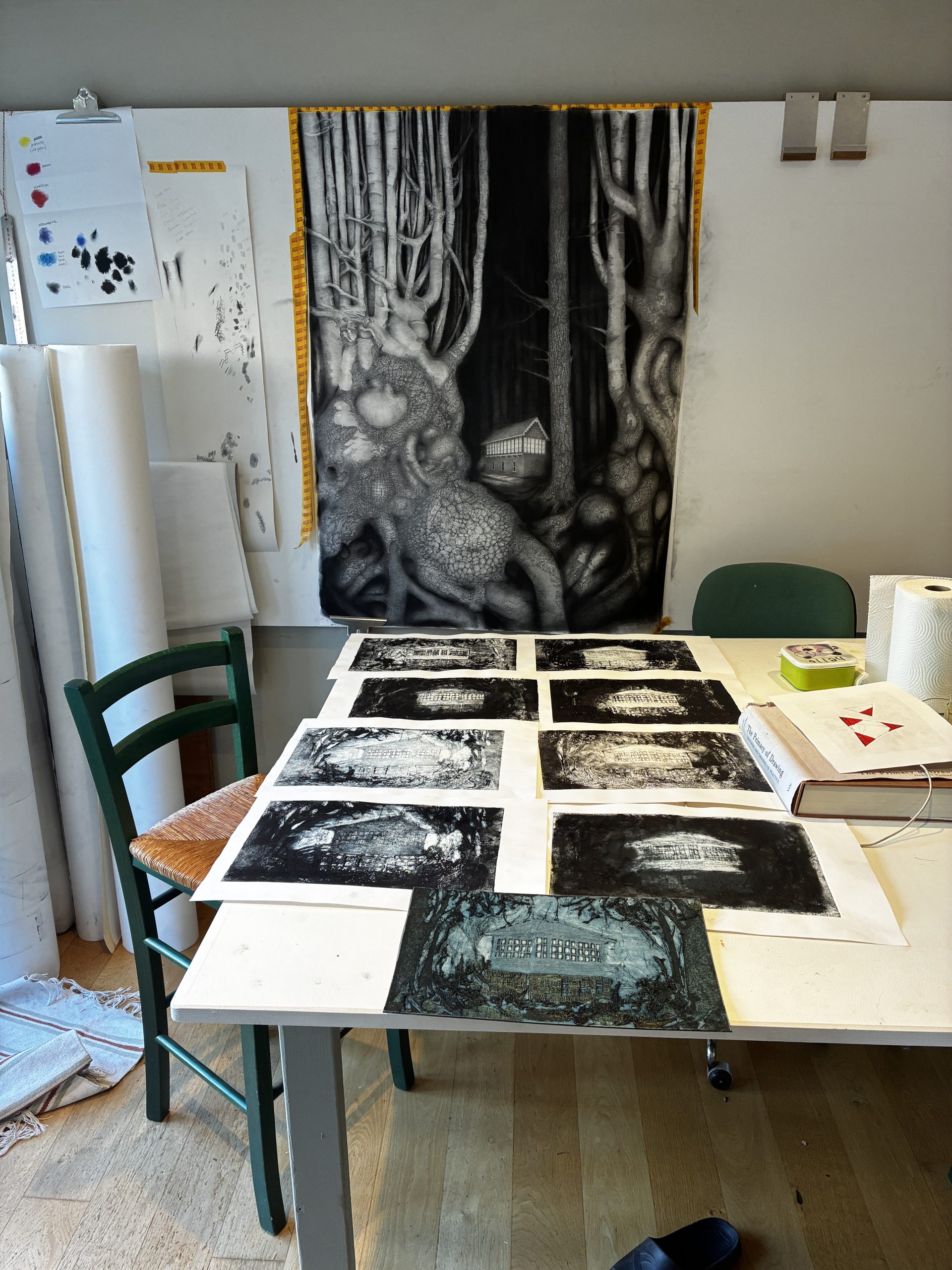
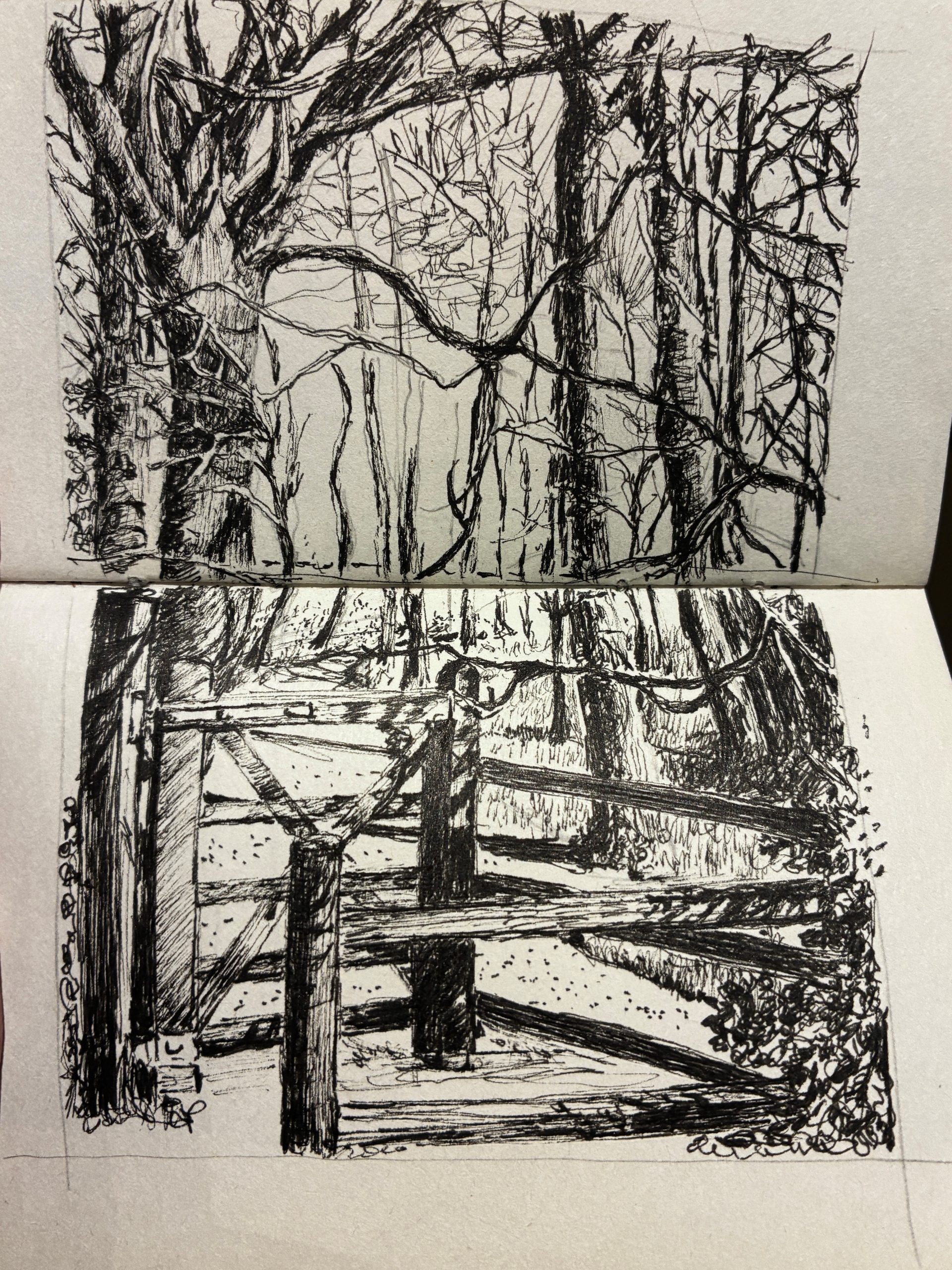
I start by making small, quick drawings in my sketchbooks just to block in shapes and shadows. I think noticing the way shadows fall is very important, and I like to chart the transition of the sun from early morning to late evening. I always record smaller details such as the prevailing wind direction, where moss or lichen grow, types of rock or stone and plants growing in the vicinity. I use tracing paper or newsprint to take rubbings of surfaces. This method of documenting the surfaces can often uncover hidden traces or patterns that go unobserved to the human eye, and can be used later to inform my drawings.
John Ruskin, the great writer on art, used to call these observations ‘Leading Lines In Nature’. And I believe, certainly in my drawing practice, that paying attention to these tiny details helps enhance the narrative of the drawing. In The Last Signal Box, I wanted to draw attention to the growth formation of the trees and highlight the pattern and texture of the bark to enhance the viewing experience of the viewer. I absolutely love the way gnarly trees contain hidden shapes and objects, and I wanted to share that experience of looking with my viewer.
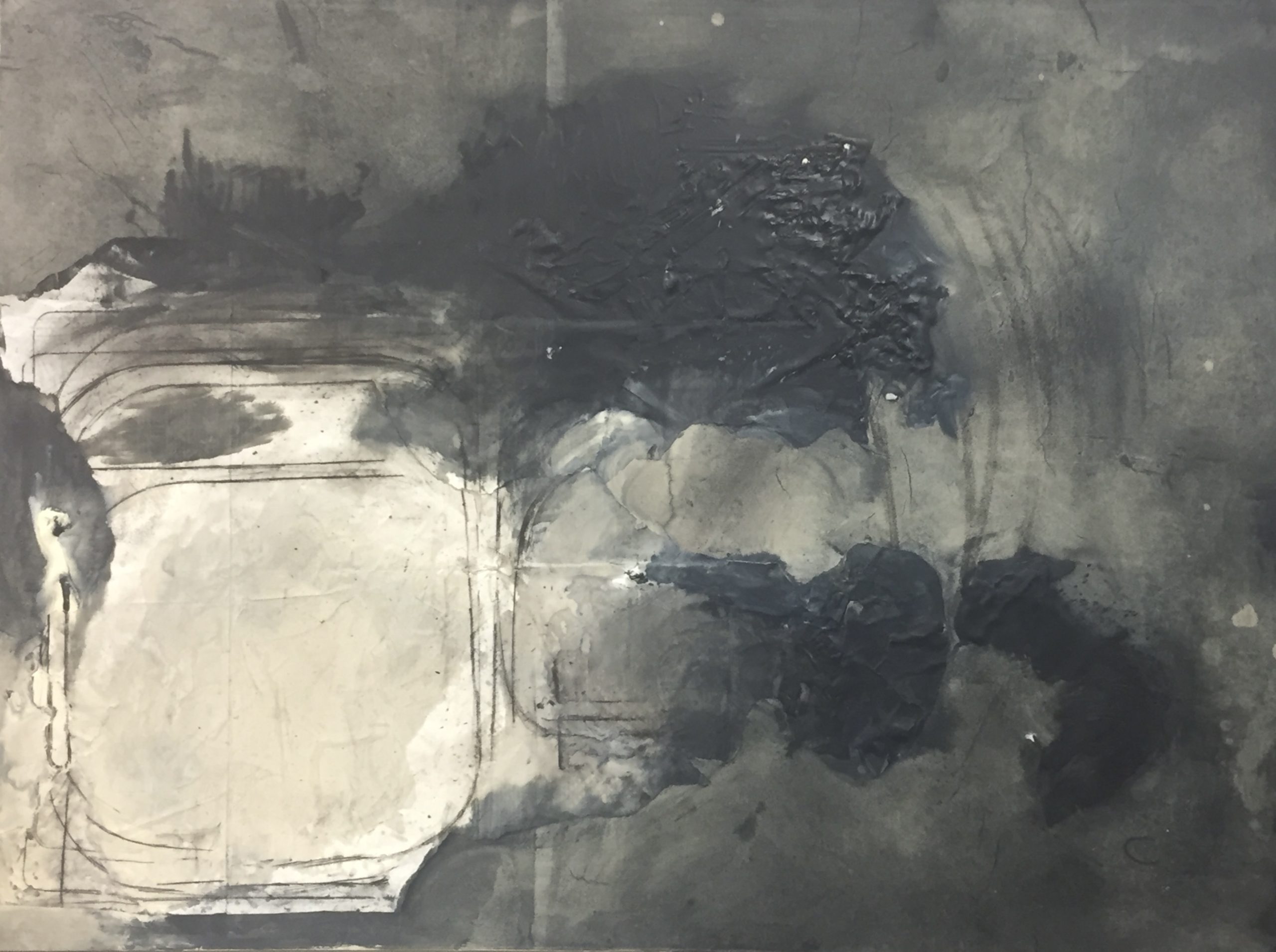
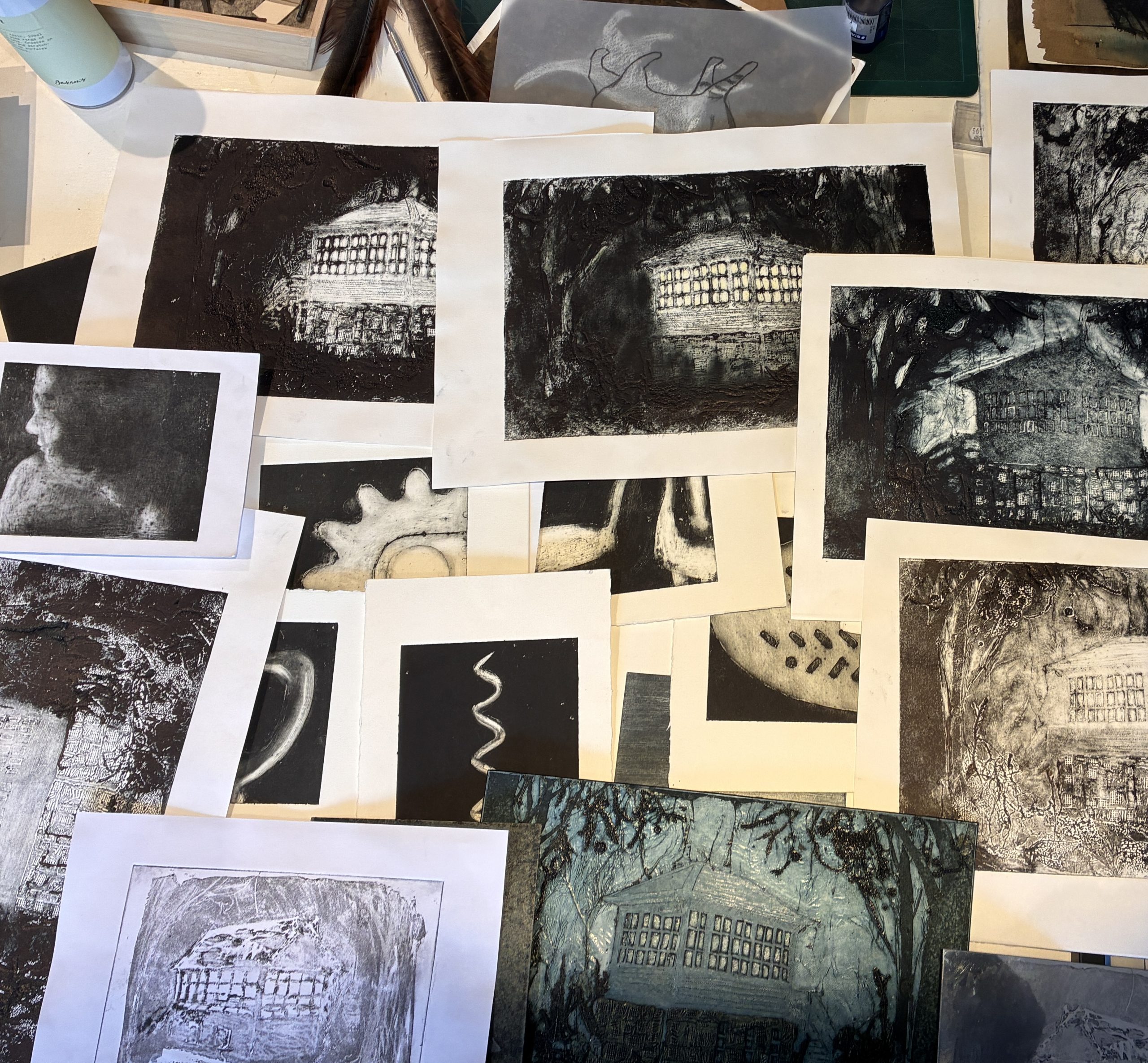
Once back in studio, I explore my sketches through printmaking. I find this method helps me explore composition and enables me to think through my ideas. I usually make a few collagraph plates, which when inked up, can be both relief and intaglio. This method helps me understand how and where I can apply deep tones and texture within my drawing. I sometimes use monoprint or drypoint, but love the effect of collagraphs, as they are inexpensive to make from cardboard and enable me to pull about 10-15 images before the plate breaks down.
Josephine: Do you regularly draw or keep a sketchbook? If so, how does this inform your work?
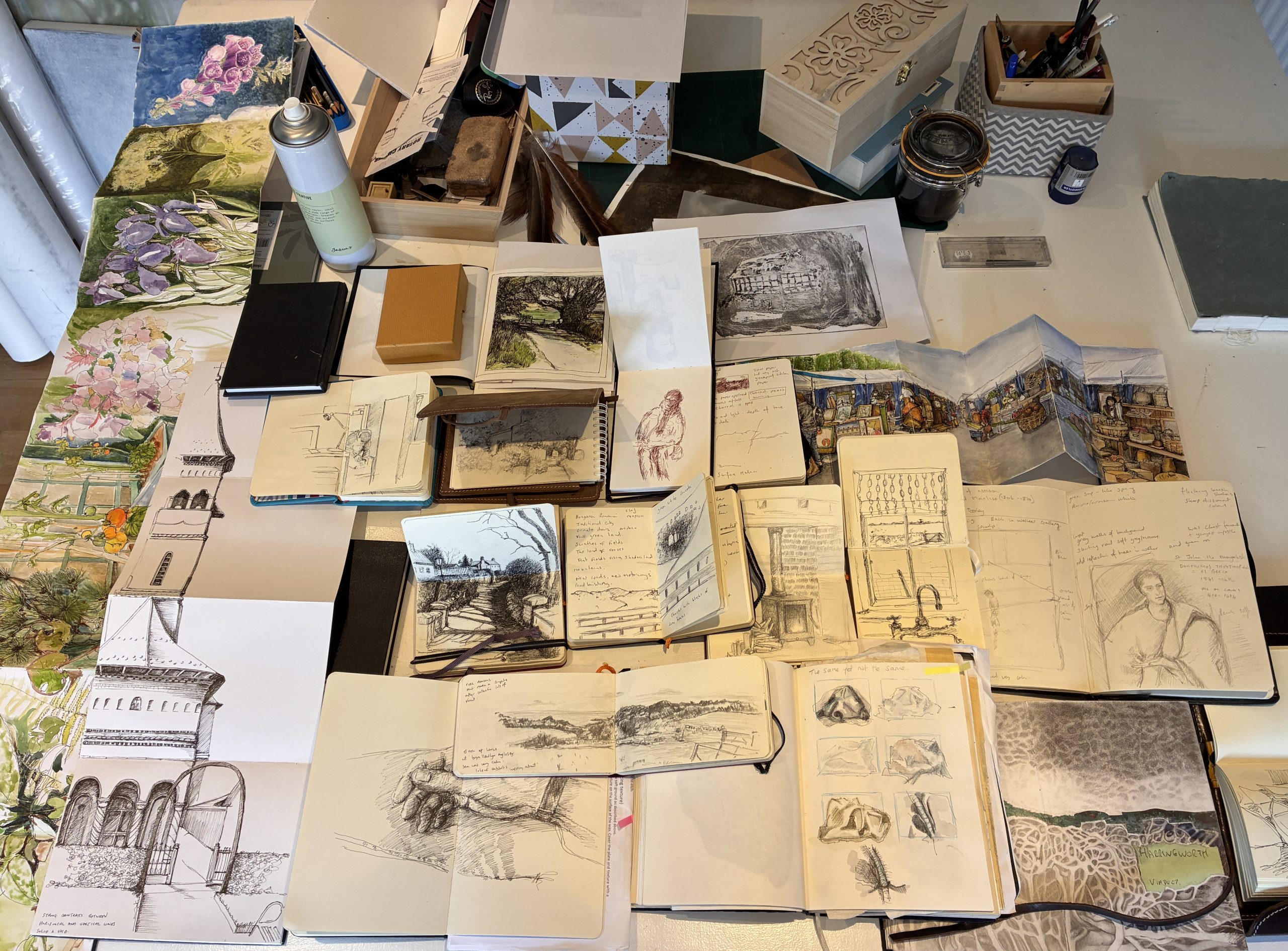
Jane: I am a prolific user of sketchbooks and have them scattered everywhere. My sketchbooks fall into two distinct categories: expressive mark-making that allows the immediacy of drawing to be explored, and longer, more detailed drawings that usually contain a narrative or a need to record detail. I live near Sherwood Forest and regularly take my sketchbook to draw the fantastical trees and undergrowth that can be found there. The trees in The Last Signal Box are an amalgamation of trees growing in a small section of The Robin Hood Way, a footpath that celebrates the legendary exploits and travels of Robin Hood.
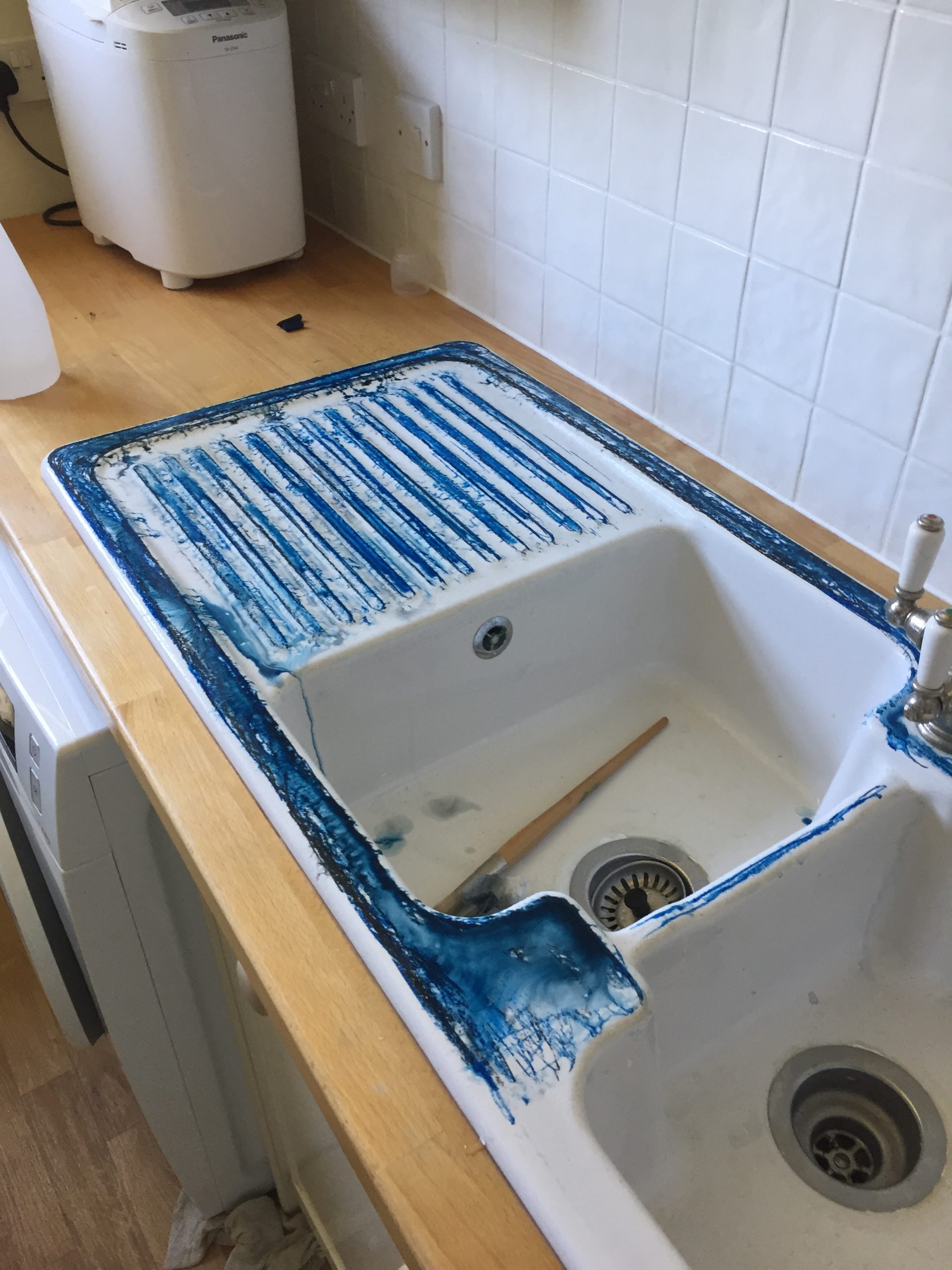
I also use sketchbooks as a form of archive to collect marks that will inform my future drawings. An example of this is an ongoing sketchbook I keep that records all the everyday marks we often overlook within the domestic home; circles made from a coffee or teacup, and the imprint certain domestic utensils such as a spatula or whisk makes or even the trace left behind on a chopping board or worktop. I like the fact that these marks are unique and personal to me, which in turn enables my drawings, that explore home, an authentic personal voice.
I have also learnt the value of thinking of a sketchbook as like a passport. Asking permission to sketch or observe is tolerated and accepted more than using a camera, I think, And this is just a personal thought that maybe using a sketchbook is somehow seen as less of a form of surveillance.
Josephine: Have you ever had a period of stagnation in creativity? If so, what helped you overcome it?
Jane: Last year, I decided to fully stop teaching Fine Art and focus full-time on developing my drawing practice. In theory, I thought this would be an easy transition, but it wasn’t. I missed my students’ enthusiasm for art and making, and I absolutely missed supporting them, celebrating their triumphs, and supporting their doubts.
To overcome this sense of loss and panic at my own inertia of how to start making artwork. I set myself the task of making a list of all the things that had deep significance to me, and that I really felt I needed to draw. Once I had a list of about six ideas, I wrote each idea on an A4 sheet of paper, pinned each one up on my drawing board and started brainstorming, which for me means using highlighter pens to develop each idea using both diagrams and words – a process which took several weeks. During those weeks, I was also reading and looking at artists, finding exhibitions that might inform the work. I found I just kept adding more and more thoughts to the signal box idea. Then, my developing excitement and need to start the drawing process just carried me through the stagnation. In fact, during those weeks, I didn’t even worry about anything; I just allowed myself, or rather, more importantly, gave myself permission to become immersed in deep unpressured thinking.
Jane Reid
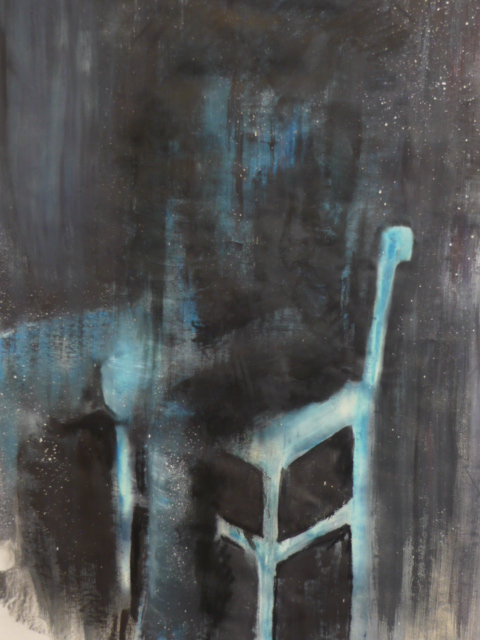
Oil on paper,
120 x 96 cm | 47 x 38 in
Josephine: Are there any specific artists or mentors who have inspired you?
Jane: Oh gosh, I have lots of artists who have and continue to champion drawing, a few are: Louise Bourgeois, Carolee Schneemann, Julie Mehretu, Mona Hatoum, Toba Khedoori, John Berger, William Kentridge, Peter Doig, Paula Rego, Professor Anita Taylor, and of course Dame Tracey Emin, who has been like a shining beacon of hope in my quest to study art (it’s a bit embarrassing saying that).
As mentioned in the first question, I always knew I wanted to be an artist and go to art school, but getting to art school was a long process. As a child, I struggled academically but loved reading and art. It took me a long time to get the qualifications needed to study at university, and at times, studying A-levels at night school felt like one step forward and two steps backwards. However, it was during my first year of study that I was tested for dyslexia and confirmed I was indeed dyslexic and had dyscalculia. I will be eternally grateful to Dr Marion Arnold, who took the time to really care and see more in me. I would dearly love to name each inspirational person during this time (especially during the PhD), but I think they know who they are, and know how grateful and indebted I am to them.
Josephine: What were you thinking about or exploring at the time you made The Last Signal Box? What inspired it, and how did it come to be?
Jane: Moving from teaching to being an artist in my own right was a big step, and as mentioned earlier, I was finding it difficult to decide on a topic or theme. Once I worked out what I wanted to focus on, I knew that through researching the history associated with the Gothic architecture of signal boxes, and the process of drawing, I would be able to explore the long-held significance of these buildings. For me, a signal box has been a personal metaphor for safety and security all my life, never changing, always solid and dependable. At night, as a child, I would look out of the bedroom window, which was directly opposite the signal box.
I would do this because my mum at the time worked as a nurse and would often work late, sometimes not home until after midnight. But I always knew there was someone working in the signal box, and I could run around to see them if needed. I have revisited this image of sanctuary and solace many times, through uncertainty and bereavement. The dramatic and foreboding trees within the image represent a period of unknown or uncertainty, yet the clearing to the haven of the signal box is apparent and most definitely not unachievable to reach.
Josephine: What made you submit this piece to Jackson’s Art Prize?
Jane: I really love the fact that Jackson’s is a not-for-profit competition and offers everyone who enters exactly the same fair and level playing field. This was my first large-scale drawing completed as a full-time artist. I hadn’t entered the Jackson art prize before, as I just didn’t have enough time to properly make any work whilst teaching. I really wanted to see in what way such a personal drawing would be received.
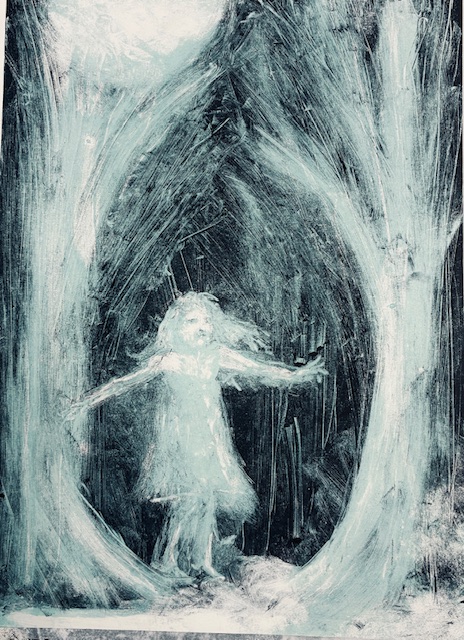
Jane Reid
Monoprint on paper, 29.7 x 21 cm | 11.69 x 8.27 in
Josephine: The judges mentioned that The Last Signal Box ‘acts as a camera flash’ – the atmospheric lighting contributing to the image feeling like a fleeting moment in time. Is there a narrative behind this?
Jane: This was such an amazing and insightful way to describe the drawing, and absolutely spot on. The comfort and safety I associate with my childhood signal box has, over time, come to exist as a strong, vivid moment etched within my brain. Making this image, which exists in a realm of privacy, clear and visible was important to me. I wanted to share this intimacy with my viewer as though holding their hand and explaining how a building, that in reality is crumbling and decayed, can still exist and provide comfort if and when needed.
My drawing also considers the unnecessary neglect of a historic Victorian Gothic Signal box and cottage, which was once my childhood home. I wanted the drawing to be carefully balanced. By which I mean the trees and forest needed to echo the Gothic architecture of the signal box. One of the ways I achieved this was to slightly elongate the trees and widen them out towards the top of the drawing, which creates a sense of eeriness and the supernatural. These two sensations were also important to Victorian ghost story writers such as Charles Dickens, Algernon Blackwood, Elizabeth Gaskell, and Bram Stoker.
My use of a monochrome palette was not only chosen for its dramatic effect, but I find that by using monochrome, I can concentrate fully on the building or object I am drawing, focusing on the shape, size, and volume. I find that if I use colour, there is almost too much going on within the image, and I feel the drawing, especially if very detailed, becomes a sensory overload for both myself and the viewer. I really like how the philosopher Paul Crowther (2017) writes about the benefits of monochrome. He describes how creatures that can’t see colour yet move through their environment easily and suggests that a drawing devoid of colour communicates the way in which we live in a clearer, more understandable way. I think this is certainly true for my own art practice.
Josephine: Were there any lessons you learned while working on or finishing this piece?
Jane: I don’t think there are any lessons, but I have come to appreciate how much I love working on large-scale drawings and how happy it makes me feel when I am drawing.
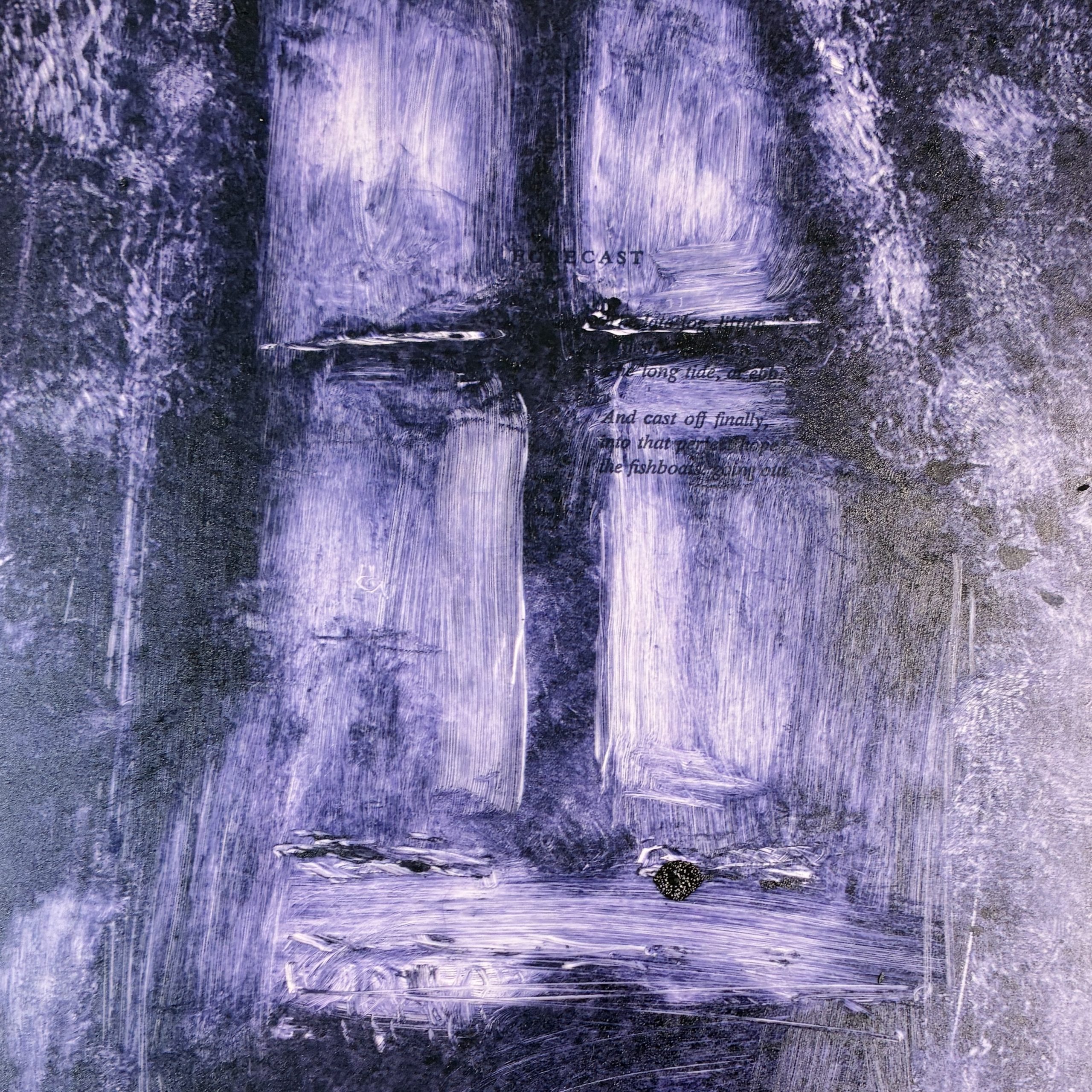
Jane Reid
Monoprint on paper, 29.7 x 21 cm | 11.69 x 8.27 in
Josephine: Are there any new techniques or ideas you’re excited to explore using the materials from your prize?
Jane: I am so excited and can’t wait to try some of the Faber-Castell Pitt dark graphite pencils and the Artist Brush India Ink Pens in grey tones. I use a lot of mark-making media, so being able to choose from such a fantastic range is a wonderful prize.
Josephine: How did it feel to move through the stages of the competition and win the Drawing Award?
Jane: I didn’t even know if my drawing would be selected at all. I almost dared not open the email each time it popped into my inbox. There is such amazing work that is entered into this competition, and I have been admiring all the long list entries on Jackson’s Instagram page. I am in awe of the judges, selection panel, and staff. You must all be superhuman and never sleep during the selection process.
Josephine: What’s coming up next for you?
Jane: Now that I am working full-time on my art, I am building a new body of large-scale drawings and collagraph prints, which I am so excited about. I am also working on a project involving large-scale drawings and sketchbooks that will help support domestic abuse survivors and their families. It’s going to be a very busy but wonderful year of drawing.
Further Reading
Jackson’s Art Prize 2026 First Prize Winner Announced
Meet Eleanor Johnson, Winner of Jackson’s Art Prize 2025
How We Collaborate With Artists
Expert Advice on Making Your Way as an Artist
Shop Graphite and Charcoal drawing on jacksonsart.com