Lindy Norton won the Itaglio Print Award in Jackson’s Art Prize this year with her work Mark’s Easter Table. In this interview, she discusses the personality of a room, manipulating tone on the etching plate to create atmosphere, and her unfinished business at Mark’s House.
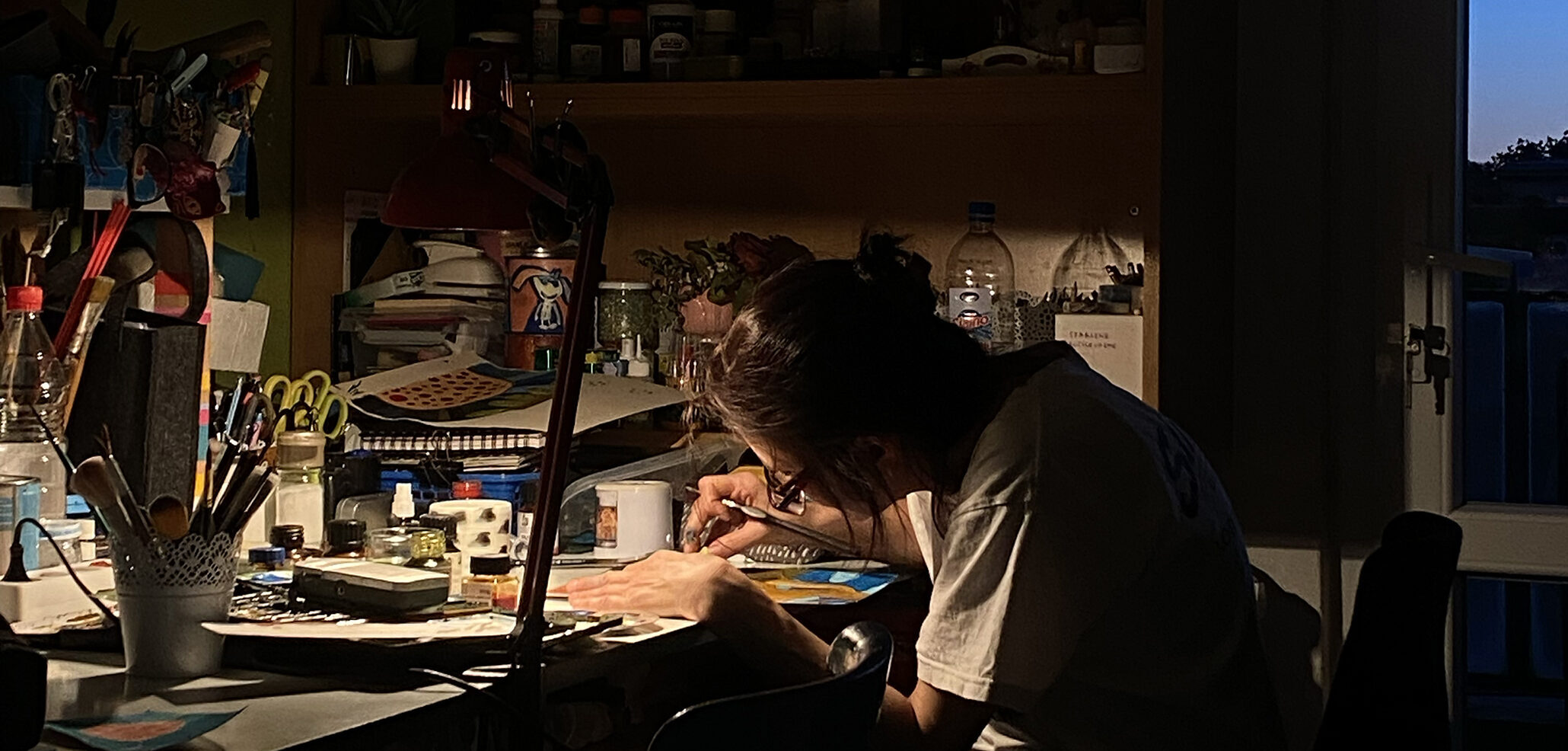
Above image: Lindy in her studio

Lindy Norton
Aquatint on paper, 75 x 55 cm | 29.5 x 21.6 in
Josephine: Could you share the story of how you became an artist and tell us more about your artistic background?
Lindy: I took solace in drawing when I was nine years old after leaving Africa, where I had spent a happy childhood. I was very unsettled on our return to England, and drawing became my outlet, a means of escape. I eventually went to Hull School of Art and Design to do a BA Hons in Fine Art, followed by an MA in Printmaking at Chelsea School of Art. While I was at art college, I began drawing in an old, derelict workhouse, next door to where we lived. It intrigued me, and although empty, it had a strong sense of human presence. The past lives and stories seemed to be impregnated into the walls. I am still trying to capture that sense of unease within my work.
I specialised in printmaking while at college because drawing was then and still is my passion. Etching is an extension of drawing and enables me to explore line and tone. I am able to manipulate the ink during the wiping process to enhance the drama and mood. I love tonal aquatint etching but I enjoy the spontaneity and immediacy of drypoint etching.

Josephine: What does a typical working day in the studio look like for you? Do you have any important routines or rituals?
Lindy: I tend to wake up early. I am at my best in the morning, and I am keen to get into the studio. For me, it is important to draw from life. So sometimes I am on location drawing. It could be an old Nissen Hut, an empty house, or a disused building. Recently, I have been drawing in my friend Mark’s house. Mark is an avid eclectic collector of objects. His house is fascinating, like a museum in disarray. I have gone from drawing empty rooms to rooms filled with treasures; from one extreme to the other.
Once I have a drawing I am happy with, I translate it into a drypoint or aquatint etching back in my studio. I try to work a full day, but I am easily distracted. Scratching up a large complex drypoint can take approximately five days of solid work.

Josephine: Which materials or tools could you not live without?
Lindy: I could not live without my Blackwing pencils, of which I go through many, or my etching tools. In particular, I have several roulette wheels that I have had since my Chelsea Art School days, which aid in mark-making on a drypoint plate. Many of my tools are like old friends that I have collected over the years. I would be lost without them.

Josephine: Do you work from a reference? Tell us more about your process.
Lindy: Where possible, I always try to work from life. I think it is important for me to have first-hand information, so drawing on location is key. I begin by making lots of quick thumbnail sketches in order to help me decide on the composition. Then I move into a large observational drawing. Once I am happy with the drawing and feel I have enough information, I start to work up the etching plate back in the studio. I also take photographs so that when I am back in the studio, I have extra reference. Shafts of light coming through a window change throughout the day, and photographs help with this.

Lindy Norton
Drypoint etching on paper, 60 x 40 cm | 23.6 x 15.7 in
Josephine: Do you regularly draw or keep a sketchbook? If so, how does this inform your work?
Lindy: I draw constantly. I enjoy using sketchbooks and generally have several on the go at a time. I use a sketchbook mainly to plan and develop my ideas, beginning with small thumbnail sketches. I then go on to develop the composition in my sketchbook in preparation for the large drawing, prior to the etching. Sketchbooks are for me more for working out ideas and compositions.

Lindy Norton
Pencil on paper, 85 x 60 cm | 33.4 x 23.6 in
Josephine: Have you ever had a period of stagnation in creativity? If so, what helped you overcome it?
Lindy: I definitely have periods of stagnation in my creativity. Sometimes I run out of steam or enthusiasm. Usually, in these instances, I have a complete break and go out and do plein air drawing and painting. This helps me to reset so that I can come back refreshed and with renewed vigour. I think these stagnant times are important in order to rethink, evolve and develop. For me, it is important to have something to say in my work; it is easy to get lazy and complacent and to just keep repeating the same images, working to a formula. I need to encounter stimulating subjects that present new challenges to sustain and invigorate my own practice.

Lindy Norton
Aquatint etching on paper, 46 x 31 cm | 18.1 x 12.2 in
Josephine: Are there any specific artists or mentors who have inspired you?
Lindy: There are many artists who have inspired me over the years. I have long admired the still, calm, beautiful paintings of Gwen John, the moody, dark etchings of Anna Maria Pacheco and Paula Rego. As a student, I was very inspired by the amazing mark-making of Anthony Gross and the dramatic, gestural tool etchings of Jim Dine.

Lindy Norton
Drypoint etching on paper, 35 x 27 cm | 13.7 x 10.6 in
Josephine: What were you thinking about or exploring at the time you made Mark’s Easter Table? What inspired it, and how did it come to be?
Lindy: I have always been drawn to dark, lit rooms and windows. Rooms definitely have personalities and history. On a visit to my friend Mark’s house, I walked into his front room and knew instantly I had to do a drawing of exactly what I saw. The room with all its beautiful artifacts and clutter took my breath away. I felt so excited by his front room this one particular visit, even though I had been there many times before. I returned shortly after, equipped with a drawing board and pencils, and started drawing. It was probably one of my biggest challenges as I wanted to be true to the ‘essence’ of the room… which in a way is a portrait of my friend. From the drawing, I returned to my studio and scratched up the drypoint etching. The etching process enables me to manipulate the tone on the plate in order to exaggerate the atmosphere. This way some objects become ambiguous, enabling me to create a sense of unease and mystery.

Lindy Norton
Aquatint etching on paper, 59 x 49 cm | 23.2 x 19.2 in
Josephine: Light and shadow play an important part in your work – can you tell us more about your interest in these high-contrast subjects?
Lindy: Light and shadow have always been integral to my work. This is something that has lingered since my student days. I like to create a sense of unease within my work. I amplify the tone in order to create a sense of ambiguity within my work. I like the viewer to have to ponder whether certain objects are friendly or hostile to create a narrative.

Lindy Norton
Aquatint etching on paper, 59 x 45 cm | 23.2 x 17.7 in
Josephine: How much of the scene at Mark’s house is real vs imagined? There’s something so mythical and magical about all the creatures and objects gathered together.
Lindy: The scene at Mark’s house is totally real. I have been very faithful in drawing what I observed. Mark’s house is an easy one because it is already full of extraordinary artifacts, doll houses, masks, rabbits, etc. The alchemy comes when inking up the etching plate and manipulating the tone to create mood and atmosphere.

Lindy Norton
Drypoint etching on paper, 45 x 30 cm | 17.7 x 11.8 in
Josephine: Are there any new techniques or ideas you’re excited to explore using the materials from your prize?
Lindy: I love to print on Fabriano Rosapina and Somerset Satin, but Handprinted has other papers that I am excited to explore, such as the Hahnemühle etching papers. I always use Hawthorne Etching Inks, which Handprinted supplies, but Gamblin Etching Ink is new to me, so I will try that. There are so many amazing goodies to choose from, I am not sure where to start.

Josephine: How did it feel to move through the stages of the competition and win the Intaglio Print Award?
Lindy: Like so many artists, I work in a solitary way, never really knowing how my work is going to be received. I entered the Jackson’s Art Prize with no expectations. So to be longlisted with two images was a huge thrill. Then, to be shortlisted with one image was an encouraging endorsement. The competition was fierce. It has given me a real boost. Most artists, like myself, work in isolation, and it is very easy to become insecure and disheartened, with many rejections. Being accepted for the Jackson’s Art Prize is immense, and winning the Intaglio Prize is an achievement I will treasure and never forget.

Josephine: What’s coming up next for you?
Lindy: I still have unfinished business at Mark’s house. Rooms, corners, windows I have yet to explore. I am always on the lookout for interesting houses, derelict buildings, etc. I still feel the dark, moody interiors have mileage for me; it has been a long-held obsession and still remains unfinished business.
Follow Lindy on Instagram
Visit Lindy’s website

Further Reading
Jackson’s Art Prize 2026 First Prize Winner Announced
Meet Eleanor Johnson, Winner of Jackson’s Art Prize 2025
How We Collaborate With Artists
Expert Advice on Making Your Way as an Artist
Shop Printmaking on jacksonsart.com