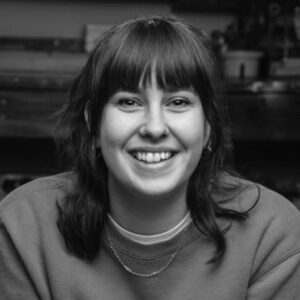
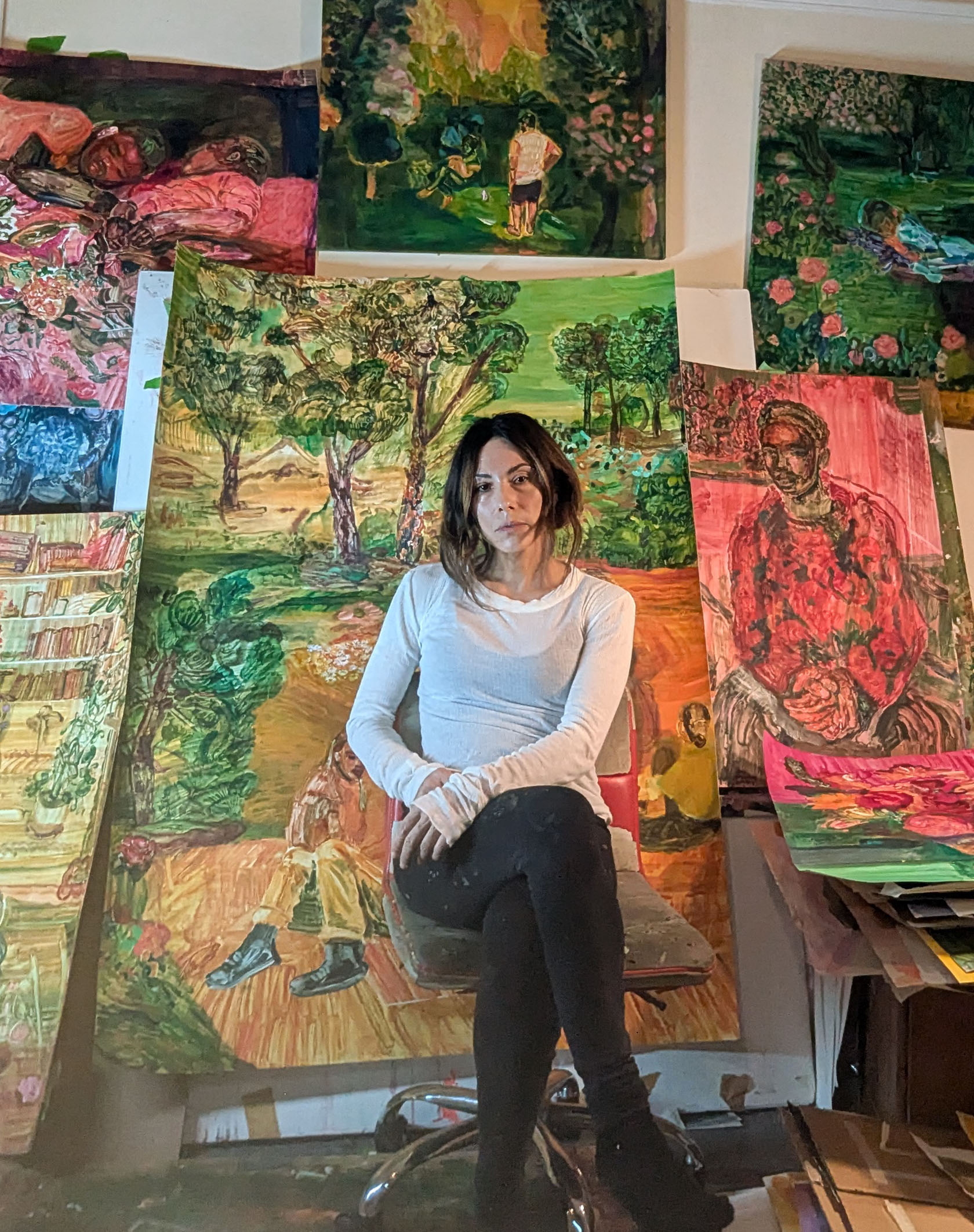
Sofia Luiz Brightwell won a Jackson’s Choice Award in Jackson’s Art Prize this year with her work Boiled Eggs and Other Tender Acts. In this interview, she discusses the artistic influence of her childhood in Brazil, the joy of ragged, ‘crunchy’ brushes, and how making art was a safe space in an overwhelming time of grief.
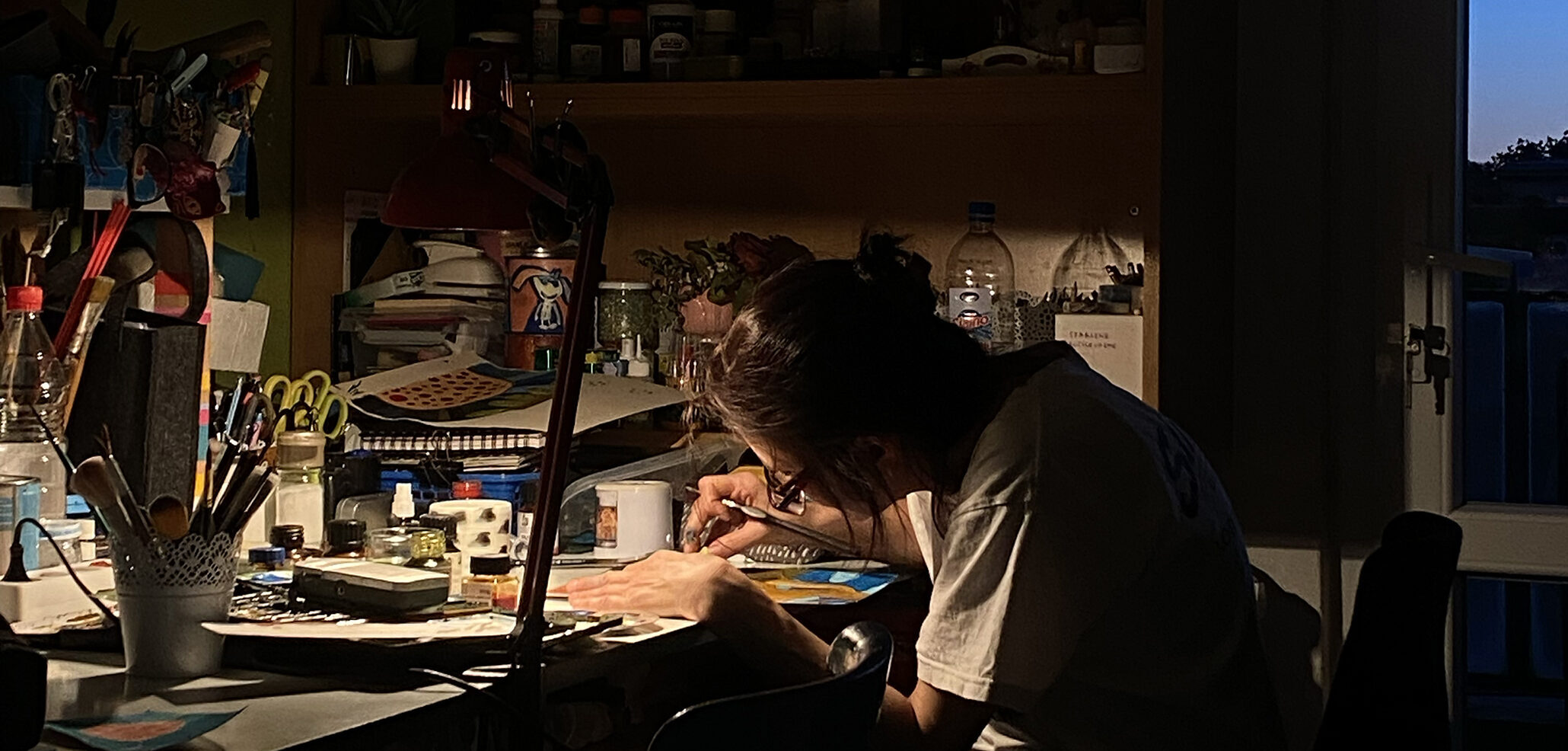
Above image: Sofia in her studio
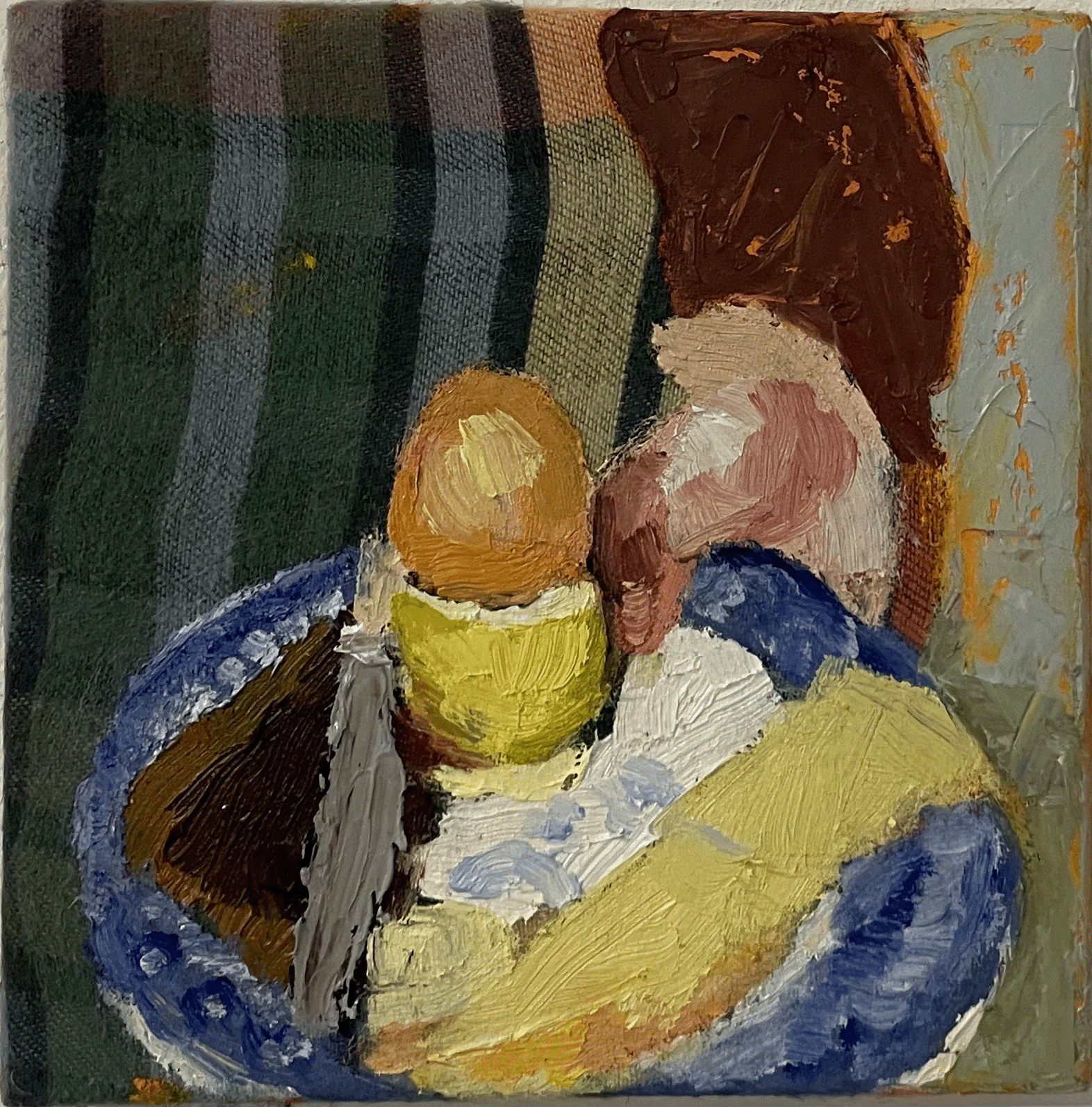
Sofia Luiz Brightwell
Oil on fabric, 15.5 x 15.5 cm | 6.1 x 6.1 in
Josephine: Could you share the story of how you became an artist and tell us more about your artistic background?
Sofia: My paternal grandmother was an artist, and so was her father. She used to paint watercolours of flowers in an almost illustrative style, a sensibility she seemed to share with her father, my great-grandfather. Every year, he would make something he called the ‘Brightwell Chronicles’, a newspaper/comic of stories and events from that year, with illustrations and hand-written captions, handed out on Christmas Day. My family has a collection of around 30 of these chronicles.
Whenever my father’s family would visit us in Brazil, they would bring a suitcase full of presents, often filled with children’s books and art supplies. I remember receiving a packet of pastels and being utterly in love with the colours, and frustrated with how they smeared. This is my earliest memory of working with a material that felt ‘noble’, and there was something so utterly validating in being allowed to use such grown-up materials.
Growing up, art was always a part of our lives, but not necessarily in the traditional paint-and-brush kind of way. I spent the first nine years of my life on a small island in Southern Brazil, with two somewhat bohemian parents who often hosted parties and dinners at our home. There were people from all walks of life at those gatherings, everything from my father’s football friends to my mother’s academic colleagues. It was a home filled with discussion, music, laughter, dancing, and multiple languages. And the best evenings were those where we would walk down to the bay and end the night dipping our feet into the warm water, the lights of the city spread out before us. Being exposed to the vibrancy of the surrounding nature of Southern Brazil, and to the varied groups of people my parents would host, I would say was the start of my art education.
We then moved to England when I was nine, and adapting to the properness of English culture wasn’t the easiest of transitions after such a carefree childhood. Like most artists, I didn’t excel in conventional subjects, apart from art, which felt like one of the few spaces where I didn’t feel invisible or average. It was particularly around age 14 that I truly started thinking of myself as an artist, versus just making art, thanks in large part to the art curriculum at my school, and a brilliant art teacher who exposed me to such a wealth of varied artists.
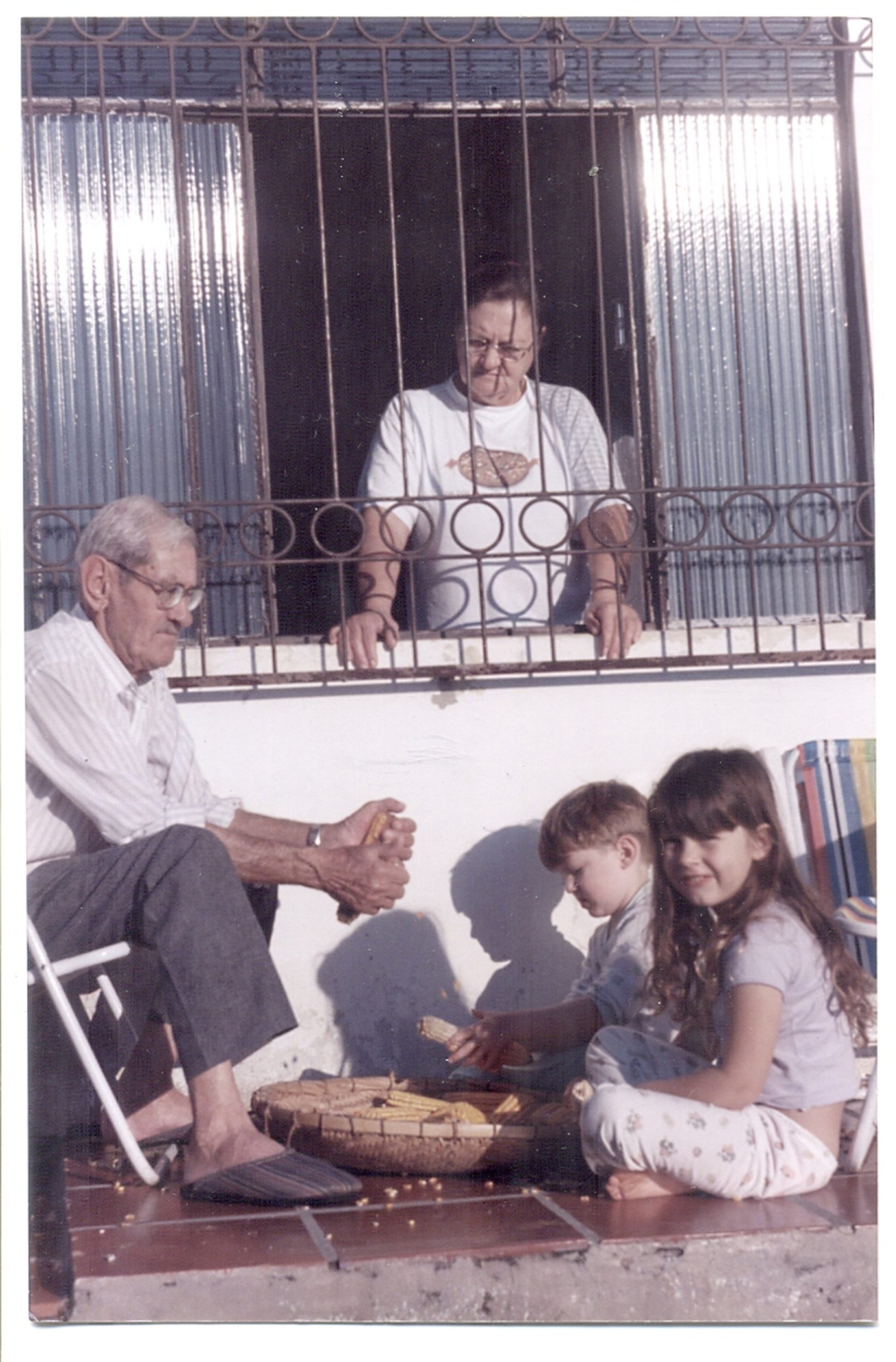
Sofia Brightwell
Photograph
‘This is one of my favourite images of my childhood, which perfectly encapsulates the beauty and simplicity of my childhood in Southern Brazil. Here, me and my youngest brother are peeling corn which has been harvested and dried. This will have then been sent to the mill, to be turned into flour for polenta and Brazilian cuscuz.’
Josephine: What does a typical working day in the studio look like for you? Do you have any important routines or rituals?
Sofia: The first thing I do when I get to the studio is change my clothes. I can’t tell you the number of clothes I have ruined with oil paint, and I know that even if I don’t paint that day, I will get oil on me somehow.
I’m an incredibly messy and expansive painter, but equally, mess can really annoy and overwhelm me. So once I have a cup of tea in hand, I begin tidying and rearranging the space, which has most probably been left somewhat untidy from my last visit. I then begin working on whichever painting is the most resolved, doing something easy like filling in a blocked-in background or a quick wash, which helps me warm up.
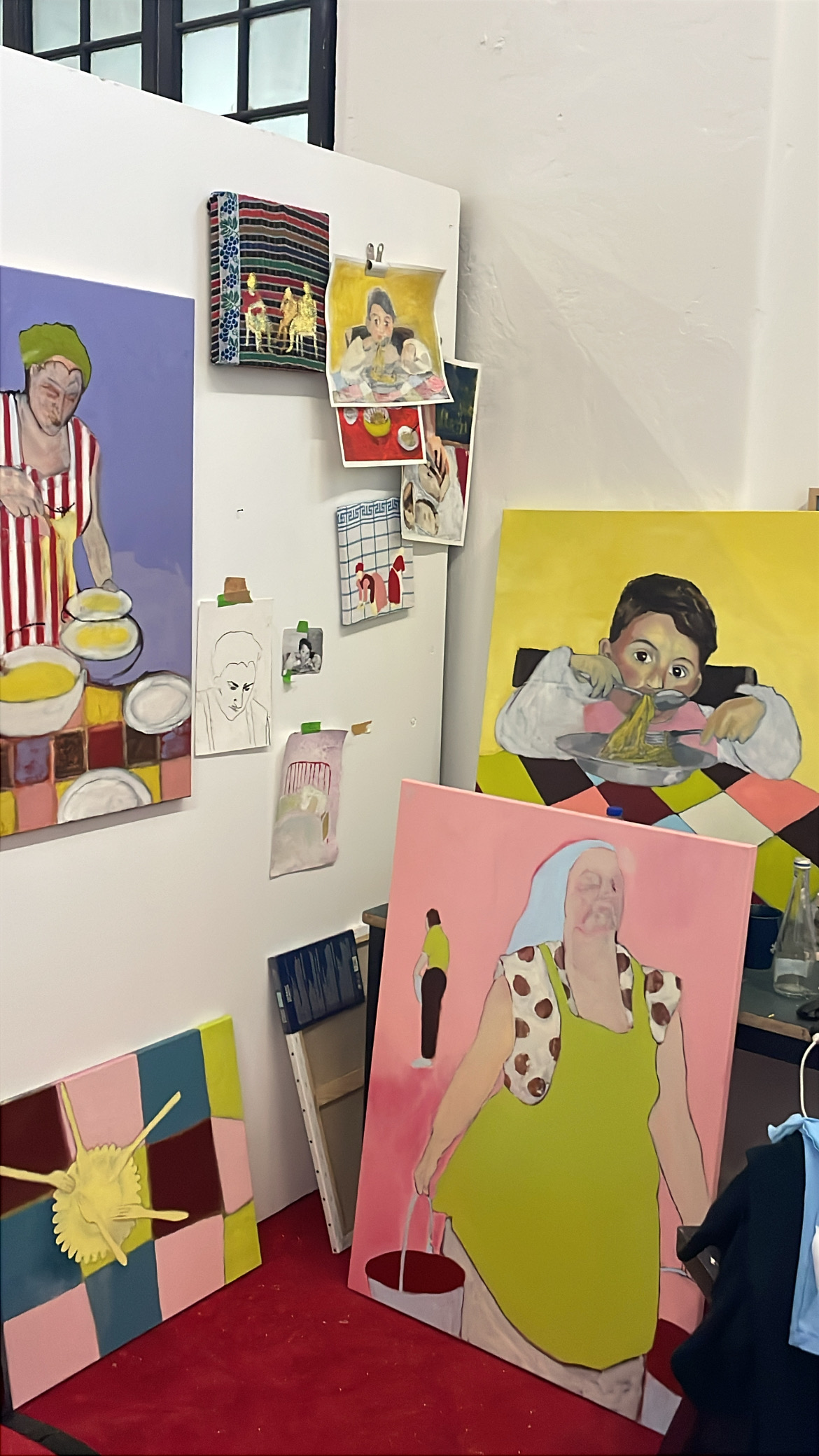
I like working on several artworks at the same time, meaning there will be several palettes on the go and a mountain of paintbrushes spread across the space. Moving between different paintings helps me not to overthink any single one, and consequently, get frustrated.
Josephine: Which materials or tools could you not live without?
Sofia: A really scratchy and somewhat ragged brush. I find the crappier and more rugged the brush, the better and more interesting the stroke. I have some really smooth synthetic brushes that apply paint in a silky, solid way, which are a joy to use, but the result is an utterly boring, untextured stroke. My favourite brush is one I believe I inherited from my grandmother’s collection, and the best way I can describe it is ‘crunchy’!
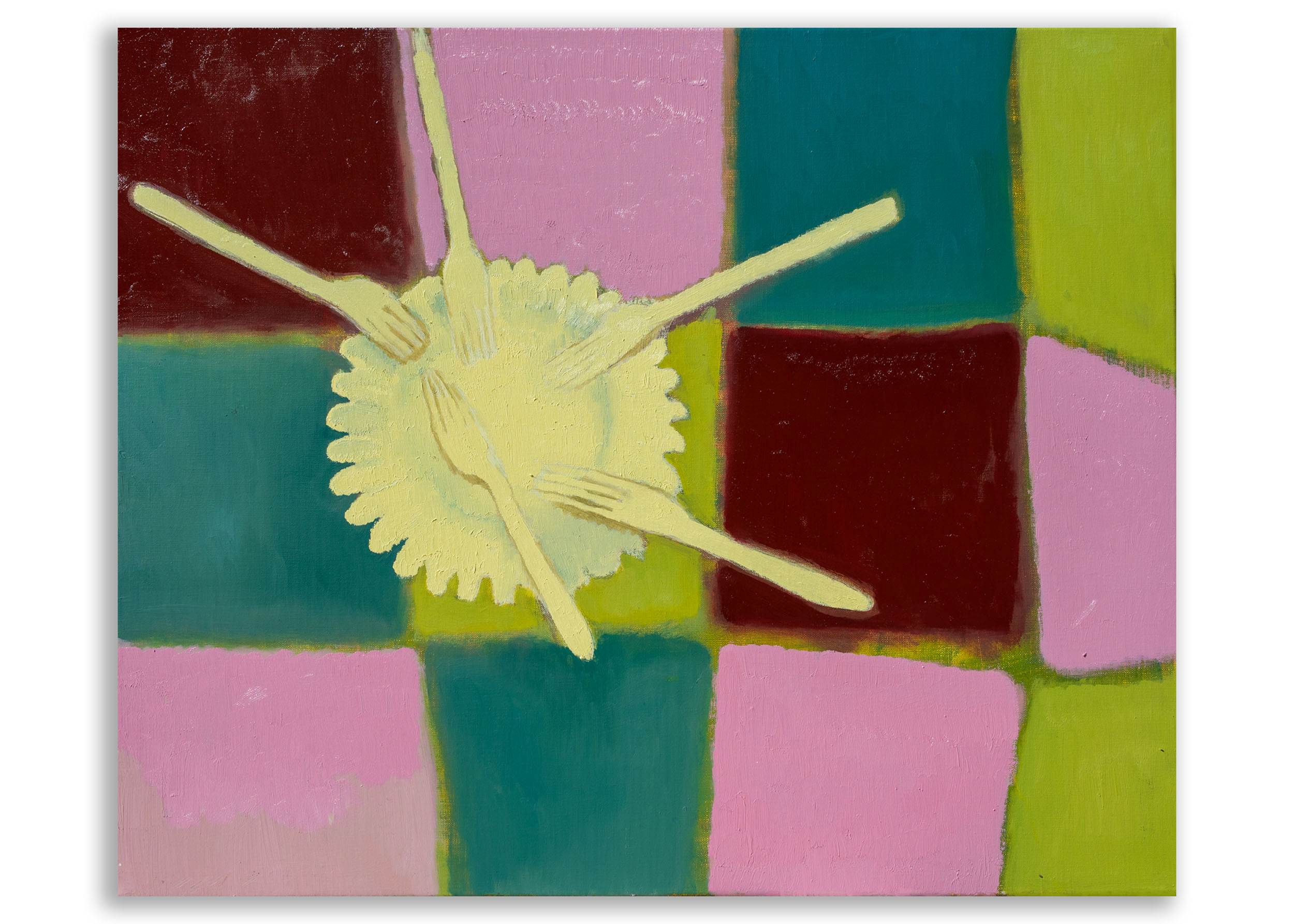
Sofia Brightwell
Oil on linen, 50 x 61 cm | 19.69 x 24.02 in
Josephine: Do you work from a reference? Tell us more about your process.
Sofia: I would say most of my paintings start from an image I’ve come across that speaks to my area of research. I spend a lot of time scouting for archival images of Southern Brazil and pre-war Europe, and I’m particularly drawn to images of women in domestic and agricultural contexts. What fascinates me is how the life of a rural woman can be so similar across such different places, be it Southern Italy or Brazil; there is a grit, endurance, and love, but also an exploitation that runs through all of these images.
But the photographic image only takes me so far. Textiles are also a significant part of my research, informing the patterns I want to feature in a painting, but also my colour palette. And sometimes, as with the artwork I submitted for the Jackson’s Art Prize, the textile becomes the surface for the painting itself.
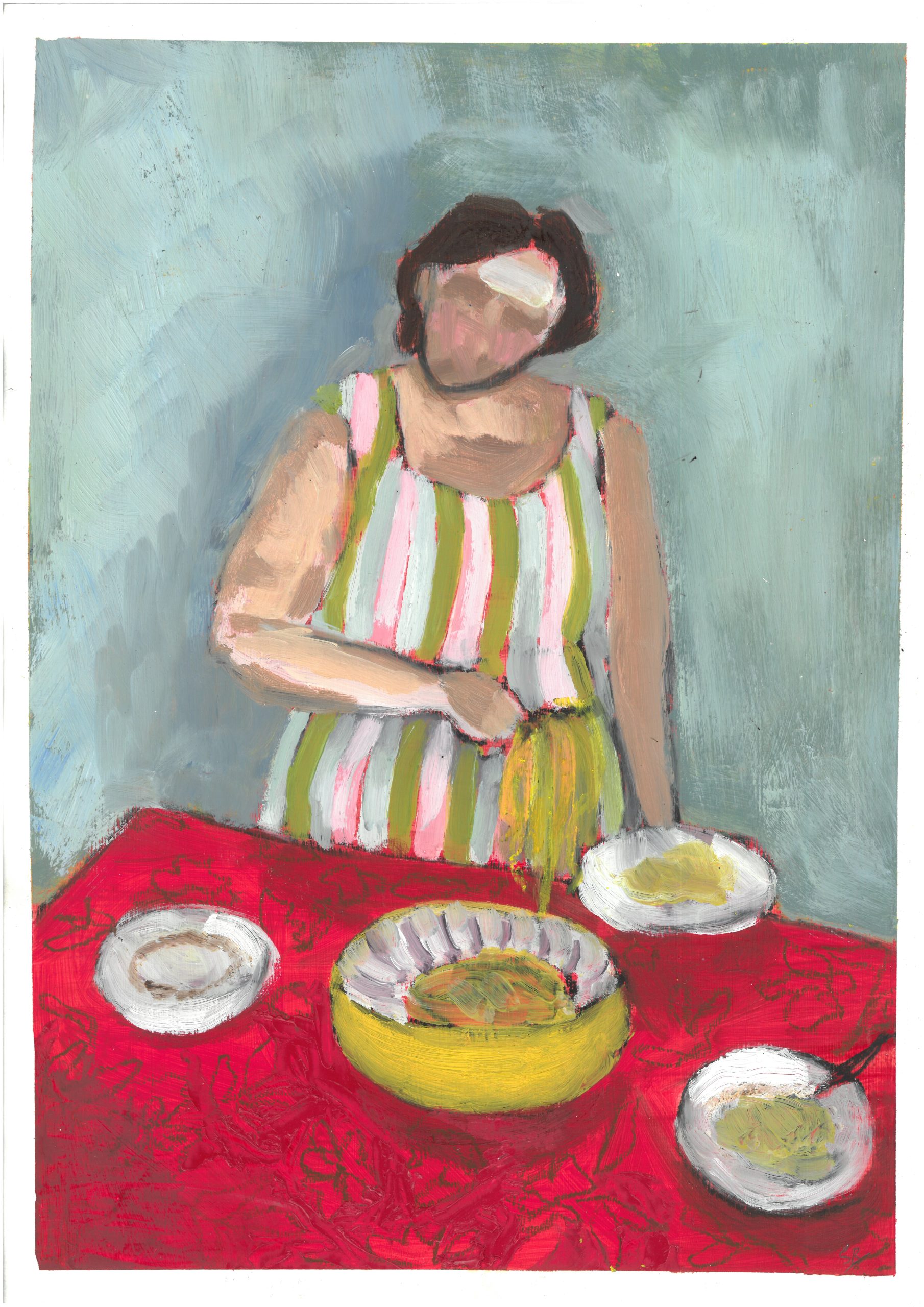
Sofia Brightwell
Oil on gessoed paper, 29.7 x 42 cm | 11.7 x 16.5 in
Josephine: Do you regularly draw or keep a sketchbook? If so, how does this inform your work?
Sofia: In all honesty, no. When my work was more illustrative and drawing-based, a sketchbook was incredibly present in my life. Now, however, I much more enjoy doing quick studies of potential artworks on gessoed paper. These are often loose and quick and help me understand if the composition is working or if the colour palette needs adjusting. That said, I do however, feel that the best way is always to try and work the artwork as I go. One of my favourite paintings, called Braço de Polenteira (Polenta Making Arms), was the result of endless trial and error, of painting and erasing. It gave the work a great deal of depth and layering, almost like a palimpsest of attempts. Part of what attracts me so much to the work of someone like Andrew Cranston is that unapologetic spontaneity to his painting, like a patchwork of attempts that result in something utterly singular.
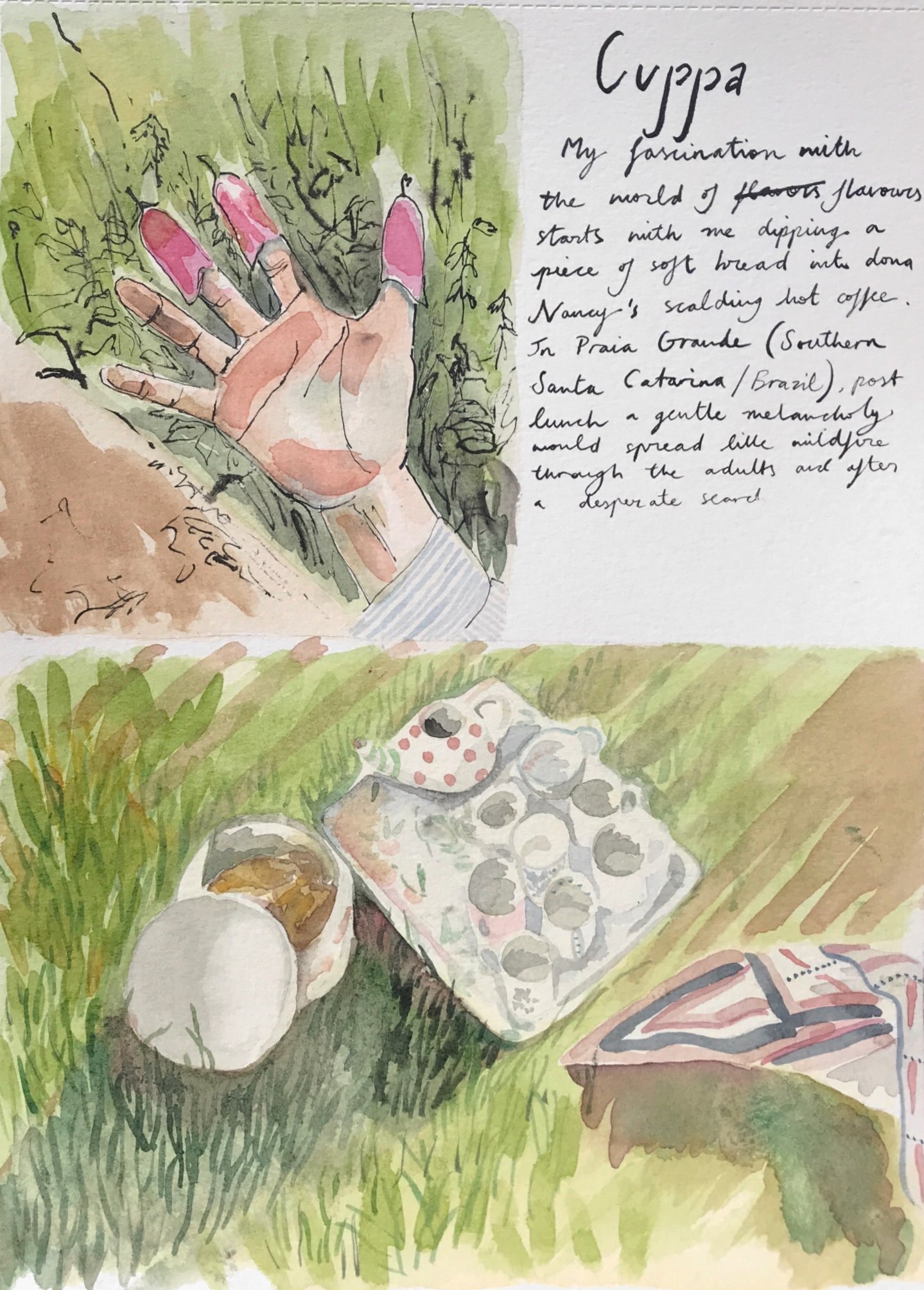
Sofia Brightwell
Watercolour and ink on paper, 21 x 29.7 cm | 8.27 x 11.69
Josephine: Have you ever had a period of stagnation in creativity? If so, what helped you overcome it?
Sofia: I would say that one of the most fertile artistic periods of my life was paradoxically one of the worst. I was in my early twenties, dealing with the grief of losing my mother, and the tragedy of losing her so young, paired with the realization of having to face life without the most important figure in my life, felt utterly overwhelming. Making art wasn’t so much a refuge as an emotionally safe space to explore that pain. I remember coming home from my shift at the pub at 11:30 pm and spending hours drawing and writing, producing so much that I remember it starting to spread all over the flat.
Looking back, I think that period created an idea in my mind that a fruitful artistic practice had to come from a place of extremely deep emotional states. Meaning that as I slowly healed from that grief, I found myself producing less and almost feeling like I was tapped out of ideas.
After that, it was a good few years before I managed to paint with any consistency. I wouldn’t necessarily call it a rut, just a shift in expression, and during that time, writing and photography came to the foreground of my work. I think if you’re feeling stuck or if something isn’t flowing, experimenting with something outside of your conventional practice can help jangle a stuck cog.
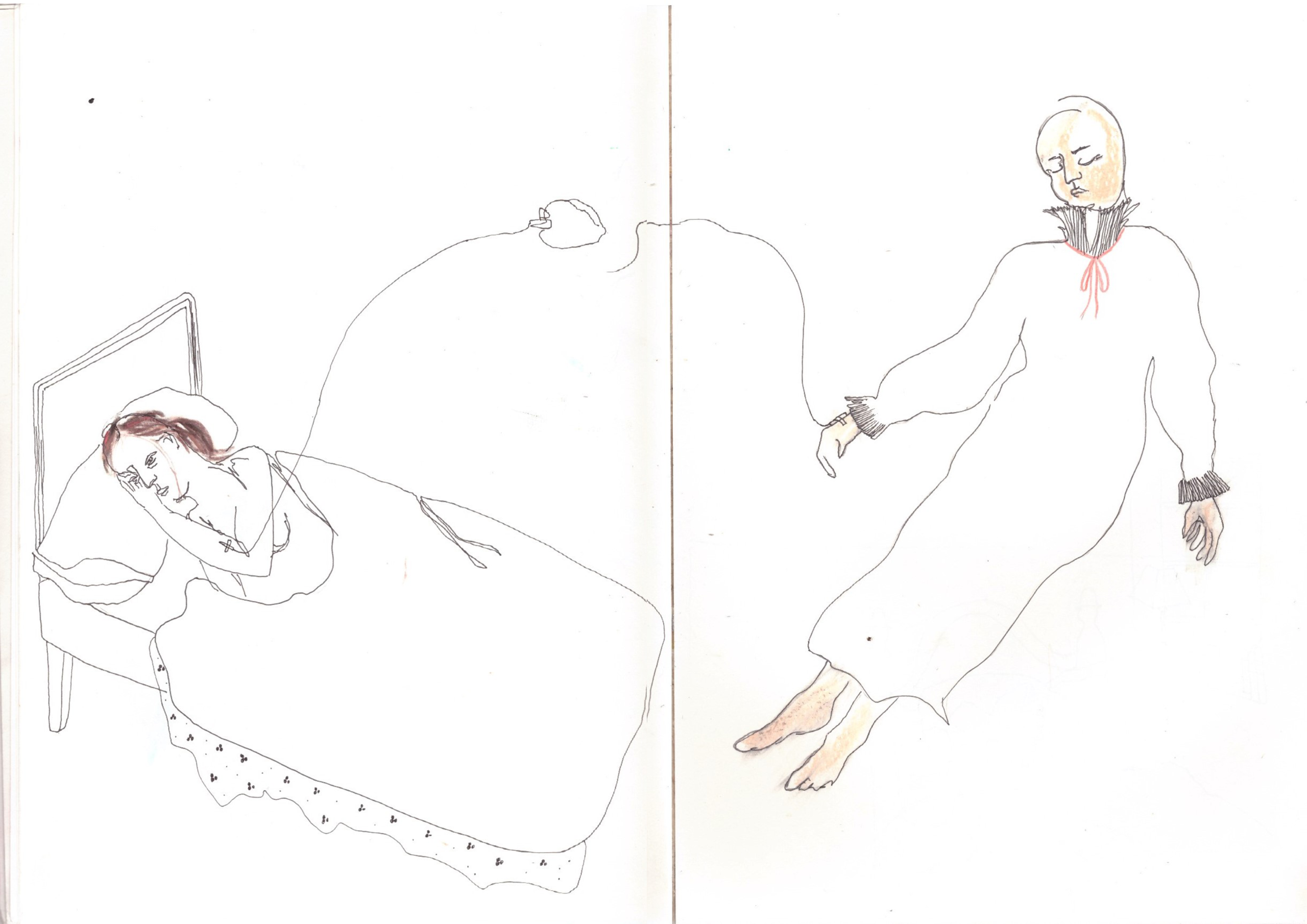
Sofia Brightwell
Ink and colouring pencil on paper, 21 x 29.7 cm | 8.26 x 11.6 in
Josephine: Are there any specific artists or mentors who have inspired you?
Sofia: I had always known about Louise Bourgeois and her work. But it wasn’t until I saw a show of hers at the Tate as a teenager and later read a book on her by Ulf Küster that I truly understood how brilliant she was. What drew me to her work was how deeply she mined her memories of childhood and family, and how her practice had this freedom of expression across multiple materials, which, though very varied, felt connected. It was the first time I had really paid attention to how brutality and fragility could sit and converse within the same artwork, and it really touched me.
Later, towards the end of my graduate degree, I came across the artist Cassi Namoda, whose work still inspires me to this day. Her explorations of Lusophone Africa, and of how an upbringing shaped by multiple cultures can inform our vision of the world, translated so many layers of what it is to look at one’s own culture through both an insider and an outsider lens. There is tenderness, longing, ecstasy, critique, affection, and ambiguity in her work, and it continuously makes me question my own practice, and how multiple layers of meaning can be evoked by representing less rather than more.
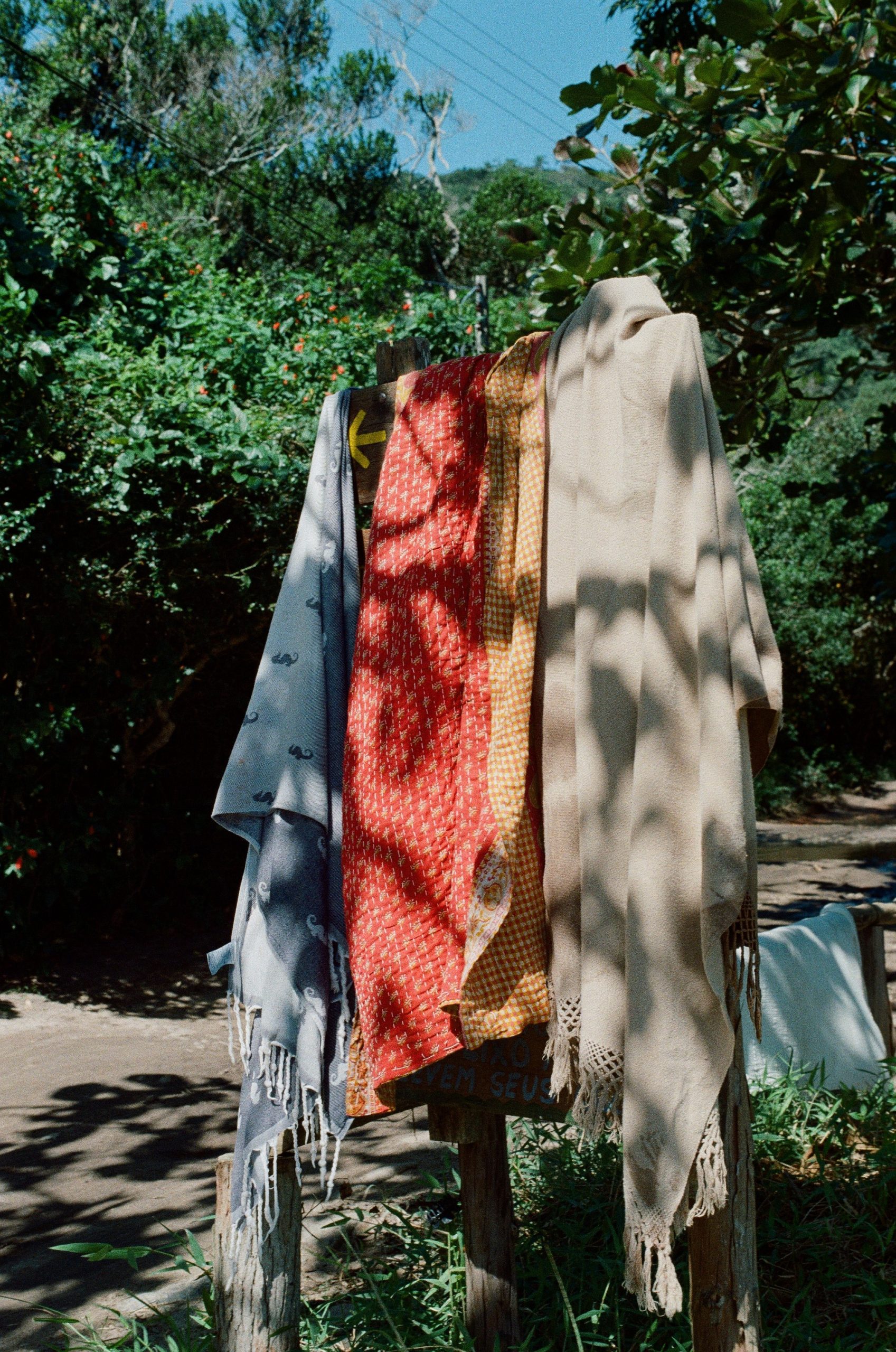
Sofia Brightwell
35mm photograph
“I often daydream about the vivid greenness of nature in Brazil.”
Josephine: What were you thinking about or exploring at the time you made Boiled Eggs and Other Tender Acts? What inspired it, and how did it come to be?
Sofia: People often think my work is simply about food, but what it is really exploring is how care is manifested. I painted this shortly after moving to Lisbon, feeling slightly homesick for my family and the comforts of home. I wanted to experiment with painting on different surfaces, and since this was meant to be a study, I painted directly onto the fabric. The way the fabric absorbed the paint in those first few layers reminded me of how butter melts into toast, so I decided to apply the paint as thickly as I would butter my toast: generously.
The painting is very small, measuring 15.5 x 15.5 cm, and I wanted to depict a simple yet deeply affectionate act: someone handing me a plate of boiled eggs. Everyone has their particular way of taking their eggs, and their toast, and there is an intimacy in knowing that – in serving someone exactly what they like. What I was thinking about when painting this was how lovely it is to be loved and taken care of, and how that can be expressed in the simplest of acts, such as passing a plate of food.
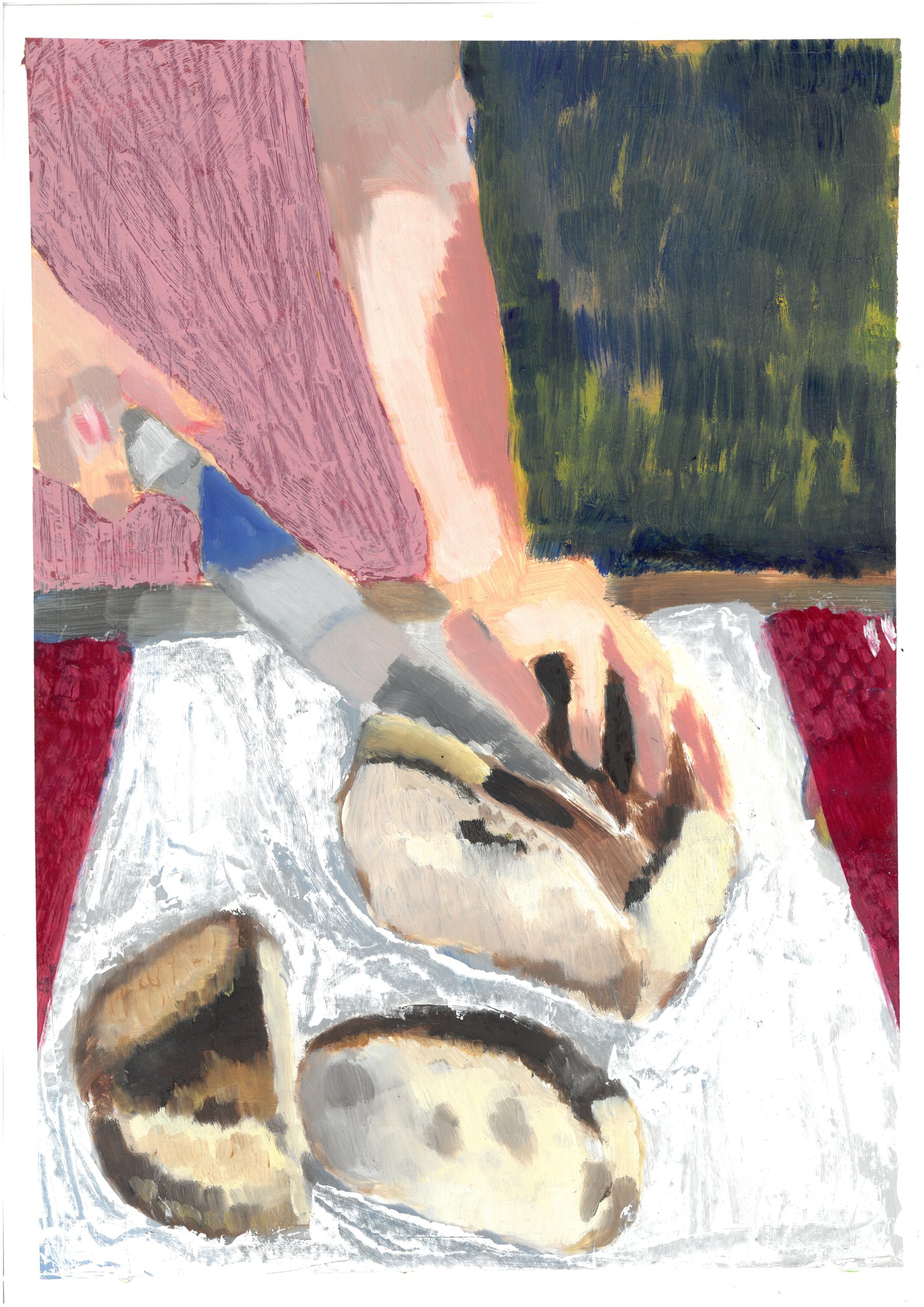
Sofia Brightwell
Oil and varnish on gessoed paper, 29.7 x 42 cm | 11.7 x 16.5 in
Josephine: What made you submit this piece to Jackson’s Art Prize?
Sofia: I’ve always been incredibly shy about sharing my work beyond my own networks, and I suppose I’ve had a self-sabotaging habit of thinking ‘this won’t get through anyway’. When I applied for the prize, it was just after a small exhibition I took part in in Porto. It wasn’t anywhere particularly fancy, but I decided to go for it and attend the opening. Halfway through the opening, I sat down in the middle of the gallery to read the programme, and found myself within earshot of a couple of young people who were standing in front of my work, commenting on it. They didn’t know I was the artist, and were talking freely and openly and in a really positive, engaged way. It gave me so much confidence that I thought, ‘What the hell, let’s apply for this prize.’ So thank you to those strangers, they gave me the courage to enter, and consequently win the Jackson’s Choice Award.
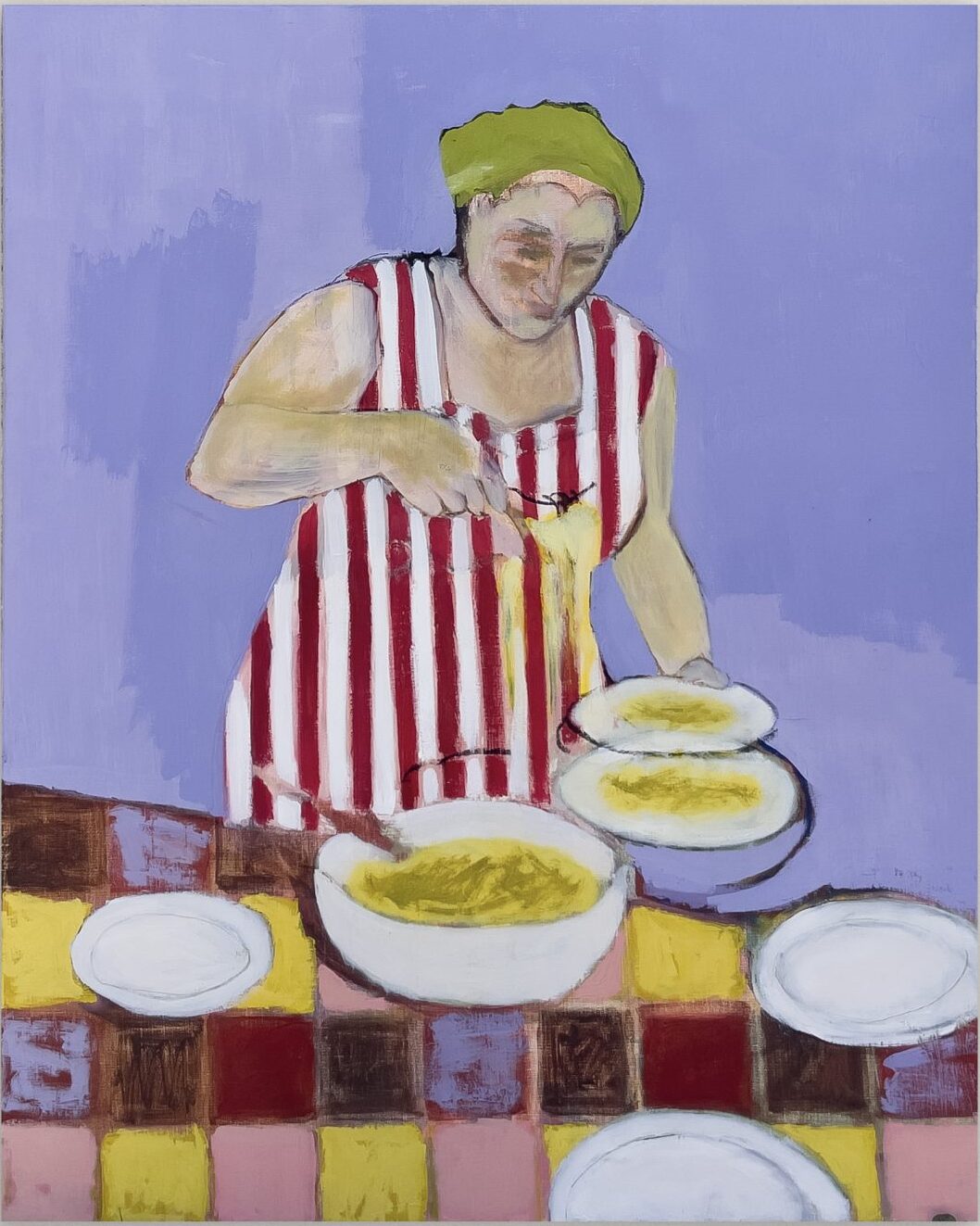
Sofia Brightwell
Oil on linen, 92 x 73 cm | 36.22 x 28.74 in
Josephine: Is there significance in the fabric the work is painted on? Have you used this mixed media approach before in your work?
Sofia: I have always associated flannel with the UK. It very much reminds me of pyjamas and my British grandmother’s house. I had started noticing that patterned fabric was a recurring theme in my work and in the work that attracted me. And I kept looking at my paintings, feeling like they lacked a fresh take. I was working on really cheap, flimsy canvases that would bounce with every brushstroke, and I kept thinking I should just try stretching my own. So I went to the fabric shop to buy canvas, and on the way, came across so many fabrics I wanted to buy instead. I suddenly had the thought: why not stretch one of these onto the frame? So I did.
The fabric speaks to domesticity, which is a constant theme in my work. I’ve been experimenting with different fabrics ever since, exploring how varying textures affect the way paint goes on, how it absorbs, and how they relate to the image I’m depicting. I think similarly to how I’m applying my paint in thick strokes, which evokes a desire to eat it, using fabrics that also have a particularly tactile nature is an attempt to evoke the sense of touch.
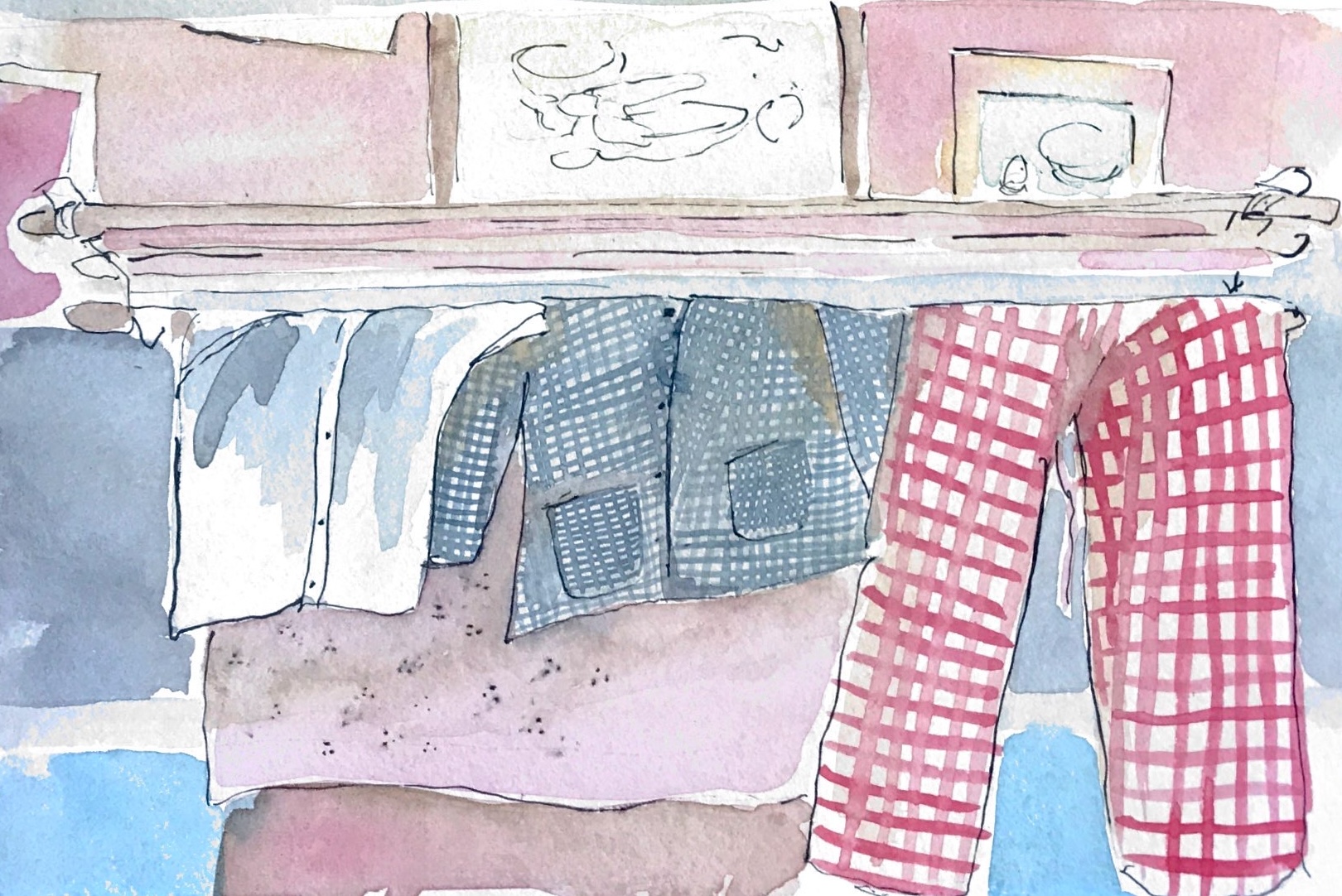
Sofia Brightwell
Watercolour on paper, 14.8 x 21 cm | 5.8 x 8.3 in
Josephine: What feelings do you hope people take away from looking at your work?
Sofia: Whenever I look at one of Bonnard’s or Vuillard’s paintings, I feel a sense of recognition. It isn’t necessarily because I’ve been to those spaces, but because I’ve felt what those spaces are like: a sun-drenched dining room and the particular silence just before dinner is brought to the table, or the dimness of a cosy living room, warmed by the presence of a figure quietly occupying the space, reading or sewing. I hope that when people look at my work, they don’t necessarily find recognition in the subject of the image, but in the intention behind the act – remembering, hopefully, fond memories of how love and care manifested in their own lives, and the subtlety of those gestures.
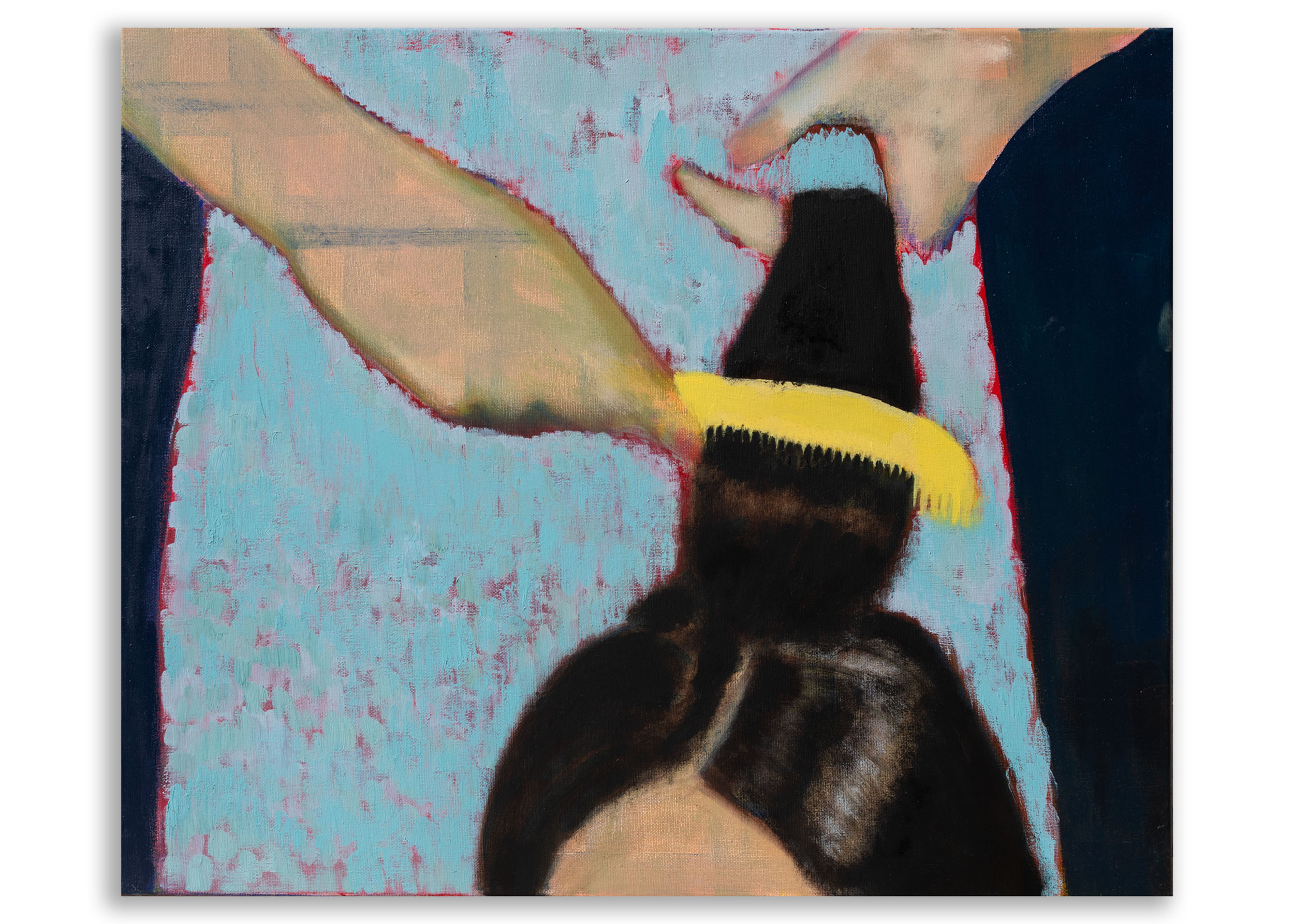
Sofia Brightwell
Oil on canvas, 50 x 61 cm | 19.69 x 24.02 in
Josephine: Are there any new techniques or ideas you’re excited to explore using the materials from your prize?
Sofia: I’ve ordered some tempera paints, which I’m very excited to experiment with, as the last time I used them was when I made my own during my undergraduate degree. I’ve also ordered some pastels, inspired by Chantal Joffe’s pastel work, but also by that earliest memory of being gifted a set by my grandparents.
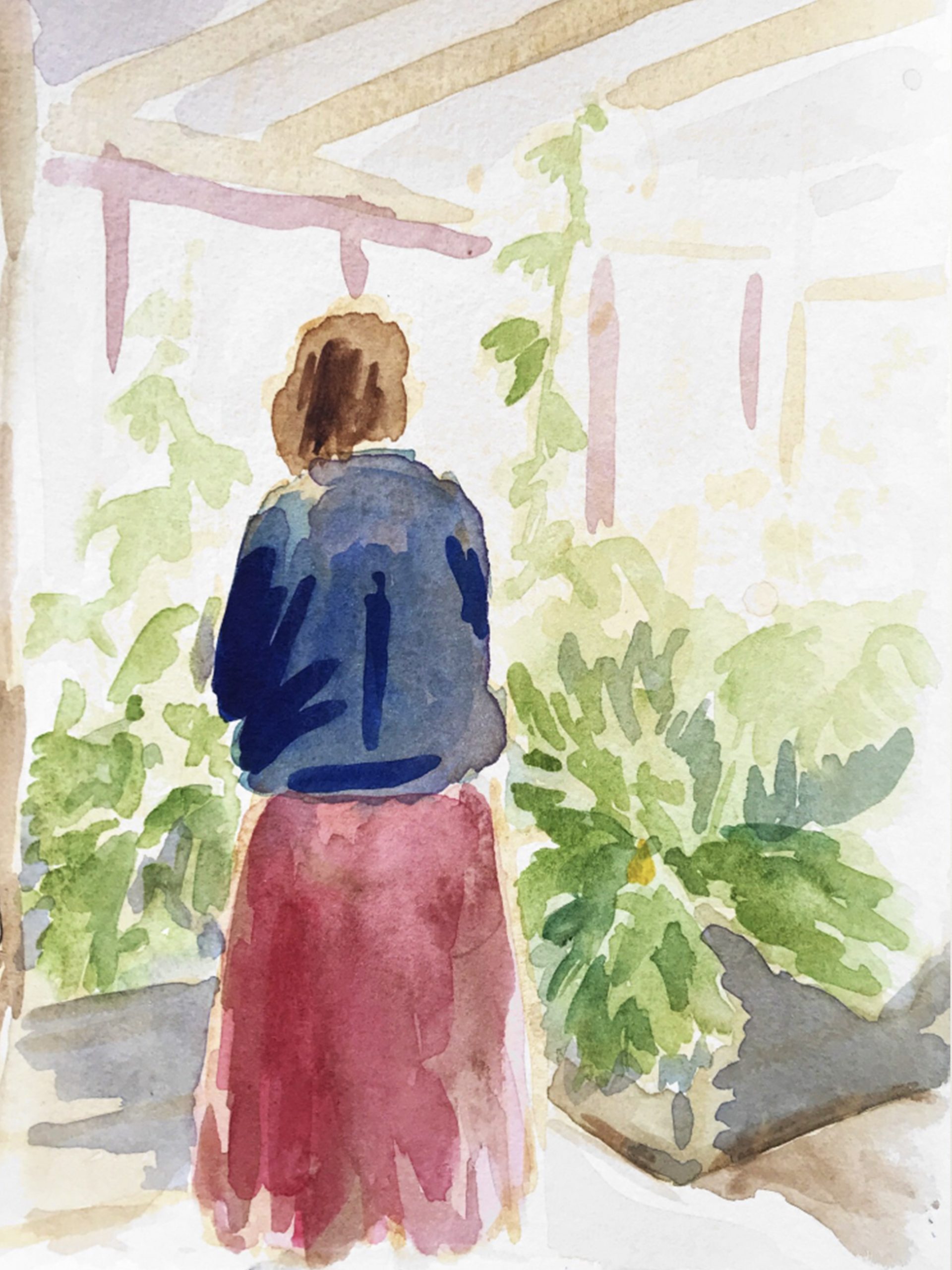
Sofia Brightwell
Watercolour on paper, 21 x 29.7 cm | 8.27 x 11.69 in
Josephine: How did it feel to move through the stages of the competition and win a Jackson’s Choice Award?
Sofia: I kept obsessively checking my emails as the announcement date approached, and when the news came that I had won the Jackson’s Choice Award Prize, I was elated!
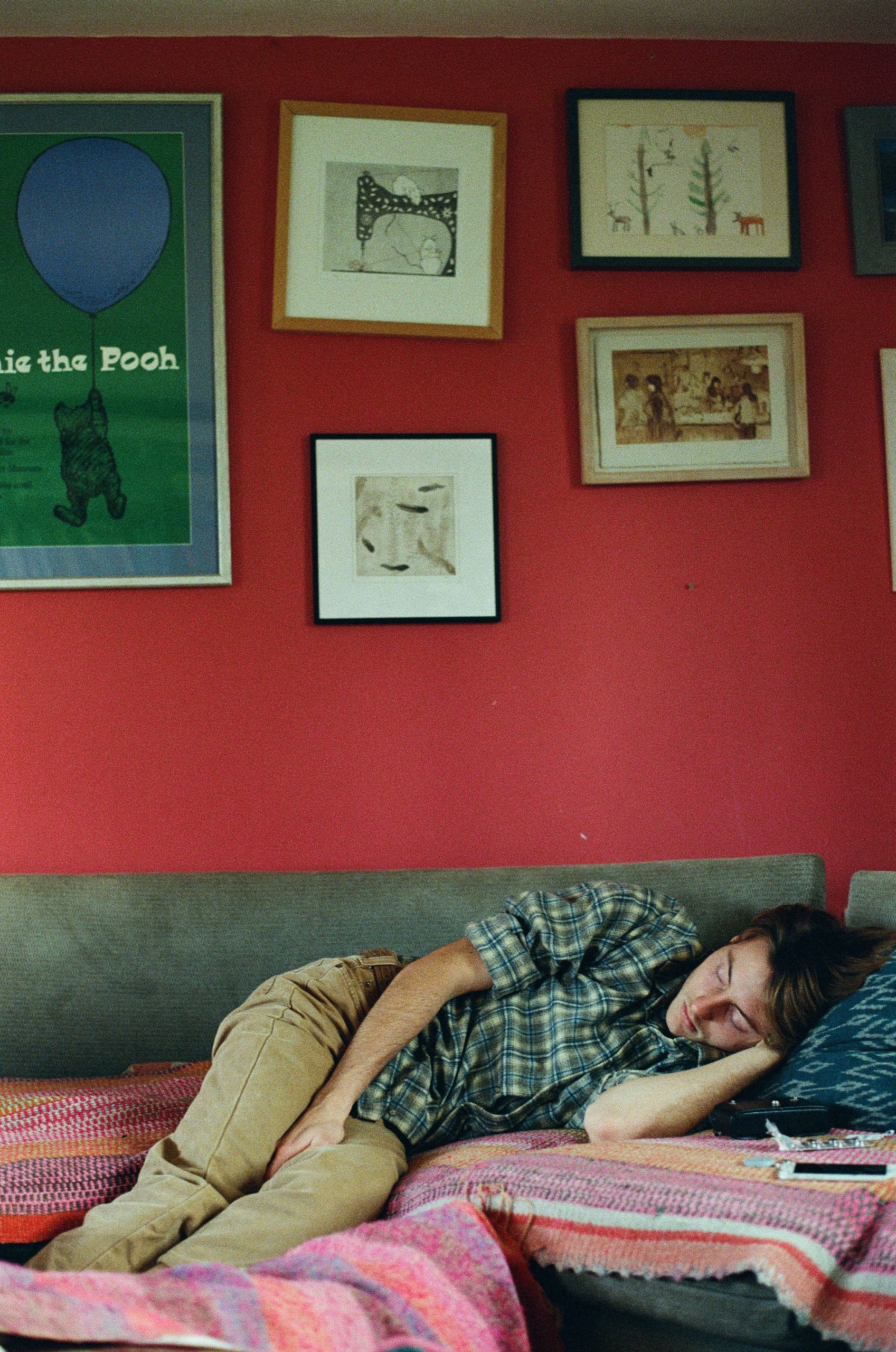
Sofia Brightwell
35mm film photography
Josephine: What’s coming up next for you?
Sofia: I am currently completing my Master’s in Painting in Portugal, which I will complete next year, and the research component of which will become a solo exhibition. I am slowly and intentionally building my exhibition practice, and I’m so excited to be showing my work in the UK for the first time at the Bankside Gallery with Jackson’s. I also continue to run my newsletter, Cozinha da Saudade, in which I write about art, food, and life.
Further Reading
Jackson’s Art Prize 2026 First Prize Winner Announced
Meet Eleanor Johnson, Winner of Jackson’s Art Prize 2025
How We Collaborate With Artists
Expert Advice on Making Your Way as an Artist
Shop Oil Painting on jacksonsart.com