



When the term Hudson River School was first coined, the group were disparaged for their immersive landscapes. Yet the title has grown to hold mountainous weight. In this article, I consider the broader historical context of what is considered ‘the first American art movement’, explore the group’s key artists, works, and aesthetic choices, before demonstrating how to create your own landscape oil painting inspired by their sublime depictions of the wilderness.
In our Behind the Movement series, we look at the history and influence of significant movements in art history and share studio demonstrations inspired by the techniques and materials of the artists involved.
Contents
Defining the Hudson River School
What is the Effect of the Hudson River School?
Women Artists of the Hudson River School
The History of the Hudson River School
The Impact of Westward Expansion and Slavery
Significant Artists of the Hudson River School
Demonstration of a Hudson River School Technique
Defining the Hudson River School
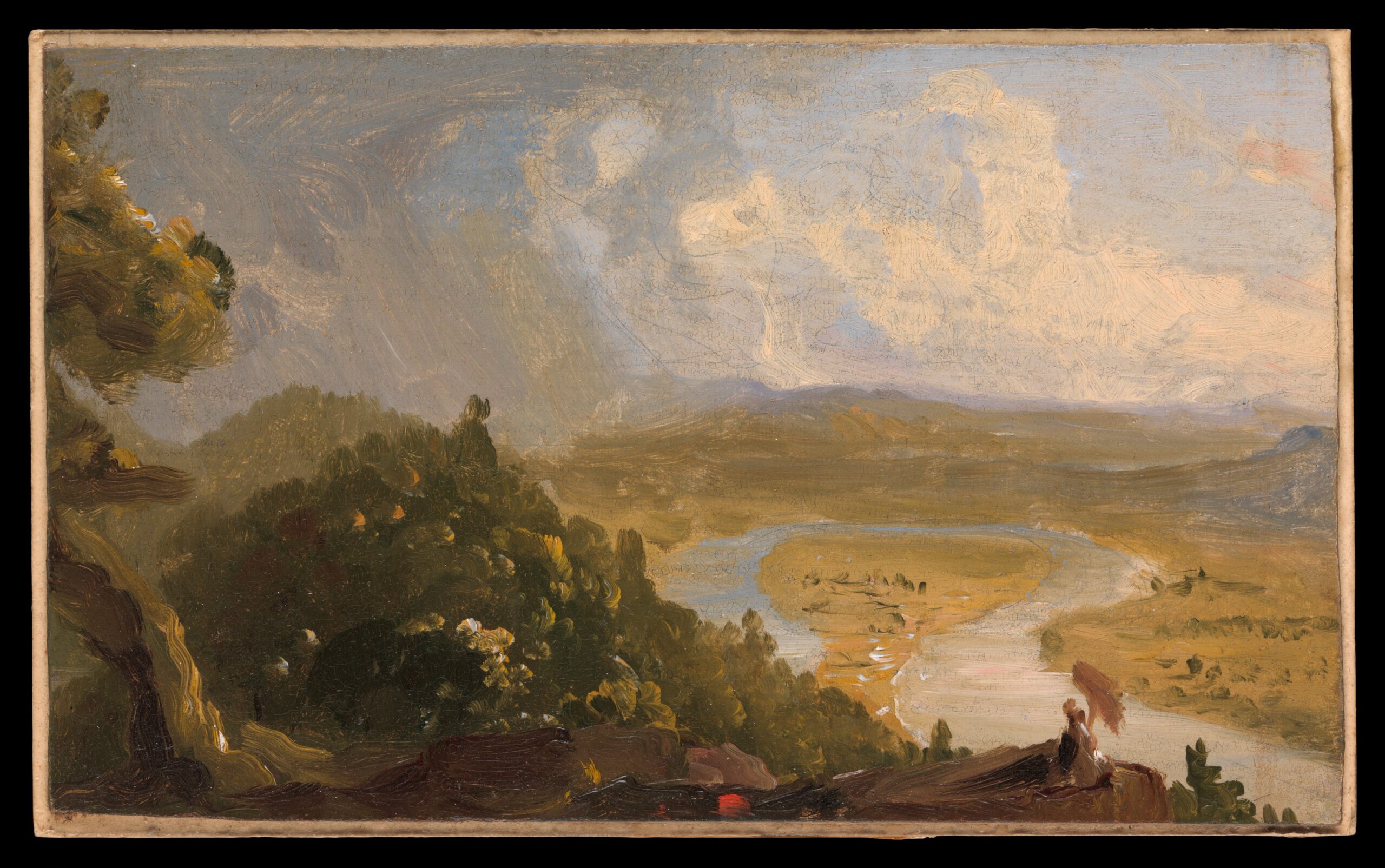
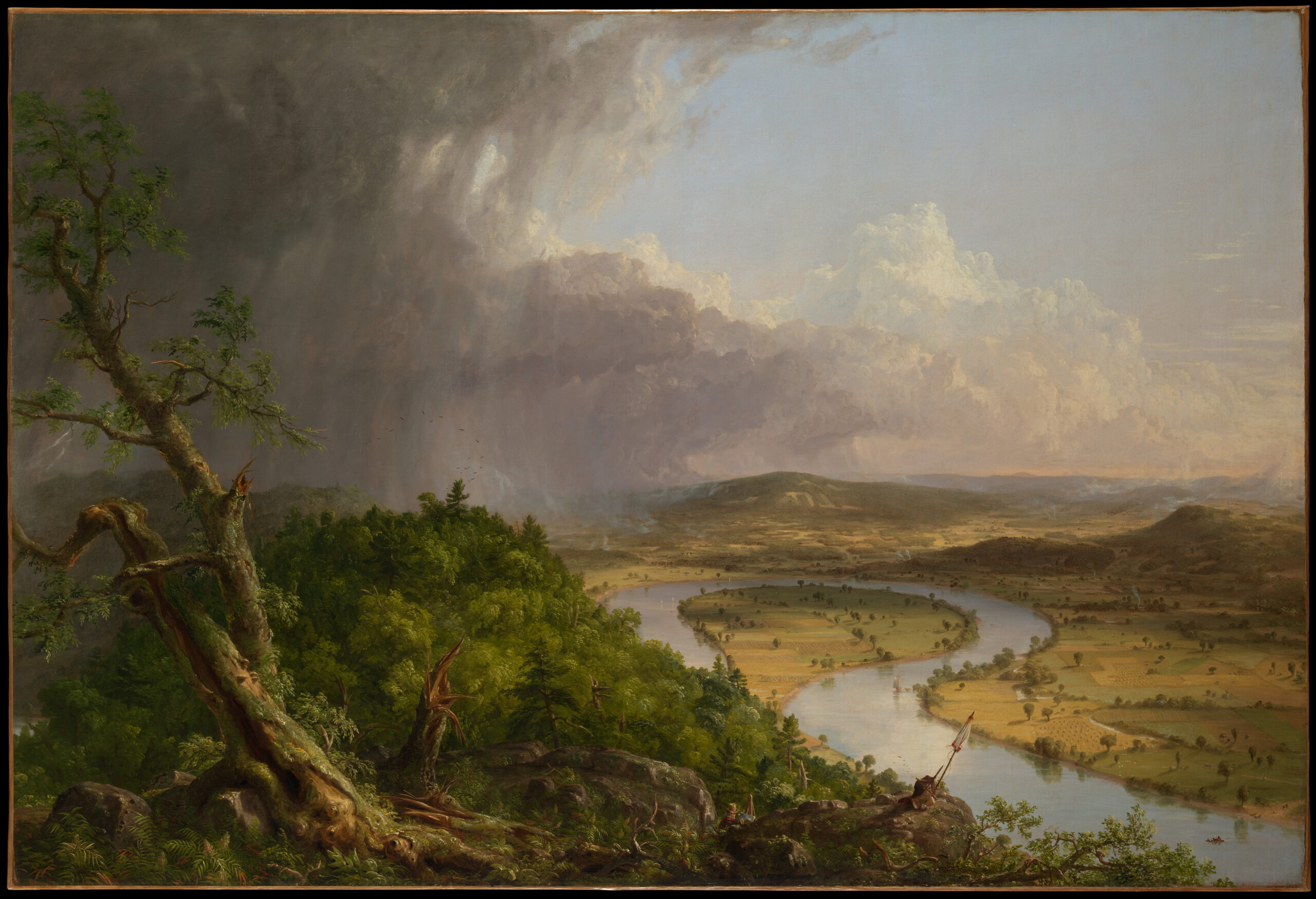
The Hudson River School is the title ascribed to two generations of American landscape painters inspired by Romanticism and the sublime. The movement was initiated by Thomas Cole in the 1820s and endured until the 1870s, roughly. The title of the movement refers to the location of many of its artists, who set up studios along the Hudson River in New York state in the mid-19th century. Several artists travelled across North and South America, as well as Europe, in pursuit of geographical wonders, before returning to their studios to conjure large-scale oil paintings from their sketches.
Thomas Cole
Oil and pencil on composition board, 14 x 23.8 cm | 5.5 x 9.4 in
The Metropolitan Museum of Art
Thomas Cole
Oil on canvas, 130.8 x 193 cm | 51.5 x 76 in
The Metropolitan Museum of Art
What is the Effect of the Hudson River School?
By the turn of the 20th century, the idealist aesthetics of the Hudson River School were derided by the Eurocentric art world, having been surpassed in favour of the French Barbizon School. The Barbizon School approached the subject of landscape with realism, as opposed to the Hudson River School’s utopian nationalism, ‘old-fashioned’ detail, and theatrical scale. The Barbizon School also inspired the Tonalists – a new American art movement including artists George Inness and James McNeill Whistler, who captured nocturnal scenery to evoke mortality and introspection. These landscape movements are inextricably connected, each borrowing from the last in quick succession and moving together in the evolution of landscape painting.
Jasper Francis Cropsey
Oil on canvas, 151.8 x 274.9 cm | 60 x 108.2 in
National Gallery of Art
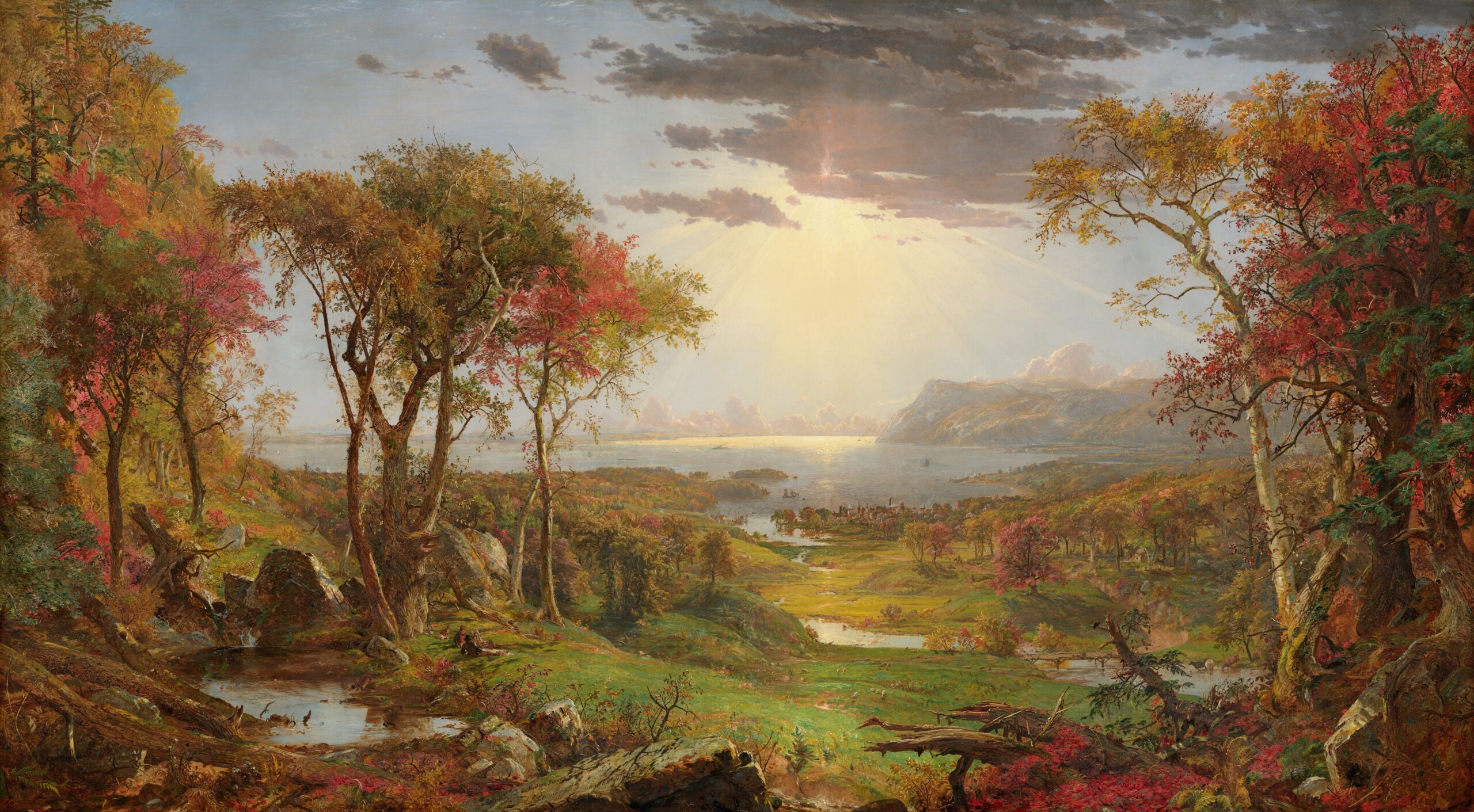
Today, the Hudson River School artists are celebrated for the emotive power of their immersive landscapes, which evoke awe and wonder. They demonstrate a technical mastery of light, painting on a huge scale, and rendering immersive forms and vast distances with intricate detail. Without disregarding the violent history of the era in which these artists were working, the grandeur of their works represents an emerging American nationalistic identity through pride in the landscape. This forms part of what is widely considered the first distinctly American art movement.
Techniques-wise, the Hudson River School artists were pioneers of working en plein air. They created drawings and oil sketches in the landscape, which they brought back to their studios to work from. There, they combined elements of their sketches to execute their magnificent scenic paintings. Unlike the Impressionists, they didn’t complete any of their large-scale paintings outdoors, although their practice of painting in an outdoor environment predated Impressionism by about 40 years.
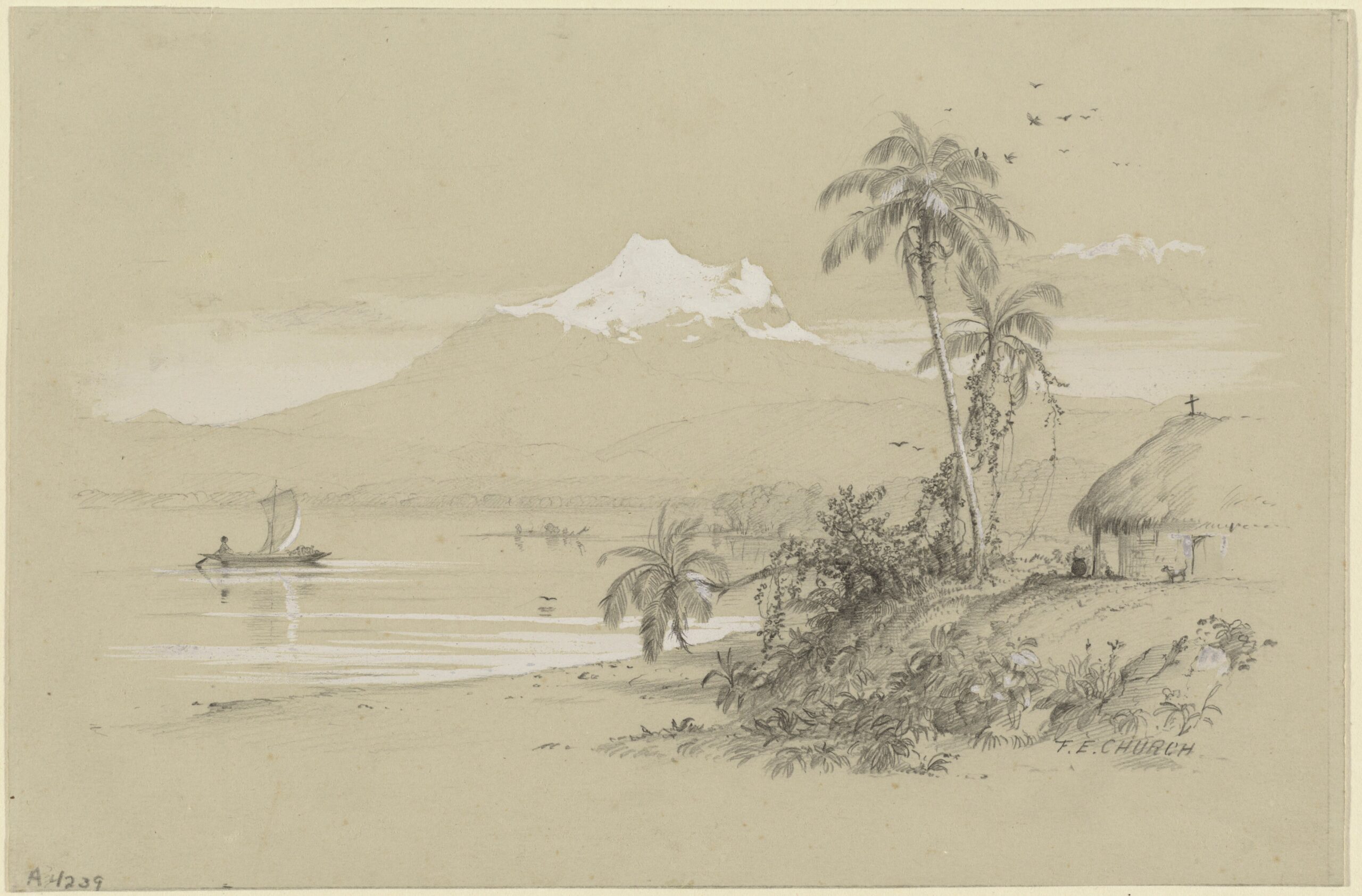
Frederic Edwin Church
Graphite and white on paper, 18 x 27.2 cm | 7.1 x 10.7 in
National Gallery of Art
Luminism
Luminism originated as an offshoot of the Hudson River School and consisted of artists who had a particular focus on the aesthetic qualities of light, water, and air. Their works are connected to the philosophy of Transcendentalism, explored by the American writer and philosopher Ralph Waldo Emerson in his essay Nature (1836):
‘Standing on the bare ground, – my head bathed by the blithe air, and uplifted into infinite spaces, – all mean egotism vanishes. I become a transparent eye-ball; I am nothing; I see all; the currents of the Universal Being circulate through me; I am part or particle of God.’
Many of the Hudson River School artists were influenced by Emerson’s writing. And their visual language conveyed the belief that absorbing the beauty of the natural world could lead to personal spiritual enlightenment. For artists of the Hudson River school, this sense of transcendence was sometimes paired with terror in their pursuit of the Sublime. Luminism wasn’t a self-imposed title, but was ascribed to them retrospectively in 1954 by John Baur, the director of the Whitney Museum of Art. He described Luminism as:
‘A polished and meticulous realism in which there is no sign of brushwork and no trace of impressionism, the atmospheric effects being achieved by infinitely careful gradations of tone, by the most exact study of the relative clarity of near and far objects and by a precise rendering of the variations in texture and colour produced by direct or reflected rays.’
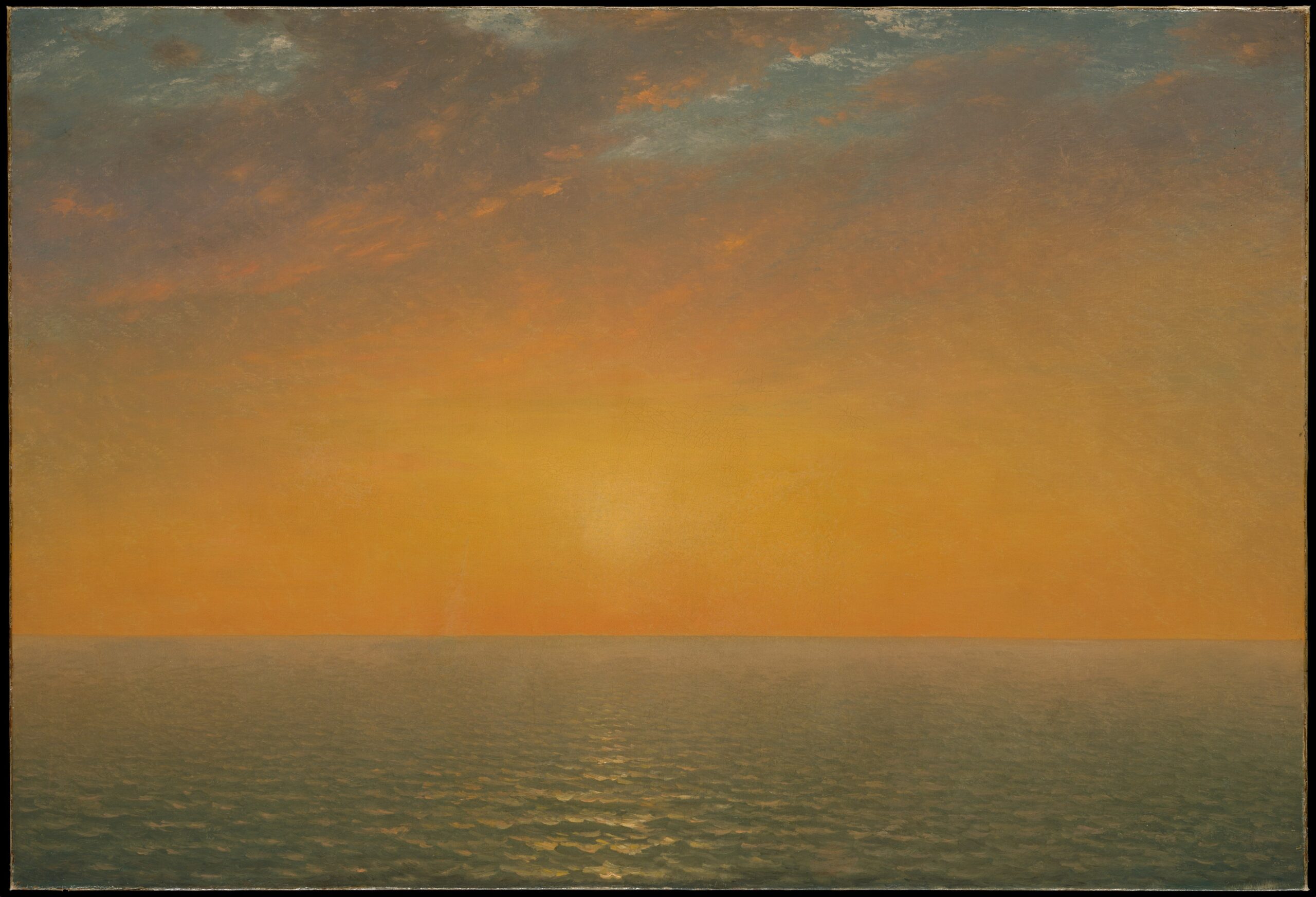
John Frederick Kensett
Oil on canvas, 71.1 x 104.5 cm | 28 x 41.1 in
The Metropolitan Museum of Art
Sunset on the Sea by John Frederick Kensett depicts pure sunlight, sky, and water, with no other narrative or landscape devices. Kensett is often considered the master of Luminism, and this work was part of a series of 38 paintings he made during the final summer of his life. At his memorial later that year, this work was described as ‘pure light and water, a bridal of the sea and sky’. It’s impossible not to draw direct comparisons with contemporary artists who continue to make work concerned with the evocative effects of light on the elements, such as James Turrell and Olafur Eliasson.
Women Artists of the Hudson River School
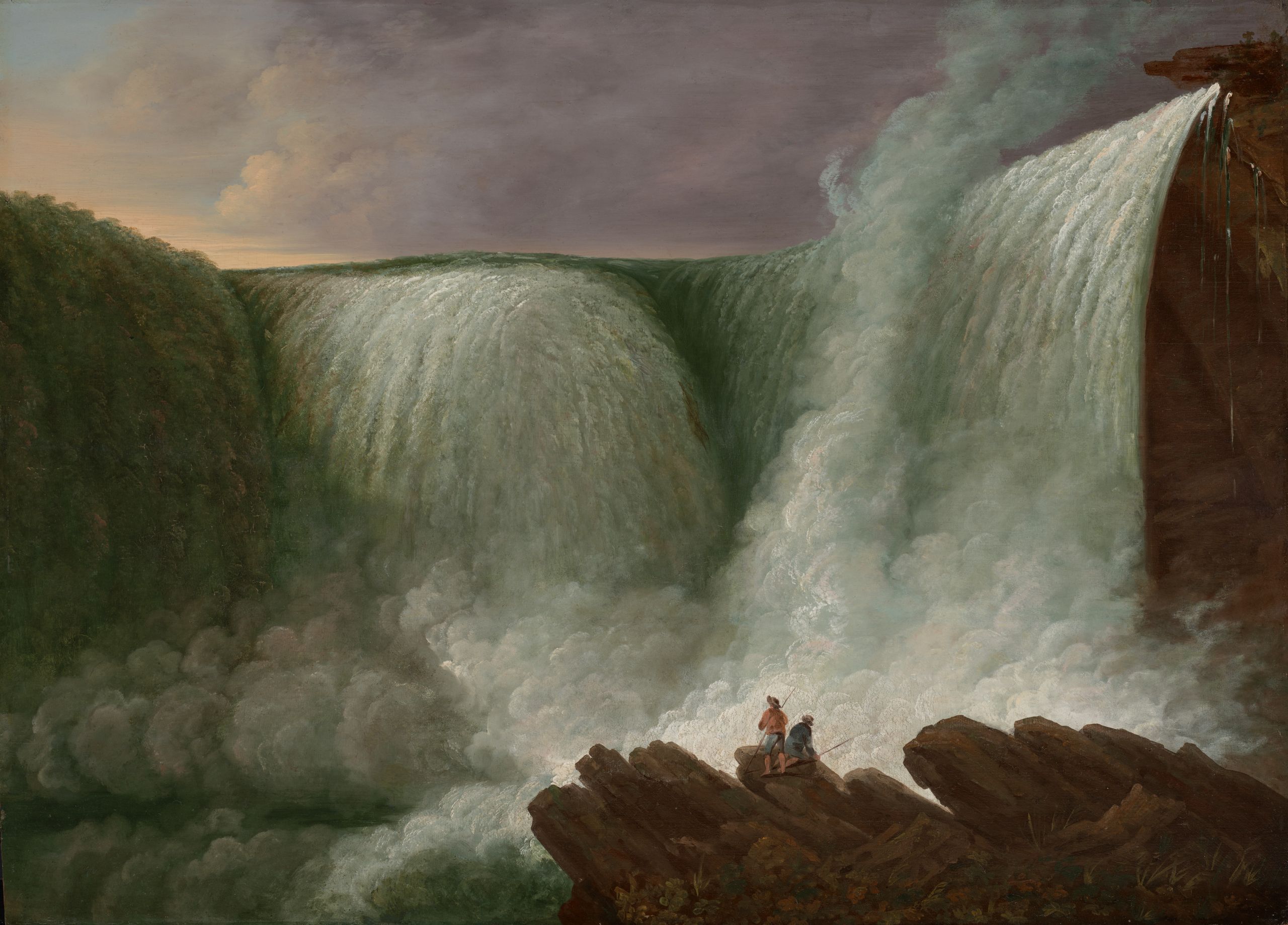
Louisa Davis Minot
Oil on wood panel, 69.9 x 96.5 cm | 27.5 x 38 in
Baltimore Museum of Art
It was difficult to practise professionally as a woman artist in the 19th century, and many other art movements of the era included only a handful of women, if any at all. The Hudson River School is notable for its inclusion of over 50 women artists. Like many pioneering women in art history, they faced barriers to formal training and access to life drawing classes because of their gender. Painting the landscape offered liberation from the formal art school system, and many were taught to paint by their friends, family members, and partners.
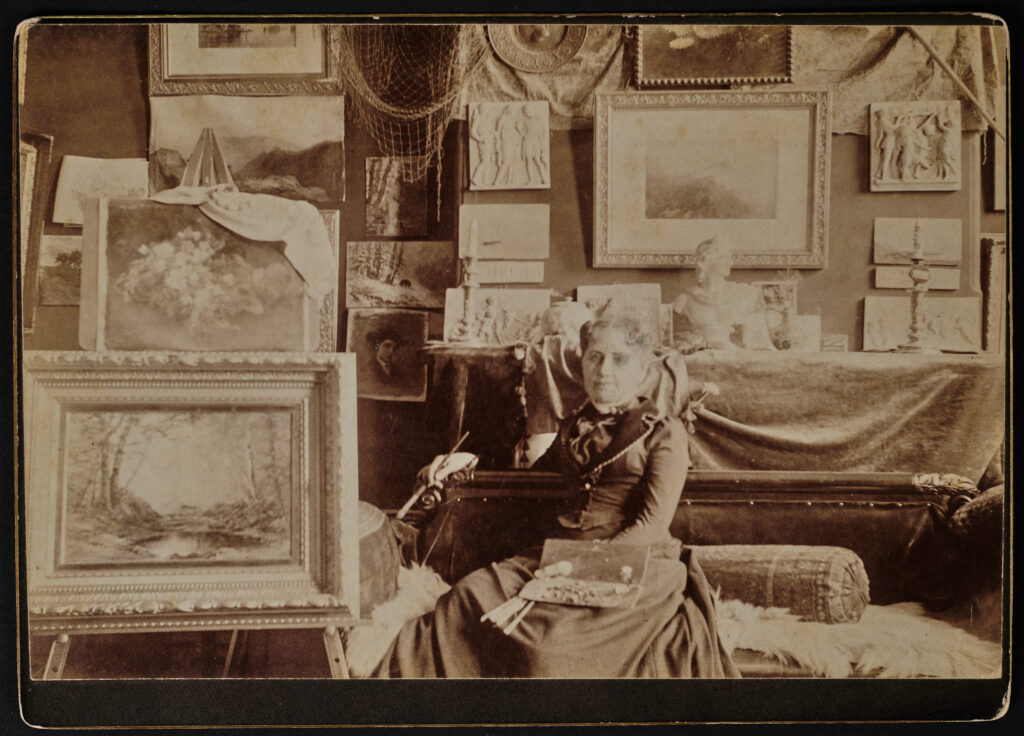
Unknown photographer
Photograph, 12.7 x 17.8 cm | 5 x 7 in
Wikimedia Commons
On top of these systemic barriers, the women of the Hudson River School bravely ventured out into the landscape. They hiked to work from natural wonders despite the hindrance of wearing skirts, bodices, and heeled boots. Some of these women modified their outfits to allow them to hike for miles, wearing bloomers, raising their skirt hems, and using clothes pins to manipulate their skirts into loose trousers. Despite the physical challenges they faced, they painted their incredible landscapes with determination. Among the best remembered are Susie M. Barstow, Julie Hart Beers, Elizabeth Gilbert Jerome, and Eliza Greatorex. Although their contribution to the movement was significant, their works remain underrepresented in major American museum collections compared to those of their male counterparts.
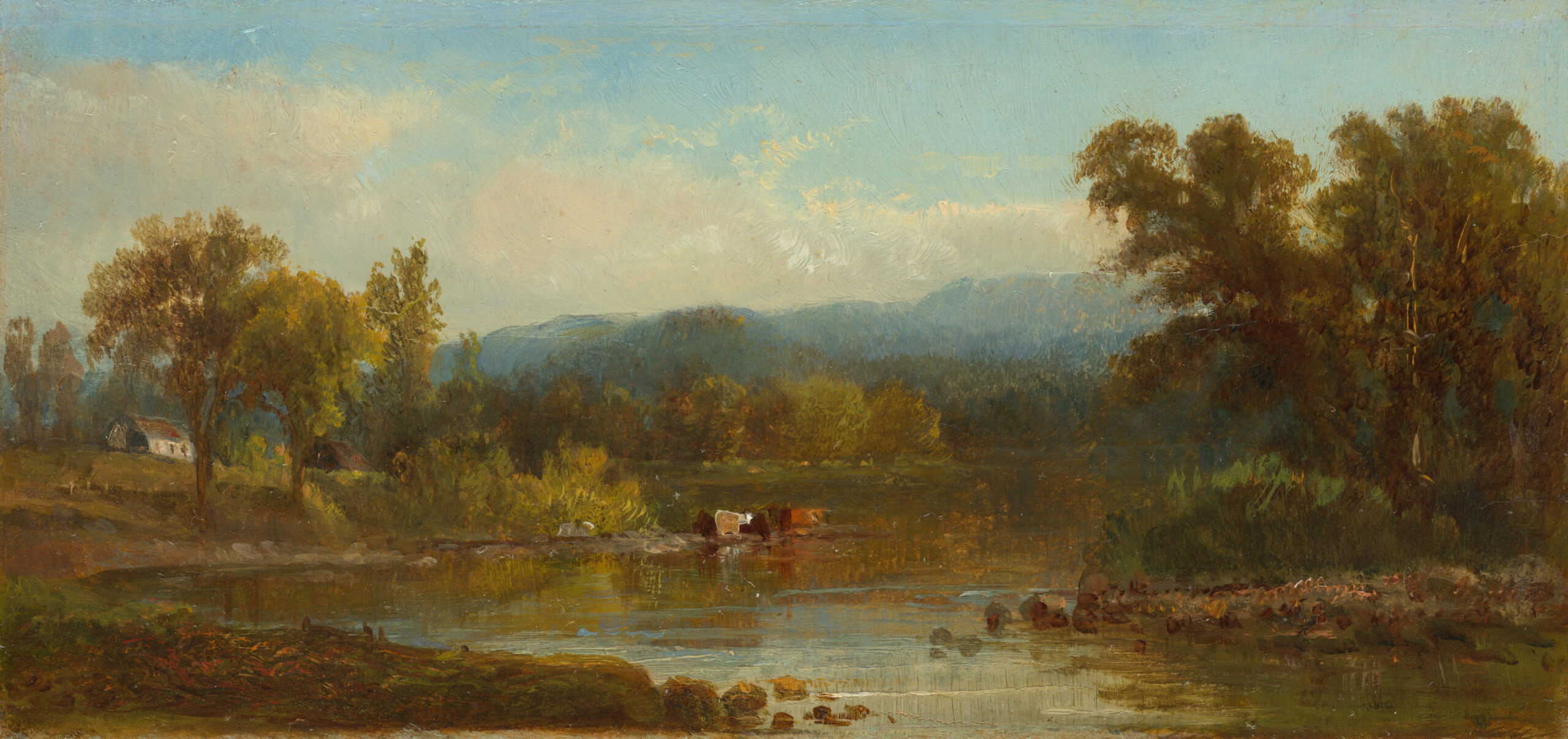
Eliza Pratt Greatorex
Oil on paper mounted to board, 12.1 x 25.4 cm | 14.8 x 10 in
The Metropolitan Museum of Art
The History of the Hudson River School
The Impact of Westward Expansion and Slavery
The context in which the Hudson River School emerged is inseparable from the history of slavery and colonisation in America. Many of their works embody the ideology of Manifest Destiny, the belief that the westward expansion of the United States across North America was a God-given right, and that the land was free to be claimed. The paintings often present a version of the landscape that is placid and idyllic. In reality, settlers faced extreme hardship, including disease, violence, and extreme environmental conditions on their journeys west across America. In the process of westward expansion, Indigenous peoples were brutally oppressed and displaced from their ancestral lands. European colonisation of the Americas resulted in catastrophic death rates for the Indigenous people through the spread of disease, warfare, forced displacement, and state-sponsored massacres, including those associated with the California Genocide (1846-1873) and the Trail of Tears (1830s).
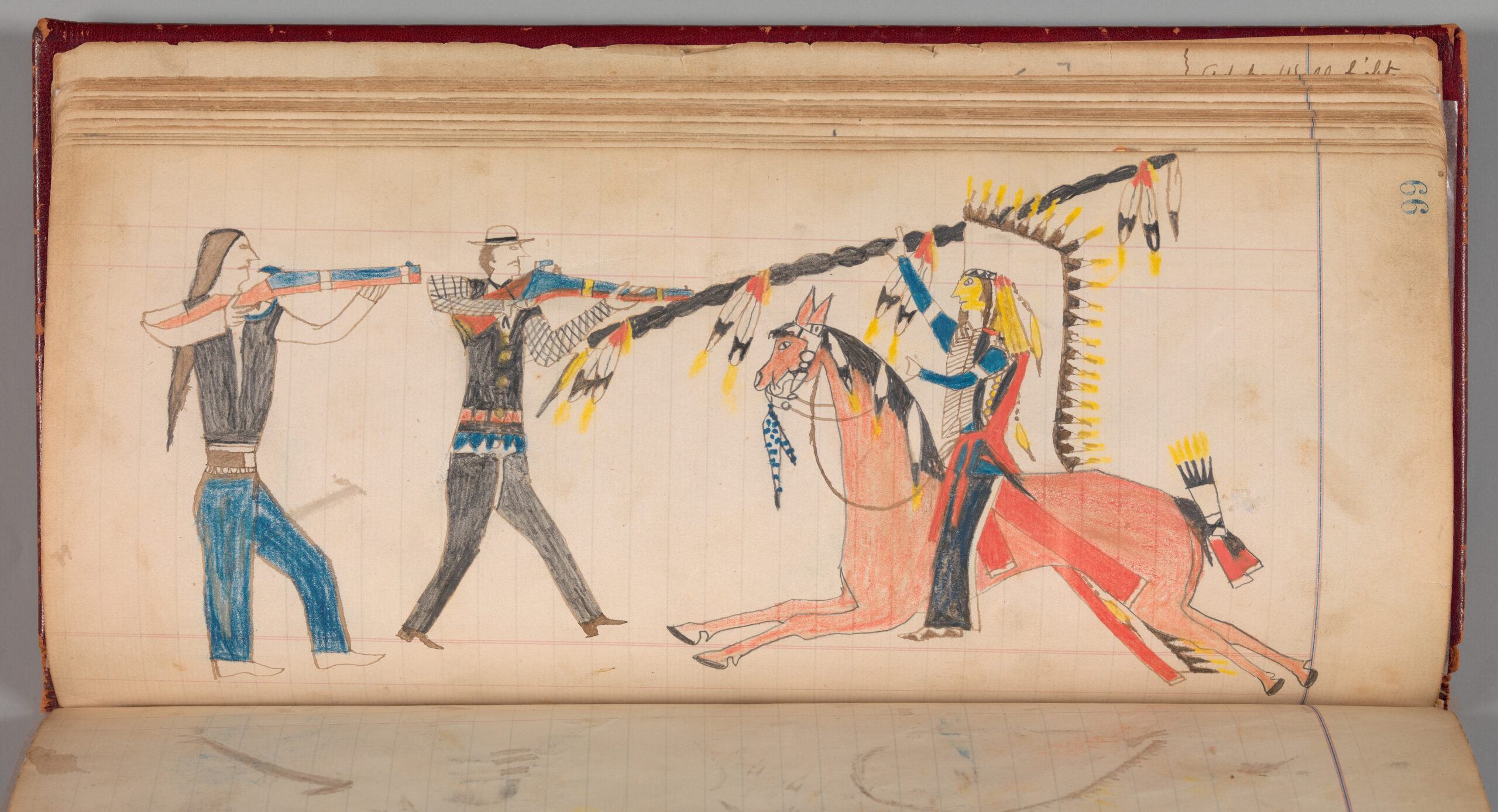
Southern and Northern Cheyenne artists
Graphite, watercolour, and crayon on paper, 29.8 x 13.3 cm | 11.7 x 5.2 in
The Metropolitan Museum of Art
The transatlantic slave trade began in the early 1500s, with the first documented arrival of enslaved Africans in Colonial Virginia in 1619. It would take another 246 years for chattel slavery to be formally abolished throughout the United States in 1865, following the Civil War. Despite this, exceptions to the new law were exploited to perpetuate forced labour, including enforcing slavery as punishment for a crime. Systemic oppression also endured beyond abolition through social and economic means, including segregation and sharecropping. These events were contemporary with the Hudson River School artists. Yet their paintings often ignore the brutality and exploitation of human lives involved in cultivating and capitalising on American land. Instead, their works frequently present the landscape as empty, lush, and welcoming, sometimes even cast in ethereal light, emulating a false heaven.
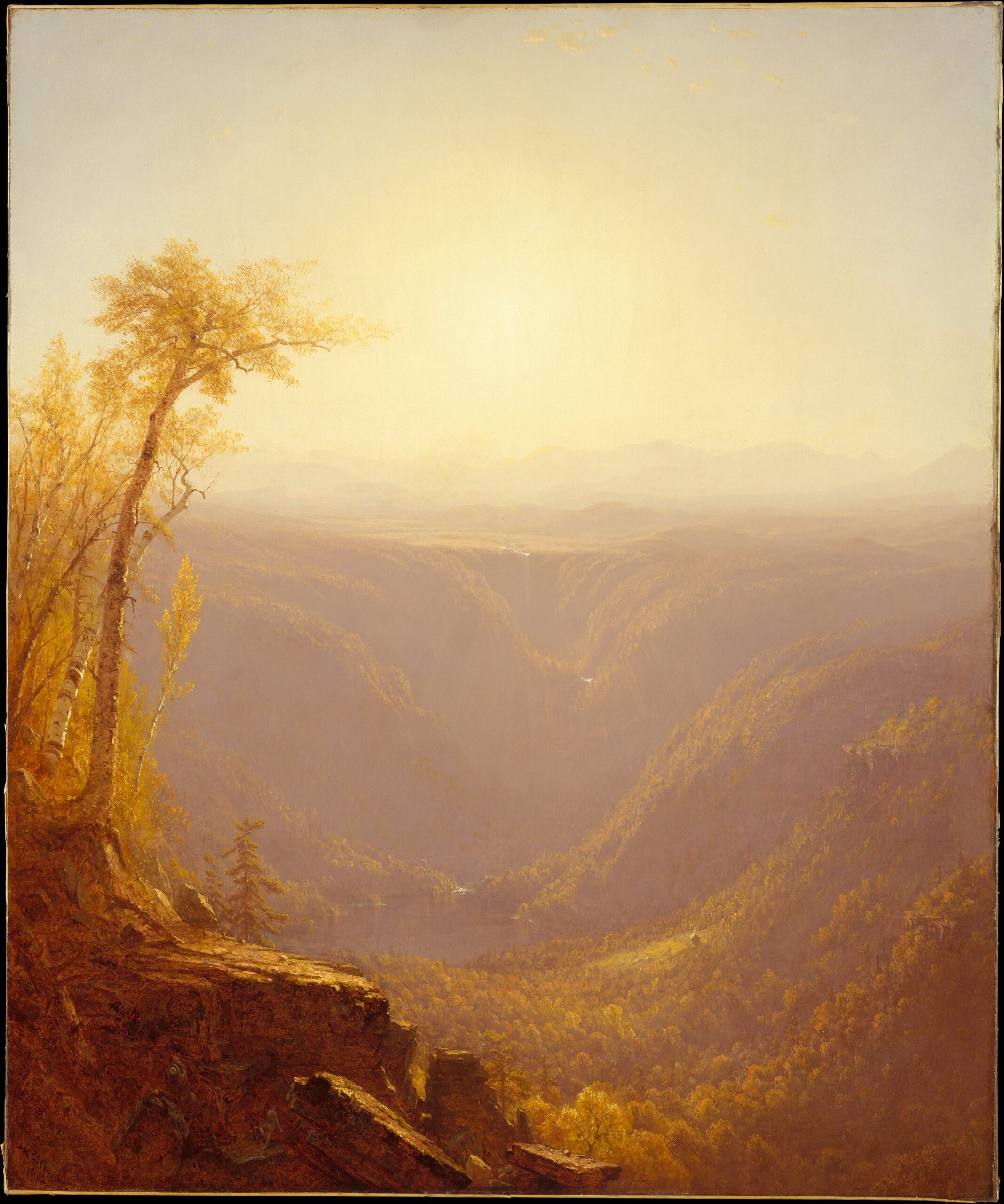
Sanford Robinson Gifford
Oil on canvas, 121.9 x 101.3 cm | 48 x 39.9 in
The Metropolitan Museum of Art
Many of the artists of the Hudson River School were connected to the social elite, who had benefited from the wealth brought by slavery. And some of the collectors of their paintings had amassed fortunes from cotton and other goods produced by enslaved labour. This includes the movement’s founder, Thomas Cole, who moved into a home in the Catskills built by his wife’s uncle, John Alexander Thomson. The Thomson family had amassed a fortune through the labour of enslaved people. Formerly enslaved people continued to live and work at the Catskill property during Cole’s residence, with the history of exploitative labour ongoing.
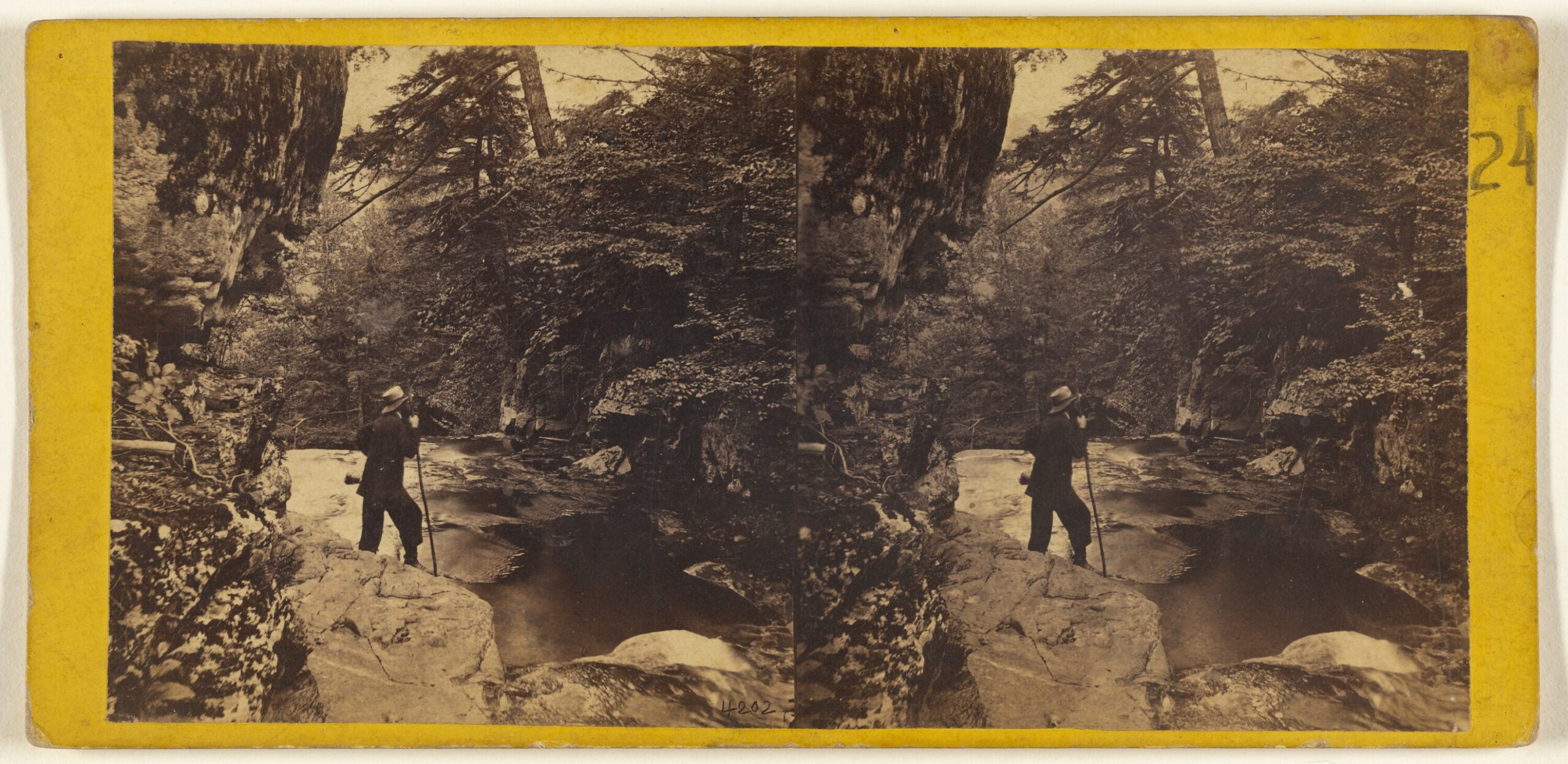
c. 1864-68
Albumen silver print, dimensions not recorded
Getty Museum
By the time the Hudson River School emerged, Romanticism had already taken hold of American art. This influence can be seen in works such as Washington Crossing the Delaware (1851) by the German-American artist Emanuel Leutze. In it, we see a turning point in the American Revolutionary War between the American colonists and the British. The painting became popular in both Germany and America as an emblem of revolutionary national identity. On the boat, we see figures representing America. At the front are figures identified as an African American and a Scotsman, and at the back of the boat, a man wearing Native American clothing. Together, sitting at Washington’s feet, they push the boat through the ice. The work dually represents a sense of triumphant nationalism and is a painful reminder of the people who were exploited to create the nation.
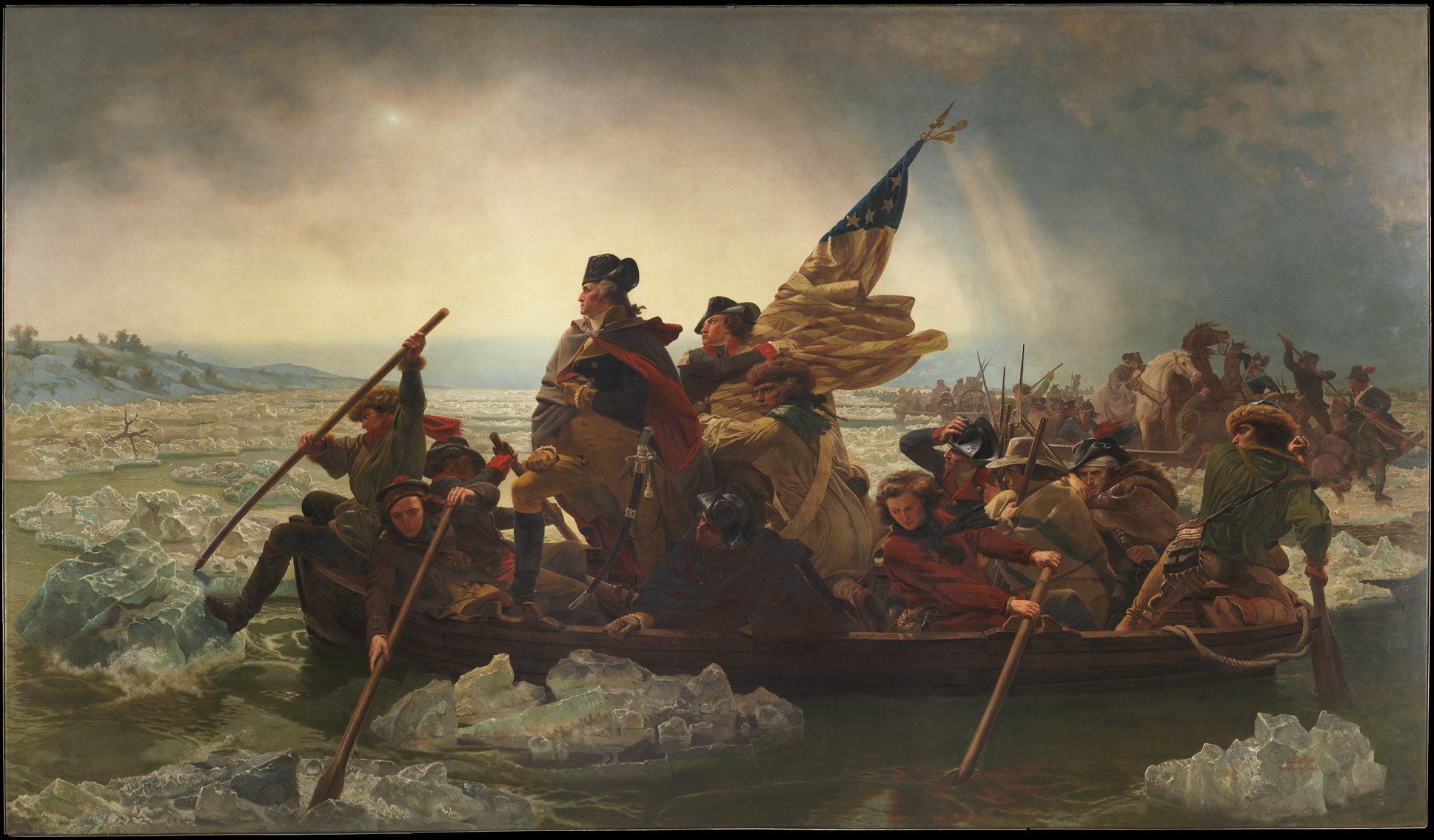
Emanuel Leutze
Oil on canvas, 378.5 x 647.7 cm | 149 x 255 in
The Metropolitan Museum of Art
Significant Artists of the Hudson River School
There are a significant number of Hudson River School artists in total, since the movement is broadly grouped rather than formally organised. It’s generally considered that there were 70 to 100 Hudson River School artists, so it’s only possible to cover a handful in this article in detail. The following section explores key works made by Thomas Cole, Frederic Edwin Church, Albert Bierstadt, Robert S. Duncanson, Edward Mitchell Bannister, Elizabeth Gilbert Jerome, and Julie Hart Beers.
The Hudson River School emerged among New York artists inspired by the landscape paintings of Thomas Cole – an English émigré who left Lancashire for Ohio as a teenager with his family. Cole is considered the founder of the movement, although, unlike other groups, he didn’t play an organising role or write a manifesto for them. The group were loosely connected socially during their lifetimes, but didn’t intentionally form a movement. Many were members of the National Academy of Design, and some shared a workspace in the Studio Building on West Tenth Street, the first purpose-built artists’ studio building in New York City.
Several artists built homes along the Hudson River in close proximity to one another. The term Hudson River School derives from this region depicted in many of their paintings and was first used to criticise the artists’ aesthetics in the 1870s. Thomas Cole’s works were an important point of departure for the first generation of Hudson River School artists, closely followed by a second generation after Cole’s death in 1848.
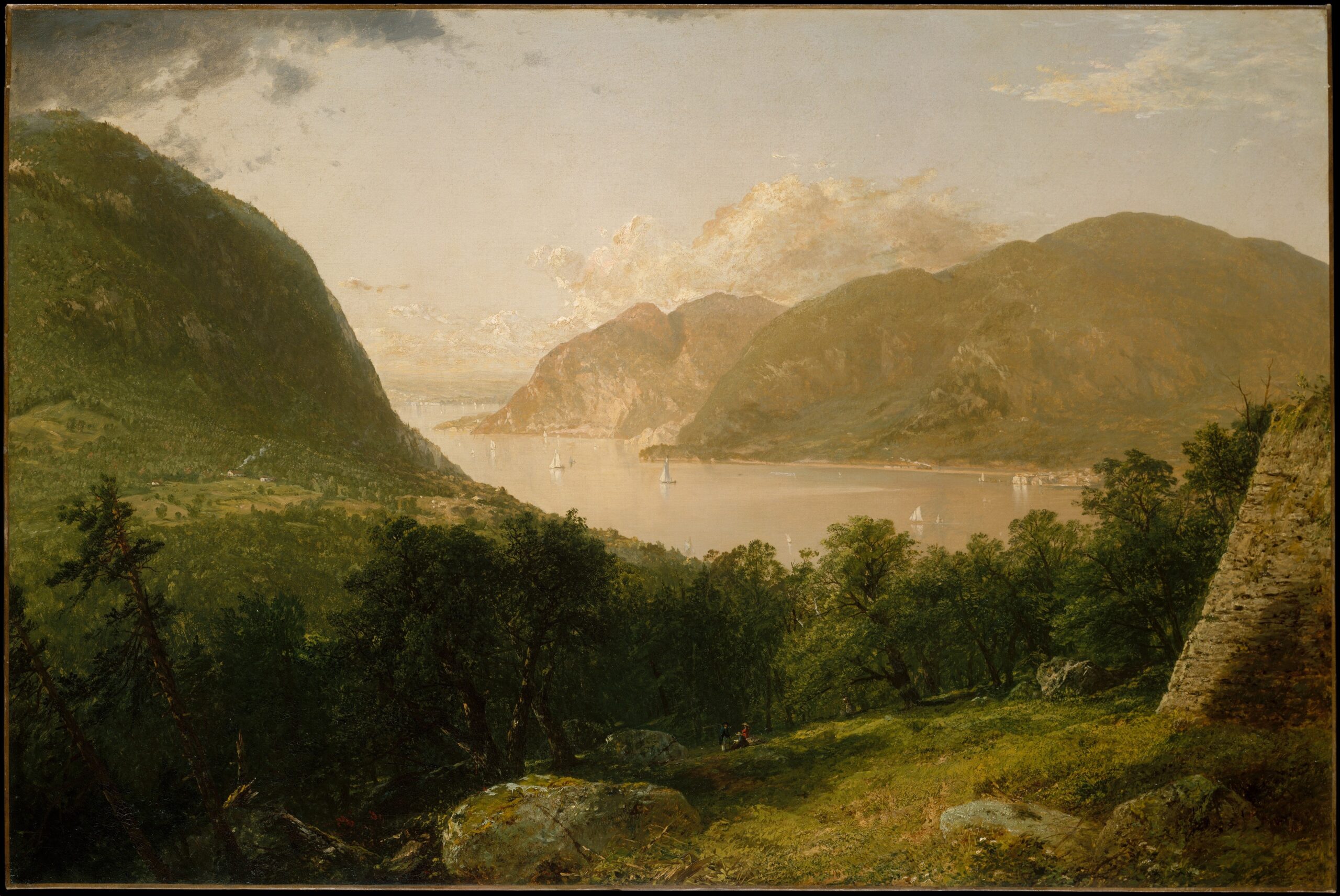
John Frederick Kensett
Oil on canvas, 81.3 x 121.9 cm | 32 x 48 in
The Metropolitan Museum of Art
Thomas Cole
Thomas Cole began his career as a portraitist until he came across the work of early American landscapists like Thomas Doughty, which inspired him to make his own landscape paintings. In 1825, aged 24, Cole began a series of paintings in the Catskill Mountains, northwest of New York City. These works are considered the inception of the Hudson River School. He displayed the paintings in a bookshop, where they attracted the attention of local artists who introduced Cole to the New York art world, garnering him instant recognition.
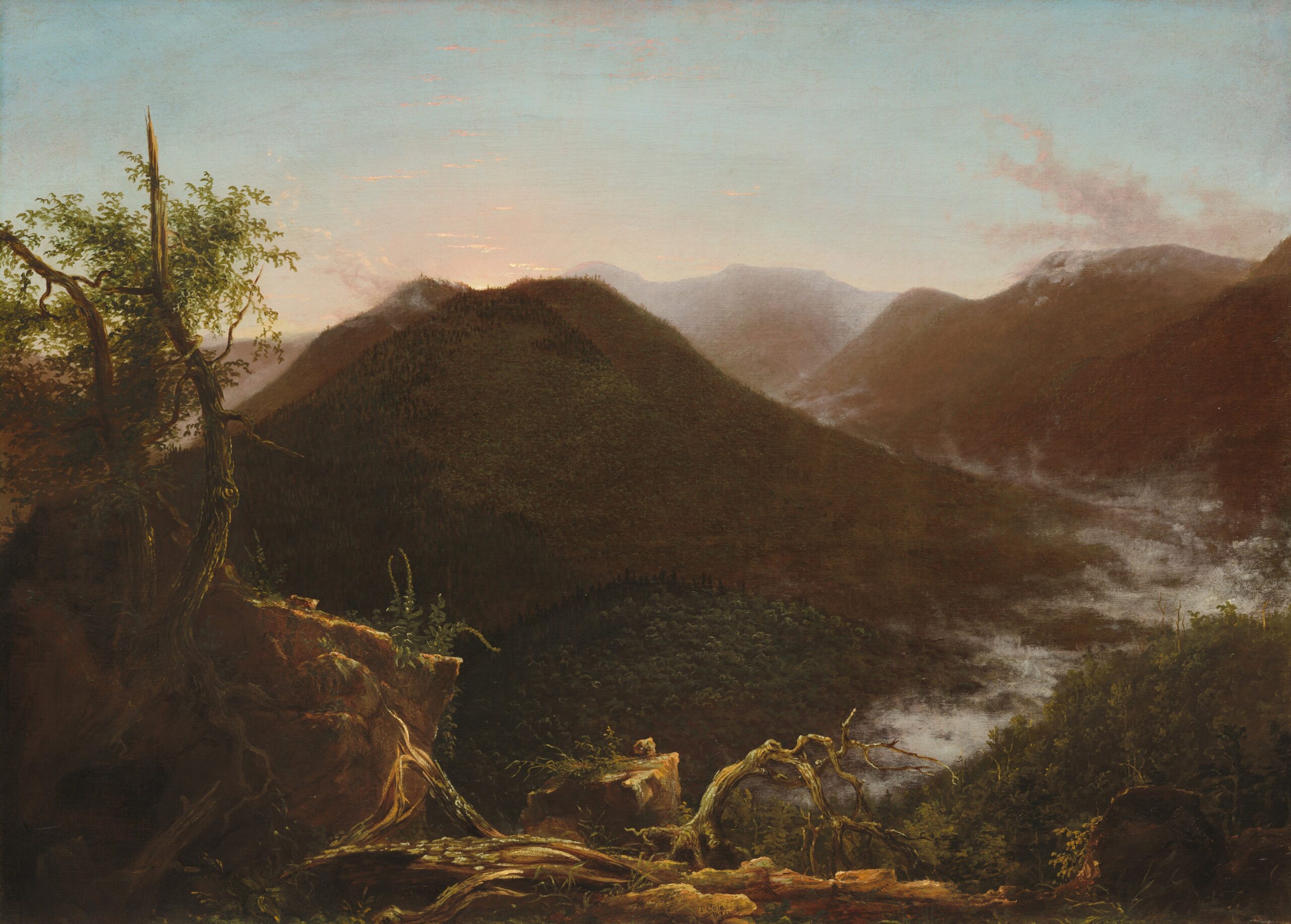
Thomas Cole
Oil on canvas, 64.8 x 90.1 cm | 25.5 x 35.5 in
National Gallery of Art
The concept of the ‘wilderness’ hadn’t been a prominent feature in American landscape painting before Thomas Cole’s works, but it was already established in literature. It’s clear that Cole was influenced by popular fiction of the era in developing his own take on the landscape, since he made early works inspired by the Leatherstocking Tales by James Fenimore Cooper. Cole had also seen engravings of paintings by J.M.W. Turner and John Martin, whose palettes and flair for the dramatic, poetic, or even cataclysmic can be seen reflected in his works.
Following in their wake, Cole travelled to Europe himself to paint from the landscape. On his return to America, features of the Italian landscape appeared in his allegorical paintings, influenced by artists like Claude Lorrain and Nicolas Poussin. Perhaps his most famed allegorical paintings are his The Voyage of Life series – showing the wonder and trials of life through a symbolic boat journey representing the passage of time. Across four paintings, a character journeys from Childhood to Youth, Manhood, and finally Old Age. The series can also be interpreted in relation to the early development of America as a young nation. A cycle of life and death was in motion for European settlers as they traversed unfamiliar landscapes full of promise and danger.
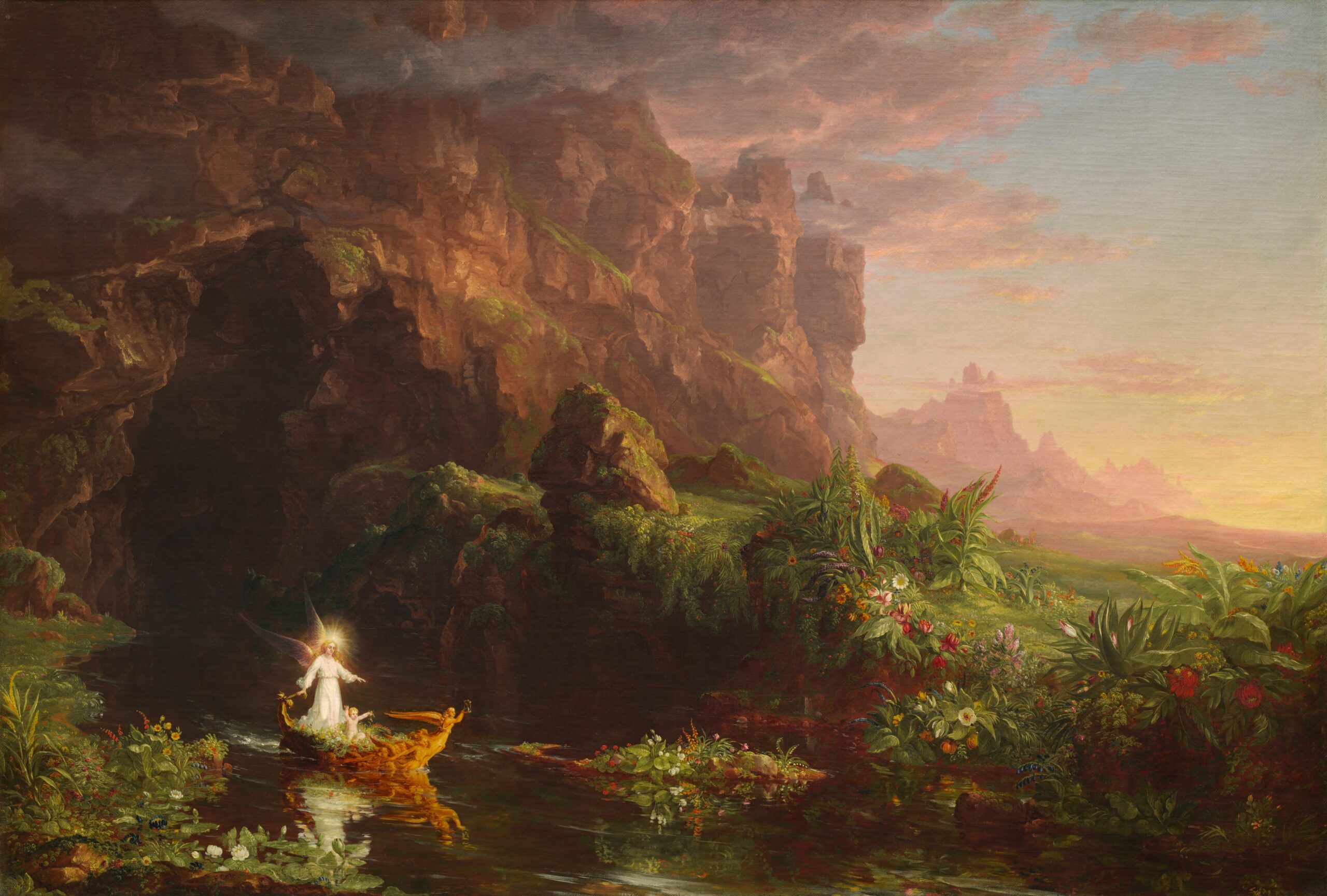
Thomas Cole
Oil on canvas, 134.3 x 195.3 cm | 52.9 x 76.9 in
National Gallery of Art
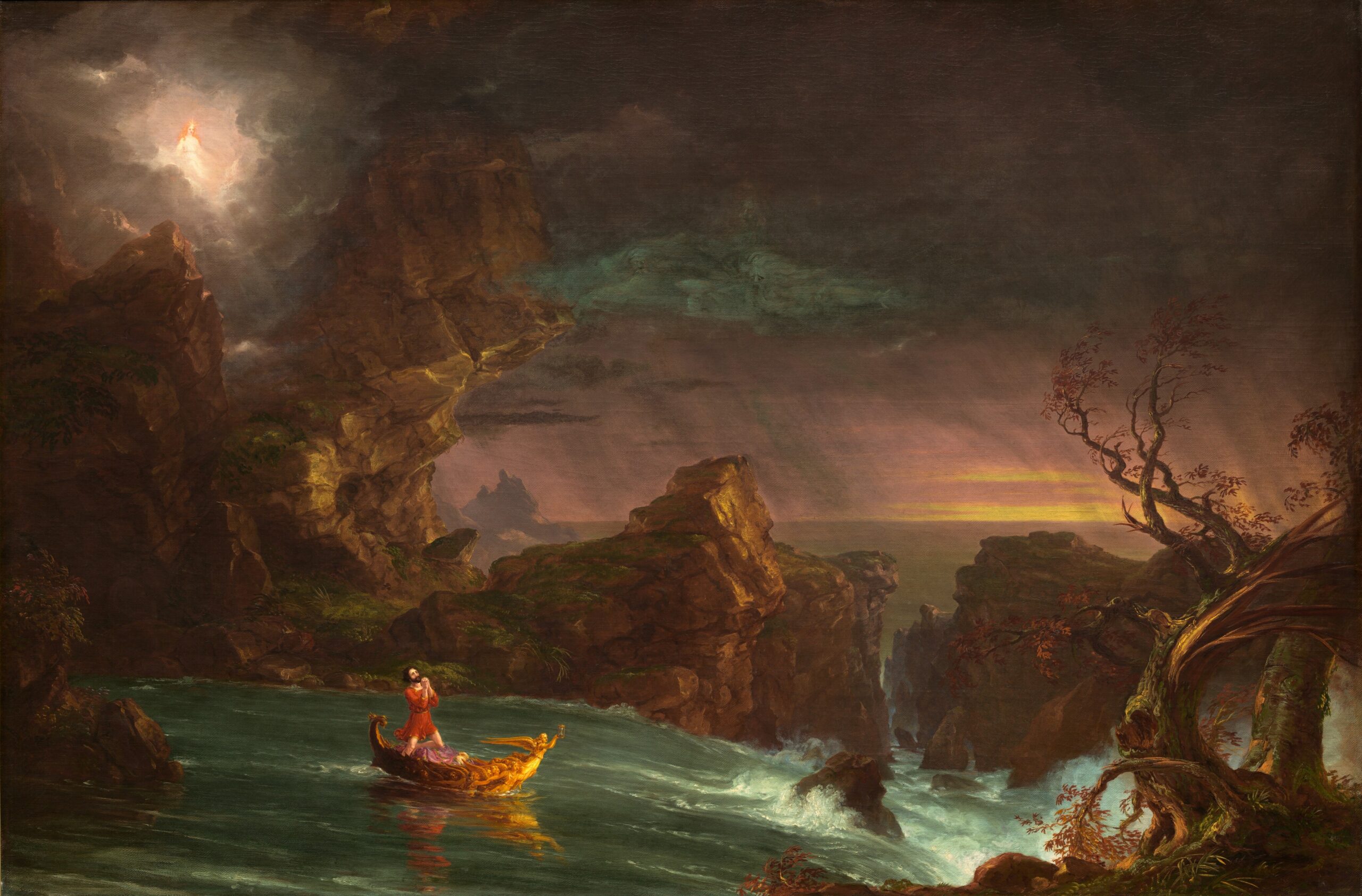
Thomas Cole
Oil on canvas, 134.3 x 202.6 cm | 52.9 x 80 in
National Gallery of Art
Cole continued to paint the American landscape imbued with wonder and narrative until he died from pleurisy at the age of 47 in 1848. His peers were shocked at his premature passing, yet the impact of his works endured. After Cole’s death, his older contemporary, Asher Brown Durand, became a leading figure in the movement. In 1845, Durand became president of the National Academy of Design, and in 1855-56, he published a series of ‘Letters on Landscape Painting’. These essentially laid out the aesthetic goals of the Hudson River School without associating them with a named group.
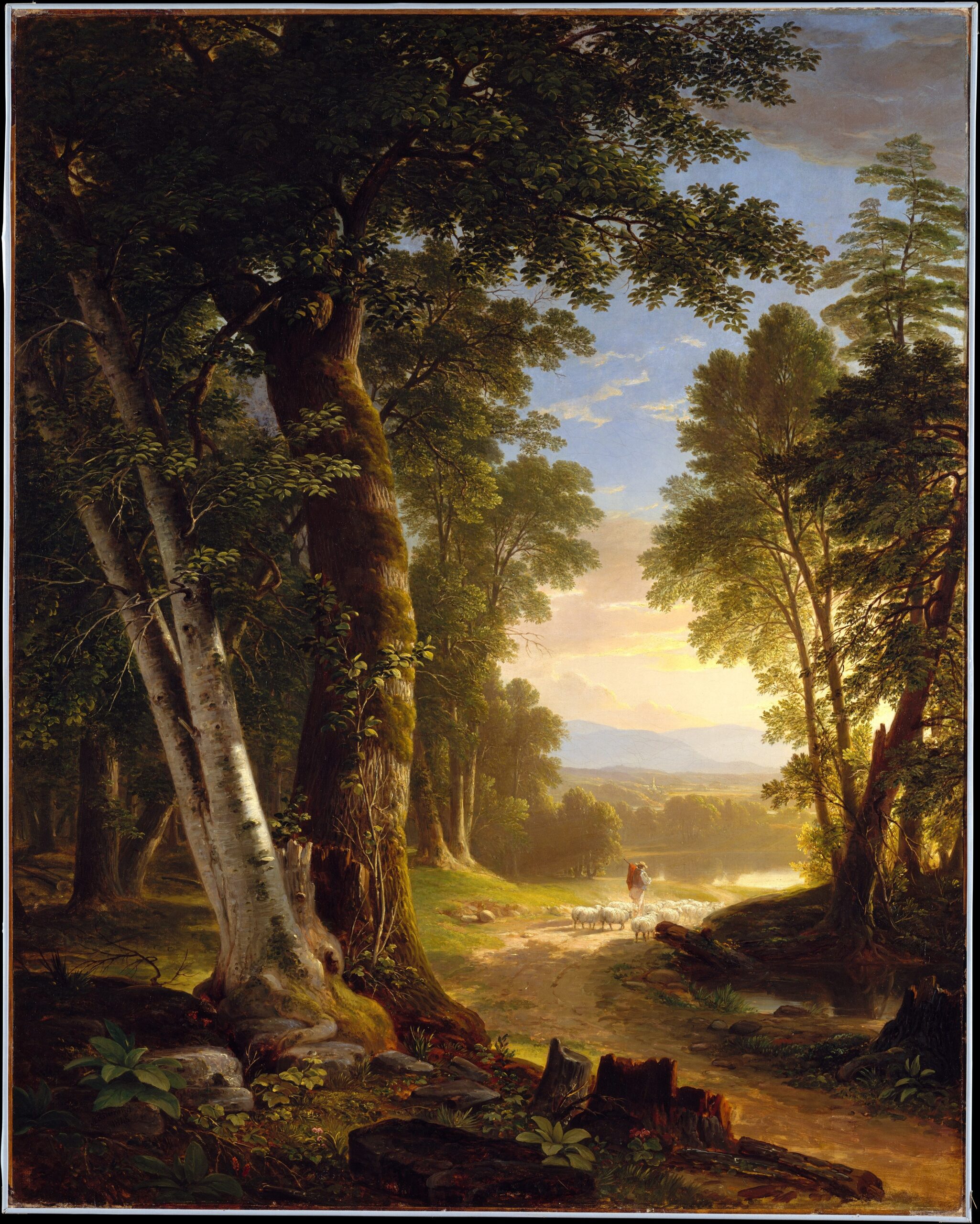
Asher Brown Durand
Oil on canvas, 153.4 x 122.2 cm | 60.4 x 48.1 in
The Metropolitan Museum of Art
Frederic Edwin Church
Frederic Edwin Church was a central artist of the Hudson River School and a former teenage student of Thomas Cole, who described his pupil as having ‘the finest eye for drawing in the world’. They became close, and when Cole passed away, Church was devastated. In memory of his mentor, he painted To the Memory of Cole, depicting monumental clouds over Cole’s grave in the Catskills.
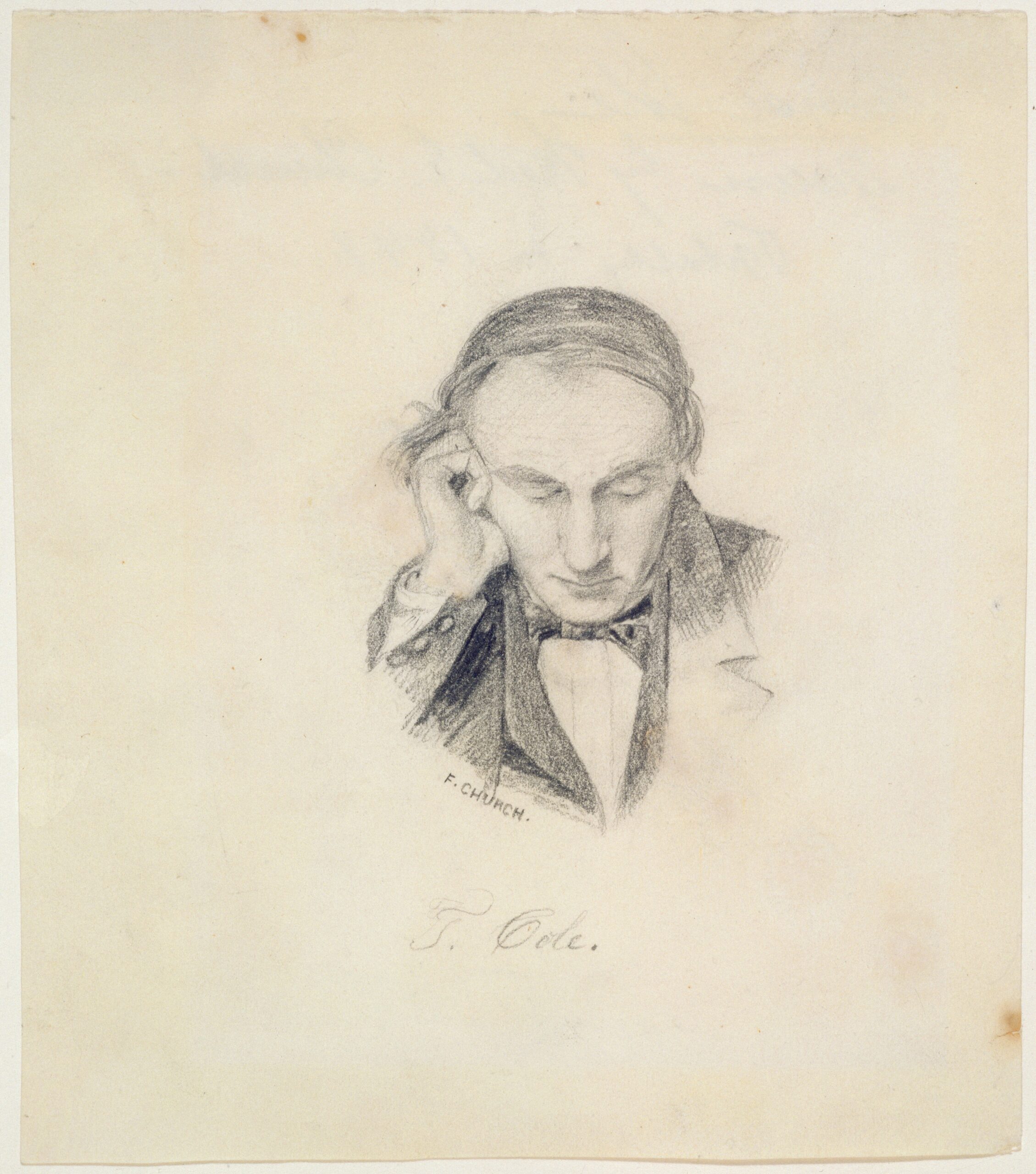
Frederic Edwin Church
Graphite on paper, 17.5 x 15.2 cm | 6.9 x 6 in
National Gallery of Art
Frederic Edwin Church surpassed Thomas Cole in the extent of his explorations in search of inspiration for his works, which also reflected a growing social consciousness. He painted iconic American landscapes, including Niagara, positioning the viewer hovering above the water cascading over the edge. In Church’s time, the composition of this painting was radical in its acute depiction of a landmark that was already emblematic of the nation. In the 1850s, Niagara Falls was a vital endpoint of the Underground Railroad, where enslaved people escaping to freedom could cross the nearby border into Canada. Harriet Tubman led groups of freedom seekers across the Niagara Falls Suspension Bridge, including a group in 1856. A curator at the National Gallery of Art, where the work is housed, has suggested that this history is integral to Church’s motivation for painting the work, depicting the Falls as a site of opportunity and freedom.
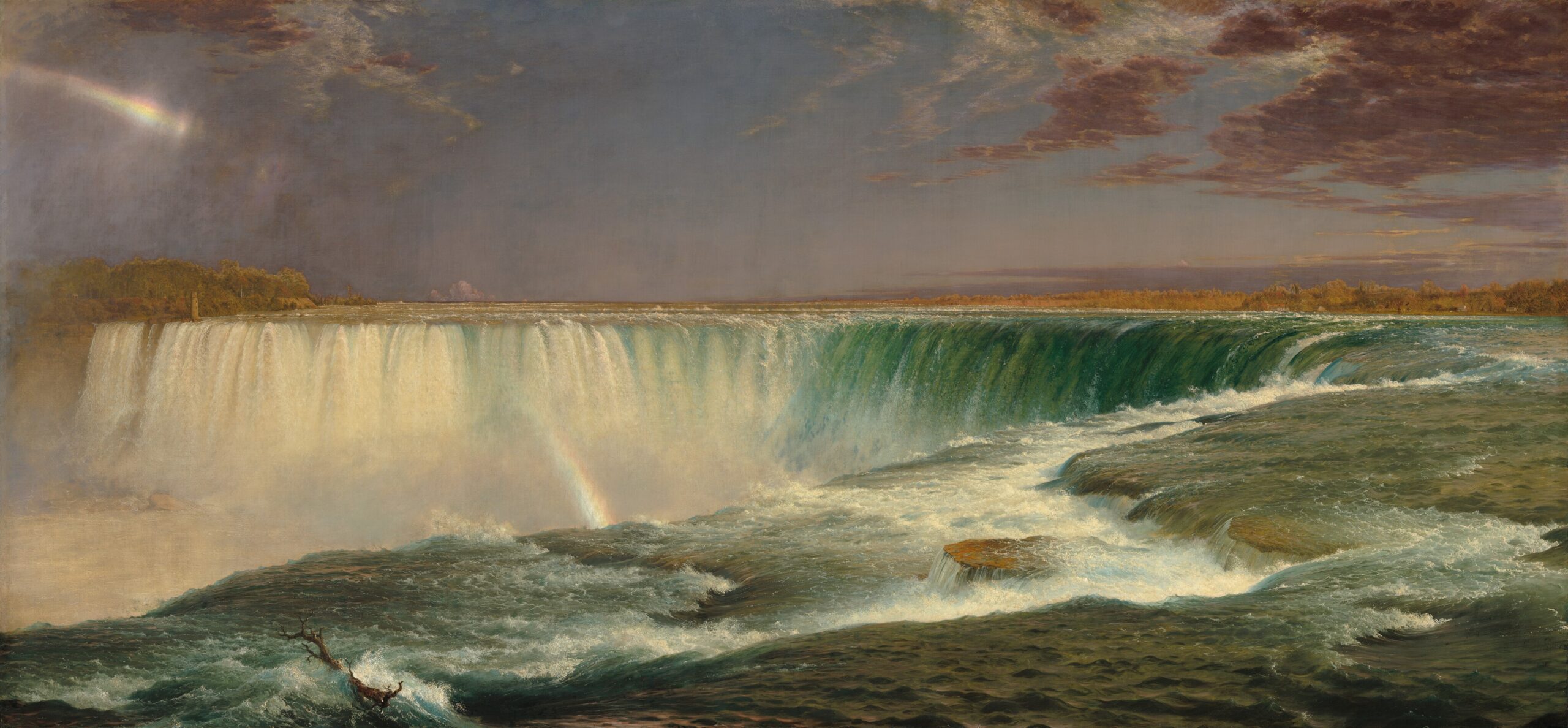
Frederic Edwin Church
Oil on canvas, 101.6 x 229.9 cm | 40 x 90.5 in
National Gallery of Art
This wasn’t Church’s only landscape painting to be connected to the abolitionist movement. In 1849, he painted Lower Falls, Rochester, positioning the viewer at a point along the Genesee River associated with the Underground Railroad. Frederick Douglass helped organise the transportation of freedom seekers through Rochester, with some travelling under cover of darkness by boat towards Lake Ontario and freedom in Canada.
Church is best remembered for works inspired by his two journeys to South America in the 1850s. These trips were undertaken to paint the Andean landscape, spurred by the writings of German Romantic explorer and naturalist Alexander von Humboldt. The most famous of these works is The Heart of the Andes, in which he combined arid and frozen landscapes from his travel sketches within the same picture plane to emphasise the diversity and beauty of the region.
On public display, Church hung the work in a darkened gallery, with only the painting itself illuminated within a huge frame. Curtains were hung around it to make it resemble a window, and the audience was encouraged to view the painting through opera glasses to examine the detail from a distance, as if immersed in a real landscape. The painting was incredibly popular in New York and then London, with a public clamouring to know what South America might look like. The reception of the work was recorded in one account: ‘The work caused a sensation, and twelve to thirteen thousand people paid twenty-five cents apiece to file for it each month.’ At this time, Frederic Edwin Church was one of the most famous artists in the world. Characteristic of Church’s landscapes, he included two people revering a crucifix on the left side of the painting, suggesting that all the beauty he captured was God’s creation.
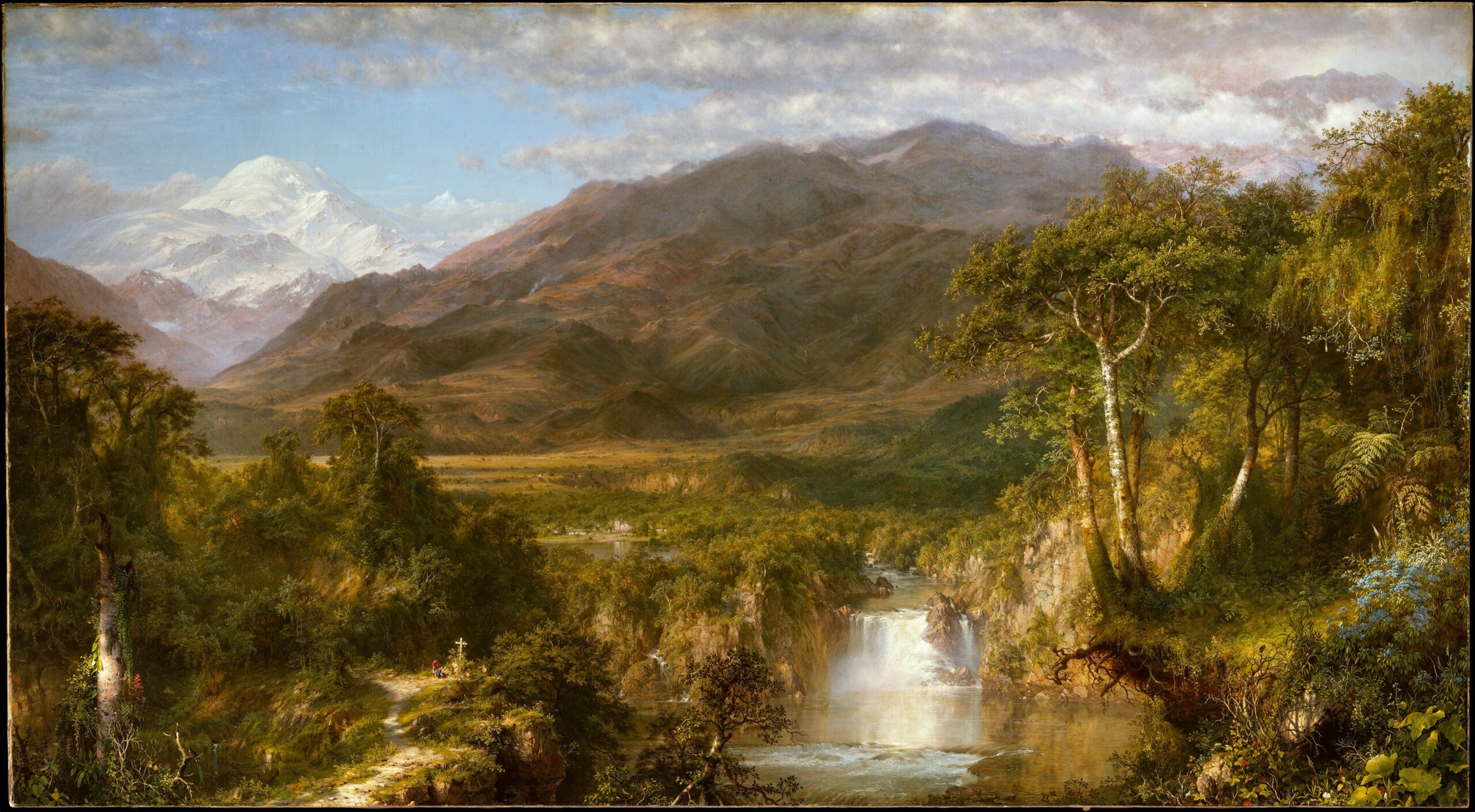
Frederic Edwin Church
Oil on canvas, 168 x 302.9cm | 66.1 x 119.3 in
The Metropolitan Museum of Art
Church also went on a month-long journey into the North Atlantic to sketch icebergs off the Canadian coasts of Newfoundland and Labrador. From his chartered boat, he ventured out in a rowboat towards the formidable ice to sketch it in closer proximity. The painting he made on his return, The Icebergs, captured the public’s mania for news of Arctic exploration. Expeditions during this era were common, with some groups tragically going missing, such as the doomed Franklin Expedition. Much like his South American paintings, Church had tapped into the desire of European and American audiences to know what these once-inconceivable landscapes looked like by delivering them on an immersive scale.
For his painting Aurora Borealis, he worked from sketches given to him by his friend Isaac I. Hayes, who had led an Arctic exploration mission during which his boat, the United States, became trapped in the ice. During the Civil War, auroras seen across North America were sometimes interpreted as signs of God’s anger at the Confederacy. Contemporary viewers may have understood Church’s painting as an allusion to the conflict and his stance on it.
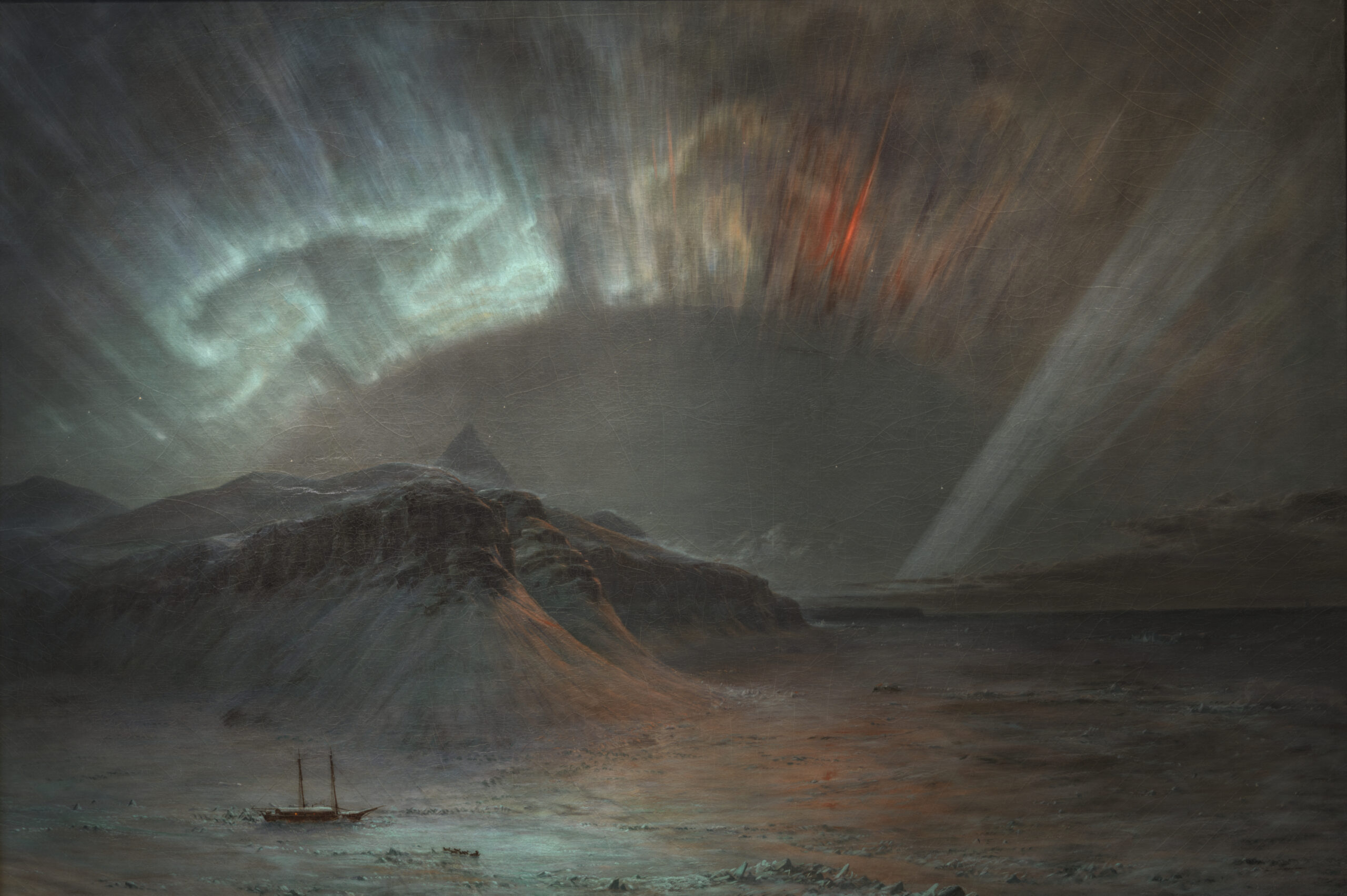
Frederic Edwin Church
Oil on canvas, 142.3 x 212.2 cm | 56 x 83.5 in
Smithsonian
Albert Bierstadt
Albert Bierstadt was perhaps Church’s only true artistic rival for his pioneering paintings of the wild landscapes of North and South America. He was born in Germany and raised in Massachusetts, but as a young adult, he returned to his home country, where he studied and worked alongside Emanuel Leutze and Worthington Whittredge. After returning to America and exhibiting his works, Bierstadt embarked on his first journey into the American West in 1859, which would begin the body of work that would define his career.
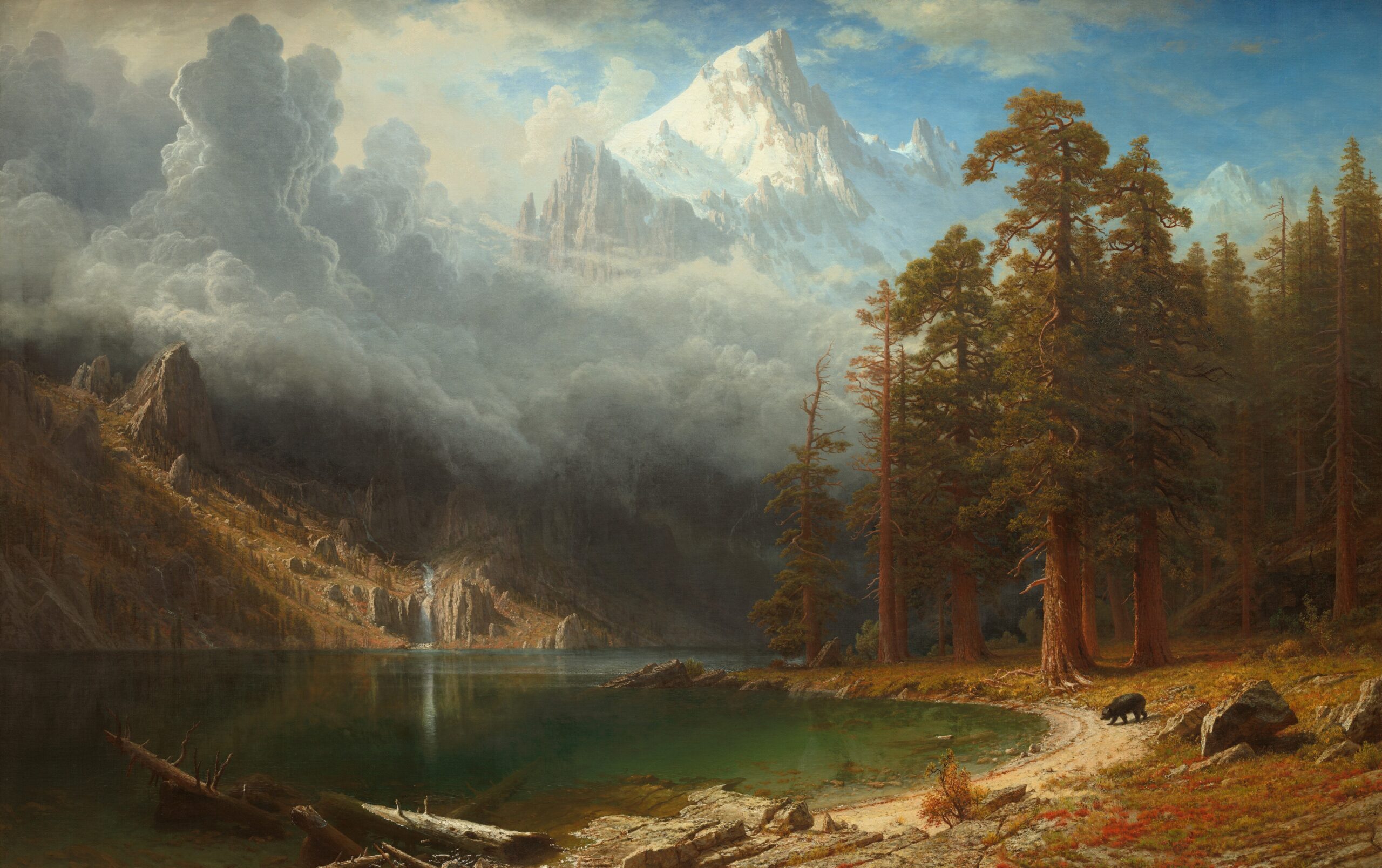
Albert Bierstadt
Oil on canvas, 154.1 x 243.5 cm | 60.7 x 95.9 in
National Gallery of Art
Bierstadt travelled with a US government land surveyor, who was planning wagon trails for European settlers. He sketched landscapes that were largely unfamiliar to European American audiences and included depictions of the Indigenous peoples who lived there. Throughout his career, he repeatedly returned to the West to gather visual research for works that would be exhibited internationally during his lifetime. His painting The Rocky Mountains, Lander’s Peak is a perfect example of the popularity of his works – it sold for $25,000 in 1865, equivalent to over half a million dollars today. His Western paintings can be interpreted as embodying the propagandising notion that the American West was ripe to be claimed by settlers, with dire consequences for Indigenous Americans. This is exemplified in The Rocky Mountains, Lander’s Peak, which depicts members of the Shoshone Nation in the foreground against a vast landscape.
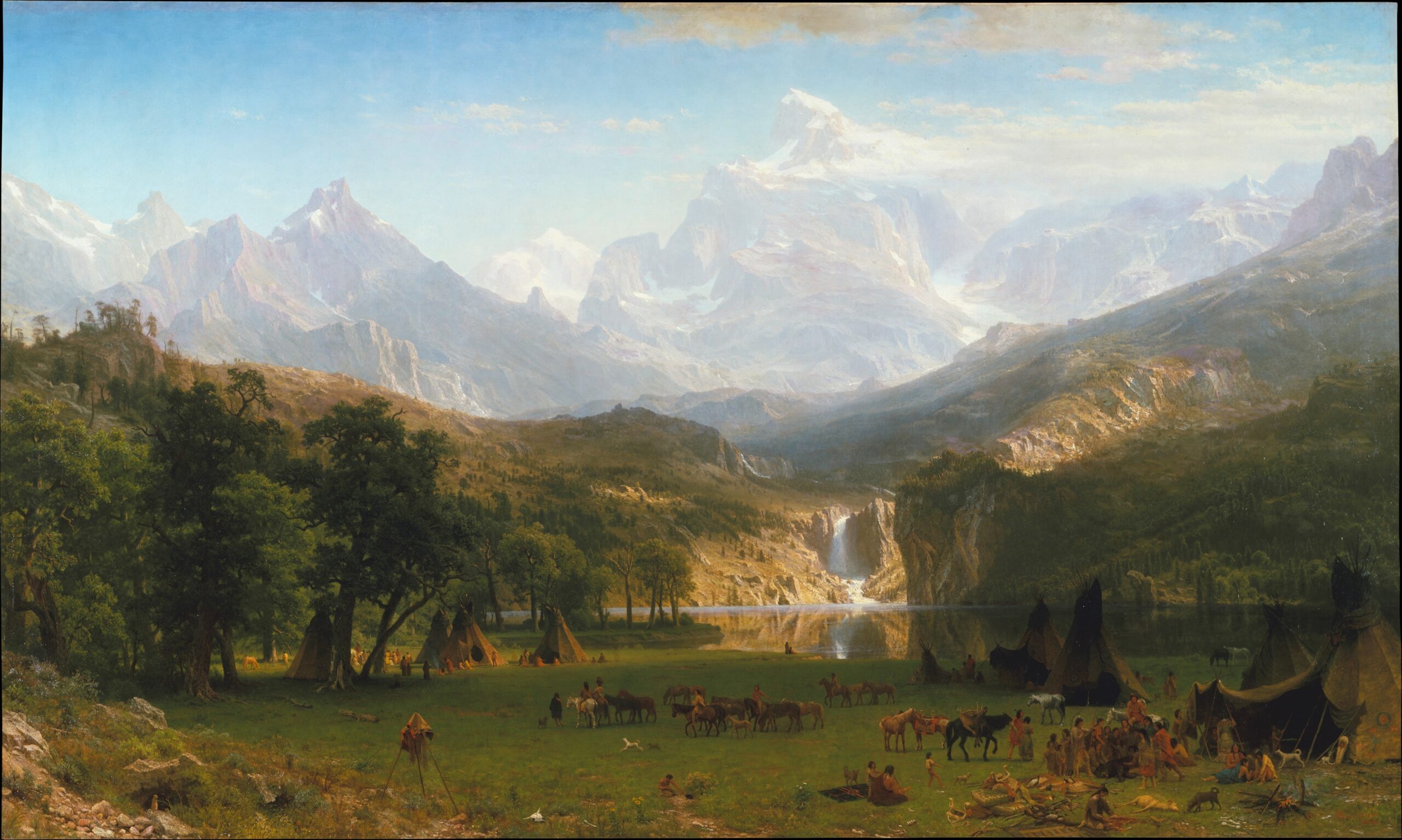
Albert Bierstadt
Oil on canvas, 186.7 x 306.7 cm | 73.5 x 120.7 in
The Metropolitan Museum of Art
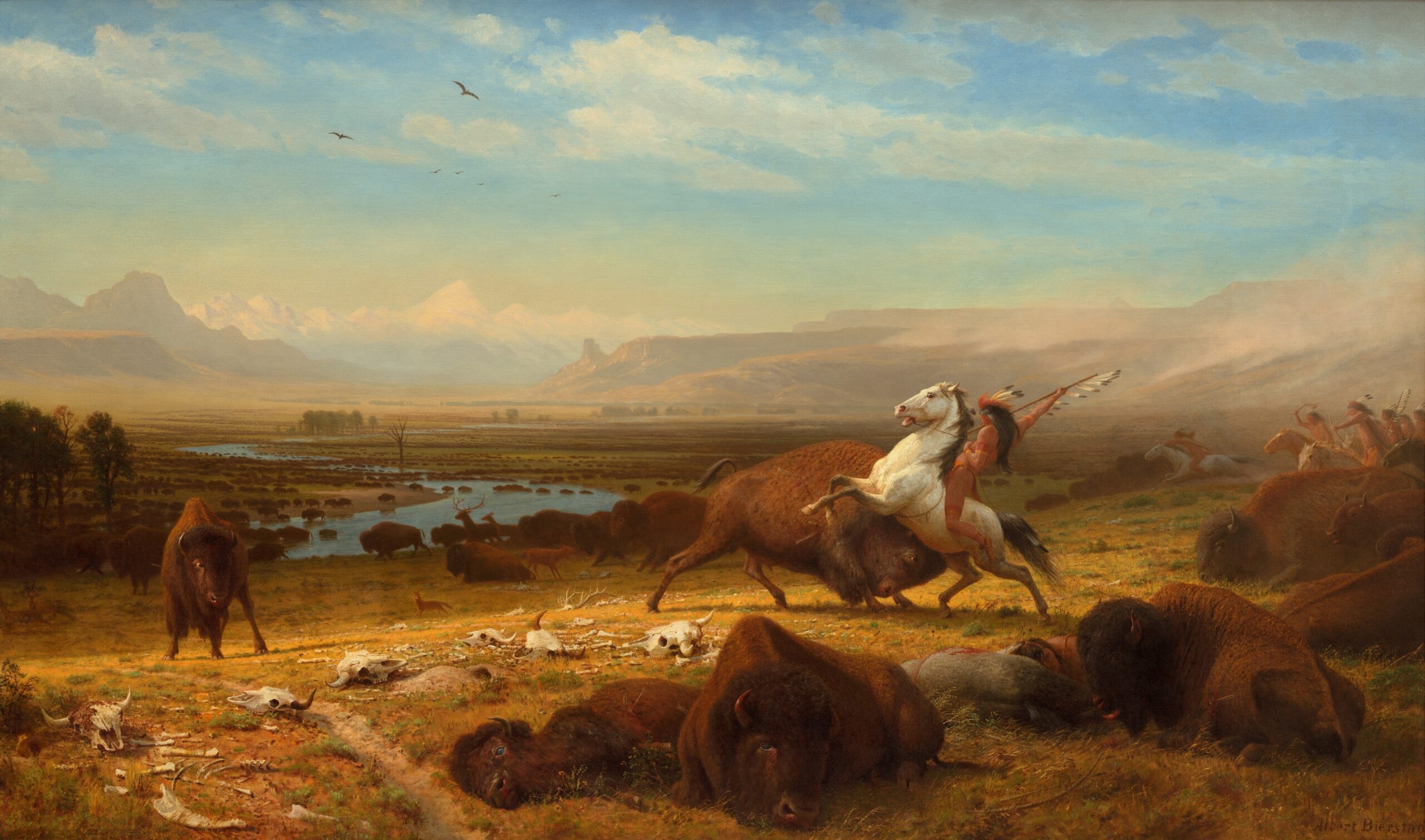
The Last of the Buffalo was Bierstadt’s last major painting of the West, showing a decimated population of buffalo. Dead animals are strewn across the plains, and Indigenous Americans are hunting down the remaining stragglers. The painting is a complex Romantic invention, combining composite landscape sketches with an imagined hunting scene. Despite the fiction, the work reflected contemporary fears about the impending extinction of the buffalo. By the late 1880s, the population had been reduced to around 1,000 animals, compared with an estimated 30 million at the start of the 19th century. However, Bierstadt inaccurately portrayed the Indigenous Americans as the perpetrators of the buffalo slaughter. In fact, the US government had intentionally eradicated them to destroy the Indigenous way of life, to make way for westward expansion.
Among the buffalo carcasses, Bierstadt also included a dead Indigenous American – which may suggest his sympathy towards the concurrent destruction of Indigenous lives, or regret at the consequences of widening colonisation. By the time Bierstadt completed this conservationist work, efforts to protect the remaining buffalo were already underway. But the painting has also been interpreted as a plea for their preservation.
Alongside the painful implications of Manifest Destiny in his works, Bierstadt, along with his Hudson River School contemporaries, has been credited with rallying support for conservation efforts through his depictions of the American landscape. These works contributed to a growing appreciation of the natural landscape that helped influence the establishment of national parks during this era. This included Yellowstone, the first national park in the US. Without ignoring this context, Bierstadt’s paintings represent a crucial moment in American history, shaped by the privilege of his position as a biased observer.
Albert Bierstadt
Oil on canvas, 180.3 x 301.63 cm
National Gallery of Art
Robert S. Duncanson
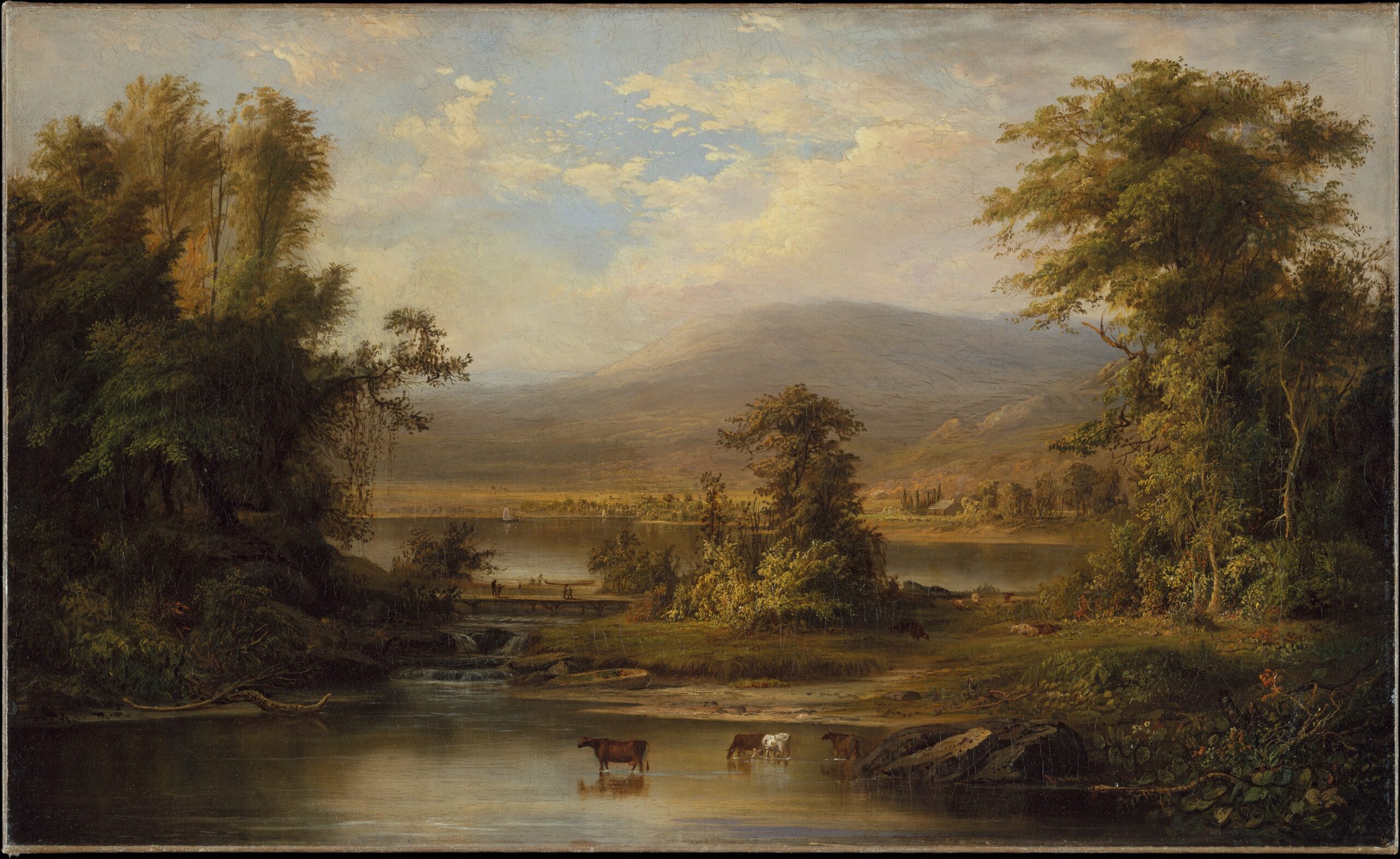
Later members of the Hudson River School, and those inspired by them, included pioneering Black American artists. Robert S. Duncanson was the grandchild of an enslaved man and is considered one of the first African American artists to achieve international acclaim and study abroad. As a child, he was apprenticed as a carpenter and house painter with his four brothers. Robert emerged as the most talented painter in the family, and in 1838 established a painting business. A year later, he suspended the business to pursue a career as a portrait painter, and the following year moved to Mount Healthy, Ohio, where he had access to the Cincinnati art community. Incredibly, despite his mastery, Duncanson received no formal artistic training, instead learning to make art by copying European prints.
Robert S. Duncanson
Oil on canvas, 53.7 x 87.6 cm | 21.1 x 34.5 in
The Metropolitan Museum of Art
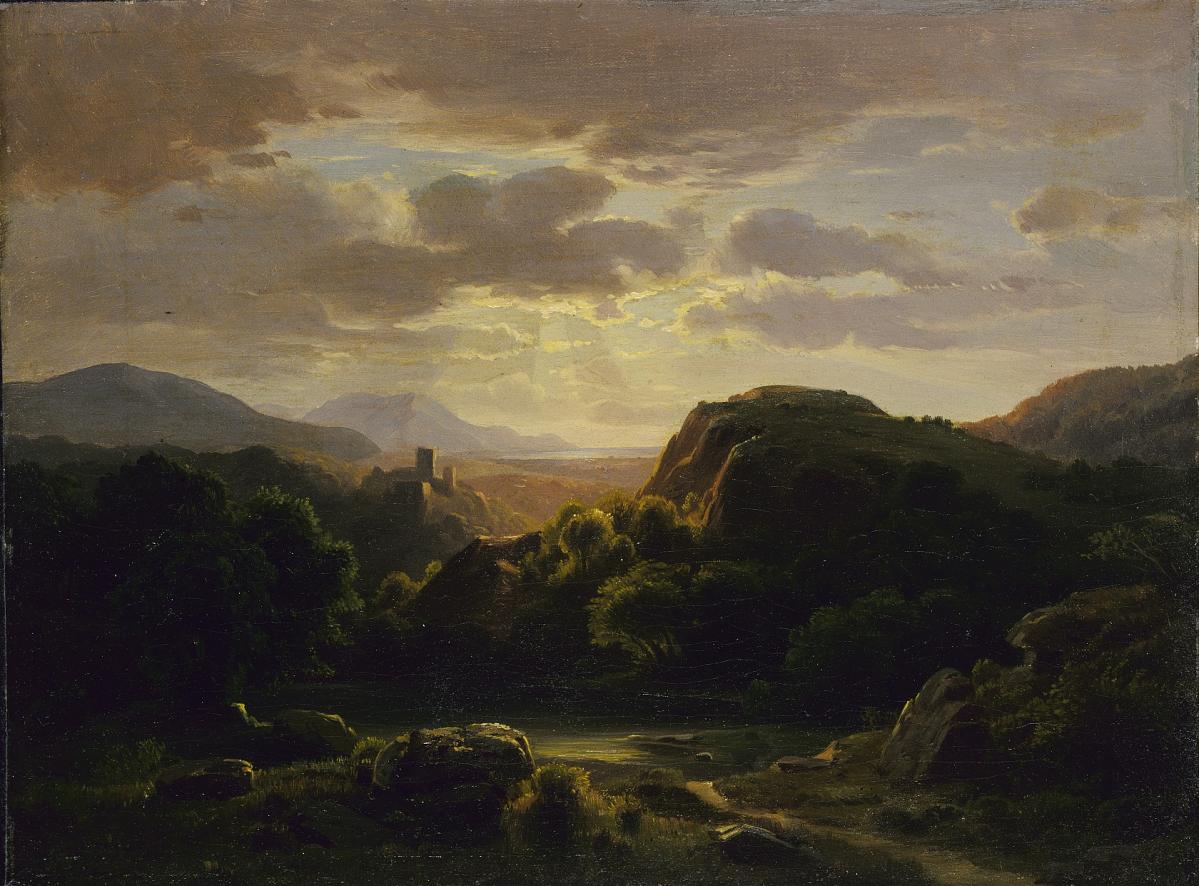
In 1842, three of his portraits were displayed at the Cincinnati Academy of Fine Arts, despite the fact that, as a Black American, he wasn’t allowed to study there, and his family were barred from viewing the exhibition because of their race. In 1848, Duncanson completed his first major landscape painting, Cliff Mine, Lake Superior. From this point forward, Duncanson focused on landscape painting and ventured across America on painting trips with fellow artists T. Worthington Whittredge and William Louis Sonntag. In 1853, he became on of the earliest African American artists to study abroad when he embarked on a traditional grand tour of Europe to study classical art. On his return to America, he made works such as Remembrances of a Scene Near Auerbach.
Robert S. Duncanson
Oil on canvas, 34.3 x 46.7 cm | 13.5 x 18.4 in
Smithsonian
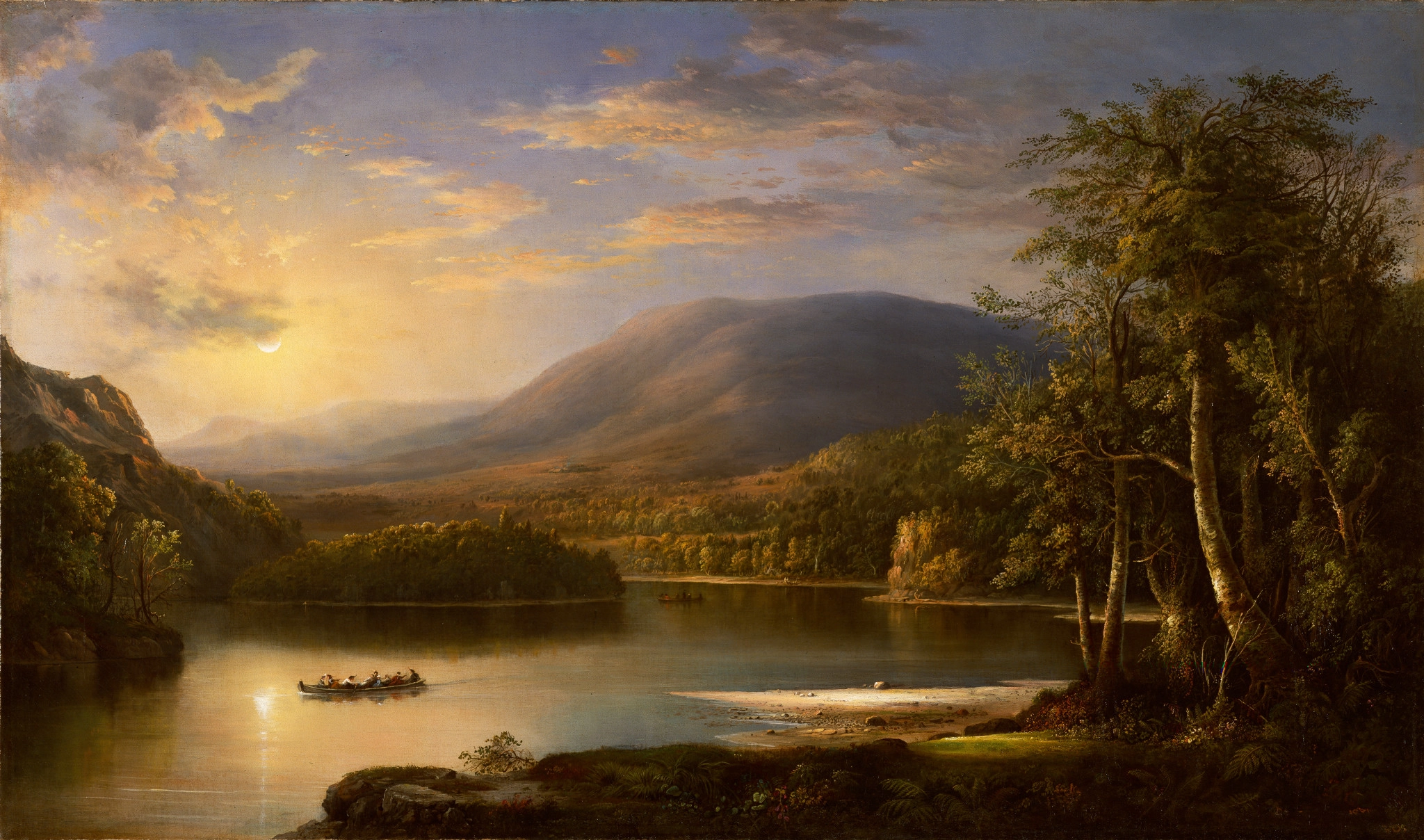
In 1861, he completed his most acclaimed work, Land of the Lotus Eaters, inspired by Alfred Tennyson’s poem of the same name. Unlike many of his American contemporaries, he was particularly interested in European Romantic and Classical subjects. Alongside his flourishing art career, Duncanson was also associated with the abolitionist movement. Many of his patrons were abolitionists who provided him with commissions and funded his travels. In 1863, with the onset of the Civil War, Duncanson left America and lived in Montreal for two years. There, he was influential in the development of an emerging Canadian school of landscape painting. In 1865, he left for Britain, where he made landscape studies in Scotland that he painted from on his return to America, such as Ellen’s Isle, Loch Katrine.
Robert S. Duncanson
Oil on canvas, 72.4 x 124.5 cm | 28.5 x 49 in
Detroit Institute of Arts
Edward Mitchell Bannister
Edward Mitchell Bannister was born in New Brunswick, Canada, before settling in America as a young adult. His childhood was grief-ridden, and after both his parents passed away, he was adopted by a white family. Once he left home, he took a job at sea before moving to Boston, where he worked as a barber. Soon after, he began painting, working in the Boston Studio Building and attending evening classes at the Lowell Institute taught by the sculptor Dr William Rimmer.
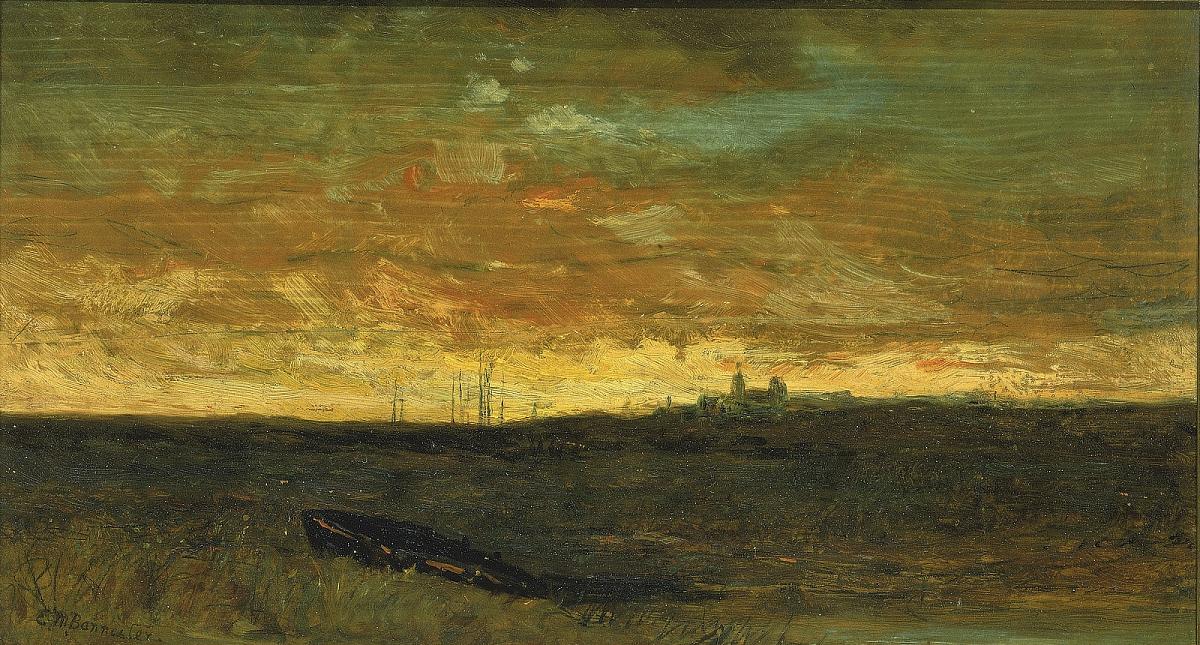
Edward Mitchell Bannister
Oil on wood, 27.2 x 48 cm | 10.7 x 18.9 in
Smithsonian
In 1870, he moved to Rhode Island with his wife, Christiana, where he established his studio practice. Despite his limited training, Bannister became the first African American artist to receive a national award. He was awarded a medal for his painting Under the Oaks at the 1876 Philadelphia Centennial Exposition. Bannister later recalled that the judges wanted to reconsider the award once they discovered his race, but it was eventually kept in his name. Sadly, the painting itself has been missing since the turn of the 20th Century.
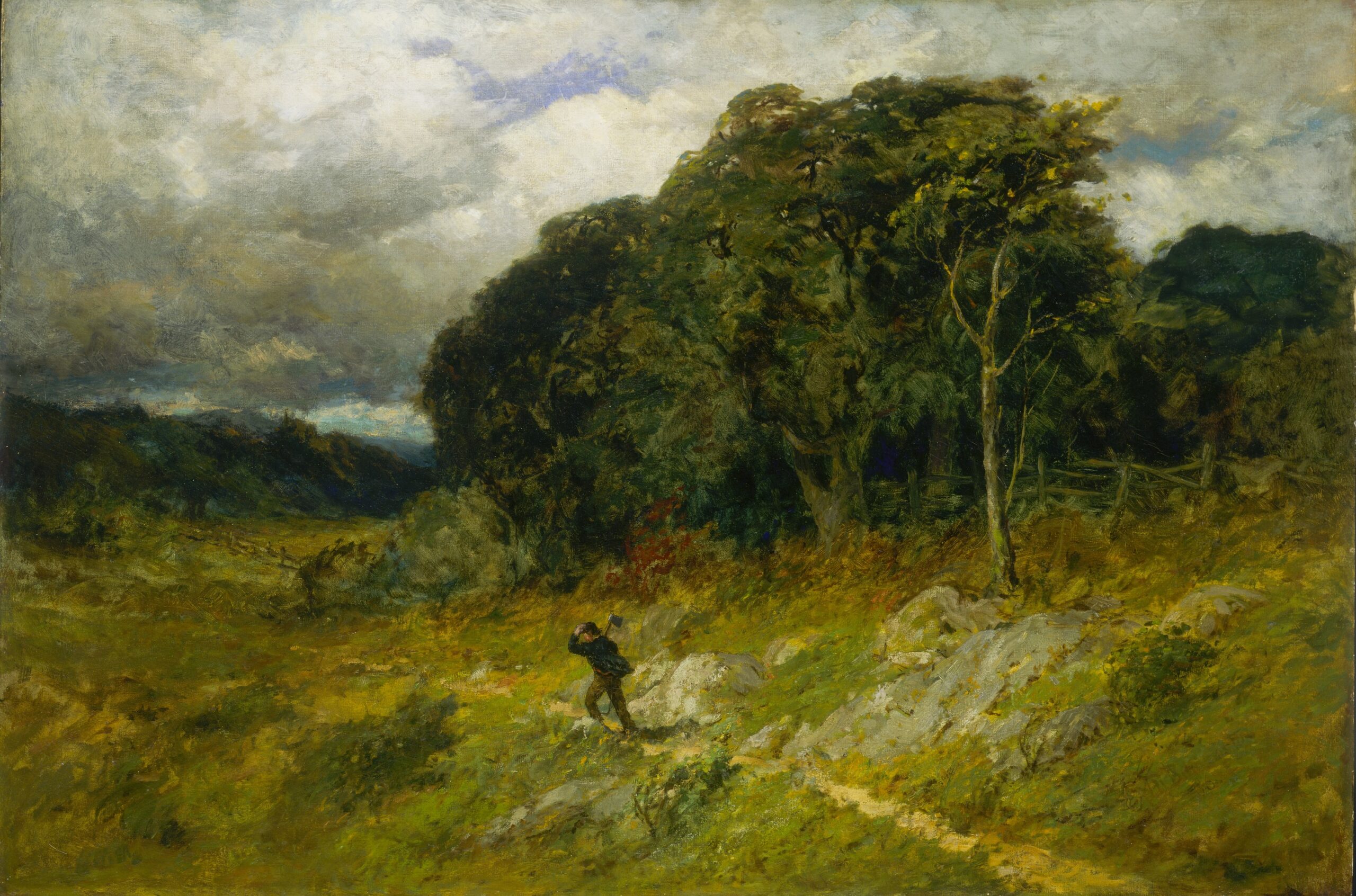
Edward Mitchell Barrister
Oil on canvas, 102.0 x 152.4 cm | 40.2 x 60 in
Smithsonian
Bannister’s work was influenced by both the Hudson River School artists and the French Barbizon School. His works aren’t rendered with the seamless, smooth colour of many of his contemporaries. Instead, Bannister’s paintings are full of expressive brushmarks and impasto, often on an intimate scale, making them closer to an Impressionist approach to the landscape. Other works take on a distinctly Tonalist aesthetic by capturing the waning light, such as Untitled (Sunset with Quarter Moon and Farmhouse). Bannister’s work represents a compelling moment in landscape painting, where we can see an infusion of influences – interpreted by an original hand. Unlike some other Hudson River School and American Barbizon painters, Bannister didn’t benefit from exhibiting his paintings in Europe. Despite this, he became one of the most influential painters in Providence during his lifetime. Today, a significant number of his paintings are housed in the Smithsonian’s collections.
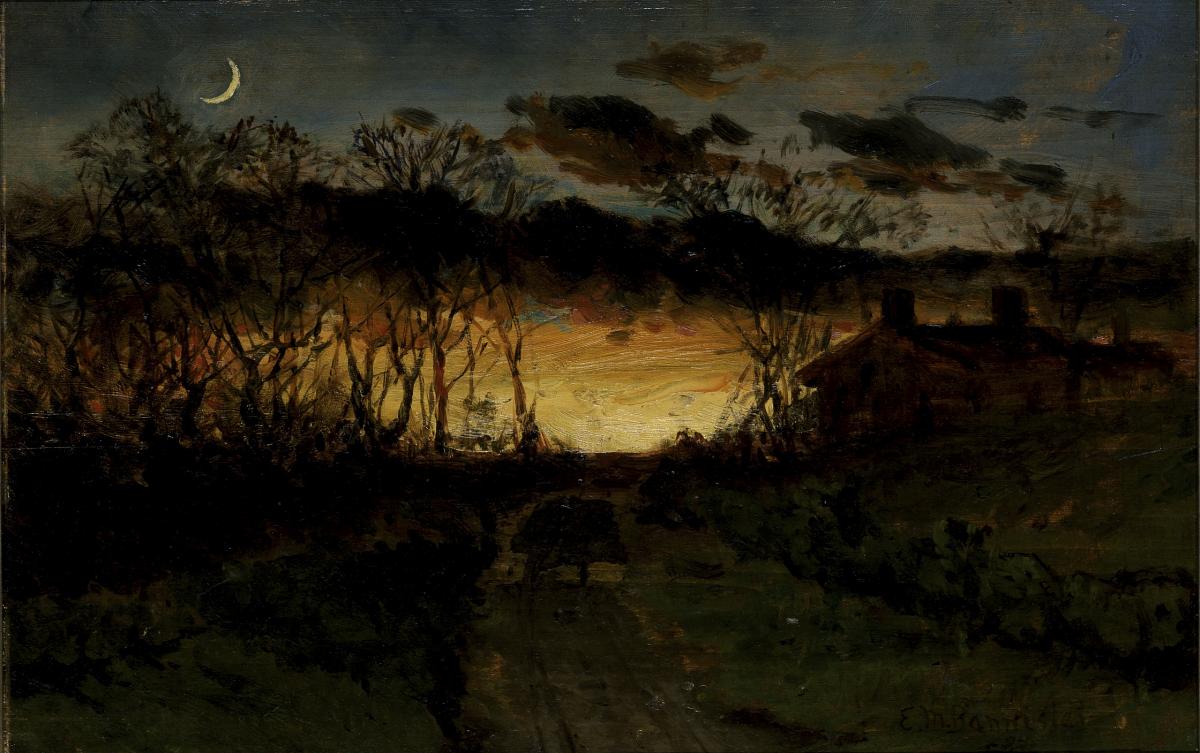
Edward Mitchell Bannister
Oil on wood, 25.4 x 38.1 cm | 10 x 15 in
Smithsonian
Elizabeth Gilbert Jerome
Elizabeth Gilbert Jerome had a passion for making art from childhood, but she was discouraged from pursuing it, to the point where her stepmother would destroy her drawings when she was a teenager. After years of familial discouragement, Jerome returned to painting as an adult, aged 27. Her determination from this point was unshakeable, and she continued to paint throughout the rest of her life. She studied with Julius Busch in Connecticut and later with Emanuel Leutze, who painted Washington Crossing the Delaware.
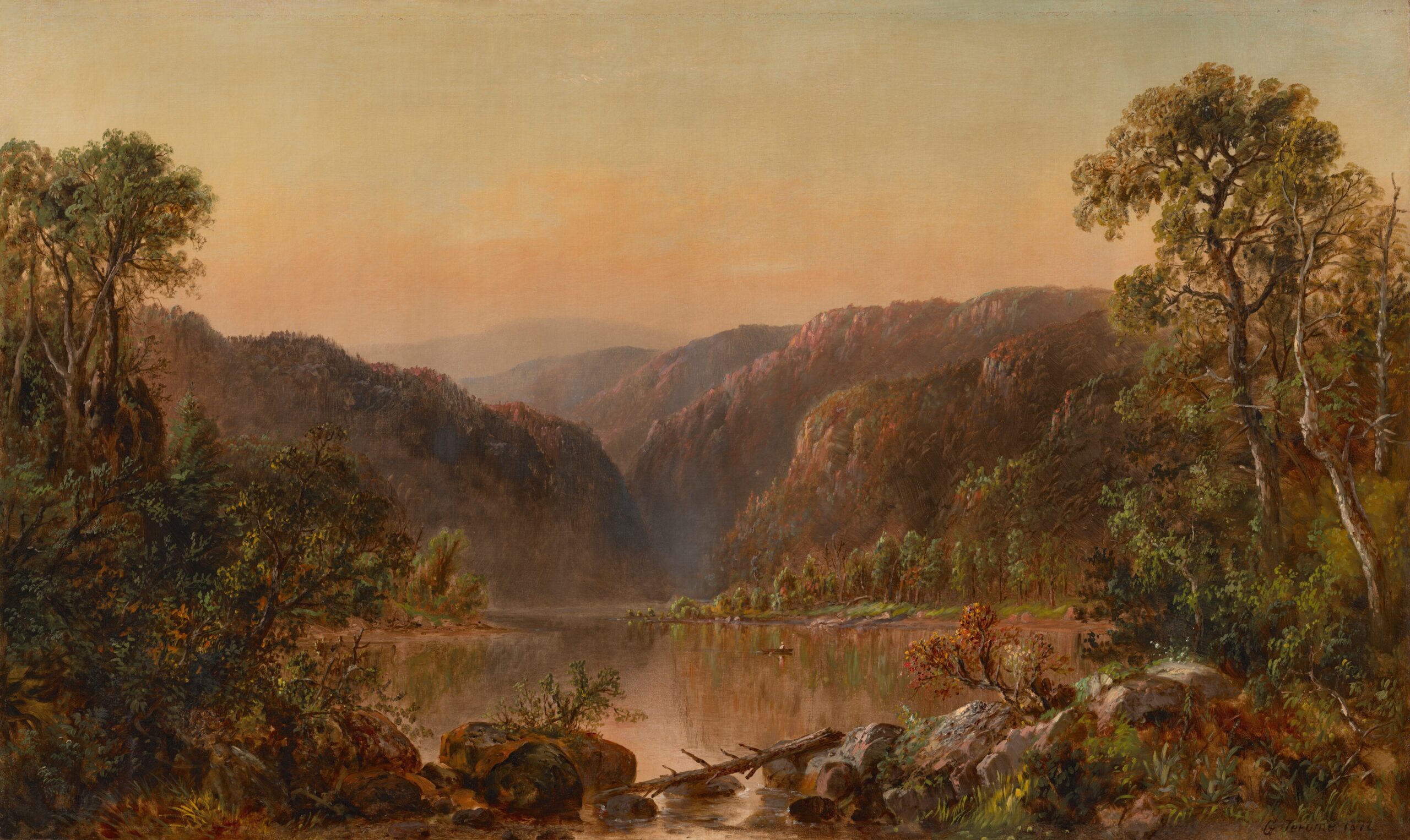
Elizabeth Gilbert Jerome
Oil on canvas, 76.2 x 127 cm | 30 x 50 in
National Gallery of Art
Supported by their tutelage, she ventured into the landscape to develop her works, refusing to be barred from painting outdoors. Few women of this era painted on such a large scale as Jerome, whose works sometimes surpassed 4 ft in length. She often signed her works E. Gilbert Jerome or E. Jerome to disguise her gender and avoid prejudice in the public evaluation of her work. Alongside her landscape practice, she also painted portraits and continued to innovate in her artmaking into old age. Remarkably, at the age of 80, she began making miniature paintings for the first time.
Julie Hart Beers
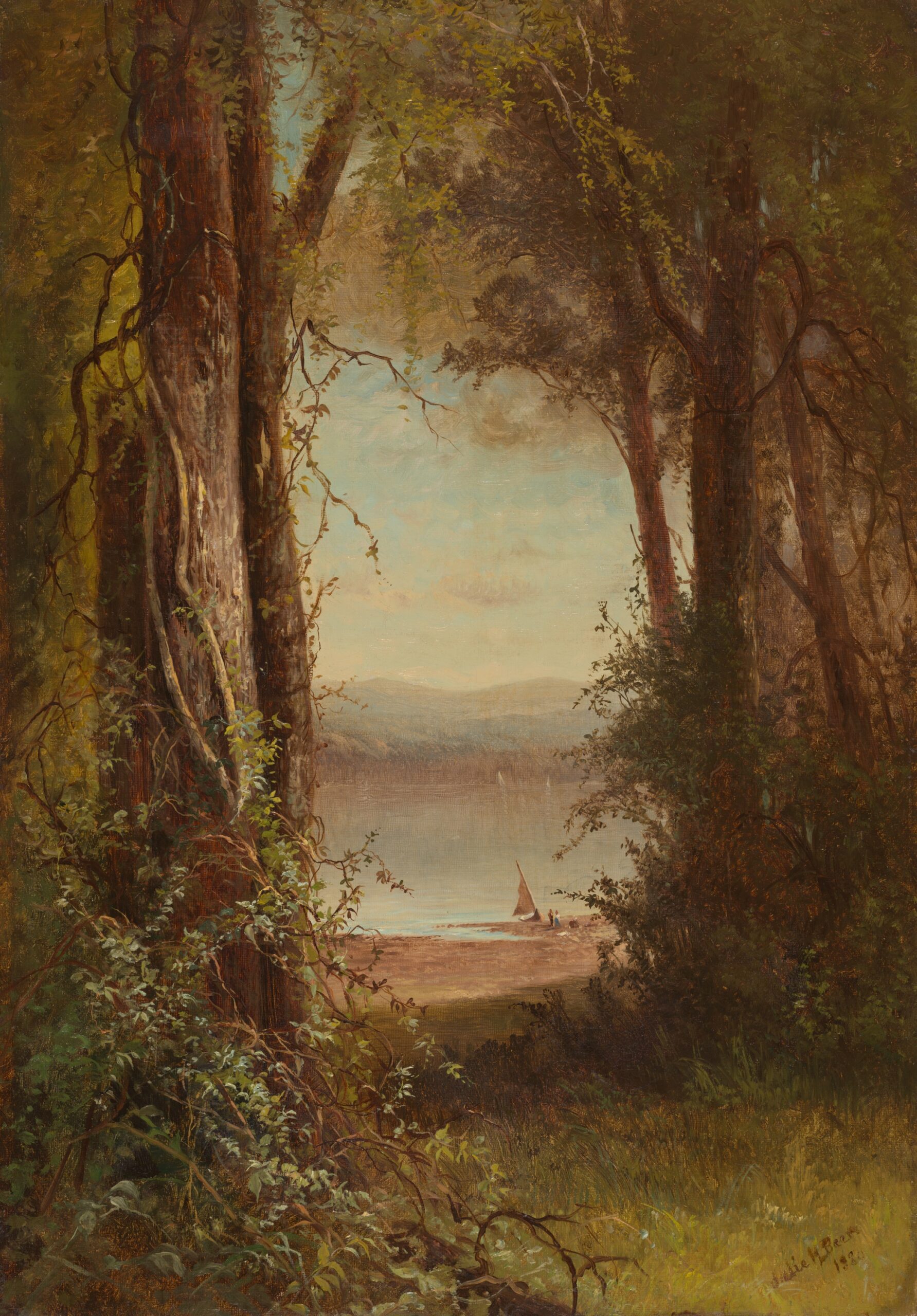
Julie Hart Beers
Oil on canvas, 51.3 x 35.9 cm | 20.2 x 14.1 in
Art Institute of Chicago
Julie Hart Beers was a member of an artistic family with two older brothers, William and James, who were also Hudson River School artists. In 1853, she married, but unfortunately her husband passed away just three years later. After his death, she moved with her two daughters to New York City, where her brothers had established a studio. Although Julie had no formal training, it’s thought that her brothers taught her to paint. In New York, she developed her practice and became a professional painter with commercial success. She remarried and moved to New Jersey with her family, where she set up her own studio – although she still used her brothers’ studio as a showroom for her work in the city. She began exhibiting her work in 1867 with the Brooklyn Art Association, followed by the National Academy of Design and the Pennsylvania Academy of the Fine Arts.
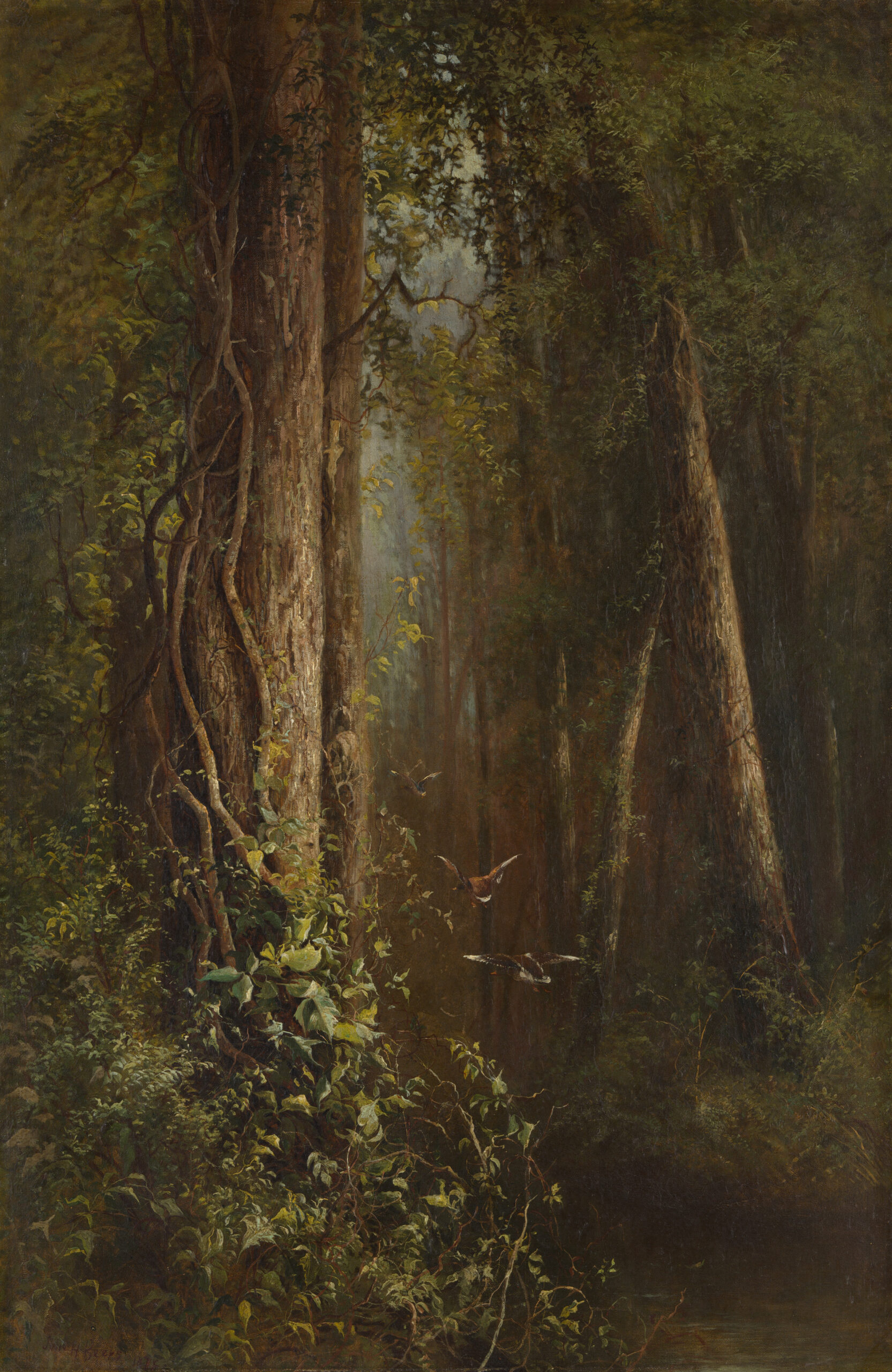
Julie Hart Beers
Oil on canvas, 66 x 45.7 cm | 26 x 18 in
The Metropolitan Museum of Art
Alongside her prolific studio practice, Beers led sketching expeditions for women into the mountains of New York and New England. She is best remembered for her exquisite, immersive forest scenes and her ability to capture fleeting moments in nature, such as the birds flying away from us – startled by the viewer’s presence – in Ducks in the Woods.
Demonstration of a Hudson River School Technique
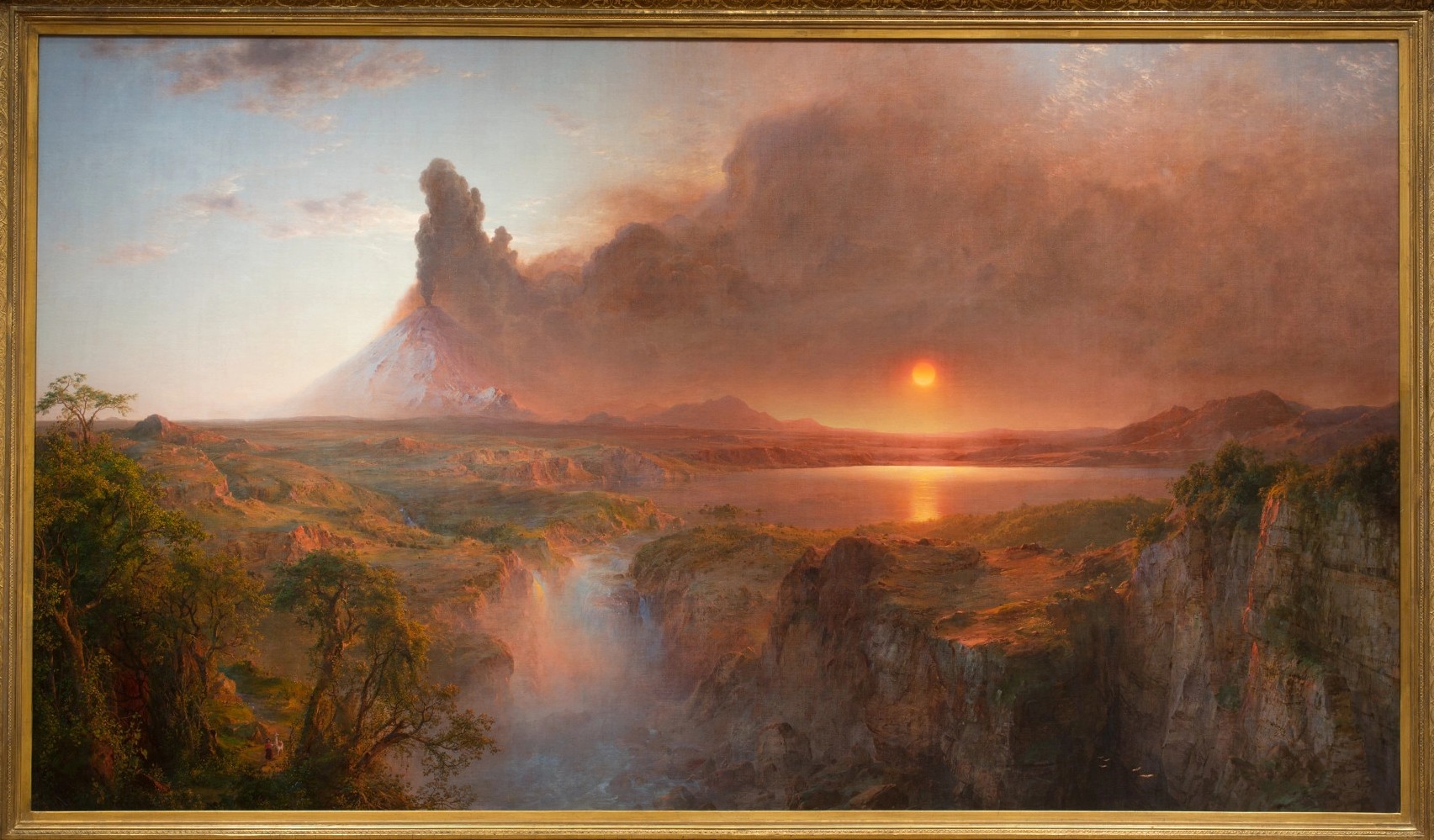
Frederic Edwin Church
Oil on canvas, 121.9 x 215.9 cm | 48 x 85 in
Detroit Institute of Arts
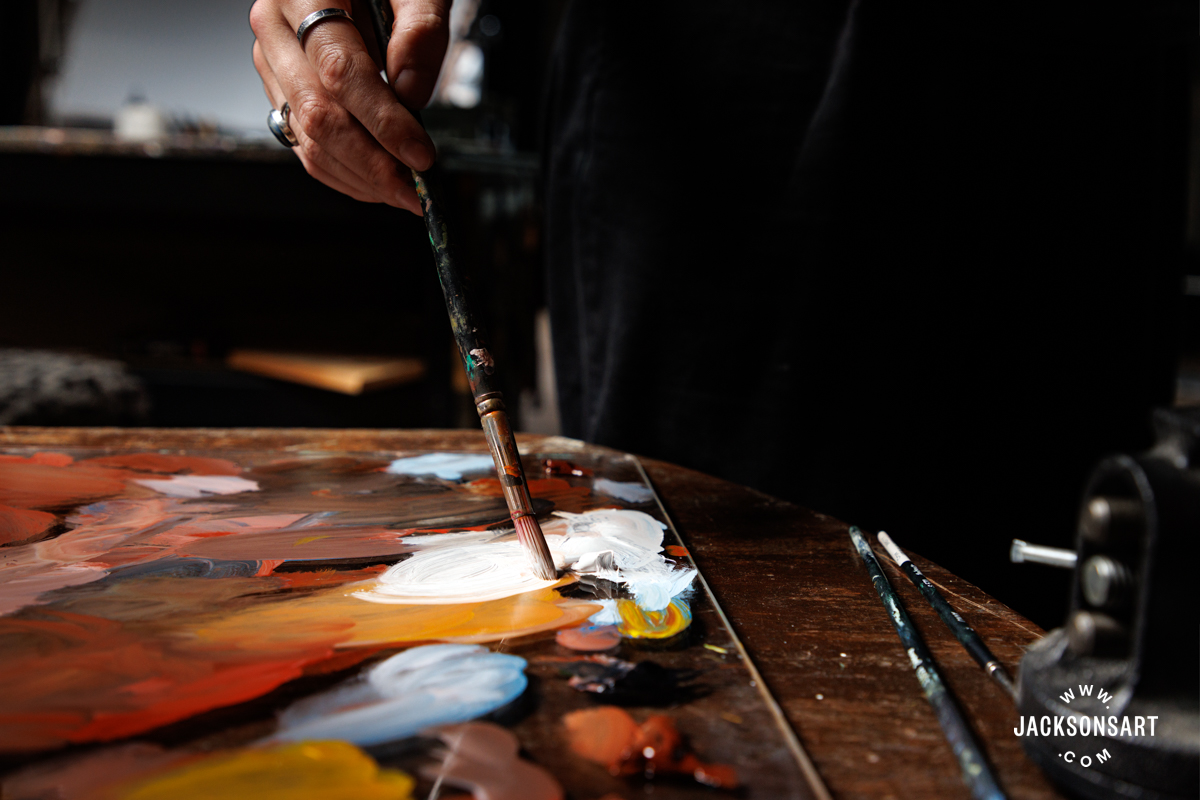
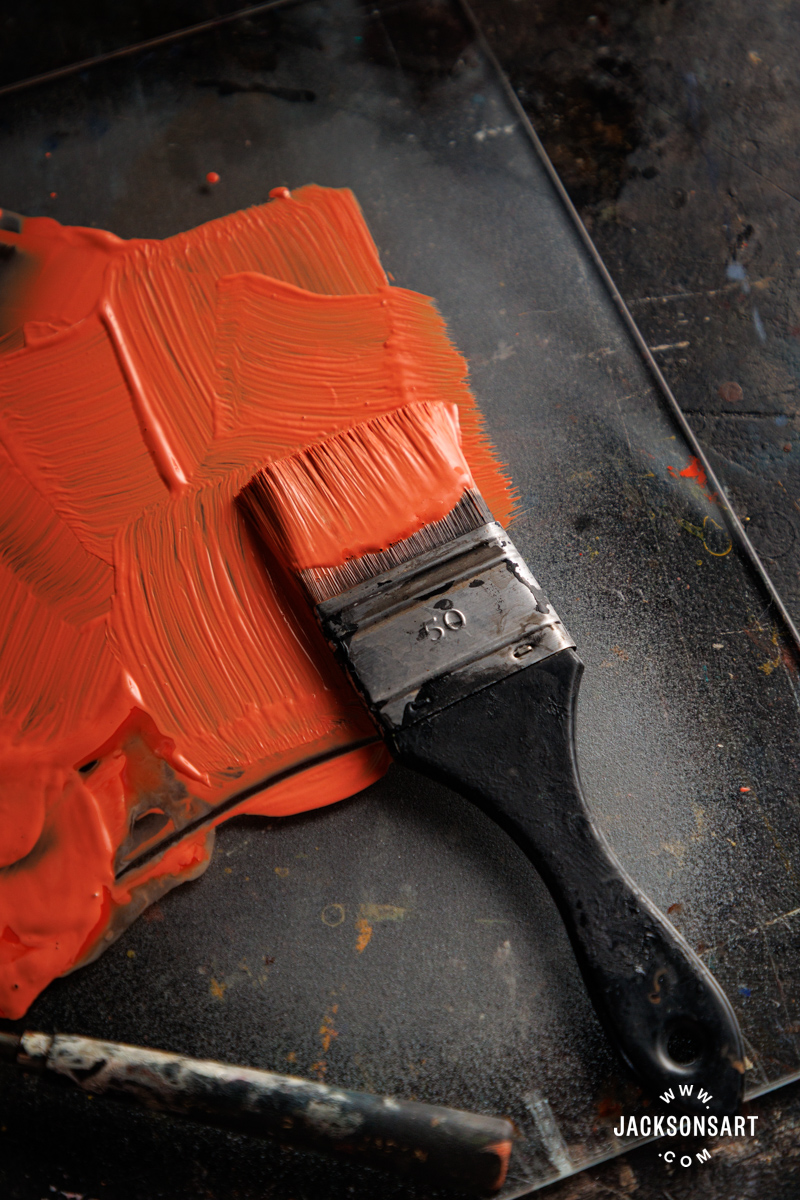
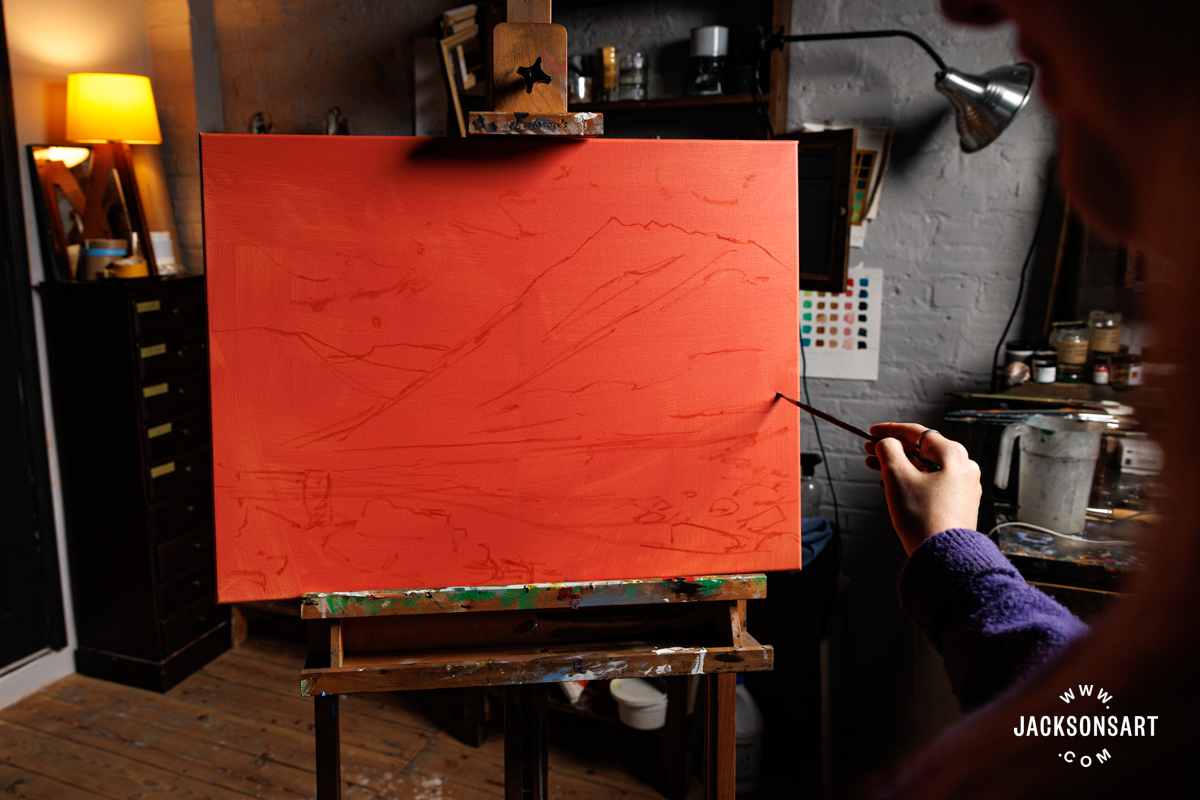
Frederic Edwin Church painted on a dark salmon-pink ground in his early career, which allowed him to infuse his paintings with warmth, before later switching to white. Inspired by Church, I prepared a Jackson’s Primed Cotton Canvas with a similar ground by mixing Jackson’s Studio Acrylic Paint in Crimson, Cadmium Orange Hue, and Titanium White, and applying it evenly to the surface.
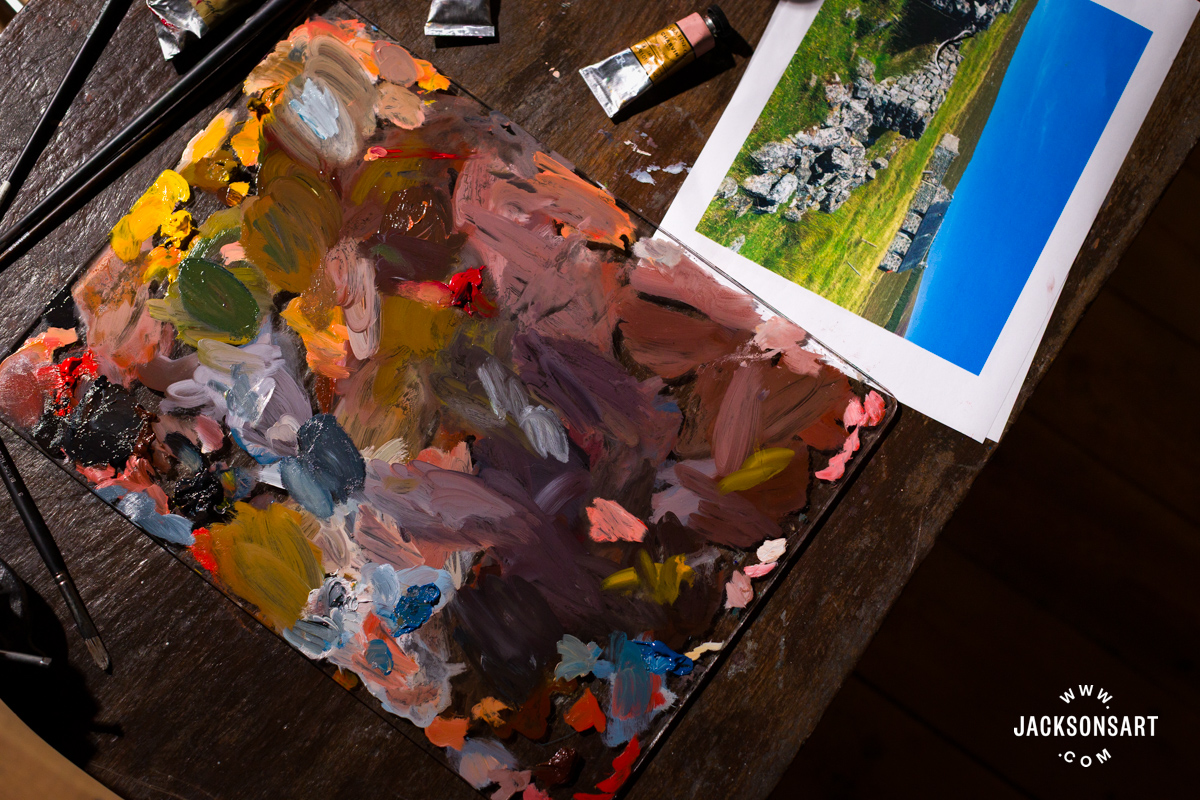
Church worked from a collection of drawings and oil studies that he made on his expeditions into the landscape. On his return to the studio, he combined them to create composite scenery within his finished paintings. He didn’t make preparatory drawings or scale up a smaller painting before starting on a canvas – instead, he would work out how to combine his references directly on the canvas. To follow this part of his process, I printed out a few photos of landscapes that I took whilst walking and combined them directly on my canvas.
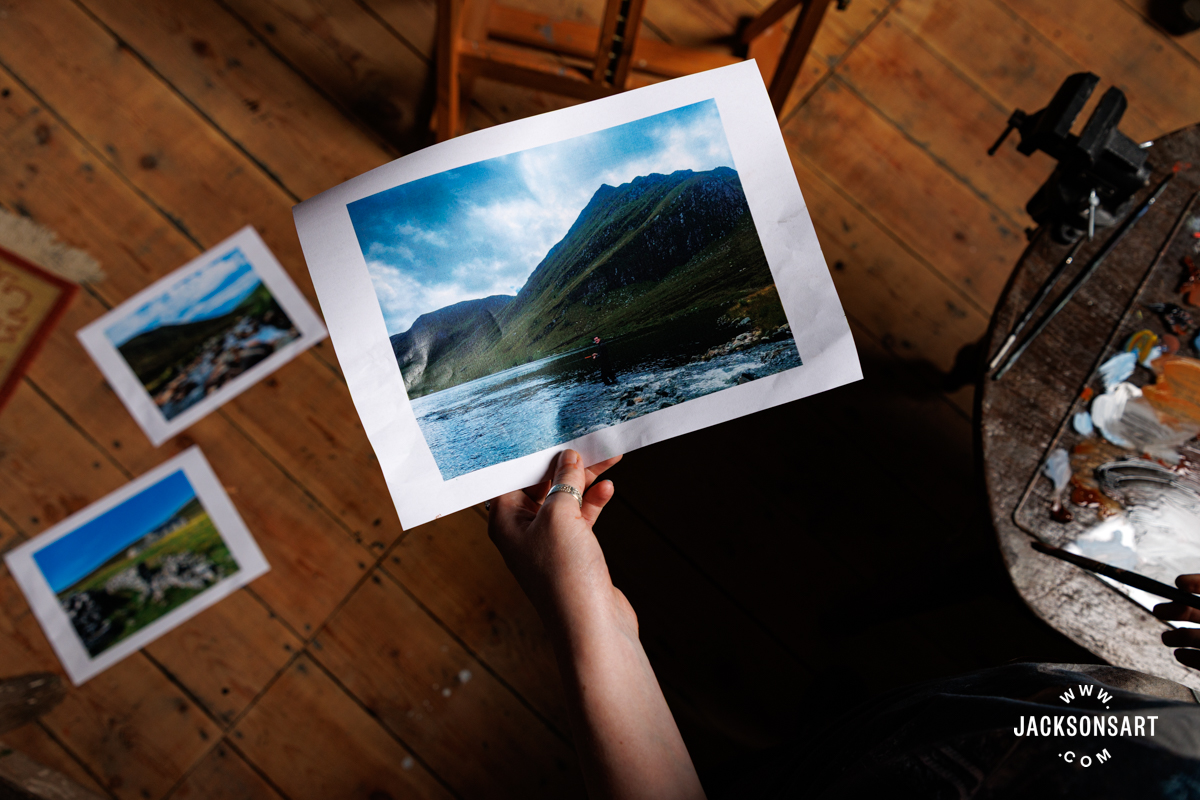
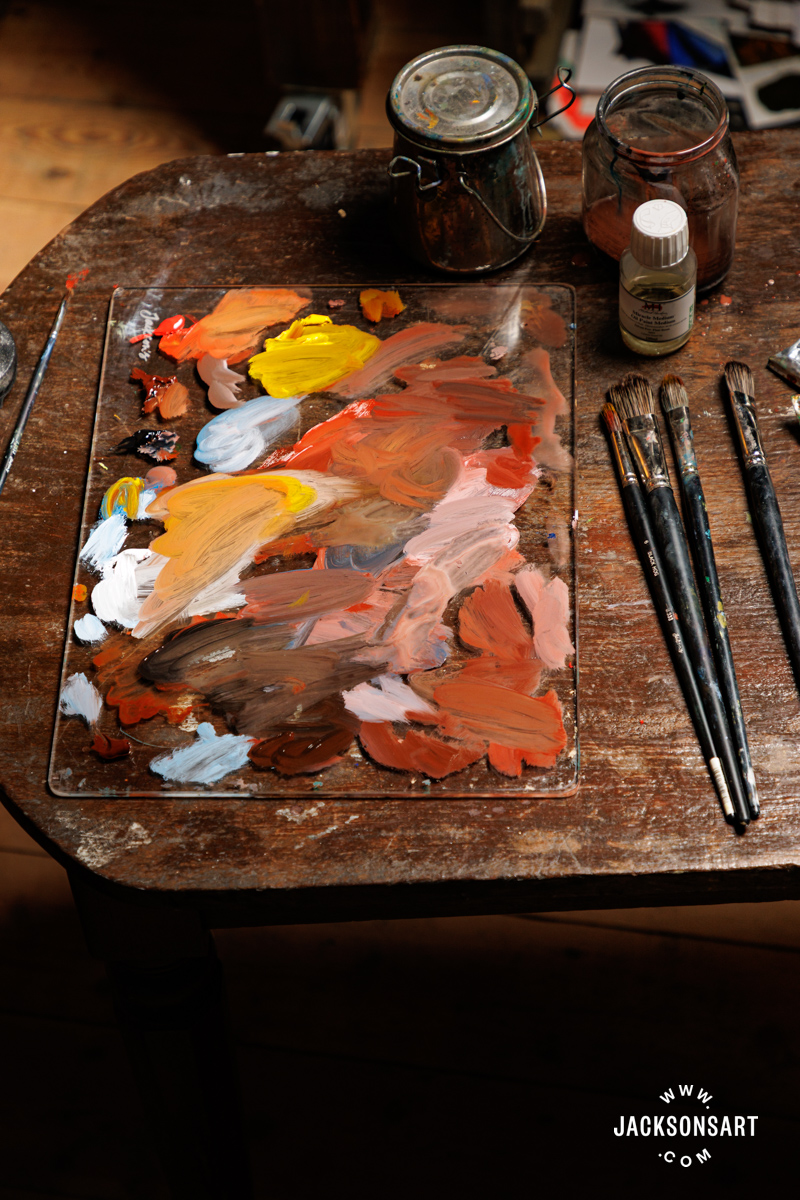
For my painting, I worked with a variety of warm oil paints: New Gamboge, Cerulean Blue Genuine, Pyrrole Crimson, Cadmium Yellow Genuine, Tanned, Cadmium Red Genuine, Indigo, Burnt Sienna, Ultramarine Violet, and Titanium White.
To begin my painting, I made a light underpainting to decide the position of different elements from each photo, to combine them into one landscape.
Next, I built in the key forms of the painting, slowly building up the tone. This light paint layer would allow me to amend the position of any elements before committing to them.
I began by building in a mixture of Burnt Sienna and Indigo to establish the tone of the mountains, and Cerulean Blue mixed with Titanium White for the sky. Then I reinforced the darkest shadows by applying a chromatic black, mixed with Ultramarine Violet and Burnt Sienna.
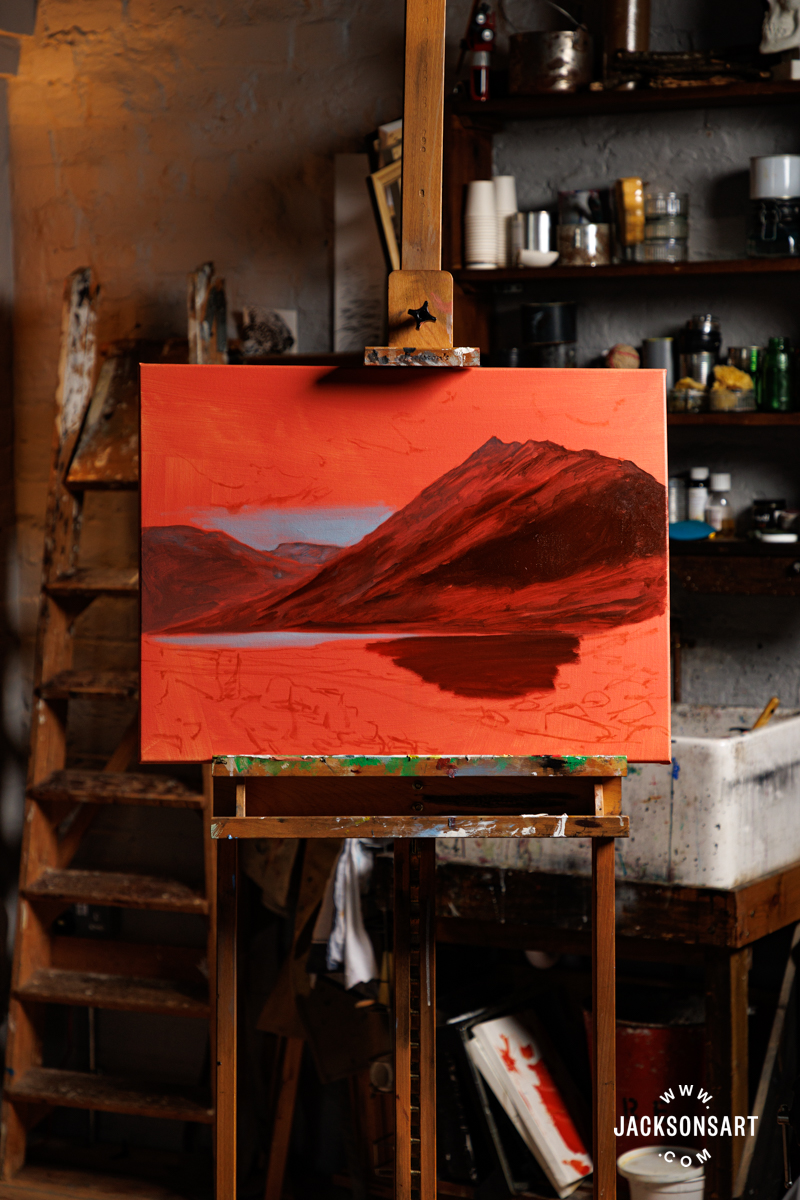
I used a light hand to paint the sky, trying to be selective about how much of the salmon pink ground to allow to show through, and where to cover it with opaque light.
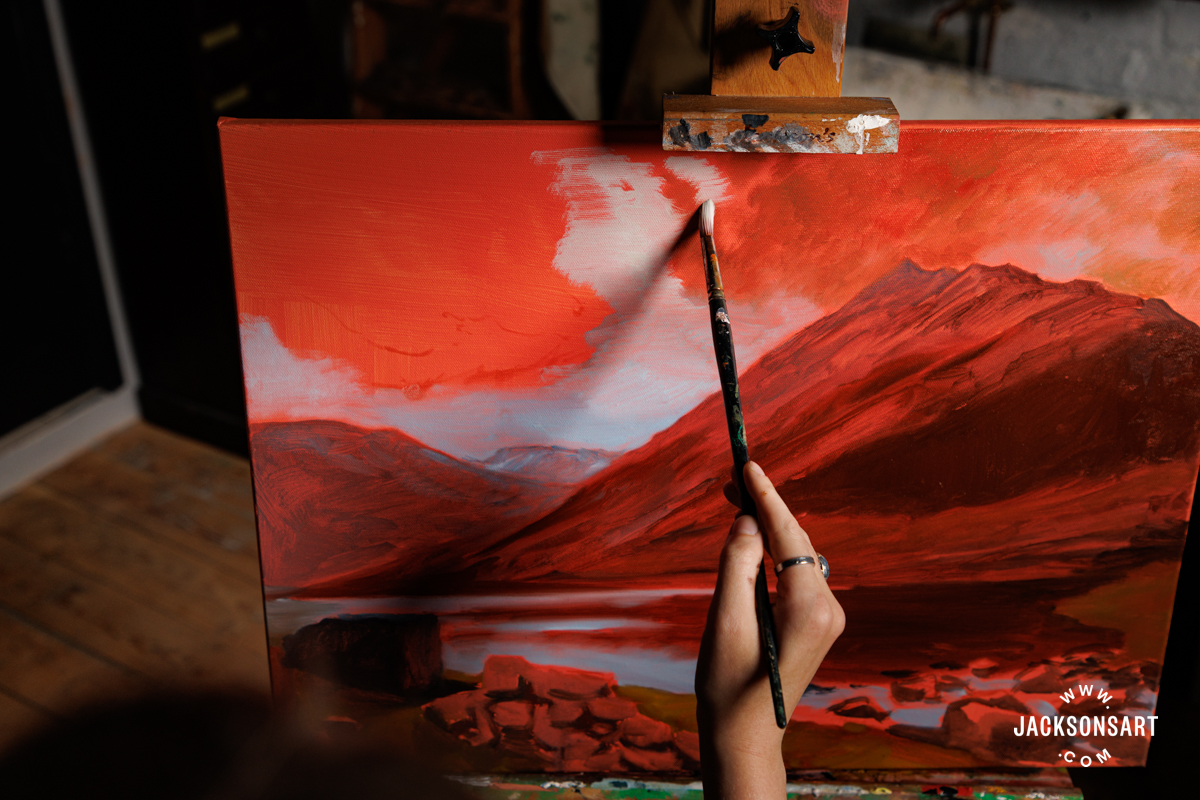
As I worked, I consciously tried to balance the warmth of the ground with cool layers of colour to give the painting balance.
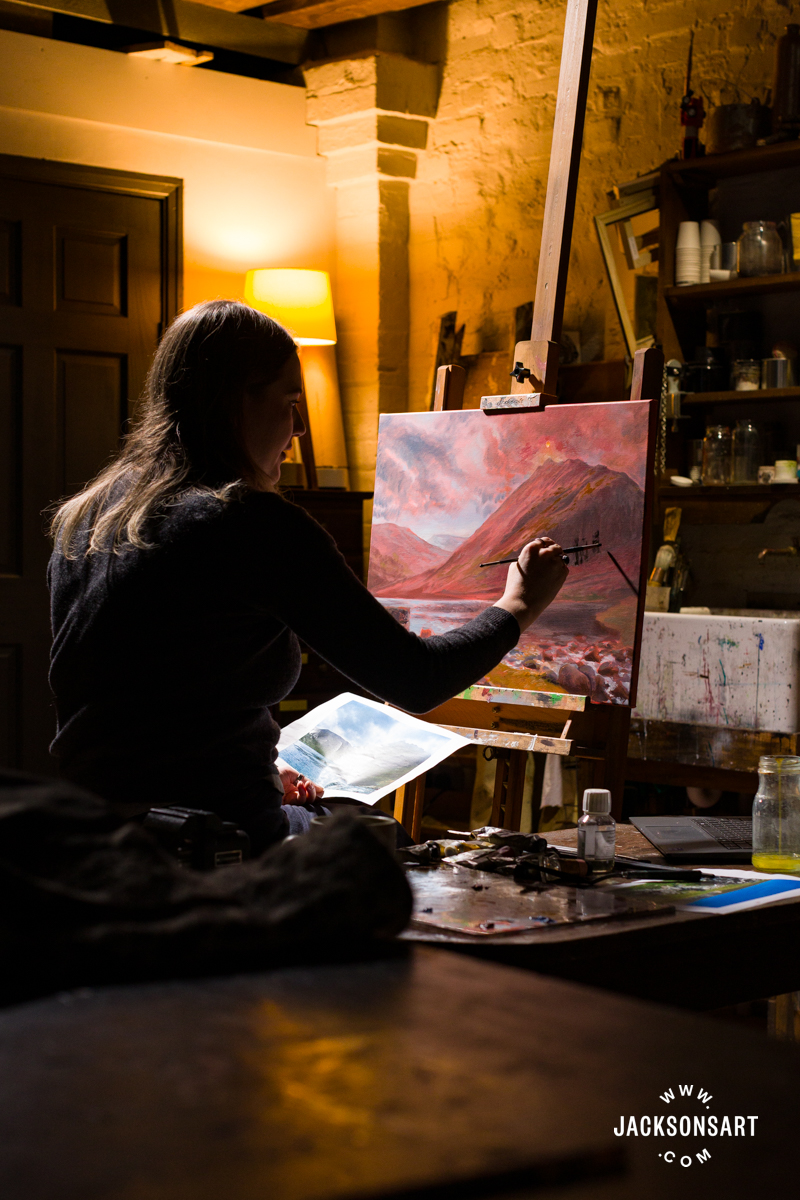
To refine the painting, I worked up details like the collapsed building in the foreground, picking out the texture of the grass and sparkling light on the loch, and adding bright yellow to the centre of the setting sun.
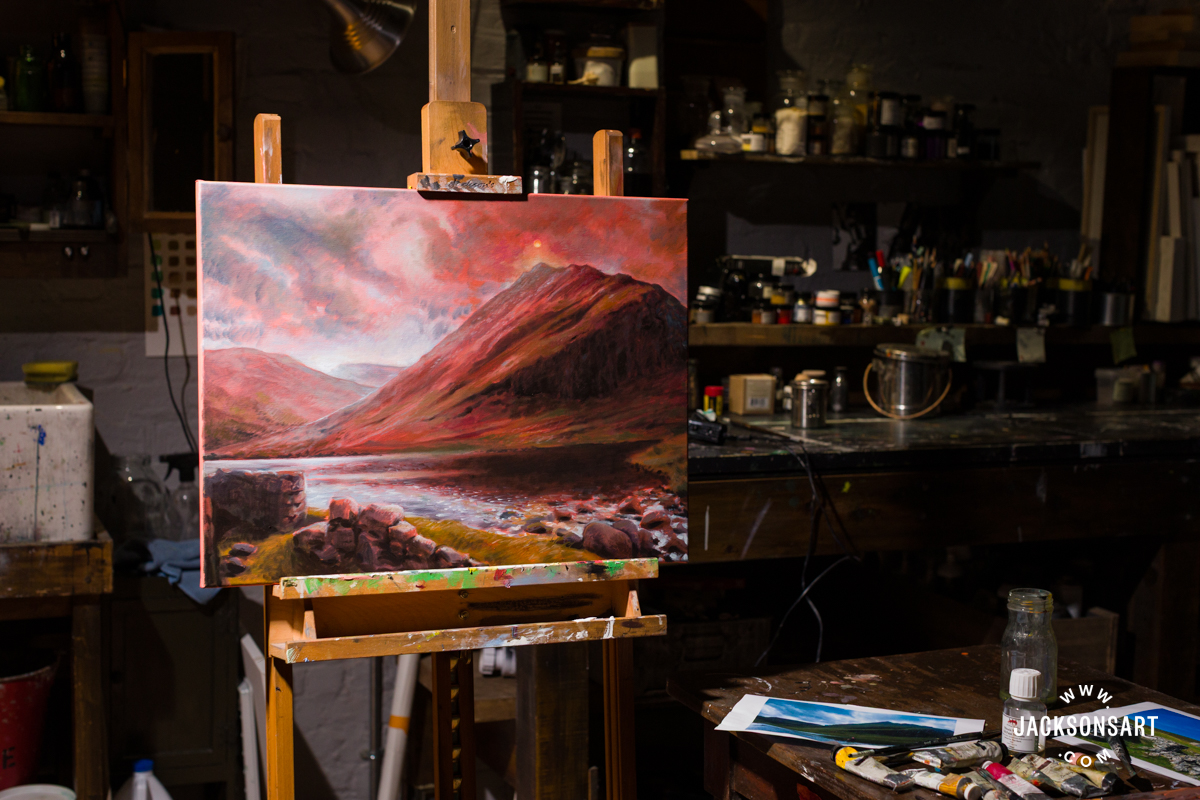
Many paintings by Hudson River School artists combine ethereal light with sharp realism. To continue developing this painting, I would refine the surface and details, aiming to achieve their characteristic laboriously painted surfaces.
Further Reading
Behind the Movement: Symbolism
How to Resolve a Landscape Painting Composition
Tips for Landscape Painting on Location
Shop Art Supplies at jacksonsart.com


6 thoughts on “Behind the Movement: The Hudson River School”
Beautiful landscapes full of mood and atmosphere
Stunning research I loved this, how precious the world is and not very long ago really. Just amazing paintings
Thankyou so much for this wonderful condensed yet highly informative article. I especially loved your painting to finish. It’s always a delight to discover yet more of the history of art and artists. Again, thank you very much indeed.
I loved this article and the paintings shown. So interesting and inspiring. The style is something that I have always loved but did not know what it was called. Luminism is a perfect name for it with the ethereal qualities, lighting and wonderful sky. So dreamy. I also love the painting done by Louise. It is fantastic. Thanks so much. I have saved this article for future readings. Cindy
Thank you so much for this wonderful article on the Hudson River painters and Women and African-American artists. I learned a lot!
Your Hudson River school painting ,has great warmth and gentleness mixed with dramatic landscape and power in land and sky a rare combination