



Chinese Brush Painting is the art of using simple and effortless brush strokes to depict the essence of a figure or scene. It is an ancient art that continues to fascinate contemporary artists. A distinguishing feature of Chinese Brush Painting is that each brushstroke is a defining move that is not changed or corrected.

The vivid and varied calligraphic style of Chinese brushwork comes from the combination of three things: a soft absorbent brush, soaked in strong Chinese or Indian ink, and the permeability of Chinese (rice) paper. The Chinese do not differentiate between brushes that are used for calligraphy and those used for painting. Besides brush handling, another important skill that comes with practice is knowing how much to dilute the ink and how wet your brush should be. A variation of Chinese Brush Painting can be painted on watercolour paper. You will use a lot more water because the surface isn’t soaked the same way as rice paper.
Chinese Brush Painting Set of Brushes
Jackson’s stock a set of five brushes for Chinese brush painting that contain a variety of hairs, so I thought it would be a good set to look at to show the different hairs.
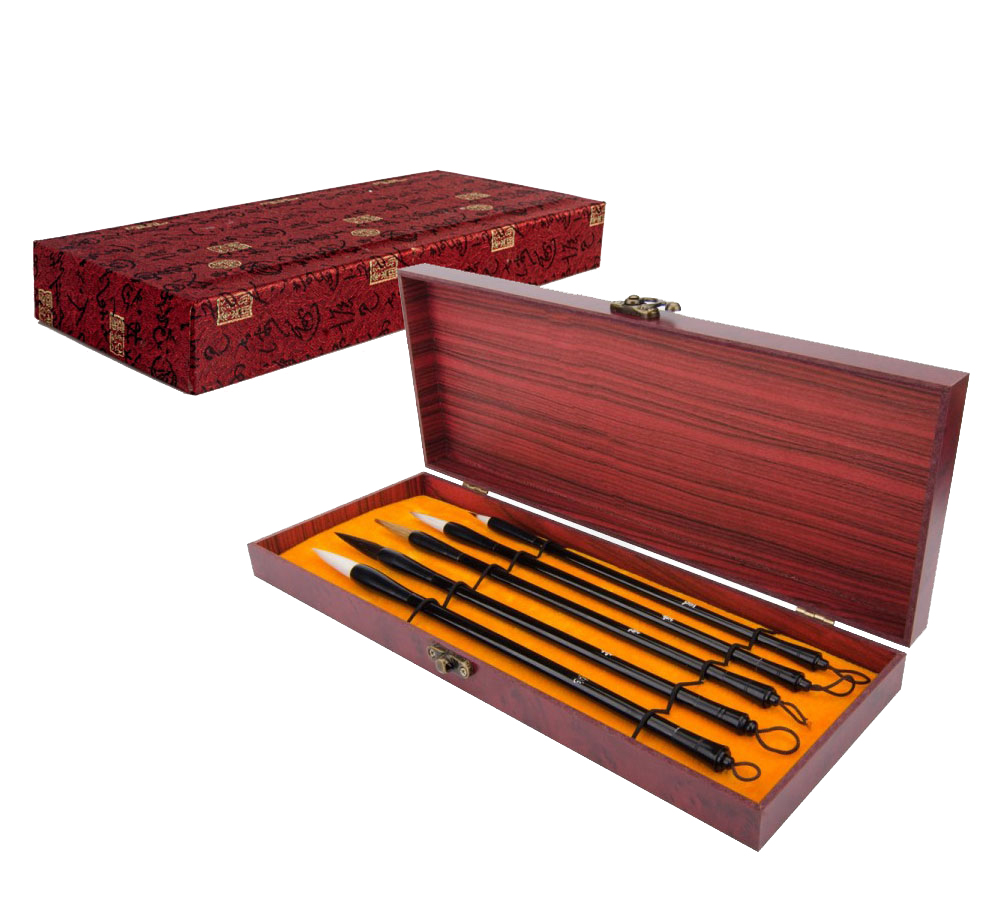
This set of five brushes for Chinese brush painting is made with a variety of hairs. So you have a range of ‘soft’, ‘medium’ and ‘stiff’ brushes. It is a range of softness, really, as they are all rather soft. The brushes come in a 32 x 12 cm coated wooden presentation box with a nice clasp, inside a fabric-covered outer gift box.
The brushes are from 25 to 27 cm long overall and have a cord attached at the ends for hanging from a brush rack. All the brushes come with a protective cover for the bristles that can be used again. These brushes are very absorbent and they hold a lot of ink.
Chinese brushes are heavily starched to protect the hairs, so when they arrive the brush head is very rigid. Before use, the starch should be removed by soaking the brush head for a few minutes in room-temperature water and then washing the brush until the entire length of the brush hairs are fully loosened.

The set contains five brushes of different hairs:
Please note: The sizes I have measured are approximate and may vary slightly as the brushes are handmade.
Goat Hair
10 mm hair diameter at the ferrule, 43 mm hair length
The white hair brush is the widest one in this set with the fullest belly; it is a soft pure goat hair brush. Goat brushes are popular in China. Goat hair is long, at least two inches in length. It is very absorbent and can be shaped into a fine point when wet. Goat hair has a natural inclination to stay together when wet and will, therefore, make it possible to maintain excellent control (after some practice).
Few types of hair will hold up well or make good control possible when the direction of a brushstroke is changed 180 degrees without stopping, or without lifting the tip of the brush off the working surface. Goat hair is very elastic and is one of the few hairs that will survive this type of treatment. They can be difficult for beginners to control but soft brushes used skilfully will deliver very interesting and unpredictable lines.
Black Rabbit Hair
8 mm hair diameter at the ferrule, 45 mm hair length
The longest brush is made of black rabbit hair. Called a ‘hard’ brush it is still absorbent and relatively soft but the hairs are stiffer. It is more absorbent than weasel hair.
Weasel Hair
7 mm hair diameter at the ferrule, 37 mm hair length
Then there are two medium-sized brushes. The brown one is made of weasel hair. Weasel hair is at the opposite end of the hardness spectrum in the Chinese brush scale from a goat hair brush. Called a ‘hard’ brush it is still absorbent and relatively soft but the hairs are stiffer and yet very flexible. The brush tip will move fast and with accuracy, even if fully loaded with ink.
A Mixture of Black Rabbit and Goat Hair
The other medium-sized brush (7 mm hair diameter at the ferrule, 37 mm hair length) and the small brush (6 mm hair diameter at the ferrule. 20 mm hair length) are made of a mixture of hairs: black rabbit hair in the centre and tip and goat hair on the outside. This makes them medium soft. The small brush is particularly useful for small calligraphic script because it is short.

L – R: Goat, black rabbit, weasel, mixture of black rabbit and goat.

L – R: Goat, black rabbit, weasel, mixture of black rabbit and goat.
Further Reading
Artist Review: Roman Szmal Synthetic Squirrel Quill Brushes
A Family Matter: Handcrafting Brushes
The Development of Synthetic Brushes
Introducing Da Vinci Colineo: Vegan Brushes for Watercolour
Shop Chinese Painting on jacksonart.com




56 thoughts on “Brushes for Chinese Brush Painting”
Is there not a synthetic hair alternative for Chinese
paint brushes?
I found one with Google, but synthetic Chinese brushes
are unheard of.
Hi Jo,
Jackson’s now sells synthetic Akashiya brushes which can be used for Chinese painting techniques. https://www.jacksonsart.com/search/?q=akashiya+synthetic
Many thanks!
Lisa
Dear Lisa,
If you used a goat hair japanese brush
in oil paint would it leave a texture on
the canvas?
I have found it difficult to use a goat brush with oil. The dragging of the brush tends to pull out loads of hairs that are then left in the paint and the oil gums up the brush and it is very hard to clean the oil out, so the brush is good for one use only as a blender.
If you are looking for a soft blender, a badger brush will work much better. Though it will lose some hairs, too.
i am also looking for synthetic versions as i will not paint
with sable, bear, wolf hair etc. disgusting. I am also looking
for very large oriental artists brushes. Any help would be
gratefully received. Many thanks
Hi Katie
I can’t find any synthetic Chinese brushes available. But this soft, pointed, mop brush might work for you.
Raven Mop Brush.
Please don’t recommend a mop brush as a substitute for a Chinese brush.
They contain too much water and flood the paper. You also can’t do the flick
strokes with this type of brush. Please only recommend what you have tried
out for yourself. Many thanks, Ann
Hi Ann
You seem to have misunderstood my reply to Katie. I suggested a possible solution to her problem, it was not a recommendation, but rather the closest thing I could find: a full-bodied, soft brush with a point – but with no animal ingredients. Do you know of any synthetic Chinese painting brushes?
Need to import from US
I am looking and found some but have not ordered yet. Did you
have any luck?
Hi Jacqui
We have some gorgeous new synthetic brushes for Chinese Brush Painting and Calligraphy.
Hi Katie
Jackson’s now sells synthetic Akashiya brushes which can be used for Chinese painting techniques. https://www.jacksonsart.com/search/?q=akashiya+synthetic
Many thanks!
Lisa
This brushes hair losing problem what can i do
Pls help me….
Hi Suresh
It sounds like a binding problem, possibly. If you bought the brush from Jackson’s Art Supplies then please contact customer services and we can look into the issue further.
Many thanks
Lisa
I am not an painter, but I read this
somewhere:
When you are finished painting, make sure
not to stand the brushes on their handles
in a cup or jar. This will make the water
run into the binding, softening it over time.
Roll the brushes in absorbent paper towel
and lay them on their sides to dry.
I hope this helps.
Where can I find Chinese Oil painting
brushes like the ones above to
purchase. Please help
Hi Errol
Chinese painting brushes by definition are really designed to be used with ink, as the ones in the article are. However if you clean them well with soap and water after use and keep them separate from brushes used for water-based media these brushes can be used with oil paints. Here’s the link for them – https://www.jacksonsart.com/jas-chinese-brush-gift-set-5-mixed-hair-brushes-wooden-box
Many thanks
Lisa
Stick to the animal hair brush, those are the
best for using calligraphy.
Hello , are the hair in these brushes
made from animal hair fallen naturally.
Hi Holly
Unfortunately no.
But the hair may be a byproduct from larger industries like meat and fur, so it would have been hair that would have been wasted otherwise.
Julie
I would also really like some quality Chinese
brushes but we must not buy animal hair
products from China, the animal will have
suffered, however much we like to pretend it
hasn’t. I am sure there must be synthetic
calligraphy brushes available somewhere.
Hi Sarah
You are right, we will try again to see if we can find any or get some made.
I saw a few from blue heron arts by Henri li from california but not very many!
Hi Sarah,
Jackson’s now sells synthetic Akashiya brushes which can be used for Chinese painting techniques. https://www.jacksonsart.com/search/?q=akashiya+synthetic
Many thanks!
Lisa
I observed the practice of tieing thread at
the top of a brush prior to using it for
calligraphy with ink. Do you recommend
this practice (to tie it at the top) if you are
using the brushes with ink and Chinese
watercolors (for painting mostly))?
Thank you, Jeff
Hi Jeff
I have only seen string on a brush to form a loop to hang it from or as a string-bound ferrule instead of a metal or plastic ferrule.
I have not seen it added after, by the artist. Where have you seen it?
Hi I’m also looking everywhere for
synthetic chinese brushes but its
impossible to find. Has anyone had any
luck?
Hi Jennifer
We are still trying to source them. We haven’t been successful so far. I have let the buyer know we have another artist interested.
Hi Jennifer
Jackson’s now sells synthetic Akashiya brushes which can be used for Chinese painting techniques. https://www.jacksonsart.com/search/?q=akashiya+synthetic
Many thanks!
Lisa
Julie, Thank you for trying to source synthetic alternatives! Let me add my voice to those customers above seeking viable cruelty-free versions. It would be a huge help if you are able to find them.
Hi Kim
I will remind our buyer to keep looking!
Thanks for letting us know you are interested.
Yes I am also searching for cruelty free
alternatives, can I add my voice too
Hi Anne
We are working on it.
Thanks for letting us know you are interested, too!
I’m addng my voice too, and not only for Chinese-style brushes (I work in several different media).
I don’t know how brushmakers and art materials suppliers can in all conscience continue to trade in animal hair brushes, knowing how and from where the hair is sourced (including sable). The trade is a throwback to times when all kinds of hideous and barbaric practices were deemed justifiable. In my own opinion, animal hair brushes should have been banned long ago.
A ban would also serve to focus the minds of manufacturers on synthetic hair technology, in order to produce higher quality alternatives than are available now.
Hi Helen
Thanks for adding your voice. I will let our director know.
I’m not sure a ban would be the right answer. Some artists prioritise using no plastic so they would prefer natural hair brushes as being better for the planet, because they are biodegradable. Wool is now the environmental choice instead of plastic fleece, for example.
If for instance, hog bristles were the leftovers of the pork industry then using them in brushes would be making sure they aren’t going to waste. But I understand that with the rise of synthetics the effort of collecting the bristle is no longer profitable so they are just binning it. Which seems a shame.
There are some excellent synthetic hairs available already. The Jackson’s Icon Synthetic Sable Quill brush is one of my favourite brushes and Jackson’s Akoya are great for oil painting. But you are right, the super soft limp hairs like goat aren’t available as synthetic yet. But we are working on it.
I’d also like to add my voice, I’ve been
searching for synthetic Chinese-style
brushes. Has there been any progress in
sourcing them?
Thanks!
Hi Lucy.
Yes, we think we have found someone. We are just confirming it.
Not sure how long it will take though.
Any news to this? I Really want one
Hi Petra
We have found someone who will make them for us and placed an order. Since they are making them to our specifications and it is our first order together it will take a few months. We are hoping to get the first ones in late Spring.
This is really exciting. Was just
looking for some new Chinese
brushes but I will wait, with
baited breath!
It would be fantastic if they were
announced in your emails so we
know to keep an eye out for
them!
Thanks for working hard to
provide supplies that are sought
after 🙂 Personally I am happy
to use natural hair brushes if the
source is a byproduct and
thereby reduces waste. The
traceability for these things is
hard though.
Hi Georgia
That’s true, it’s hard to get a clear answer.
We have so many people waiting for these that I also hope we will mention it in our newsletter.
Thanks!
Me too me too! I want a syntethic
chinese brush. No harming animals for
the cause of painting, thank you very
much
I’m also looking synthetic Chinese brushes,
thank you for trying to source some. You
have a definite customer for them here!
Hi Lynette
They are almost here!
I am late to this conversation but would
be very interested in buying synthetic
or at least cruelty-free brushes. I have
excellent synthetic watercolor brushes
so it must be possible. Thanks!
I am so pleased that you are working on
sourcing an ethical alternative. I too have
been looking for a cruelty free alternative for
a while. If you will be emailing out details
then please add my name to the list.
Hi Lucy
They should be here in the next month or so!
We will probably announce them in our weekly email newsletter.
If you aren’t already signed up you can do that at the bottom of our home page jacksonsart.com.
Yes to synthetic calligraphy brushes!
Coming soon!
pleased to have found this post. I am
also keen to see when they arrive!
Hi Rachel
We will mention it in a newsletter, hopefully sometime in May.
If you don’t already get our newsletter you can subscribe on our home page.
Another yes to the synthetic brushes! Will
there be different sizes Julie?
Hi Kylie
Yes, there will be a few sizes.
Hello, I’m also very interested in the idea of
high quality synthetic calligraphy brushes.
Any chance of an update on when these
might come into stock? Many thanks.
Thanks Sue, it looks like next month.
We will mention it in a newsletter.
Glad you are interested!
Comments are closed.