We occasionally invite guest artists to talk about their work, techniques and materials on the blog. I hope that one artist explaining how they solved a problem or their approach to art will help other artists. I would love to see a community evolve where artists will assist each other with their artistic dilemmas, share ideas and technical information as well as make connections and give each other friendly support.
To join the conversation please add your comment below. It will be great to have some interaction!
Here today to share her art with us is Anthea Bareham, who paints in Axminster. Thanks Anthea!
Jacksons: Please tell us a little about yourself.
Anthea: I’ve always enjoyed art but, apart from graphics and desk top publishing, never done anything much since leaving school. Like so many others, it took retirement to kick start me. A chance conversation got me into the local art society (I live near Axminster), that was 8 or 9 years ago, and I haven’t stopped since.
Jacksons: What materials and techniques did you use in making the art work you are showing here?
Anthea: I always work in acrylics but, apart from that, haven’t developed my own style yet; in fact, I wonder if I ever will. I so enjoy experimenting with different techniques and ideas, usually spawned from some source of inspiration or other – three completely different sources for the work shown here.
I started getting quite interested in semi-abstract and after researching several books on the subject ending up buying “Painting and Understanding Abstract Art” by John Lowry. One of the exercises was to cut through a cabbage. The cross section of a cabbage is a convoluted affair and I got in a right muddle trying to copy it. I ended up placing the cabbage (a red one – for maximum contrast) on a scanner
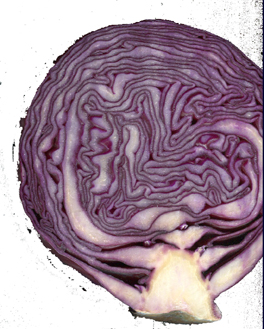
and working on it in Photoshop to desaturate, rotate and crop it.
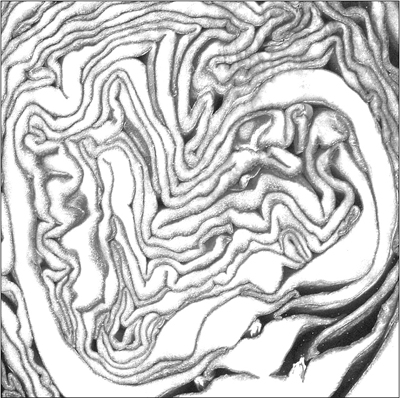
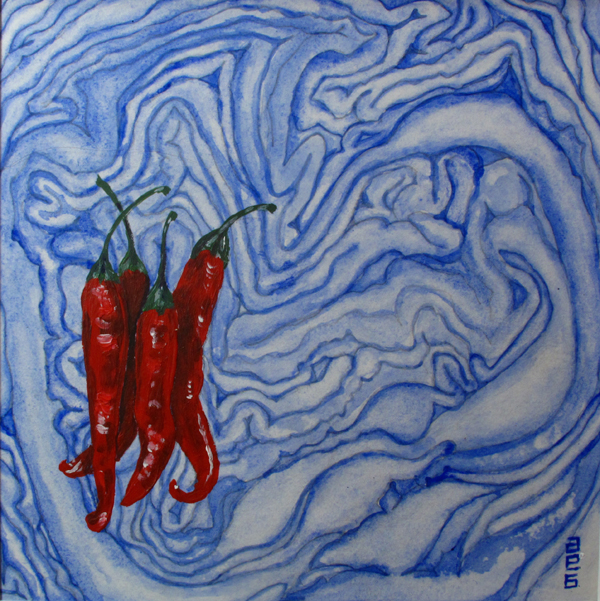
When I was happy with the composition I traced the image onto a sheet of Bockingford. Whilst carrying out this exercise I got to thinking where I wanted to take this, which meant discarding John Lowry (I never did finish that exercise). To get the effect I had in mind I chose a granulating colour – that was the sole reason for making the cabbage ultramarine. I blocked in one section at a time and then blotted the middle so the granulation would settle towards the dividing lines. When I had finished it looked boring so I added the chilli peppers on the basis that it was another vegetable but added the flash of colour that I wanted to improve the composition.
The Red Queen was inspired by something completely different. My daughter asked if I would do a painting for a charity auction to raise funds for the Crantock Surf Life Saving Club – it was jubilee year and the painting had to have the theme “Queen”. At the same time I was inspired by an article in The Artist magazine by Jean Haines and, not wanting to be conventional, came up with the queen bee idea. So lots and lots of water – probably it would have been better in watercolour, but I don’t do watercolour. I worked on mountboard which I had primed with plenty of gesso – this made a finish that the fluid paint flowed over very freely. I liked the idea of contrasting this loose background with the careful painting of the bee. If I want to get accurate reference material (as for the bee) I use Google images quite a lot, but only as a guide so I cannot be guilty of copyright infringement. I don’t know what the picture fetched at auction, but I do know it sold!
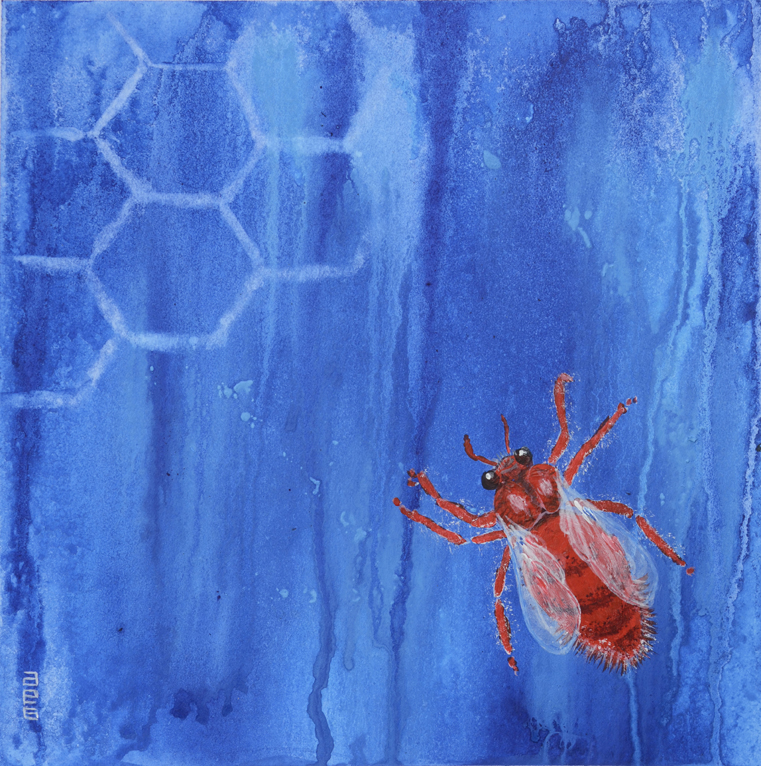
“Red Queen” acrylic painting by Anthea Bareham
I am not particularly pleased with this third picture but will talk about it because of the inspiration and the way I sourced the material; I intend having another go at it one day. Having had the idea of a “Queen theme” I decided to do a series of queens for the Art Society’s summer exhibition last year; but I wanted them all to be different. I had already done the bee, other ideas were Queen of Hearts (based on the playing card), Diamond Queen (based on the classic painting of Ann Boleyn – my first attempt at cubism) and Queensway. I wanted to include a street scene because I had been inspired by the work of Hashim Akib. At the ‘All About Art’ event in Bristol last year our art society arranged a coach party; I had never been before but friends raved about it. I looked up all the participating artists on the web before the event and that’s how I found Hashim Akib – I ended up buying his DVD and book before even going to Bristol and I spent most of my time there watching his demos. So I had two forces driving me – one to do something in his style and the other to bring in the queen theme. I settled on Queensway, the London street, and then, having no reference material, utilised Google’s street scene facility. It is really good, you can work your way down the street, you can look to left and right and behind you until you find a colourful view; that’s what I did. Trouble is, I find it really difficult to loosen up and when I have another look at Akib’s work I am reminded that I just haven’t got it – far, far too much detail.
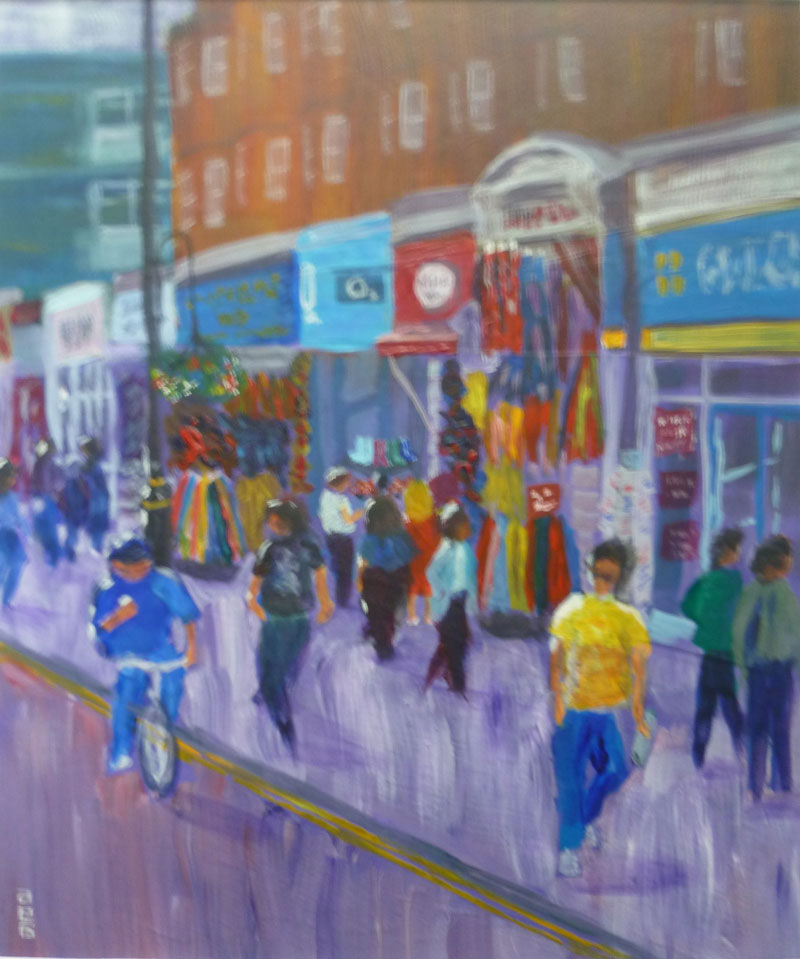
“Queensway” acrylic painting by Anthea Bareham
He uses System 3 heavy body and Jackson’s have just had this on special offer – I bought about 10 tubes. Other manufacturers describe their ‘buttery’ acrylic ranges as ‘heavy body’ but the System 3 range is something else, it’s as if it already has relief paste mixed in. I have only just got the new paints but can’t wait to try them and am determined to cut the detail and loosen up.
Jacksons: What drives you to make work? (what is your inspiration, what interests you, how do you get started?)
Anthea: I can get inspired by almost anything – just looking around can give you an idea, but it has to be said that membership of Axminster Art Society has had a huge influence. We hold lots of events but the key ones are the monthly demonstration meetings and the follow-on workshops. Our tutors are professionals and our (superb!) programme secretaries get together a varied programme covering all media, all topics, all styles and a surprise or two. I rarely miss a demonstration and find I am inspired by all the artists, even when I approach a meeting believing it is “not for me”. Then, of course, when you get home you want to have a go. The joy of working in acrylics is that you can, to some extent, apply the techniques of oil or watercolour, so no demonstration is without value.
The Society holds several exhibitions during the year and, as I am on the committee, I always feel a duty to put work in – so that is a strong driving force. Our main exhibition is in summer when we have our own marquee at the Axe Vale Festival. This is a huge event over two days, not as big as the Devon Show, but along similar lines. We get about 2,000 people through our tent every year and lots of positive feedback. In the autumn we have a themed exhibition; last year the theme was “Summer 2012” We had pictures covering Jubilee, Olympics and – of course – the weather. I did a copy of Renoir’s Les Parapluies only I put all the familiar characters in modern dress (scooter instead of hoop, crash helmet instead of bonnet, earphones instead of ear warmers, and so on) and kept all the umbrellas navy except one which was red, white and blue. I haven’t shown it because I am not very pleased with it – it sounds better than it looks! Our theme for 2013 is “At Home”; I don’t have any ideas for that yet – the Red Queen would have suited it, but I’ve already done that. I like having a theme; a few years ago our President set a challenge to paint something that would fit the title “Above and Below” – it inspired me to do this picture of flamingos which I just called “Legs”.
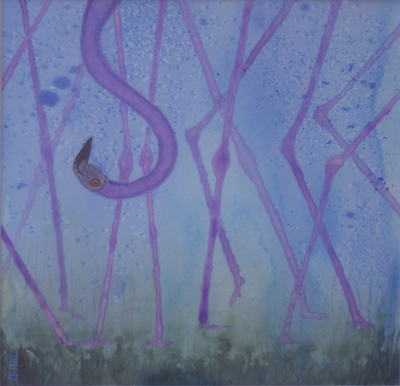
“Legs” acrylic painting by Anthea Bareham
I generally take a small camera with me if I am going anywhere and take shots specifically for reference. Other sources of inspiration come from books and from the internet. On one occasion I clicked the link from a Jacksons Newsletter to a You Tube clip – if you’ve ever tried that you know that one thing leads to another as you see a more interesting clip in the side bar, follow that through, and so on. That is how I found Mix Lang; he works big and has an amazing blending technique. It was his work, along with some photographs I had taken, that led to this picture of Hay Tor, which is on Dartmoor. There are always lots of tourists at Hay Tor but I don’t know why everyone raves about it so much; yes, it is big, but oh so grey! So I changed the colours.
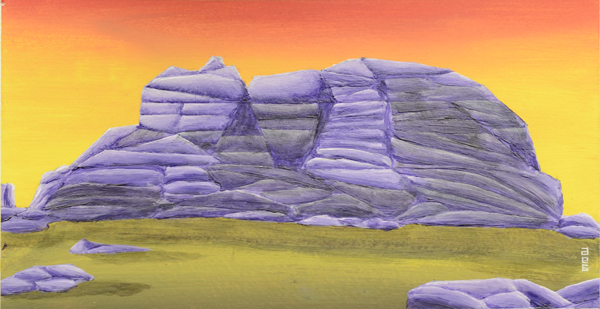
“Hay Tor” acrylic painting by Anthea Bareham
Jacksons: Do you have any art advice you would like to share?
Anthea: That would be very presumptious of me! Just a thought, rather than advice. Never forget that art is very, very subjective. I quite often disagree with a judge or the public’s vote. If I wanted to please the world and sell lots of pictures I would have to do completely different stuff, but I really just want to do what I enjoy doing. If your style is not run-of-the-mill just accept it and carry on having fun!
Jacksons: What is your favourite art material?
Anthea: I suppose I should be more adventurous, but I only use acrylic. Trouble with moving away from acrylics is that I have accumulated quite a wide range of them – inks, fluid, “buttery” and, most recently, heavy duty – along with a fair range of media, and it is quite an investment. It also takes up a lot of room and I don’t have the luxury of a studio. I do experiment by using different media though. One of the books that has inspired me is Rheni Tauchid’s “The New Acrylics”; wonderful photography and very helpful text. It makes you seek a reason to incorporate in your work the techniques that are described.
Jacksons: What is coming up next/your plans?
Anthea: I have just had this idea about a painting of green bottles. Didn’t I say inspiration could come from just about anywhere? We have had a run on elderflower cordial this hot weather – gloriously rich coloured bottles, just asking to be painted. My first thought was lots of overlaying and glazing (I am not good at glazing and would like to get better) but now, on re-reading the Tauchid book, I have decided on another approach. I was interested in an article in which she describes how to create a sheet of acrylic with self levelling gel which could then be cut into shapes – bottles and shards in my case. I have already started to play and these photographs show my efforts at creating the sheet – it was easier than I thought. The book says to spread the self levelling gel on a surface to which the paint would not stick. I wasn’t confident that I had such a surface so stretched cling film over a saucer, really tightly so there were no wrinkles, thinking that if I couldn’t peel it off I would stick the whole thing on my canvas, cling film and all.
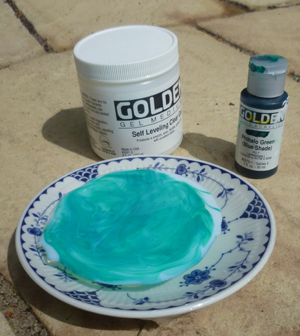
In the event it was very easy to peel off.
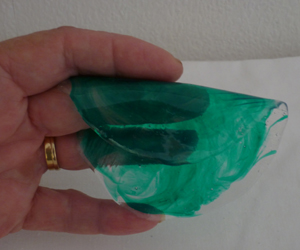
For this mini experiment I poured the gel on first, then swirled the colour through it. When I do it for real I will mix the colour in well, then pour, then swirl more of the same colour through it, so that it is not so much green and white (the white dries completely clear) but rather green and darker green. The book says to let the mixture settle before using it to avoid bubbles, but I propose giving it a good whisk as I think a few bubbles might look quite interesting. I clearly need to plan this one carefully and have started by cutting out and arranging bottle shapes; I tried doing this in Photoshop but found good old fashioned hands-on quicker and easier.
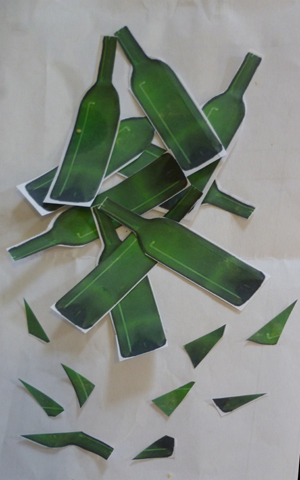
My plan is to paint a fairly plain wall first and then place the acrylic shapes on it – they can be stuck on with gel. I like thinking up titles – this one will be “Off the Wall”.
I always plan to (and sometimes actually do!) go back to some of my unfinished projects, or those I want to improve. We had a workshop, following a demonstration, where we made a collage of random shapes cut from magazines and fitted them into a still life that had been set up (here is a picture of the demonstration).
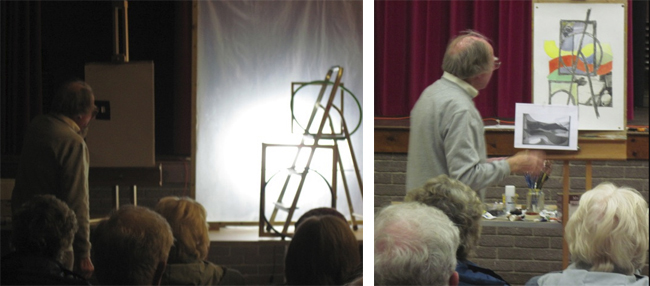
Knowing roughly what was going to happen I got prepared for the follow up workshop by downloading lots of images of internal body parts – sounds gruesome but they make great patterns; I desaturated them with the intention of tinting them, but didn’t have enough time at the workshop to finish it.
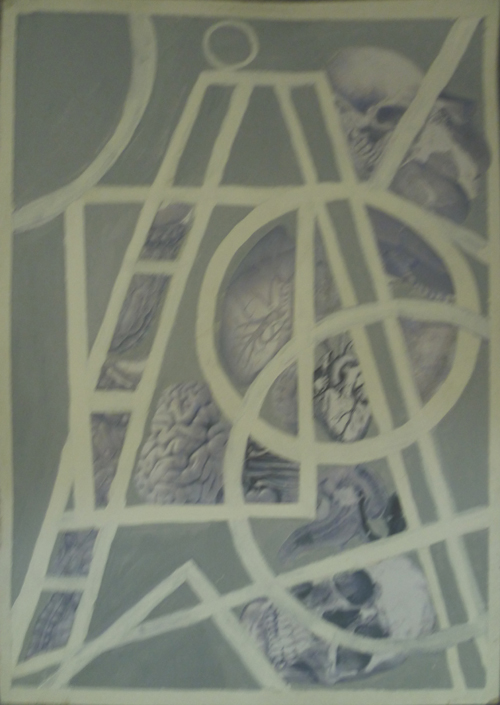
I would like to go back to it one day – probably changing the layout; if it ever gets finished I shall call it “Inside Out”.
Thank you for letting me talk to you – it has focussed my thoughts and I have really enjoyed it!
I am responsible for the Axminster Art Society’s website – I don’t have one of my own, keeping this one up to date takes a fair slab of my time, but I do enjoy doing it.
All images are copyright of the artist