When we were informed that Patsy Whiting was recently awarded the Jackson’s Visitor’s Choice Award for her work ‘Rose and Wrench’ at the Society of Women Artists 152nd Annual Exhibition at the Mall Galleries, we were all thrilled, as her work is stunning.

Patsy Whiting – Rose and Wrench – 47 x 67 cm – Coloured pencil
Whiting’s portraits and still lives are drawn in coloured pencil on a roughly textured pastel ground. The image is built up gradually in layers from detailed photographs, focussing on a small area at a time. It is the play of light which fascinates and challenges the artist. Patsy loves the process of taking away the black to make a form appear out of the shadow.
Patsy Whiting was born in Bolton in 1950. She graduated from Loughborough with a degree in Fine Art in 1971. After a period of working as an artist, exhibiting in Bolton and Manchester, whilst bringing up a family, she began a career in teaching. Teaching art eventually led, through specialist training and a further MSc degree; to an Educational Audiology post in Bolton Sensory Service, working with deaf children aged 3-18.
Patsy continued to produce art throughout her career in deaf education, working in a variety of media, including print, sculpture and painting. During the course of her teaching she developed skills in visual presentation and digital animation which became her key expressive medium. However, a visit to the Picasso museum in Paris a few years ago inspired her to begin drawing again in earnest and to leave teaching. She now has a studio in Sutton Bonington, Leicestershire.
Jackson’s: How would you describe your artwork to someone who has never seen it before?
Patsy Whiting: Do you know I really cannot answer this question very well at all!! Maybe that’s why I needed a picture. Recent work depicts moody, dark, still life, roses in jugs or juxtaposed with tools, in a realistic style. Earlier work drew inspiration from the female figure, often reclining, nearly always alone in a shadowy interior. The work is created using soft coloured pencil on black pastel paper and though technically a drawing, looks like a painting.
Jackson’s: How do you select the subject matter that you draw?
Patsy Whiting: Chance encounters with ordinary things give me ideas but no doubt there are influences from my past, such as working in my dad’s garage as a teenager, that have driven the choice of subject. I cannot get enough of roses at the moment, the sculptural quality of the form, how each petal seems unique and the ragged, crumpling edges as they decay. I like to contrast them with battered, mechanical or man-made forms, glinting metal versus velvety petal. At the moment I am looking out for a carburetor to include though it may be difficult to find now regular cars have fuel injection systems.
Jackson’s: How did you discover your chosen medium? How key is experimentation on your art studio?
Patsy Whiting: I took my first cue from John Russell’s description of Seurat’s drawing technique which I remembered reading as a student. I was fascinated by his gorgeous treatment of form. Russell (1965) describes it as “drawing in which line (in Ingres’ sense) plays almost no part and the thick-grained paper is rubbed with a soft, fatty Conte crayon in such a way that the artist has at his disposal a gamut ranging from the most brilliant and velvety blacks to a white that is, as Leibniz would say, ‘furiously’ white.” I loved the way Seurat made form emerge on the paper so convincingly, with such beauty. His mastery of value was absolute. I experimented trying to emulate his technique using various kinds of soft crayon on rough papers, with a concentration on achieving a wide tonal range.
Jackson’s: What do you like best about working with coloured pencil on pastel paper?
Patsy Whiting: Those moments when a form suddenly appears to gain substance and become real. It may be something very faint in the distance or the addition of a highlight in exactly the right spot.
Jackson’s: What are your favourite brands of art materials and why?
Patsy Whiting: Without doubt my favourite materials are Caran D’Ache Luminance pencils and deep black Colourfix pastel paper. The Luminance pencils are very soft, blend perfectly and cling well to the paper surface, which is matte black providing depth and rich contrast to the brightness of the pencils. They are luring me into a more colourful phase.
Jackson’s: What is the difference between a good day in the studio and a bad day in the studio? Can you ever turn a bad day into a good day and how?
Patsy Whiting: Just being able to work is good though things go wrong all the time and it is necessary to start again or redo sections. Going for the challenge even if I fail makes a good day. It is a bad day when something prevents me working unless of course it is a holiday!
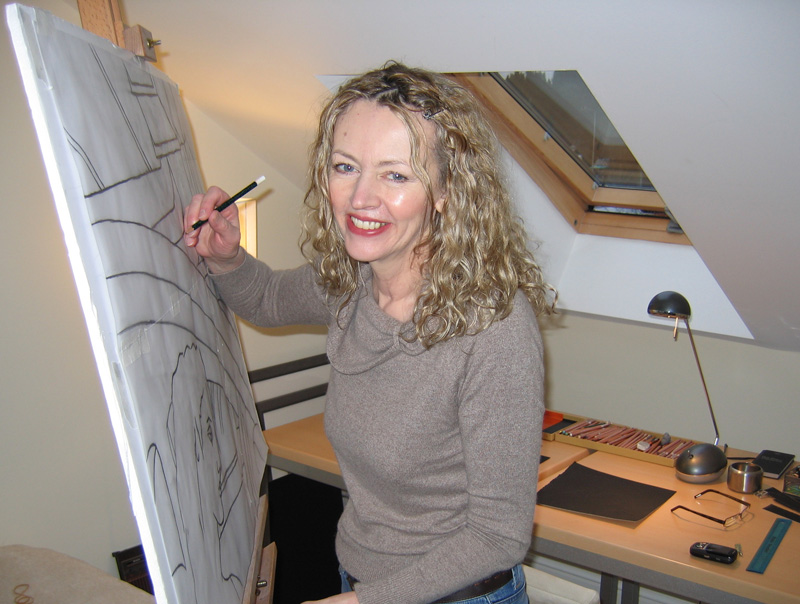
Patsy Whiting in her studio
Patsy Whiting’s website
The Society of Women Artists
All images are copyright of the artist.