



Most brands of watercolour paint come in a choice of two formats: dried pans or moist tubes. Watercolour painters often ask how to choose which to use – what are the benefits of using watercolour in pans versus in tubes. To help you decide which will work better with how you paint, here are the advantages and disadvantages you can expect from each format.
Sizes – Pans
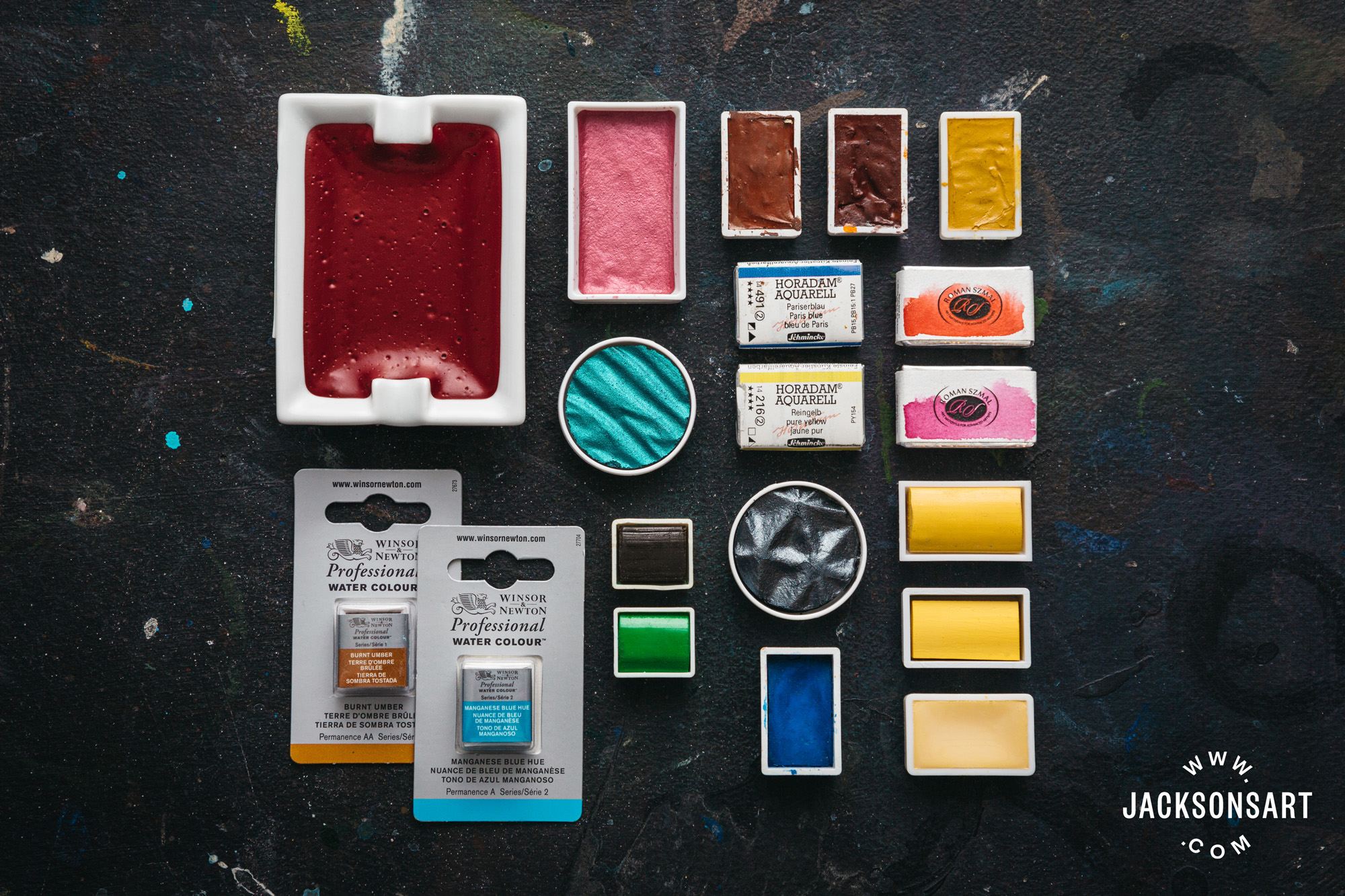
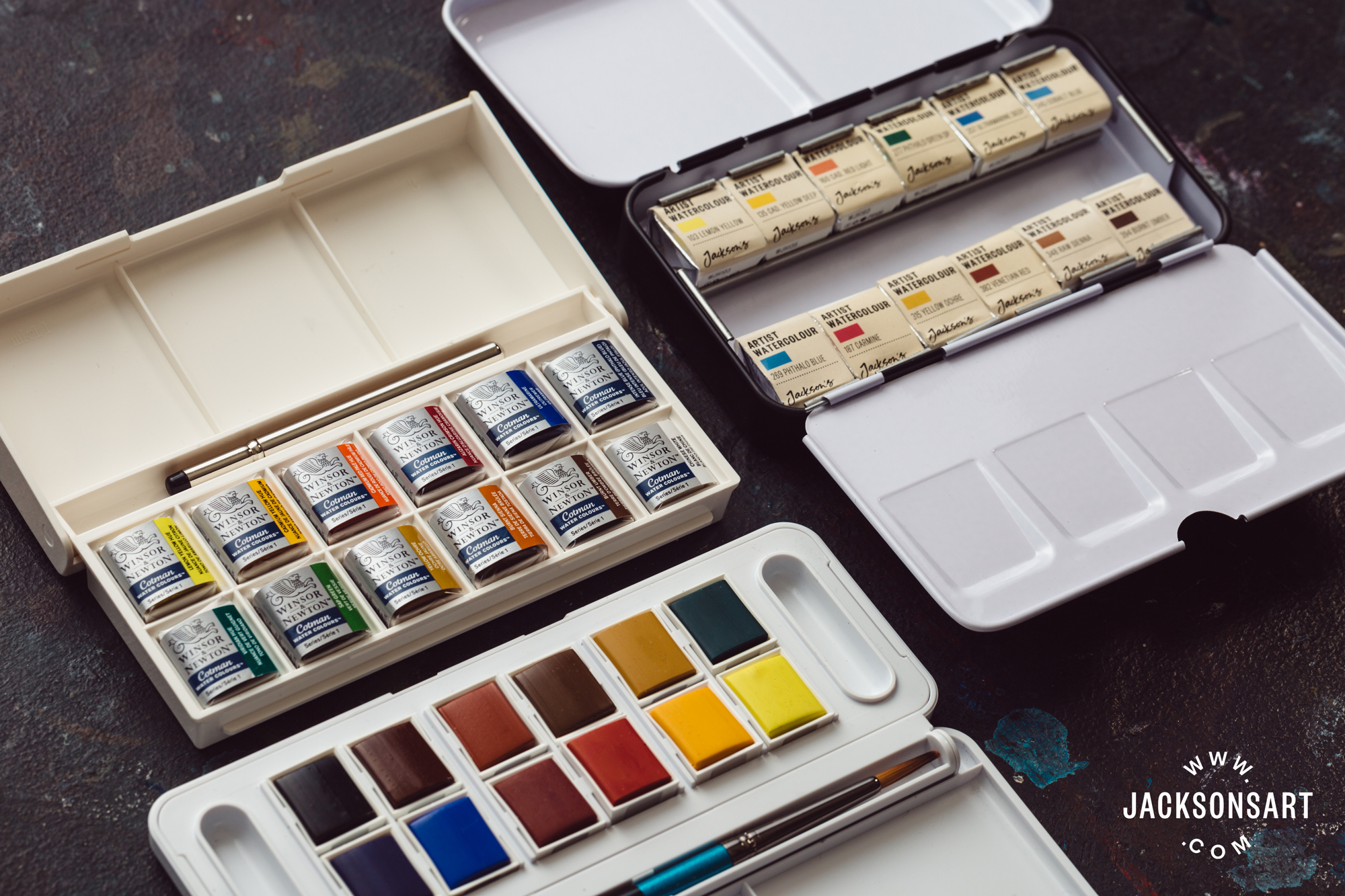
Watercolour pans come in two rectangular sizes: a full pan and a half pan. (A full pan is sometimes called a whole pan.) Across brands the sizes of pans are nearly the same standard size but not quite. So that’s why many watercolour boxes have bendable compartments that allow for slight adjustments to hold the pans. Travel watercolour boxes that do not have adjustable compartments will not work with all brands of pans because even a part of a millimetre difference means that they won’t fit in the slot. In the Holbein half pan sets the plastic pans come with a magnet on the bottom of each pan to hold it in place in the box.

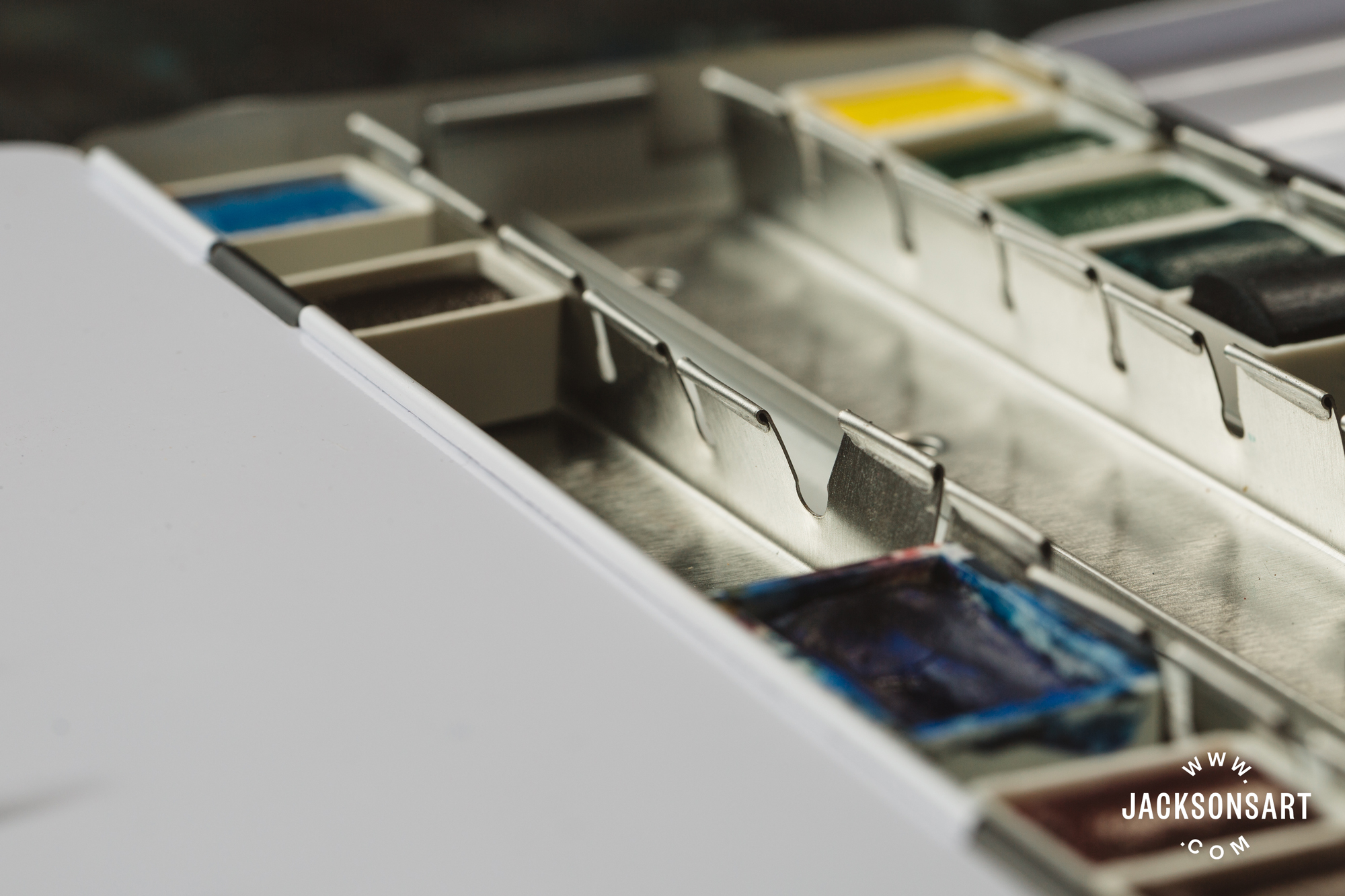

A few brands do other sizes than the two common ones: Blockx do a Giant Pan (a generous 3.5 by 2.5 inches), Gansai Tambi are much larger than standard and Coliro do two sizes of round pans. Daler-Rowney does a delightful miniature set of 1/4 pans. To refill it you purchase extruded half pans and gently cut them in half with a craft knife.
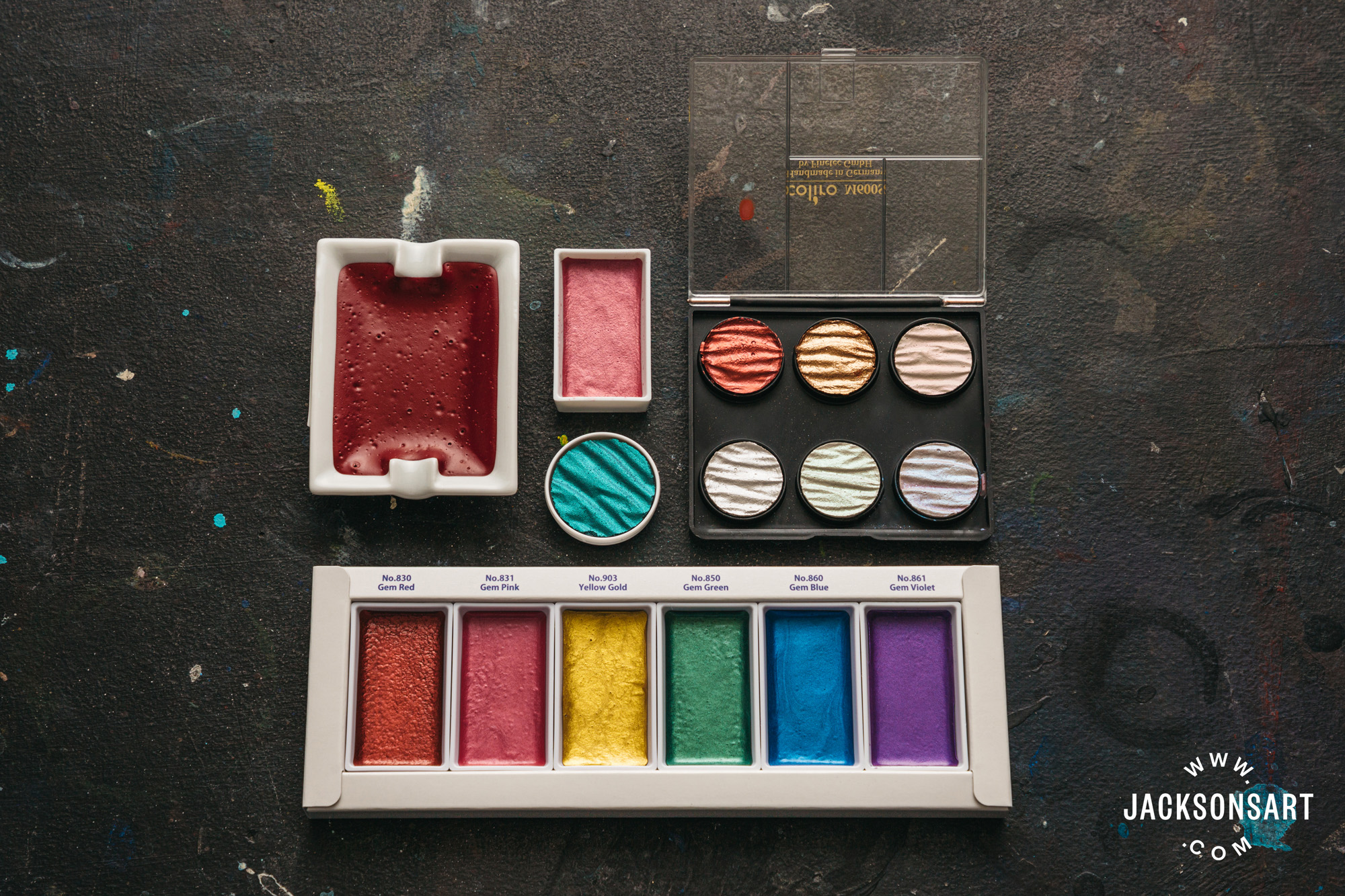
Pans also vary in their formula and method of manufacture. Some pans are extruded like dough, cut into cubes, let dry, and then placed into pans as a hard cake. These can often be seen sticking up above the rim of the pan.
Those that are poured also vary. Some are poured once and allowed to shrink so the pan is only partially full. Other brands top up the pour a second or third time for a fuller pan. And of course the actual formula of the paint differs. Some paints have added honey, some contain different amounts of gum arabic, and some contain wetting/flow agents. Those with honey are not as soft because they are extruded, while the poured honey paints can be only semi-hard. These differences in formula are more readily visible in a pan than a tube, as a shiny/matt, sticky/smooth, or soft/hard surface.
Sizes – Tubes
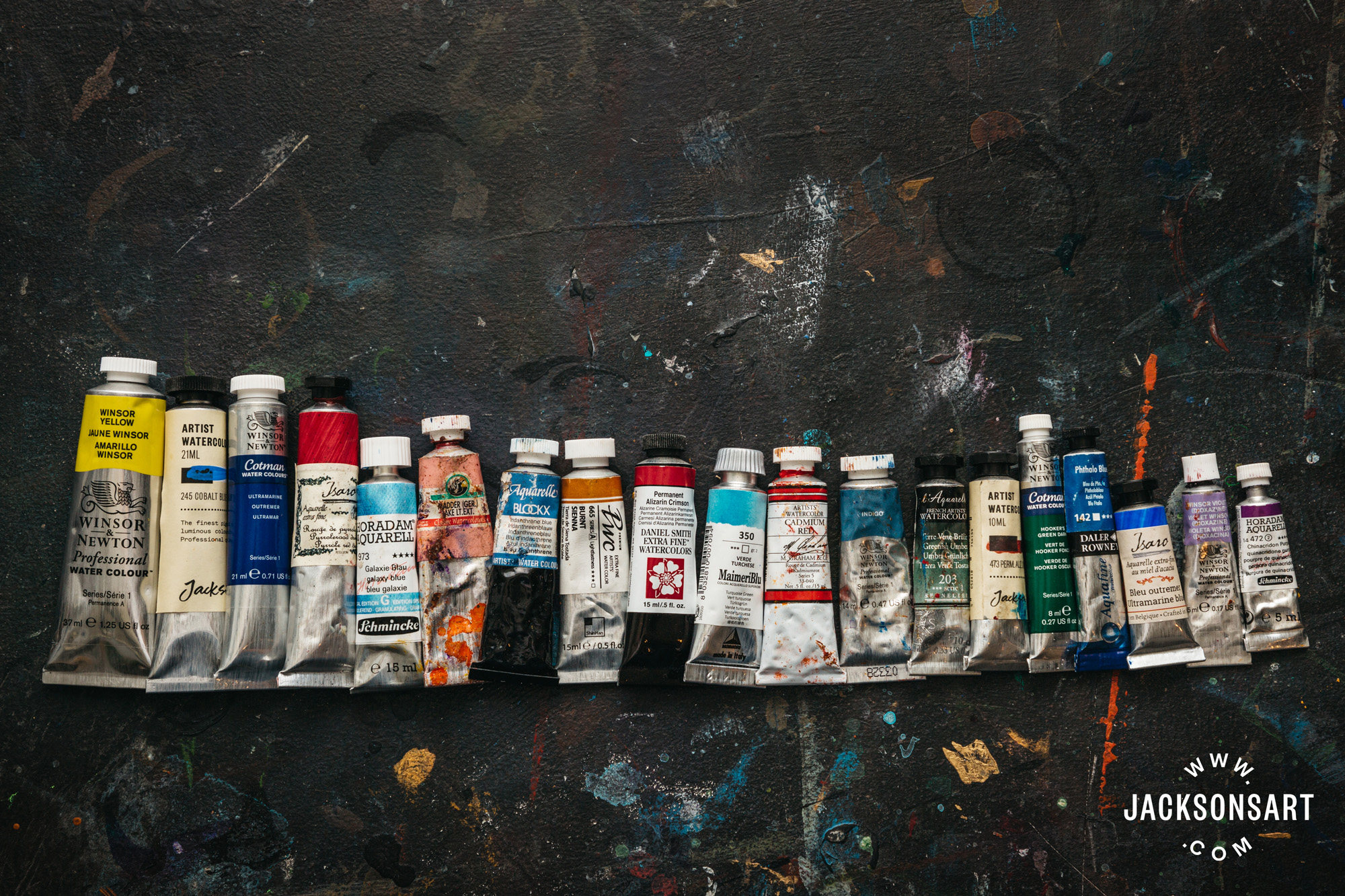
Most brands of watercolour make two sizes of tubes, their small and their large. The most common sizes are 5 ml, 10 ml, 14 ml, 15 ml, or 21 ml. In addition to their two regular sizes, Winsor & Newton also do a very large 37 ml tube. Some of the brands that only do one size of tube often do it in an unusual size such as 7 ml, 9 ml, 11 ml and 24 ml.
Occasionally you may find a favourite paint and not have a choice of format. There are some brands that are only available in one format – some that only come in tubes and some that only come in pans.

Comparing the Benefits of Watercolour Paint in Pans Versus Tubes
*Note: One of the main reasons people buy tubes is as bulk refills for their pans. If you do this and let the paint dry, then you have changed your moist tubes into hard pans. So the characteristics on this list that apply to pans will also apply to your home-filled pans as they are no longer moist tube paints.
Convenience – Portability and Speed of Set-up
Pans are more convenient and so are the usual choice for portable paint boxes. Opening and squeezing out all the tubes each time you paint is not as convenient. You can also get more colours in a smaller space with half pans than with tubes, which means a lighter, smaller box. Some tube colours do not completely dry on the palette so if you are travelling and you have used tubes, your palette can remain sticky or even wet so all the colours may mix or spill, especially in hot weather.
Air Travel
When travelling tubes can be a problem on an aeroplane. The unpressurised hold can cause the paints to expand in the tube and they may spurt out excessively when opened later.
Convenience – Faster Wetting
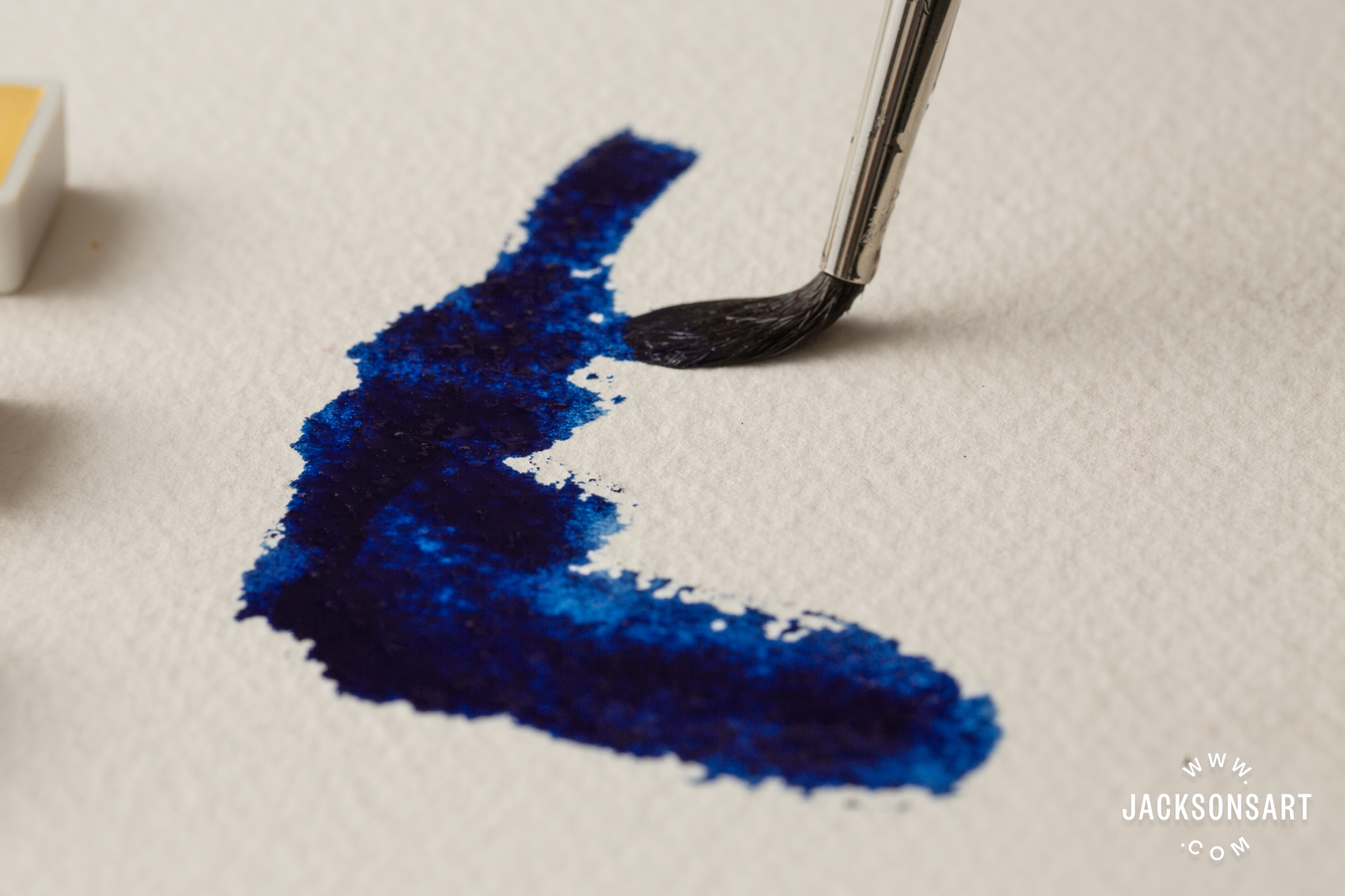
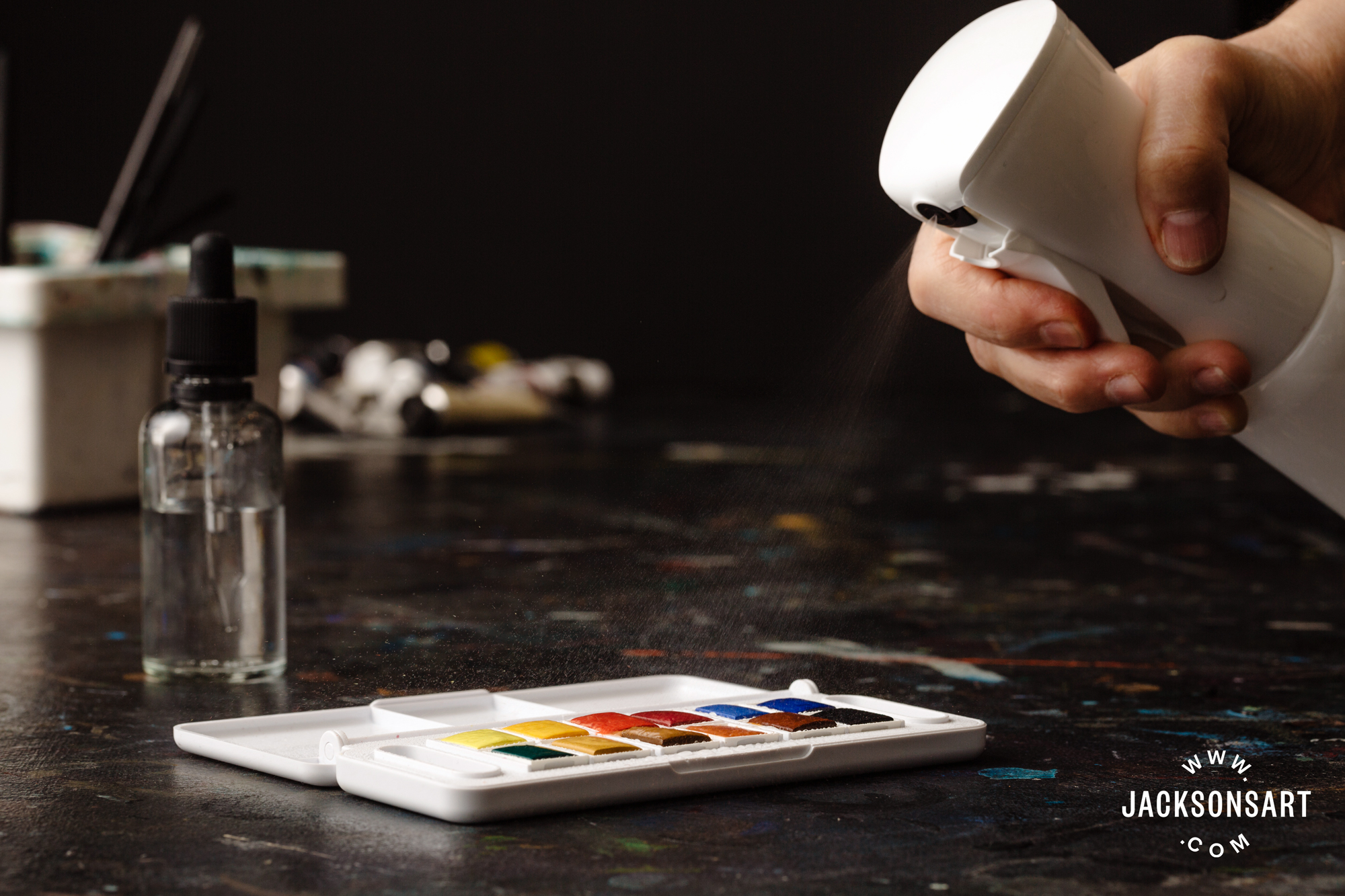
Tubes are moist paint so they are already soft. Because pans are dried hard, they usually take longer for the paint to soften with water. You can alleviate this somewhat by spraying water over your palette five minutes before you begin painting to let them soak up some water to soften them up. You can also use an eye dropper or small plastic bottle that lets you squeeze a few drops on to pre-wet them. Also, some brands of pans are softer than others. Be aware that although some painters love the more moist pans, some find the semi-hard nature a problem both because they can be ‘sticky’ and it can mean that if the box is left on its side, then the paint very slowly responds to gravity and can sag into the next colour.
Customise Your Palettes or Your Pans
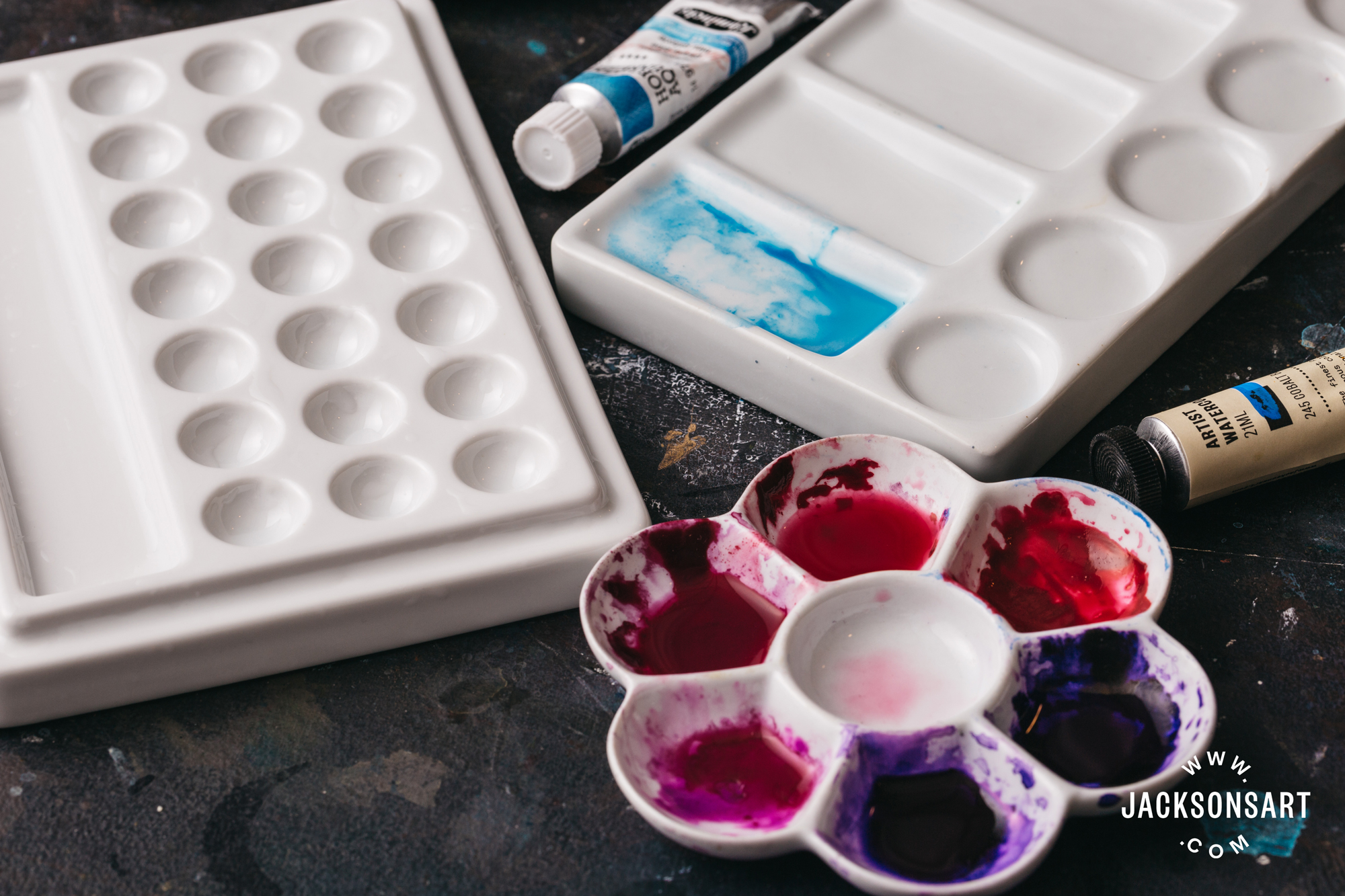
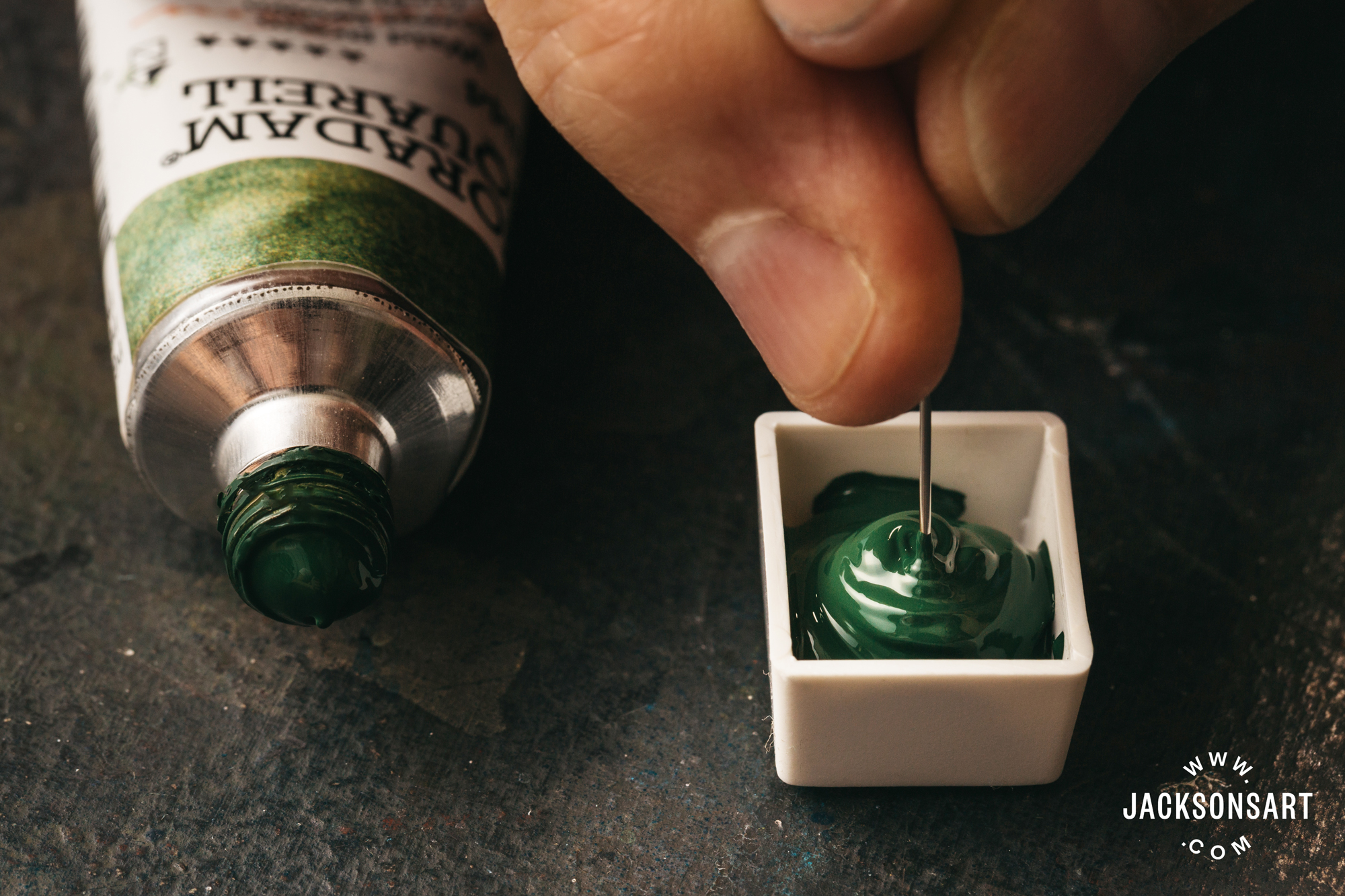
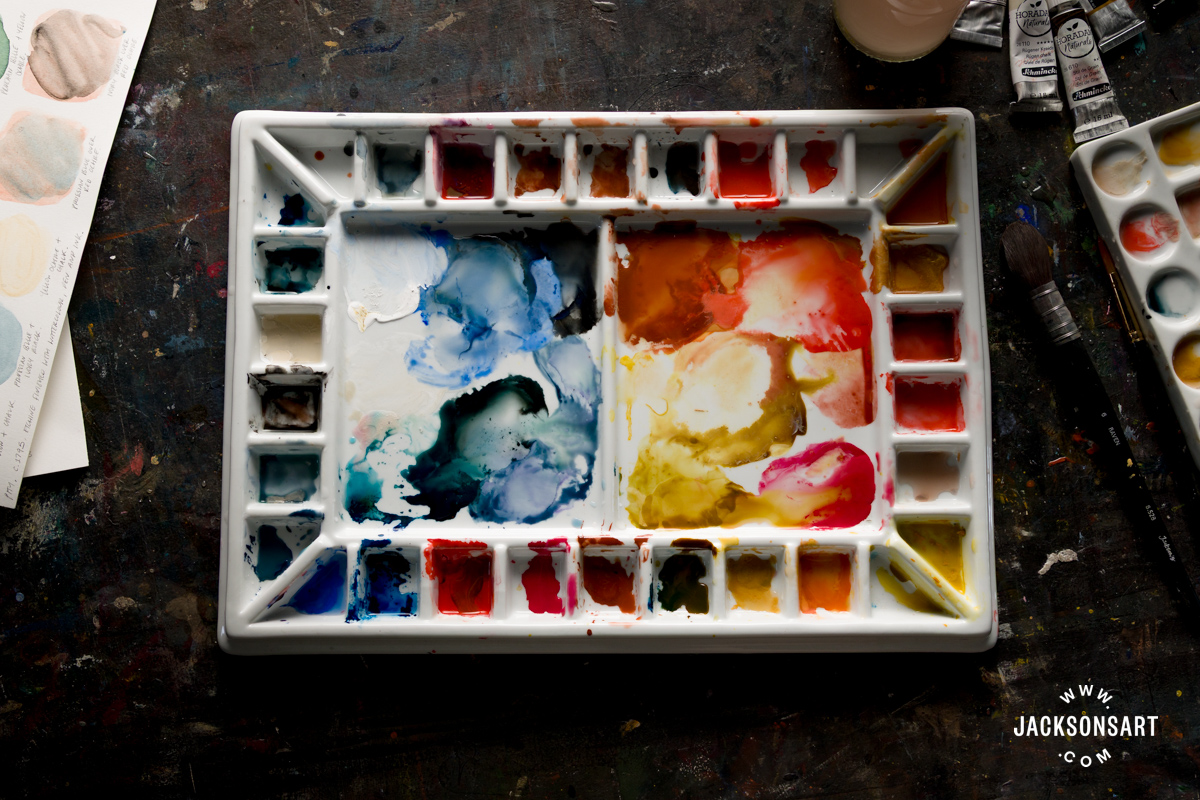
You can squeeze paint into a wide variety of ceramic palettes, or special travel boxes if you want something other than half or full pans. If you want a special mix, you can fill an empty pan from two tubes and stir it with a toothpick or pin. And if you like your pans only half-filled so that there is room for water and a brush without overflowing, you can fill them only half way.
To fill a pan from a tube: squeeze paint around the inside bottom edge of the pan and then into the centre, tap the pan on the table to settle the first layer, repeat for a second layer. Then stir in a circle around the pan with a pin for a minute to get rid of gaps and bubbles and evenly distribute the paint. Let the pan dry for one to two days. It will shrink by up to 50%, which is how some poured pans come anyway. Extruded pans can come partially or very full.

Large Paintings, Large Areas of Paint, and Large Brushes
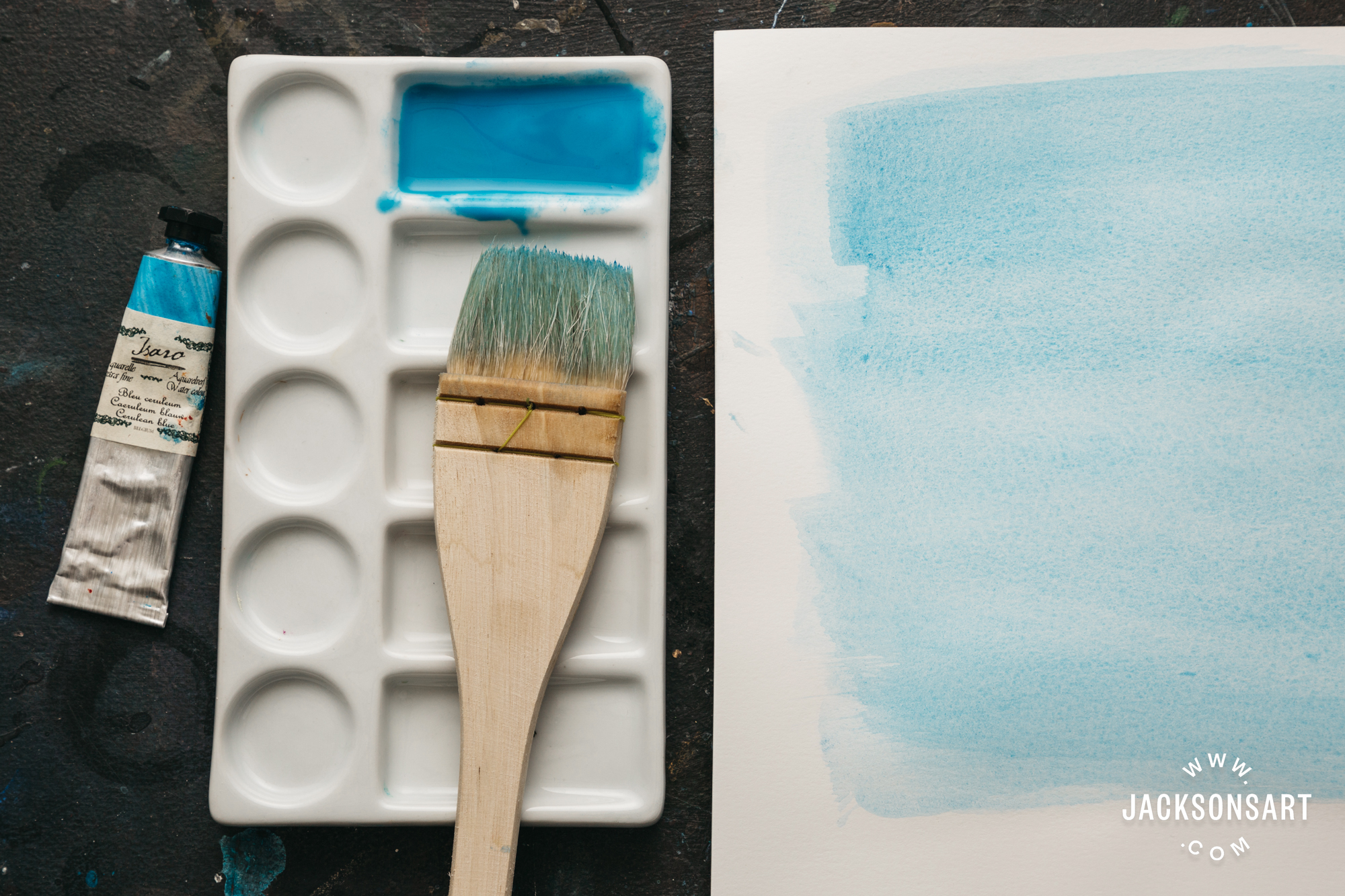
Anything A3 or larger can be considered a large watercolour painting. With tubes you can mix up a large amount of colour on a palette quickly, dip into it with a large brush and paint large areas quickly. If you squeeze more paint into your palette wells than you ended up using, you haven’t necessarily wasted it, you can rewet it in the future, just like a pan. Half pans are so tiny that it is hard to get paint out with anything but a smaller brush.
Colour Identification
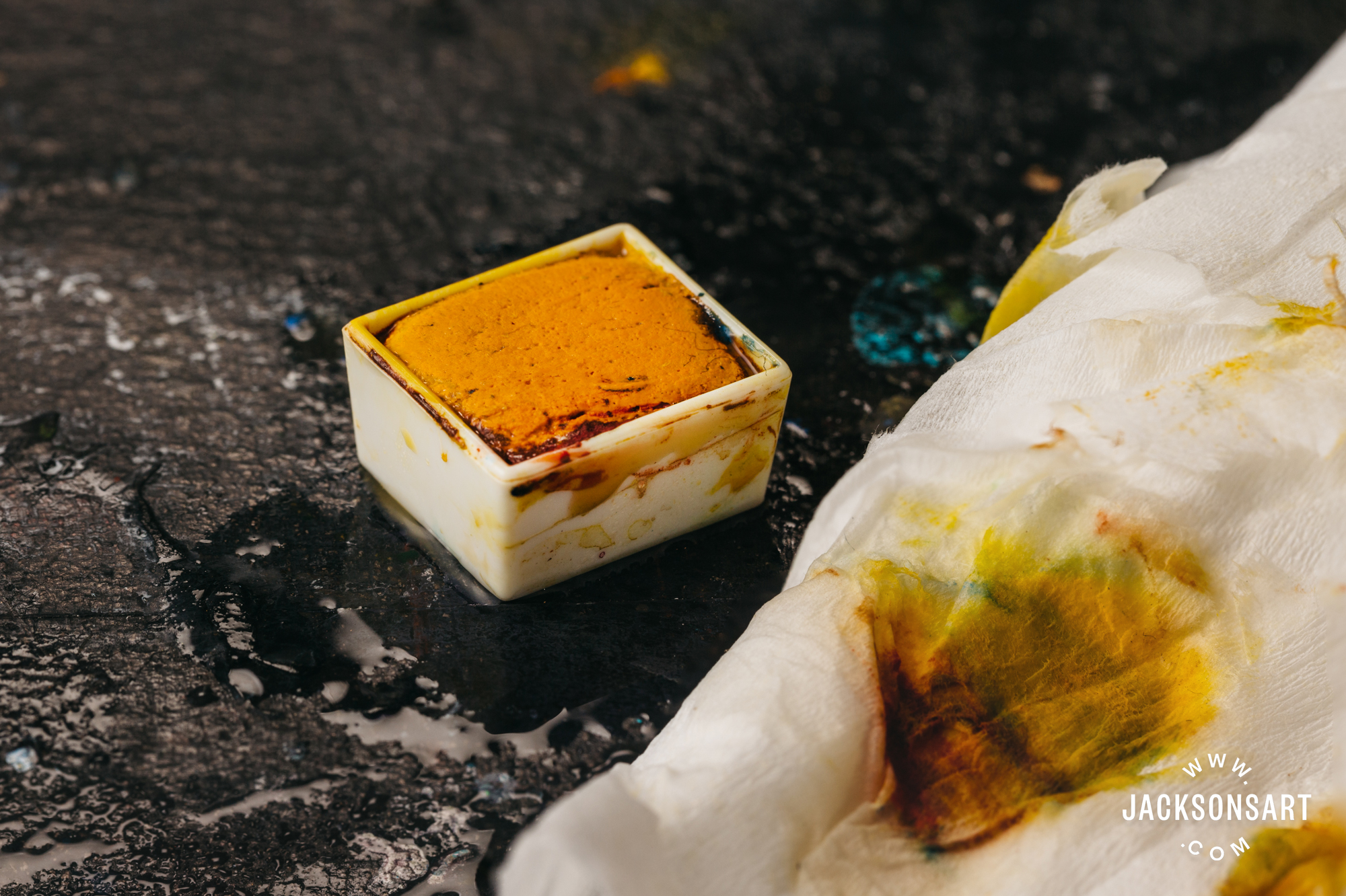
After you take the wrapper off of a pan of watercolour you may not be able to tell what it is anymore. Some brands have a number printed on the bottom or the brand logo, but most do not. Most dried colours are very dark because they are concentrated, transparent colour and even bright yellow can look like dark brown. So it is a good idea to arrange your pans in your box in an orderly way and not move them, so you know where the colours are – because the cool reds, violets, cool greens, transparent browns, and blues can all look like black in a pan. Unless you make a colour chart to refer to with brand and colour number, and use a Sharpie marker pen to write the number on the bottom of the pan, you may not even be able to replace the exact colour because you don’t know what brand or colour it was.
On the other hand, you always know what is in a tube, because the name remains on it.
Wear and Tear on Brushes
Using pans generally causes slightly more wear of watercolour brushes because you have to scrub a bit in the pan to pick the colour up. A well-known watercolourist prefers pans and says she accepts that she will go through a lot more brushes. If you like pans and know that you go through a lot of brushes you may wish to choose more economical brushes. Again, though, you can minimise this by wetting your colours and letting them soften before you start with your brush. I have found that some brands of tube colour dried on a palette can be quite hard to re-activate and in that situation, the dried tube colour will be the one that is harder on your brush.
Saving Money
Tubes are more economical than pans, and you can also think of a tube as a bulk refill for a pan. You can buy the extra large 24 ml or 37 ml tubes for even bigger savings. Because the tube paint contains water that will evaporate from the wet paint it will shrink in the pan and you will have to top it up a second time if you want to completely fill the pan. But I like a half-filled pan, it gives room for water and the brush to swirl. But not everyone wants to squeeze tubes into pans as you are losing the main benefit of the tube, that it is already wet and ready to go. So some painters don’t think of a tube as a pan refill, but as a moist form of watercolour and they use it from the tube on a palette.
But even though they cost less per volume of paint, somehow tubes don’t seem to last as long. Many painters have told me that their pan paints have lasted for years but they go through a tube really quickly. I have also experienced this and it can be quite surprising. It is easy to use a lot of paint from a tube but a bit harder to use a lot from a pan. And pans are more concentrated because some of the volume in a tube is water.
My rough estimation is that a 15 ml tube of Horadam will make about eight to ten half pans if you are using the tube as a refill. But the pans are not quite as full as those filled by Horadam because they top up their pans after the first shrinkage. See the ‘Customise’ paragraph above for a good way to fill your pans.
There is also a bit more wastage in several ways with tube paint than pan paint (see below). And in an effort to avoid wastage sometimes you can be stingy with the amount of paint you squeeze onto the palette, which may hold back your painting as you scrimp.
Another thing to consider when squeezing tube paint into a pan is that the formula for the paint in the pan and and the paint in the tube is different for some brands. For example, Winsor & Newton extrude the paint like clay for the pans and place it into the pan as a dried cube. (I was lucky enough to visit their factory in London before they moved their production, and got to see the process – it was fascinating.) They say that these two different formulas mean that their pans are easier to re-wet than the paint from their tubes after it has dried on the palette, because they’ve added wetting agents to help get the dried paint in the pan to activate. For other brands the paint is the same for both – for example, Schmincke fill their pans with the same paint as their tubes and it takes three cycles of filling and drying for a pan to become full. So, for some brands the dried tube paint is not supposed to revive as well as the ready-made pan paint does, though some people have done tests and found that any difference is not really noticeable.
Old Holland say that their paint in tubes and pans is the same, even though they extrude the paint for their pans, just that the pan paint has been left to dry and so the artist must re-hydrate the paint.
*Note: Fixed cost per unit
Small tubes (5 ml – 11 ml) are much more expensive per volume than large tubes (14 ml – 24 ml) and half pans are much more expensive per volume than full pans. In some paints the price for the small tube is almost the same as the large tube. This was explained to me as being caused by a fixed per unit cost – each item has to be handled multiple times (mixed, filled, labelled, packaged, inventoried, stored, shipped, marketed, etc.) and all those costs are the same per item whether it’s 5 ml or 15 ml.
Wastage
There will probably be some wastage in the lid and the threads of a tube, though you can wet it and scrub your brush over it to use it up a bit. Another small wastage is that it can be hard to get all of the paint out of a tube without cutting the tube open, whereas you can reach all of the paint in a pan.
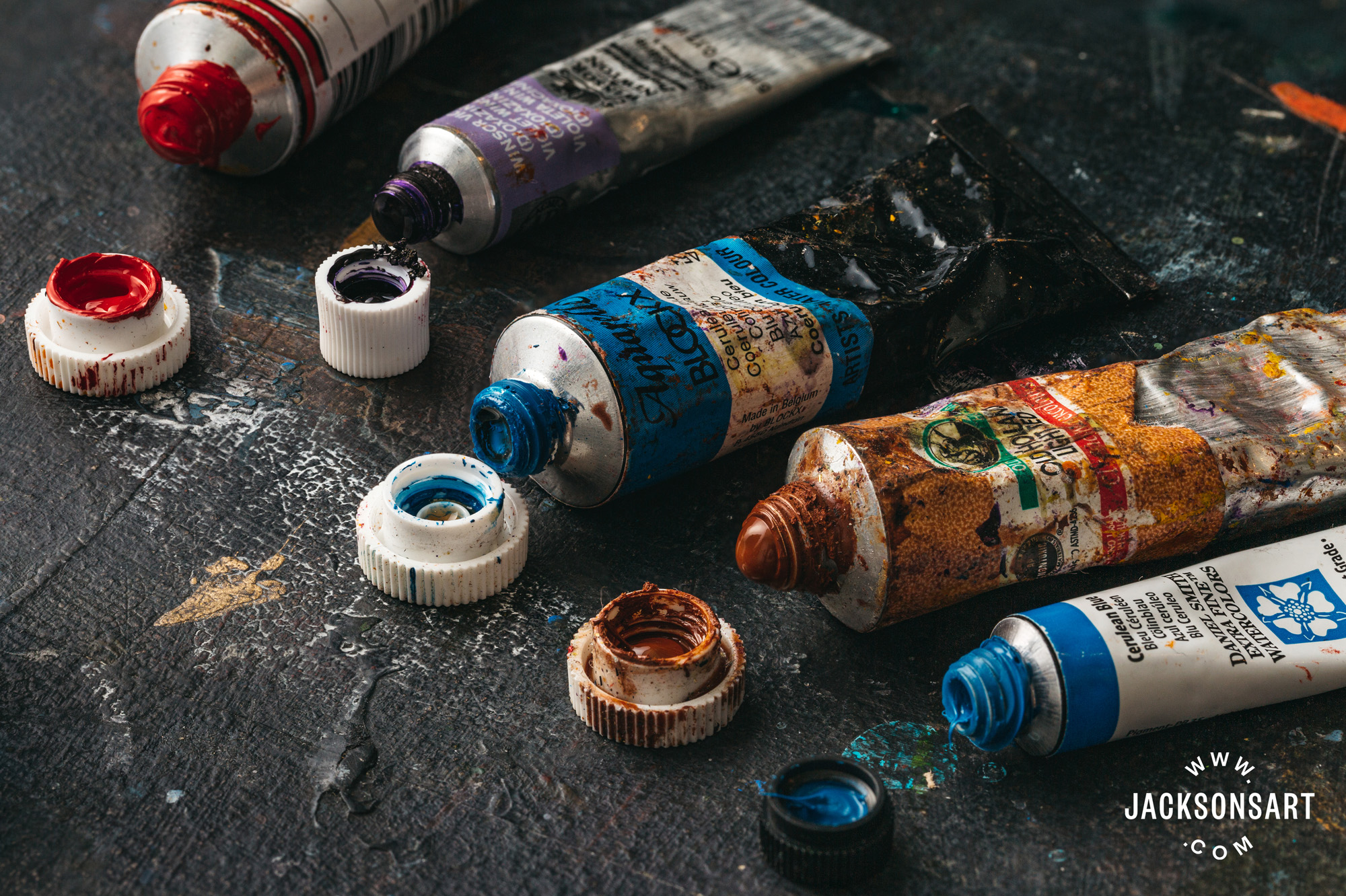
You may squeeze out more paint onto your palette than you will use, either intentionally or because tubes are often filled very full and when you unscrew the cap for the first time the paint acts like it is under pressure and a little or a lot can shoot out. You can help prevent this by holding your tube upright and tapping the folded end lightly against the table top to encourage the paint to go to the bottom and any air bubbles to go to the top. If you take off the lid and more paint squeezes out than you want, you can encourage it back inside by slightly squeezing the sizes while holding it upright and it will usually retreat enough to get the lid back on. If you can’t get it back inside, remember that the dried paint on your palette isn’t necessarily wasted if you can rewet it in the future. You can also just squeeze that excess into an empty pan to use later.
Tubes Can Dry Up
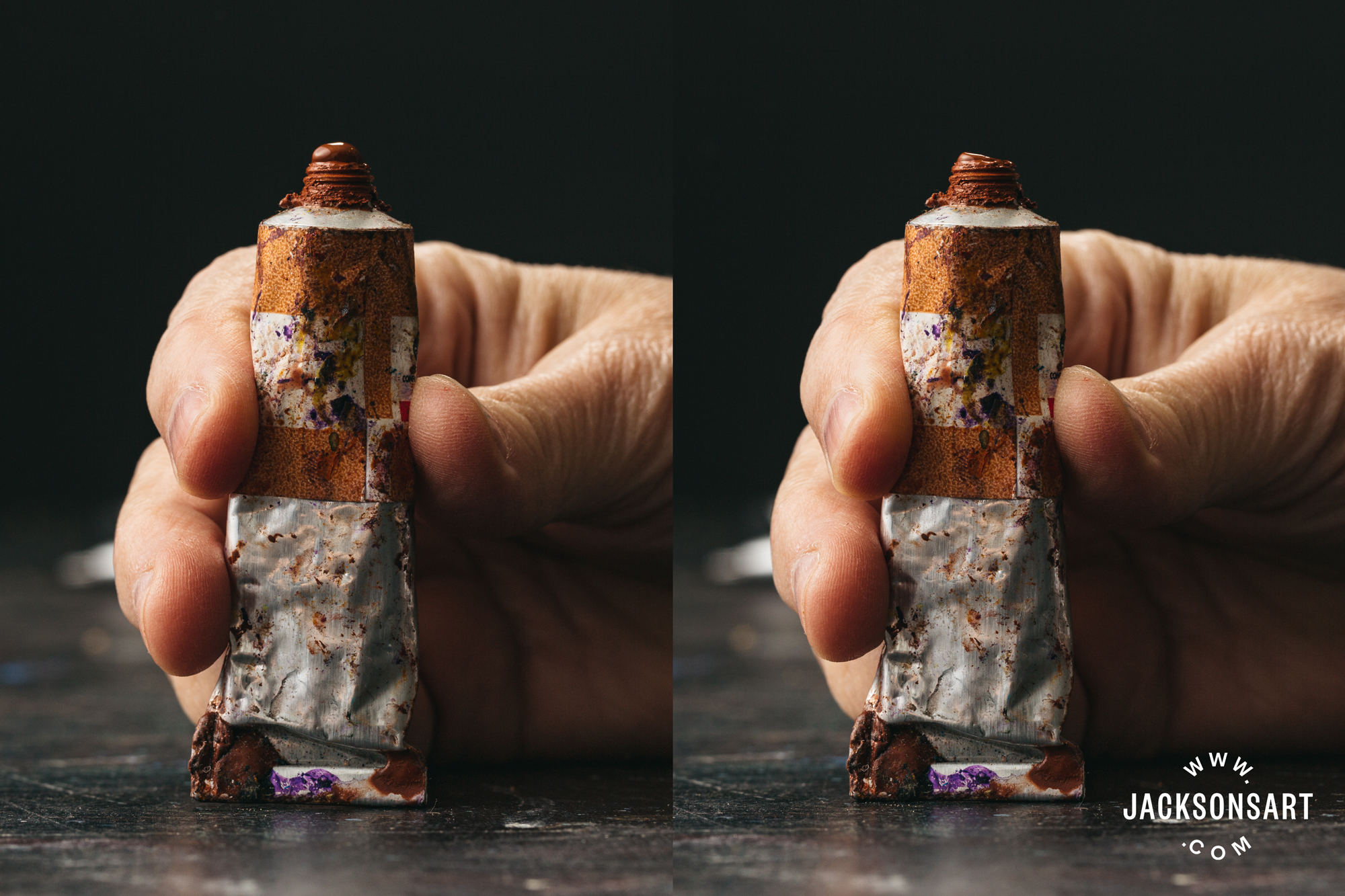
It is not uncommon for tubes of watercolour to dry out, especially if they are more than a few years old or it is a little tube. Some painters find this a huge drawback to using tubes.
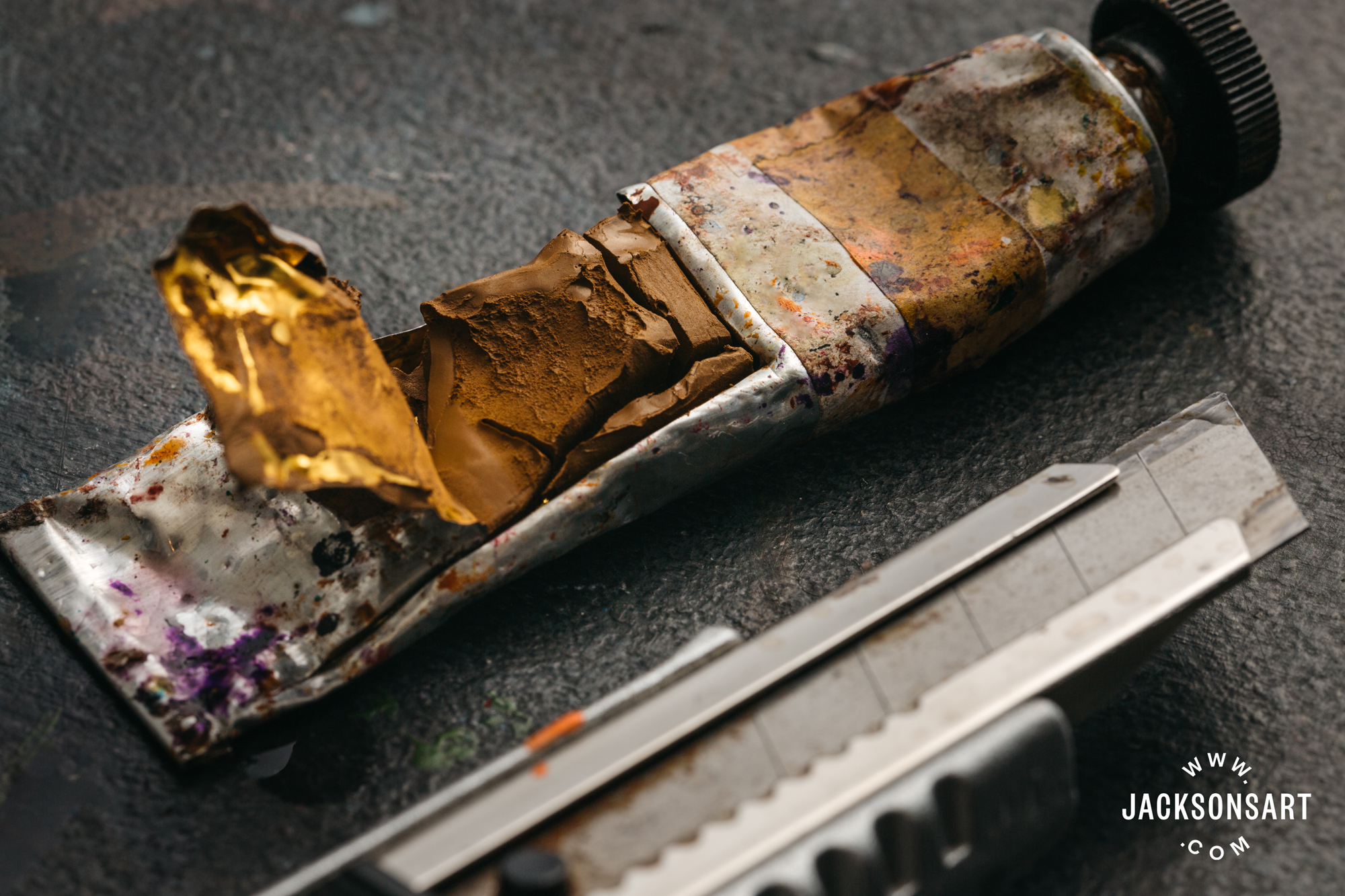
If a tube of paint dries up and you can’t get any out, you can quite easily slice open the side of the soft metal tube and peel it open. Then just use it like it were a dried pan. But you can’t make the paint moist in the tube again.
Paint Separation
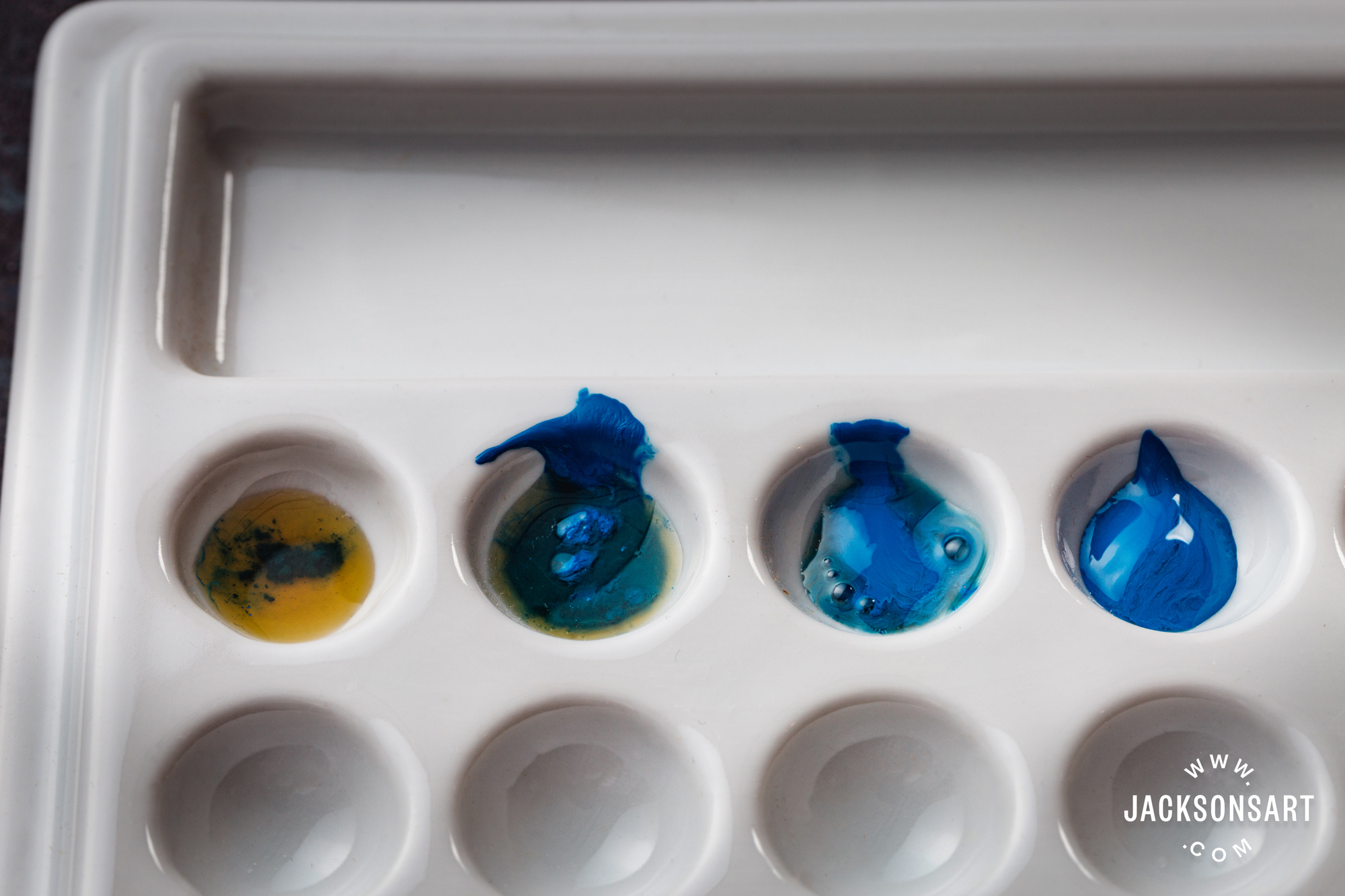
Sometimes when you open a new tube you can squeeze out far more than you needed just trying to get to the pigment because at first all that comes out is the gum arabic binder. This separation of pigment and binder can’t happen with a dried pan. Fortunately, if you are using the tube as a refill for a pan you can just continue squeezing it into the pan and stir with a pin as described above. If you are using it as moist paint then you can stop squeezing and try stirring inside the tube with a pin to mix the binder back in.
I know that in the factory they rotate tubes of oil paint every few weeks to try to keep the binder from separating from the pigment during storage so you may wish to try that in your studio with watercolours, if you have a big problem with that. Some colours seem to be more prone to separation than others. Cerulean, for example, will often separate, perhaps because the pigment is often ground quite coarsely, you can see it is grittier, so it must be harder to suspend in the binder.
Colour Strength and Brightness
Some painters believe that tube colours have more pigment. Others say that pans are more concentrated. As mentioned previously, for many brands it’s the exact same paint, the tube just already has water added and with pans you have to add the water. So after you have added some water to the pan paint to rehydrate it they should be quite similar. I think the feeling that the colour is stronger with a tube is simply that it mixes so easily without much water that you are actually picking up more paint on the brush. So if you want your pan colour to be as strong as your tube colour, you need to dampen it in advance, and scrub up a good amount of paint into a wet mixture that isn’t mostly water, so you also get a good amount of paint on the brush. Then you will find that both formats are very similar in strength.
If you want strong, vibrant colour and large pools of colour for even washes then you may prefer the moist tube paint and I have heard many artists say that their painting improved considerably when they switched from using dried pans to moist tubes.
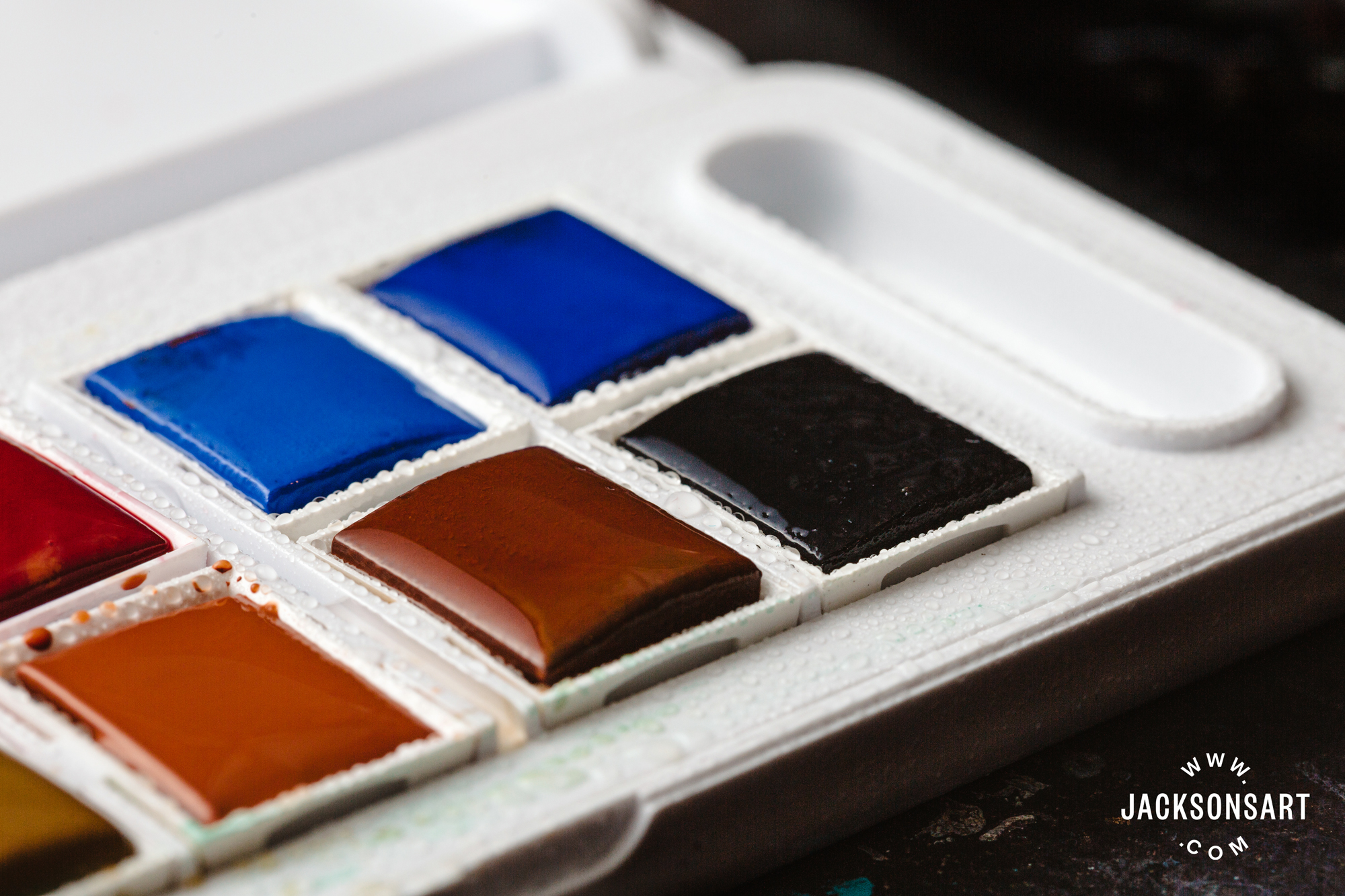
On the other hand, many fans of pans don’t want strong colour, they don’t want to get too much paint on the brush, because they like to layer more transparent, diluted paint, not apply a brushful of saturated colour. So they don’t activate the paint as much and they use more water on their brush so the colour is more diluted. These painters feel that a pan is more easily controlled, especially if you measure the water that you add by drops, so you are consistent with your dilution.
Cleaning Contaminated Colours
Dampen the surface of a pan and you can wipe just the top layer off and the paint underneath will be clean again. Tube paint on a palette can be quite muddy by the time you are finished painting and it can be hard to salvage the little bits left on the palette. Although if you have larger lumps, you may be able to spray water on them and pour off any mud.
Versatility
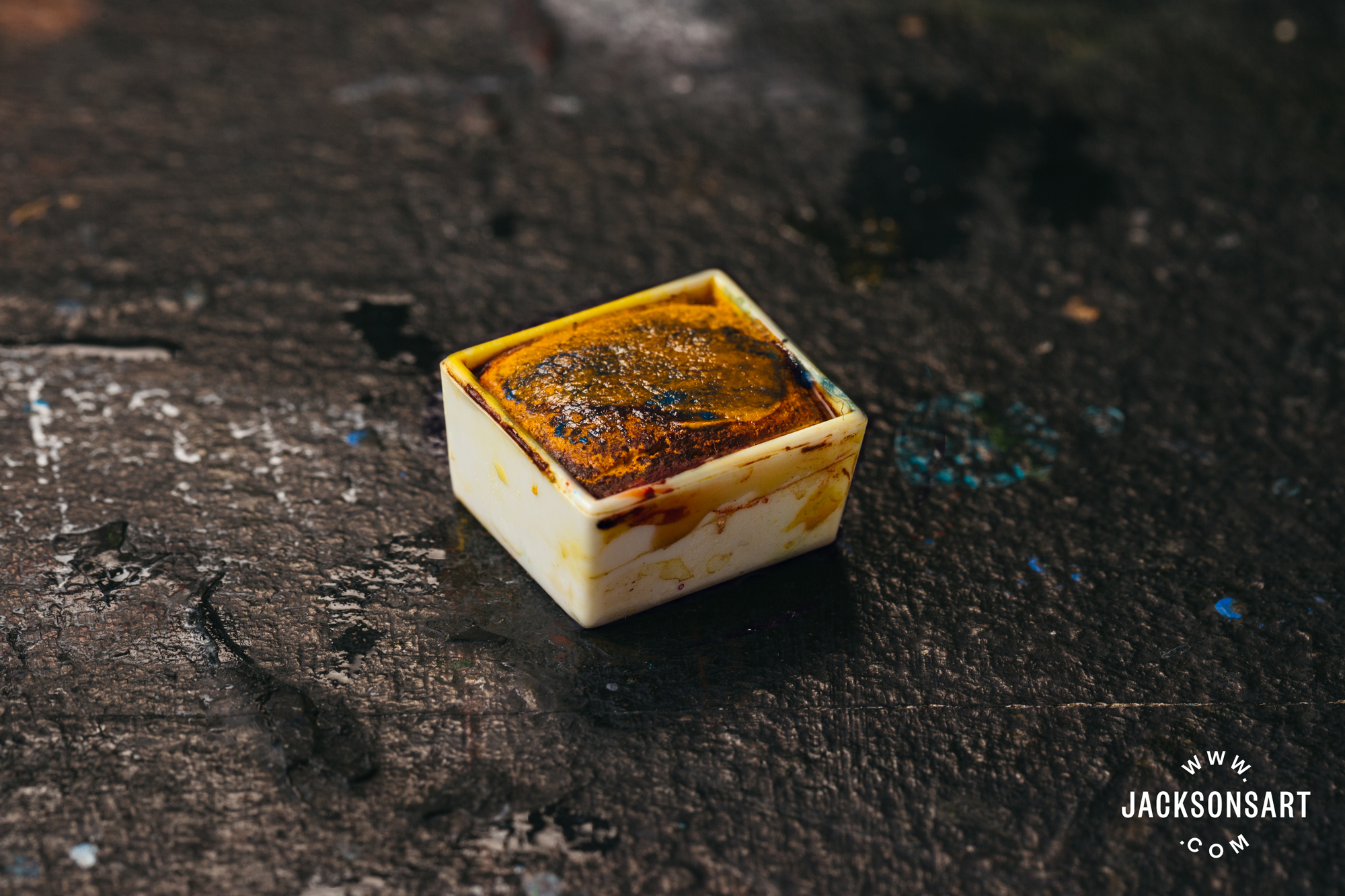
With a tube you get to choose how you want to use it, it is more versatile.
Do You Have a Preference of Format?
Well, those are all the positive and negative attributes I could think of. If you can add other reasons that you prefer a pan or a tube, please let me know in the comments below.
Other Formats
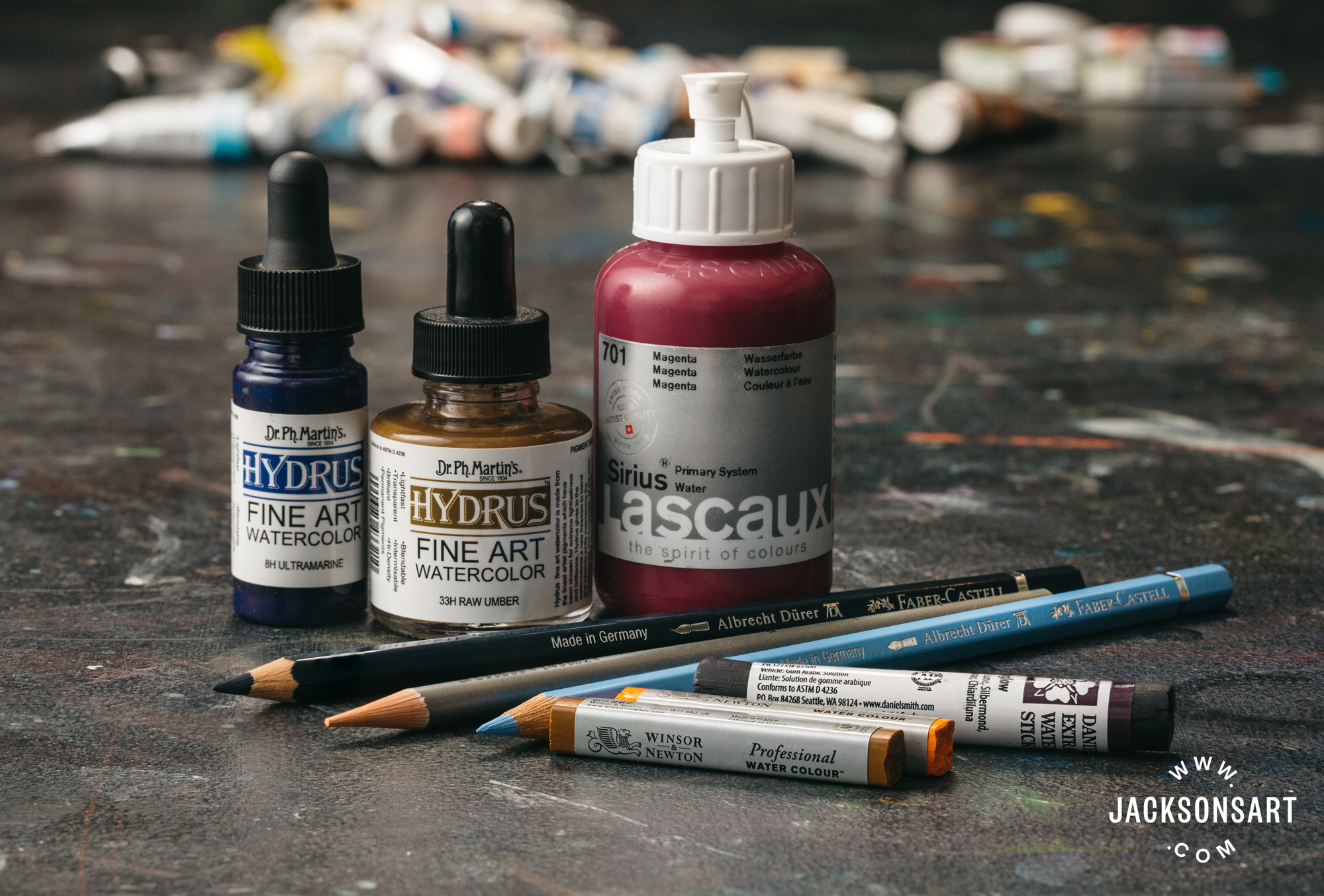
To add to your choices there are a few more formats, though they are not available in as many brands. In addition to tubes and pans, watercolour comes in liquid, stick, and pencil form. Liquid watercolours can be a creamy fluid or very fluid like ink, but are all concentrated colour and are made with a gum arabic binder so can be re-wetted and lifted from your paper. The sticks are similar in consistency to pans, they are extruded paint left to dry. You can draw with them on wet paper or you can wet parts of your drawing afterwards. Viarco make a stick shaped like a tailors chalk. Use the pencils to draw with and then run a wet brush over to make parts of the drawing flow.
A few readers have suggested that watercolour sticks make great refills for pans. I have not done this but it sounds like a good idea. You would just need to break the stick into smaller peices.

In the end, many watercolour painters use a combination of tubes and pans, perhaps with a few sticks or pencils for fine lines. Those who prefer pans might have French Ultramarine or Cerulean Blue in a large tube for quick, large sky washes. But there are some painters who are loyal to painting with just one format. Knowing the benefits of each will help you decide which you want to use.

Shop Watercolour at jacksonsart.com:
The extensive Watercolour Department
Further Reading
Your Comprehensive Guide To Watercolour Mediums
Schmincke Aqua Drop: Liquid watercolours that can be used undiluted
Choosing Colours to Fill Your Watercolour Box

68 thoughts on “Is Watercolour Better in Pans or Tubes?”
Excellent article on watercolour pans and
tubes – much appreciated
Thanks, Ruth! Glad it was helpful.
Thanks for such a comprehensive and
informative article. As a newcomer I’ve
been trying out pans and tubes and your
article has helped me understand some
of the differences I’ve noticed. I’ve also
acquired some very old dried-up tubes
and will now try your trick of cutting into
them to use the pigment. One idea I’ve
recently come across which you might
like to add, from painter Jane Blundell, is
to use sticks to refill pans. Apparently
it’s a very economical approach and
works well with certain brands.
Thanks James, I’m glad you found it useful.
I hadn’t considered using sticks to refill pans, I will go back and mention this in the article. Thanks for sharing the tip.
My watercolours improved in leaps and
bounds when I began to use tubes. Now I
can get good saturated colour where I want
it, and even washes when I dilute my paint in
a palette. With gum Arabic added where I
need the most intensity, at last I can get
strong deep colours I never achieved when I
used pans.
I totally agree, Hazel. You can make up a good batch of wash colour and you can get so much more colour on your brush.
Thanks for reading!
not sufficient attention to the fact that
tubes can dry hard in time and become
unusable and can only be of any use if
they are cut open and the metal discarded
–I have some colours I rarely use and if in
Smaller tubes can become useless —–Full
pans I find are most economicand if
bought in a set as St petersburg russian
sets best of all
Hi David
I think you are right and I will go back to do a small edit and emphasise it more.
Yes, full pans are a much better value than half pans and St Petersburg make sets that are very well thought of. Thanks for sharing your recommendation.
What an amazingly clearly written piece on watercolour paints : a tour de force and a real pleasure to read . So well written it was a joy to read as a piece of writing as well as being direct and comprehensive. Thanks
Thank you, Ann!
I’m glad that you enjoyed it!
Thank you Julie. I am just starting
out in the world of art and prefer
watercolour paints. I have attended a
few classes and with use of your
articles, I have created some pieces I
am really happy with. A few have
been added to a local gallery by my
tutor.
Your articles have been invaluable for
learning and creating using the
technique described or a product or
medium reviewed.
Much appreciated. Thank you
Welcome to painting, Fliss! It sounds like you have started your art journey well!
I’m glad you find the Jackson’s Art Blog a useful resource. We do have a lot of information for artists on here!
I prefer tubes as at least on the tube is the name of the colour! I have old paint boxes with a lost chart, and some of the pans get moved around, so if I am told for example to use Burnt Sienna, I have no idea which it is or even if I have any in the paintbox!
It is quite a problem with pans to get enough paint, and I get loads of loose hairs left on the pan. So tubes for me although I do use my old paintboxes when the exact shade is not important.
Hello! You make a very good point, I had forgotten that problem!
I am going to go back and edit that in, thank you!
Whenever I unwrap new pans, I use a black
03 Micron pen to note the manufacturer and
color number (if it’s not already marked), e.g.
DS104 or WN535. I also make a color chart
on w/c paper specifically for the palette,
showing what is in each section of the
palette. Takes a little bit of time when
setting up the palette, but so worth it when
painting. If I swap out a color, I cut a little
rectangle from w/c paper to paint a new
color swatch and note the color name, then
glue this on the color chart – saves having to
redo the chart for awhile.
Such a good method! Thanks for the tip about cutting out the square!
Thank you Julie really enjoyed your
information about watercolour paints. I
am going to find my watercolour paints
out now and try some of your
suggestions. Thank you again for
sharing.
Thanks, Malcolm, glad you found it inspiring!
What an excellent article, thank you Julie!
I want to mention pigment sticks as potential ‘source’ of already
dried paint: cut off whatever length you need, put in its pan and you
ready to travel immediately, without waiting for tube paint to
solidify. Excellent solution for procrastinators – got me out of jam
few times.. 🙂
Best regards,
@marekbad64
Thanks for the tip, Marek!
Glad you enjoyed the article!
I just said this – the sticks make a good
alternative to refilling pans especially for
pigments that seem to be always very gloopy
across all brands (yellow ochre, some
pthalos)
This was so interesting and extremely
useful. Thank you very much.
I’m glad you found it helpful! Thanks!
Very helpful, Julie! Thank you for all the
information.
You are very welcome! Glad you found it useful!
Great article, thank you.
Sometime you can salvage a messy tube
paint on your palette by letting it dry, then
spraying with water and tipping up to let
the unwanted pigment run off.
I’m glad you liked it!
Thanks for the tip!
Hello
I love Art im not professional Artist but I
love doing Botanical art, this blog is very
Informative & I learn a lot by reading
Thank you for putting this out to all the
want to be Artists & the professional
Artists
You are welcome! I am glad you find the blog a helpful resource.
I hope your botanical painting continues to grow 🙂
Your explanations have helped me in my understanding of Watercolour paints. Most informative and well written resume thanks.
Thanks Wendy, I’m glad you found it useful!
Great article very interesting and full of
really good ideas thank you Julie. I always
find the articles by the Jackson team so
good and helpful.
Thank you for reading Barbara! Glad to be helpful!
Hello Julie
The article was great and I just wanted to
add a few observations from my very
limited experience;
1) Smearing a thin coating of petroleum
jelly with a cotton swab around the
threads of your tubes prevent sticking
caps.
2) Some people have commented on initial
oozing out of paint from only a blue shade,
I think it was cerulean but not positive.
Thanks Donald, glad you liked it!
Thanks for sharing your tip, lubricating the threads sounds like a good idea.
I have had the binder separate from many colours, but yes, cerulean is a big culprit, I assume because the pigment is ground so coarsely, you can see it is grittier, so it must be hard to suspend in the binder.
Some good tips there – in practice there
seems to be little difference with W&N
using the tubes in pans vs the tubes – you
can add a little glycerine or a wetting
agent and it’s fine (in practice I don’t
bother, most paints are a bit too ‘gloopy’
anyway, like Yellow Ochre or pthalo
greens).
You mention tube wasteage – a good way
of avoiding this with any tube paint is use
a toothpaste squeezer – I call it the ‘rack’ –
the ones with rollers are best. This means
you can squeeze out almost all the paint,
bar the last bit which you can squeeze out
with your fingers.
Also something I learned from Jane
Blundell is you can use the watercolour
sticks as pan paints – I do this when I’m
travelling cos tubes are not convenient.
And although I agree about the tube vs pan
vibrancy, the sticks do seem to have a far
higher pigment load. So I pick up the
watercolour sticks when I see them on
sale – especially the ‘gloopy’ pigments
because otherwise after I use them they
go all over my palette in my bag!
Good points, thanks Tim!
Also not tried the Viarco but that’s closer
to how Derwent XL works, or indeed the
Derwent Graphitint paints – not exactly
watercolour but similar in approach, a
watersoluble chalk or graphite.
Also I’d point out that a lot of the liquid
watercolours are not lightsafe – many of
them are dyes, not pigments. Always
check!
Very helpful article for a beginner like me.
I’m glad you found it useful, Donna!
Interesting article, much appreciated as I
start out on my watercolour journey and
haven’t actually bought any paints yet.
Thank you.
I’m glad to hear that you found it helpful, thanks!
Great article! I only use pans and always
replace the original pan tray with a much
larger plastic serving tray from the
discount shop. Hot glue all the pans much
further apart from each other so you don’t
pollute the colors ( and buy a second tray
to use as a lid). Also, never use those
lightweight plastic palettes that don’t stay
put when you’re mixing colors. Instead,
buy inexpensive porcelain sushi sauce
dishes. Much heavier and way more
satisfying to use.
Hi Jocelyn
Thank you, I’m glad you liked it!
It sounds like you have hacked a great system for yourself!
Yes, porcelain palettes are my favourite to use as well, although I use the ones made for painting because they come in so many useful shapes and sizes and are a good price. Porcelain Palettes.
A very good and comprehensive article
so thank you. I usually buy tubes and
squirt into my pallet to dry. It is true that
Winsor & Newton does not wet up that
well and within a few months most of
the paints had dried and cracked to a
point beyond return. Holbein much
better but now, after several years in the
pallet (I have several loaded with
different colours) they also are
becoming harder to revive. The best for
rewetting that I have used are Daniel
Smith although I have heard good things of Schmincke for this also.
Thanks Kevin, I’m glad you liked it!
Thanks for the tips on which tubes re-wet best, very helpful info!
Thank you for a most informative
presentation of water colors in all their
forms – pan, cake, tube, pencil, liquid, etc.,
and their many uses. I have not dabbled in
watercolor when I was about five. My
uncle, a Goudy protege type and book
designer, feeling I had some talent,
provided me with a metal travel pan water
color collection I adored (now carefully
protected in a drawer – a keepsake). My
uncle encouraged me in his interest and
study of calligraphy, which I did pursue
having received nibs/ holders /historical
books. Now in my late 80’s I have found a
renewed interest in water colors –
recognizing their range from delicate to
great strength – to me so reminiscent of
Nature. I thank you for your inspiration.
What a lovely keepsake to have! Your encouraging uncle sounds grand! The versatility of watercolour is quite like Nature, isn’t it, I hadn’t thought of it that way.
I’m glad you found the article inspiring, Madge.
What an excellent article. It covered so much more than just pans vs tube format. I found some of the tips extremely useful. Thank you.
Hi Edward
Thank you! I do try to cover a topic fully, including any related things that seem relevant. I’m glad you found it useful!
Thanks for an informative article, I
learned a few things I didn’t know
before. Just one thing I’d like to add
though. I don’t know if this is just me
and being inexperienced in using
watercolour, but I find that when I use
wet watercolour straight out of the tube
I seem to pick up too much colour and it
gets wasted in the water jar. I’ve been
preferring to squeeze out the tube paints ahead of time and let them dry, then when I use them I don’t seem to waste as much of my pigments. It seems to be worse for some brands than others because the wet paint is sometimes more sticky and grabs onto the filaments of my brushes. But maybe it’s a learning experience for me since I’ve only been using watercolour for a couple of months and only practice once or twice a week with them.
Hi Susan
That sounds like a good approach.
I think the preference for lots of strong colour or less colour on your brush depends on how you paint. So it sounds like you work best with dried paint.
I’m glad you found the article useful!
Wow. Such a joy to read so very
informative, a true pleasure. Thank you
for the effort and all the work you
lavished on this project. I could tell it
was a labor of love by the writing. You
have no idea how you connect with your
audience and how much you are
appreciated. Please stay well and safe
and I for one, am looking forward to your next project. Much appreciated and
always looked forward to.
Thank you, Steve! I do try to write in a thorough way, covering all the possible questions that artists will probably have.
I’m glad that other painters appreciate it, that’s great to hear!
thoroughly enjoyed your article! thank
you very much for laying it out so
clearly. i would like to know more about
storage of watercolours (you mentioned
that the tubes would benefit from
occasional turning to prevent
separation; would pans keep better
wrapped if i’m not planning on using
them for a few months? or should i just
let them be?) and shelf life of
watercolours in general as well as in
tubes vs pans. i greatly appreciate you
sharing your knowledge! thank you
Hi Oksana
I’m glad you found it useful!
I don’t know much more about storage than I said, that some manufacturers rotate paint tubes in storage. That is, they turn them top down and then a few weeks later they turn them top up. I don’t know any artists who do this, but if you have a big problem with tubes that are separating it might be worth a try. I know that they mostly do this with oil paint tubes, but since it is for the same reason, to stop the binder from separating from the pigment, I thought it might work for watercolour as well.
Watercolour has a long shelf life except that the tube may become hard. They can still be used by cutting them open and using them like a pan. They are not ruined and are perfectly fine to use. But they cannot be made moist again.
Very very very good article, and really really
helpful!!! Thank you so much!!
Thank you Alan! I’m glad you found it useful!
Very interesting article thank you. I’m new
water colour students. Definitely help me to
understand better the difference.
One think I would like to understand is the
difference in paper. Thank you
Thank you, I’m glad you found it helpful!
We have some good articles about watercolour paper on the Jackson’s Art Blog:
— Everything You Need to Know About Watercolour Paper
— Understanding Watercolour Paper Textures: A Visual Guide
— Stretching Watercolour Paper for a Better Painting Experience
We also plan to have an article next year comparing watercolour papers.
Wonderful read! There are lot of take aways from here. Thank you!
Thank you! Glad you found it useful!
One of the main benefits of tube paints
is the freedom to prepare your own
mixes.
Choosing carefully 7~10 tubes and
premixing them in pans can produce an
extensive library of colours for a small
fraction of what it would cost to get
each mix individually.
Most artists I know who buy tubes will
still use pans (or dried paint in palettes)
when painting. The small, dried cakes
are more practical to carry around and
set up. To pit pans vs tubes is, in my
opinion, a false dichotomy. Tubes have
the pros and cons of fresh paint, PLUS
all the pros and cons of dried pans, all
while being cheaper. Crazy!
(The only exception to this is Winsor
and Newton, whose tube formula dries
sour, thus a real choice of buying wet vs
dry is imposed.
But this is an old company who, in
today’s competitive market wouldn’t get
the attention it gets if not for the fact
that they were the best at placing their
products everywhere.)
I am so sorry Julie to hijack your
beautiful article with my rant. It is
lovely, thorough and enlightening, as is
most of the content that gets published
here at Jackson’s. I simply felt that the
idea of tubes being tubes AND pans
(thus not on equal grounds as simply
buying more expensive pans) was
missing, and I had to write the comment
I’d love to have read when I was
starting.
Cheers!
You make a good point Carlos. I will go back and point out that a tube is more versatile as it can be used either moist or dry.
Thanks!
I thought I’d mention the disadvantage of
tubes when travelling by plane. So many of
them can expand in a hold during the
flight. Paint then flows freely out of an
unscrewed top and it has had me
frantically trying to stem an uncontrolled
ooze, removing excess paint around the
top, and wasting a great deal – not to
mention the mess on my hands. Also, I
guess tubes are not great hand luggage
material whereas pans are not liquid.
Since I paint lightly and in small quantities
at a time, pans suit me fine though I keep
tubes for some purposes.
Hi Sarah
That’s great to know, thanks for sharing!
I will go back and mention it in the article.
Julie, hello,
I guess I know a lot about watercolor
paints, some I even make for myself from
pigments and other necessary ingredients.
They are surprisingly easy to make, I
deliberately determine the ingredients
amounts just by eye, without measuring
(sorry for immodesty). However, I read the
post with great pleasure, it says it all and
you make no definitive conclusion. In
addition, everything is very well supported
with photographs. This approach is almost
a rarity. It was a joy to read your article.
PS: I should read this 40 years ago.
I’m glad you found the article useful!
Comments are closed.