



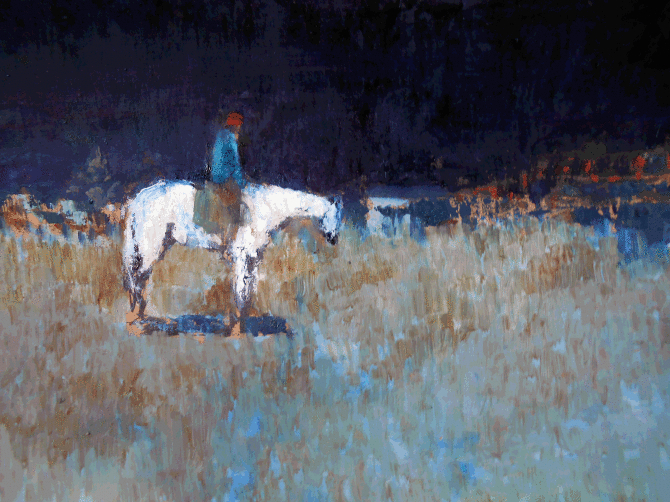
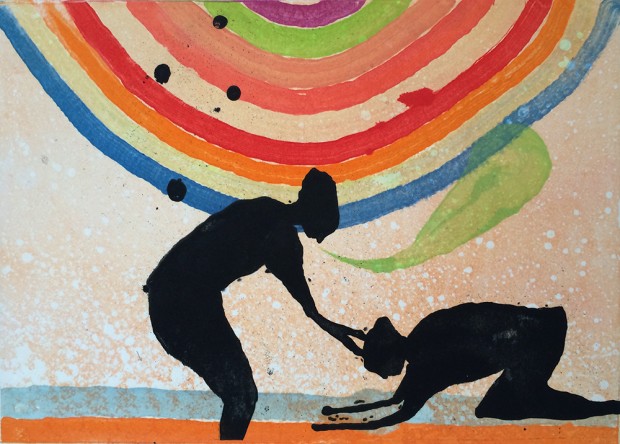
Meg Buick’s prints and paintings are heartbreakingly beautiful evocations of a world that is recognisable yet timeless, where animals and humans inhabit a world but do not speak, thoughts and moods are held within, beautifying human survival in an atavistic landscape. The Jackson’s Art Blog wanted to learn more about Meg’s powerful art.
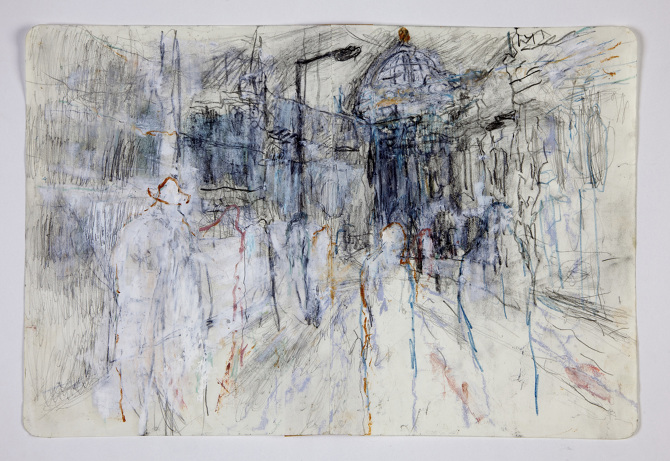
Lisa: Can you tell us a bit about your artistic background? You began by studying Theatre Arts but went on to do the Post Graduate Diploma at The Royal Drawing School but looking at your CV it appears that you have always painted and drawn?
Meg: I have always been involved with drawing or making, but at one point I was more interested in making three-dimensional work and work for theatre. I decided not to go to art school and study fine art because I was concerned there would be too much focus on the ‘conceptual’ and I knew that I wanted to do something practical and skills-based. So until I went to the Drawing School I was mostly self-taught. I used to buy a lot of second hand art books and draw from them, and I drew a lot from life, and went to some life drawing too. The Drawing School meant that I went from being completely alone in my work to being surrounded by other artists and tutors, with constant exposure and criticism – it was amazing! It was exactly what I needed to propel my practice forward. But I’m glad that I had a period of several years where I worked pretty much on my own, because after finishing the course that’s how it has become again. I think being an artist or a writer essentially involves spending a lot of time on your own.
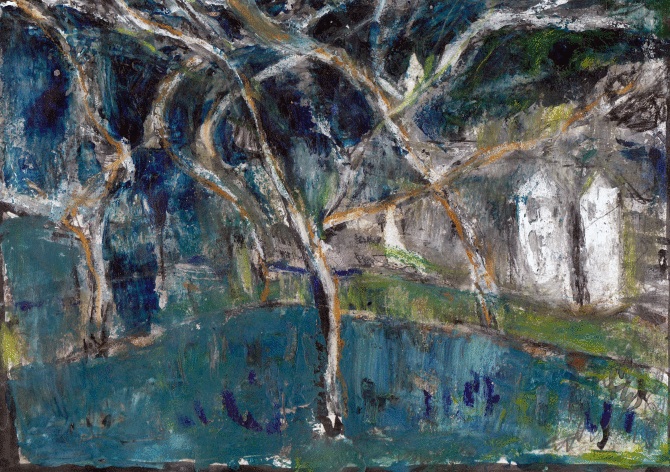
Lisa: Can you tell us about your relationship to the French Impressionists? There are a few nods to Monet on your website…
Meg: I think Monet is an incredible painter, and there is really a lot more to his work than many people realise. I find the way he handles the paint, particularly towards the end of his life, has an incredible energy and freedom. I’ve been fascinated by his painting ‘Boating on the River Epte’ since I first saw it, and have made various studies of it to try and better understand it. I think there is an incredible darkness and depth in the way he has painted the water, with the light shapes of boat, oar, and figures against it. I am also drawn to many other artists from around that time and place, particularly Bonnard and his use of colour and light.
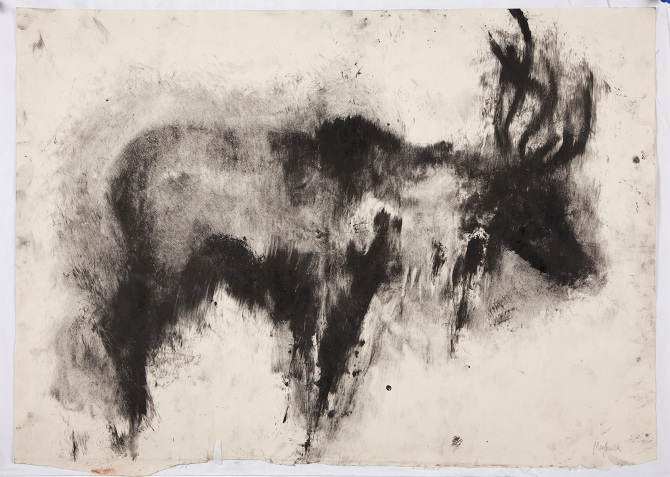
Lisa: What subject matter are you drawn to and what do you think your pictures evoke?
Meg: People often say that my images seem ghostly or fragmentary. It’s not something I’m doing consciously, but I do feel instinctively that it would be dishonest to show the whole of something, in detail – I don’t think you ever know anything entirely.
I want to express an experience of beauty, and spend a lot of time thinking about colour, harmony, and light. A part of me just wants to make beautiful images that make people feel good. But I can’t ignore the uneasy relationship we have with the natural world. I don’t think I could paint landscape or animals as if our relationship to them wasn’t extremely troubled – when we are facing climate change, mass privatisation, the damage caused by large scale industrial farming. There is a collective fear. I wouldn’t want to make paintings that don’t carry some sense of this, and I hope this is present in my work. I frequently paint animals, and I often find that they look weary, or sad, for the same reasons. I want them to have pathos without sentimentality.
So there is a contradiction in everything I do – between wanting things to be beautiful and yet wanting to represent an undercurrent of something else. I attempt to resolve this contradiction within a theme of pilgrimage or of journeying. I would like there to be a kind of hope.
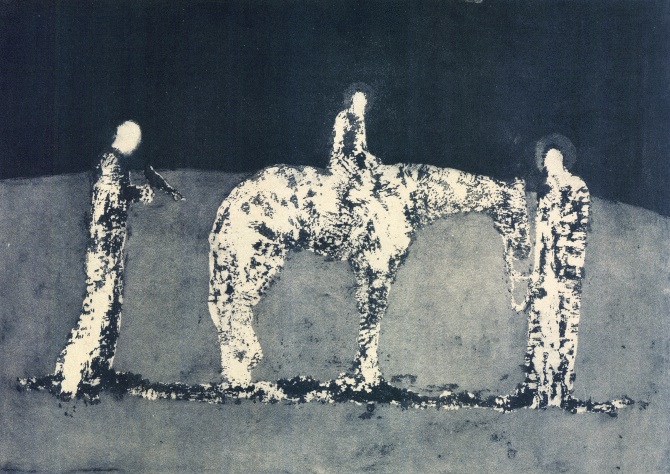
Lisa: You will be showing work at the London Original Print Fair on the Royal Society of Painter Printmaker’s stand. What can see expect to see from you?
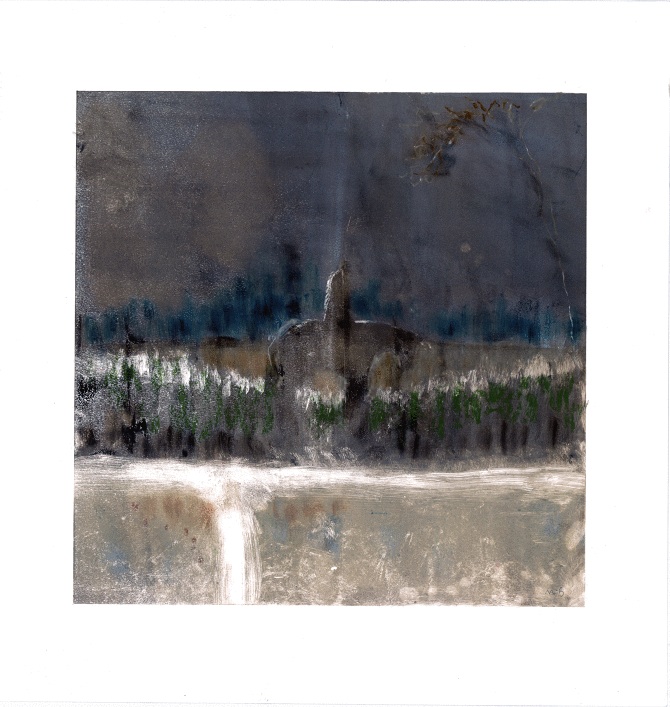
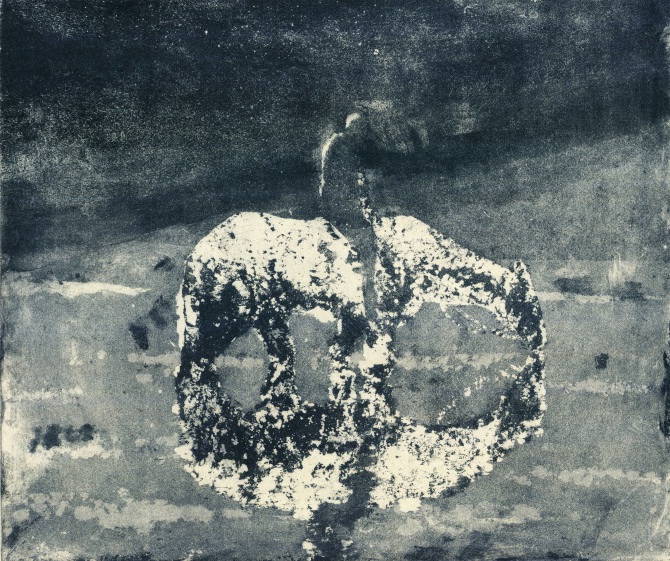
Meg: I’m really privileged to be a recipient of this year’s recent graduate award from the Royal Society of Painter-Print makers. It has given me a push to get back into etching again, after spending a few years focussing mainly on drawing and painting. I used to make etchings using a process called hard-ground, which is basically making an image on the plate using only line. But since doing a lot more painting I found that I wanted to achieve more painterly marks, and have spent the last few months developing prints using aquatint, sugar-lift, and spit-bite processes which are much more tonal and gestural. I’ll be showing some of these etchings, along with some of my lithographs and monotypes.

Lisa: What is your favourite printmaking process and why?
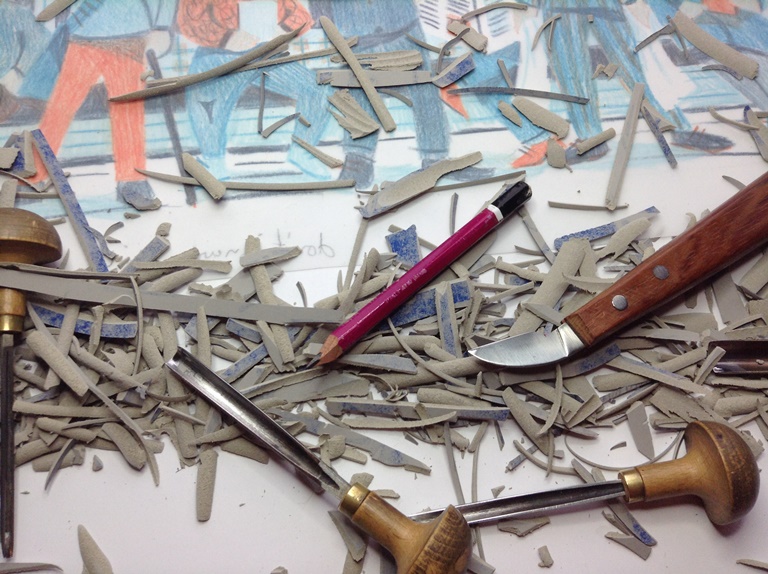
Meg: Etching is a wonderfully mysterious process and you have to be prepared to allow the process to guide the image, to some extent anyway. You never really know what it will look like until you print it, and the results often surprise you. There is a very physical element to it – you have to really understand the relationship between the metal, the acid and the grounds, and be very thorough and precise. Yet within every stage there is a lot of opportunity for creativity and invention. You can keep working on the same plate until you are happy with it, and in this sense it can be like an oil painting – but with prints of every stage that record the development of the image and can stand alone as finished pieces. With the aquatint process you can get wonderfully deep, dark tones and they often have a moody, atmospheric quality that is completely unique to etchings.
Lisa: What do you feel are the benefits of making pictures in different media rather than focussing on just one process?
Meg: I think it’s important not to ever get stuck in a process of working which you know works. I like seeing work that looks as if it had been made effortlessly after a lot of struggle. Changing media can stop you getting too comfortable, and allow you to bring elements of one process into another in a way that you may never have considered otherwise – making a drawing with the same tonal depths as and deep aquatint etching, or approaching an oil painting with the freedom and immediacy of watercolour. They all start to feed into each other and push your practice forward.
Lisa: How often do you draw?
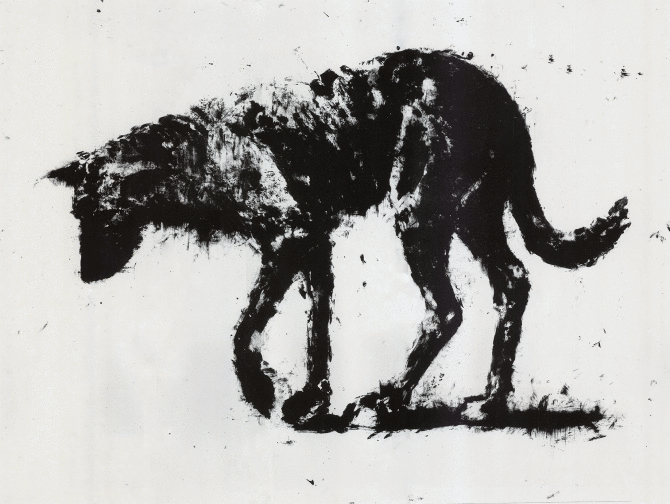
Meg: Every day I can really. I think drawing really is at the core of everything I do. I use drawing in lots of different ways. Sometimes I’ll just draw to pass the time on the train, and other times I’ll make a drawing of a painting I am working on to try and work out any compositional problems, or to see it in a different format. You can’t go on and on with it the way you can with oil paint, you can’t hide the history of your marks, there is nothing layered or opaque. After doing a lot of painting this can feel like a great freedom. I also draw a lot from paintings in galleries – I find it helps me to understand a painting and absorb some of its energy into my own practice.
Lisa: Where do you find your source material for your pictures?
Meg: Most of my images are either started from life, and then continued from something in between memory and imagination, or are completely imagined from the beginning. Its not that I have a finished image in my mind and then just paint it out – I’ll put down a mark, and the mark will suggest something. Or I’ll start drawing a landscape, say, and then turn the whole image upside down and realise it looks like something else, and I’ll start working on it that way. It’s like a conversation with the materials themselves. I think because I draw so much from life I have a strong ‘store’ of visual images, and that makes it possible to work without many references. As I have said, I draw a lot from other people’s paintings too, especially the early renaissance in the National Gallery. And sometimes I find that images or compositions from these paintings will start cropping up in my work. Sometimes I’ll make a little study of a painting, to work out the colour harmonies or just because I am drawn to a particular image, and then it will turn into something else completely. I do spend a lot of time looking at the work of other artists, getting books out of the library and going to exhibitions.
Lisa: Where online or in the flesh can we see more of your work?
Meg: My website www.megbuick.co.uk. I’ll be showing with the RE over the next two years, and in the immediate future at the Bankside Gallery for the RE Original Print and the National Original Print Exhibition.
1 thought on “Meg Buick”
MARAVILLOSO. Imágines realmente imperdibles. Muchas
gracias
Comments are closed.