Viarco ArtGraf No1 Drawing Putty is a soft graphite putty that allows artists to shape the graphite to their specifications. It can be used straight from the container as a large ball or block, broken off, rolled up, or shaped into a smaller point. It can be used dry or wet, with water added before or after laying down marks, it’s quite a versatile medium. The article will discuss some of the technical aspects of Viarco ArtGraf No1 Drawing Putty and demonstrate some ways you can incorporate this unique product into your art practice.
Review of Viarco ArtGraf Drawing Putty No. 1
About Viarco ArtGraf
About Viarco ArtGraf
Viarco ArtGraf is made in Portugal and the company makes several other drawing products, which can also be watersoluble. Historically a pencil company, over the years with research, Viarco has developed some innovative products. Even though I haven’t tested them with the graphite putty, one would assume that they designed each one to have the possibility to work together which could lead to some further experimentation.

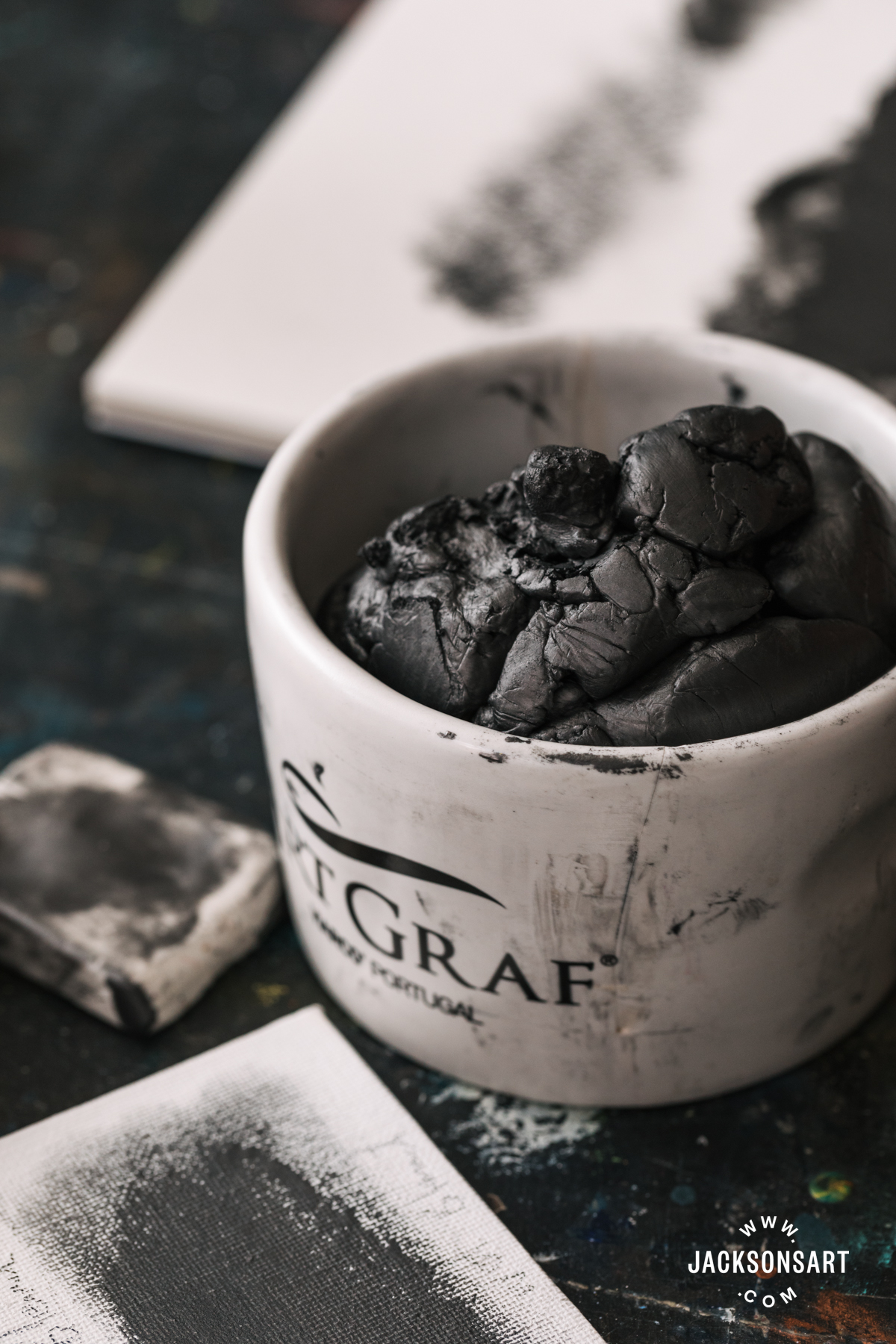
Viarco ArtGraf No1 Drawing Putty is lightweight and comes in a convenient ceramic pot with a cork lid. As it’s so malleable it’s nice to have a sturdy container to help reshape and store it in. Brand new, it is about the size of a cricket ball out of the packaging, it doesn’t have a smell at all, and has a light waxy/smooth feel to it. Be warned, it’s messy and it does get all over your hands. However, that is all part of the enjoyment of using this material, and it is really easy to clean off your hands with warm water. For the size and quality of the packaging, you get quite a lot, and I imagine it would last you a very long time as long as you look after it. It has a similar texture to a mixture of soft clay and putty rubber. It must be treated like clay, by that I mean you don’t want to let it completely dry out. If it does though it can easily be reversed by slowly adding water back into the product and leaving it for 1-2 days to return to its initial state.


Mark-Making with Viarco ArtGraf Drawing Graphite Putty
I did several tests using it drier (no added water) and several adding water in different ways on different surfaces. You can achieve a soft, transparent look using it drier and it can become quite dark and opaque if wetting the putty. Applying different pressure to the surface also leads to varying results.

Drawing-wise, the mark-making is quite versatile depending on how you shape it, if it’s wet or drier (I don’t say “dry” and mention “drier” as the putty always has a level of moisture within, and it’s recommended to not let the material completely dry out). I found it difficult to have sharp/tight precise pencil-like marks but I feel with more time and experimentation this product is something you could use for any kind of work.

It has a nice fluidity and movement when using it, and it lends itself to building up layers and making sweeping gestural marks.


Applying the drawing putty wet and using a paintbrush to push, distort, and ‘paint’ with the graphite makes for some really beautiful drawings. It is also possible to place a little water into the container and ‘paint’ using the pigment from the graphite. This approach was one of my favourite ways to experiment with using the drawing putty to make different kinds of marks and strokes and creating a lovely balance between drawing and painting.


Blending with Viarco ArtGraf Drawing Graphite Putty
As it is a fast-drying material, traditional blending can be difficult unless it is wet or extra water is added. Working with the drawing putty drier reminds me of using HB pencils, which are usually used to build up layers rather than blending, but if you work quickly when wet it can blend nicely, especially if using your fingers/hands. It offers itself to being built up to achieve softer transitions, rather than over-blended like charcoal. I found the paper stump didn’t work for blending with the drawing putty due to its fast drying properties, which is great for working quickly but doesn’t give a lot of time to push or pull the graphite around.


Erasing with Viarco ArtGraf Drawing Graphite Putty
When it comes to erasing I tried using a standard rubber and a putty rubber and it only worked slightly with the hot pressed watercolour paper. I found that drawing putty has some amazing versatile uses but it also has limitations compared to using charcoal or regular graphite. When applied on the cotton canvas board wet it can stay wetter for longer, giving the artist longer to adjust or change the marks made. It felt as though it was best built up rather than erased and re-drawn.

I also attempted to use it with hard pastels, however, the two didn’t mix. The waxy-like texture of the drawing putty is too smooth for the pastel to mix with.

Testing out this product was great fun. As I mentioned earlier, it’s messy, so you have to embrace the process and enjoy graphite getting it all over your hands. I felt it would suit those who like to work expressively, gestural, and on larger mark-making. It helps to loosen up the process and create intuitive work.

You may ask yourself why use a material like this instead of pencil or charcoal? Well, the Viarco ArtGraf No1 Drawing Putty allows you the freedom and versatility of charcoal, whilst giving you a faster drying material with a graphite look. The only drawbacks I think could be it may take some experimenting to find how you like to use it in your practice and if you’re used to charcoal, this fast-drying material could take time to experiment with. It has a very similar finish to regular graphite without the super tight preciseness which I think makes for a really beautiful material, making us create looser, gestural, intuitive marks.

Further Reading
The Difference Between Graphite and Charcoal Explained
How to Prepare for Your First Life Drawing Class
Preparatory Drawing Methods for Painting
Choosing a Rubber: Comparing Erasers
Shop Erasers on jacksonsart.com