Skulls may arouse our morbid curiosity – with the knowledge each of us carries one hidden beneath the surface – yet their enduring symbolism extends far beyond anatomy. As memento mori, they remind us that we all meet the same end, but throughout art history, skulls have also embodied power, served as instruments of satire, and even become emblems of beauty. The Art Through Symbols series explores the interpretation of symbols throughout art history – be they cultural, religious, folkloric, or personal. Each article analyses a series of artworks before detailing an art-making tutorial inspired by the symbol for you to try.
Art Through Symbols: The Skull
Interpreting Skulls
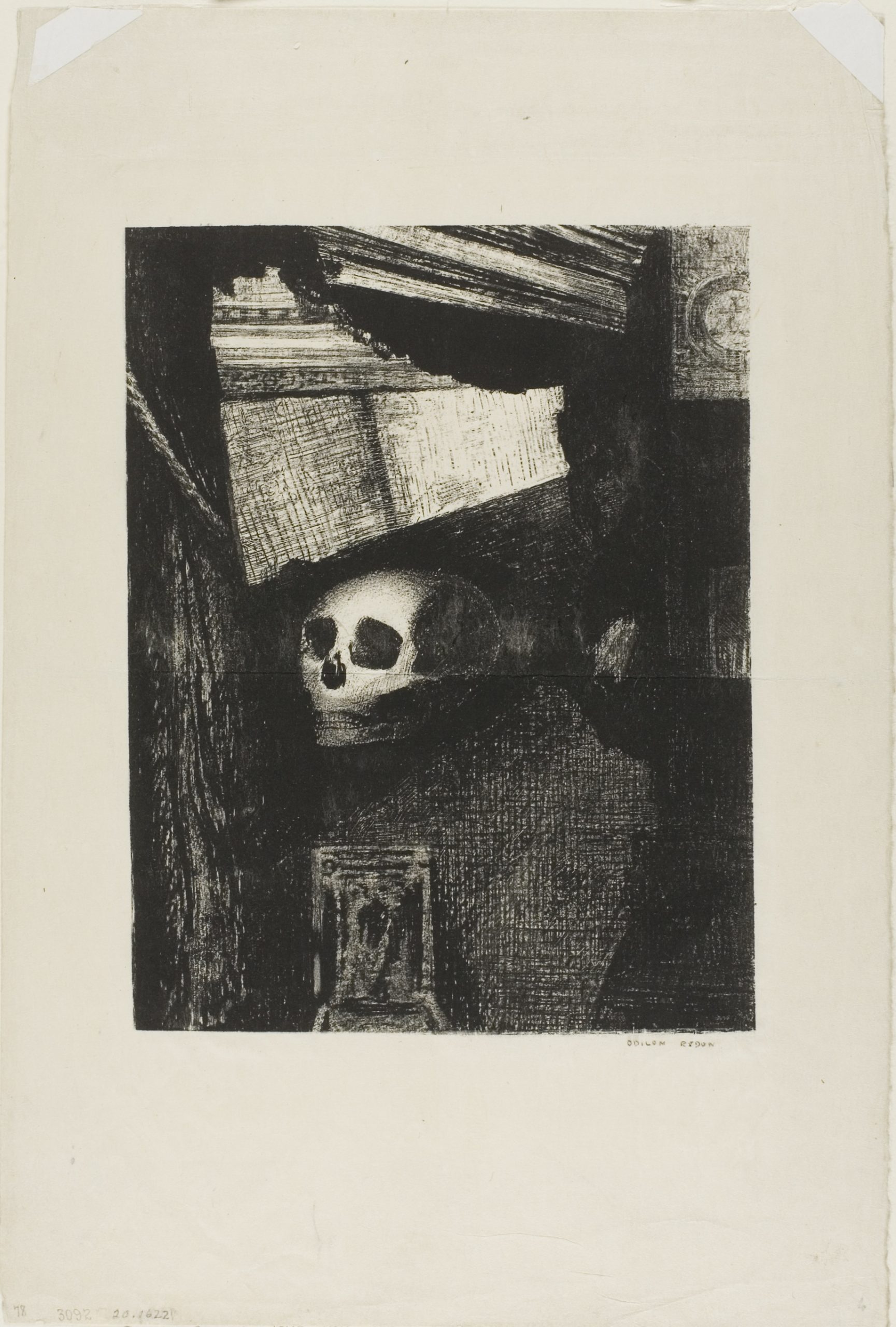
Odilon Redon
Lithograph in black on cream Japanese paper, 23.9 x 18.5 cm | 9.4 x 7.3 in
Art Institute Chicago
“The skulls were there and I could say something with them. To me they are as beautiful as anything I know. To me they are strangely more living than the animals walking around…” – Georgia O’Keeffe
When we look at skulls, we are confronted with our own mortality – perhaps welcoming in an existential dread – or giving us the steadying reassurance that, aside from birth, death is the one experience we all share. For artists living through times of crisis, amid plagues, famines and wars, the image of the skull looms closer, tragically woven into the fabric of daily life. Religious artworks from Christianity to Buddhism feature the skull to convey the impact of the spiritual choices we make in this life, whereas the Stoic feels an indifference because of death’s inevitability. To look instead to the behaviours of the living, satirical artists find the skull as the perfect device for instigating critique.
To cast the net even further, the skull may conjure up the imagery of horror and witchcraft. Perhaps the most universal approach to analysing the skull is through its beauty and complexity as a pure object. The following examples circle the globe, from Belgium to Italy, France, Tibet, and Mexico.
Skulls in Art History
Memento Mori – ‘remember you must die’
It may seem too on the nose to use skulls to represent death, but that’s the point. We are confronted by our own image, and immediately made aware of our common mortality. The memento mori – which is Latin for ‘remember you must die’ – stems from philosophies written in Ancient Greece and Rome. In early works, the memento mori functioned as a reminder to savour each fleeting living moment, in relation to the phrase, ‘Nunc est bibendum’, ‘now is the time to drink’. This is opposed to the later Christian interpretation and artistic genre born from the phrase. In this context, memento mori is instead employed to emphasise the emptiness of life on Earth, to encourage the viewer to focus their energies on securing their heavenly eternal afterlife.
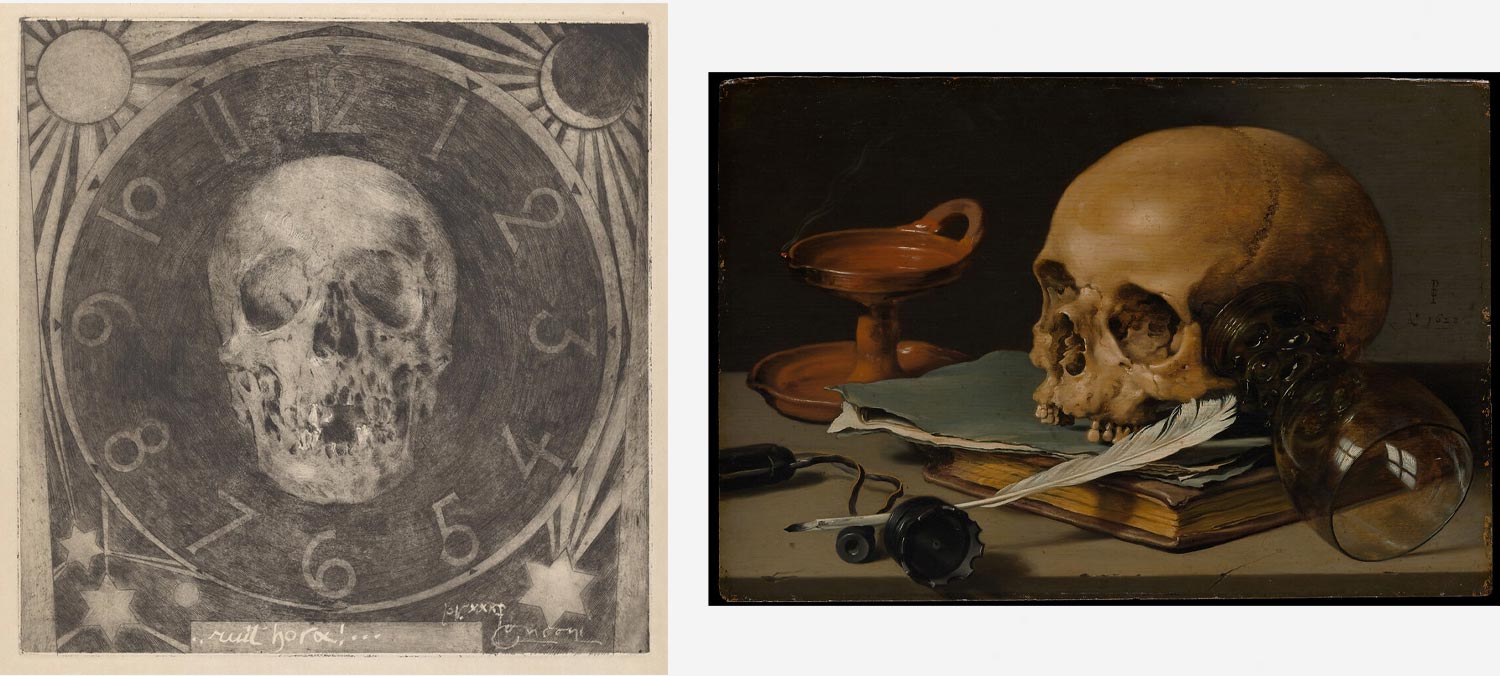
Luigi Conconi
Etching with monotype inking, 65.5 x 41.5 cm | 25.8 x 16.3 in
National Gallery of Art
Right: Still Life with a Skull and a Writing Quill, 1628
Pieter Claesz
Oil on wood, 24.1 x 35.9 cm | 9.5 x 14.1 in
The Metropolitan Museum of Art
In his memento mori, Still Life with a Skull and a Writing Quill, the Dutch Golden Age painter Pieter Claesz represented life’s brevity through objects – the skull, alongside the almost extinguished lamp, upturned glass, and ink pot. The placement of the objects at different toppled angles pulls our gaze in toward the securely seated skull. The limited palette of browns and greys is complimented beautifully by the faded blue of the papers below the skull. 265 years after Claesz’s memento mori, Luigi Conconi created his own, in the form of a printed, carefully rendered skull on top of a clock face with celestial corners. The skull as memento mori is such an enduring archetypal image that it seems impossible to imagine visual culture without it.
Perhaps the most renowned skull in literary culture appears in Hamlet, who is confronted by the inevitability of his own death, and given the reminder that everyone ends up in the same state; regardless of their status. In this beautiful drawing, Alas! Poor Yorick by Delacroix, he quickly renders the moment Yorick’s skull is exhumed, in preparation for a painting and print of the same subject. Despite the brevity of the sketch, the expression in their faces that he captured immediately conveys the discomfort of confrontation with death in the moment.

Eugene Delacroix
Drawing on paper, 28.5 x 21.7 cm | 11.2 x 8.5 in
The Metropolitan Museum of Art
Power
This richly colourful painting of Yamantaka – a violent aspect of the Bodhisattva Manjushri, who assumes this form to vanquish Yama, the god of death – is a brilliantly detailed and impactful painting, swirling with rich oranges and deep blues. Atop Yamantaka’s head is a crown of skulls with seeing eyes that also peek from the lower edge of the platform the battle takes place on. Buddhists consider skulls as a reminder to remove attachment to the body, with the crown here mirroring the victory over the cycles of death and rebirth. In this work, the skulls also become a symbol of power, fit for the crown of an incredible spiritual force.

Tibet
Distemper on cloth, 184.2 x 118.4 cm | 72.5 x 46.6 in
The Metropolitan Museum of Art
Contemplation and Belief
There are countless examples of paintings where a Holy figure, a fictional character, or a subject of portraiture holds or gazes upon a skull. The combination of the figure with the skull conveys that the person is deep in contemplation, ruminating about the choices made in their life, or the ambitions they still have before death.
In this Self-Portrait by Salvator Rosa, we see him writing on a skull with the words “Behold, whither, eventually” in Greek, which he painted as a gift for his friend Giovanni Battista Ricciardi. He was interested in Stoic philosophy, and included a book by the Roman philosopher Seneca under the skull. Interestingly, there is a small teardrop painted on Rosa’s right cheek – raising the question, why would a Stoic cry over death? The reading of the painting, and the purpose of gifting it to a close friend are complex and mysterious. Rosa himself was a satirist with a flamboyant personality, who deliberately selected obscure religious figures for his paintings, alongside allegorical self-portraits, and idealised landscapes. Despite the mystery, the subtle disrespect of writing on someone’s skull, with a thumb gently placed in the eye socket, gives the work an uncomfortable tension.
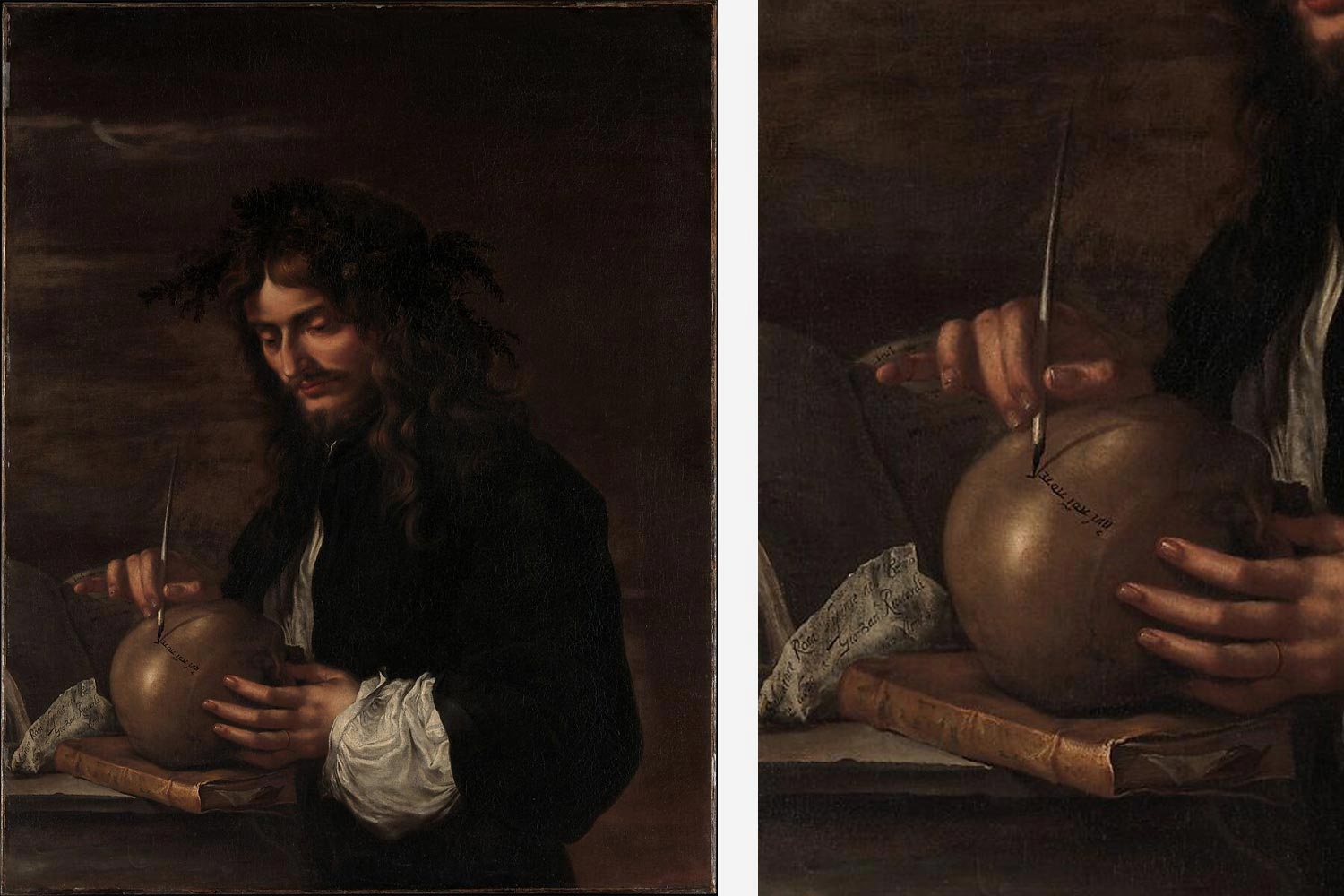
Salvator Rosa
Oil on canvas, 99.1 x 79.4 cm | 39 x 31.3 in
The Metropolitan Museum of Art
Saint Mary Magdalen is often depicted with a skull, invoked as a symbol of penance for the sins of her past. She rejected worldly pleasures like riches, victory, and relationships, to focus entirely on her faith. In The Penitent Magdalene by Georges de La Tour, we see her rendered in chiaroscuro tones by candlelight at her mirror, with a skull on her lap under clasped fingers. She turns away from us towards the candlelight – conveying her spiritual enlightenment. The skull catches the light, mirroring the profile angle of her head, emphasising to us that her penance will be worth her struggle beyond death.
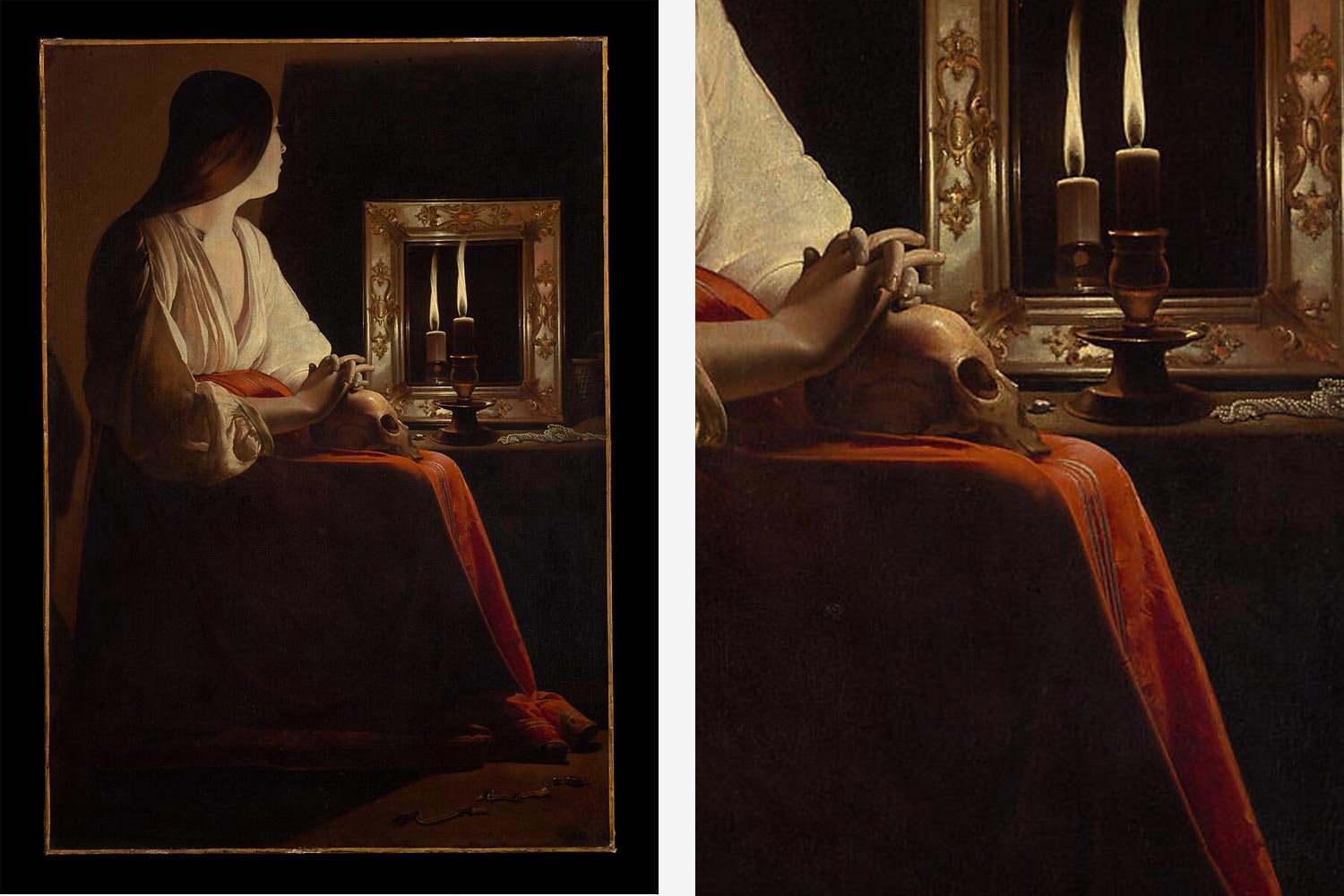
Georges de La Tour
Oil on canvas, 133.4 x 102.2 cm | 52.5 x 40.2 in
The Metropolitan Museum of Art
Calaveras and Satire
José Guadalupe Posada Aguilar was Mexico’s most prolific printmaker, amassing over 20,000 prints in his lifetime. His career began in the 1870s, specialising in satire. He often used skulls and skeletons as devices for his political and cultural critique. His prints featured in newspapers, magazines, books, and posters, making his imagery influential and representative of the cultural identity of his era, bearing witness to political unrest and societal inequality.
‘Calaveras’ means skull in Spanish, but has come to have a broader meaning, referring to the decorative skulls of the Day of the Dead festival, and all artistic representations of skeletons. Posada’s most famed works are his calaveras, especially La Calavera Cristina, which has become synonymous with the Day of the Dead festival. His engraving, A skeleton wearing a hat having a drink, is one image from the broadsheet ‘Calavera de Cupido‘, which satirises the living through the lens of the dead. A skeleton holding a bone and leaping over a pile of skulls while people flee, depicts one of the assassins of the ex-President of Guatemala in skeletal form. Both prints are defined by their strong graphic style and careful hatching.
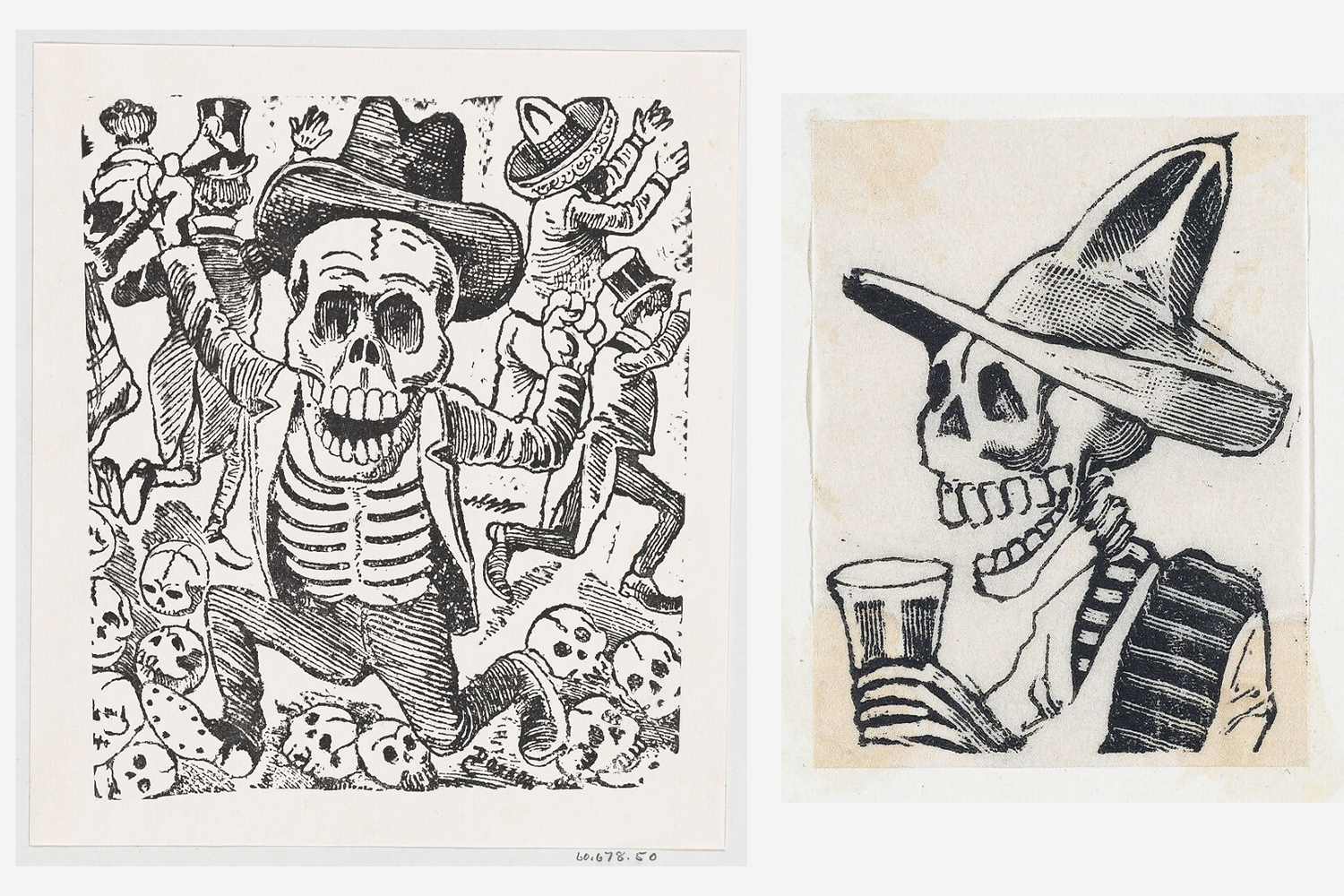
José Guadalupe Posada Aguilar
Zincograph, 15 x 12.8 cm | 5.9 x 5 in
The Metropolitan Museum of Art
Right: A skeleton wearing a hat having a drink, ca. 1892
José Guadalupe Posada Aguilar
Type-metal engraving, 6.5 x 5 cm | 2.6 x 2 in
The Metropolitan Museum of Art
Beauty
“How beautiful a skull is to paint!” is said to have been exclaimed by Cezanne, who repeatedly revisited the subject in his still lifes. It’s very hard to disagree with him, with their deep recesses, smooth curves, and sharp edges – all in one form. Therefore, we can consider some examples of the skull in art history primarily for their beauty as objects. Portraiture is amongst the most significant genres in painting, so it’s unsurprising that the structure beneath the face is also fascinating to us. Perhaps painting skulls from an appreciative angle also reminds us that our life cycle is a beautiful process. In The Three Skulls by Cezanne, he lightly painted the skulls that he kept in his studio in watercolour, giving them a lighthearted, almost uplifting quality, allowing the paper to illuminate the scene.
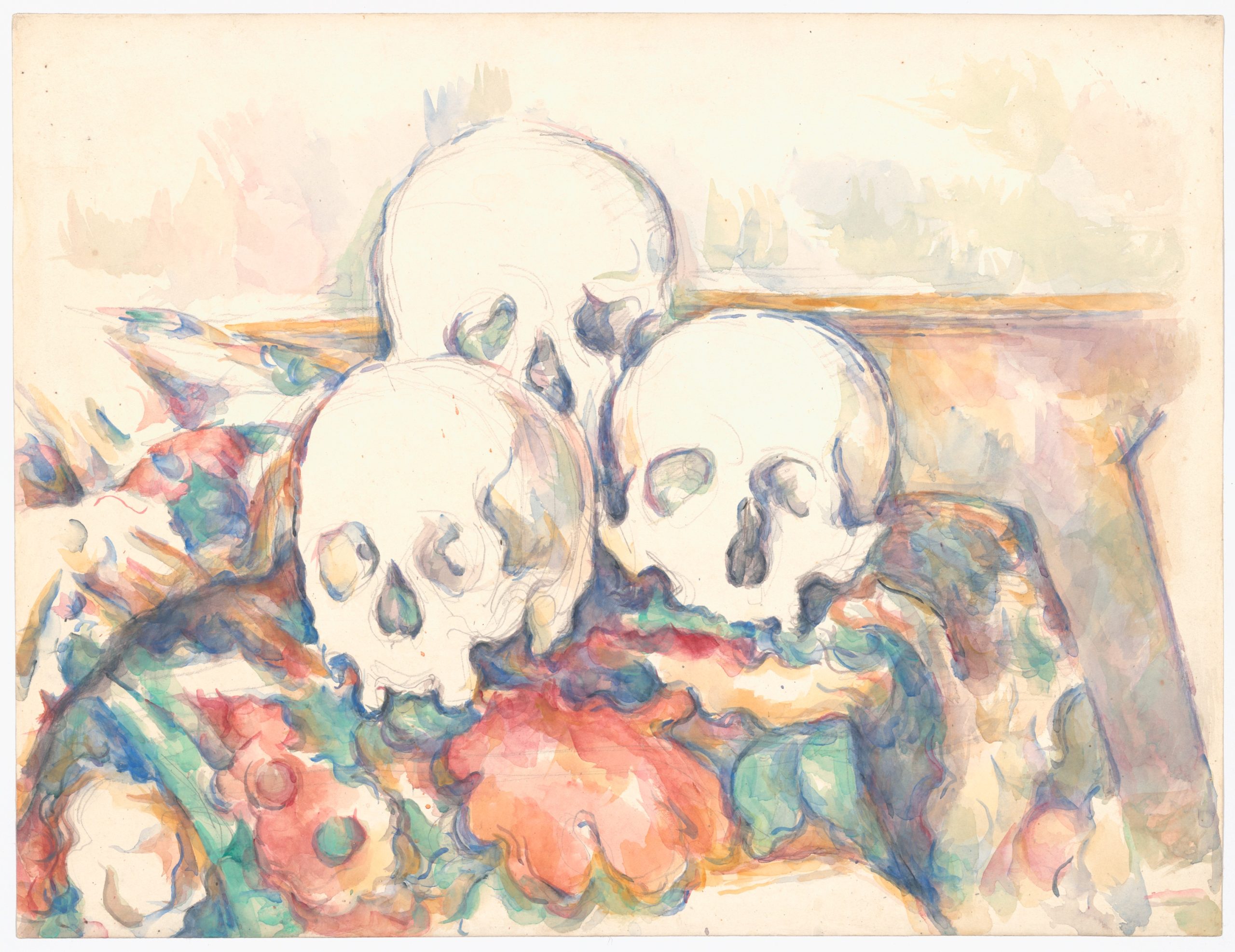
Paul Cezanne
Watercolour with graphite on ivory wove paper, 48 x 62.8 cm | 18.9 x 24.7 in
Art Institute Chicago
Fear and Witchcraft
The witches’ sabbath became a popular genre in artmaking, striking fear and paranoia in the hearts of viewers. Following the witch trials of the 16th to 18th centuries, the popularisation of the subject in art peaked in the 19th century. These works often depict women coercing evil spirits and creatures to plan their next sinister moves. The skull features heavily in artworks of this theme, becoming a symbol for fear of the occult – and a warning that we could be a victim of their magic too. It goes without saying that the popularisation of these scenes did little to improve the treatment of women in history, and visually assisted in widespread persecution and mistreatment.
In the etching Departure for the Sabbath, we see two seemingly sweet women sitting amongst a host of unsettling characters – reminding us that anyone could be a witch. The standing figure has a head resembling an animal skull and threateningly brandishes a torch. Another creature to the left props open a book to reveal a drawing of a skeleton, positioned beside a human and horse skull. We can speculate that the book contains instructions for reanimating the dead. The dense tonal crosshatching gives the work a half-light, pulling us closer to examine their horrifying activities.
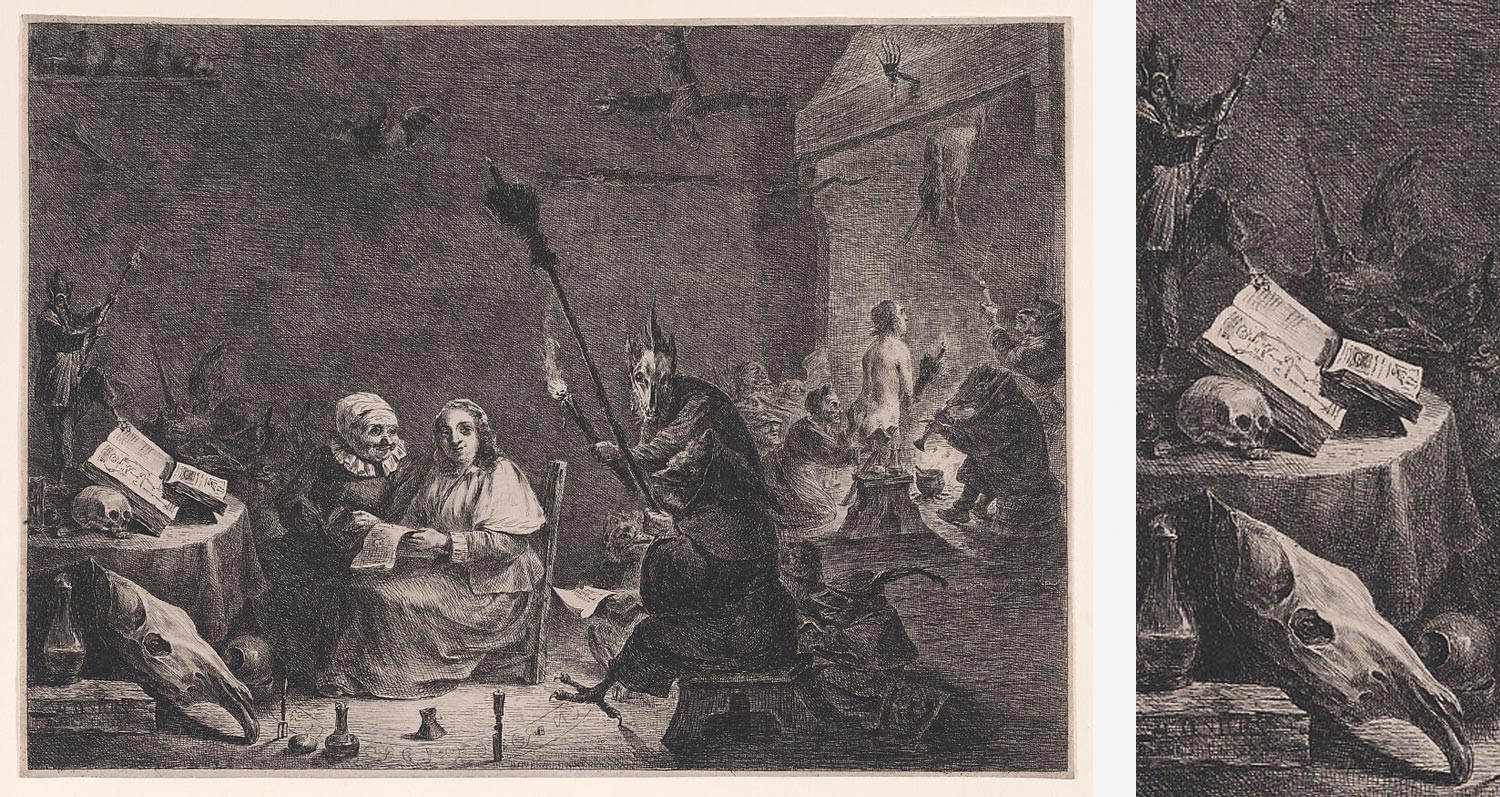
Baron Dominique Vivant Denon after David Teniers the Younger
Etching, 20.9 x 28.9 cm | 8.2 x 11.4 in
The Metropolitan Museum of Art
The Skull – Art Prompt
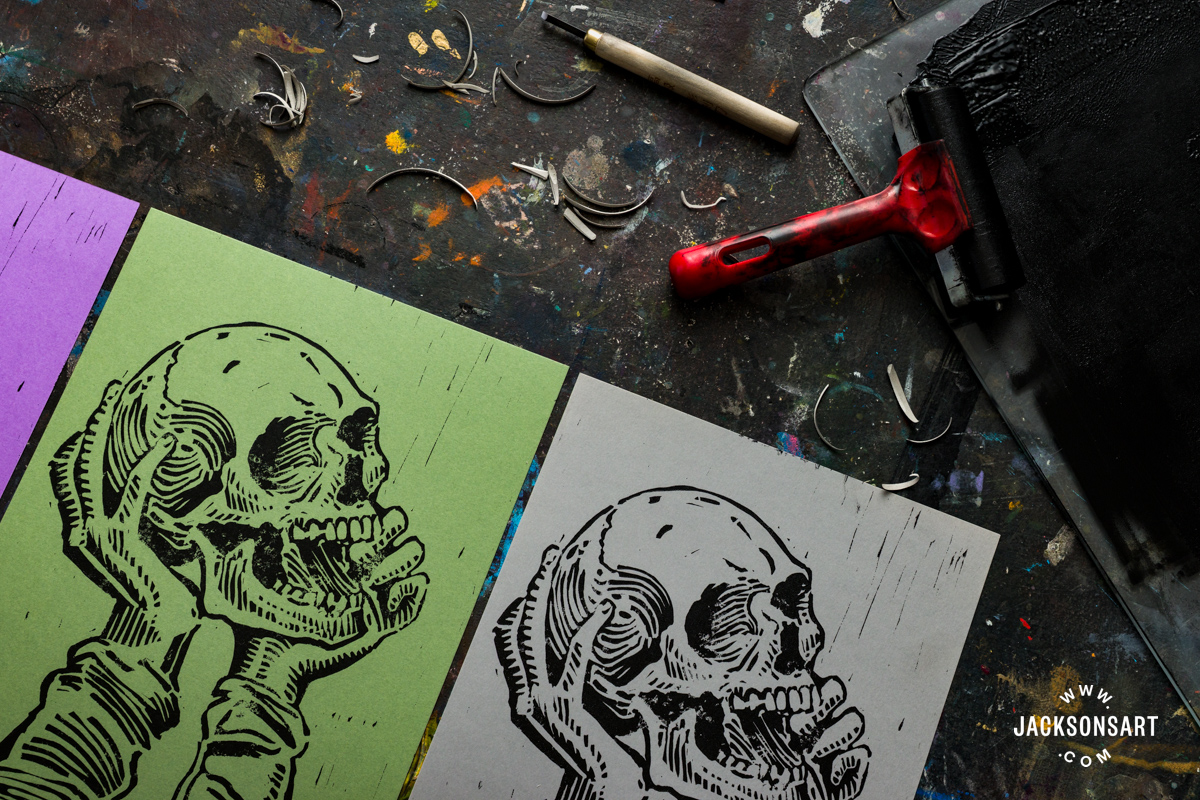
I was inspired by the graphic line and bold hatching in José Guadalupe Posada Aguilar’s prints, paired with the motif of hands interacting with the skull in Georges de La Tour’s The Penitent Magdalene. For this art prompt, we’ll create a series of lino prints on coloured paper.
For this art prompt you’ll need:
A sheet of Jackson’s Snowdon Drawing Paper
A sheet of Jackson’s Carbon Transfer Paper
Speedball Professional Relief Ink in Supergraphic Black
Slama Hand Printing Press, a baren, or a spoon
Sheets of Clairefontaine Maya Coloured Paper – I used grey, purple, and moss green
I trimmed a sheet of drawing paper to be the same size as my lino block and sketched a skull being held up by two hands in pencil. Once I was happy with the light pencil drawing, I went over it with my black marker pen to get a better sense of the final outcome of the print.

Next, I taped a sheet of carbon paper to my lino block to ensure it wouldn’t shift whilst I transferred the drawing over.

I placed my marker drawing on top of the carbon paper and lino, and drew over my drawing in pencil with pressure, to transfer my drawing to the block.

Once I’d transferred the drawing, I drew over the transferred drawing with my black marker pen onto the lino, since the carbon can shift as you work, but the permanent marker won’t.

I began cutting my lino print by removing all of the blank areas of lino, leaving behind the black drawing, which would later hold the ink.

I scooped some ink out of the Speedball tin with a palette knife and spread it in a broad line at the top of my glass palette. I spread the ink out with my roller by running it towards the ink and back again, picking up some ink with each roll. I continued this spreading process until the ink was evenly distributed and wet.
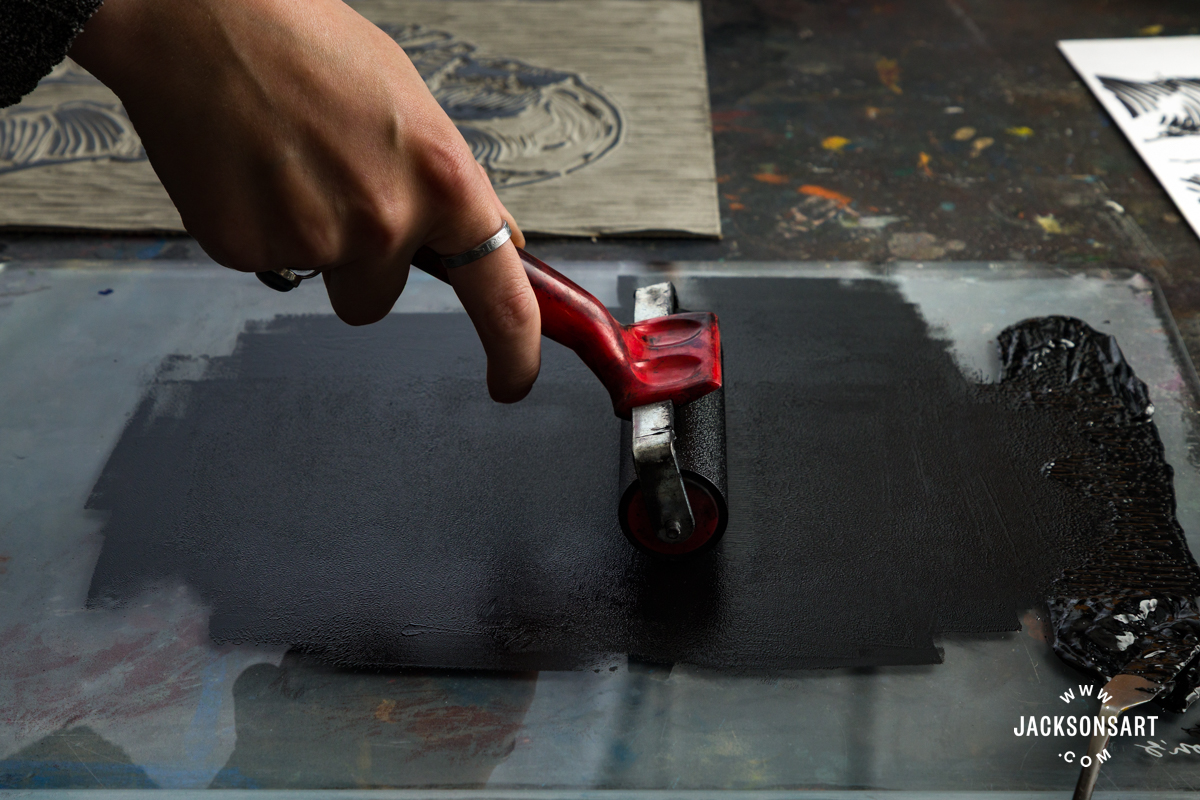
I rolled the ink onto my lino block, making sure to change the direction of the roller to distribute it evenly. To pick up more ink, I ran the roller backwards and forwards through the spread-out rectangle of ink on the palette.

I placed my coloured paper on top of the lino block, being careful to line it up with the block, before rubbing the back of it with my Slama Hand Printing Press. The back of a spoon also works as a baren if you use it to rub the paper with even pressure.
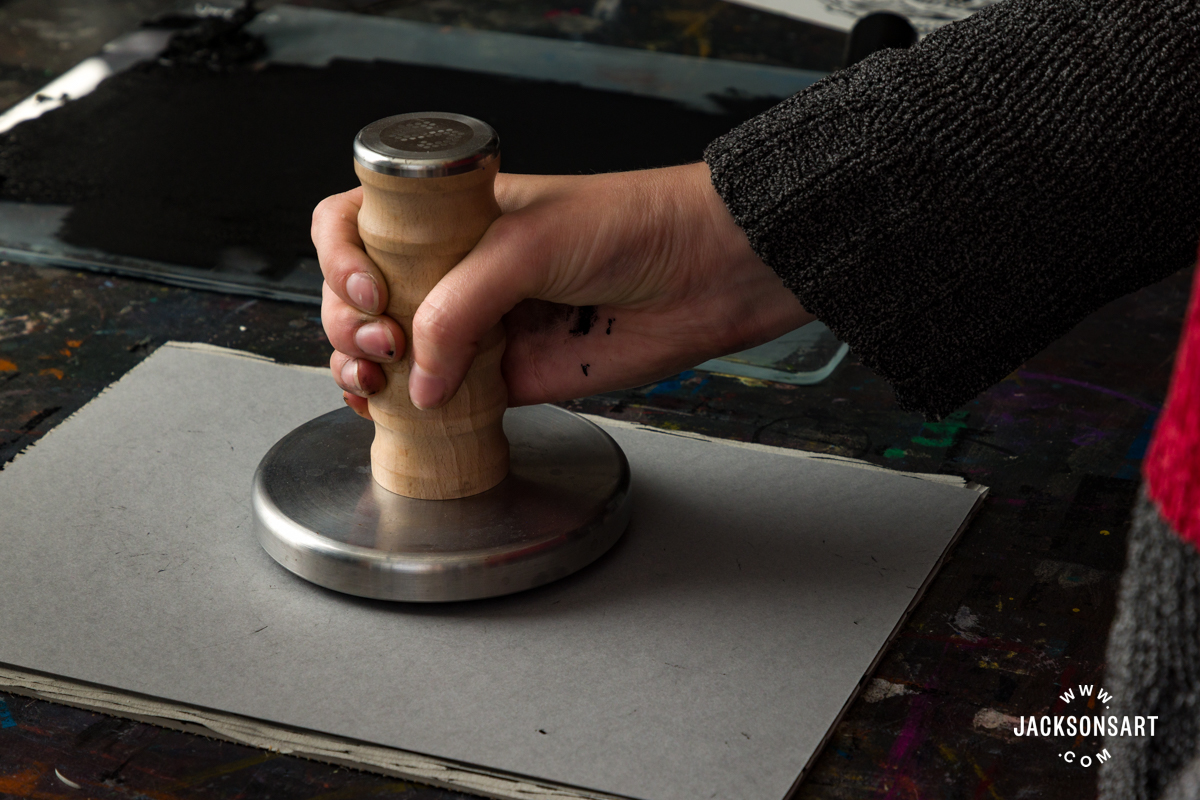
I carefully pulled my print off the block, in one movement, so as not to smudge the ink, and put it aside to dry.

I repeated the process again on different colours of paper.

Further Reading
Chiaroscuro Techniques for Painting, Drawing and Printmaking
The History of Cast Drawing, and How It Can Help You Draw Form
A Guide to Linocut Printmaking
Shop Art Materials on jacksonsart.com