Hanna Brody won a Guest Judge’s Choice Award selected by Eleanor Johnson in Jackson’s Art Prize this year with her work I Woke Up Embarrassed With A Pain In My Head. In this interview, she discusses how she creates her claustrophobic compositions, the use of acidic green in her award-winning painting, and the influence of Renaissance and Baroque paintings on her work.
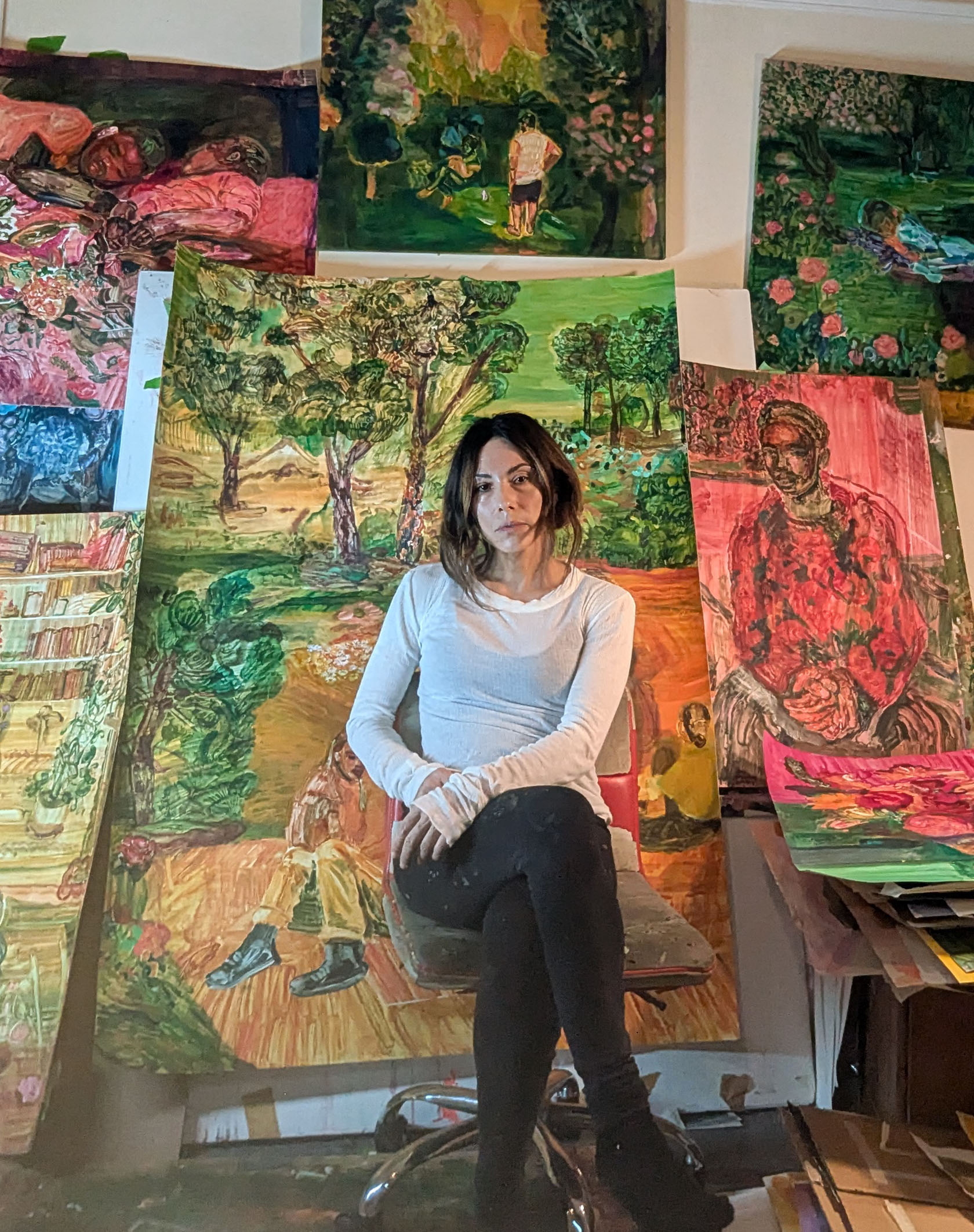
Above image: Hanna Brody in her studio in Albuquerque, New Mexico

Hanna Brody
Oil on transparent silk, 112 x 92 cm | 44 x 36.2 in
Josephine: Could you share the story of how you became an artist and tell us more about your artistic background?
Hanna: There is a photo of me around age six with paintings hung everywhere behind me that are covering the walls of my parents’ house with a sign I wrote that says “Hanna’s Gallery Show”. I began to take painting more seriously in high school when a public art school opened in New Mexico, where I grew up, and I transferred there. At this school, art making was prioritised, and I learned that it was just as important as other academic subjects. I tried later to pursue other career paths that might have provided me with more financial security over the years, but I always felt resentment when I was unable to paint. After spending my 20’s working in different areas of the art world in New York, and painting during the moments that I could manage, I decided to move back to New Mexico for Graduate School. I was eager to have the time and space (both physically and mentally) to dedicate to my practice.

Josephine: What does a typical working day in the studio look like for you? Do you have any important routines or rituals?
Hanna: While in the studio, I typically alternate between drawing and painting or painting large and small. While one work dries, I focus on another. I do not have a specific routine while in the studio, but I prefer to work with coffee or diet coke nearby, and a TV show playing that can be mostly ignored – reality shows or something I’ve watched many times. I prioritise breaks when I remember to; stepping outside to breathe air without fumes, or stepping across the room to view my work from afar.

Josephine: Which materials or tools could you not live without?
Hanna: Oil paint and charcoal. My sketches are done in charcoal, and recently I’ve been incorporating moments of this material into my paintings, though oil paint is my primary and preferred medium. Charcoal is quick and gestural – it is textured and opaque. Oil is slow and smooth – it can be as thick or thin as I need it to be. The combination allows me to reach the range I desire in my work.

Hanna Brody
Oil and dye on transparent fabric, 50.8 x 38.1 cm | 20 x 15 in
Josephine: Do you work from a reference? Tell us more about your process.
Hanna: I work from many references in my paintings. I begin with research – looking through my favourite art books, Renaissance and Baroque paintings, and anything specific I may be thinking about at the time – for example, Henry Fuseli’s The Nightmare one day or Gustave Courbet’s The Wrestler the next. I then drag images into Photoshop and begin cropping and collaging them together until I have a composition that feels exciting. This usually means a slightly claustrophobic, overlapping of body parts, which provides a complexity of feelings.

Josephine: Do you regularly draw or keep a sketchbook? If so, how does this inform your work?
Hanna: I do not keep a sketchbook, but I do make small charcoal drawings of each painting that I make. This is similar to a sketchbook, but they live individually, scattered around my studio. Quick, gestural sketches help me to solve compositional challenges that arise during my painting.

Josephine: Have you ever had a period of stagnation in creativity? If so, what helped you overcome it?
Hanna: Yes, I certainly have. This happens to me when I am focusing so much on a day job that I have little capacity left to give to my studio practice. The best way for me to overcome this has been to make time to go see art. In these moments of stagnation, becoming inspired by others helps me to feel so excited about art making that I must get back into my studio.
Josephine: Are there any specific artists or mentors who have inspired you?
Hanna: So many! I have a long list of female painters, specifically, that I revisit over and over. To name some: Jennifer Packer, Alice Neel, Artemisia Gentileschi, Cecily Brown, Marlene Dumas.

Josephine: What were you thinking about or exploring at the time you made I Woke Up Embarrassed With a Pain in My Head? What inspired it, and how did it come to be?
Hanna: This piece began from a cropped portion of Peter Paul Rubens’ Samson and Delilah, where one figure collapses over the lap of another, while someone else cuts a lock of the defeated figure’s hair. I was intrigued by the presence of intimacy, vulnerability, and dominance. Experiences that might feel like binaries or polarities – care vs. violence, trust vs. manipulation – I find are actually intertwined. I paint to capture this complexity.
I focused on the aspects of the figure that evoke these senses, the hands, the scissors, the braid, the weight of the figures and the composition of them stacking on top of one another. In the reference painting, we see a moment between two people in love. They are partially unclothed, implying a vulnerability, and their bodies gently hold one another. At the same time, we see that they are in pain. The physical collapse and weight of figures imply an emotional heaviness, and there are soldiers in the background foreshadowing the moment when Samson is taken away from Delilah by force. I reinterpreted this painting through the collage of personal images, cropped and composed onto the historic painting. I reimagined the moment in green – a bodily, mucus-like colour that washes over the piece.
Josephine: What made you submit this piece to Jackson’s Art Prize?
Hanna: This work felt most fresh and urgent within my studio at the time. It held the multitude of ideas that I was exploring, and was in a palette that mirrored its meaning, both of the natural body and imitating a toxicity.

Josephine: What inspired your use of green in I Woke Up Embarrassed With a Pain in My Head? Which greens did you use for this piece?
Hanna: I typically lean towards pinks when painting, as I think about what is beneath the skin or the surface of the body. This thinking brought me to acidic, or mucus, green. A colour that, to me, like pink, holds both a beauty and a grotesque when referencing the body. One of my favourite oil colours is Williamsburg Oil’s Green Gold. Depending on the thickness and opacity in which it is applied, it can range from a yellow hue to a true green.

Josephine: Eleanor Johnson talked about perceiving a ‘quiet but unmistakable violence’ in the act of cutting the figure’s braid depicted in this painting. Is this a theme you resonate with, and does it thread through more of your work?
Hanna: This absolutely resonates with me, and it is a central theme throughout my practice. In references, I look for moments that may be interpreted as simultaneously violent and intimate. I paint an entanglement that stems from a history of perpetuated violence in our culture. Many of my references date back to the Renaissance, but the violence that I see in these images is just as relevant today. The overlapping bodies in my paintings do not simply represent interpersonal relationships; they also reflect how bodies have been used to navigate and uphold broader social and political structures. Touch becomes a site where intimacy, violence, and power remain entangled. In this instance, the cutting of hair can be seen as an act of kindness and attention, or it could be a symbol of a power dynamic and control.

Josephine: How did it feel to move through the stages of the competition and win Eleanor Johnson’s Choice Award?
Hanna: This was such an exciting process to be a part of. I had watched video interviews with previous winners and felt moved by Eleanor Johnson’s in particular! Finding out that she was the juror who chose my work made this even more special.

Josephine: Are there any new materials or ideas you’re excited to explore using your prize?
Hanna: I am thrilled to be able to purchase new oil colours! I have been relying on a particular palette for this past year or so in graduate school, and I will use the prize to explore new colours, blending, and pairing of tones. In addition, I plan to try new oil mediums and hope to make discoveries through thinning and thickening techniques.

Josephine: What’s coming up next for you?
Hanna: This summer, I will be travelling to Los Angeles to study Baroque and Renaissance works at the Getty Institute. Here, I hope to gather more references and inspiration for my next body of work, which will make up my Graduate thesis exhibition. I will also be attending a residency, the Ranch Residency, in northern New Mexico this upcoming July.
Follow Hanna on Instagram
Visit Hanna’s website

Further Reading
Jackson’s Art Prize 2026 First Prize Winner Announced
Meet Eleanor Johnson, Winner of Jackson’s Art Prize 2025
How We Collaborate With Artists
Expert Advice on Making Your Way as an Artist
Shop Oil Painting on jacksonsart.com