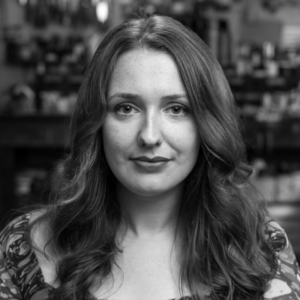
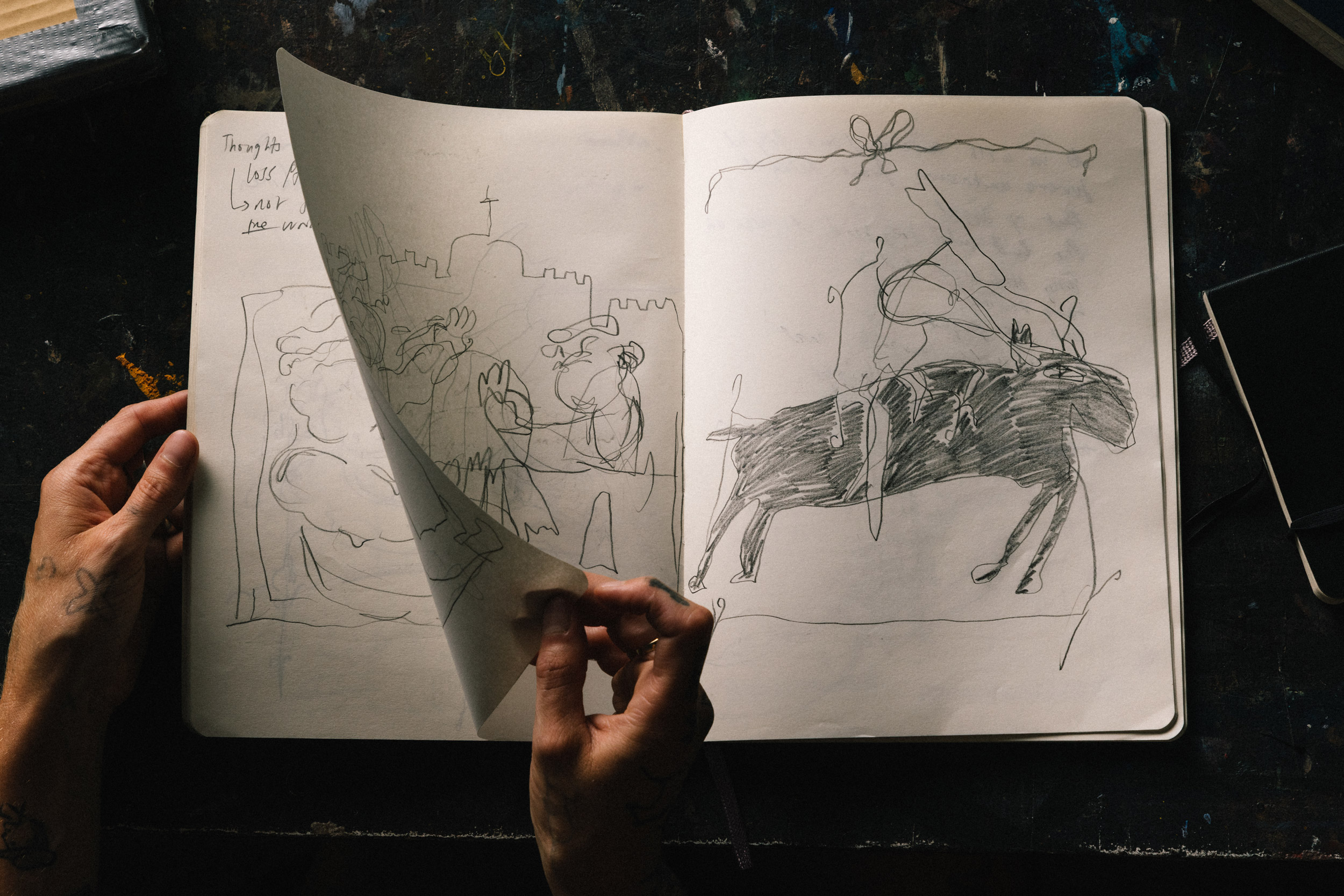
Evie May Adams is an artist, ceramicist, and illustrator from East Sussex, UK. Her work is rooted in the folklore and history of the local area, drawing inspiration from antiques and artefacts dredged from the sea or uncovered in the landscape, which she then combines with elements of modern design. She visited us in the Jackson’s Studio to discuss her sketchbook practice, including the importance of playfulness, how her sketchbook serves as a visual sourcebook for her ceramic work, and the value of making work purely for herself.
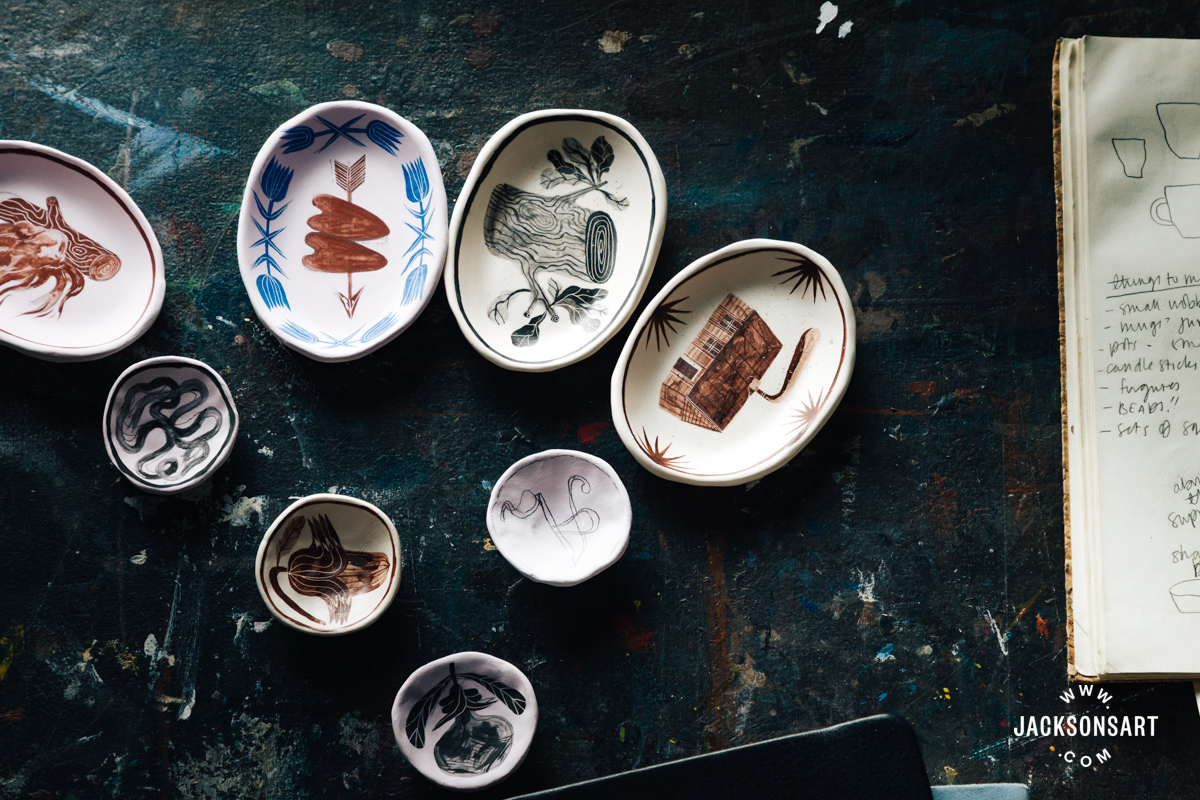
I usually have around two sketchbooks I’m drawing in at one time, each designated for different things; one for ‘work’ and one for ‘play’. My work sketchbook is where I map out thumbnails for commissions and sketches for pet portraits. I also use it to explore new ceramic shapes and design ideas. Anything to do with commissioning and selling goes in here.
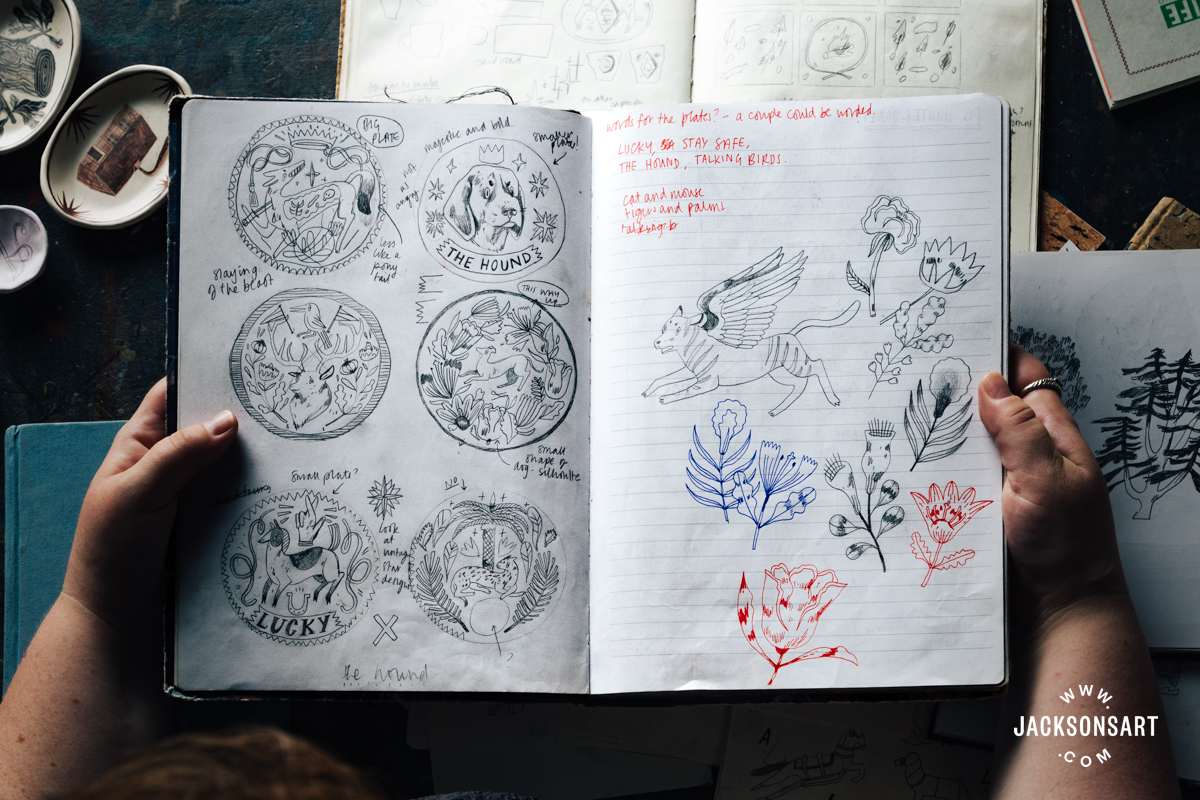
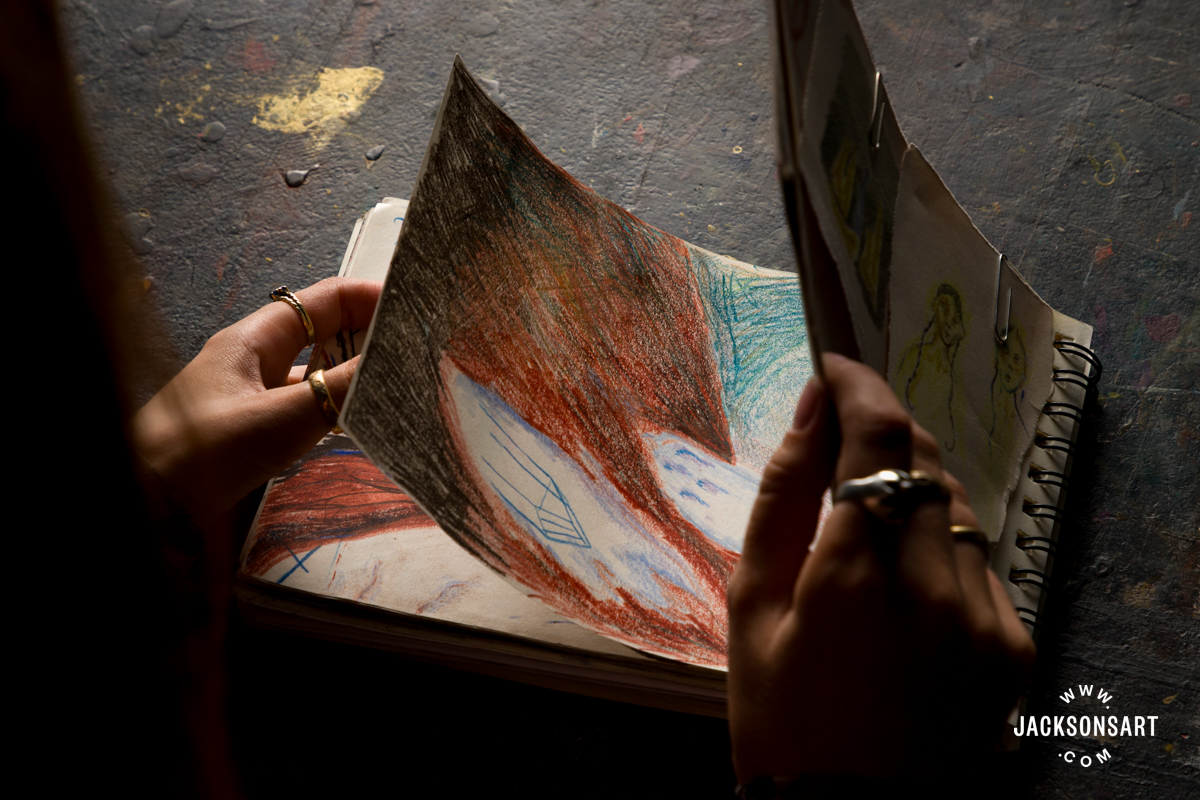
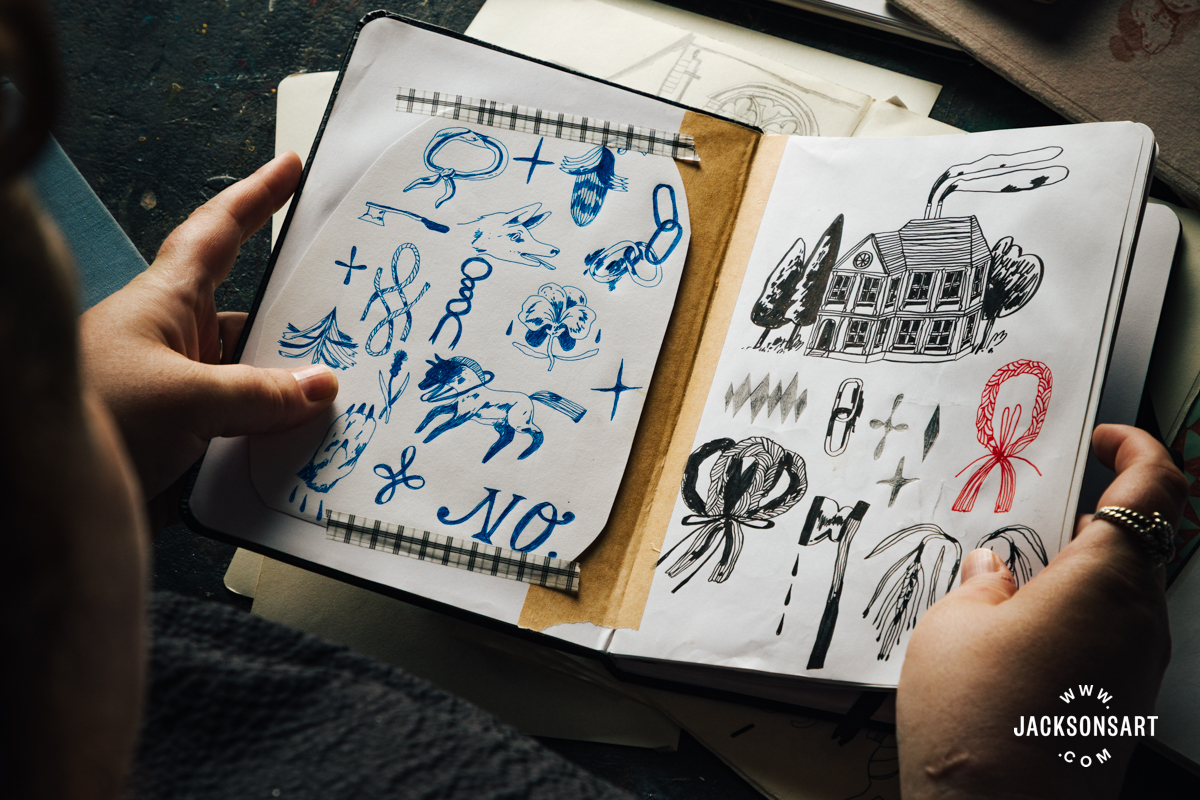
I like to treat my play sketchbook as an artist’s book. I draw for fun in here, or from life, making sure there are no thumbnails or plans. I’ll be exploring things I’m into or testing out new pens. This is the sketchbook that I grab and spend some time with when staring at a screen is becoming too much!
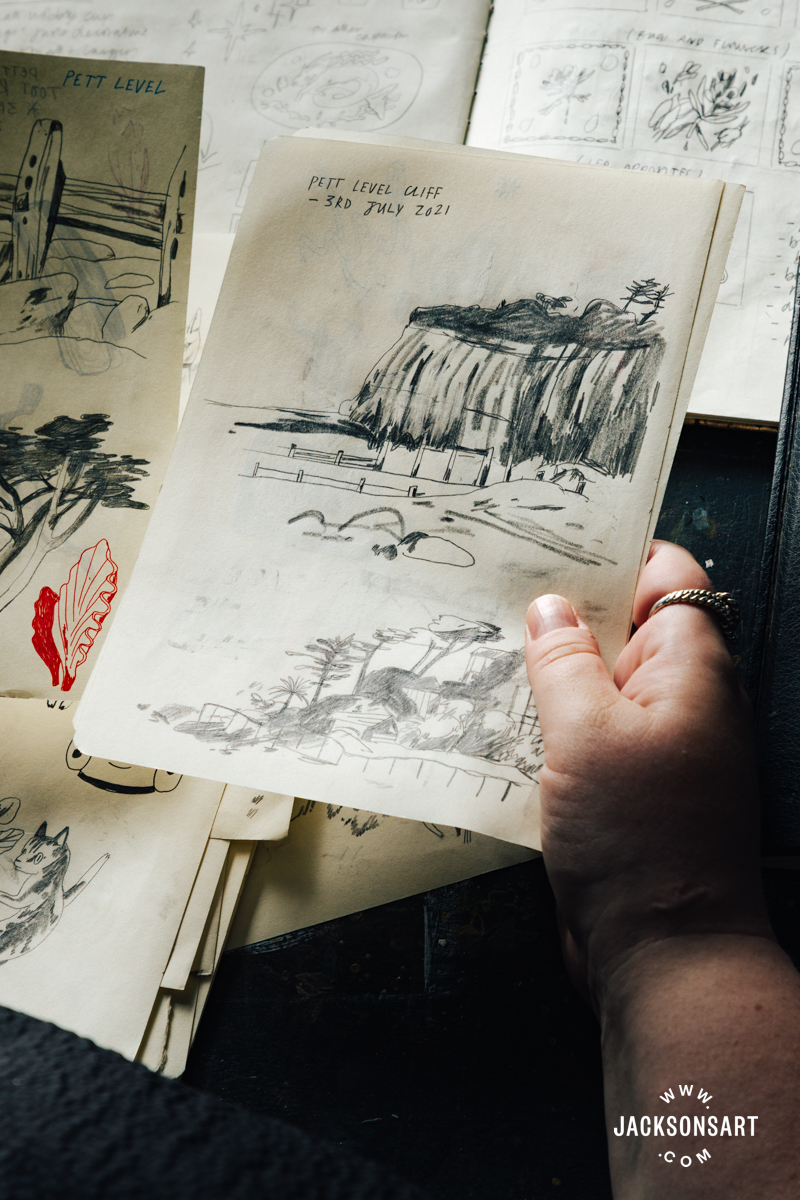
I feel quite precious about it; I make sure every page looks nice and rip out things I’m not into. Perhaps it’s like my own little portfolio of my work, just for me. I avoid looking at my ‘for work’ sketchbook when I’m playing, but sometimes when I’m working, I’ll have a little peek into ‘for play’ to refresh my ideas.
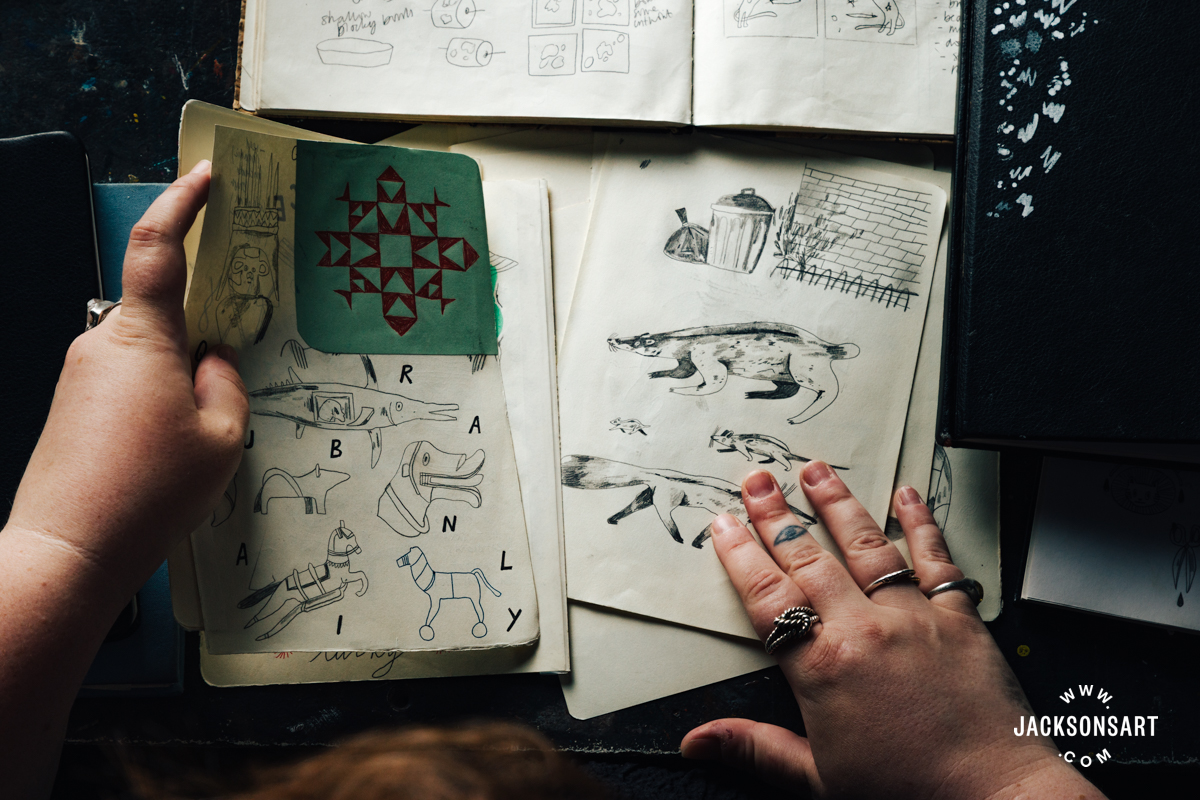
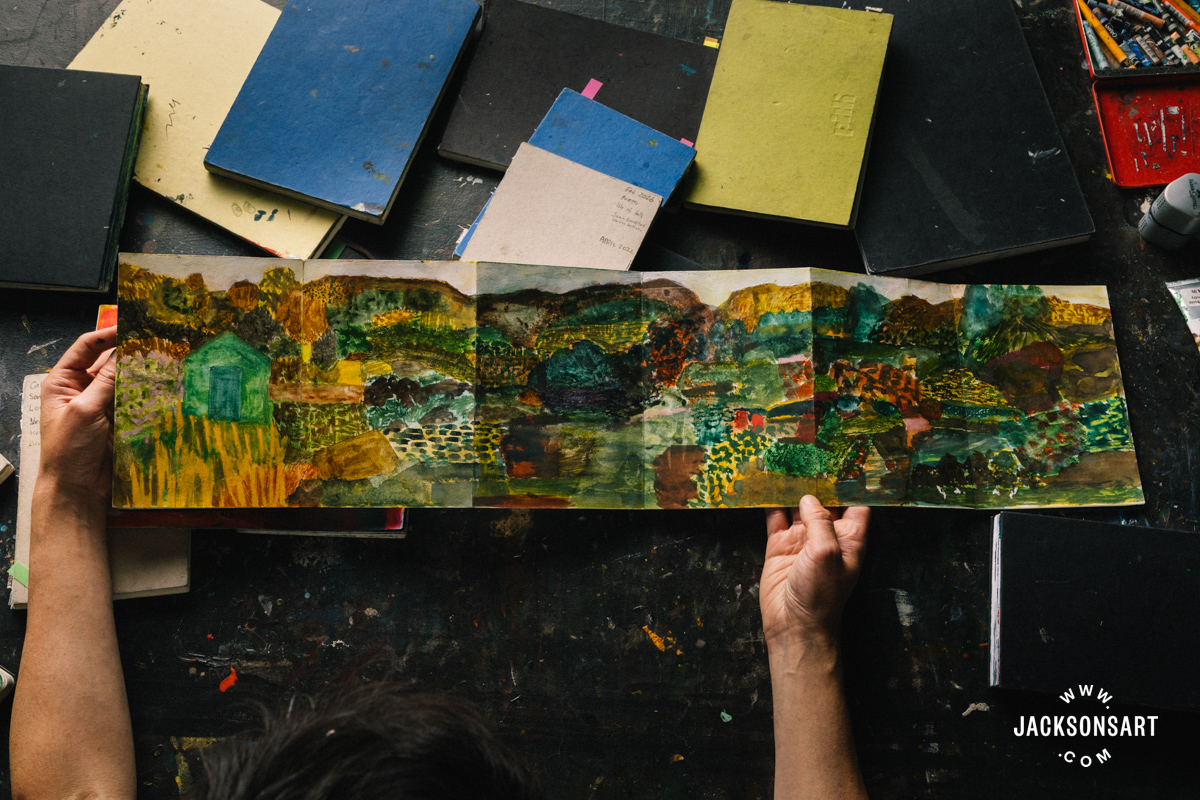
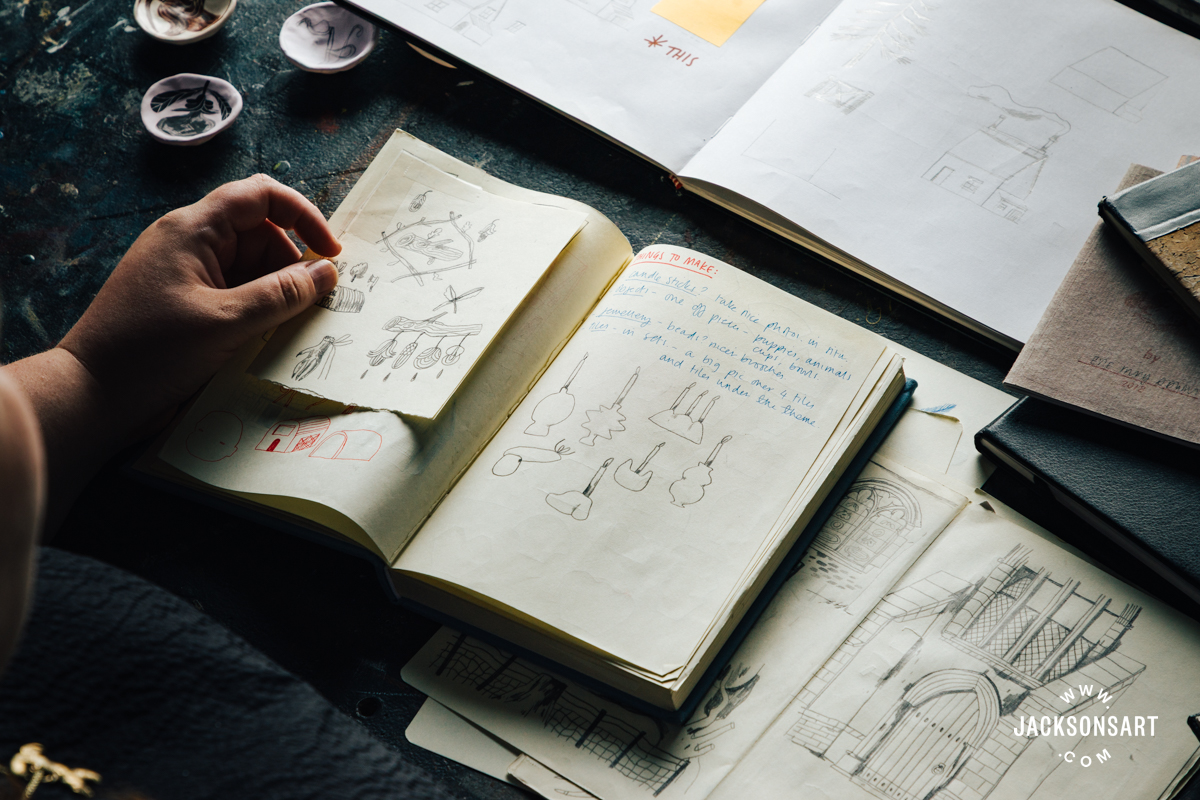
The sketchbooks and paper I use are far from anything special. I really like the feeling of drawing on very cheap, thin paper, the stuff that makes a crinkly sound when you turn the page you’ve drawn on and bleeds through with any type of pen. I’ve tried using more expensive books, but I get very nervous about messing them up – something I’ve been trying to get over my whole artistic career! The books I’ve enjoyed using the most are notebooks, hardback, and no bigger than A5.
I keep a core collection of materials in my pencil case, or chucked into the bottom of my bag. A rubber, a pen, a couple of felt-tip sign pens in different colours, and a pencil. I know I can usually do what I want to do with just these items. However, if I’m staying somewhere for a while, or I’m just at home, I’ll upgrade this to include scissors, glue, a graphite stick, and some more random pens I want to try out (these get swapped out regularly), and a thermal printer. The thermal printer is a new edition, and I’m obsessed with it. I use it to print out reference photos and stick them in my books straight away. Very convenient and very cute.
Embarrassingly, my pencil case at the moment is an IKEA freezer bag! My last case recently smashed into a million pieces. It’s grungy, but it works for me at the moment as it’s very light and easy to see what I’ve got inside. I promise I’ll upgrade it soon!
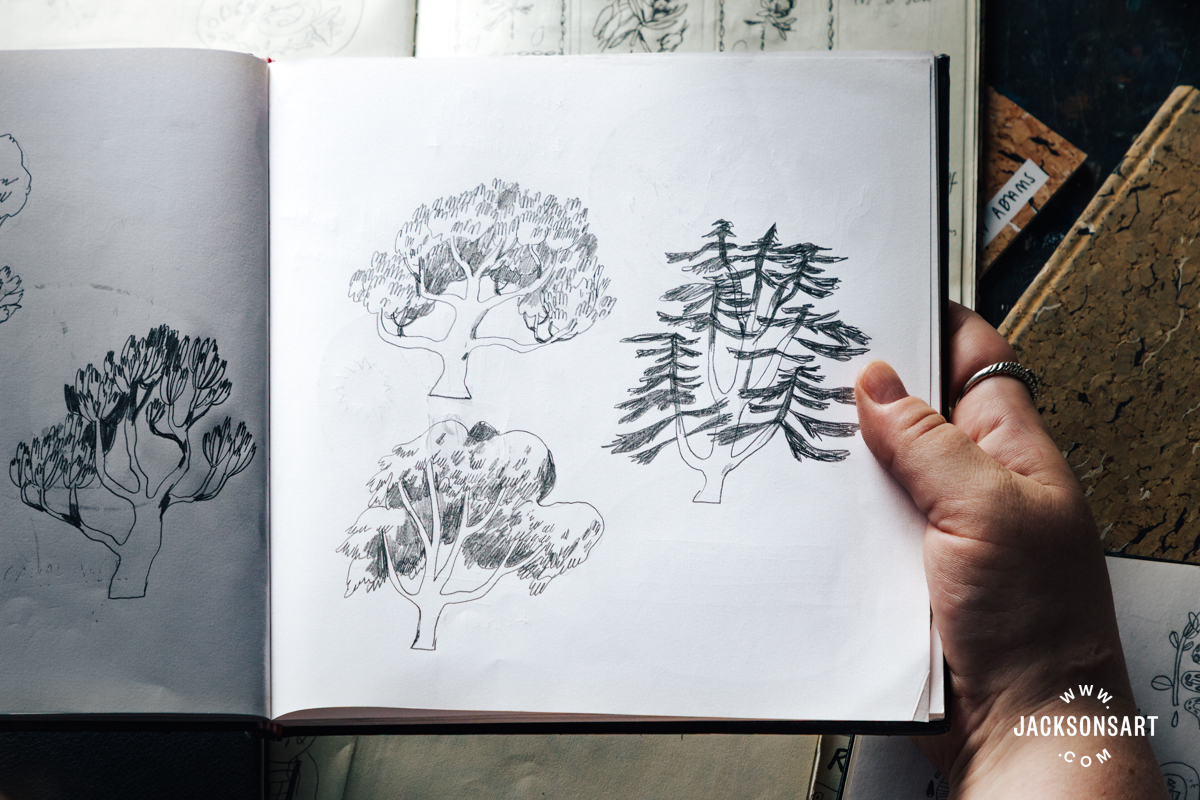
I use mainly my thin ‘single line’ pens and mechanical pencils. I’ve actually only ever used mechanical pencils over regular pencils since I discovered them at university and fell in love with their ease – no pencil sharpenings – and their solid line. However, you can still achieve a tonal drawing with them when using the right lead. I keep two on me, 2B and 4B.
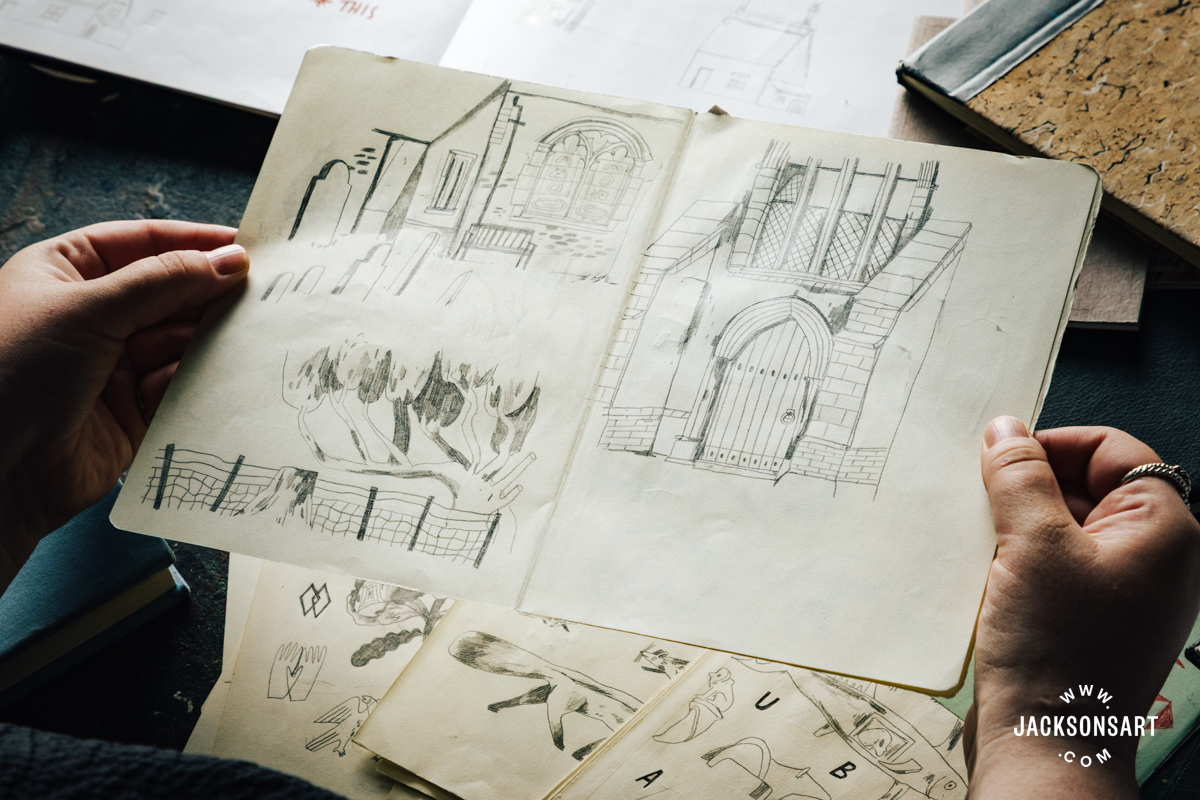
I’ve been quite bogged down with big projects at the moment and have found it hard to make time for sitting with my sketchbook, so these are perfect ‘grab and go’ materials for when I suddenly have the urge or find myself with a few free hours.
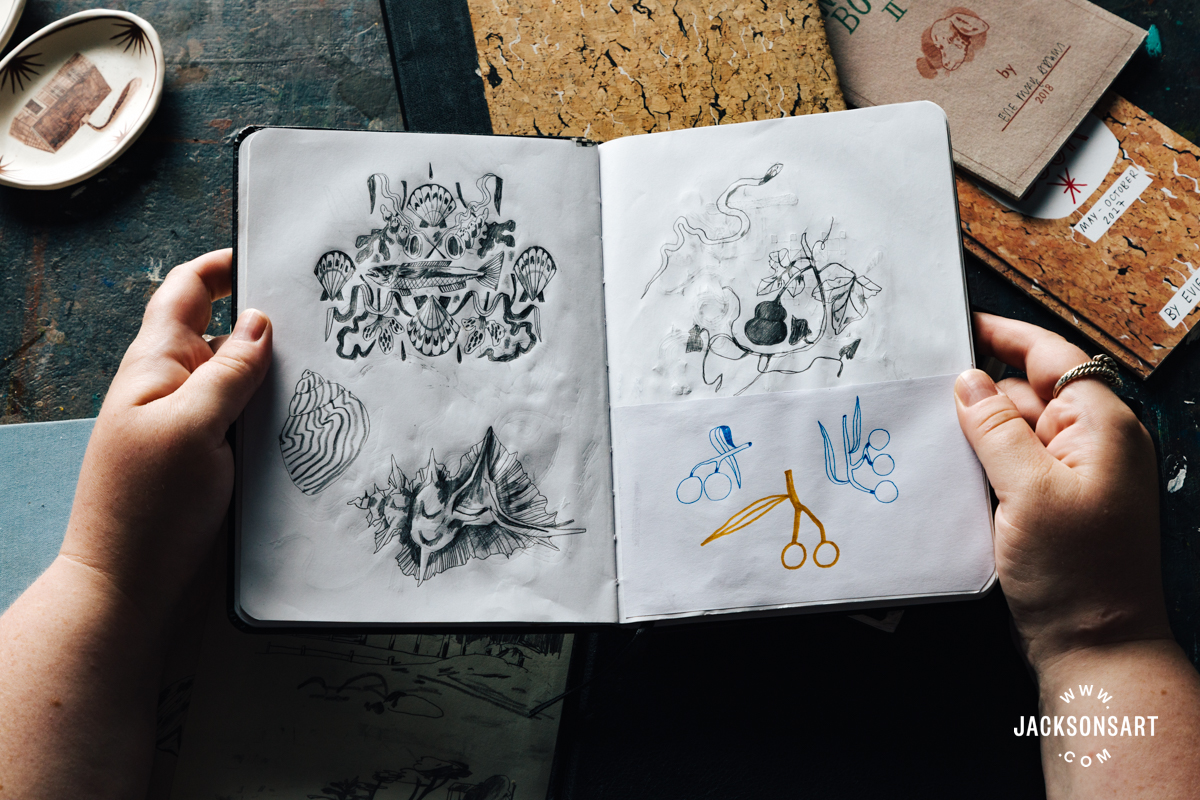
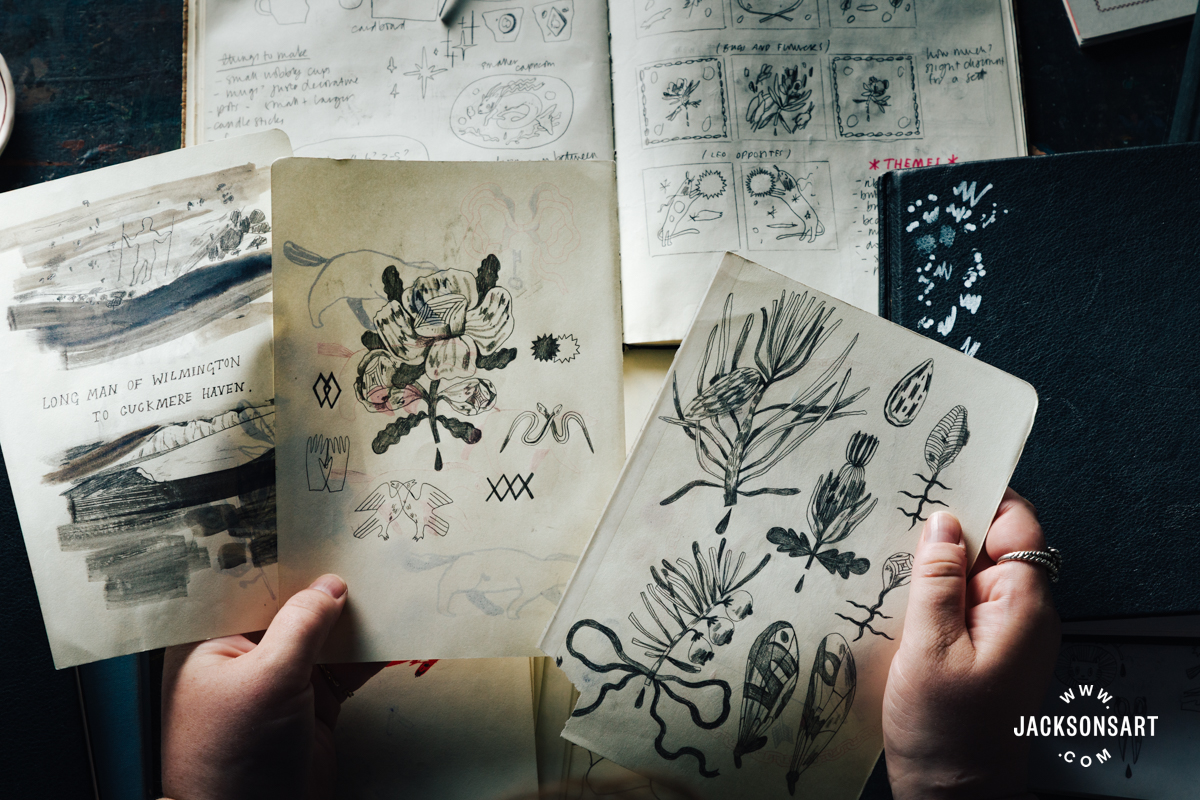
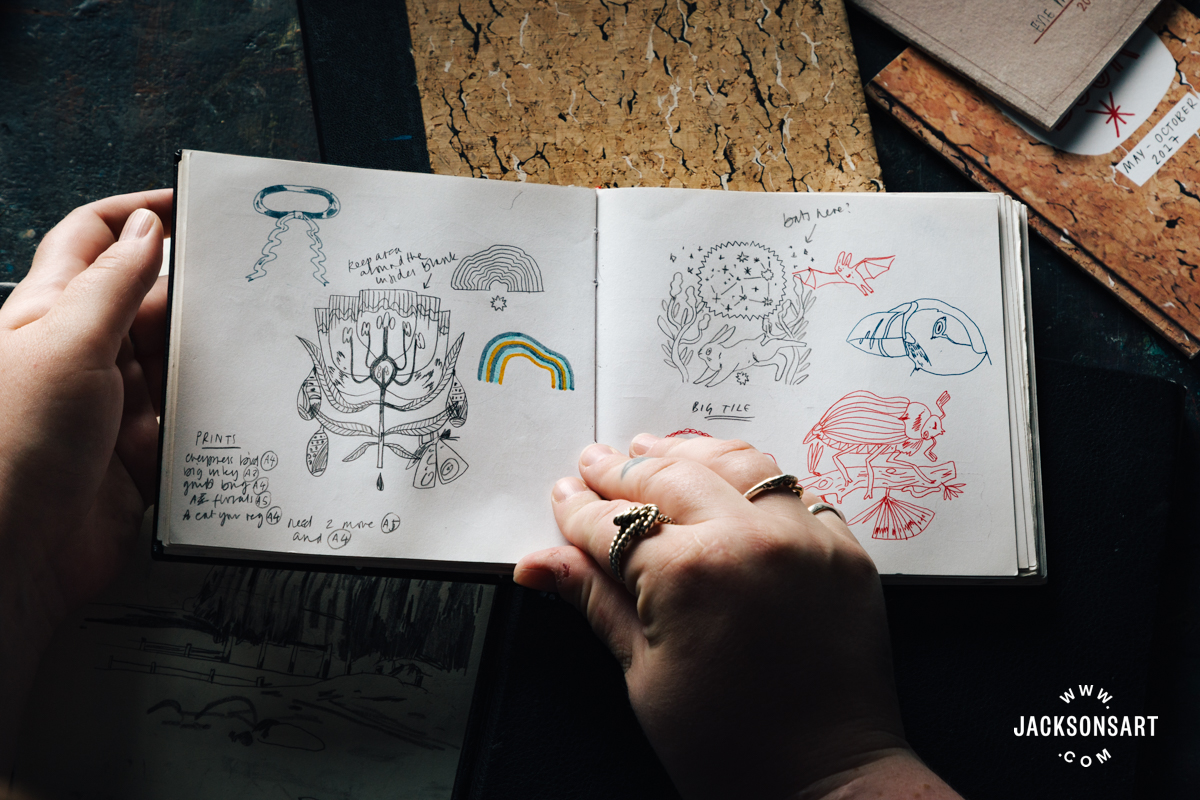
I refer back to my books quite a bit when making. Obviously, my work sketchbook, for the plans and thumbnails for commissions, but I will also use this book as a brain dump with motifs and imagery for ceramic pieces to sell. These will be a variety of shapes and creatures, far less thought out than in my play sketchbook. Things I’ve seen or thought of in the middle of the night, ‘I’ve got to get that on a plate’ – some of them copied out of old nature books, most of them straight from my imagination. My version of a notebook, I guess!
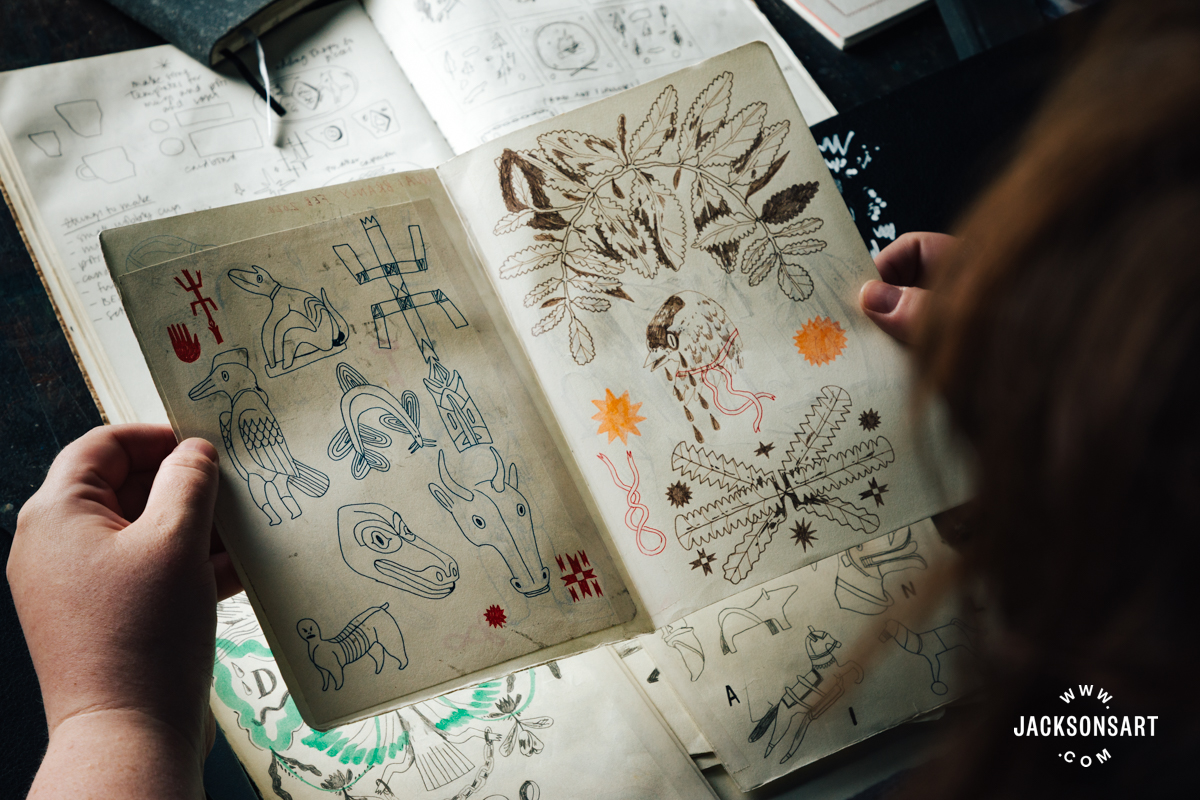
These pages will always be open when I’m working on a ceramic collection. Usually alongside past work sketchbooks and their pages of scribbles. I’ll sit with a stack of blank dishes, tiles, and plates. Then work through each one, sketching out an idea straight onto the piece, referring back to my drawings. After, I’ll glaze them all in one go. I’d also say that maybe my unglazed ceramics are an extension of my sketchbook, or at least the next small step before a finished piece, where I am refining an idea.
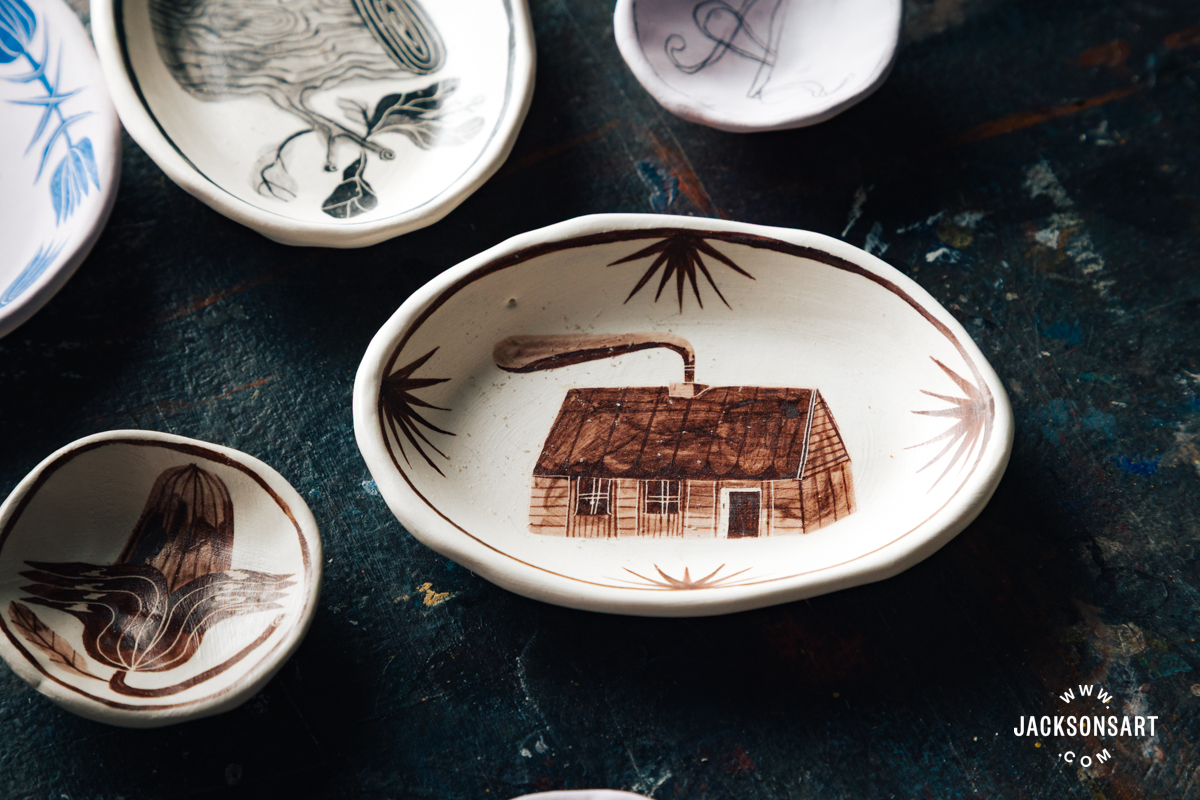
I feel that shape and form are very important to me in all areas of my work. I’d like to think my drawings show this off by being precise and confident. This also really helps when translating them over from page to ceramic, helping me visualise the base layer of stain, where I’d need to fill in or where I’d need to take out. With the stains I work with, things can get very messy and muddy very quickly.
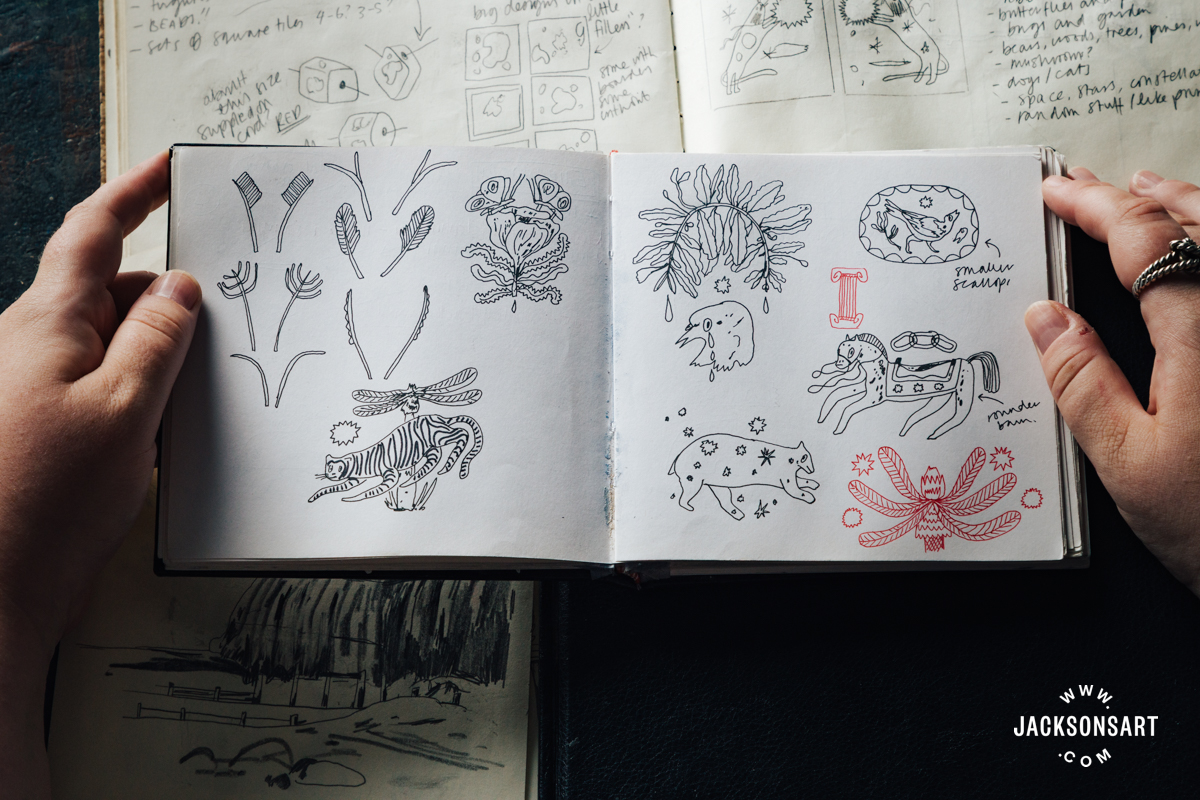
To have a nice, solid shape to start with usually helps everything fall into place, and luckily, I usually can lift these right out of my books, then add texture, brushstrokes, and sgraffito detailing.
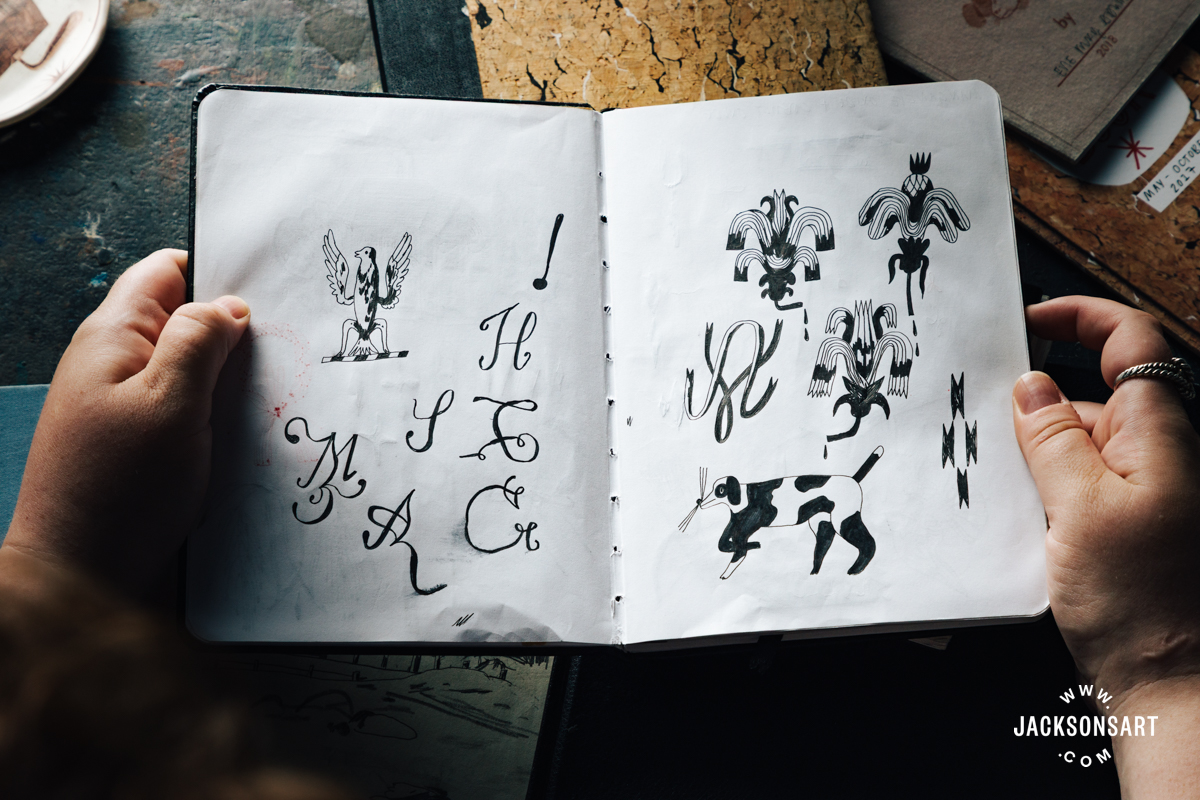
I’d say my advice for others wanting to make the most out of their sketchbooks, whether it be professional artists or someone just picking up drawing, is to try to remember that they are for you and only for you!
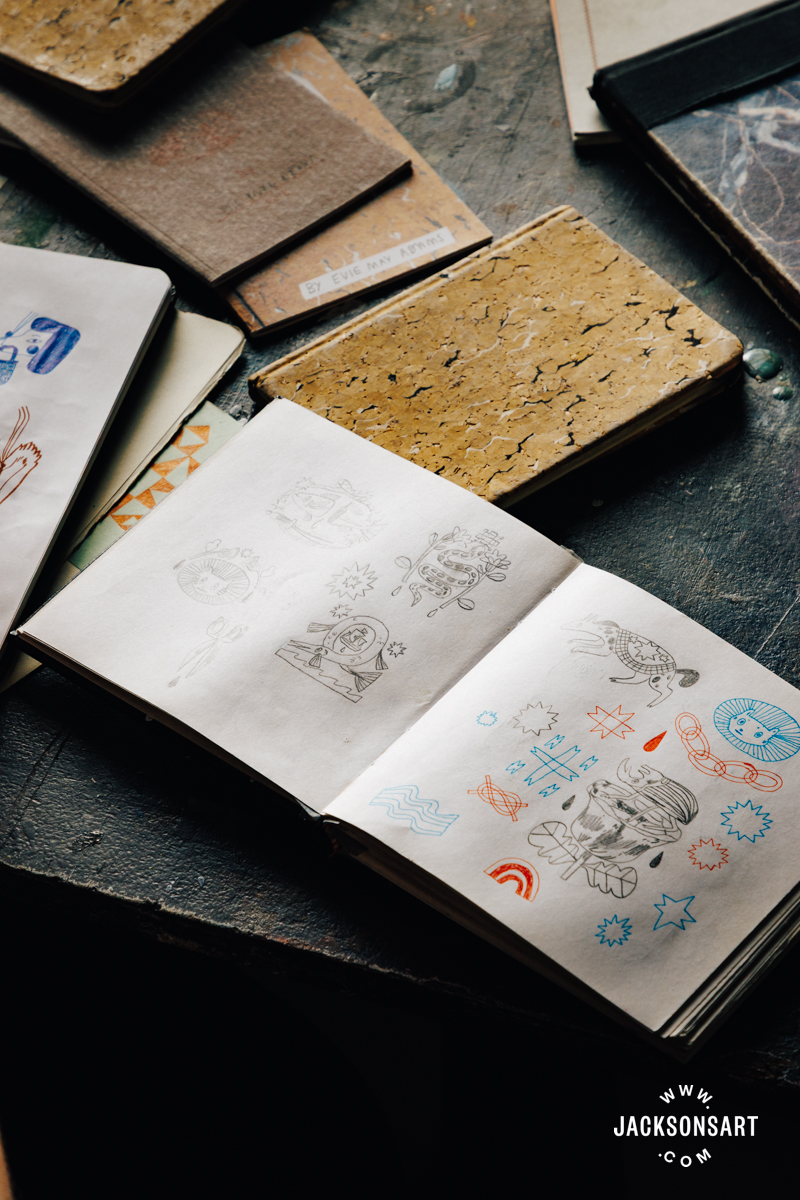
I’d say that I still struggle with this, I am so very precious about my play sketchbook (but perhaps that is just me, making it look ‘right’, for me!) And comparing myself to artists who use their sketchbooks for amazing full-colour miniature works of art. I must remember, and you must remember, that no one has to see it if you don’t want them to. Fill it with scribbles, fill it with paper cutouts, or just words. If it’s feeding your practice and your mind, then you are doing something right.
Materials
Mechanical Pencil lead in 0.5mm, 2B and 4B
Gel pens, 0.5mm, Blue, Black, and Red
Felt tip sign pens, Ochre, Blue, and Brown
Travel scissors
Thermal printer
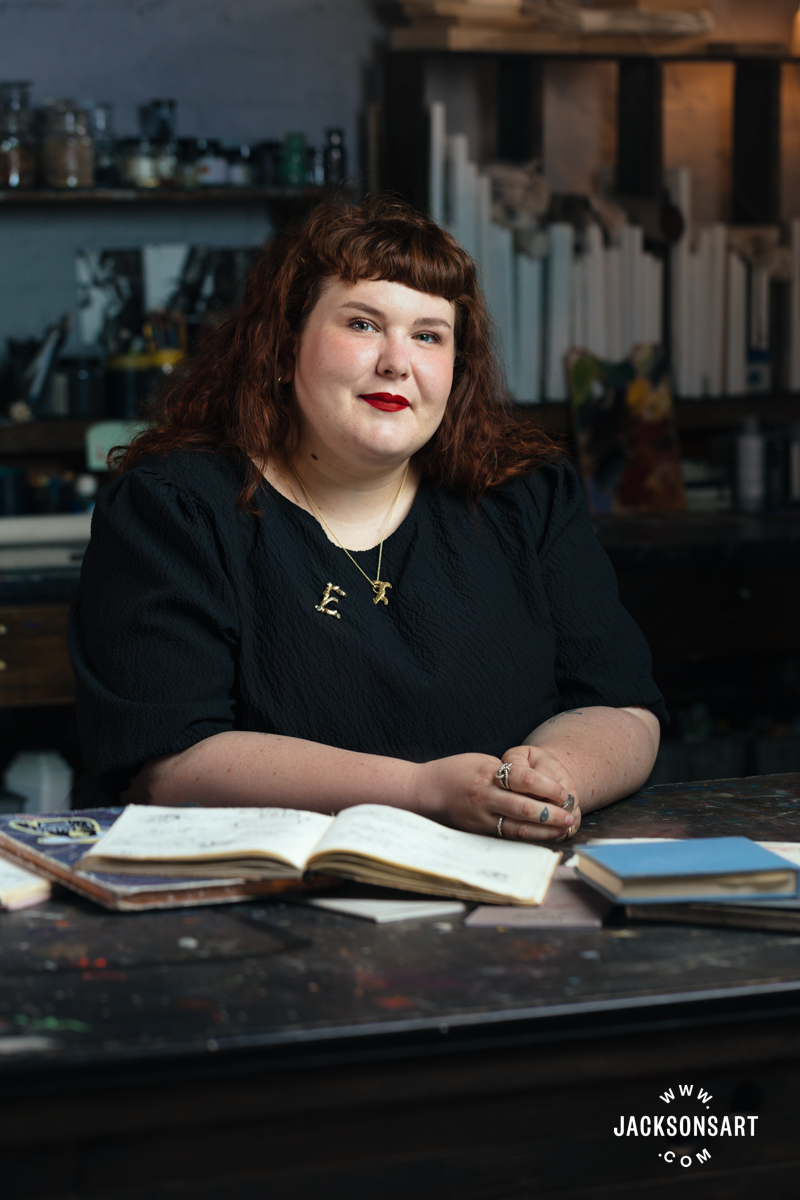
About Evie May Adams
Evie May Adams is an artist, designer, ceramicist, and illustrator based in Hastings, UK. Her work draws upon British folklore and folk art, as well as history and archaeology. Evie studied Illustration and graduated from Norwich University of the Arts in 2015. She has exhibited her work in the UK as well as internationally.
further Reading
Sgraffito Techniques for Painting and Drawing
Art through Symbols: Songbirds
The Dark History of the Pencil
Inside the Sketchbook of Alan Ashworth-Muñoz
Shop Sketchbooks on jacksonsart.com