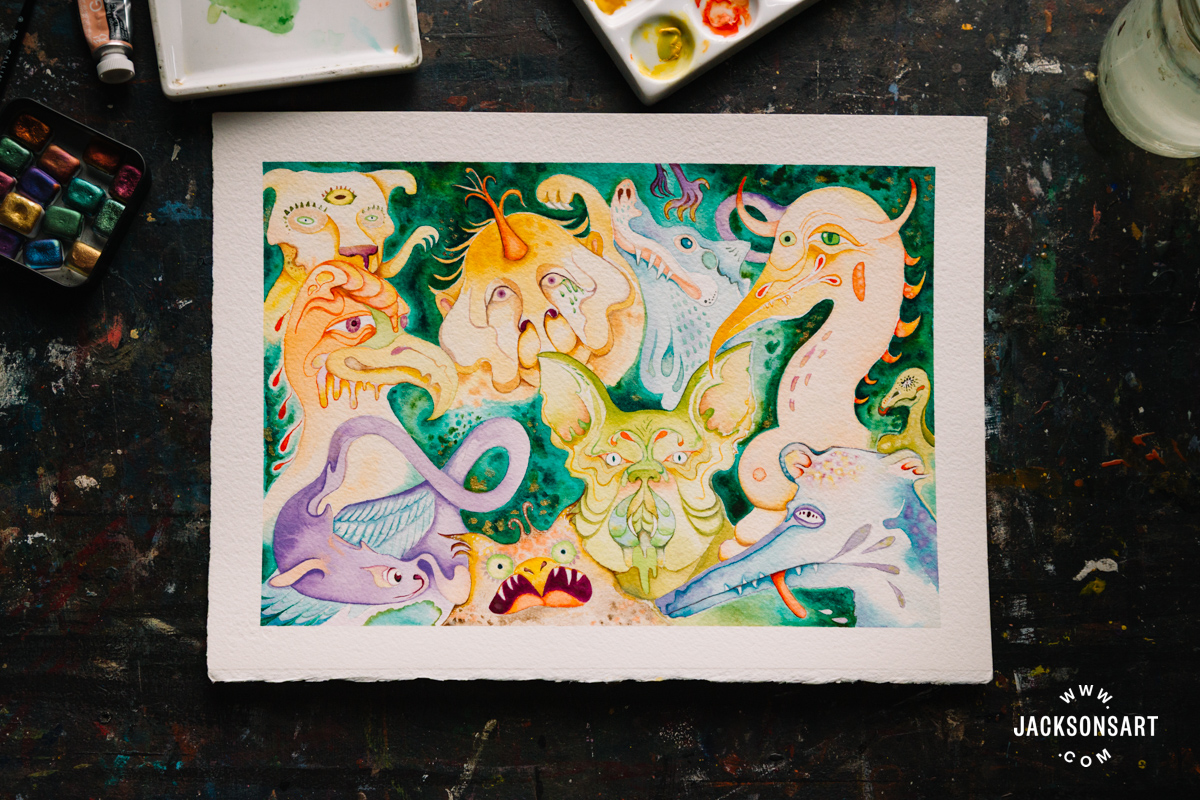
As the seasons change, and the warm months come to an end, farmers across the world reap their crops. This universal task renders the harvest a timeless subject for artists. Endurance and fragility contrasted against abundance and pleasure, and bound together for survival, has grown the harvest into a ripe symbol for the picking. Across cultures, gods were revered to ensure a bountiful crop, intrinsically tying essential resources and work to divinity. In other iterations, the harvest becomes melancholic, virtuous, and sometimes even erotic.
The Art Through Symbols series explores the interpretation of symbols throughout art history – whether cultural, religious, folkloric, or personal. Each article analyses a selection of artworks before offering an art-making tutorial inspired by the symbol for you to try.
Interpreting the Harvest
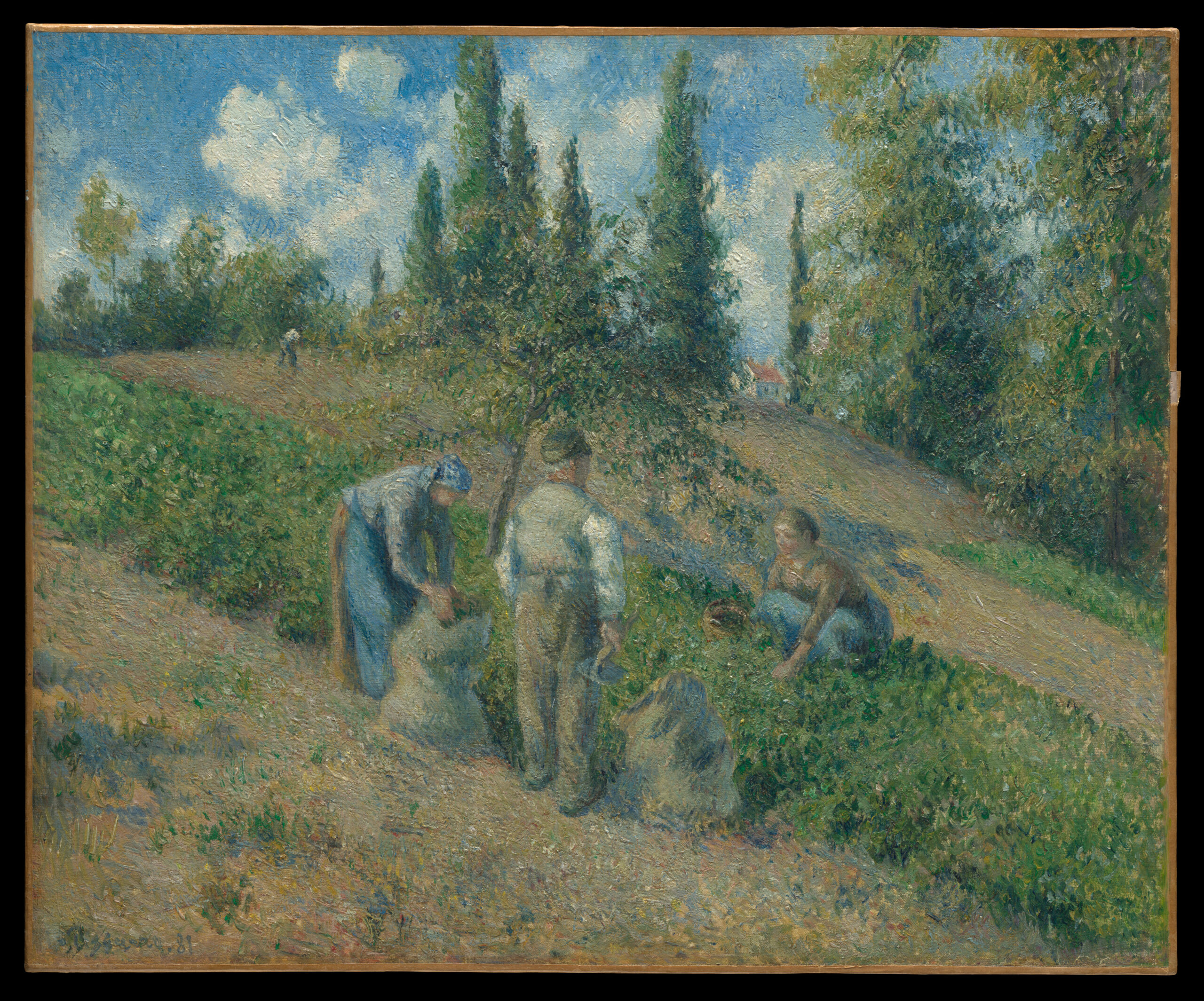
Camille Pissarro
Oil on canvas, 46 × 55.2 cm | 18.1 x 21.7 in
The Metropolitan Museum of Art
‘Blessed are they who see beautiful things in humble places where other people see nothing.’
– Camille Pissarro
In our past, the cycles of the harvest were more closely tied to people’s daily realities. Now, with many of us living in the sprawl of cities, a major proportion of the global population consumes produce without ever having to confront the reality of how it’s grown or collected. For many modern viewers, our detachment from agriculture has made artwork depicting the harvest seem idyllic. Yet the labour continues, albeit in most cases with greater industrialisation and scale. However much machinery has advanced, the forces of nature and the seasons are unavoidable factors in farming. This uncontrollable element of nature, and the influence humans try to exert over it, is essential to interpreting the harvest in artworks.
Across cultures, an abundant or poor harvest has been tied to the blessings or curses of the gods. This correlation is part of the intuitive human tendency to experience nature through a spiritual lens. Therefore, many artworks depicting the harvest carry a symbolic sense of piety or exultation, expressing the virtue of hard work. This is partly rooted in Christian parables that refer to the harvest, where the souls of virtuous believers become metaphors for crops ready to be reaped.
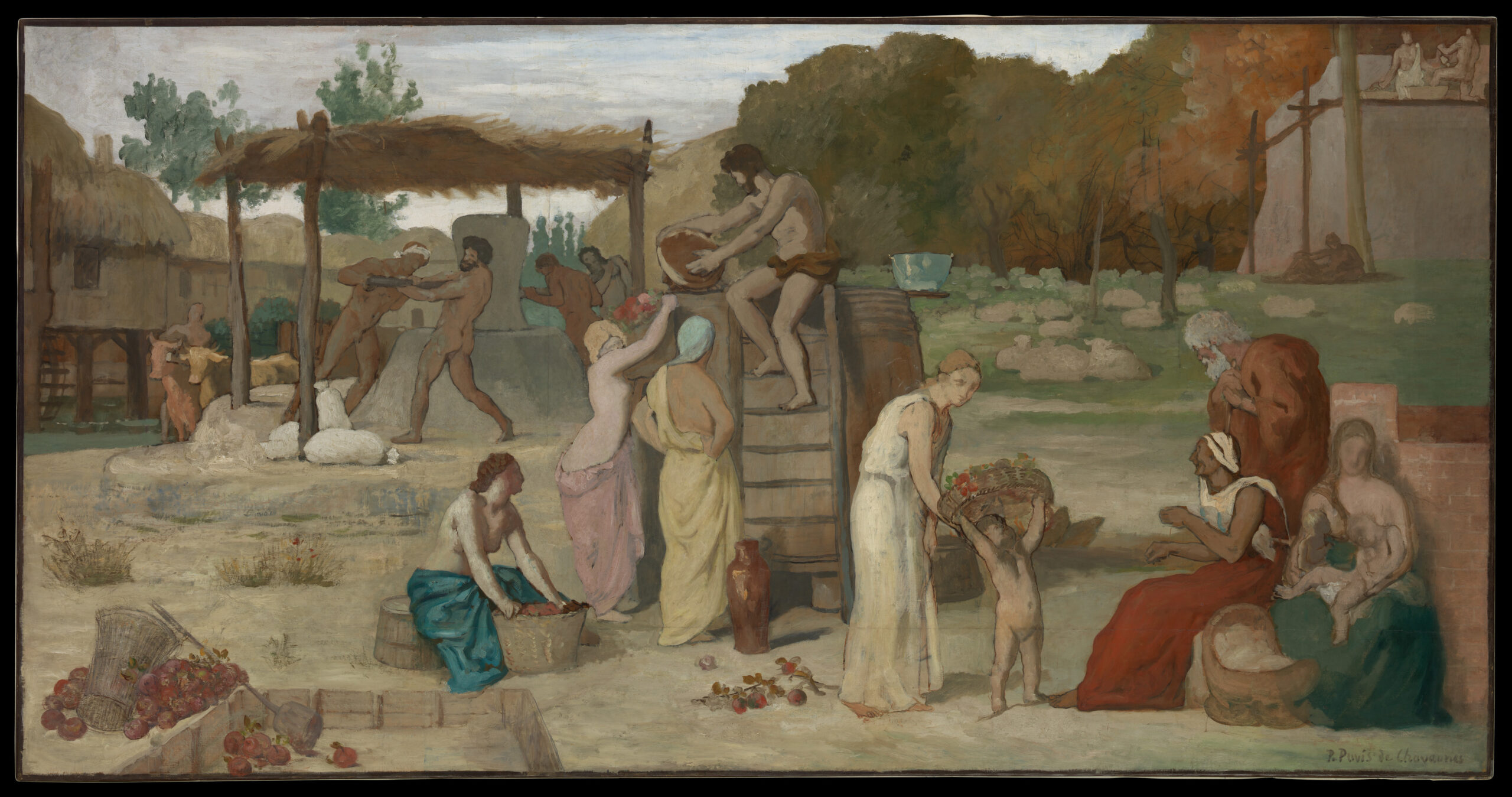
Pierre Puvis de Chavannes
Oil on paper, laid down on canvas, 129.5 x 252.1 cm | 51 x 99.3 in
The Metropolitan Museum of Art
Given the struggle involved in producing a bountiful harvest, it is no wonder that the idea of a utopian harvest appealed to artists who imagined a world where abundance required no toil. This is reflected in the eroticism of artworks depicting Greek and Roman gods relishing in hedonistic abundance, where love, sustenance, and indulgence are closely intertwined. These contrasting yet equally potent associations made the harvest an appealing subject for artists of differing ideologies, including the Romantics and Realists alike.
Divine Blessing
Shintō is a polytheistic and animistic religion from Japan, with an extensive mythology and folklore. It centres around a cast of supernatural beings known as kami which include deities, spirits, natural features, forces of nature, and even the dead. Kami are believed to inhabit the natural world and can possess both positive and negative traits. Inari is a kami who protects rice cultivation and appears in various forms in art. These include a young woman with long hair carrying rice, or a bearded man riding a white fox. White fox yōkai, or demons, known as kitsune, serve as Inari’s messengers, travelling between the spiritual and human realms and sometimes bringing news of bountiful harvests.
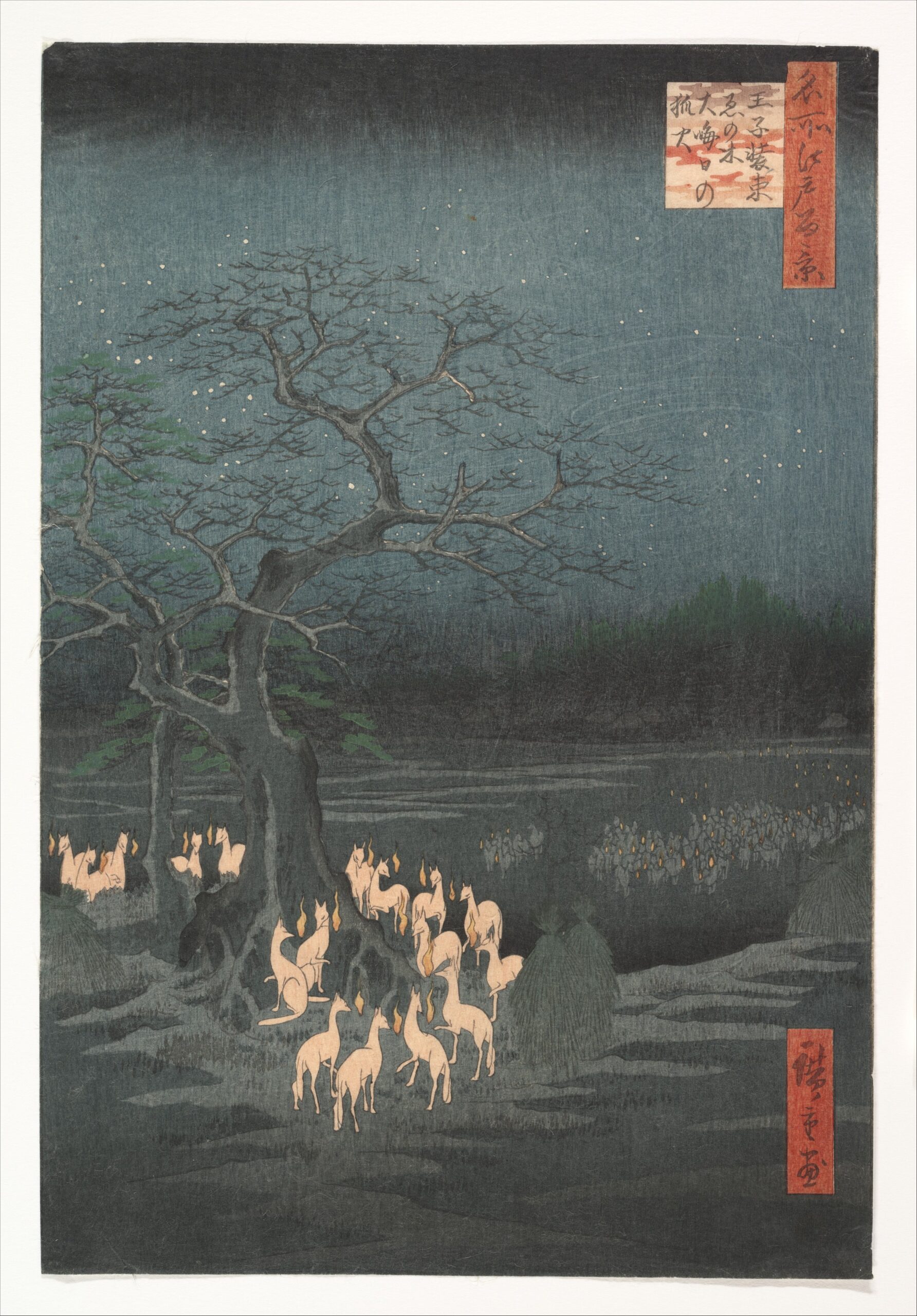
Utagawa Hiroshige
Woodblock print on paper, 32.5 × 21.9 cm | 12.8 x 8.6 in
The Metropolitan Museum of Art
At countless Inari shrines across Japan, fox statues stand as guardians, where farmers, merchants, and consumers alike show devotion in the hope of securing prosperity and sustenance. In New Year’s Eve Foxfires at the Changing Tree, Ōji, by Hiroshige, the kitsune assemble beneath the Changing Tree, near the Inari shrine in Ōji. According to folklore, on their way to to celebrate, the foxes light mysterious fires known as kitsunebi, which farmers count to predict the success of the coming rice harvest. Each fox cultivates their own flame in front of them, illuminating the shadowy darkness of the landscape they bring hope to.
Labour, Endurance, and Fragility
Artists of the Naturalist movement, which spanned the late 19th and early 20th centuries, often venerated agricultural workers in their paintings. Through the hardship of their labour, these workers embodied the perfect subject matter to be painted with careful realism. In The Song of the Lark, a peasant girl stands proudly, her face upturned in awe as she listens intently to a lark’s song. She grasps her sickle confidently, completely at one with the landscape around her bathed in the emerging light of the rising sun. Jules Breton was from Courrières, a rural village in northern France. His experiences here gave him a deep empathy for the farm workers he depicted. By representing them with dignity without diminishing the difficulty of their work, his works are amongst some of the most poignant portrayals of harvesters. For Breton, the harvest becomes a symbol of noble duty.
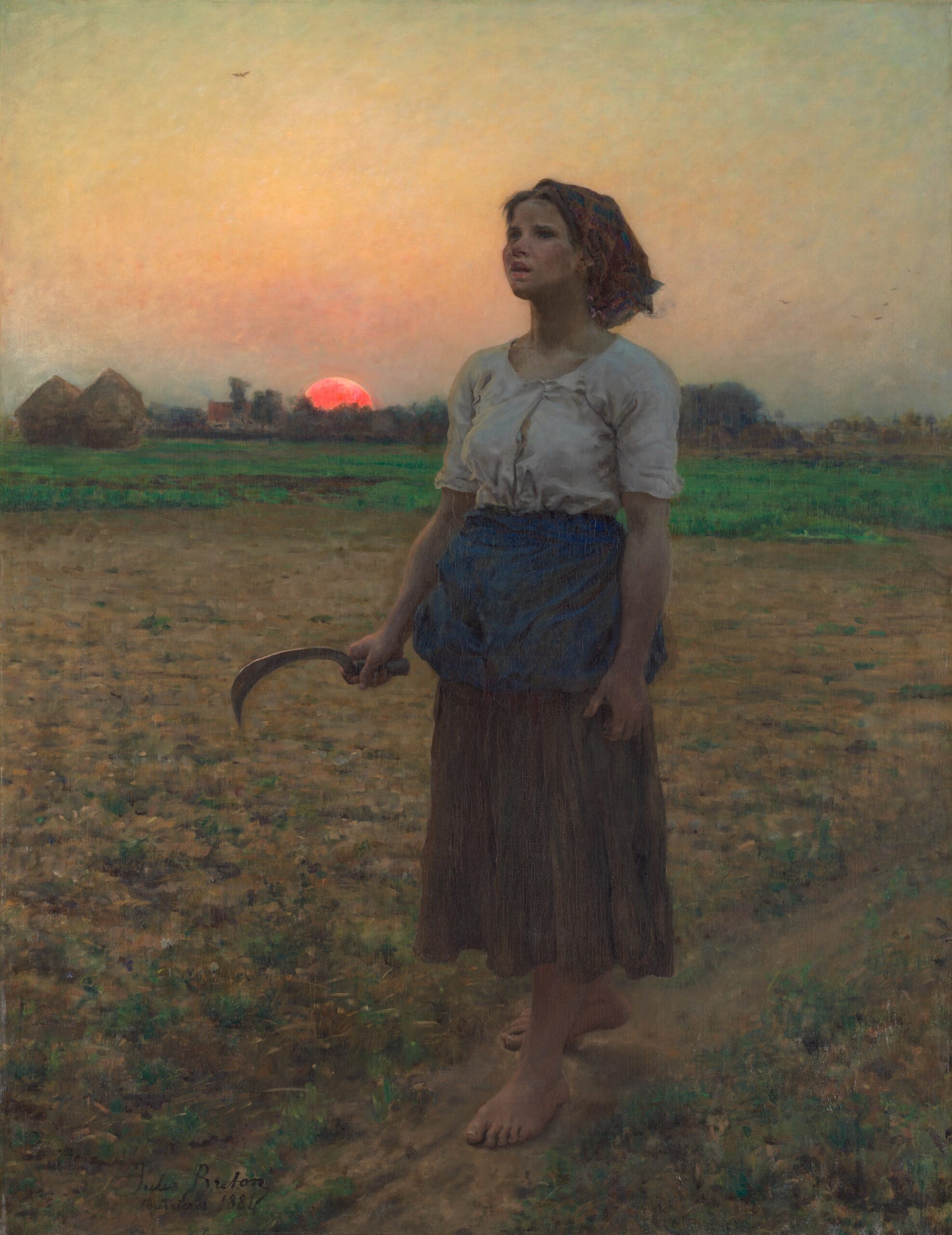
Jules Breton
Oil on canvas, 110.6 × 85.8 cm | 43.5 x 33.8 in
Art Institute of Chicago
The Gleaners by Jean-François Millet is amongst the most renowned paintings depicting labourers in the landscape. In it, three women toil uncomfortably, bent towards the ground. They methodically comb the freshly harvested wheat field for any stray stalks left behind, tasked with collecting them one by one. The austerity of their task contrasts directly with the abundance of the stacks of wheat in the field beyond them. Class stratification adds further contrast to the work, as a steward on horseback supervises the harvest in the background. Another of Millet’s works, A Norman Milkmaid at Gréville, was painted after he returned to his hometown for a year to escape the Franco-Prussian War. On his return he wrote:
‘I went over the fields that I once plowed and sowed. Where are those who worked with me? Where are those dear eyes that, with me, gazed over the scratch of the sea?’
The painting is imbued with melancholy and a sense of loss, conveyed by the strong, solitary woman dramatically backlit by the setting sun.
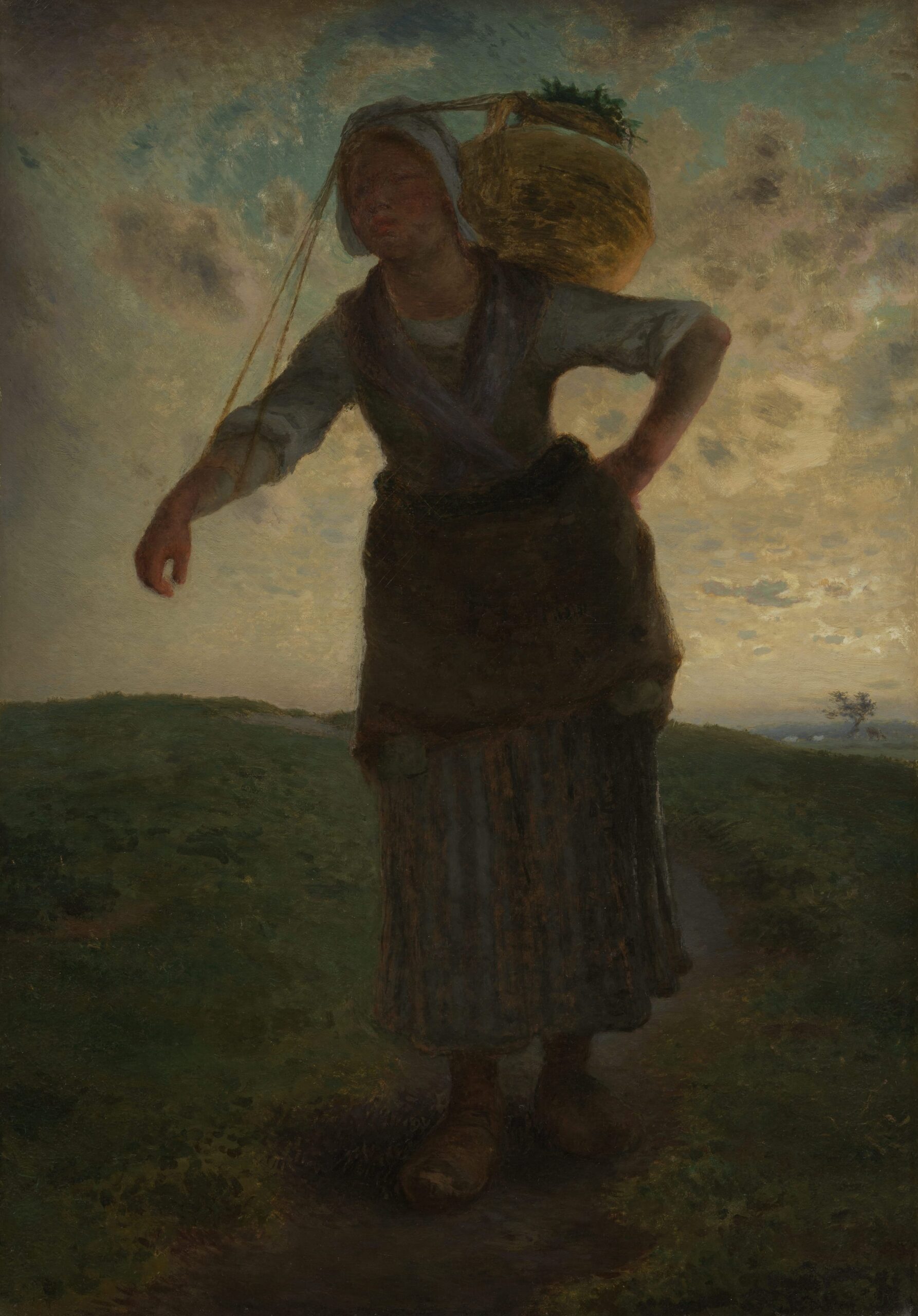
Jean-François Millet
Oil on canvas mounted on paperboard, 80 × 55.6 cm | 31.5 x 21.9 in
LACMA
Artworks of agricultural labourers have persisted throughout modern and contemporary art, including one of the most famed series of photographs in art history, which includes Destitute Pea Pickers. Dorothea Lange pulled onto a side road after seeing a sign marking a camp for seasonal farm workers in Nipomo, California, whose livelihoods had been destroyed by a failed crop from freezing weather. There, she photographed a mother, Florence Owens Thompson, and her seven children living in poverty. These photographs consciously emulate traditional imagery of the Madonna and child. The series became emblematic of the strife experienced by migrant workers during the Great Depression. Here, the harvest is dually symbolic of human resilience and fragility.
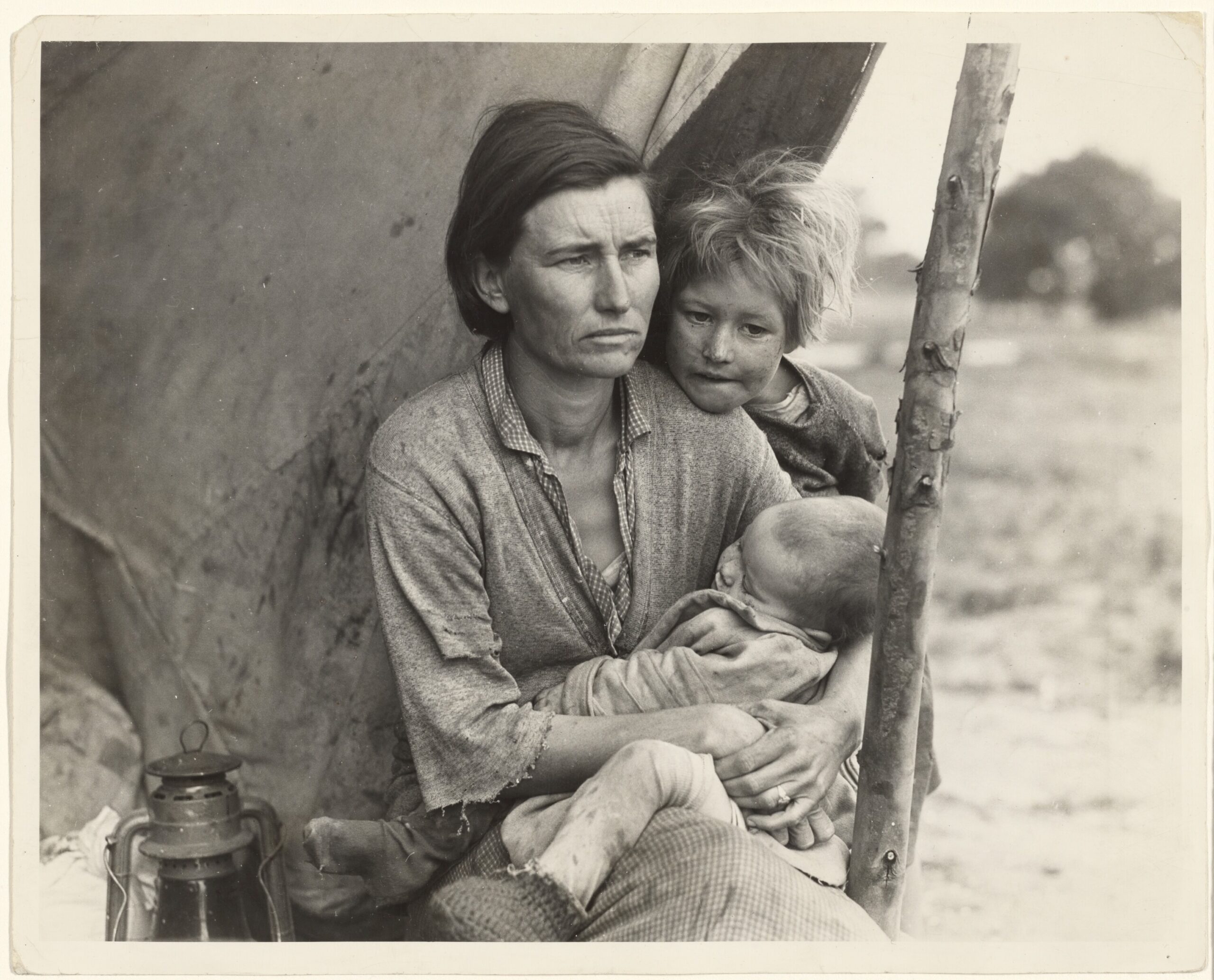
Dorothea Lange
Gelatin silver print, 19.1 × 24.3 cm | 7.5 x 9.6 in
Getty Museum
Rebirth and Sacrifice
Osiris was an incredibly busy god in Egyptian mythology. Alongside his role as King of the Underworld, tasked with the judgement of the dead, in which their hearts were weighed against the feather of Ma’at to deem their worthiness to enter the afterlife, Osiris was also believed to merge with every deceased pharaoh to become him in death. Osiris provided fertility and agricultural prosperity through the annual flooding of the Nile. It was believed that the flooding of the Nile was caused by bodily fluids flowing from Osiris’ corpse after he was murdered by his brother Set, the god of chaos and disorder. Osiris was viewed as the ‘first mummy’, as his body was reassembled by Isis, who ritualistically wrapped him in linen to prepare him for rebirth.
In artworks, Osiris is often depicted with green skin, representing the fertile banks of the Nile which he brought to life each year through his rebirth. He embodied death, judgement, resurrection, and growth through his cyclical nature – maintaining the balance of the universe and mirroring the agricultural calendar. To ensure a bountiful harvest, priests would create corn mummies set in coffins in the image of Osiris. They would fill these with mud from the Nile and grain seeds, such as barley and wheat, which they would water and allow to sprout. The previous year’s corn mummies would be buried as new ones sprouted, to symbolically make way for his rebirth, and ensure the next harvest.
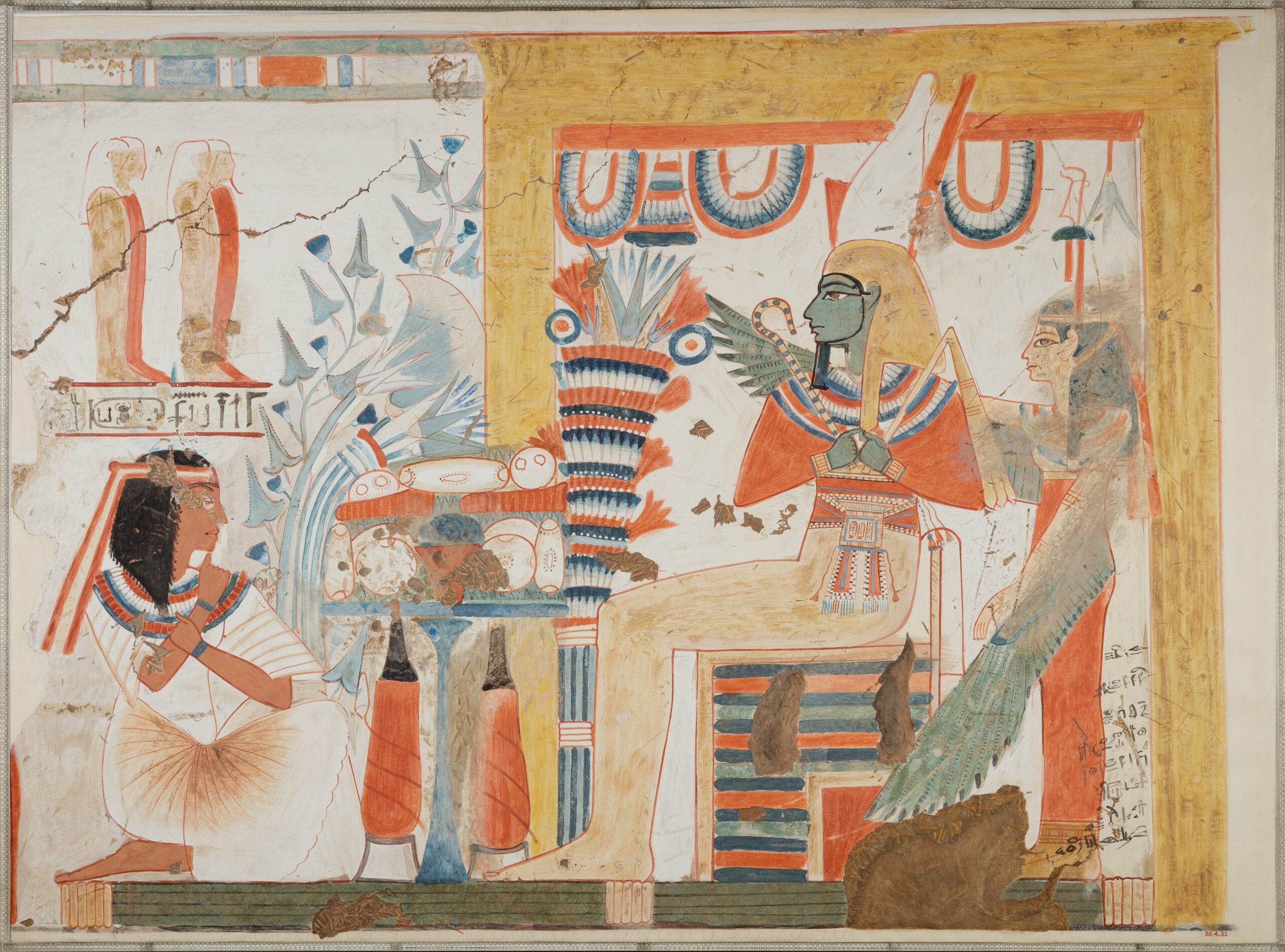
Norman de Garis Davies after New Kingdom artists
Tempera on paper, 67 × 91 cm | 26.4 x 35.8 in
The Metropolitan Museum of Art
In Greek mythology Demeter, known as Ceres to the Romans, was the goddess of the harvest, agriculture, and fertility and is often depicted holding grains, fruits, or flowers. Demeter was sometimes regarded as an earth goddess in a broader sense by certain cults that venerated her. She gifted the knowledge of agriculture to humankind, therefore giving them sustenance. Her daughter Persephone is also associated with the cycles of the seasons. She was abducted by Hades, god of the underworld, who wanted to marry her. Demeter’s grief at her daughter’s kidnapping caused the earth to become barren and all the world’s crops to fail, and Zeus ordered that her daughter be returned, provided she hadn’t eaten anything in the underworld. Hades tricked Persephone into eating a few pomegranate seeds, which kept her bound to return to him annually for half the year. Her return from the underworld each year marks the beginning of Spring, and her descent marks the beginning of Autumn, when the crops become ready to harvest.
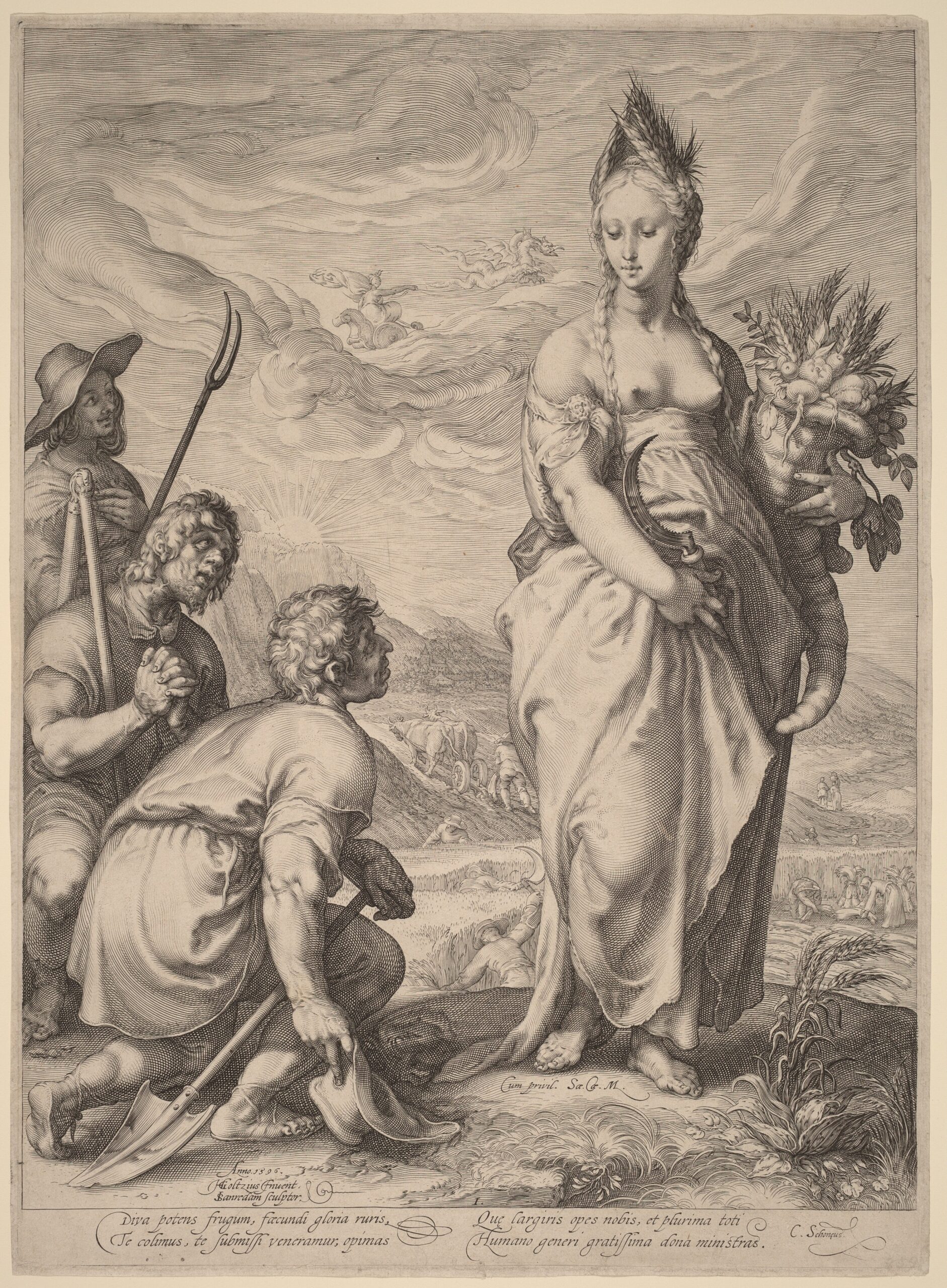
Jan Pietersz Saenredam
Engraving on paper, 44.4 x 32.3 cm | 17.5 x 12.7 in
National Gallery of Art
Love and Hedonism
Roman Bacchus, known as Dionysus in Greek mythology, was the god of the grape harvest, orchards, and fruit, and was said to have created wine for his debaucherous parties. Beyond this bucolic veneer, he was also the deity of insanity, ritual madness, and theatre. Some of the most famous paintings in the world depict the god of the grape harvest, such as Caravaggio’s Bacchus and Titian’s Bacchus and Ariadne. His mythology crosses the fine line between pleasure and madness, teetering between celebration and chaos. Worshipping Bacchus meant revelling in Bacchanalian feasts, where crowds dined and drank themselves into ecstasy.
The origin of Bacchus’ wine is a darker tale than the jovial persona he often inhabits in art history. His lover was a satyr named Ampelos, who unwisely mocked the goddess Selene. In retaliation, she caused him to be gored to death by a bull, and from his blood, Bacchus created the first grapevine – revealing a mournful root to his hedonism.
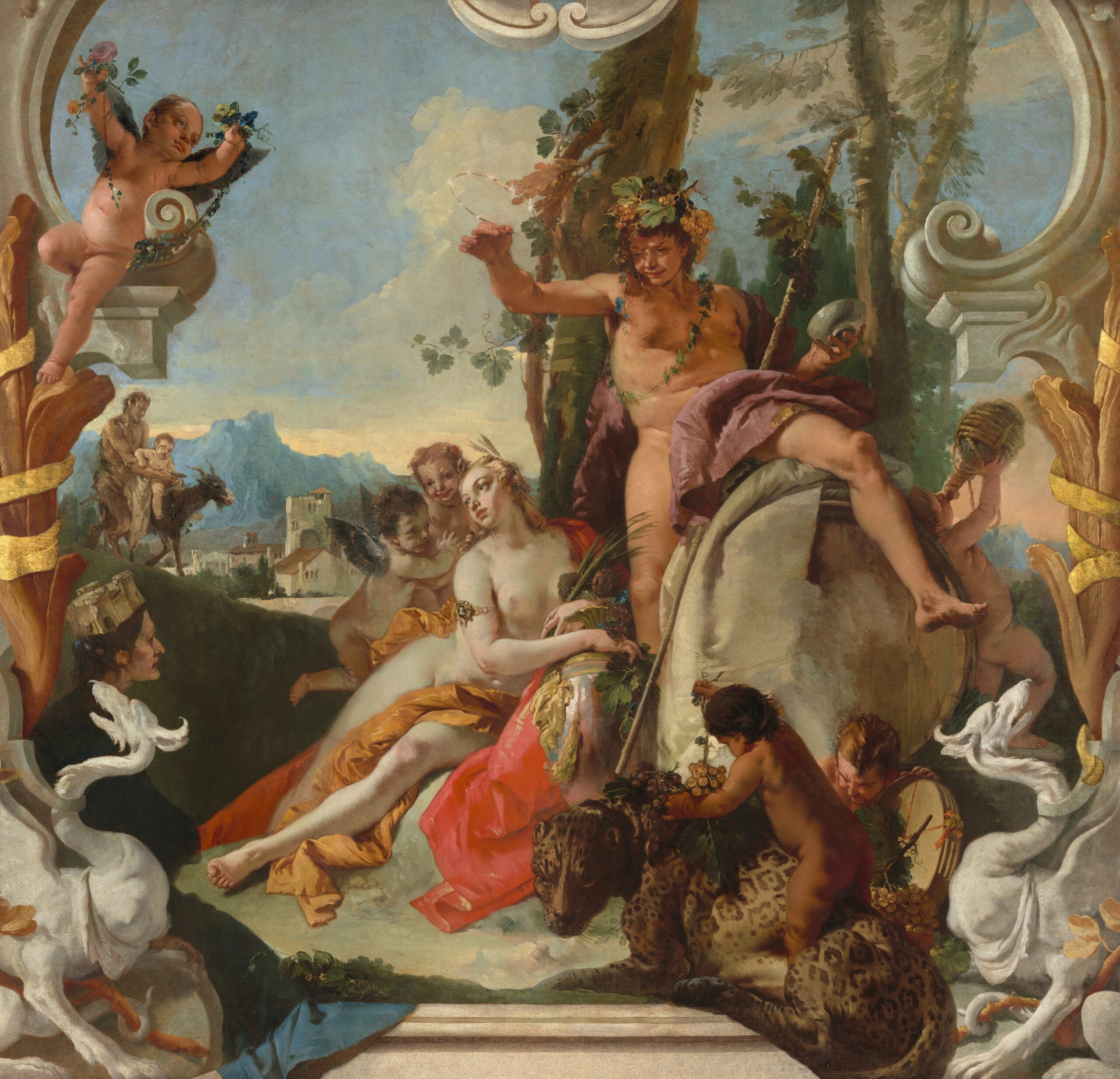
Giovanni Battista Tiepolo
Oil on canvas, 214 × 232.4 cm | 84.3 x 91.5 in
National Gallery of Art
In 17th-century paintings, Bacchus is often depicted alongside Ceres, linking their shared symbolism of abundance from the earth. They are sometimes depicted with Venus too, connecting the harvest and revelry with passion and love, and making the trio a popular subject for erotic artworks of the era. Hendrick Goltzius’ incredible ‘pen painting’, Without Ceres and Bacchus, Venus Would Freeze, is an unusual mixed-media work in which ink drawing is combined with oil paint on canvas. The work draws us into an intimate huddle of the gods. The title alludes to the idea that the love and eroticism embodied by Venus cannot exist without the nourishment provided by the harvest of food and wine, brought by Ceres and Bacchus.
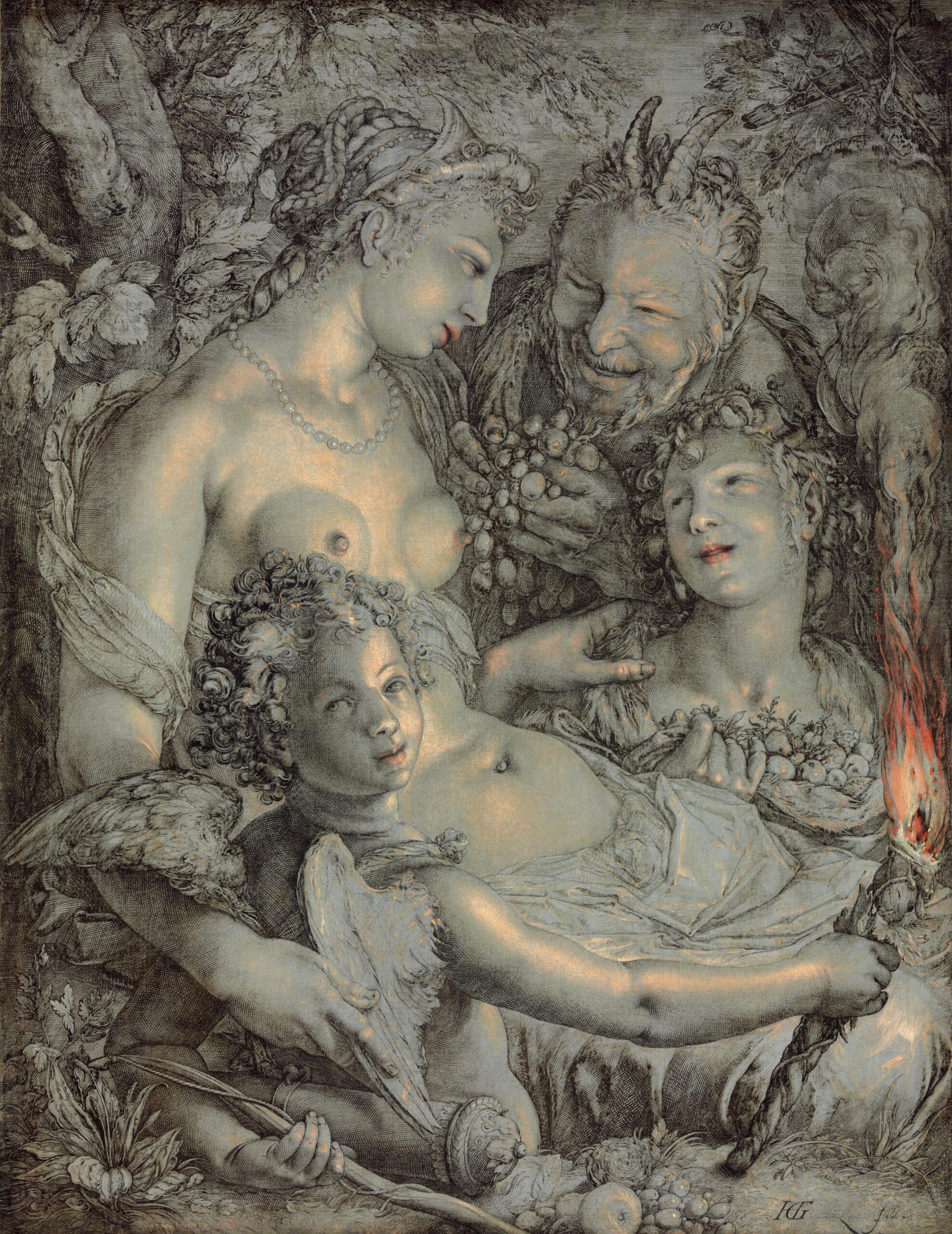
Hendrick Goltzius
Ink and oil on canvas, 105.1 × 80 cm | 41.4 x 31.5 in
Philadelphia Museum of Art
Industry and Pleasure
A master of the Northern Renaissance, Pieter Bruegel the Elder was at the forefront of the development of secular art, making strides in depicting subjects that departed from religious themes. He was commissioned by an Antwerp merchant to paint a series of six paintings depicting the changing seasons, including The Harvesters. This is perhaps the most famous painting of the harvest, capturing labourers resting for lunch in the heat of the late summer sun, under the shade of a tree. Other figures persist with their work, with women in the background bent over, resembling the haystacks around them. The path through the uncut crops winds away into the vast distance, suggesting that their labours will sustain people in far corners of the country, making Bruegel’s harvesters symbolic of importance of industry to agricultural societies.
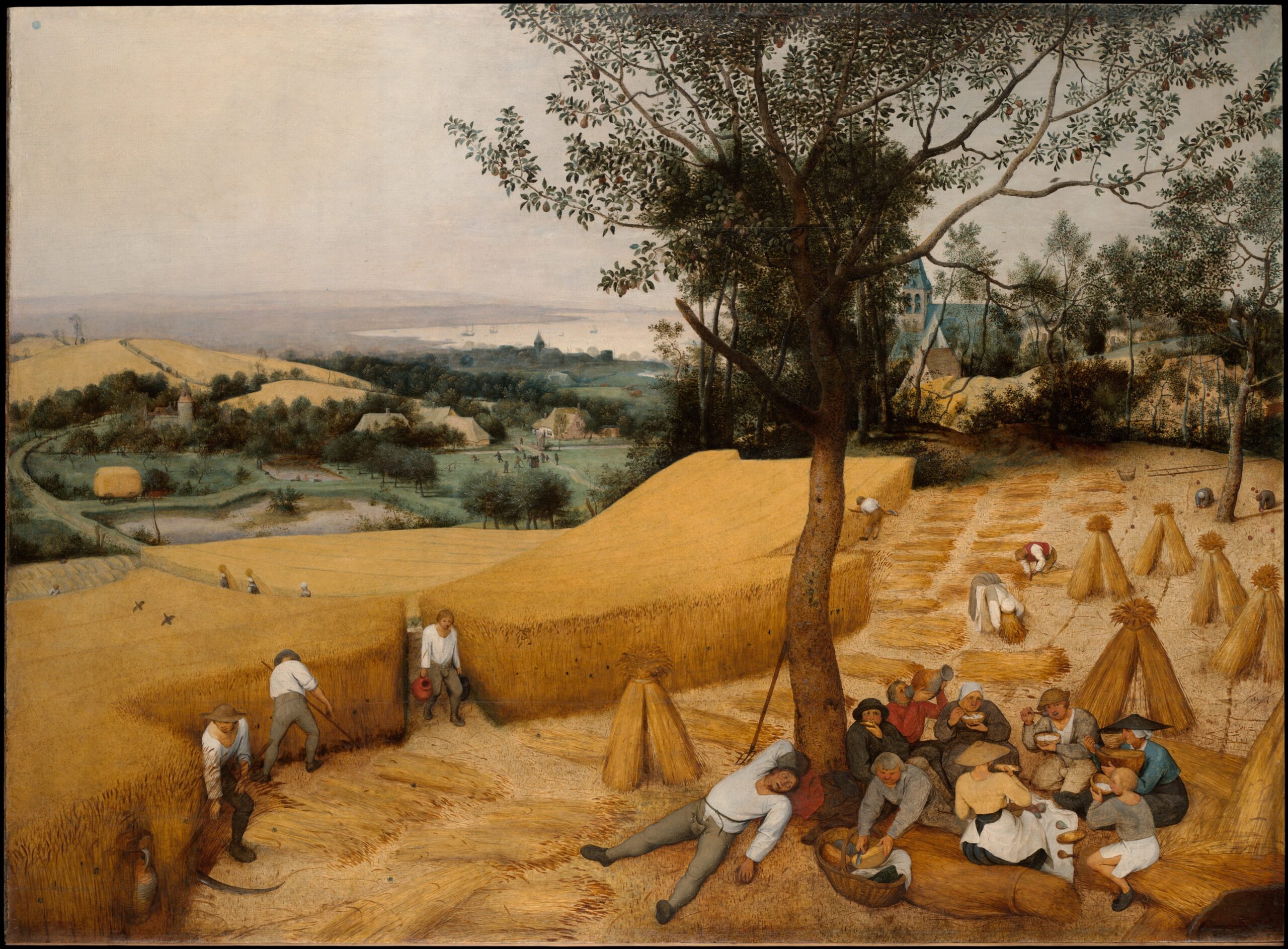
Pieter Bruegel the Elder
Oil on oak, 119 x 162 cm | 46.9 x 63.8 in
The Metropolitan Museum of Art
Bruegel’s workers are imperfect – they pass around a jug of beer or wine called a kruik, while one man lies sprawled beneath the tree, asleep, passed out from exhaustion or intoxication – or maybe a mixture of both. On the left of the foreground, we see another kruik half-hidden amongst the wheat, stashed there by the workers, which a man with a scythe notices as he works. These details humanise the workers, making the painting sympathetic to their hardships while also depicting the small pleasures found amidst the hard work, without moralising judgement.
Virtue and Judgement
The Bible includes numerous parables that use the harvest as a metaphor for spiritual doctrine, themes that are reflected throughout Christian art. The Virgin Mary is sometimes depicted with sheaves of wheat, in reference to the bread of the Eucharist. These depictions echo the earlier iconography of Ceres and Demeter. Some of the many biblical parables centred on agriculture and the harvest include the Parable of the Sower, the Parable of the Growing Seed, the Parable of the Rich Fool, and the Parable of the Wheat and the Weeds.
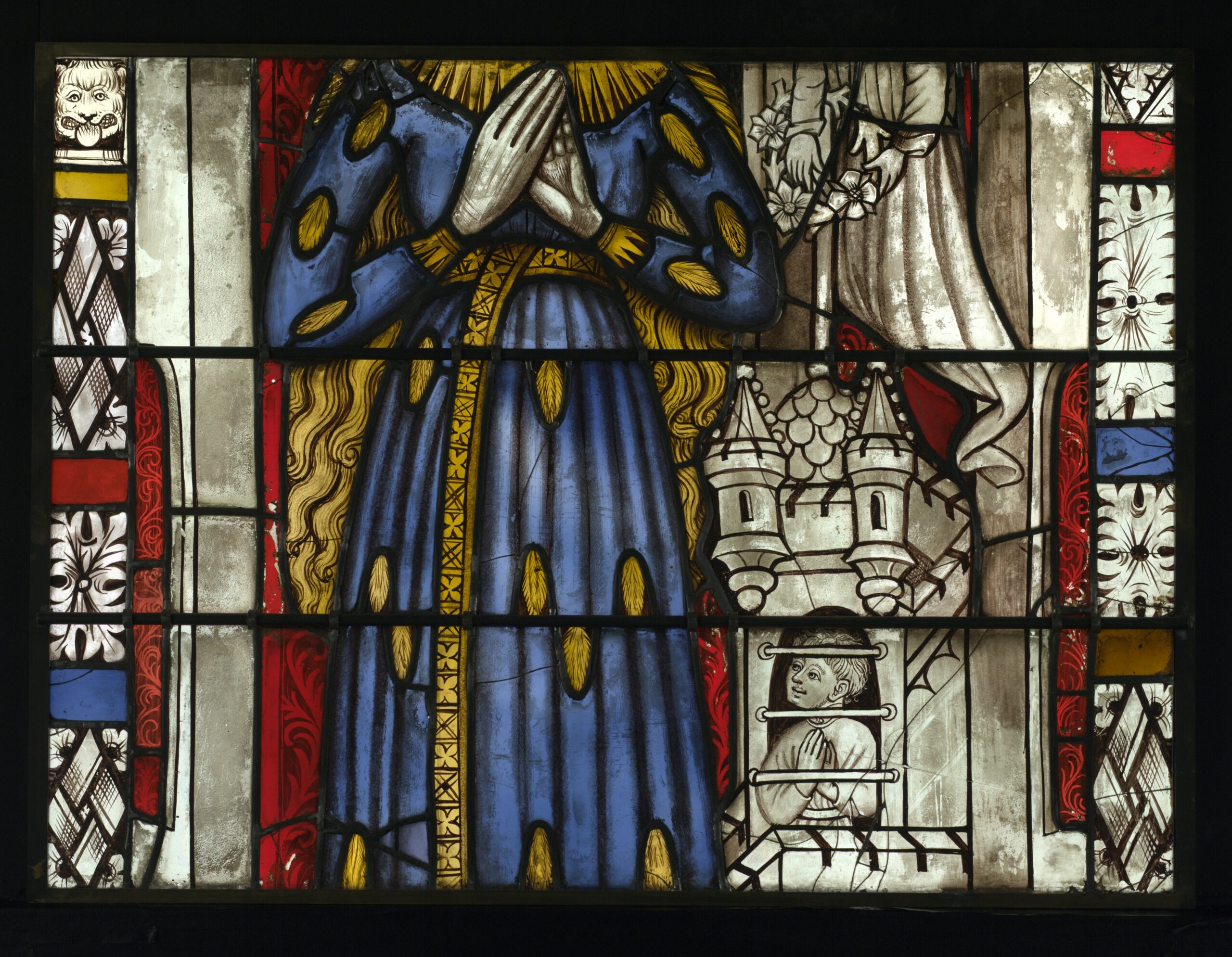
Middle Rhine Valley, Germany
Pot-metal glass, white glass, vitreous paint, silver stain, 337.2 x 71.8 cm | 132.8 x 28.3 in
The Metropolitan Museum of Art
In the Parable of the Wheat and the Weeds in the Book of Matthew, a farmer sows his field with wheat, but under cover of darkness, an enemy comes and sows weeds that resemble wheat in the early stages of growth amongst his crops. When the weeds grow and are recognised, the servants ask the farmer if they should remove them. He says no, since pulling them out too soon would uproot the wheat as well. At the end of the season, the harvesters separate the wheat from the weeds, taking the wheat to be stored in a barn and the weeds to be burnt.
This parable refers to Judgement Day, instructing Christians to leave the judgement of individuals’ virtue to God. Like separating the wheat from the weeds, the blessed will be taken to Heaven and evildoers sent to Hell. The parable was depicted in the following painting by Isaac Claesz. van Swanenburg, with the God-like farmer swathed in red, ordering his angelic workers to carry out his decision, and the harvest of wheat symbolising the virtuous.
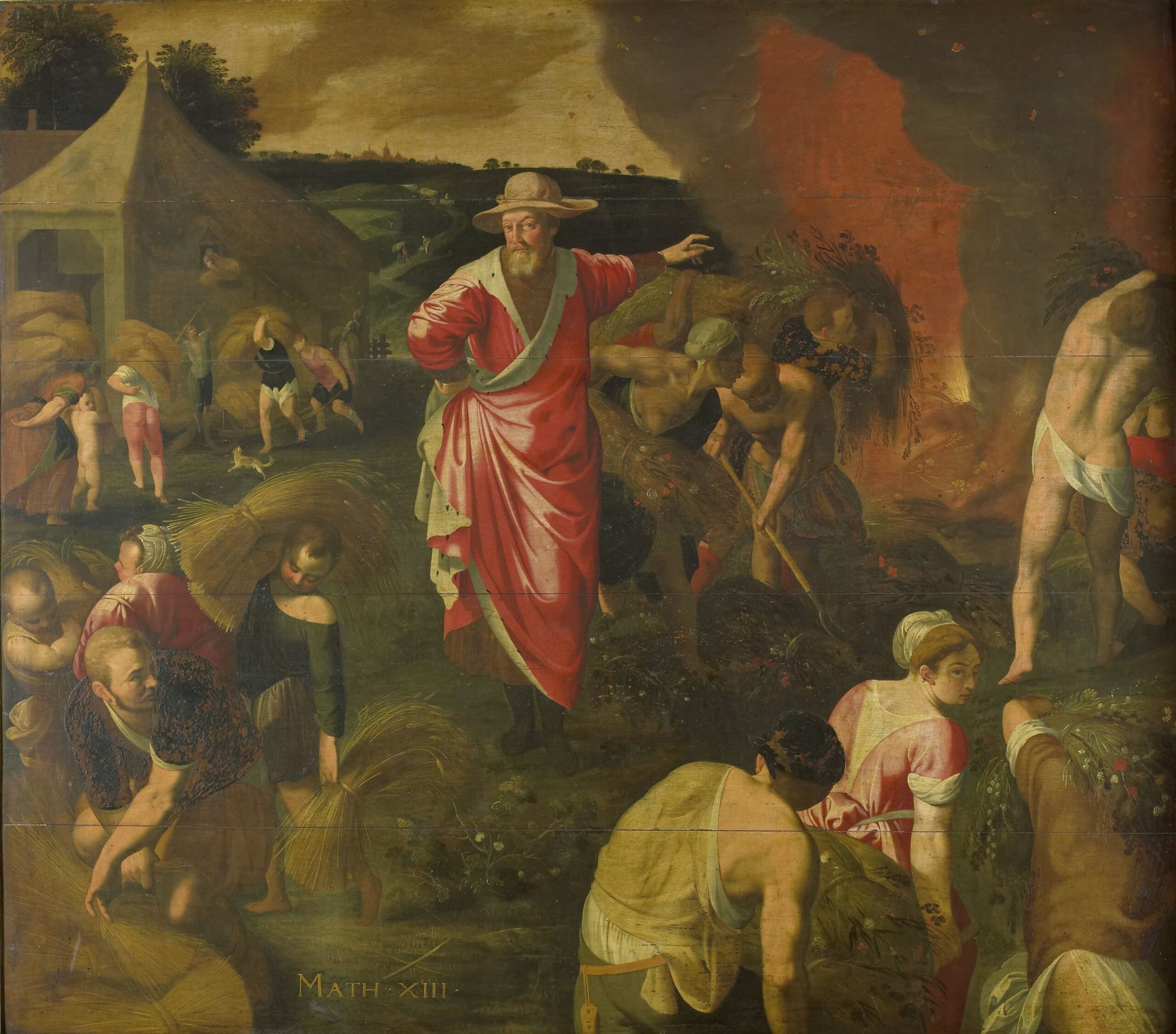
Attributed to Isaac Claesz. van Swanenburg
Oil on panel, 131 x 147 cm | 51.6 x 57.9 in
Rijksmuseum
Harvesting imagery, in which people are ‘reaped’ like crops, also features in the apocalyptic Book of Revelation. In it, Jesus is instructed by an angel that the time has come to reap the ‘harvest of the earth’. Again, the virtuous are represented by wheat, depicted here in the medieval manuscript illustration The Harvest of the Earth. The passage reads:
‘Take your sickle and reap, because the time to reap has come, for the harvest of the earth is ripe.’ So he who was seated on the cloud swung his sickle over the earth, and the earth was harvested’ (Revelation 14:15-17).
In the next passage, sinners are harvested, this time through the metaphor of collecting grapes to press into wine, brutally condemning them to damnation, as they are ‘trampled in the winepress outside the city, and blood flowed out of the press’ (Revelation 14:19–20). In these works, the harvest symbolises both eternal salvation and impending damnation.
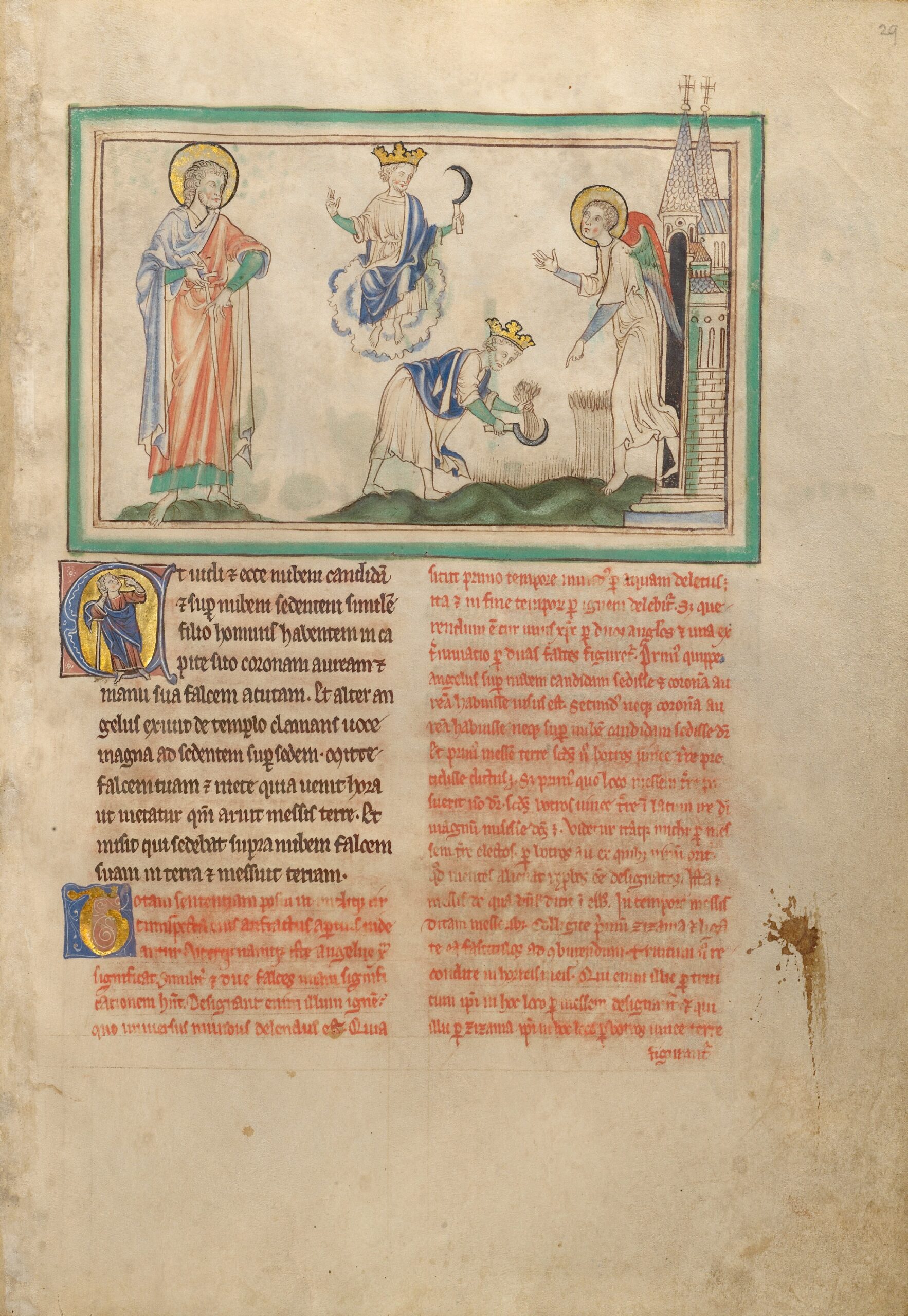
Unknown artist
Tempera colors, gold leaf, colored washes, pen and ink, 31.9 × 22.5 cm | 12.6 x 8.9 in
Getty Museum
Seasons and New Beginnings
The Veteran in a New Field by Winslow Homer may initially appear to be a typical Realist pastoral scene, but it carries deeper social context and symbolism. Homer painted the work in the year the American Civil War ended. Both the title and the army jacket on the ground at the bottom right of the painting signify that this man has recently become a veteran of the conflict. He works in a ‘new field’, which acknowledges his previous one – the battlefield. His scythe now brings life through the harvest and the start of a new cycle, while also evoking the scythe of death that he previously wielded. In this poignant work, Homer invokes the harvest as a reminder of the possibility of renewal and new beginnings.
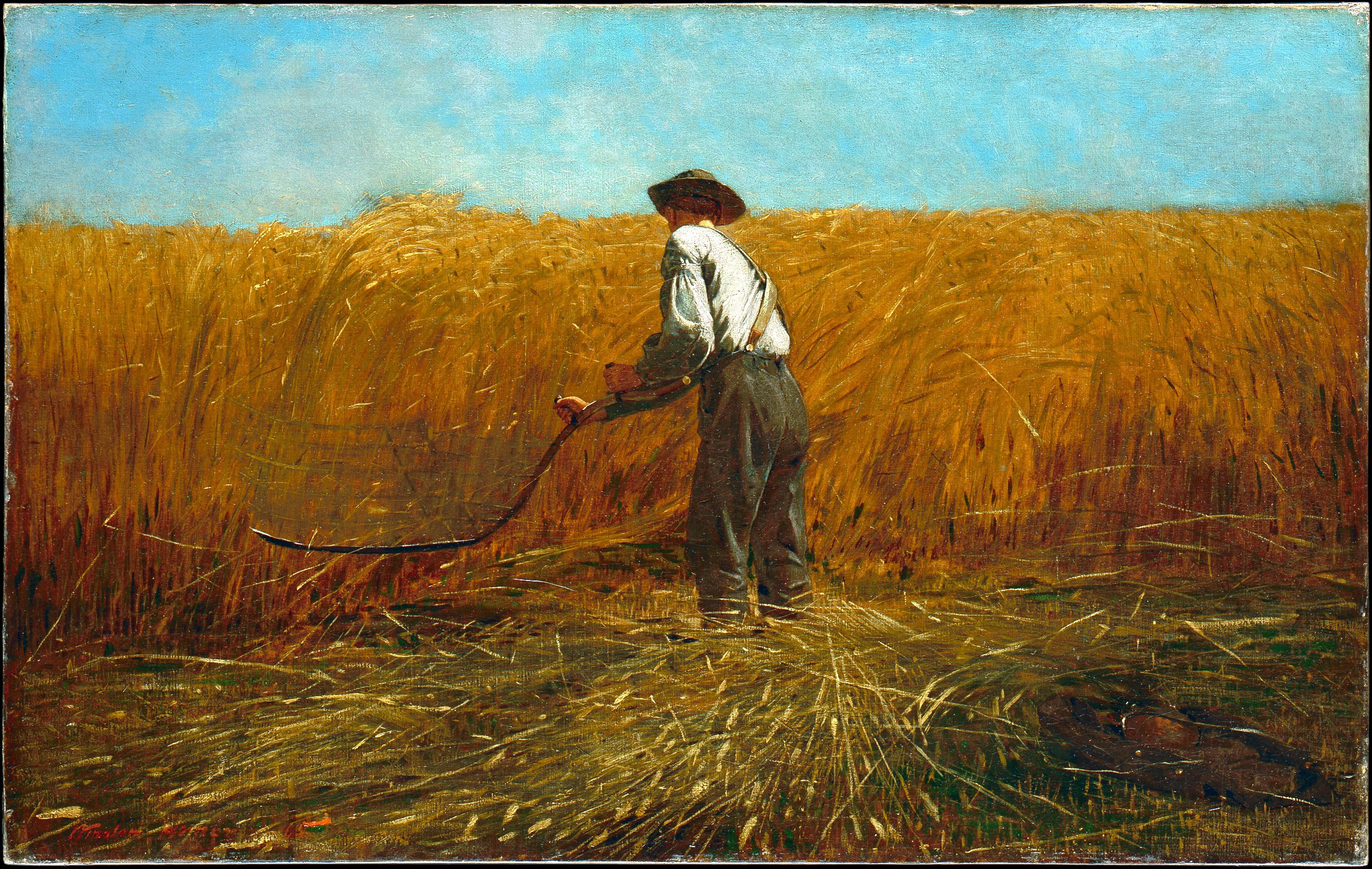
Winslow Homer
Oil on canvas, 61.3 x 96.8cm | 24.1 x 38.1 in
The Metropolitan Museum of Art
In contrast to Homer’s painting, which uses the harvest to signify new hope after years of strife, other optimistic depictions of the harvest evoke a more rapid sense of time passing through the transience of weather. The Rain Shower by Chintreuil depicts a storm moving across a vast sky, with labourers pausing in their work to stand over a little boy, who lies jovially on the harvested crop. This moment of humanity and childhood, linked with the changing weather, imbues the work with a reminder that troubles will pass, allowing the light to break through again. This harvest also expresses the fleeting nature of human life, with survival tied to labour through the seasons, which will continue long after the workers’ time on earth.
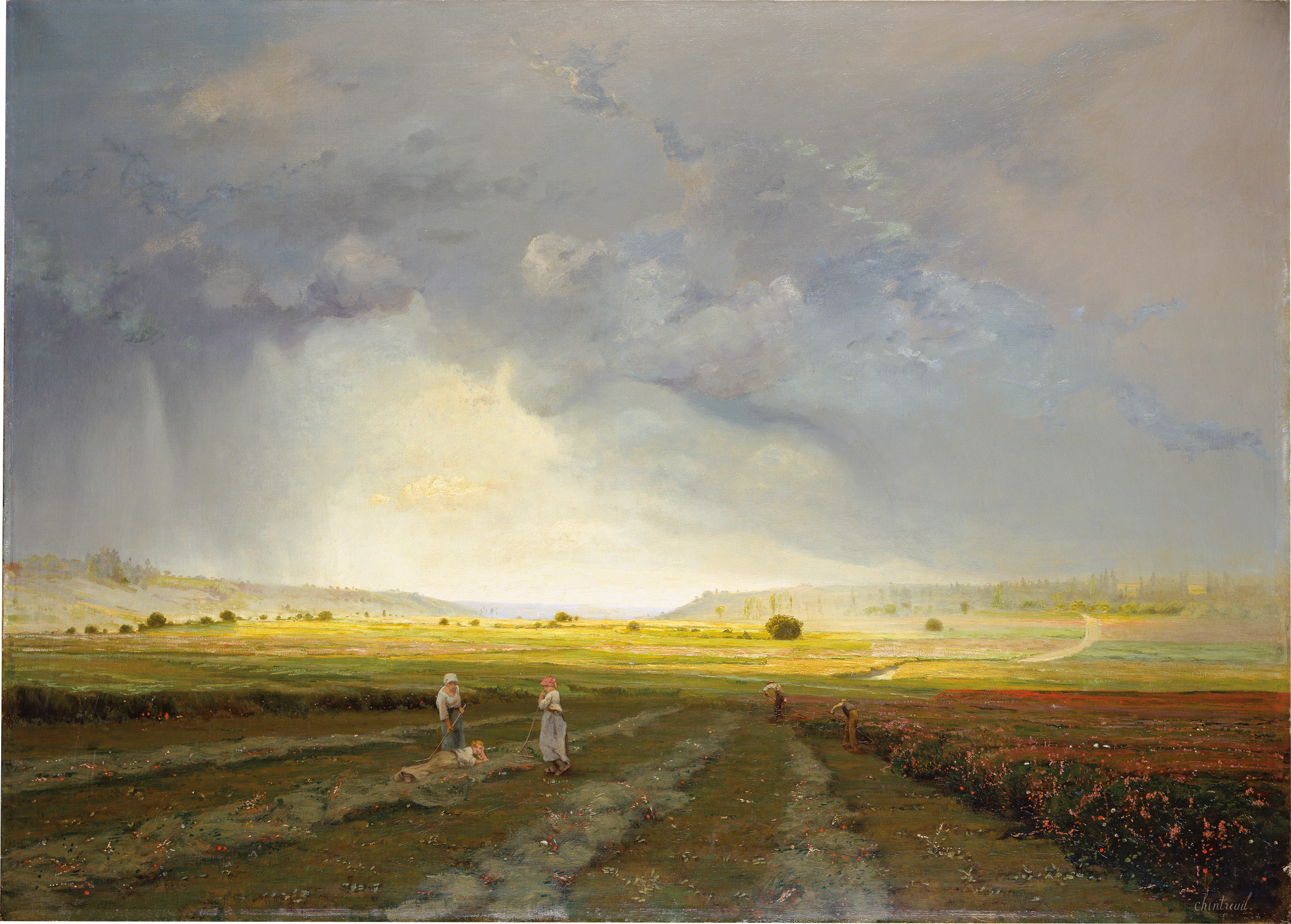
Antoine Chintreuil
Oil on canvas, 96 x 133.5 cm | 37.8 x 52.6 in
Staedel Museum
Claude Monet created a series of 25 paintings of haystacks, charting the changing seasons from the end of summer in 1890 until the following spring. They capture the haystacks at different times of day, in varying qualities of light and weather conditions. Broadly, the series symbolises the passage of time. His meditative approach to reinterpreting the same subject makes these works an important precursor to abstraction, since the subject of the haystacks matters less than the placement of light and colour across them.
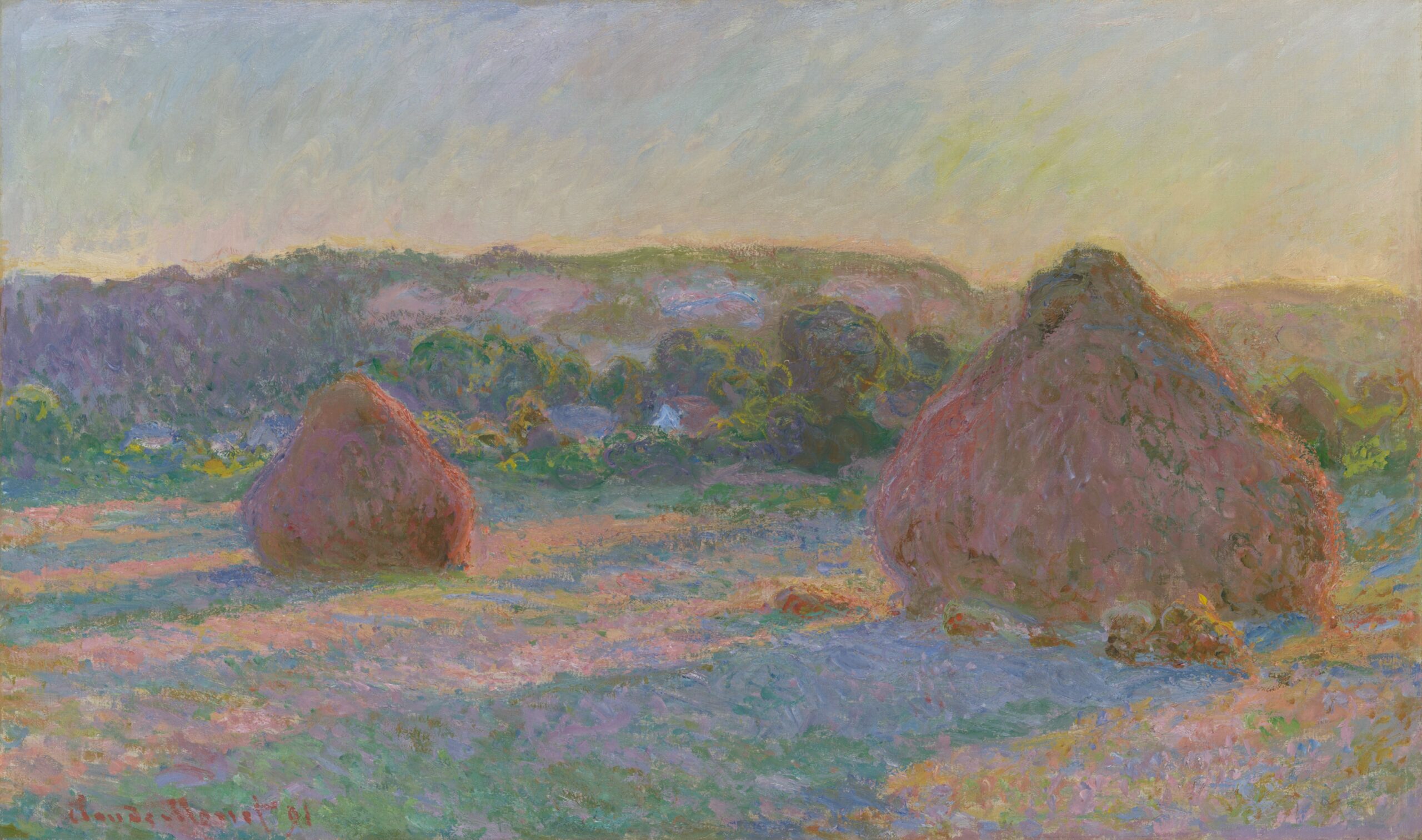
Claude Monet
Oil on canvas, 60 x 100.5 cm | 23.6 x 39.6 in
Art Institute of Chicago
Utopia
Utopian harvests inspired by the opening passage of Ovid’s Metamorphoses can be found throughout art history. The passage describes ‘The Golden Age’ on Earth, preceding the successively worsening ages of Silver, Bronze, and Iron. The story details how people of the Golden Age indulged in bountiful resources, living in harmony with nature in a time of peace, without having to labour for anything. Alongside the bucolic joy of the subject, it also provided artists with the perfect opportunity to create complex figure compositions. The passage that inspired them reads:
‘The earth herself also, freely, without the scars of ploughs, untouched by hoes, produced everything from herself. (…) Spring was eternal, and gentle breezes caressed with warm air the flowers that grew without being seeded. Then the untilled earth gave of its produce and, without needing renewal, the fields whitened with heavy ears of corn. Sometimes rivers of milk flowed, sometimes streams of nectar, and golden honey trickled from the green holm oak.’
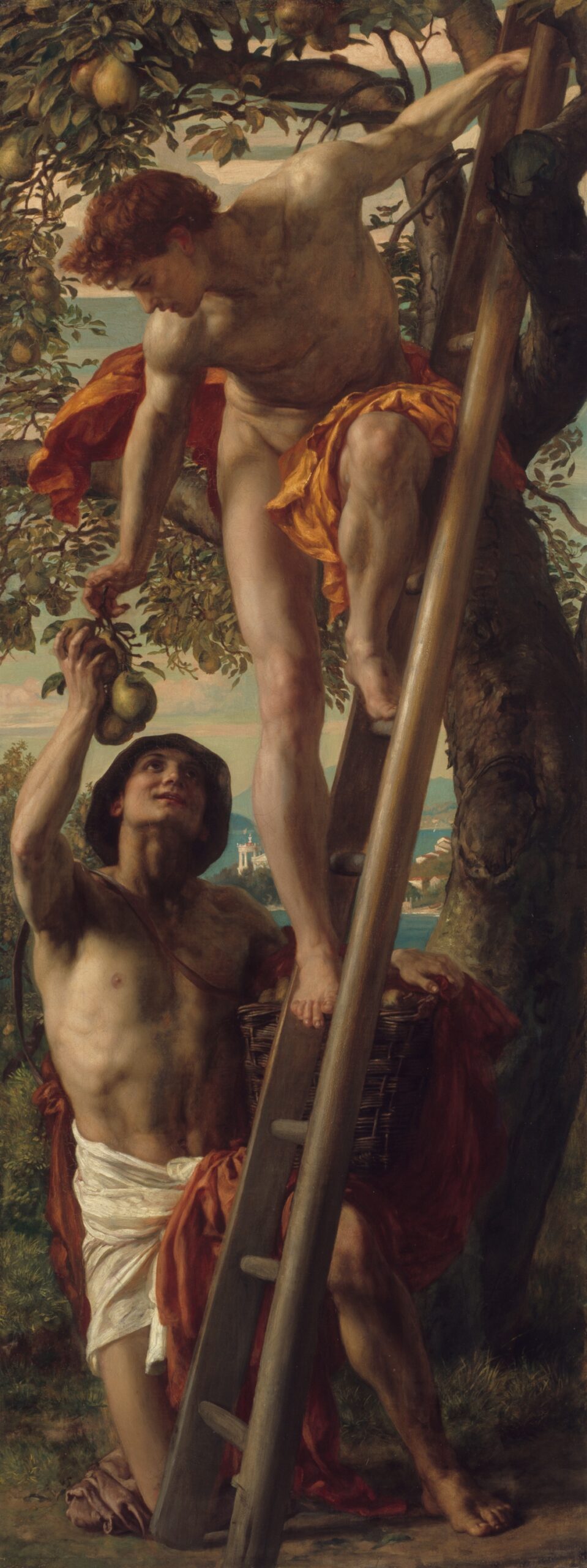
Edward John Poynter
Oil on canvas, 137.2 × 53.4 cm | 54 x 21 in
Art Institute of Chicago
The Dutch Mannerist Wtewael painted his own complex miniature version of the passage, in which nude figures of all ages jubilantly gather to pick fruit from the lush forest around them. We see sensual figures scrambling through the branches throughout the painting, grasping for the brilliant grapes and apples. In the top right corner, a goat even pushes its way upwards to reach the fruit before the man below can. This scene transforms the harvest into a utopian vision, before humankind and the gods destroyed it through their actions. Imagining a harvest without the need for cultivation or hard labour appealed to viewers who were acutely aware of the hardships of the harvest in reality.
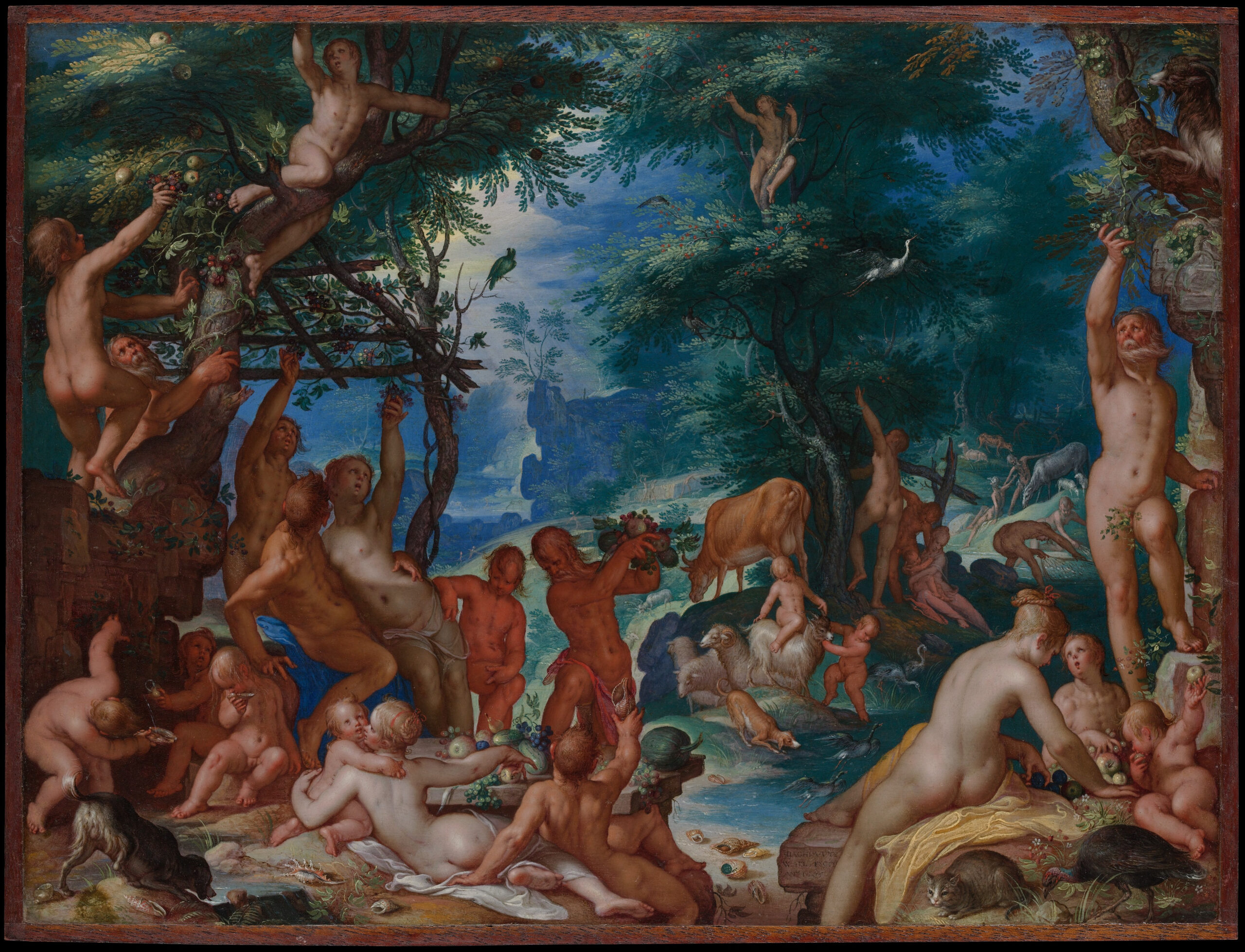
Joachim Wtewael
Oil on copper, 22.5 x 30.5 cm | 8.9 x 12 in
The Metropolitan Museum of Art
The Harvest – Art Prompt
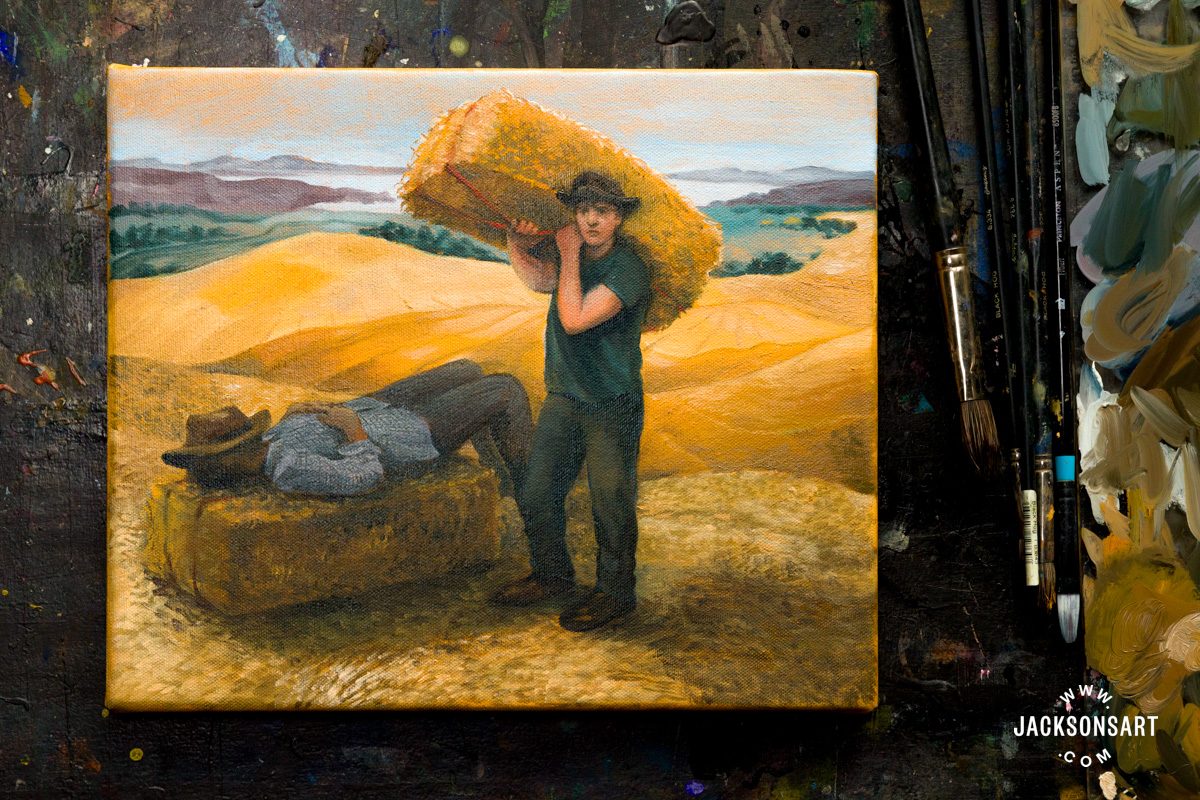
For this art prompt, I was inspired by Bruegel’s The Harvesters, which depicts farm workers stopping to rest amidst the harvest. I decided to paint my figures in contemporary dress, while maintaining the original combination of labour and rest against a sprawling landscape.
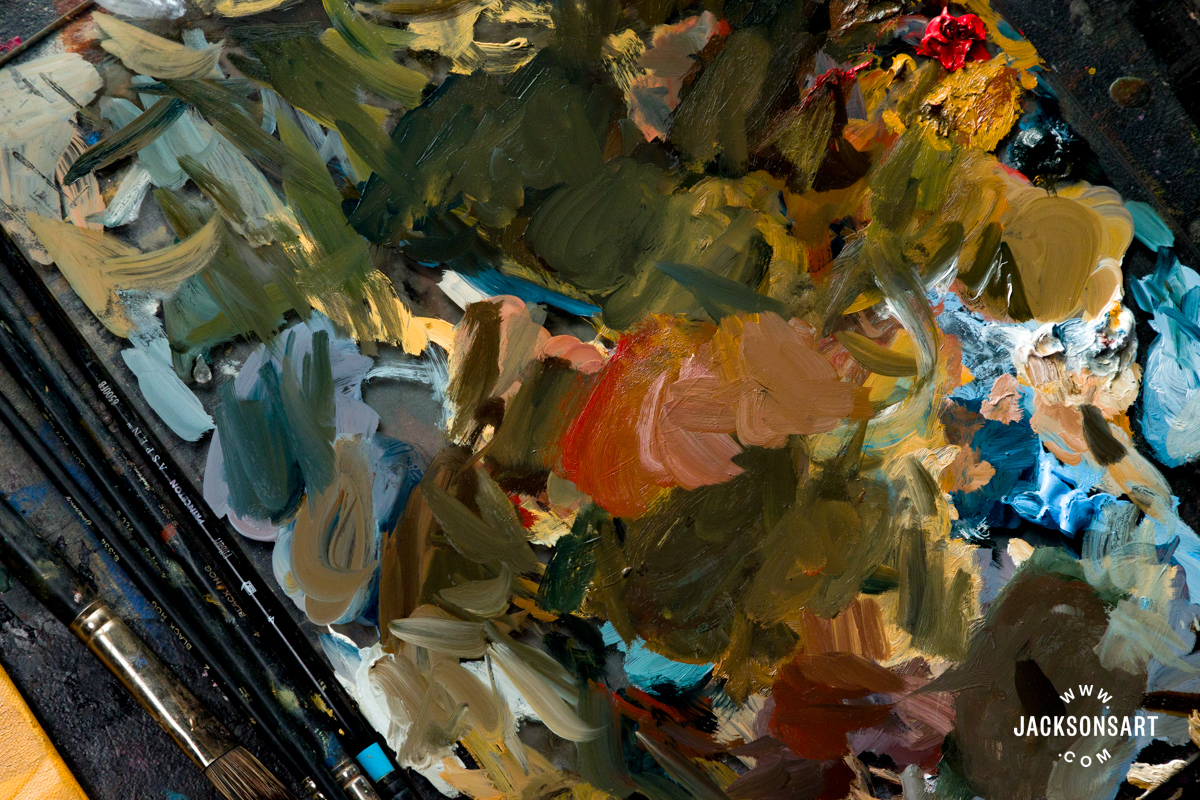
For this art prompt you’ll need:
A Jackson’s primed stretched cotton canvas
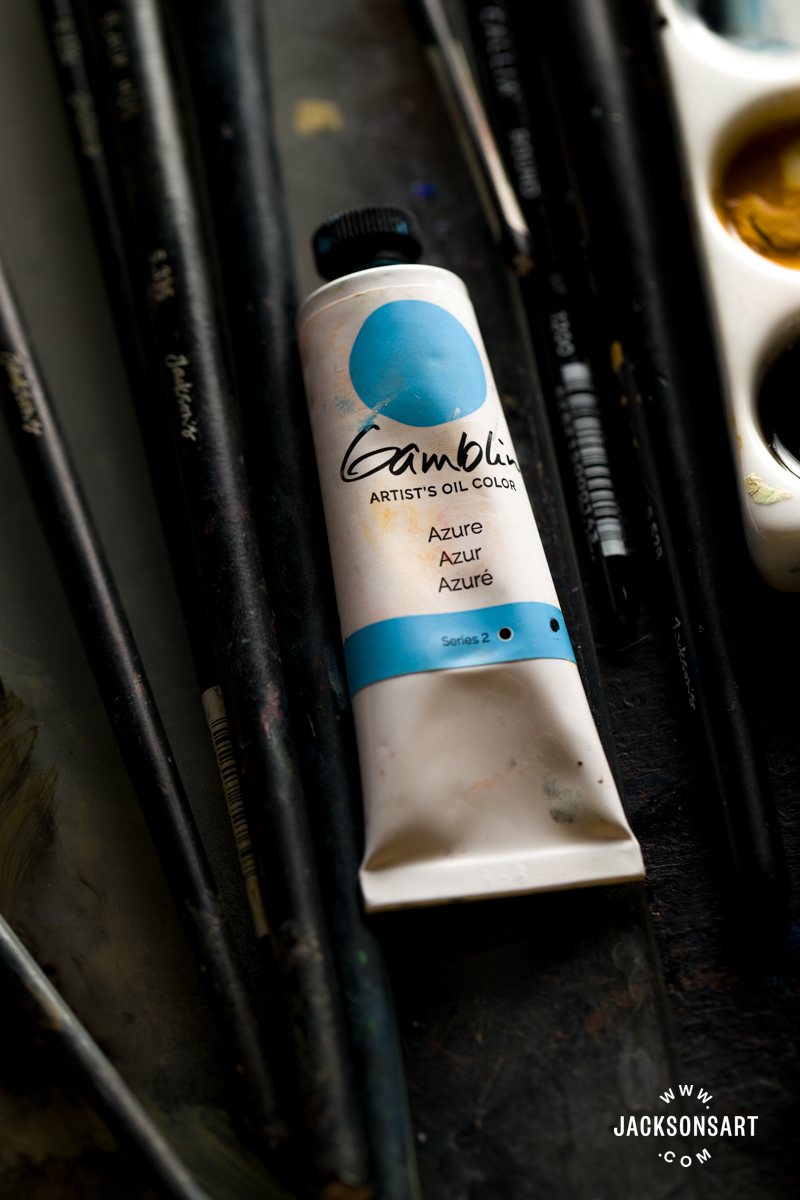
A selection of oil paints – I used Yellow Ochre, Raw Umber, Burnt Sienna, Azure, Titanium White, Cadmium Red, Alizarin Crimson, and Indigo
A selection of oil brushes
A jar for oil medium – I used Langridge Solvent 75 and Jackson’s Refined Linseed Oil
A palette
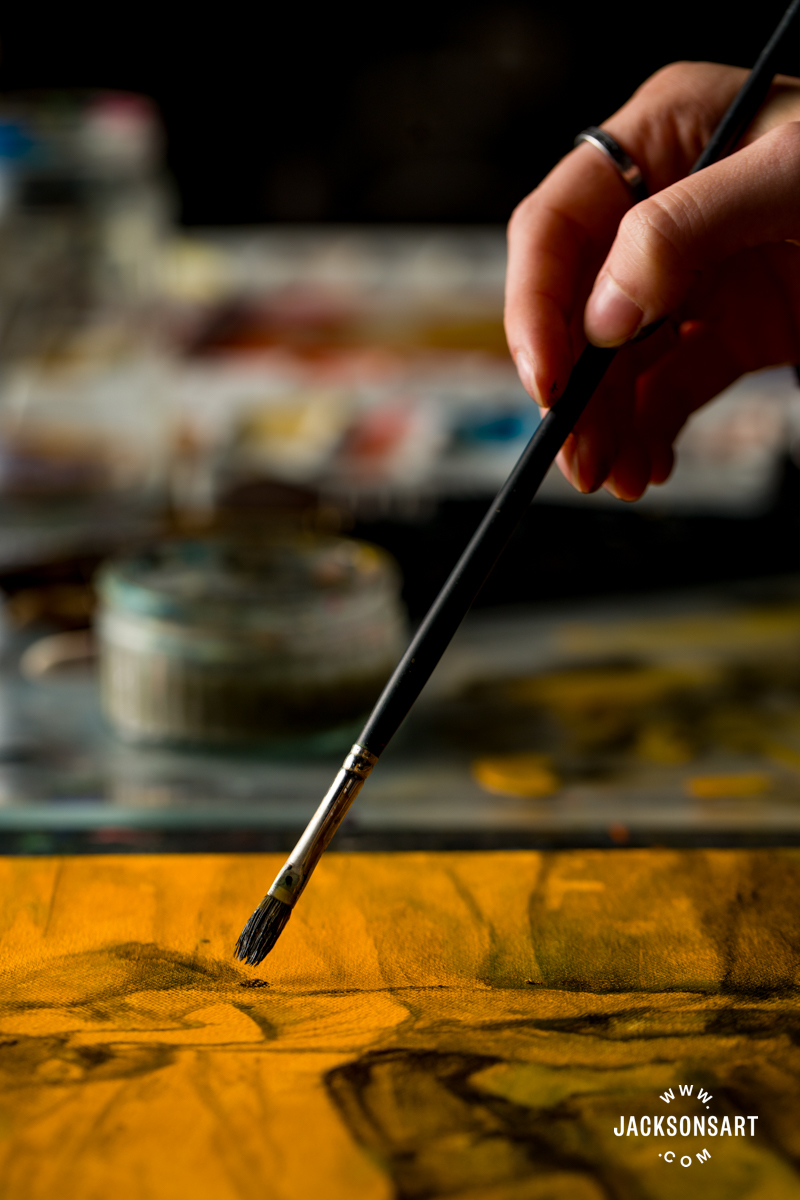
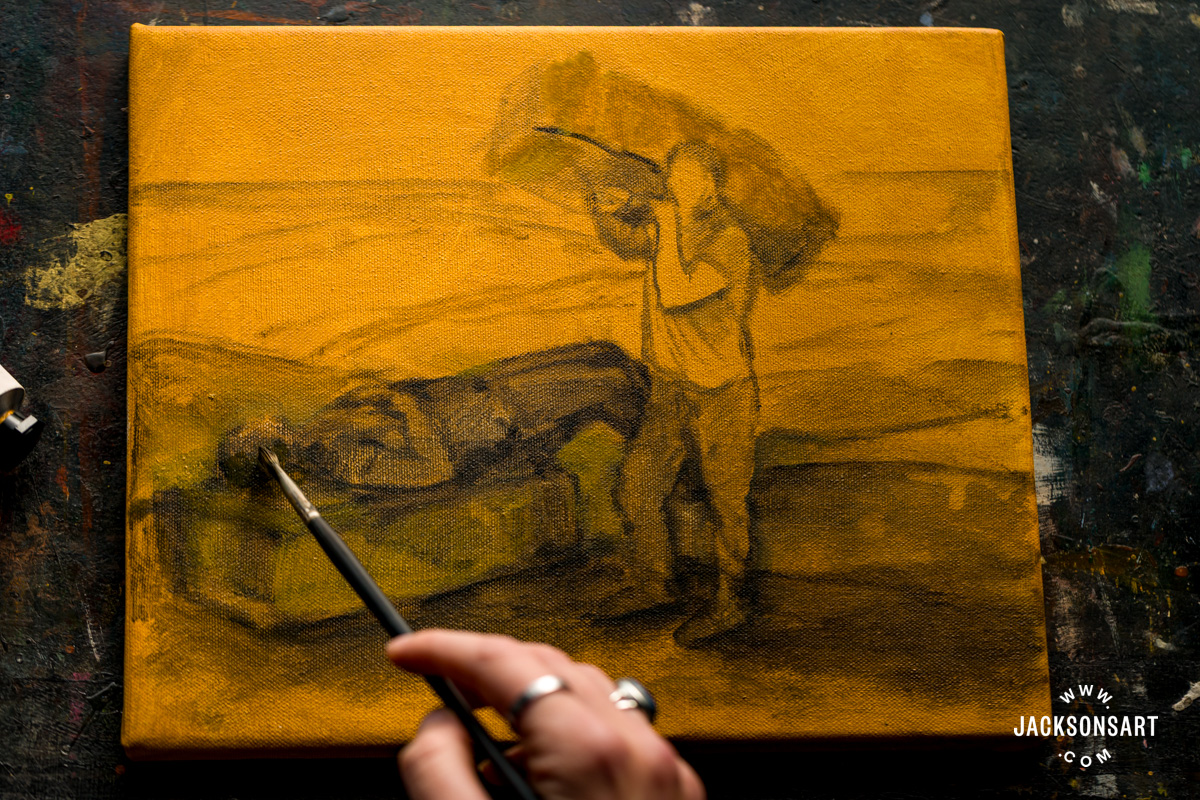
To begin my painting, I applied an acrylic ground to the canvas using Yellow Ochre. This brought immediate warmth and a golden hue to all of the subsequent layers of paint.
Next, I added an underpainting to establish the composition of the work and placement of my figures, using a mixture of Raw Umber and Indigo. I added one man holding a straw bale on his shoulder, and another napping on top of one.
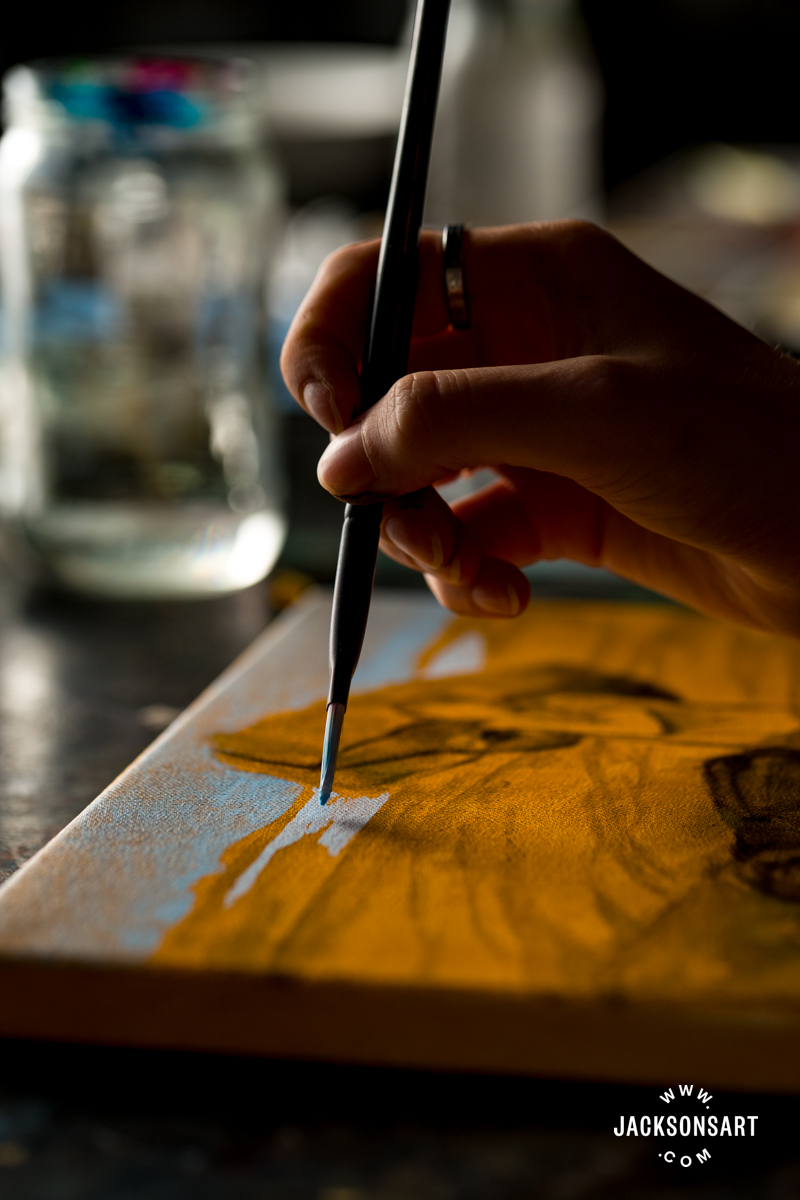
To begin the painting I immediately established the crisp blue of the sky and water in the distance, to ensure they weren’t muddied by subsequent layers of paint.
I steadily blocked in the painting, establishing areas of broad tone, and creating the undulating form of the fields beyond.
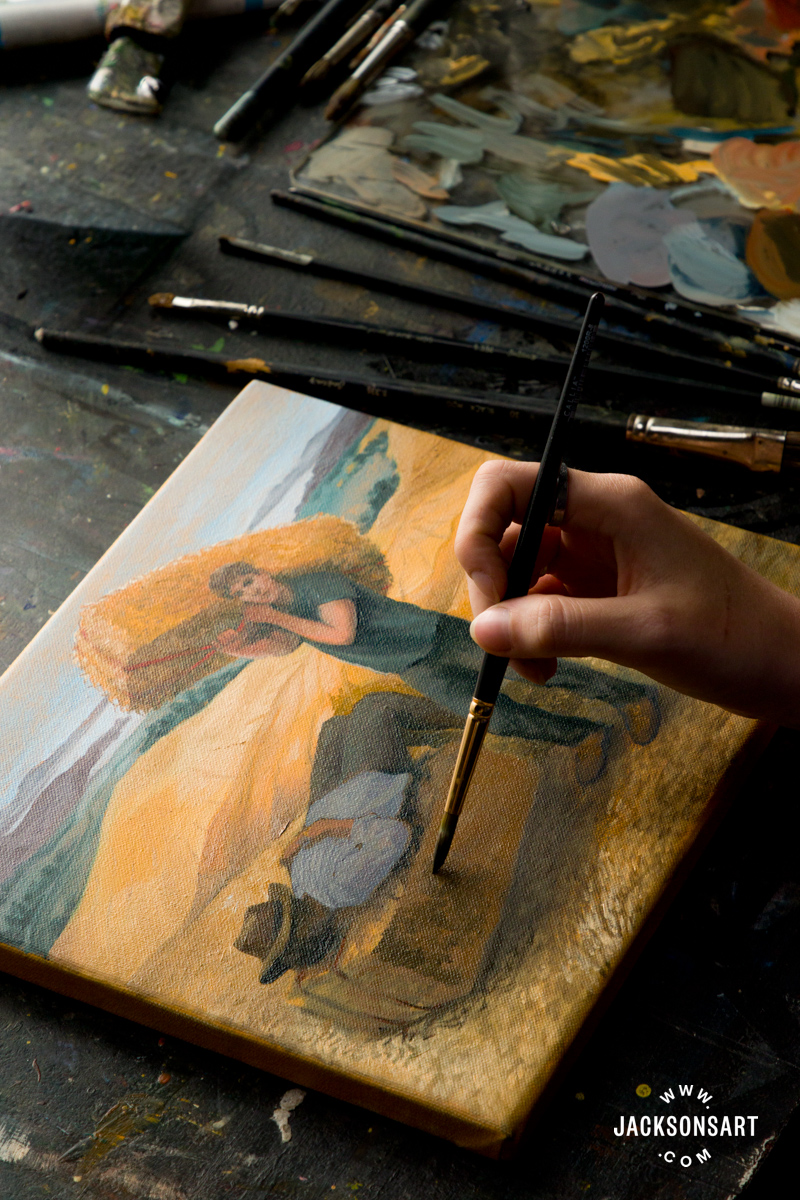
To complete the painting, I added details like the texture of the rough cut ground, the stalks of the straw bales, and folds of my figures’ clothes.
Further Reading
Behind the Movement: Northern Renaissance
Introducing 24 Innovative Oil Colours From Gamblin
Art Through Symbols: Bathers
Behind the Movement: the Brotherhood of ‘the Ancients’
Shop Art Materials on jacksonsart.com