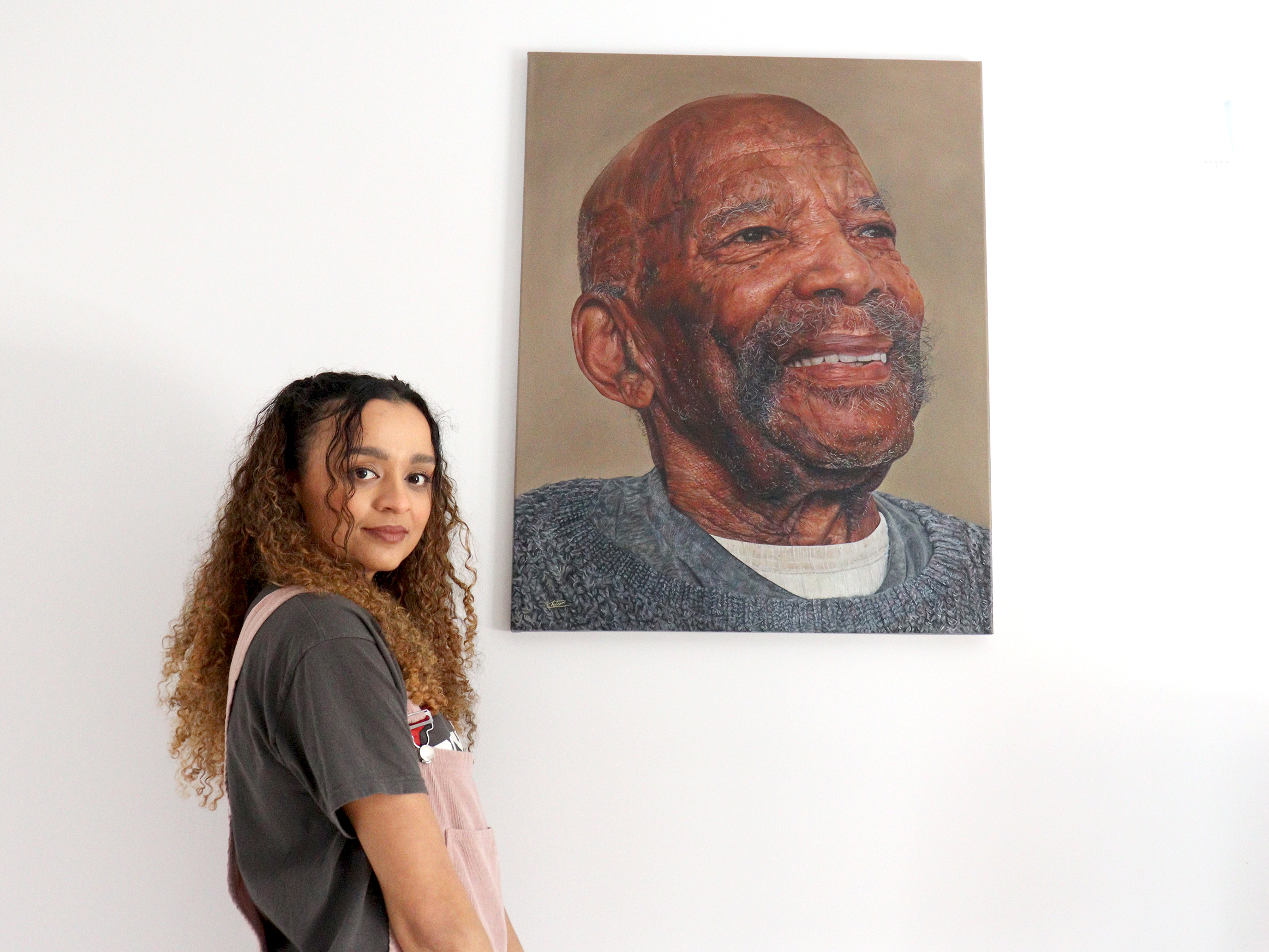



Robert Cook, who paints and draws in Poulton le Fylde in North West England, is an award winning wildlife artist and experienced lecturer in natural history and wildlife art. His fascination with the natural world is what drives his passion for drawing and painting. He has exhibited widely in the United Kingdom.
Robert’s numerous awards include:
2008 – Winner – David Cook Drawing Award National Exhibition of Wildlife Art (NEWA)
2008 – Winner – Wildlife & Animals Category Award in Artists & Illustrators Magazine Artist of the Year Competition
2009 – Wildscape Wildlife Artist of the Year 2009
2009 – Winner of “Animals in their environment” BBC Wildlife Artist of the Year

Oil on Linen 40x60cm
Robert Cook
Jacksons: Please tell us a little about yourself.
Robert Cook: My parents after they witnessed my keen interest in drawing encouraged me. From an early age I used to copy the Health and Safety posters Dad brought home from the Steel Works where he worked. When I was ten we went on a family holiday to Butlin’s Filey. Butlin’s held a drawing competition and he encouraged me to enter; to my surprise I won first prize! I still have the certificate, a bit tatty now, but a treasured possession. Later I trained as a scientific Illustrator fuelling my passion for drawing and observing nature. After graduating I worked as a freelance illustrator for several years, then taught scientific & Natural History Illustration in colleges for over twenty years. I now continue to share my knowledge and passions, working and living in the North West as an artist and freelance tutor.
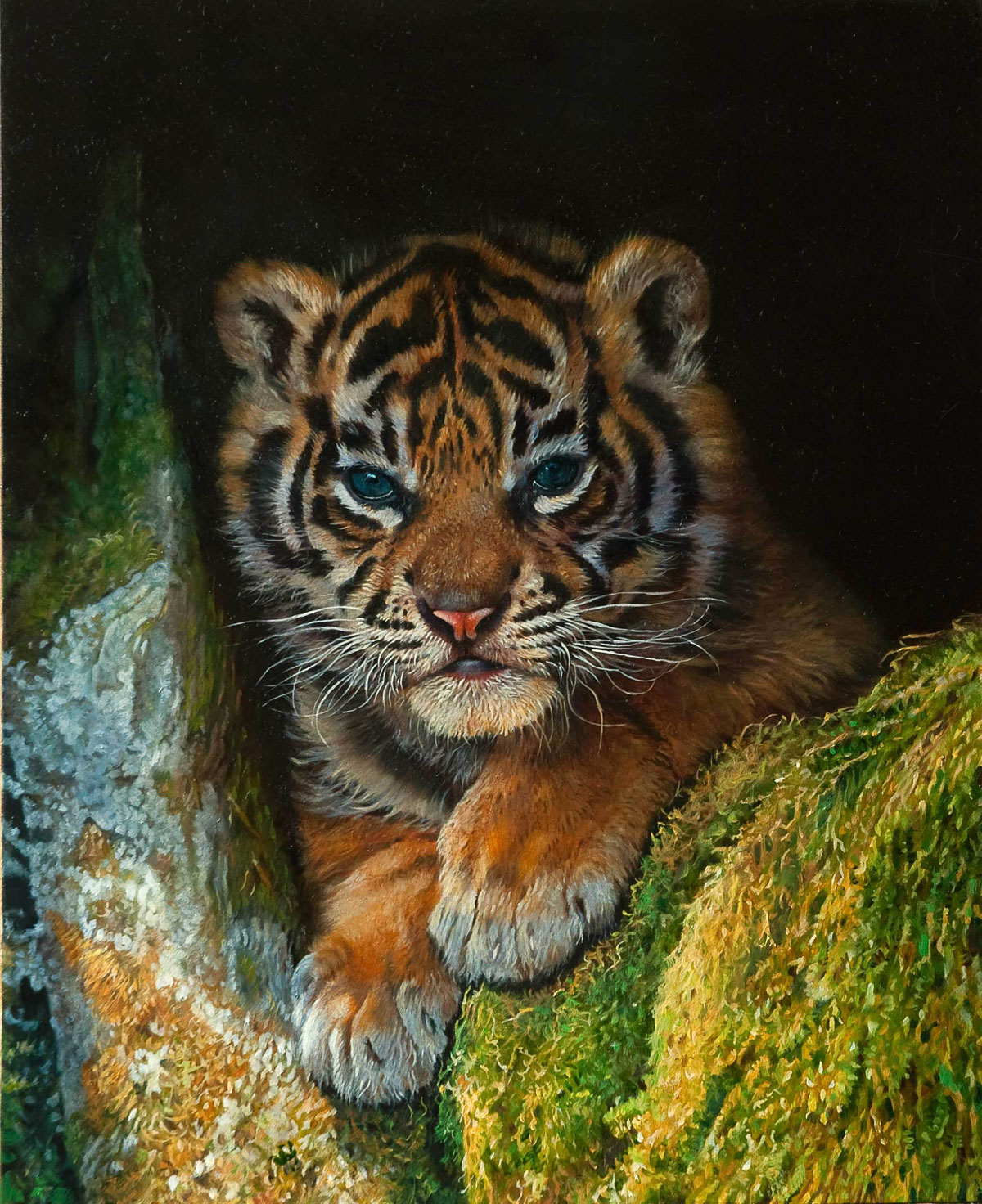
Oil on panel 22x27cm
Robert Cook
Jacksons: What materials and techniques did you use in making the artwork you are showing here?
Robert Cook: The Painting “Optimism” is a portrait of a six-week-old Sumatran tiger cub, peering out a cave entrance. The idea for the piece came about from several zoo visits and a lot of patience. The image is of a vulnerable creature emerging into the light, a symbol of hope for its kind. As a captive animal she will become part of a coordinated breeding programme, vital to ensuring the survival of Sumatran tigers. The cub is one of twins born on the 2nd June this year at Chester Zoo; they are naturally shy creatures and remain hidden for most of the day, so even getting a glimpse took quite some time.
The painting support I opted for was Medium-density fibreboard (MDF), oil primed with three coats of C Roberson & Co Primer and sanded down each time for a really smooth finish. For oil painting I mostly use canvas, I like Italian Belle Arti superfine linen canvas, however on this occasion I thought I would give MDF a try. The initial drawing was roughed in using a Derwent Drawing Pencil, sepia in colour. This was only to give proportion, placement and some detail. The drawing was then blocked in using Burnt Umber, Winsor & Newton Artists’ Oil Colour. At this early stage I tried to get the general form of the subject, applying the paint with Pro Arte filberts and rounds, Series 205 and 202 respectively. At times I also used a lint free rag to get back to the white of the support, keeping the drawing fairly loose.
After 24 hours or so of allowing this stage to dry, I began to introduce colour. With it being a tiger cub, I wanted to establish the general appearance of the stripes early on. I gradually built up the chroma of the painting, with just enough detail to keep everything in place, still using rounds and filberts (filberts are very versatile because you can use them with a fine edge for lines and flat on for broad brush strokes). As the painting progressed I changed brushes and began using Winsor & Newton Series 7 sables, employing a limited palette of no more than ten colours throughout the painting. Paints included a wide range of oil colours by several manufacturers including Winsor & Newton, Michael Harding, Schmincke Mussini and Talens Van Gogh ranges.


As for mediums, I like the quick drying qualities of Liquin especially the Liquin Light Gel. My preferred turpentine substitute is Low Odour Sansodor. You can re-use the Sansodor a few times over, simply by putting the murky used Sansodor in a glass jar and leaving it overnight. By morning you can decant the now clear Sansodor into another container to be reused, discarding the sediment at the bottom of the jar.
The final stage of the painting involved carefully refining the drawing of the cub and moss. I reduced the size of the ears as they had become elongated through the painting process and adjusted the eyes several times. This fiddling with the details takes quite a long time and only when I am happy with the result, can I finally add the all-important whiskers. To unify the piece as a whole, thin glazes of colour are applied over the painting. Now all I need to do, is in a few months time protect the piece with a Beeswax Varnish. I prefer a Beeswax Varnish as it’s easy to use and I can control the level of sheen I want the painting to have.
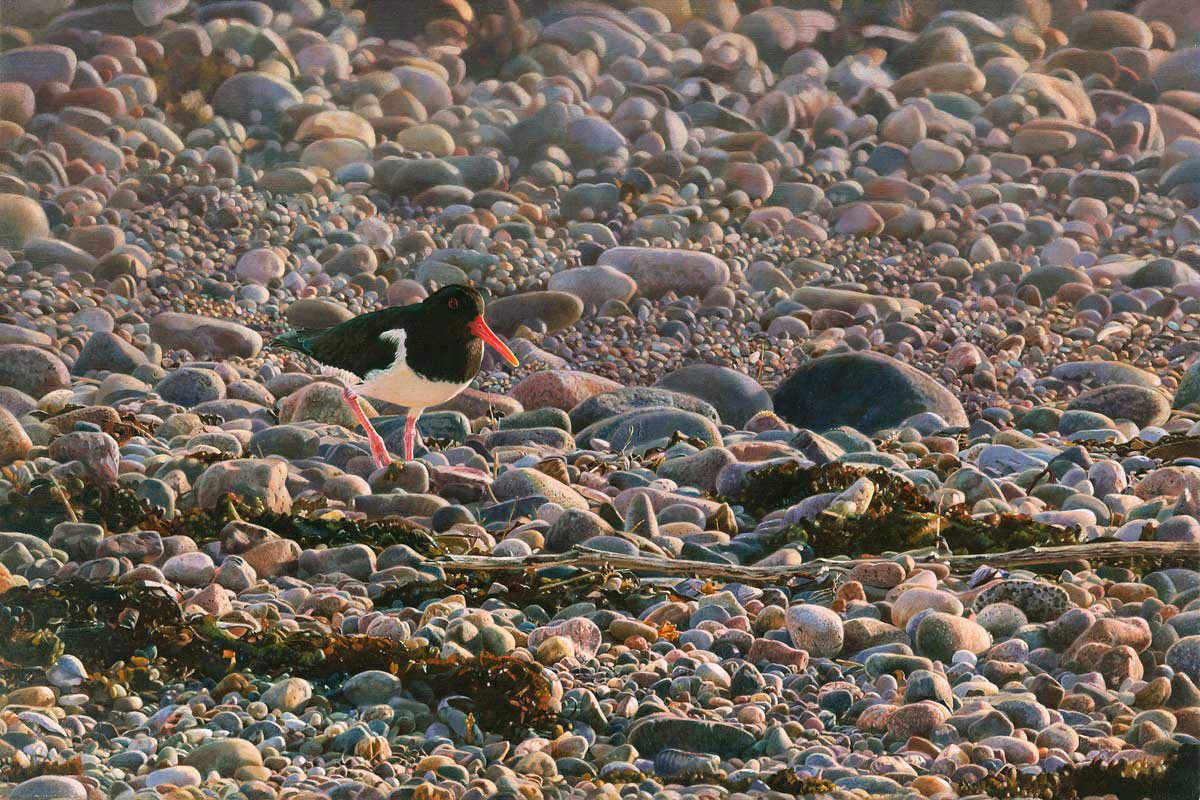
Oil on Linen 60x40cm
Robert Cook
Jacksons: How does this work relate to your artistic practice, how you approach art over-all?
Robert Cook: I think my background and training has had a strong influence on my artistic practice. To me as a scientific Illustrator, research and knowledge of a subject is crucial. My artistic works tend to be considered and well thought out. For the piece ‘Beachcombing’ I visited Foulney Island near Barrow in Furness. On walking around the island I was struck by the raking light illuminating the individual pebbles. The striking contrast between the background and the oystercatcher picking its way through the pebbles was a strong memory. I hastily took some reference photographs to remind me of the scene; the beginning of an idea was there, but it took a long time to finally materialize into the painting. To assist in my understanding of the bird I arranged to visit Liverpool Museum, where I was allowed access to their collection of oystercatcher skins and stuffed specimens. Here I was able to get detail and depth of understanding it would be difficult to get by any other means. The painting itself was approached in a methodical way and this was reflected in the painting technique I adopted. All this helped to achieve a naturalistic painting that is well balanced and has depth, reflecting what I remember from visiting Foulney.
The support is a pre-primed Italian Belle Arti superfine linen canvas. After carefully transferring the drawing onto the canvas, I began the painting using Griffin Alkyds. The high value under painting (Grisaille,) was achieved by mixing Titanium White and Ivory Black with Sansodor. The exclusion of colour allowed me to concentrate on the form and composition of the painting. Only when this is dry can I add colour; translucent and opaque applications are built up initially with Alkyds then Artists’ Oils.


Jacksons: What challenges if any did you face in making this work and can you give other artists any tips for solving similar problems?
Robert Cook: One of the biggest challenges was getting the depth and recession into the landscape whilst keeping the overall lighting I wanted. I think all paintings reach a point where there is a certain amount of toing and froing, for me the issue was with the tonal value of the background and at times I thought I would never get it to what I wanted. Glazing was the key to stopping the background competing with the sharply focussed foreground. I adjusted the tonal ranges of the background pebbles so that they were lighter in hue and kept a lot of their edges soft.
Jacksons: Do you have any art advice you would like to share?
Robert Cook: My advice would be to pay attention to the basics and keep drawing. No matter what medium you work in, you will be mark making in some way. The practice of drawing means that by the end of the artwork you will have more knowledge of the subject you were observing than when you started. Truly knowing a subject helps you to edit information and therefore to convey your ideas with greater clarity.
Jacksons: What is your favourite art material?
Robert Cook: This is a difficult question to answer as it all depends on what I am working on and what medium it is in. I love Derwent Graphic soft pencils and Faber Castell putty erasers when I am drawing. As I am painting at the moment, and I stress at the moment, I love the smell of Linseed Oil in the room and the intense colours of Winsor & Newton Artists’ Oils on the palette.

Robert Cook’s work can be seen:
www.robcookart.com
Facebook page
email him at [email protected]