



An artist asks:
Use of black ‘killing’ your colours
“I have heard many differing opinions on using black to create darker tones and shadow. I personally try to avoid it but sometimes it is undeniably useful. I have heard some go so far as to say that the addition of black will ‘kill’ another colour. I would be interested to hear what other people think about using black in their work.”
We received some helpful responses from other artists on our forum:
I understand perfectly where you’re coming from; yes black can kill another colour but can also save it from anonimity.
Is there such a thing in real life/nature as pure black? Or any pure colour come to think of it. But I tend to use black in backgrounds especially in portraits, & draw threads of much brighter colour through it to give a ribbon effect. The black still holds everything together but doesn’t swallow it whole! In more contemporary projects I love the way black slices through mundane portions and brings it to life.
On a gentler note, I tend to use Payne’s Grey ….a near companion to black but with a hint of mystery about it!
hope this was helpful 😀
-Yaj
“Before, when I didn’t know what colour to put down, I put down black. Black is a force: I depend on black to simplify the construction. Now I’ve given up blacks.”
Henri Matisse, 1946.
A recent book written about Matisse was called Black Is Also A Color.
Manet said something like all colours existed except for black but he paints it better than anyone.
Both Manet and Matisse used black as a colour, not to tone other colours which is what I think you’re asking.
To create a tone using black may deaden a colour depending on the black. Each pigment has different characteristics and mixes differently. Most blacks have a bias towards a colour that can affect the mix.
But deadening an area may allow your focus area to stand out, you may do it on purpose.
On the computer you add black when trying to darken a colour. But many painters add a complimentary colour to darken.
-Julie at Jacksons
All I know is, when I was at art school, I was told to use every other colour except black and when I needed to use black and had to “create” my own black from a mixture of different colours. Sometimes,when I am painting, I feel black can overpower an image. It is interesting though as most of my work is illustrative and comic based – often calling for black lines and black boxes/panels. It is an interesting topic,I’d be interested to see what anyone else thought?
-threepanels
I always taught my mostly amateur groups to stay away from black and Payne’s Grey. When learning it is far too easy to add a drop of either to darken another colour or to use either for shadows. This can quickly lead to a ‘grubby’ looking picture. Part of the problem is that most amateurs need quite a long time before their ability to actually see what they are looking at rather than what their brain tells them they are seeing. Thus black seems to them to be the obvious choice for a darker result.
I steered clear of black for many years but now have Ivory Black on my palette and make very occasional use of it for extreme,although often tiny, emphasis. I suppose the message is Black is OK but use with great care.
Incidentally have you tried mixing a little Ivory Black into a couple of yellows — it can give some useful dark greens.
-jkay8jay
For me, personally, a definite yes.
My father was a great fan of impressionism and some such artist (I forget who) had said ‘there is no such thing as black in nature’. He passed this ‘doctrine’ onto me and for years I never used black.
Eventually, I got to thinking and thought ‘if there is no such thing as black in nature, just what exactly is black paint. Take carbon black for instance… it utilises carbon, which is a pretty natural substance if ever there was one.
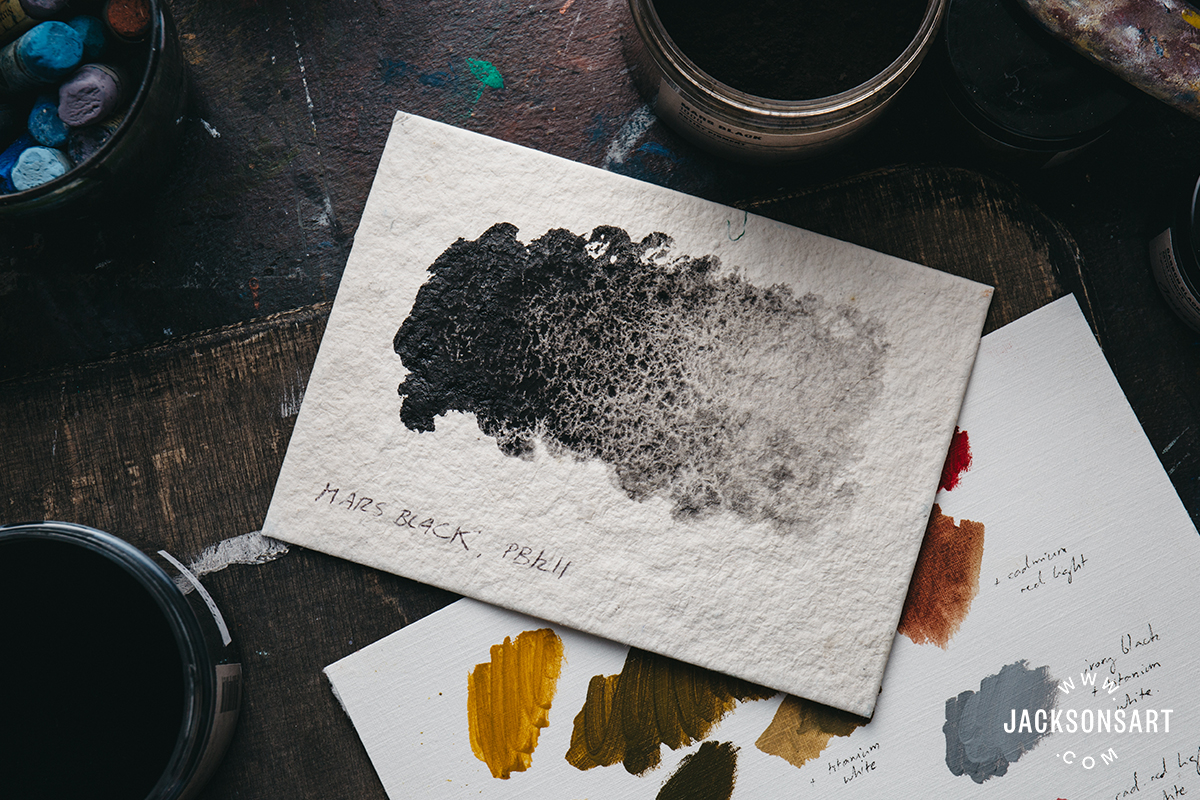
The term black relates to a state or condition of light and all the colours we call black: carbon black, Mars black, Ivory black, etc are conveniently put in the category of black for ease, but are not a reflection of the true definition of black (which I suppose would never reflect under any circumstance).
With this thought I started using black once more. For me it is a vital component(s) of my painting. As somebody else has mentioned, added to yellow and a rather nice green turns up. The list goes on and on. There are moments when black is simply the right colour, just as with any other colour.
Now I feel maybe all those blackless years were useful for me to understand other colours better and so the use of black can also be better appreciated.
As for killing colours ? Of course it can, and sometimes that is exactly what I expect it to do and I would be most put out if it didn’t.
-RobRidley
One of the most famous watercolourists of all time must be Rowland Hilder. He used lamp black fairly freely both alone and in colour mixes. Try mixing lamp black with Phthalo blue. Try it with Lemon yellow, or with Burnt Sienna. If you’re familiar with Hilder’s work you will instantly recognise the results. The reply to those who would ban it is – “It was good enough for Rowland Hilder; It’s good enough for me”.
-Rik Middleton
As a mix black can create some very rich colours, try cadmium red and black to make maroon.
Apart from that black has a terrific use:- the nature of pigment and colour is that a colour absorbs all the light spectrum except the one that is reflected – black absorbs all of the light falling on it so that your eye sees an absence of light. In practice black emphasises a colour placed next to it for that reason.
-Macgill
I always steered clear of black after my art school discouraged its use in oil and acrylic painting.
Afterwards I learned that Franz Hals and Anders Zorn used black in their very restricted palettes (black and white plus little more than a couple of earth colours) with wonderful effect.
I sometimes use it myself now, but only in mixtures.
-arontus
The key thing is to understand what your variety of “black” will do, and what it is. What it isn’t, is true black. None of them are. (Although they come close.) So, if someone reminds you that there are no blacks in nature, you can safely riposte that there are none in your paint box, either.
Personally, I choose not to mix tube blacks with other colours very often at all, and I try to reflect the subtlety of the shadows by not using black there, preferring a “dark”, frequently mixed from primaries. But, like others who have posted before me, I have been known to use a variant of black to set off other colours…
-Amanda
This was originally published on our art supplies forum.
The image at the top:
Olympia
Édouard Manet
1863, oil on canvas, 130 × 190 cm (51.2 × 74.8 in)
Current location: Musée d’Orsay


3 thoughts on “Does Mixing in Black to Darken Kill Your Colours?”
I wouldn’t employ black to darken colours – if I’m going to use it, it would be with a primary, a red, blue or yellow, and then to achieve a particular hue. It’s sometimes useful on its own, too. And of course, it comes into its own with monochrome work. What kills colour – a rather dramatic use of words – is using black (or Payne’s Grey) to darken or tone: you might as well use soot: it dirties colours when used for that purpose, sucks all the brilliance out of them; darks should ideally be transparent: black is opaque. Use it for what it’s good for.
Thanks Robert.
The link in the blog post will take you to the forum to read what others have said and to share your insight.
Anders Zorn mostly used only 4 colours and of those one was
white and another was black
Comments are closed.