



James Albon ARE is a highly talented and prolific illustrator and artist who specialises in creating beautiful images in ink – be it in the form of drawings or linocut prints. He is a well travelled Scotsman, who has just returned to the UK following some time working in Hong Kong; previous to this he worked on a commission in Ethiopia. he is a member of the Association of Illustrators as well as an associate member of the Royal Society of Painter Printmakers. I asked him about his life as an artist and illustrator, with a particular passion for linocut printing.
Lisa: How would you describe your linocut prints to someone who had never seen them before? Would you say your work was influenced by any particular individual artists?
James: My prints are bold and colourful, with thick, rough marks. I really prefer making multi-layered, multi-coloured prints, rather than single black-on-white layers. A lot of the thinking behind my prints is influenced by Claude Flight and Cyril Power, the British Modernists. I think they were the first people to really see lino as an interesting medium in its own right, rather than a cheap substitute for traditional wood. I find that whole broad period, I suppose the 1850s to 1950s, really interesting, not only because of the amazing vision of the impressionists, post-impressionists, modernists, expressionists and so on, but because they were responding to this amazing global change and turmoil.
My most recent big project was making 22 illustrations for Ford Madox Ford’s novel Parade’s End, for the Folio Society, which is exactly of that era. I muted my palette a bit there, because it better suited the tone of the book. Previously I’d done a big series of prints about Ethiopia, following a residency there with the Frankfurt Zoological Society. This work was a lot more colourful, more like the landscape and the amazing traditional Ethiopian religious art- but through all my work there’s the same sort of mark-making I think, and the same sort of attitudes to composition.
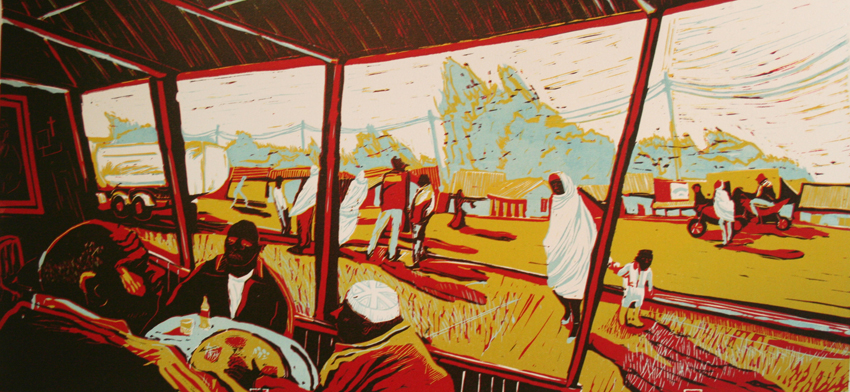
70x32cm
Reduction Linocut
James: There’s an awful lot of drawing behind my lino prints. Drawing is really fundamental to the way I work: almost all the elements of my work are based on observational drawings, whenever it’s possible, then those drawings are taken to the studio, where I’ll work up compositional ideas in sketchbooks at first, then on big pieces of paper, in pencil, ink, and coloured crayons. Then in the end, I’ll redraw the composition loosely on the lino, then carve it out.
What’s important is that each redrawing is quite loose. The marks from a pencil are so different to those of carved lino, and for me it’s very important that the marks on the lino are honest and lino-y, rather than trying to emulate pencil marks in lino. So the drawing phase, while it’s important, is very much about ideas and composition, and then the lino carving is actually about realising the image.
Lisa: How do you create multiple colour relief prints?
James: I use a reduction technique, which is probably fairly well-known as a sort of easy-to-learn-and-difficult-to-master method. I think Picasso referred to it as “Sudden Death Printmaking” or “Suicide Printmaking” or something. The colours are printed lightest-to-darkest, with each layer of colour carved into the same block, on top of the previous layer after it’s been printed. This means you can never go back and change anything, so any mistakes are just stuck there, or you have to start all over again (which has happened many, many times). I quite like that though. One of my great paranoias about drawing and painting, and especially any sort of digital imagery, is that it’s too easy to go back and alter mistakes. I tend to get very hung up changing tiny details of something that I think is “wrong” with an image, which stops me from taking a step back and looking at the whole thing. Reduction printmaking makes any alterations impossible, so you just have to work fast and hard and be happy with what you come out with. It takes a lot of practice, but I think the results have this sort of thrilling, nervous energy which makes the process much more enjoyable.
Lisa: Do you use a press to make your prints? If so please describe the press that you use.
James: I use a workshop whenever possible, so a press is usually involved. I’ve moved around quite a lot in recent years so I’ve used several different presses, but for me it’s better to be in a nice, well organised, dedicated print studio, rather than trying to fiddle around with a glass plate and a wooden spoon in the kitchen. I was really spoilt in art school (as many students are) by having such amazing facilities available for free, because once you’re in the “real world” it becomes very expensive to be in the print studio a lot. (Students: get as much out of your print studios as you possibly can, because you’ll miss them when you’re gone.)
I’ve been in some funny print studios though. When I was a student I went on an Erasmus exchange to L’Ecole Supérieure des Arts Décoratifs, the art school in Strasbourg. The workshop was this tiny cramped basement, with almost no ventilation, and everyone worked with these beautiful, very rich oil-based inks and so we had all these various solvent cleaners too. The combination of fumes in there was just overwhelming, and everyone worked very intensely with few breaks, so we were just in this sort of chemical-induced psychedelic daze the whole time. The standard of printmaking there was really very impressive, so I wonder if it was because of this high that everyone was on.

28x20cm
Reduction linocut with digital text and layout
In contrast to that, when I was working on Parade’s End last year, I was living with my family up in the rural north-east of Scotland, and I was working in the studio of a wonderful artist called Nicola Chambury. She has this tiny cottage beside her house which she’s converted into an incredibly beautiful and well-equipped workshop, and I had it all to myself, for about four months, so I’d just wake up in the morning, drive through the countryside, and spent all day working in this beautiful silent studio, surrounded by trees.
But then for the last six months I’ve been living and working in Hong Kong. I went into one print studio there, hoping to get an induction and use their equipment, but the technician spoke very little English and I speak almost no Cantonese beyond “two beers please”. For that time I had to work in my drawing studio, with just a roller and some stamping ink. I made a lot of mess and it was harder to clean up, and the smoothness of the impressions really wasn’t as good. I won’t be trying that again unless I’m really forced to.
Lisa: How do you decide which colours to use in a print and what kind of inks do you use?
James: The colours are normally pretty much decided in the drawing part of the process, where I’ll draw out colour studies to try different combinations. Because of the sudden-death element of reduction printing, it’s never wise to gamble too much with wild colour choices, and it might look dreadful and there’d be no going back. Inks-wise, I really like Caligo safe-wash inks, because the colours are nice and bold, but they’re not a nightmare to wash up like some old-fashioned oily inks. That said, I often use fairly muted colours, so my ink tends to be diluted right down from its original pigment.
Lisa: How important is the quality of the paper that you use to print with?
James: Really, really important. I mean, when you’re just trying things out or making proofs it’s fine to use cheap paper, but when you want something final to be framed on a gallery wall, you’ve got to really make the investment. Better paper holds the ink better, and won’t deteriorate over time, which is very important. I use a lot of Fabriano printmaking papers, because they have a lovely tone and texture.
Lisa: What is your single most favourite piece of printmaking equipment and why?
James: I’m not really sure; I think the value of equipment is really a “sum of the parts” thing- having a good set up overall is better than a few really expensive pieces and others which are no good. I have a nice set of lino tools- I prefer buying them individually, so I have a combination of different shapes and sizes which suit the marks I want to make. A nice, heavy, vinyl roller is important, because there’s nothing more frustrating than an uneven plastic one. One of the funny things about printmaking is that it’s easy to take good equipment for granted, but it’s so annoying when a piece of equipment isn’t quite up to the job. This can come up in the strangest of places- I once had a drying rack that was designed in such a way that when you lifted up each layer, the prints would just fall out of the back!
Lisa: What is your biggest frustration in the studio as a printmaker and how would you overcome it?
James: I think frustration normally comes out of tiredness, or rushing, which is a vicious circle because the more frustrated you are the more you rush. I know the stereotype of an artist is normally that they’re messy, disorganised, and drunk, and I am like that in various other elements of my life, but in the print workshop it’s really important to be precise and disciplined. I sort of have this mantra that “The Devil is in the Detail”, because so much of good printmaking process (and thus good prints) is in being really precise with registration, and mixing just the right colour, and being thorough in cleaning up afterwards (there’s nothing more upsetting than putting some nice new paper down on a surface which you though was clean, then finding a big streak of red ink on them afterwards). If you’re ever getting frustrated and making mistakes in the workshop, the solution is just to stop for a while, go outside, have a cup of tea, and relax for twenty minutes. Funnily enough, screenprinters and etchers don’t really have the same problems because those processes have these stages of waiting for screens to dry or acids to etch or whatever, so they’re forced to stop working for occasional periods.
When I was a student we’d sometimes plan to work late evenings, but there’d be an exhibition opening on, so we’d go to the exhibition, have a few glasses of wine and then go back downstairs to the print workshop. Inevitably we’d lose the ability to line up our layers properly, or end up with inky thumb-prints all around our pages, and the whole evening would be wasted.
Lisa: Is there a difference between a fine art linocut print and a linocut illustration?
James: There isn’t really one! On a practical level you could point to differences in application (“fine art” might go in a gallery and be discussed with a curator, “illustration” might go in a book, and be discussed with an art director), but otherwise the process that I go through for making an illustration compared to a fine art print are exactly the same: I’m trying to make good pictures.
The idea that fine art and illustration are different or mutually exclusive is just nonsense. I think it comes out of art schools often putting “art” and illustration in different departments; or certain artists who think that somehow commissioned illustration is “selling out” and that it disrupts the mystique of being a proper bohemian fine artist. At the end of the day both fine artists and illustrators are making pictures which communicate something to their audience, it takes all of about three seconds to think of a long list of both contemporary and historical figures who make work for both fine-art-galleries and commissioned illustrations clients. The American artist-and-illustrator Chris Buzelli summed it up best: “The only different between fine art and illustration is that with an illustration you know how much you’ll get paid before you start, as a fine artist you only find out afterwards”.

30x18cm
Reduction Linocut
Lisa: Where can we see more of your work (online or in the flesh?)
James: The easiest place to go is my website, which is online at www.jamesalbon.com. If you want to see more in the flesh then there’s some of Ethiopia works in the Bankside Gallery, and I’ll be exhibiting a selection of the Parade’s End work in the RE annual show there from the 9th of May til the 7th of June (with more information here).
1 thought on “Linocut Printing with James Albon ARE”
What wonderful prints and an insightful interview. I’ve just bought a print making set so I’m looking forward to having a go minus the proper printing press. He’s also reminded me to make more use out of the printmaking room at college…
Comments are closed.