



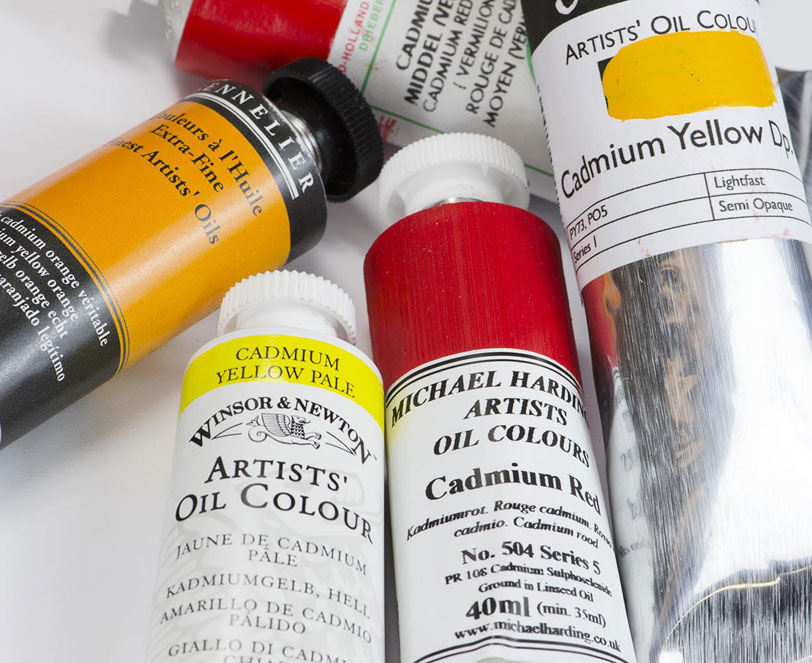
Following on from our report on the EU’s threat to ban Cadmium pigments and therefore severely reduce the palette of professional quality colours available to today’s European painters, author of ‘The Painter’s Studio Handbook‘ Simon Fletcher got in touch with an excerpt from his book celebrating the beauty – and importance – of Cadmium pigments.
An update on the issue was published last Friday 13th June by Julie on the blog here.
Remember that if this issue is important to you please express your thoughts by adding a comment at the European Chemicals Agency website here.
Throughout history and well into modern times painters have had problems with the permanence of colours. Colours in many paintings have faded dramatically because the pigments used were not stable in light. The beautiful Alizarin crimson is a case in point. My own tests as well as a number of others, M Wilcox for instance, have proved conclusively that the colour fades quickly as a watercolour wash and due to pressure from some of us painters the big manufacturers now offer a permanent alizarin, not exactly the same but at least it will look the same in a few years!
If pigments are not permanent then the paintings done with them will not be a reliable witness to the talent of the painter. Some of the very best pigments in the red to orange range are the cadmium pigments are now these are threatened by EU regulations.
Artists use a tiny fraction of the production of these colours and our use of them could not I think affect the environment so please, by all means find an alternative colour for industrial production (Pyrrol looks very promising), but leave us our bright yellows and reds!
“The big breakthrough in the permanence of bright red and yellow colours however came with the introduction of Cadmium pigments towards the end of the 19th century because, although invented in mid century it was not until the 1880’s and 1890’s that these paints became readily available and how lucky for us that they were! You have only to look at the difference between the chrome yellows used by Vincent van Gogh in some of the sunflower paintings for example, now a warm brown, and his use of Cadmium yellows, still bright yellow, to realise that without these pigments we would not have a proper idea of how great a colourist van Gogh was. Monet too used these new yellows and reds for his paintings, sometimes replacing the fugitive, beautiful traditional colours like rose madder*, but there was a problem here. The Cadmium pigments, wonderful lemon yellow, deep yellow, scarlet, orange and deep red, are all on the yellow/orange/red side of the colour wheel. This of course means that they will not make satisfactory violet tones when mixed with blue.”
Taken from ‘The Painter’s Studio Handbook’ by Simon Fletcher.
Published by Bloomsbury 2012



1 thought on “Keep Our Cadmiums! By Simon Fletcher”
Pingback: Best Painting Holidays: creative escapes for artists - Jackson's Art Blog
Comments are closed.