



Derivan Liquid Pencil

Derivan Liquid Pencil is an innovative new product that allows you to create actual graphite pencil sketches using a creamy graphite in a jar. Liquid Pencil is available in six shades of graphite with subtly tinted undertones in a permanent (acrylic) or rewettable (watercolour) formula.
The graphite shades are: blue, red, yellow, sepia, grey 3 and grey 9. It has been formulated to be easily thinned with water or acrylic medium and allows the softest of colours to be applied with a brush.
This creamy graphite in a jar can be used to cover a large area quickly, in a smooth, even way or in a gradation. Both permanent and rewettable formulas have the highest lightfast rating.

Testing Liquid Pencil
I tried them out on both smooth and textured watercolour papers and found they behaved like this:
The Permanent (acrylic) formula
- will burnish up in a manner similar to traditional graphite
- you can smudge the edges for blends
- it is similar to other graphite grey acrylics but because it is not as dark, it can be made to look more like graphite pencil
- when dry it will not erase with eraser or water
- Both formulas have the sparkle of graphite, but the watercolour version is a little more sparkly
- looks great on textured paper – when applied lightly in a dry brush manner it will skim over the textured surface
The Rewettable (watercolour) formula
- will burnish up in a manner similar to traditional graphite
- you can smudge the edges for blends, even more than the acrylic version
- allows you to lift areas using water like you would with watercolour painting, though not completely as these are all staining
- when dry it erases with a traditional eraser – though light areas erase well and dark areas erase only about halfway
- you get darker darks and lighter lights more easily than the acrylic version
- it flows more evenly than the acrylic version
- Both formulas have the sparkle of graphite, but the watercolour version is a little more sparkly
- overall, even though I don’t use watercolour as much as acrylic I preferred the watercolour version. Perhaps because it flows more smoothly, allows for more time to adjust it, is erasable and smudgable and because it looks more like pencil
Both formulas granulate if you use a lot of water.
Unlike painting with ink or watercolour, Liquid Pencil doesn’t lighten as it dries.
Images from my testing of the Liquid Pencil

Applied with a sable watercolour brush on hot press paper.


1. left: wet
2. centre: dry
3. right: finger blended across with eraser stripe

right: Rewettable has more time for adjusting

bottom: rewettable (watercolour)
top: permanent (acrylic)


left: rewettable (watercolour)
right: permanent (acrylic)
Artist Reviews
The first reaction of most of the artists who tried the Liquid Pencil was something like: “I couldn’t imagine what on earth it would be like”. They were surprised that the samples came in tubes, I think they were expecting pens full of liquid graphite.
After trying it most of the artists thought it would be useful for them. Some were quick to figure out good ways to use it. The less positive reviews were from artists that didn’t normally use graphite in their work and those who would prefer a simple pencil.
(click on the images for larger views)
“I have to say that reviewing this product has changed the way I’m going to be sketching.
I use pencil and fine liners for outdoor sketches, as well as watercolour and acrylics – but this medium has a softness and versatility that feels like a combination of all four.”

“I used a grey, sepia and red – a perfect mix of cool, neutral and warm for my seascape sketching.
They’re easy to use, and the rewettable versions are quite forgiving – being fairly liftable on good quality paper. Like graphite, they also respond well to a rubber, though not completely removable. The permanent version doesn’t budge and it is useful to have the flexibility of working with both. I let them dry overnight on the palette and only the rewettable paints were revivable, though not to their original soft, light consistency. They dilute well with water – you don’t need much – and they don’t lose their softness or graphite sparkle. I used filbert and flat brushes, and was impressed with the flowing response.”

“The challenge of sketching outside, for me, is trying to capture atmosphere and movement whilst the light is changing. The liquid pencil allows for a speedy, expressive and full sketch which dries very quickly, distinguishing them above other similar mediums. These two sketches took 15 minutes each. I am looking forward to a full day of sketching in the field with them.”

“For starters, I was surprised when I opened the packet to find that this was essentially ‘watercolour’. I think I expected something more of a felt pen type product. As I am an artist who works chiefly with charcoal pencils on paper and NOT a water-colourist, I must admit I went into the trial with a somewhat negative attitude. I didn’t expect to like them. However, I was very pleasantly surprised. They are a pleasure to use. Once diluted they transfer from brush to paper beautifully. I felt I had a great deal of control and could really ‘draw’ with them. I like the colours, like the slight glitter of the graphite and thoroughly enjoyed using them.
My criticisms would be that the ‘blue’ had far to much medium in the tube – nearly a third of the tube before I got onto actual paint and I suspect painters might find them a tiny bit uneven or blobby in the application – not quite the refined quality of pure watercolour. They are not so great applied thickly and darkly – ie. less diluted but in the pale, very diluted range they are wonderful and I would definitely buy and use them again for sketching.”

“I tried it with a pen and nib but I think I made it too watery as I couldn’t get it to work at all so I used brushes instead. It has the same consistency as paint and you just add more water if you want a paler colour. Once they dry they have a pencil/graphite look about them but also a painterly look. I couldn’t rub them out with a putty rubber but I could smudge and blend them slightly with a paper blending stump.
I did some quick whimsical illustrations as that it was I am used to doing with a pencil, I found that I didn’t have as much control as I do with a pencil, if I made a blob of liquid pencil it stayed there. It was quite fun to try and draw with a paint brush but I think I will stick to an ordinary pencil and putty rubber simply because it suits my style better.”
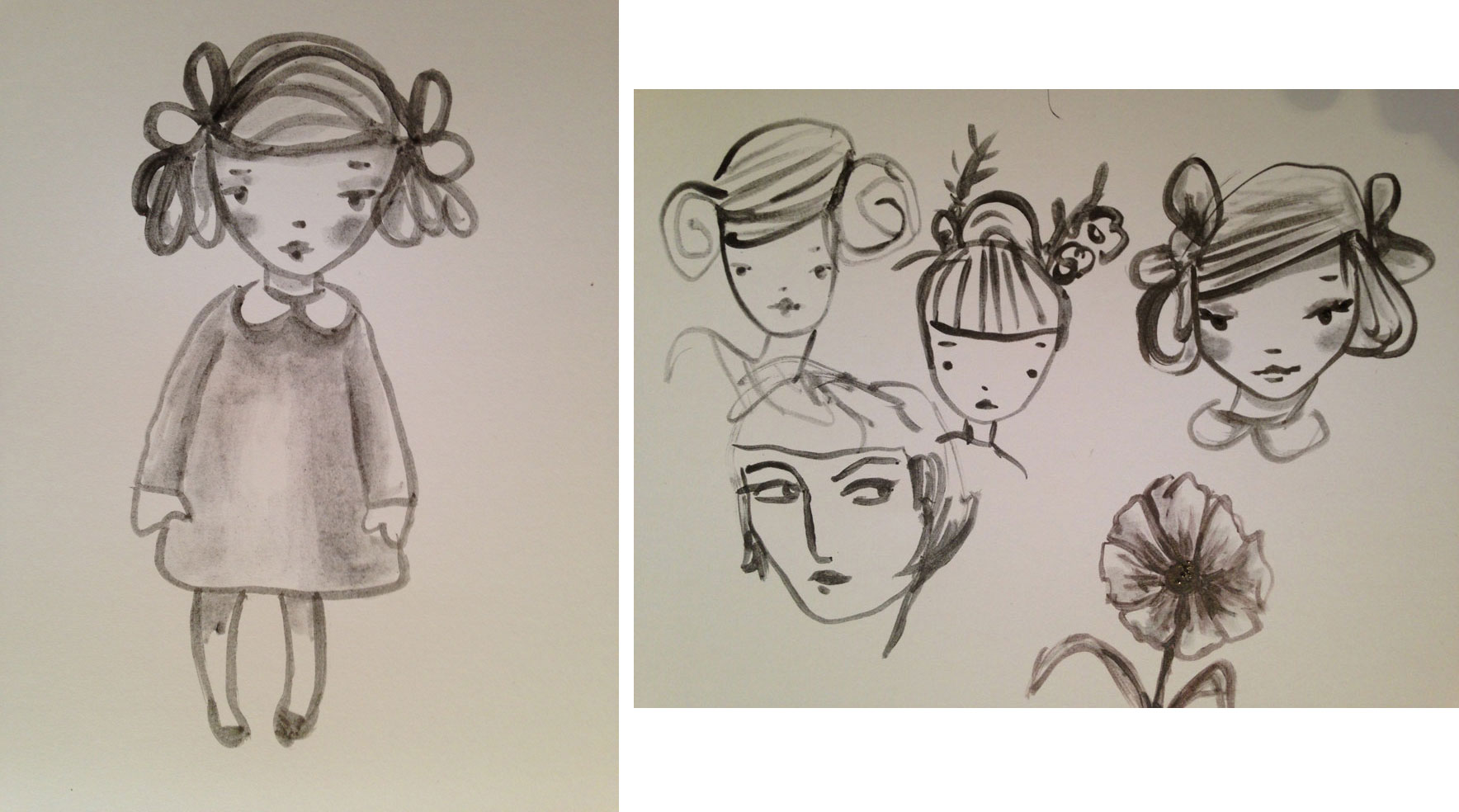
Michelle tried four colours: Grey 3 rewettable, Grey 9 permanent, Sepia rewettable, and Red rewettable (all subtle tints of graphite).
“It took me quite a while to get used to using them, but after a little practice got the hang of shading with them as you would a pencil, & they produced authentic graphite pencil effects. The only colour in the box was red & my only reservation was that there was not enough of a hint of the colour. (Being a colour junkie and usually using vibrant acrylics I had to use a hint of watercolour in my doodles!!)
My daughter, Ella Carolan-Yates, who is a designer in London happened to be visiting when I was trying them out & got involved & produced the stunning portrait next to my little doodles. She said it would definitely be a product that she would use in her work environment rather than her traditional pencil & charcoal.
So all in all it’s a thumbs up for the Liquid Pencil!”

Click on the underlined link to go to the current offers on the Derivan Liquid Pencil on the Jackson’s Art Supplies website.
Postage on orders shipped standard to mainland UK addresses is free for orders of £39.


7 thoughts on “Liquid Pencil – Paint with Graphite”
Please will you tell me who is the manufacturer of this product ?
Hi Aine.
The maker is called Derivan, as it says in the article.
Here is our Derivan department: http://www.jacksonsart.com/Brands-A-Z_All_Brands-Derivan/c2200_1044_36755/index.html
Pingback: Drawing with Derivan Liquid Pencil - Jackson's Art BlogJackson's Art Blog
is this product usable with oil paint? Of course, I would use
only on dry paintings.
Hi Marie
I haven’t heard of it being used that way.
It is not usual to use watercolour or acrylic on top of oil as the surface either is oily and repellent or glassy and non-porous.
But you can always give it a try. If you do, please let us know how it works for you.
Are these paints lightfast? If so what is the
lightfast ratings for the various products?
Graphite has a maximum lightfast rating, so will not fade over time.
Comments are closed.