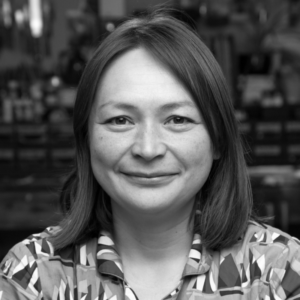
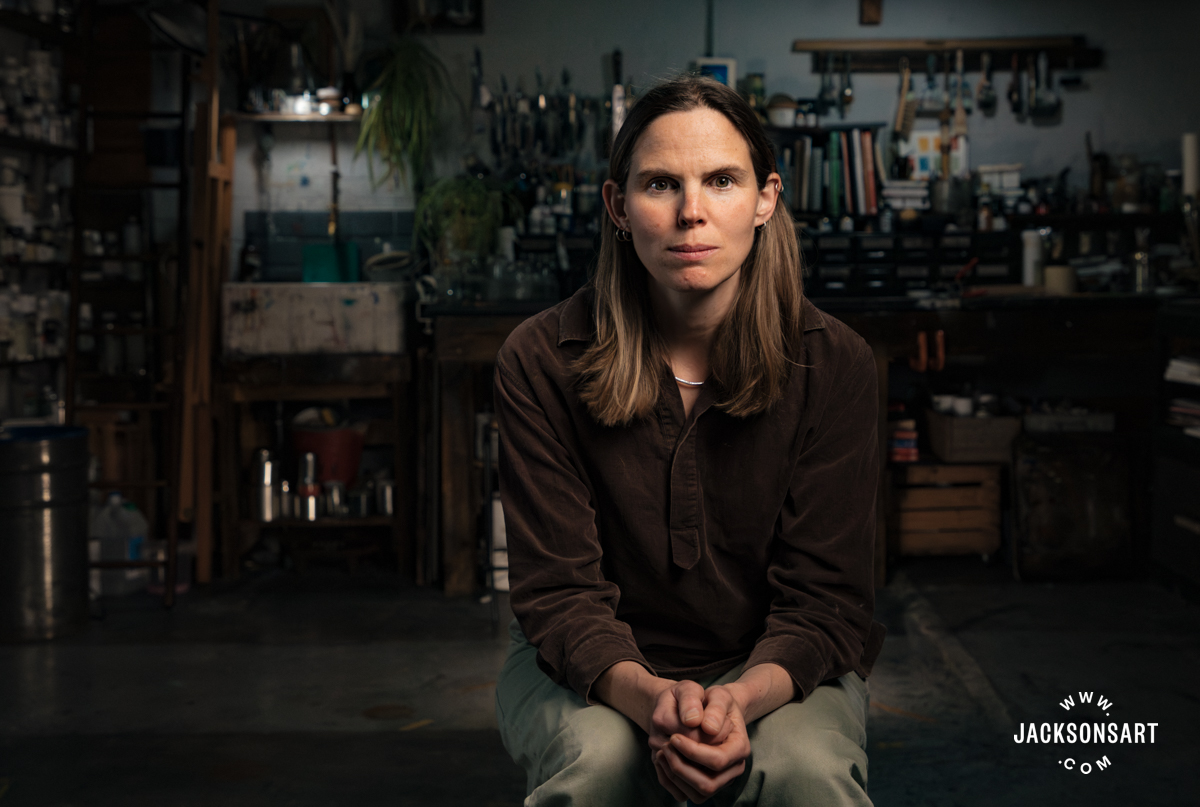
Tim Ridley’s art works explore his deeply ingrained affinity with animals. He often portrays humorous aspects found in the similarities between animals and humans. We asked Tim a few questions about his work as he prepares for his forthcoming exhibition at the PZ Gallery in Penzance this December.

Lisa: How do you see the gap between animals and humans?
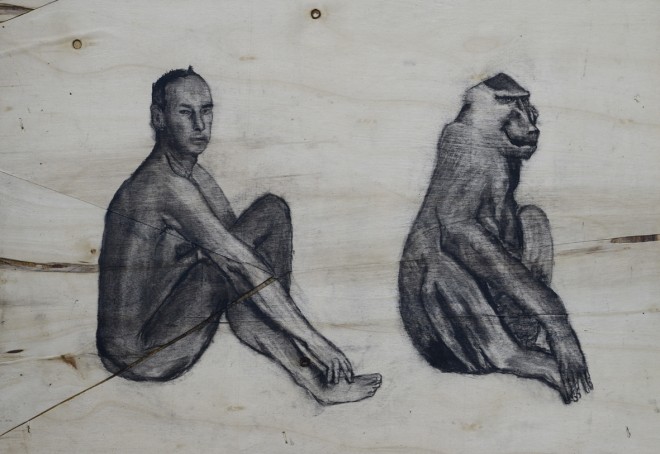
Tim: The gap between animals and humans is a fascinatingly charged psychological space. The most popular YouTube videos are concerned with animal behaviour, but we are detached from the wild in our mainly urban lives. I like to make paintings, drawings and collage using the energy of the push and pull we feel towards other species.
In December this work will form part of ‘Humanimal’ an Art Council England funded exhibition that will be concerned with ideas of animal rights, the future place of animals and humans and the question ‘Do animals have feelings?’. With some countries passing legislation to acknowledge that primates have a right to self determination, we live in exciting times, and we have to decide how we will behave towards all animals in the future. Having been bought up on a farm I saw how the food choices we make in life effect animals. I experienced the hot pungent confines of chicken sheds at an early age and that had an effect which has surfaced now both in my vegan diet and the subject area I explore.
Lisa: How do you decide what supports you are going to paint on?
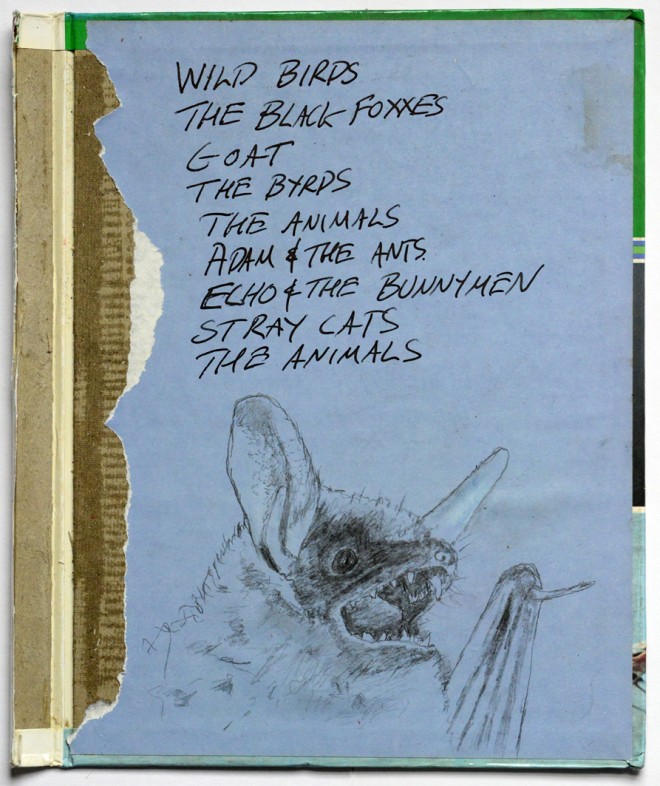
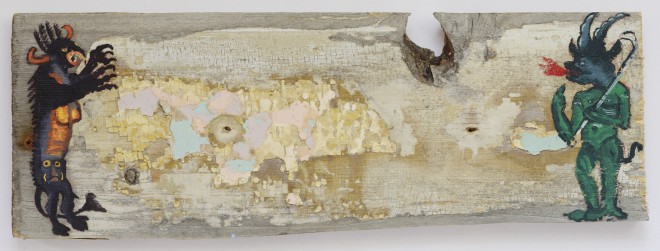
Tim: Primarily I choose supports for painting on that have had a previous use. This makes them more interesting as they possess a history and a patina which can work with and sometimes against what I do. There is also a strong impulse to re-use and recycle existing objects rather than generating more production. I find the perfect blank canvas rather scary.

Lisa: Do you think that living in Penzance influences your work in any way?
Tim: I have been more productive in Cornwall and have met so many interesting and inspirational artists. In particular Jesse Leroy Smith has been inspiring both practically and artistically. I was accepted as a member of the Newlyn Society of Artists. Also I have moved from doing a mostly performance based practice to using painting and drawing much more, perhaps this is a result of being within easy reach of the sea and moors of West Penwith and the Lizard peninsula. I have already shown work in The Penwith gallery, St Ives and the Newlyn Art Gallery, and had a residency in a local pub, The Swordfish, so the animal theme abounds.
Lisa: Did you find your art school experience an enriching one?
Tim: At Chelsea I was opened up to the vast array of practices, processes and subject matters that constitute contemporary fine art. It was in the end enriching, but at first it was a challenge as I re-assessed what areas I would explore and with which medium. I became a multi media practitioner, but performance fast became my chosen route. Winning the Ovalhouse prize allowed me to have a platform for my work after I graduated.
Lisa: What do you do if you get stuck with a piece of work?
Tim: I am lucky in that I rarely get stuck with a piece, but I can over work some ideas, losing the spontaneity and accidents that allows for something new and unexpected to appear.In my studio I will play a familiar film or piece of music in the background, this helps me to concentrate, but not to the extent of exerting too much control over the work. When work is finished, and I still am not happy with a piece I will start over after sanding or painting over the support, nothing is lost as the previous work becomes a new background.
Lisa: What is your favourite medium to work with and why?
Tim: Oil paint is good to work with, capable of subtlety and boldness, it constantly surprises me what I can do with it. For luminosity and power I love it, but I will use acrylic to under paint and prime backgrounds too. Charcoal is a fairly new discovery, I struggle with the lightness of touch needed to use it well.

Lisa: Can you tell us what it was like to collaborate with the poet Katrina Naomi? Was there any difficulties between the one that expresses in words and the one that expresses in pictures?
Tim: Both during and since collage, collaborating has been a habitual process. I went to the Czech Republic with the Wild project in 2013 as a lead artist and made performances and films about our relationship with the idea of ‘The Wild’. Katrina Naomi the poet and I have created two pieces together, The argument Art v Poetry in 2013 and Film V Poetry in 2015. We reacted in turn to a poem and then a film, each making 5 pieces of work, to be published on line. This process gave me permission to explore subject matter and processes that I would otherwise not go into or use. The two week time slot for making work was easier for me than for Katrina as she would often normally leave a poem several months from first writing to revision and final draft. Her intense process was often in contrast with my more relaxed and spontaneous approach. I found there was no problem with understanding and reacting to her words, but sometimes my imagery was more elusive for Katrina to interpret. We have performed and shown these collaborations at the Poetry cafe, London, StAnza Poetry Festival, Scotland, Gladfest in Wales, The knut, in St Just, Cornwall, where we fielded questions which we never expected about our motives and processes.
Lisa: What are you working on at the moment?
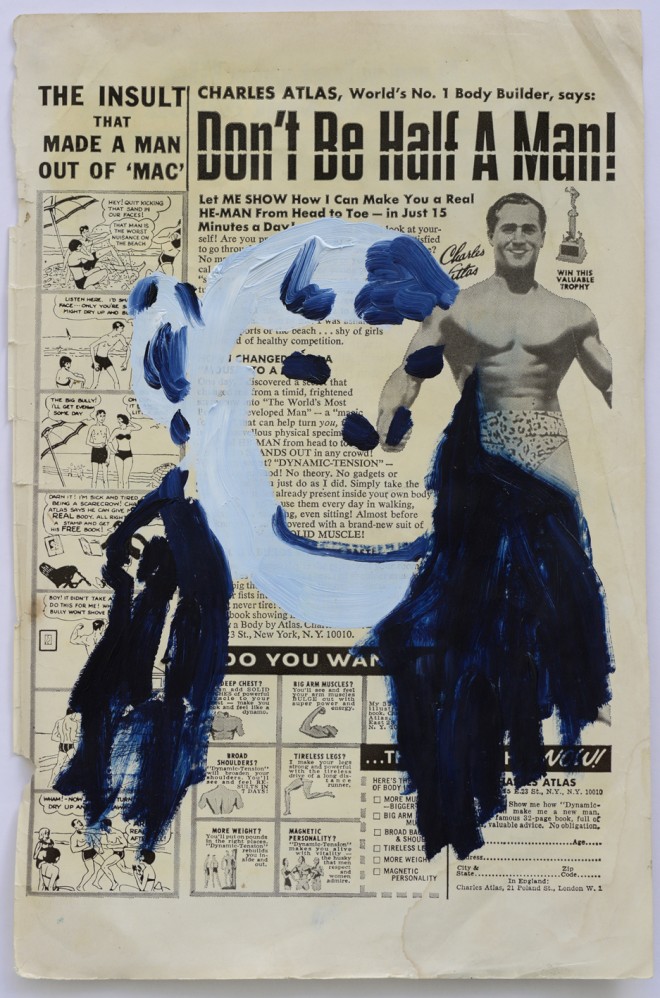
Tim: I am working on a series of paintings for the ‘Humanimal’ exhibition which runs for a week from December the 4th 2015 at the PZ gallery here in Penzance. The Arts Council England awarded me a ‘Grants for the Arts’ to make this exploration of our responsibility towards animals in contemporary society. In particular I am using found pages from 70s Marvel comics on which to paint simplified animal portraits. They are almost drawings or rough sketches, but I like their energy and spontaneity.
Lisa: How important is humour in your work?
Tim: There is always a place for humour in life and I have often used it to diffuse difficult situations, being quite shy of confrontation. My performances often used comedy to allow audiences to relax and open up to a piece of work with a difficult idea behind it. Hopefully there will be a few pieces in ‘Humanimal’ that have humour and a important message.
Lisa: Where online or in the flesh can we see more of your work?
Tim: My Facebook page – https://www.facebook.com/HumanimalArts
My work is for sale on Saatchi online http://www.saatchiart.com/art/Painting-Mr-Foxy/151547/2225946/view
My website www.timridley.co.uk
4th till the 13th of December at the PZ Gallery, Penzance TR18 4AY, Cornwall.