



Art and sustainability aren’t necessarily two things you’d think of simultaneously. Yet around the printmaking studio, the materials and processes used to create a beautiful fine art print can be highly toxic and harmful to both our health and environment. The good news? Around the world, the movement for environmentally-sound art and design is on the rise, with artists and experts leading the way towards a greener and creative future.
Sure, it’s a sensitive subject, and one we might prefer to not think about for too long. But in view of our planetary ecological crisis, sustainability issues are becoming harder and harder to ignore. In the art world, many of the hazardous and harmful compounds that were the staples of early photographers, printmakers, and painters have made a comeback. As artists, don’t we have the responsibility to produce work and be creative while making a conscious effort to minimise our impact on the environment?

Throughout the UK and the world today, more and more artists and studios are shifting to non-toxic printmaking and developing environmentally sound printmaking processes of their own. The legacy begins with artists such as Nik Semenoff and the late Keith Howard, who was the first artist to investigate alternative methods in intaglio printmaking in the 1980s, reinventing techniques which had largely gone unchanged since the 16th and 17th centuries when the likes of Goya and Rembrandt were researching and establishing traditional etching materials and processes from the resources available to them at the time. In 1991, Keith Howard published his first book, ‘Safe Photo Etching for Photographers and Artists’ and began travelling the world to share his innovations through workshops and lectures.
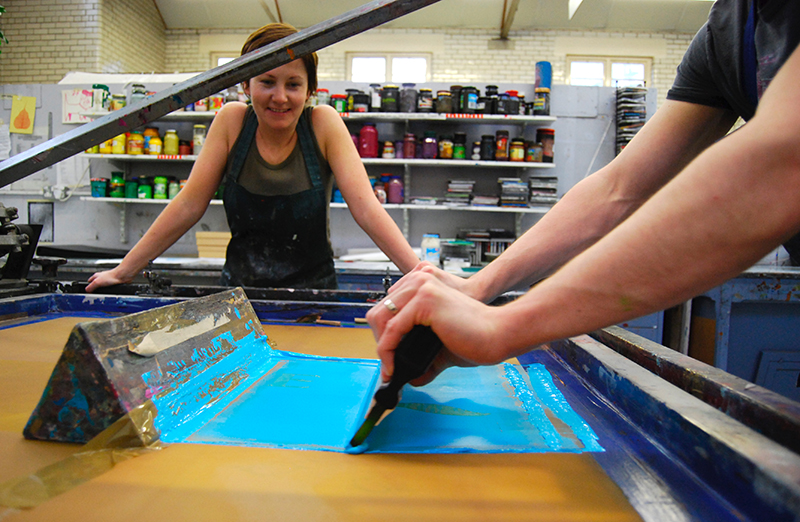
In Scotland, Edinburgh Printmakers was one of the first collectives to take Non-Toxic Printmaking seriously. Founded in 1967, Edinburgh Printmakers was the first large-scale open access studio in the UK dedicated to the promotion of contemporary printmaking practice. Artist and member of Edinburgh Printmakers Friedhard Kiekeben notably pioneered the ‘Edinburgh Etch’, a process suitable for copper, brass and steel and consisting of solutions of ferric chloride and citric acid, while artist Alfons Bytautas’ research into alternative printmaking techniques led him to develop acrylic resist etching and photopolymer techniques.
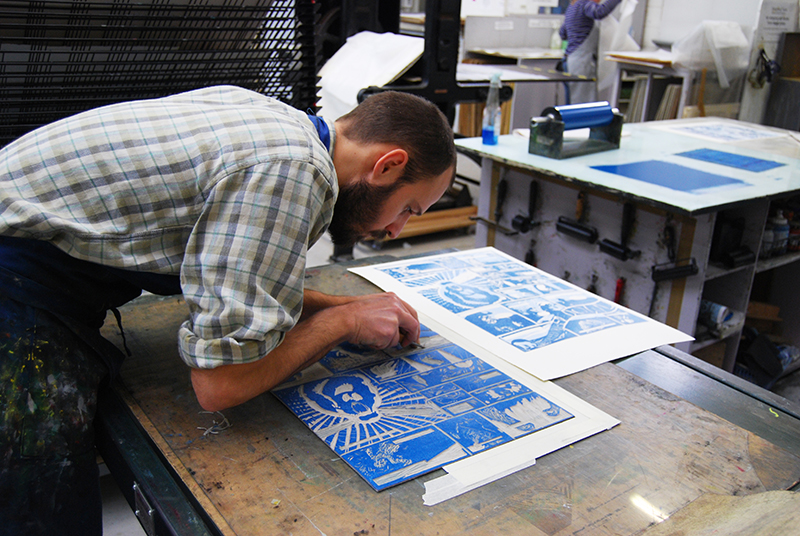
By the mid 1990s, Edinburgh Printmakers had completely changed all classic printmaking methods to the new non-toxic methods such as acrylic resist etching, water-based screenprinting, relief printing and lithography using non-toxic chemicals, to name just a few.

“The history of printmaking is a history of aesthetics, invention, and perfection – not only in technical terms but also conceptually”, wrote Friedhard Kiekeben in the foreword for Keith Howard’s book ‘The Contemporary Printmaker’. “Whereas a canvas and the actual practice of painting has changed very little in many centuries, the practice of printmaking has been accompanied by continuous development, and more recently by major re-invention. When Rembrandt wanted to etch crisper lines he invented his own mordant. When Goya wanted tonal richness in a print he perfected aquatint. Andy Warhol was innovative not only by choosing a contemporary medium, silkscreen printing, but by centering his entire art around the notion of the reproduced image. Although fusing art and invention, until recently the art of printmaking had an unhealthy association with a whole range of potentially harmful materials and processes.”
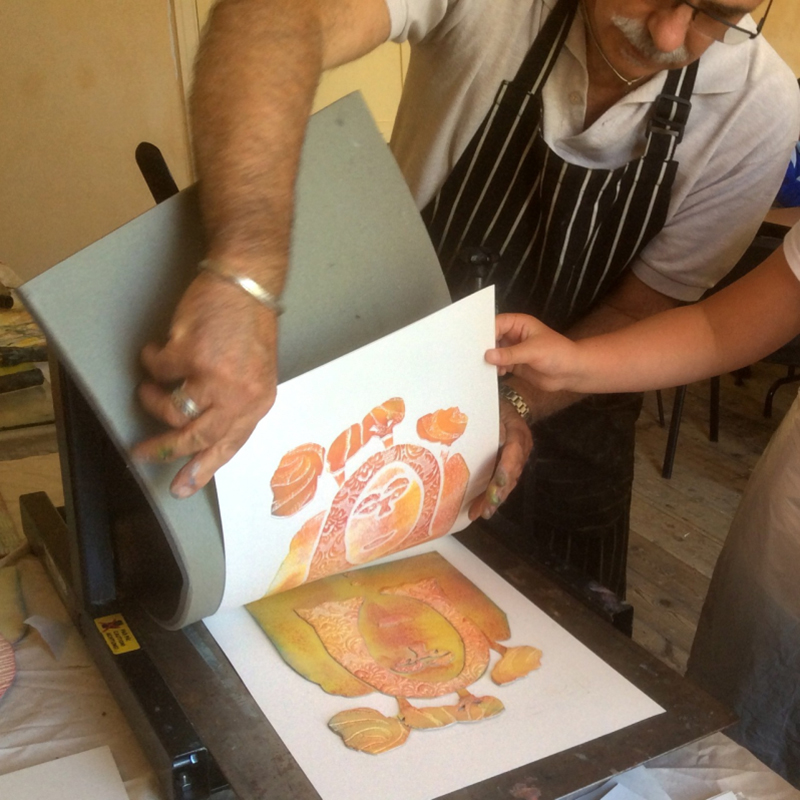
In Wales, the artist-run Swansea Print Workshop is committed to solvent free, safe and non-toxic printmaking. This is achieved by making use of either water-based techniques in place of traditional solvent-based processes or by substituting vegetable oil for white spirit when cleaning up oil-based inks. The workshop also makes use of BIG (Baldwins Ink Ground), a vegetable-based ground used as a safer alternative to traditional intaglio materials pioneered by Welsh printmaker Andrew Baldwin at Trefeglwys Printmakers.
In the Midlands, Green Door Printmaking Studio is the only open access artist studio dedicated to the art and craft of innovative and environmentally sound printmaking, while in southern England, studios such as Hello Print Studio in Margate and East London Printmakers in London offer the opportunity to work with the environmentally-sound process of Linocut and have numerous workshops and courses on this printmaking technique.
“Hello Print Studio tries to be as environmentally friendly as possible”, says Nick Morley, a printmaker also known as Linocutboy who runs workshops such as the Linocut Summer School.
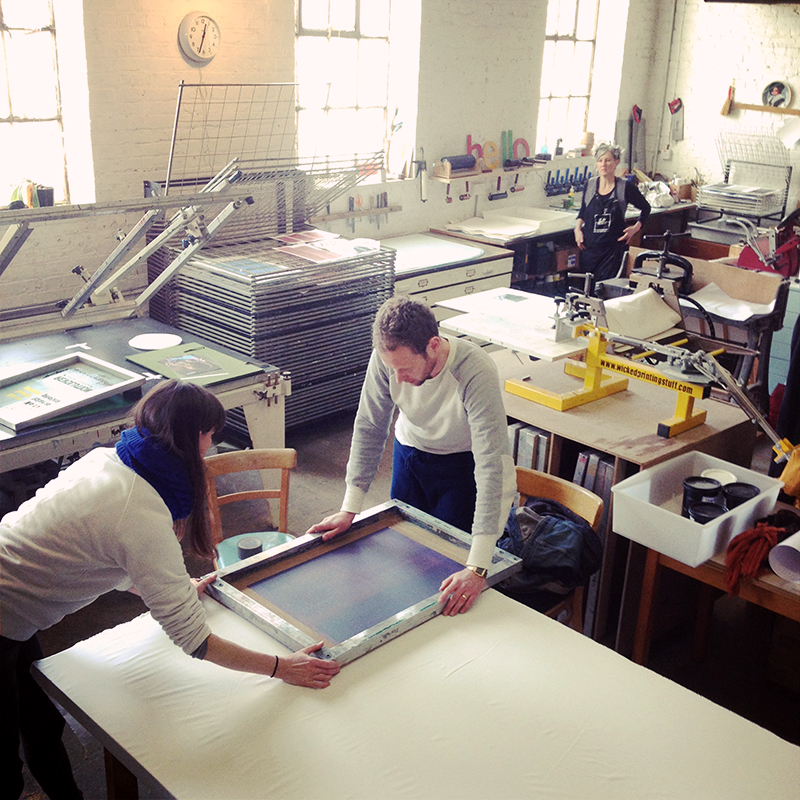
“We use only water-based System3 inks for screenprinting and water-washable Caligo Safe Wash inks for relief printing,” says Nick Morley of Hello Print Studio’s processes. “Solvents like white spirit and methylated spirit are not used, instead we clean up oil-based inks with vegetable oil. The only solvent we use is Zest-it, which is a citrus-based solvent. Most of the fixtures and fittings in the studio are made from reclaimed or second hand materials. The lights are hung from old cricket stumps, the knife rack is made from driftwood found on the beach in Margate and the inking area is made from a glass shower screen we found in the street. We recycle or re-use inks, paper and rags as much as possible.”
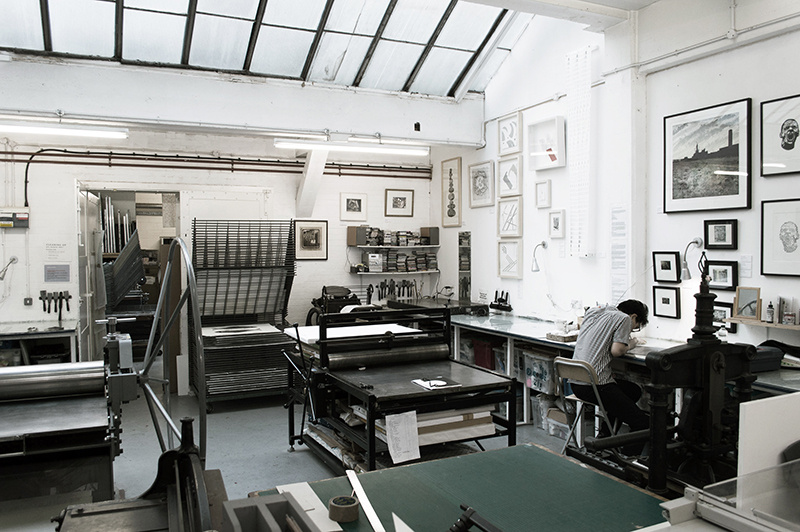
Caroline Whitehead from East London Printmakers, an artists’ co-op with about 250 members, around 350 open access users and over 40 keyholders, describes the printmaking studio as “attempting to balance traditional and contemporary printmaking practices of all kinds with respect for the environment.”
While not a pure “green printmaking studio” due to the usage of nitric acid for etching zinc plates, East London Printmakers take several measures to be more eco-friendly around the studio, explains Caroline Whitehead: “We encourage the use of cooking oil for cleaning up oil-based inks; we encourage studio users to minimise the amount of pigments etc. entering the wastewater system; we purchase bags of clothing not suitable for re-use to be cut up as rags; we recycle paper. In addition, we will always attempt to repair and re-use equipment where possible. One issue we have is the difficulty of quantifying the true environmental benefits of apparently “green practices”. For example, all screenprinting is carried out using water-based inks, which is certainly better for the printmakers’ health but does not mean that undesirable substances are not entering the wastewater system.”

During the month of May, we here at Jackson’s will be celebrating the movement for environmentally-sound printmaking with a special series of interviews with artists and experts who are pioneering some of the key innovations in the field, including Henrik Boegh, Susan Groce, Cedric Green, Eunice Kim, Lynn Bailey, Anna Johnson and Umberto Giovannini, offering invaluable advice and insight on more sustainable ways of creating art.
To learn more about how to create a non-toxic and environmentally friendly printmaking studio you might wish to read these books:
Screenprinting – The Complete Water-based System by Robert Adam and Carol Robertson


19 thoughts on “Environmental Ethics In The Printmaking Studio”
I’m using a soft lino block for my print process but I’m
looking at more environmentally friendly options, have
you got any recommendations?
hi Lou
I’ve been pondering your question…how important is it that the lino is softcut?
The classic ‘battleship grey’ lino is an all-natural material made from rosins, wood pulp, linseed oil and Hessian. This will biodegrade fully.
SoftCut is made from PVC and will last a lifetime. It won’t degrade and it wont crumble like traditional Lino – great for longevity, but less good when considering the plastics that will be thrown away when carving.
You might be able to find a local flooring company that has offcuts of flooring that could be used instead…but of course there is no guarantee that you will enjoy carving what they can offer you. But it will mean you are minimising waste products that might otherwise go to landfill! I have recently been working with Marmoleum, which is a lino that is made of pretty much the same stuff as the grey lino and is biodegradable, and it carves beautifully for relief print. It does need quite a bit of surface sanding preparation though.
Many Thanks
Lisa
Thanks for the article. Are there any inks
that aren’t toxic but also aren’t acrylic? Yes
waterbed may be better but flushing micro
plastics down the sink can’t be good either.
Thanks, Susannah
Hi Susannah
Thanks for your question. Do you know about Caligo Safewash inks? https://www.jacksonsart.com/cranfield-caligo-safe-wash-relief-ink
They are oil based but water-washable, meaning you can avoid the need of solvents and use soap and water for cleaning instead. I personally love them.
Many thanks
Lisa
I’ve found it very difficult to clean
rollers fully using soap and water for
safe wash ink – I’d love an alternative
to white spirit for this purpose. Any
ideas? ELP use greenwash – I’m not
sure what this is made of.
Hi Debbie,
My clean up process often involves:
scraping excess ink with a palette knife
apply a small amount of vegetable oil to the remining ink to make it more fluid and moveable
wipe away with a rag
finish by going over with a degreaser, such as Mr. Muscle
or… if that’s all a bit too oily, I recommend one of the more refined solvents, such as Gamsol or Zest it which does not have the heady fumes and strength of white spirit.
Hope either of these methods works for you.
Best wishes
Lisa
Thank you Lisa
Hi, I was just wondering about eco-friendly
alternatives to lino. I am not a printer but
looking to do some embossing from home
for a current art project. Is there something
other than lino that could be used?
Hi Maud,
Thanks for your question. The grey lino is an all-natural material made from rosins, wood pulp, linseed oil and Hessian. It is biodegradable too, so I would say is pretty eco-friendly, did you have any reservations in particular?
Otherwise plywood, so long as it is from a sustainable source, is another good option. I personally would avoid softcut or speedycarve as they do contain plastics of one kind or another, and will not biodegrade.
Many thanks
Lisa
Hi, Just found some info on the web (can’t
remember the site to mention) but
alternative to lino tried and tested were
Plywood MDF and pan shower liner )
(although that is not environmentally
friendly as is made of PVC unless an
ecofriendly version can be found, I have not
searched that yet). Apparently MDF was
great to cut like the pan shower liner but the
MDF did not give as neat line as the artist
required. There is a Scandinavian artist who
makes some wonderful prints apparently out
of plywood cut.
Hi Maud,
Thanks for sharing your findings. Yes, plywood is a great material for creating relief prints with, but I have not tried MDF, which I can only imagine would generate a lot of dust when cutting?
I am still keen to know your concerns about working with lino though.
I recently assisted with editioning this woodcut print for Emma Stibbon RA; it was carved on plywood and there was a beautiful subtle grain evident in the print when looked at close up.
https://www.alancristea.com/artists/33-emma-stibbon/works/207/
You’ll find some beautiful plywoods especially for relief print on this link (in among some lino!) https://www.jacksonsart.com/colour/printmaking/relief-printing/blocks-and-plates
Many thanks
Lisa
This article has been immensely helpful! I
have enjoyed carving Speedy Carve for
years, however I always cringe at what to
do with the off cuts. I am going to give the
“battleship grey” lino a try, since it is
biodegradable. Thank you for the
information!
Glad you found it useful!
Many thanks
Lisa
Thanks for the article. After finishing the
soft cut I have I’ll try the environmentally
friendly lino or MDF. Hate to throw away
the plastic offcuts thinking they will
probably end up in the ocean.. Will also
share this with my fellow illustrators xx
That’s fantastic, thank you for sharing!
With relief printing (block or Lino printing)
inks would mixing “found” or natural earthen
pigments mixed with just linseed oil work as
a printing ink? And would this not be eco
friendly?
New to making inks and want to make the
most eco friendly inks from nature itself.
Hello, yes you could print with found or natural earthen pigments mixed with linseed oil, although a print extender will give a more sticky consistency which is easier to print with. The least eco-friendly aspect of printing with oil based inks is cleaning with solvents, however, this can be avoided by either using vegetable oil clean your printmaking equipment and finish the job off with an eco-friendly household degreaser spray, or, clean with an eco friendly solvent such as Gamsol or Zest-It.
Hi can anybody recommend eco paints
for mono printing?
Hi Asmy
Oil-based printers ink that doesn’t use solvents for clean up sounds like a good choice.
So Caligo Safe-Wash ink might work for you.
Comments are closed.