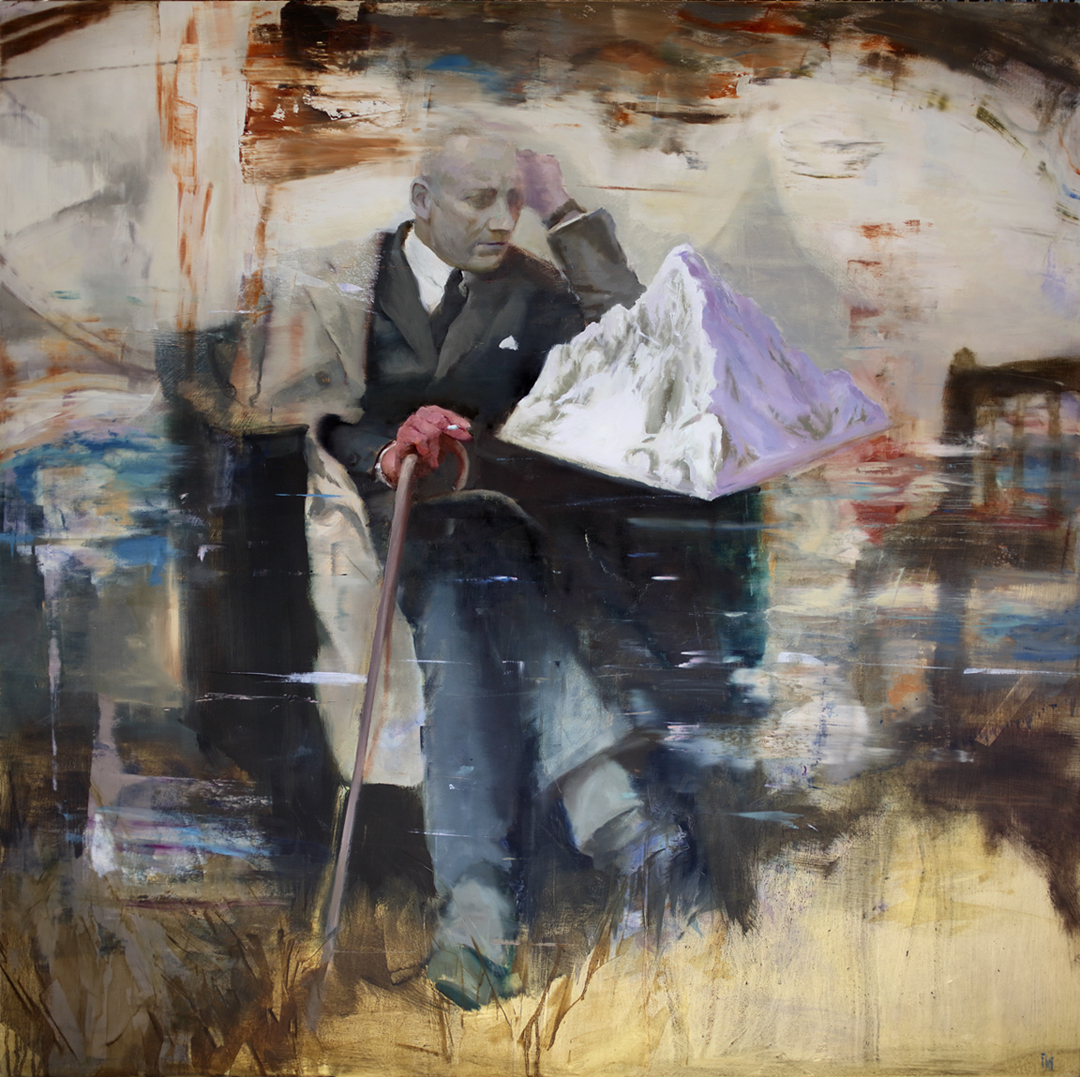
Joshua Flint’s painting ‘The Guest’ was shortlisted for this year’s Jackson’s Open Painting Prize. The painting depicts a suited man sat with his cane while a mountain seems to hover in front of him, while gestural marks create a painterly vignette on the edges of the composition. It is clear that the figure is painted from an old black and white photo, while the abstract elements and clashing motifs are layered over the top, always in response to what has been painted before. The work is a surrealist collage in oil paint, with the same mysticism and ambiguity. I wanted to ask Joshua Flint what exactly is he searching for in his paintings.
Joshua Flint
Oil on wood panel, 36″ x 36″, 2016 (Private Collection, USA)
Lisa: Who is ‘The Guest’ that the title of your painting refers to?
Joshua: That is a good question . . . and I don’t know the answer. My paintings don’t provide answers in a pedagogical sense, as if I’ve learned something and am showing that in my work. When the painting is as much a mystery to me as to anyone else that’s when I call it completed. I feel it has to arrive at that place where I’m left guessing or wondering about what is going on in the image. I’m very fond of the notion of the painting passing through the artist and then it becoming something else separate that can stand alone in the end.
Lisa: How do you develop the ideas for your paintings?
Joshua: We live in a sea of images with viral videos, memes, and the copious amounts of social networking that everyone does. Digital technology has made time travel possible. Anyone can view photos or videos throughout recorded history in an instant. All of it can be pretty chaotic but I enjoy these visual floods. I’m a visual person (and learner) so when I drop my boat into those running waters to search for images it always turns up something unexpected. The found image holds unbelievable potential, in part because it contains just that: ‘the unexpected.’ I’m always seeking photos to add to my organized collections. These collections are reservoirs for constructing the paintings, acting as a kind of scaffolding to layer my ideas on top of. I find them all over: online public archives, digitized museum archives, through social media platforms, in vintage shops, from family members, simply wherever I happen to find them. At times, this research can be directed towards a clear subject matter or I just examine these resources without any intention. If something resonates then I’ll take it and file it away or start to work with it. T.S. Eliot called this phase ‘critical labor,’ the labor of sifting, combining, constructing, connecting, and testing imagery. I’m always asking myself why a certain image stays with me, it’s like I’ve unearthed unrealized potential, which is really exciting.

Joshua Flint
Oil on canvas, 48″ x 60″, 2015 (Private Collection, Colección Solo)
Lisa: How much of the painting process is planned and how much of it is intuitive?
Joshua: Edgar Degas said, “ A picture is something that requires as much trickery, malice, and vice as the perpetration of a crime.” I interpret this as doing whatever is necessary to bring an idea to life, taking it from the conceptual into the real, which certainly is my method.
The initial stages of my creative process can take on many shapes. I scribble small thumbnail drawings on post it notes, on scraps of paper, or in a sketchbook on a regular basis. These rough scribbles find their way on to the walls of my studio for future paintings. After looking at my archives of images I may find what I need or I might have to do some more looking. At this point I’ll make a very rough digital collage to get the idea moving, it could be the preliminary idea of the entire composition or I’ll work with one element, altering and expanding on it. While I’m working digitally I’ll produce studies and drawings as I’m thinking through various aspects of the design. I go to studies when I need to familiarize myself with the subject matter. There are no parameters on the type of subject matter that populates my paintings, so I’m often painting or drawing something I haven’t before.
Joshua Flint
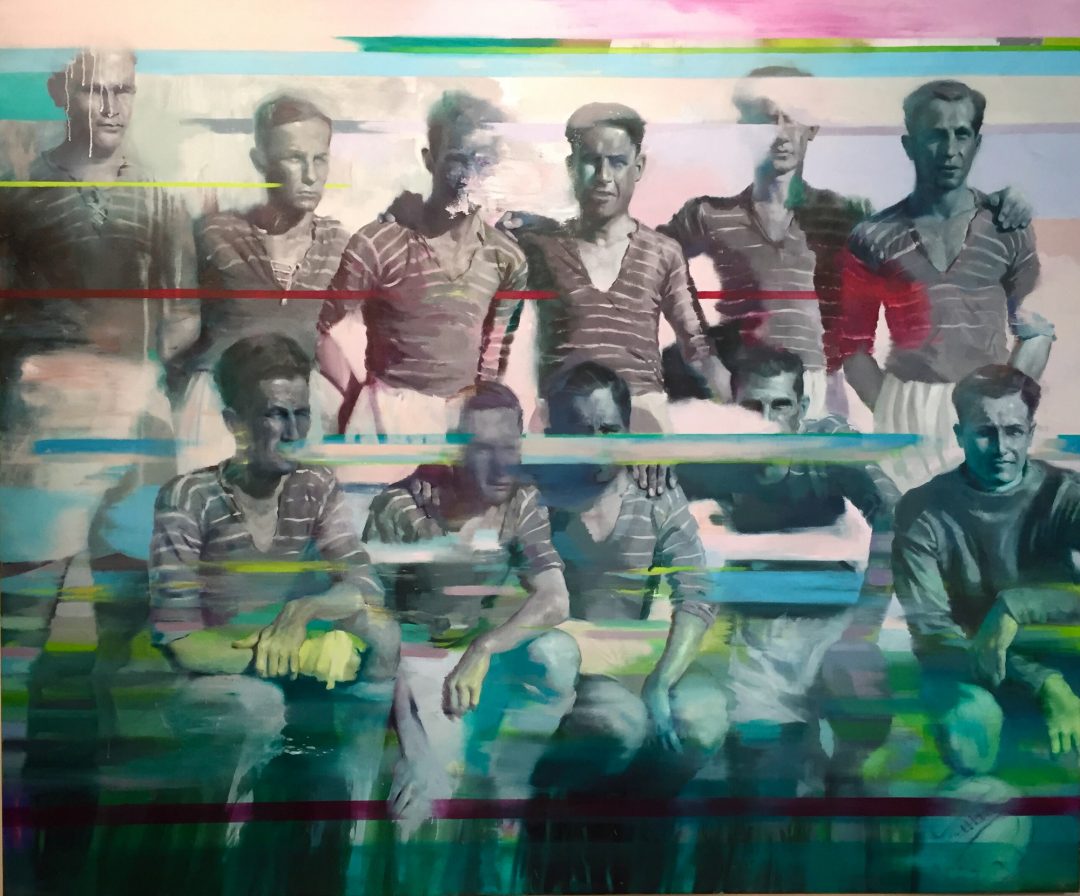
Oil on canvas, 60″ x 72″, 2016 (Courtesy of the Artist)
Traditional tools like gouache, watercolor, acrylic, or any type of dry media will be used for these sketches.
On the final surface I’ll use oil paint on wood, canvas, or linen. Often employing a muted or limited palette, my paintings are meant to be evocative not real. Because of this viewers often remark that my paintings are dreamlike, which is a quality I enjoy. If I run into problems when working on the oil painting, which is regularly, I’ll photograph the piece and take it back into the computer to test new elements.
There is nothing smooth and consistent with my approach. Many times if I have the starting point of an idea I’ll go right to canvas, skipping all the above processes, and let the act of painting take over, guiding me along the way. Ultimately, I’m looking for fluidity in my approach so I stay connected to the original reasons behind a painting.
Lisa: Can you tell us a bit about how you work? Do you have several works on the go at any one time, how often do you paint and how long does and painting usually take to finish?
Joshua: Usually I have two to three main paintings that I’m focusing on and a couple of smaller ones that occupy my main focus. While those are being completed I’ll produce drawings and small studies for future works. Then there are always a couple paintings I’ve abandoned for the moment, or in some cases, months. These paintings sit around the studio unresolved until I have an idea that brings them in a new direction. Often they end up being developed in an unexpected way, which I couldn’t have planned in the beginning. They can be some of my favorite works as that struggle teaches me about myself, my ideas, my failings, taking risks, and finding honesty in the work. As painful as it can be I enjoy the process.

Joshua Flint
Oil on wood panel, 24″ x 24″, 2017 (Private Collection, UK)
Lisa: What is your artistic background?
Joshua: I got a BFA (Bachelor of Fine Arts) from The Academy of Art University in San Francisco focusing on Illustration and sort of minoring in painting. I thought painting would come to me later in life but those doors opened up soon after I left school. I’ve furthered my education by attending workshops with Bo Bartlett, Vincent Desiderio, and a few in Shanghai, China at the China Academy of Arts.
Lisa: You also teach art. How does teaching influence your own painting practice?
Joshua: It is constant reminder of the importance of play and how taking risks is where you find new terrain.

Joshua Flint
Oil on canvas, 36″ x 48″, 2017 (Courtesy of the Artist)
Lisa: How do you work with the oil paint? Do you apply lots of layers? Do you use any mediums, and how do you select your colours?
Joshua: Process is paramount to me and showing that to an audience adds to the integrity of a piece. I find it fascinating when one can see the first layers to the last all intermingling on the surface of the canvas. So yes, there are usually plenty of layers. I work very directly with the paint to develop (or redevelop) an area so I want all the paint in the place I’m working to be open. I don’t scumble or use glazes to push and pull the paint. I keep my palette very simple usually around 12-13 colors and don’t incorporate any mediums. I use Gamsol as a thinner for my paint and for cleaning up. As you might discern at this point, I don’t follow any methodology for my set up or painting approach when it comes to the materials. I adjust my process as needed based on how best to execute the idea.
Joshua Flint
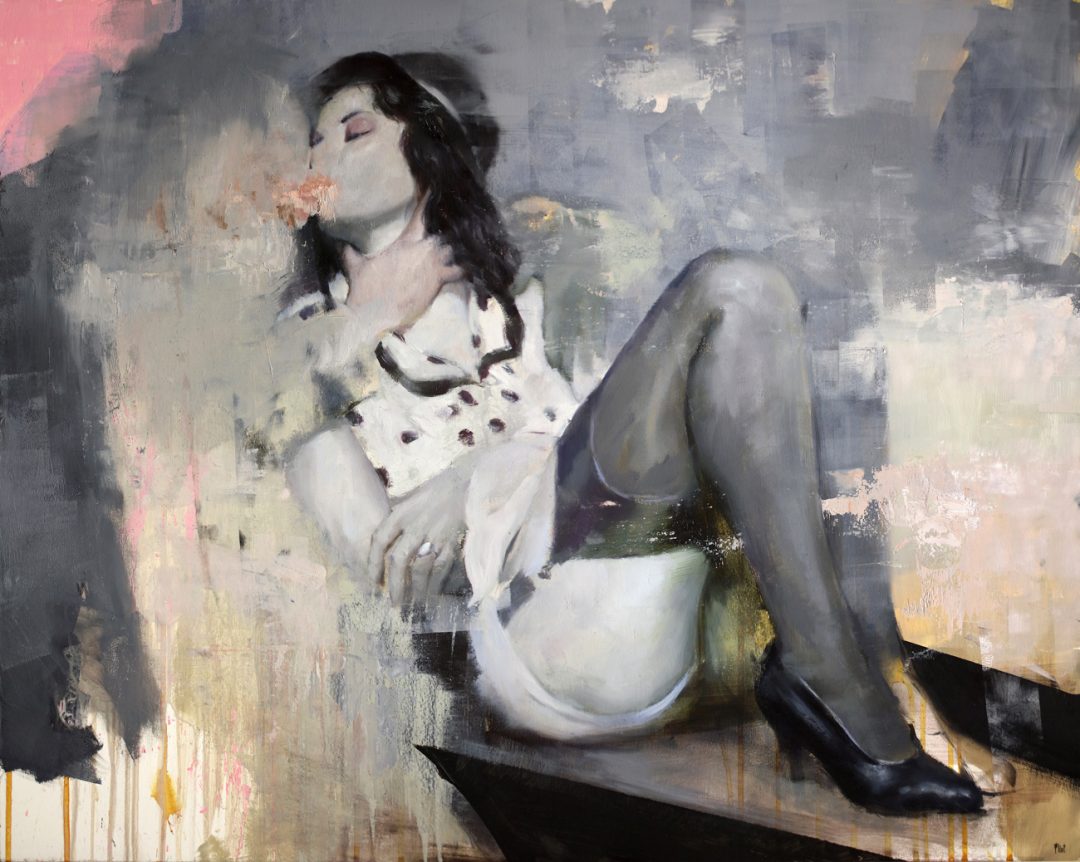
Oil on wood panel, 24″ x 30″, 2017 (Courtesy of the Artist)
Lisa: Where do you find inspiration for your paintings?
Joshua: My interests in literature, neuroscience, archeology, environmental issues, the history of painting, and, of course, my own observations of the world, tend to lend themselves to the inspirations behind my paintings. I often find that personal experience and one’s interests will always work their way into the making of a painting. The inclusion of these themes as subject matter will sometimes be overt and other times more subtle, but it’s there, regardless. There is the old adage that all painting is autobiographical and to some extent I think that is true.
Artistically speaking, I’ve got many other sources of inspiration such as Gerhard Richter, Richard Diebenkorn, Mark Rothko, Joseph Cornell, Andrew Wyeth, and Edward Hopper. Ask me on another day and I’d probably choose a much different list.

Joshua Flint
Oil on wood panel, 30″ x 40″, 2015 (Private Collection, Colección Solo)
Lisa: What are you working on at the moment?
Joshua: Currently, I have two solo shows in the Fall. The first show is in October at the Seager Gray Gallery in the San Francisco Bay Area and the second one is at Robert Lange Studios in Charleston, South Carolina during the month of November. The exhibitions will feature all new work that I am in the midst of developing. Broadly speaking the first show is focusing more on figures while the latter will see figures take a secondary role to environments or spaces.
Lisa: Where online or in the flesh can we view more of your work?
Joshua: My website: www.joshuaflint.com. For regular updates, studio shots, and works in progress you can follow me on Instagram: www.instagram.com/studioflint.

‘Backdrop’
Joshua Flint
Oil on wood panel, 24″ x 24″, 2016 (Private Collection, USA)
Header Image: ‘The Volunteers’ by Joshua Flint, Oil on wood panel, 30″ x 40″, 2016