



Dennis Doyle is an artist and a licensed merchant mariner working on tugboats, where he plies his trade upon creeks and rivers, bays and harbours, inland waterways and coastal routes, from Maine to Louisiana. Recent sea assignments have included dredging off of the Jersey Shore, Long Island NY, Outer Banks NC, Tybee Island Savana GA, Norfolk VA, and the Delaware River – working and living on boats has allowed him to chase inspirational light via painting ‘anywhere anytime, up and down the entire coast’. We caught up with him to find out more about his practice and how painting plein air influences his work.

Debbie Chessell: When did you start painting from life and how does it influence the rest of your practice? What new skills have you developed from working in this way?
Dennis Doyle: Back in art school at Massachusetts College of Art life drawing was something ever painting major had to take. It was a three-hour morning class, you drew on a pad of newsprint paper using pencil/charcoal/eraser. The first hour was just poses of five, ten, thirty seconds. This is where you learned observation and a fast hand. Here your eyes focused on the model and as the gesture changed your hand was forced to keep up and after a while, you could draw without even looking at your pad. It was very exciting. The second hour was three to five-minute poses where you had a little more time. First quickly working to establish the model’s gesture. Then moved to line form and mass, here the figure began to appear. During the last hour of ten-minute poses, you quickly established gesture, then slowed down a little to work on curves, contours, edges, weight and gravity. The figure was beginning to show and you still had more time so I worked out light and dark and the negative spaces between arms and legs and the ways light and shadow fell on the subject and the surrounding room. When time was up there was light and a figure standing in space.
I work the same way today out in the field doing plein air. A painting is made by making a series of passes. The first pass is observation, a fast block in with broad brush strokes. The second pass, composition gets established with fore, middle, and backgrounds, perspective and light. Refining happens during the third pass – working out where the sky meets the horizon, negative space is between trees and other various structures and how light is working to create the overall allusion. This is how a painting arrives for me. It’s pretty much the figure would appear in those life drawing classes many years ago.
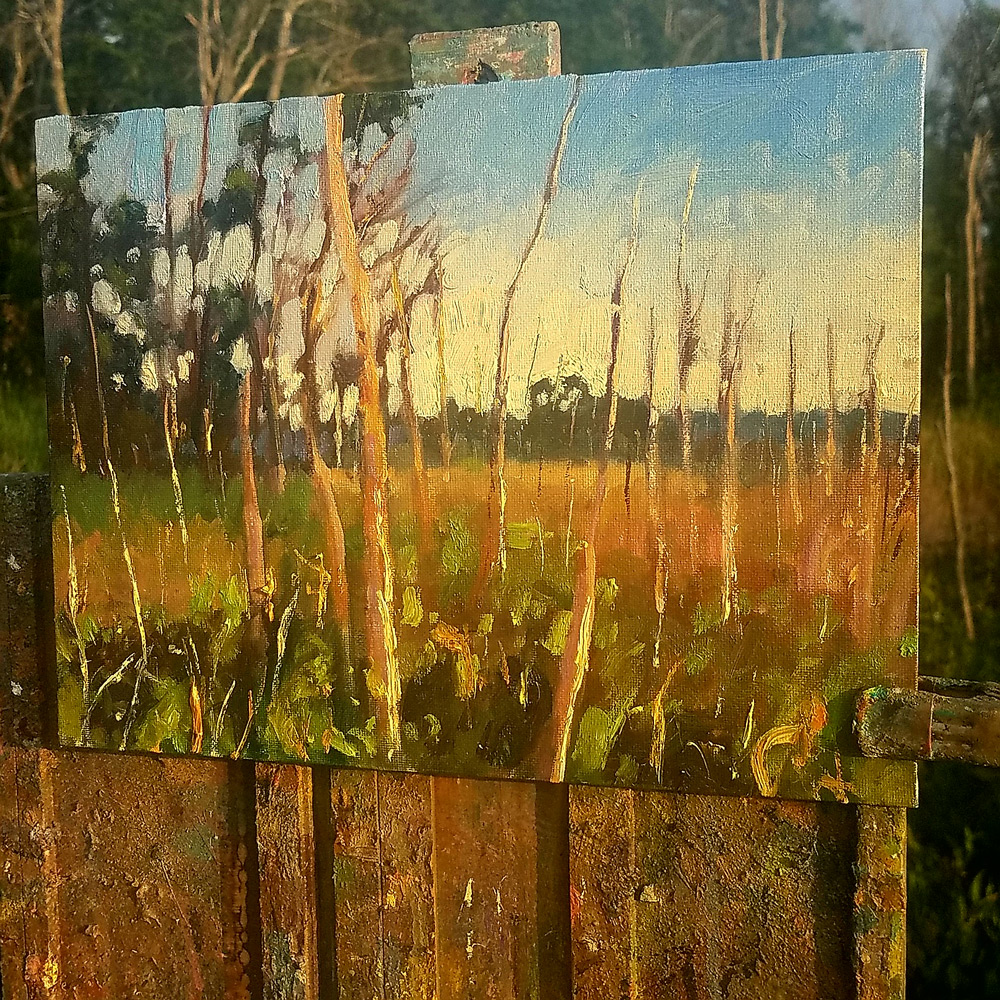
Debbie: Do you ever paint landscapes from photos/in your studio? Can you tell the difference between those and the works you make from life?
Dennis: I used to work in my studio on paintings I started out in the field and finish them off with photos I took on site. I don’t do this anymore. I realize that a photograph was a split second in time and when used to finish a painting in the studio it could only be decent. The painting was definitely lacking, this was frustration and it bored me to death. Years ago I made a decision to solely work in plein air and I’m so glad I did. Painting out in the landscape during a one to three hour window was invigorating. Chasing light and all its reveals during this window of time I had discovered what was lacking in my painting and that was SUGGESTION – it was a total breakthrough for me. Painting suggestion without finality invites participation with the viewer to finish a painting with their own eyes. It includes them into my own experience. I now call my studio my paint locker – it is a place I go to to drop off and retrieve paintings. I also pick through the piles of paintings and put the ones that are of the same place up on the walls next to each other. This is a tool I use, it helps me grow as a painter. I can see how things have changed in my work as the years have passed. It inspires me to move ahead with new paint decisions to be made out en plein air.

Debbie: I love your vivid use of colour – how do you choose which tones to use? Do you have any standard colours you always use in your palettes?
Dennis: I call myself a ‘paint junkie’ but my fix is colour, and to me, it is pure magic. Out in the field, I am constantly squinting at the landscape. It helps me determine distance, value, and temperature. With this understanding, I take a lot of liberty with colour. My palette consists of Van Dyke brown, ivory black, dioxin purple, burnt umber, burnt sienna. My yellows are cad. yellow light, cad. lemon yellow, cad. orange, cad. red light and alizarin crimson. The whites are warm white, titanium white, titanium buff, and Naples yellow-white. The most dominant colour on my palette is blue, I’m fascinated by it. There is ultramarine blue, cerulean blue, cobalt blue, turquoise blue light, and radiant blue. The blues get mixed with every colour on my palette. Its used to cool or warm up sky and water, creating atmosphere. Mixing it with yellows and reds can make a thousand greens and mixed with the browns and blacks, reds and violets, shadows do vibrate. Yes, I’m a freak about the blues!
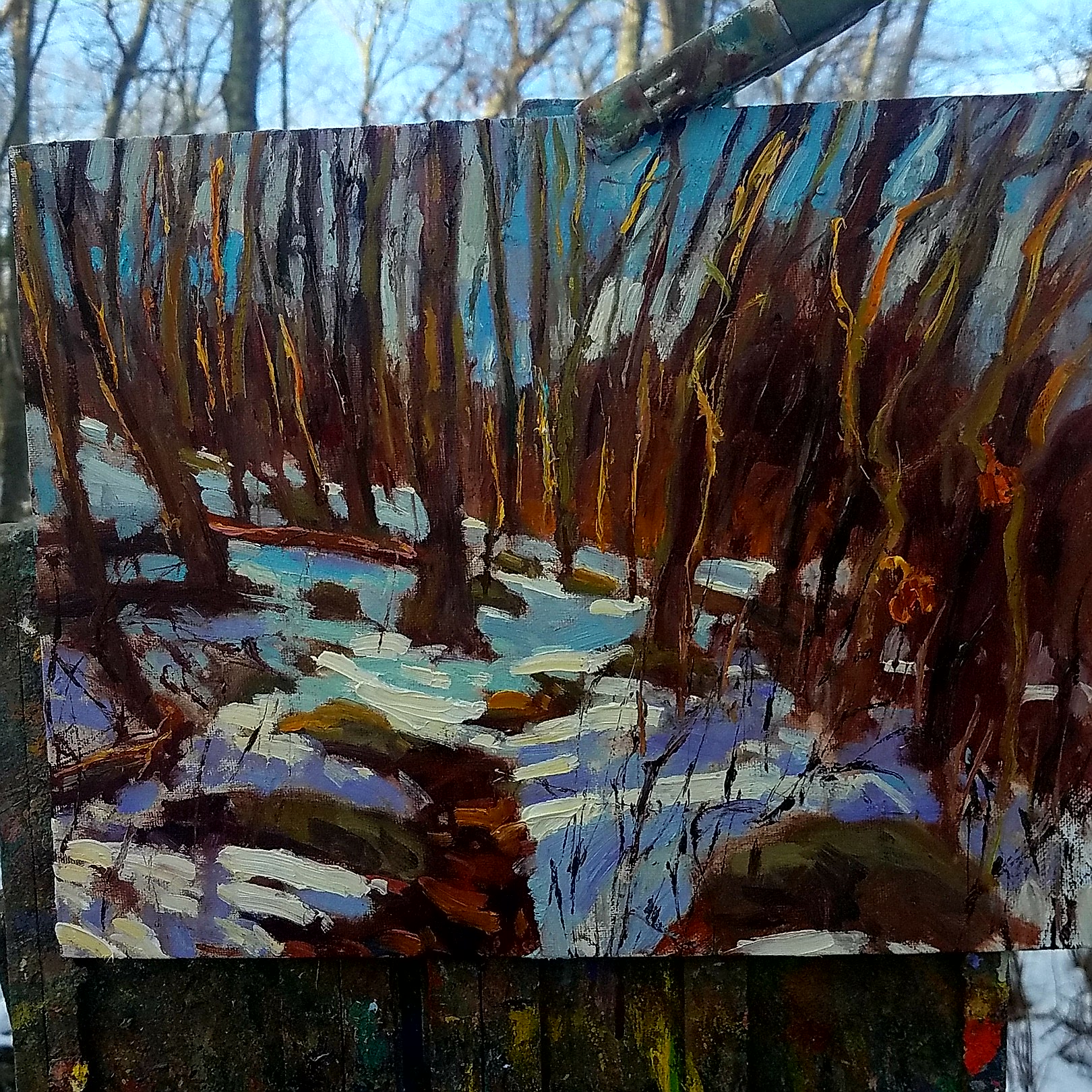
Debbie: What brush shapes and textures do you use to create such strong marks?
Dennis: I use three types of brushes – filberts, flats, liners/riggers. I always start by toning my canvas with a large flat or filbert, then a simple block in with either of these brushes will do. The brushes get smaller in size as the composition and determination of light develop. All three types of these brushes I can either load up with thick paint to drag across the canvas or use them to apply thin washes to scrub in colour. I work my brushes hard, I rarely ever clean them with soap and water, opting instead for my turps can and a rag to remove excess paint.
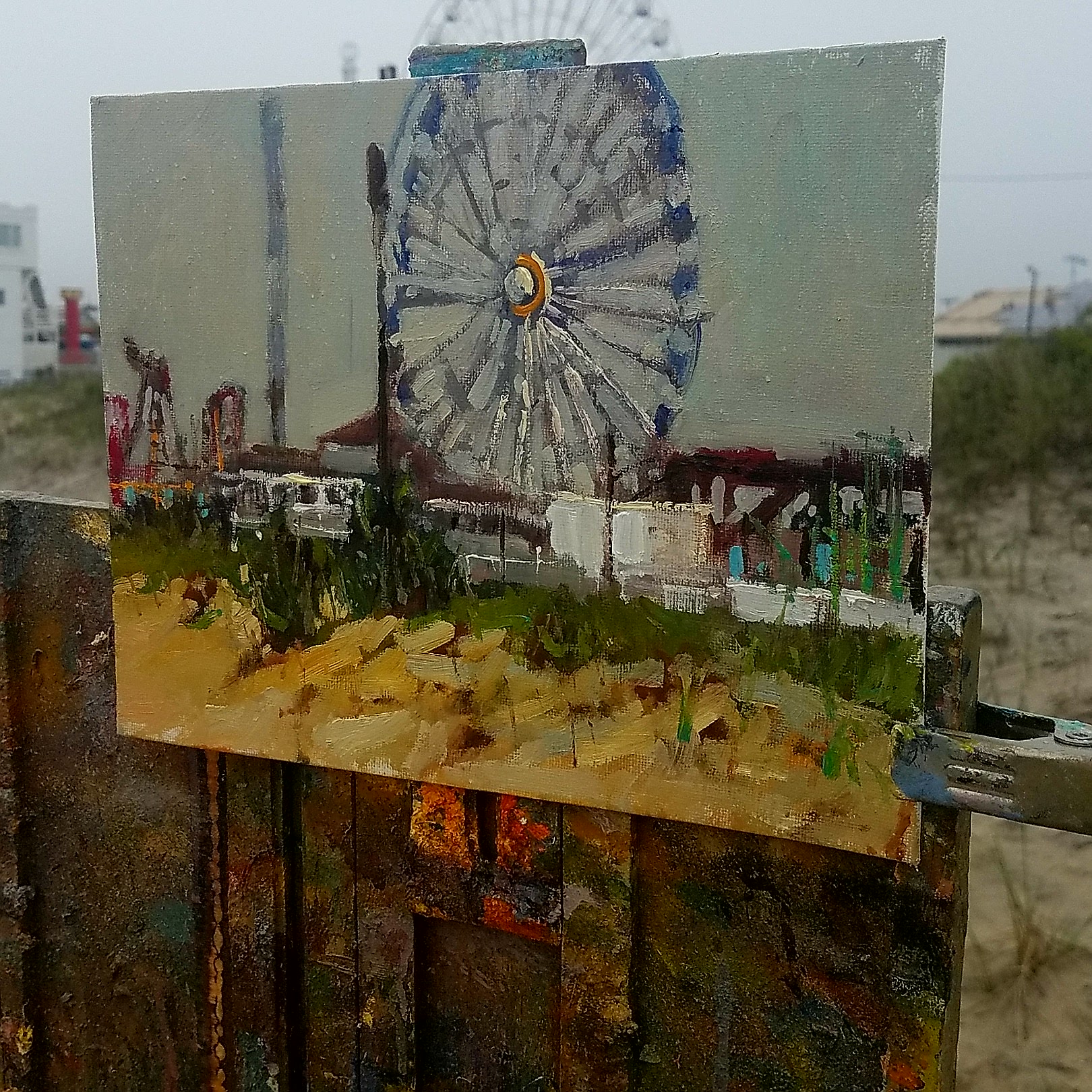
Debbie: Your plein air easel and palette looks like it has been used for many a painting – does this mean you found your perfect plein air equipment? What is it about your tools that make them so suited for painting outside?
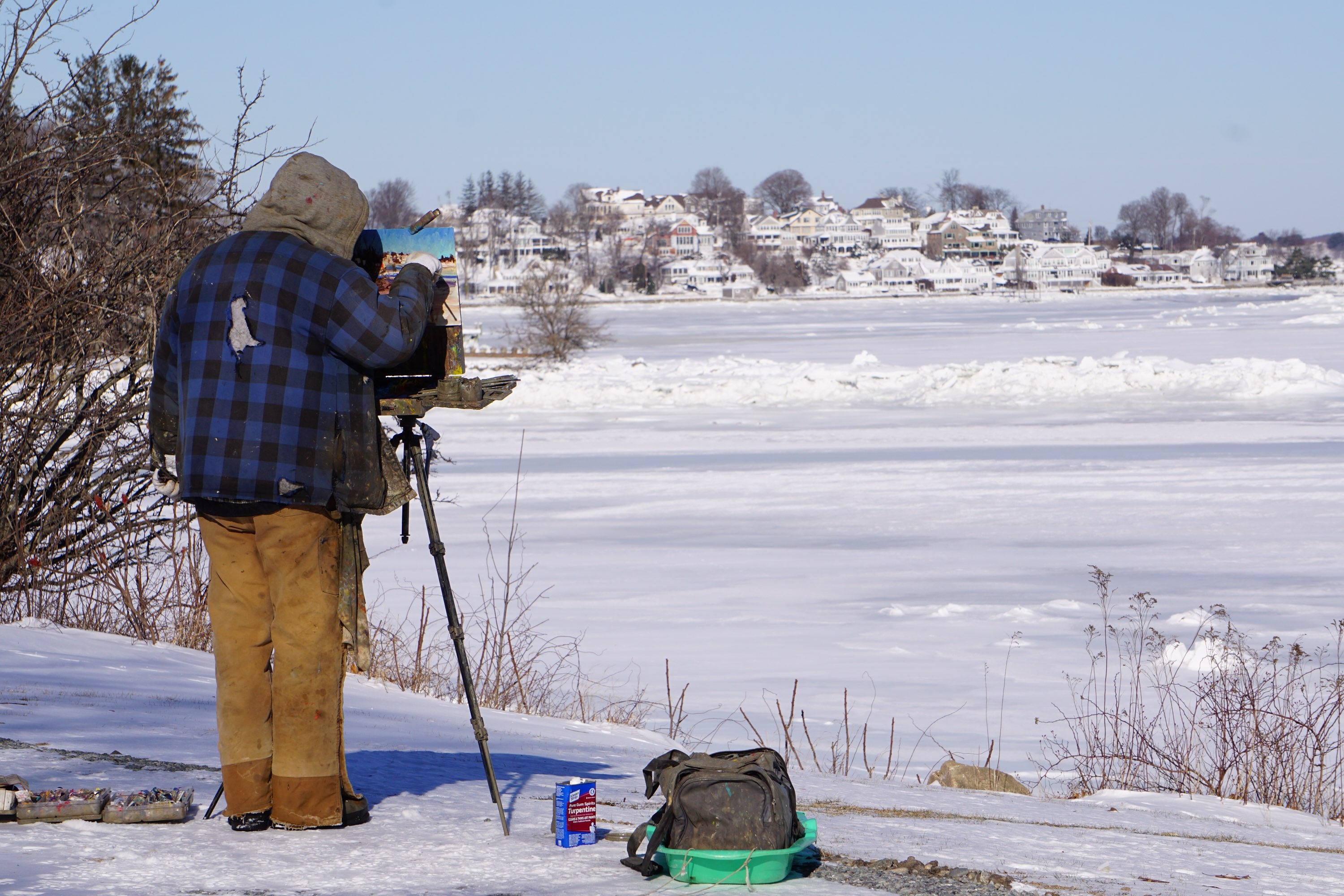
Dennis: As for right now I do believe I’ve found the perfect painting equipment. I use a 9×12 sienna plein air Pochade Box and it yields me about 300 painting a year. It has a standard fitting on the bottom which allows it to attach to most photography tripods. The box has hinges to open and latches to keep it shut. Open it up and the top side has two adjusting sliders to set canvas on. I also use clamps for bigger canvases. I can go as large as 14×18 inches and small as 8X10 inches but I mostly work in the 9X12 to 12×16 inch range. The bottom side I use as a palette. I set my colours up the same way every time around the edge of the box. Then the middle can be used for mixing colour. This whole set up along with brushes, paint, and turps fit into my paint bag which goes into the back of my truck. I am as hard on this equipment as I am on my brushes. Its durability is proven, it is versatile and can go anywhere. It is truly an amazing invention that I can’t live without.
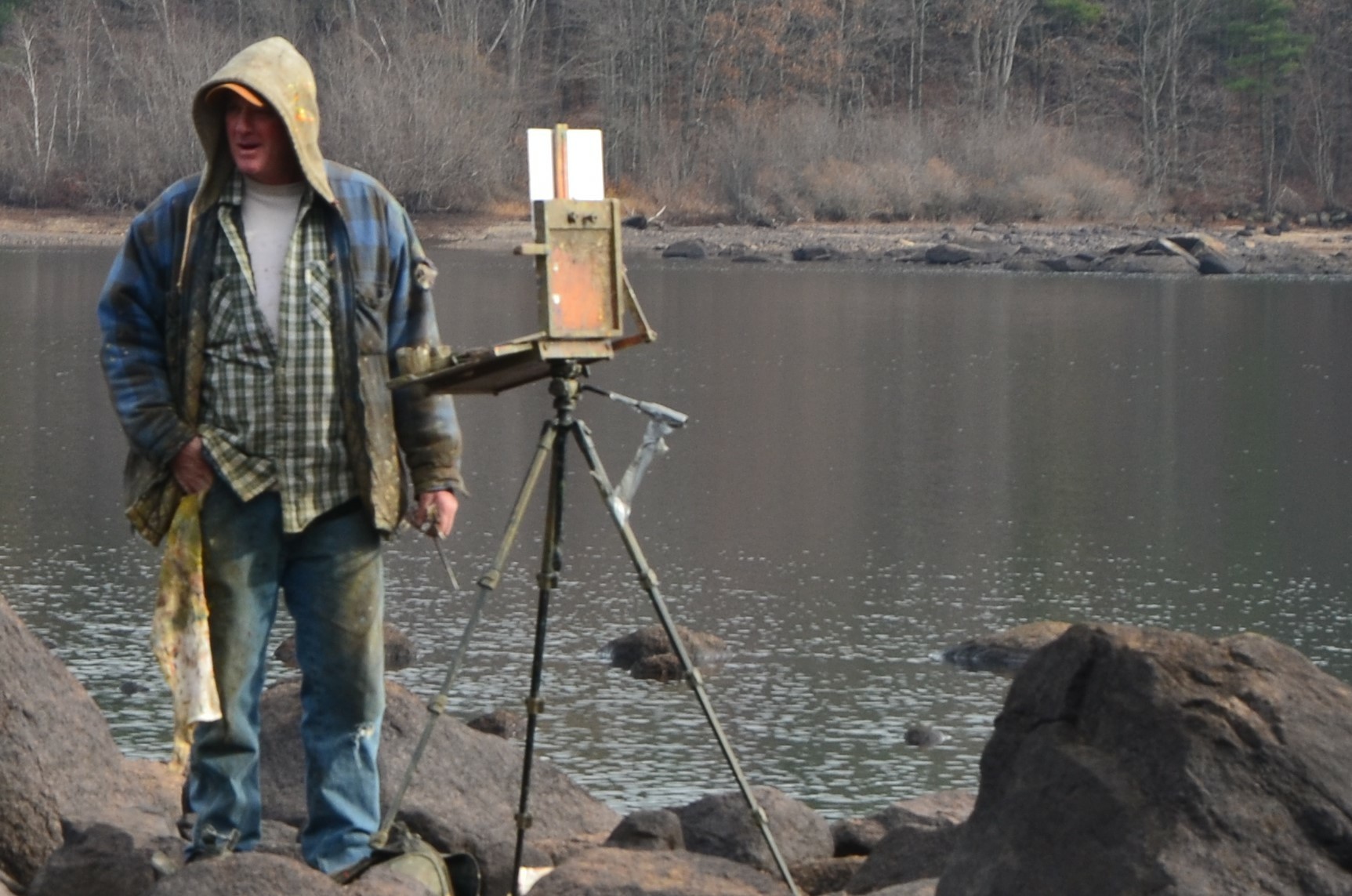
Debbie: You make paintings in a wide range of terrains – how do you handle the classic problems like sun glare on your work, unstable and uneven ground and transporting your wet paintings?
Dennis: The number one thing a plein air painter must endure are the elements. There is limitless sunshine or overcast and dreary days. They can be extremely hot and cold days accompanied by wind, rain and snow. Plein air can be done in every one of these situations – dress accordingly. The most important item of clothing you will need is a hat. I wear a baseball cap. Its brim keeps the sun out of my eyes and cuts down the surrounding glare. The majority of my setups look directly into the direction of the sun and this keeps my painting surface and palette in the shade, allowing me to mix colour and paint in an even light. When the sun is at my back and lighting up my painting surface wet paint will create a horrible glare and makes it next to impossible to get your colours right. This being said front light is an amazing light – the colour is intense and extremely exciting. When I want to paint in this situation I will look for a tree, a wall, or a bridge and use its shade to keep my paint and mixing surfaces in the cool where I can now mix colour in even light. I will also use trees, walls, bridges, etc., as shelters from wind, rain and snow. In your question, you asked about uneven ground. I do encounter a lot of that but don’t think its that much of a problem. The tripod is a very versatile tool, the three legs are adjustable in multiple places on each leg, so adjust accordingly to uneven grounds. I have painted in every one of these situations, you must be prepared to adapt to changing weather conditions. Overcoming a sudden change in conditions can be exhilarating and who knows a potential masterpiece may be the reward.
Debbie: Do you have any tips for artists considering painting plein air?
Dennis: Yes. I encourage every studio painter to get out there, stand beneath the brilliant light and paint what you see. Experience the day and chase after its ever-changing light. Plein air is a challenge, it’s an adventure, it’s spiritual and soul filling and will teach you to see the world in so many different ways. It truly is an exhilarating way of life.
Debbie: What qualities do you look for when hunting for a landscape to paint?
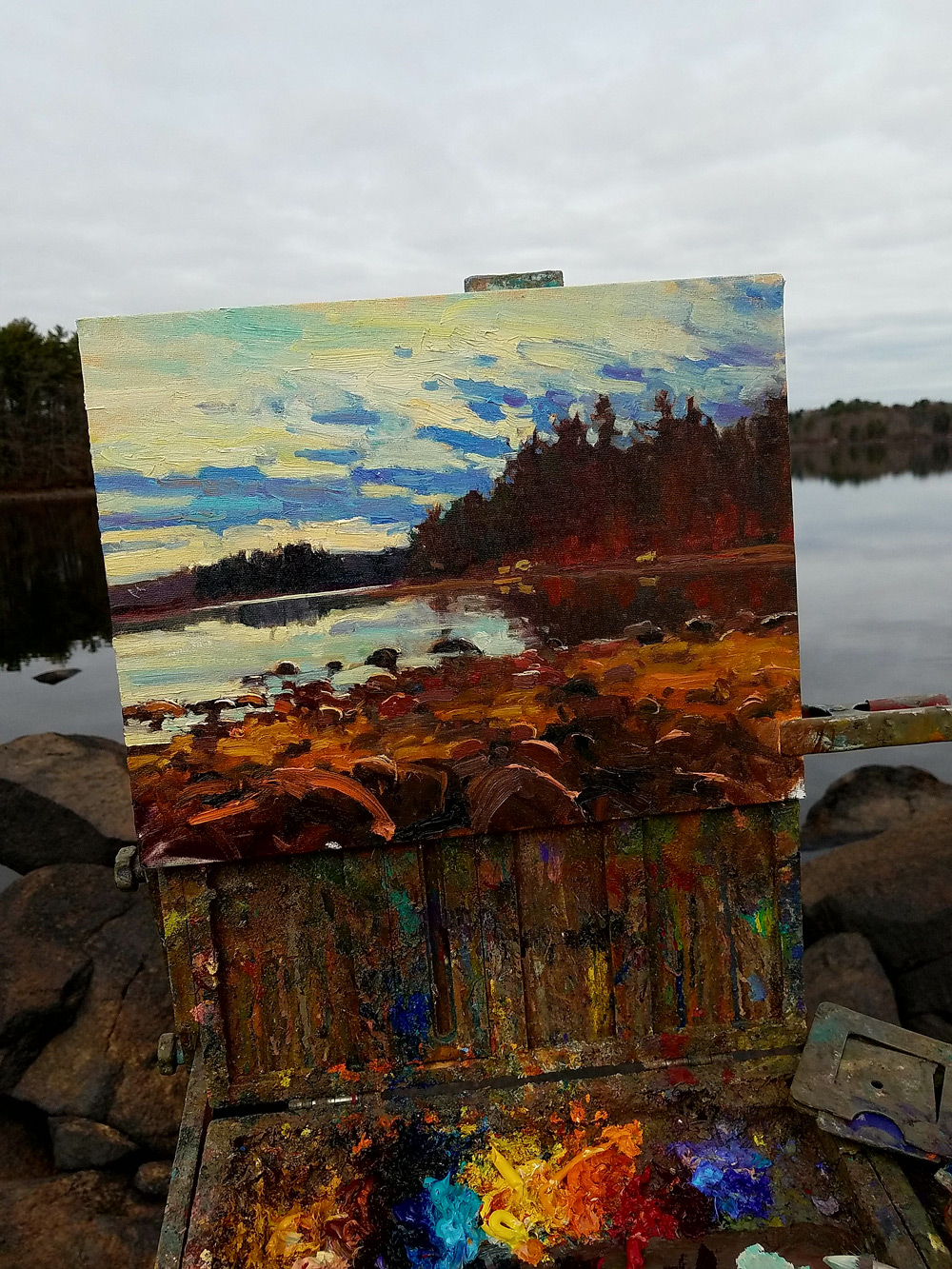
Dennis: I see paintings everywhere, whether they are alongside the road, driving to and from work, enjoying a morning cup of coffee, walking in or out of the laundromat, grocery store or your favourite bar/pub. Inspiration can come upon you at lightning speed. My paint is never far from my side and when this happens I do have the option for a paint reaction! When I actively hunt for a painting situation I look at the violet and golden hours of sunup and sundown. This is where fast light lives. At this time of day, the sun sets fire to sky and water, earth and steel, wood and sand, leaving in its path marching shadows of violets and blue. It is a daily miracle played out in a theatre that I strive to stand in the middle of and get my PAINT ON.
Debbie: Your painting subjects vary between urban scenes and stretches of the countryside – do you find painting these different spaces make you work differently? For example, does it cause your mark making or way of looking to change?
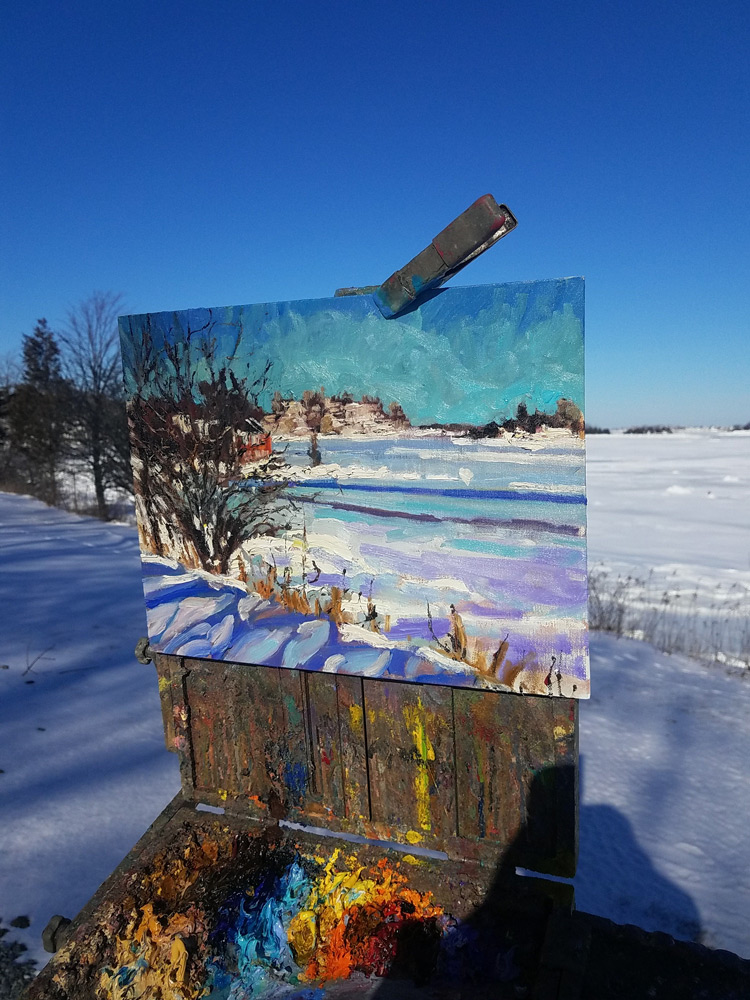
Dennis: I live a nomadic life, I travel up and down the east coast of the United States. I am constantly in different settings and it forces me to change up my game. My mark making has no choice but to change accordingly and to see in the different light. Paint is my salvation. I never want to stop learning how to see. It is my journey, my growth as a painter and the blessing of sight.
Debbie: Is there anywhere our readers can see more of your work? Do you have any exhibitions or projects coming up?
Dennis: Yes. You can see my work on Instagram @ddoylepaints – the good the bad and the ugly – I made a promise to post it all. Also, I currently show my work @southstreetgallery in Hingham, MA and The Fine Arts League of Ocean City, New Jersey. And last but by no means least I was invited to be in a group show with eighteen of the best plein air painters in the country by artist and good fried @justinvining – check him out on Instagram. The show is at Butler University, Indianapolis, Indiana. Its called IN OPEN AIR and will run from late August until the middle of October.


4 thoughts on “Plein Air Painting: Dennis Doyle”
Very interesting .loved your bright palette….and all
the blues.
I am inspired to try
Inspirational! As an aspiring plein air painter I really
connected with what Dennis had to say. Thank you!
Great Article… I love to read your articles because your
writing style is too good, its is very very helpful for all of us
and I never get bored while reading your article because, they
are becomes a more and more interesting from the starting
lines until the end.
Thank you very much for your comment, glad you liked the article.
Comments are closed.