



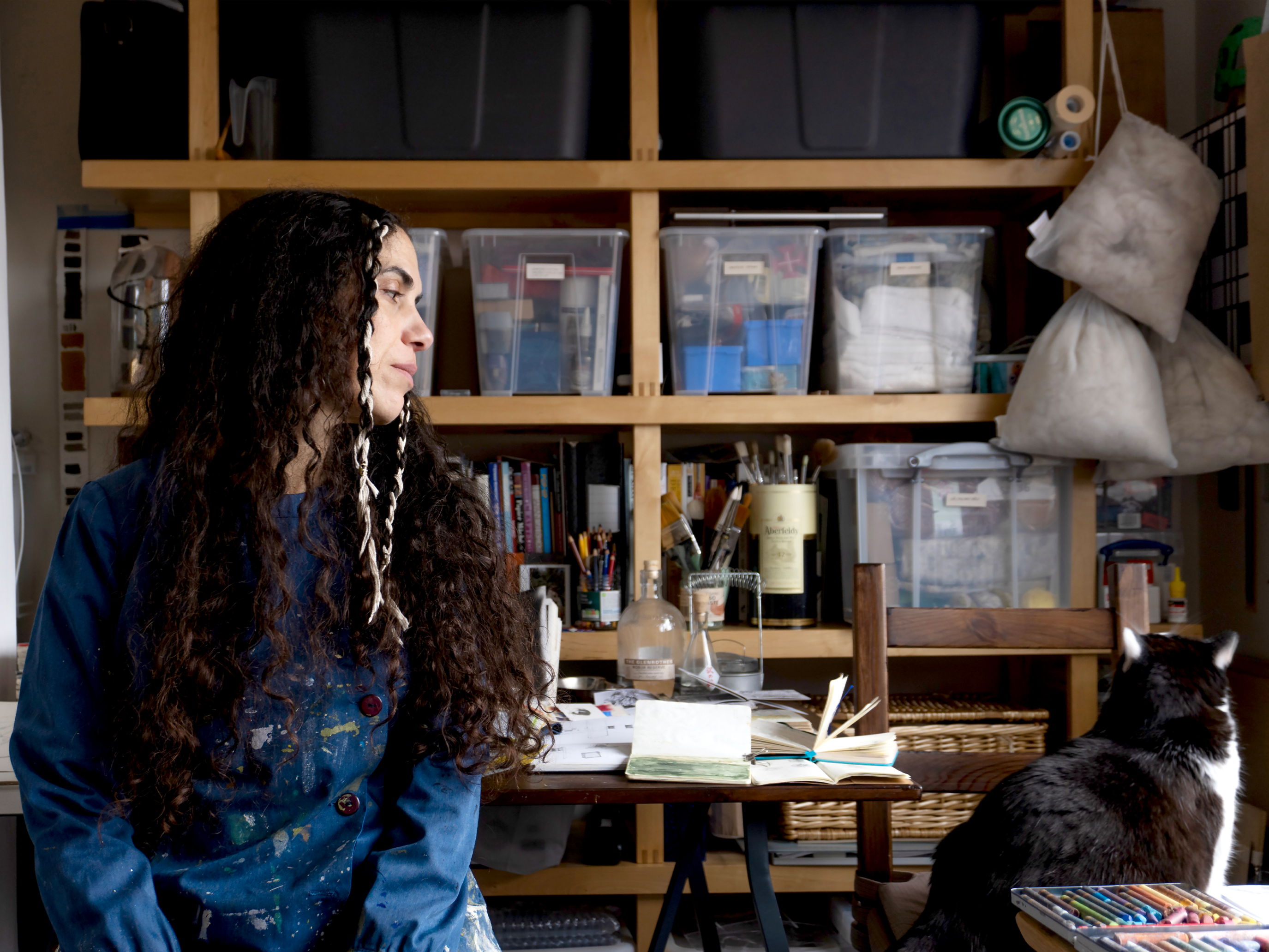
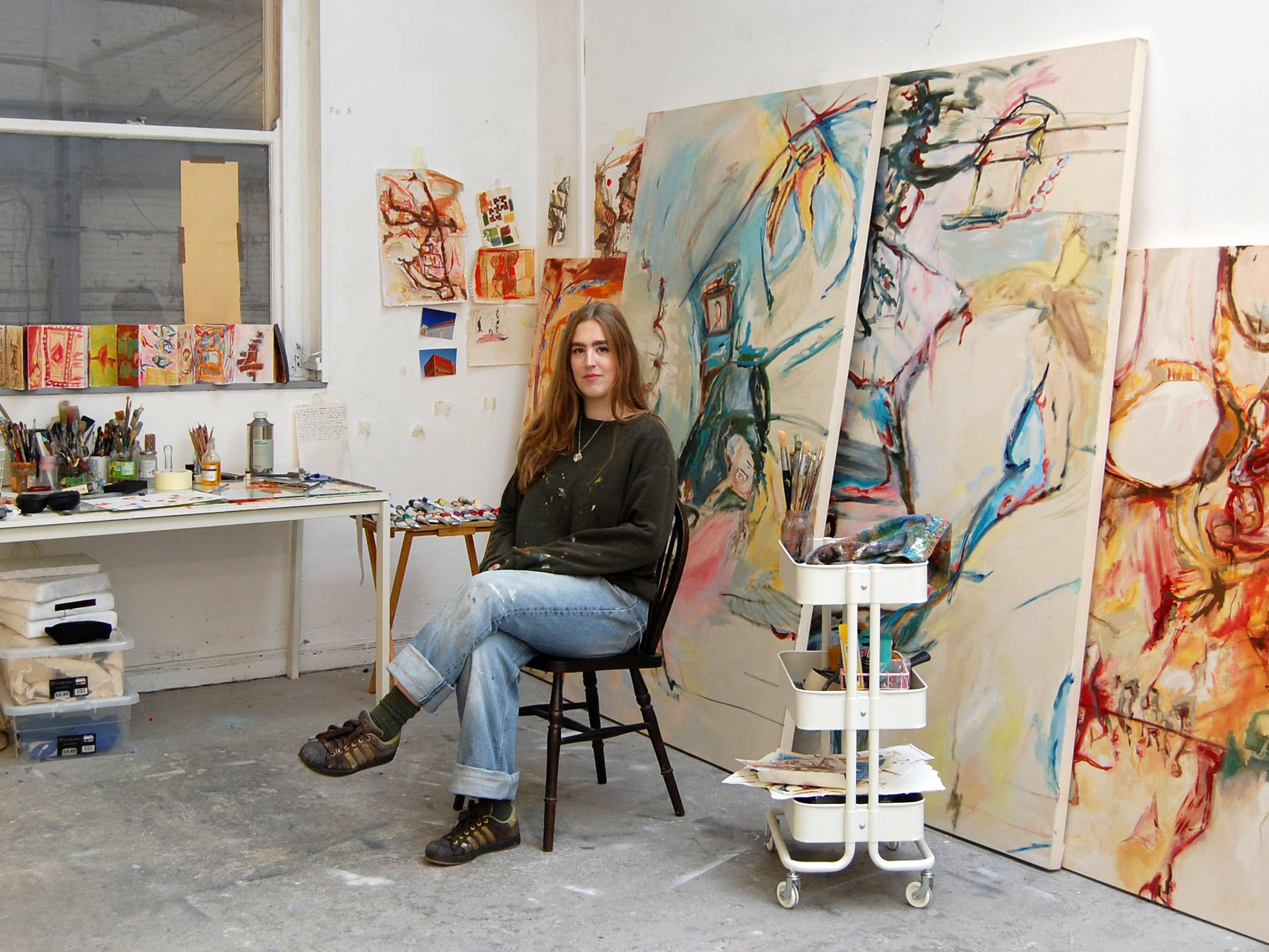
Jill Tattersall is a mixed media artist who constantly experiments with materials and techniques. She often works on her own hand-made paper with its unique, unpredictable texture, using paints, inks, dyes and pigments to build up intense and glowing colour. Throwaway or reclaimed elements are highlighted with gold and silver leaf. Each piece begins with a plan or idea but usually runs headlong into some clash, difficulty or accident. Ahead of her showing in the FLUX Art Exhibition, London (14th – 17th March 2019), we found out about her processes and how she creates her abstract work, including her tips on making your own paper.
Jill Tattersall’s Artist statement:
Jill hasn’t stopped making art since childhood but originally earned her living as an academic specialising in medieval French literature, with a special interest in old maps and travel accounts. She later took courses in art, design and ceramics at her local college; her first solo exhibition soon followed.
Her main obsession is with patterns. ‘They’re all round us; we’re made up of them. Force meets counter-force and patterns emerge: coasts and weather systems, stars and galaxies, trees and blood vessels, maps and mazes. We (some more than others) have an innate urge to mimic these patterns and weave them back into our own environment; so science and art intersect.’
Jill has had many exhibitions with projects, commissions and workshops; her work is in collections from Peru to Tasmania. She has recently moved her studio, The Wolf at the Door, from Hove to York.
At school Jill had an inspirational school art teacher Mariel Cardew, wife of the potter Michael and no formal training thereafter until years later at Newark & Sherwood College, where she was allowed to sample various courses in what was about to become an art foundation course. She specialised in art, textiles and ceramics, doing City and Guilds in Ceramics (shortlisted for a medal).
Regarding studio rituals she walks round the garden before she starts in the studio. It clears her mind and slows down her thoughts.
For inspiration Jill says ‘there’s a space in my mind where ideas and images float around. Something, usually something I’ve seen, makes one or two meet and combust. Sometimes it’s more of an abstract idea, sometimes it’s more a concrete picture. When I get stuck, it’s usually playing with materials that helps me find a way forwards.’
Her favourite purchases are canvases, khadi paper and Sennelier pigments. She is always keen to try out a medium such as Plextol recommended by an artist friend.
Her style is born of a clash between structure and anarchy, planning and intuition. Sometimes one or the other predominates. She has work in collections from Tasmania to Peru! (Her earthquake painting, Tremor, was swabbed, sampled, refused entry, then eventually bribed its way into Peru, whereupon there was a severe earthquake.)

Tegen: Could you describe in detail the main themes of your work and what pattern means to you?
Jill: I have always worked in series. These include Origins and Stories. Night Skies, Landscape and Life, Abstracts and Patterns (also Global Warning – I’ve long been concerned about the environment). It took me a while to realise they all involve patterns. Increasingly, constantly, science is giving us new insights into the forces that created us and our universe, and how they interact to form patterns on every scale and in every aspect of our existence. We’re made of patterns, we see them everywhere and, compulsively, we weave them back into our own environment. Some of us more than others!

Tegen: Do you have any compositional tricks you could share with us?
Jill: Only very basic ones, such as: view it from all angles. Does it balance? Where does your eye fall?. Is it overcomplicated? Simplicity is all, even if the elements are complicated – the eye should read the piece easily at one level but be invited to linger and explore. Art’s all about balancing opposites!
With collage you can play round and reposition elements; when you paint, it can be crippling to make marks. I personally draw little diagrams on the backs of envelopes. (I do tear them out and save them!) Don’t be like me, put it all into proper sketchbooks which you can refer to afterwards. Detailed studies aren’t usually for me; I want the piece to evolve as it goes along, or all the surprise and freshness go.

Tegen: Do you think your experience working in textiles and ceramics has affected your paintings and if so how do you think it has?
Jill: Yes absolutely! It’s so easy to be over-cerebral about art, and the discipline of making things, understanding materials, appreciating texture and accepting accident and chance in your work is immensely helpful – and grounding. Painting is just that bit more abstract – there’s nowhere much to hide – but I don’t accept an art/craft divide. A good artist can make something wonderful or indifferent with a burnt stick or some lipstick. It’s not what you use, it’s how you use it.

Tegen: If you could only use three colours or pigments what would they be and why?
Jill: The obvious answer is blue, yellow and red! For me it’s ultramarine or cobalt, not Phtalo blue. If I add some alizarin and a good strong mid-yellow I can do most things with that. Perhaps I can grind up some earth or charcoal to add to them! I try to use and mix colour instinctively and find that within a piece I mostly employ a fairly limited palette, though each painting has its own colour-map.
 Human Maze, 54 x 78 cm, hand-cast paper” width=”2816″ height=”2112″ class=”size-full wp-image-1393675″ /> Jill Tattersall, Human Maze, 54 x 78 cm, hand-cast paper
Tegen: How did you start making your own paper?
Jill: I swapped skills with a friend, Sarah Lawrence, who taught me the basics. I later did a couple of courses with the late Carol Farrow who was also a ceramicist and instrumental in introducing paper-clay. Both are sadly long dead but I owe them both hugely.

Tegen: What is the hardest part of making your own paper and do you have any recommendations for artists who are thinking of making their own?
Jill: It can be backbreaking! If you are going to do a lot of it get a big industrial beater (unlike me); making pulp with a blender can be wearisome. Pray for good weather; I make paper outside as it’s very watery and messy. Make plenty at one session. Use good quality cotton linters if you want the pieces to last and be usable for serious purposes; otherwise, have fun and use recycled papers, playing with different colours. Try casting it over an interesting surface or embedding things in it and play with natural dyes such as beetroot or turmeric (but wear old clothes!). There is nothing so satisfying as peeling a sheet of dry paper off its base.

Tegen: You’ve mentioned previously that your favourite artists are Da Vinci (and a medieval predecessor, Villard de Honnecourt), Rothko, Artemisia Gentileschi; Berthe Morisot and Mary Cassatt, why are these your favourite artists?
Jill: I plucked these almost at random out of so many, it changes by the moment. Da Vinci and Villard – a thinking brain, and something that transcends it to produce, in Da Vinci’s case, startlingly original, unfettered images. Rothko: Glowing colour: a physical and emotional need fulfilled. The women artists: each wonderful craftswomen, each with an added suppleness and tenderness or perception that I’d like to put down to their gender (without being sexist!) – not necessarily the physiology, but certainly the different life experience. I’d also like to mention cave art: I often think of Picasso when I see some of these primitive images which seem to come from a perfect knowledge and confidence.

Tegen: Where do you feel most inspired?
Jill: I just can’t answer this. Could be something I hear, creating a mood and volition; more often something I see, usually in nature, or a painting. Unpredictable!

Tegen: Describe a perfect day in the studio for you?
Jill: My work always seems to involve a conflict between opposites, so a good studio day is when I can reach some kind of accommodation between them, resulting in something exciting rather than a muddle or a mess. Abstraction v representation, precision v looseness, design v serendipity.… It’s usually a struggle. I put on music (I trained as a singer and once nearly became a Radio 3 announcer!), shut the door and see what happens. The hardest thing is starting, it goes without saying.

Tegen: What do you think makes a good exhibition or show?
Jill: I think it’s relatively easy to produce an attractive good-mannered group of paintings that sit well together – but the whole result may well be dull. There need to be several pieces veering towards the difficult, dangerous, unsettling or innovative to give the whole thing a spark. (If you only have one it’ll unbalance the rest!)

Tegen: Are you working on anything you’re particularly excited about at the moment and what’s coming up next for you?
Jill: Work has been interrupted by my very recent move from the South Coast to the North. My next event is York Open Studios, a selective and high-quality event so there’s no resting on my Brighton Artists’ Open House laurels! My challenge is to interest a completely new audience in my work. I do feel the urge to go back to using materials more experimentally again, and an impatience with well-trodden paths. I am taking more risks with my work…

Tegen: Where online and in the flesh can we see your work?
Jill: At FLUX Exhibition! (Twelve paintings.). In April (first two weekends): York Open Studios. In May: Artists’ Open House (Brighton and Hove), at Art in Bloom. Also in Brighton, my work is permanently on show at the lovely Nigel Rose Gallery opposite the West Pier. And as part of the season-long exhibition ‘Positive Emotions’ at the Kunsthuis Gallery, N Yorks. I do have some work on Artfinder and you can see more on my website.
The image featured at the top is Jill Tattersall, Japanese Whispers, 84 x 67 cm, collage with handmade and Japanese papers.
You can find out more about the FLUX Art Exhibition and which artists are exhibiting this year by reading this article on our blog.

1 thought on “Jill Tattersall’s work ahead of FLUX Art Exhibition”
Wonderfully vibrant work. Especially love Night Garden.
Enjoyed the very open and detailed answers to the
questions asked. Thanks Jill Tattersall.
Comments are closed.