



Jackson’s Smooth Wooden Painting Panels are made with sanded plywood and are reinforced on the reverse to prevent warping. We liked how Sarah Eddy described prepping the painting panels in her review: ‘I love these, I use three layers of Golden Gesso and paint with oils with linseed oil. They are wooden panels so you can sand them more if you wish but I find the oils grip the wood so much better like they are. I just brush the wood down before the gesso.’ In this Artist Review of the Month, Sarah Eddy shares her process:
Jackson’s Smooth Wooden Painting Panels for Oil Paintings
by Sarah Eddy

The very first thing that drew me to Jackson’s Smooth Wooden Panels was that they come in a large variety of sizes. Most companies I’d researched online often didn’t offer large panels, or they were very expensive. I wanted to paint larger scale landscapes, so I spent a lot of time and money trying things out. At the time, I was using MDF, but it’s heavy to ship and frame, and can easily get water-damaged. I’ve also tried wood panel boards that come ready primed, but found them too smooth and I ended up putting a layer of gesso on them anyway.

I have been incredibly happy with Jackson’s panels and subsequently, they are currently all I use to paint on. The panels arrive smooth, sanded, and ready to prime. I do wipe them down. It’s not recommended to get them wet or wash them, as you could possibly make the wood swell or warp before they’ve been sealed. You only need to check there are no bits that can get trapped in the gesso. The more time you take making sure it’s dry and clean the better the gesso is going to look and therefore the paint you apply.

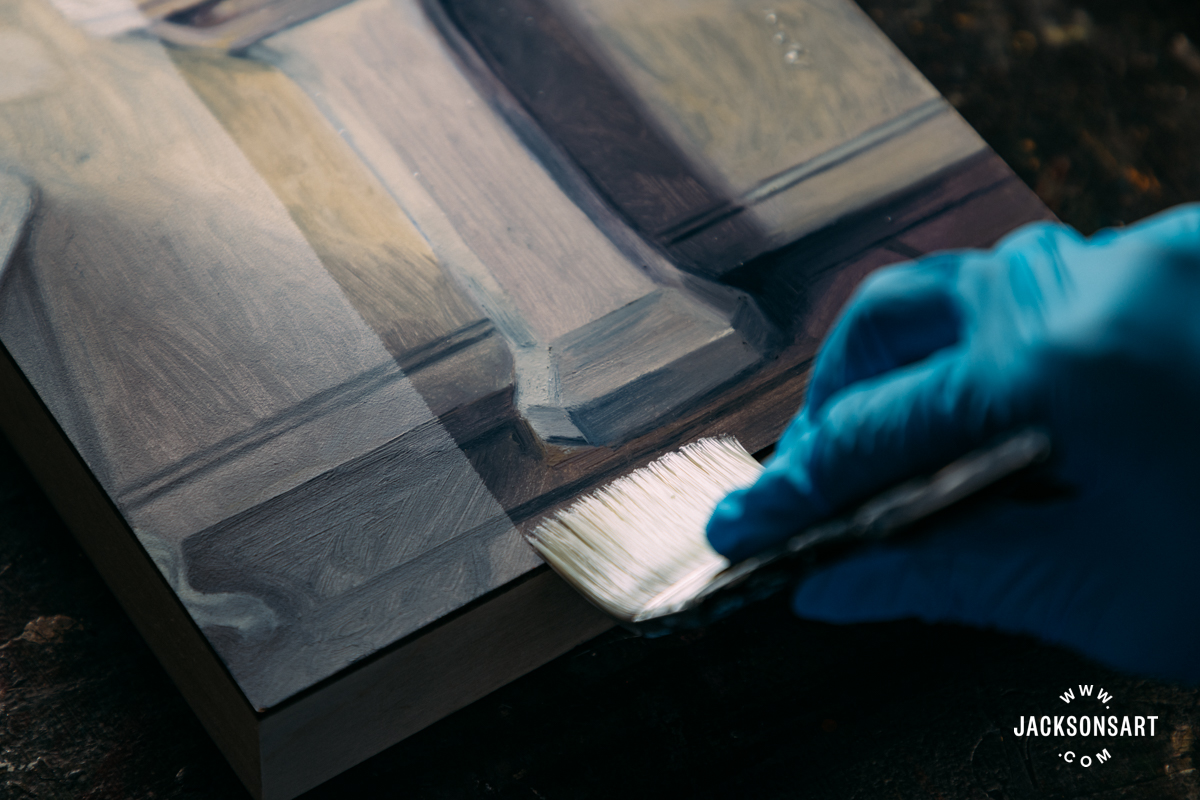
Applying Gesso to the Wooden Painting Panel
I use Golden Gesso as the quality is fantastic and I’ve tried quite a few other gessos on the market. I always paint three layers, so the oil paint doesn’t get absorbed into the wood. Sometimes I paint a coloured acrylic background again, before I paint with oils on top.
I paint the gesso horizontally and vertically, similar to a canvas. It’s important to remember that when oil or acrylic is applied, the condition of the gesso will affect the look of the paint, especially if you paint thinly. I paint with a palette knife but I still want the gesso to be applied as best as it can be. I think it makes a big difference. Make sure each layer is completely dry before applying the next one. I always wait a few hours or overnight before I use the wooden panel.
Some people like to sand between each layer, but with Jackson’s Smooth Wooden Panels, I don’t think this is necessary when you paint the gesso correctly. Also, I choose not to because I really like the finish I get with good quality gesso. Most importantly, because Jackson’s Wooden Panels are smooth, sanded plywood, they never seem to need a sand if you paint the gesso on nice and evenly.


About Sarah Eddy
Sarah Eddy is a Cornish Artist. Once a founder member and performer with the show Stomp, she’s now based in Cornwall, walking the Cornish coastal path, painting land and seascapes using oils on wood panels.

Updated 13th November, 2024
Further Reading
Two Artists Test Jackson’s Wooden Panels
Portrait Painting on Jackson’s Aluminium Panels
Jackson’s Smooth Wooden Panels as a Surface for Encaustic Painting
Shop Jackson’s Smooth Wooden Panels on jacksonsart.com
Shop Golden Acrylic Gesso on jacksonsart.com




12 thoughts on “Jackson’s Smooth Wooden Painting Panels for Oil Painting”
I have been using hdhmr sheet of 6
mm thickness.it is fairly light
weighed.damp proof with smooth
surface.i do two layers of white wood
primer and sanded after total drying.
Hi Shankar, thanks for sharing why you use it and how you prime it.
how to prepare an oil painting board
and don’t get glazed and have good grip
I’m having problems the paint doesn’t
dry and it gets slippery
Example and how to paint on a glass
plate
Hi Gustavo
If I understand you correctly you are asking how to prepare a panel that will have a more absorbent surface.
It is all down to the primer that you use. A more absorbent primer will be less slippery. Primers with the word gesso in the name tend to be more absorbent. You can add extra whiting (chalk) to your primer and make it even more absorbent.
You mention glazing but in context I think you might mean that you don’t want them to be primed. If that is because you wish to have the wood show, then you can use a clear primer or just seal the wood with an acrylic polymer medium.
This article shows an artist preparing the panels: Using Jackson’s Smooth Wooden Painting Panels for Oil paintings: Sarah Eddy
Do you need to gesso the back of
wooden boards for oil painting?
Hi Helen, you don’t need to gesso both sides of the wooden boards, but it is recommended to seal both sides of the panel with a size (this prevents moisture penetration and ensures the panel doesn’t warp). After the panel is sized you can apply gesso to the side of the panel you’re painting on. I hope that helps!
Evie What do you size with . I have
just bought some rabbit skin glue . So
gle both sides then gesso one side .
Does it matter which gesso for oil ?
What’s better ply or MDF Thankyou
for responding if you have time . Stay
safe !
Hi Jax,
You can use rabbit skin glue to size the panel, you can also use an acrylic fluid medium, a few layers will be close to completely non abosrbent thus preventing any warping (rabbit skin glue is partially hygroscopic, i.e. it will absorb small amounts of moisture from the atmosphere).
You can use acrylic or oil based gesso for oil painting.
Plywood is better than MDF generally as there is less glue holding the board together, which may not be acid-free, and the acid content of MDF may cause the board to age over time, in the worst cases causing discolouration or making the painting surface brittle (although good sizing should prevent this from happening).
Hope this helps.
Many thanks
Lisa
Hi what is best to use to seal these
panels before priming with Gesso? For
oil paintings
Hi Rachel,
if you’re using acrylic gesso you don’t need to seal the panels with anything else beforehand, 3 thin and even coats will sufficiently seal the panel.
If you are using traditional gesso (rabbit skin glue and whiting) the traditional approach sould be to seal with a light application of rabbit skin glue on its own, before applying gesso.
Hope this helps
Many thanks
Lisa
I have worked with antiques
for years and made my own
gesso… oil or acrylic gesso
puzzles me though. I would
make gesso like single cream
consistency, water animal
glue and whiting, then a
splash of linseed oil was
added to the gesso because
it gave the gesso a greater
finish for burnishing, it did
also change the hue of the
gesso. I would imagine the oil
in the gesso allows the oil
paint to bond better too. This
was a base that was used for
milk based paint, egg based
some ammonia and mixing
linseed and red lead onto as
a coloured glue base for
shells stone etc. I am keen to
try painting on birch ply with
oils, and thought I would just
use a shop bought acrylic
primer undercoat, but feel
now I best use gesso??
Hi Oliver
This article might help clear up the confusion.
SIZE, PRIMER, GESSO AND GROUND EXPLAINED
Comments are closed.