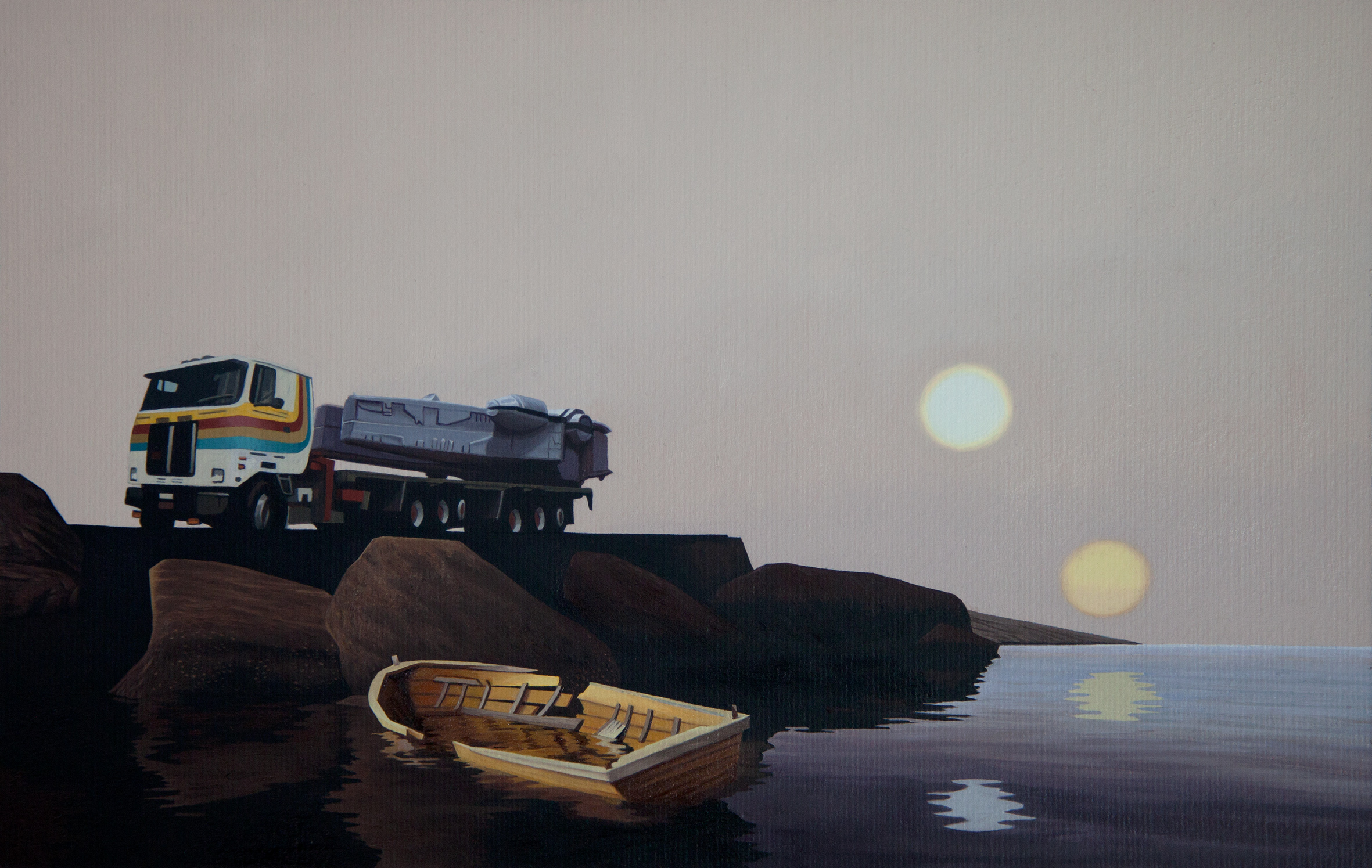
James Moore was shortlisted in the Jackson’s Open Painting Prize 2019 for his evocative painting, Michael Jackson’s ‘Bad’ tour, Cardiff 1988AD. Intrigue surrounds the painting which depicts an 80’s tour bus parked outside the Cardiff Holiday Inn at dusk. Unsettling in its realist style, it glitches here and there, eroding detail and depth. The scene appears to exist in a strange reality, a few degrees askew of what we know now. We spoke to James about his research, getting the best grey tones and painting an imagined history of Wales.
Above image: Der Dritte Raum, 2015, James Moore, Oil on paper, 40 x 30 cm
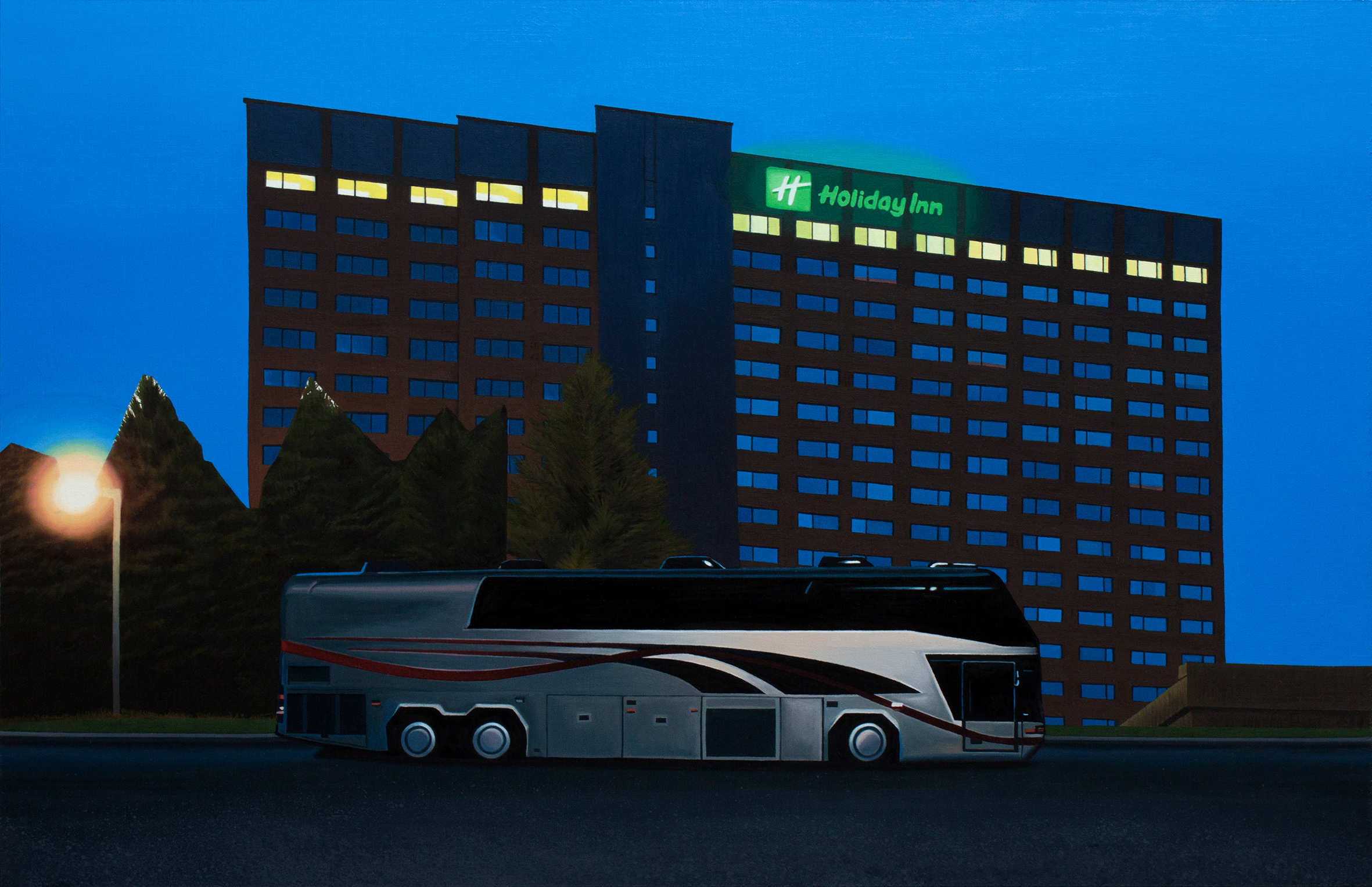
James Moore
Oil on Paper, 40 x 30 cm
Clare: Tell us a little bit about your artistic background/education.
James: I live in Cardiff and I have a studio here. I studied BA Fine Art at Manchester School of Art and MA Fine Art at Chelsea College of Art & Design. I worked as an artist and curator in both London and Manchester for a number of years but eventually moved back west to my home town.
I graduated in 2002 and have been painting and exhibiting more or less constantly since then. I’ve also organised quite a few projects as a curator over the years and I’m currently an assistant director at RUG gallery in Cardiff, which is a fairly new artist-led gallery setup by John Abell and is focused on contemporary painting, printing and drawing.
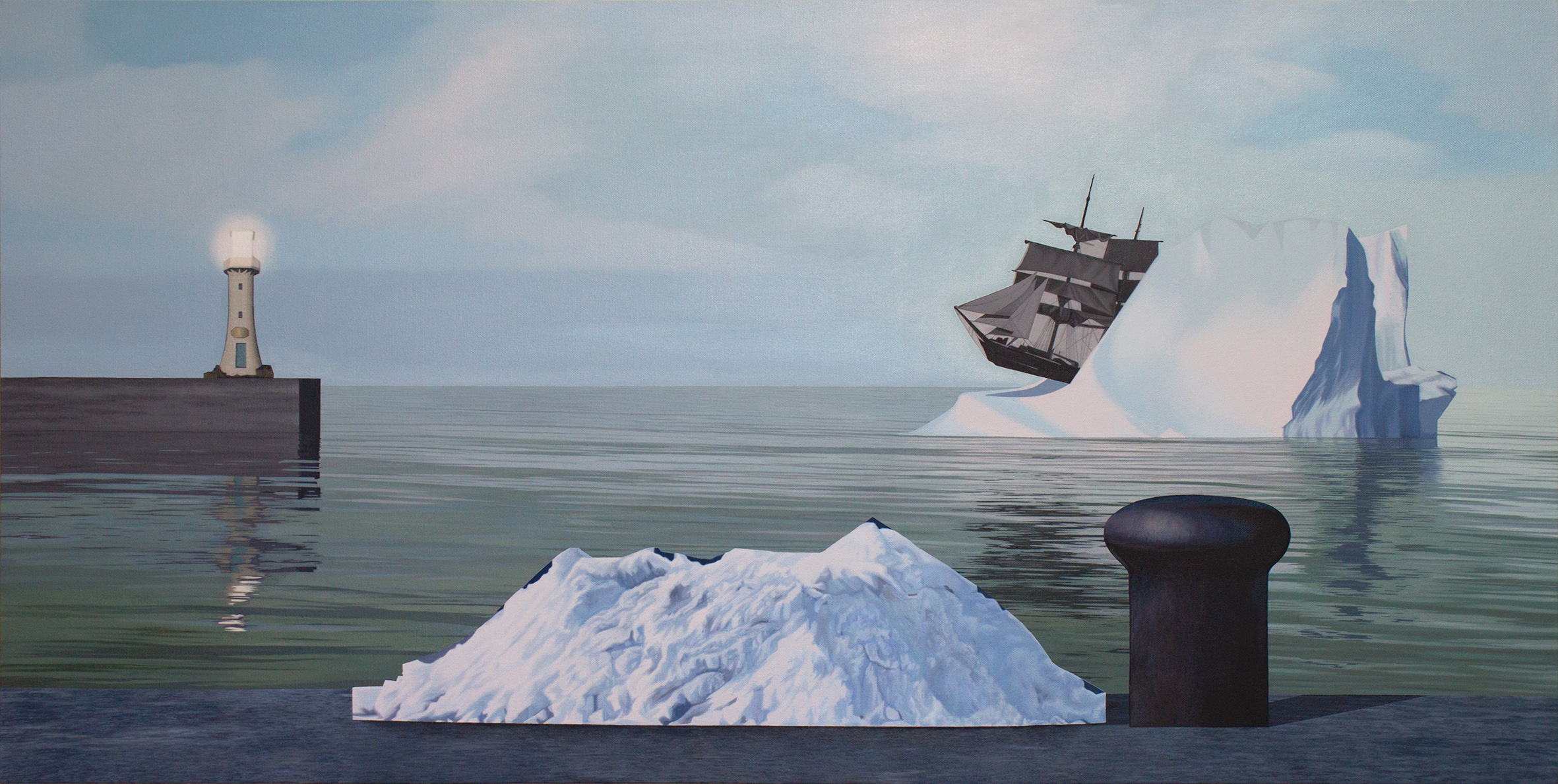
James Moore
Oil on canvas, 120 x 60 cm
Clare: How would you describe your practice?
James: Mainly I’m a painter and my pictures are representations of various simulacra – things such as computer games, models, dioramas and movie sets. They’re of subjects that are either fake, don’t really exist, or are impossible to see in the flesh, but that still have a collective reality amongst groups of people. The paintings are a visual contemplation of the ever increasing numbers of simulations that surround us. Alongside this, I’ve been making a series of works that examine myth and the genealogy of place through a sort of naïve history painting – mashing up surrealism and the cultural concerns of a working class outlook within a post-colonial society.
A particular interest for me is the perversity involved in the process of painting a virtual source image or a model as though it’s a real place. A straight forward reading of the image becomes difficult and the relation to the original objective source is lost in a succession of representation that plays off the seduction of painted imagery against the mundanity of disposable digital imagery and its own unusual relation to any standard conception of the real.
In terms of how I paint, I’m an oil painter, and I have a sort of photo-realist style. I work either on canvas for larger works or oil paper for smaller works – for which I tend to use Clairefontaine Oil Painting Paper. With canvas I like to build my own stretchers from timber and use unprimed canvas, such as Jackson’s 10oz Cotton Duck, which I size & prime with either Jackson’s Acrylic Primer or Roberson’s Acrylic Primer.
For years I’ve used Lukas oil colours, but I’m slowly moving over to the Jackson’s Pro range as I find these are really good paints. Lukas oil’s are a great paint, but it seems to me that they dry relatively fast and that was becoming a slight hindrance when I had a long session in the studio. I try to avoid adding too much additional oil as a medium to extend the drying time as it risks developing a glossy surface on the paint, which I really dislike.

James Moore
Oil on canvas, 110 x 65 cm
Clare: The Michael Jackson painting was so evocative for me when I saw it in the competition. I was reminded of Tina Turner visiting my hometown in the ’80s and playing at the local sports stadium which was shaped and painted like a rainbow. I could not believe that TINA TURNER was going to perform in a place that I had been to so many times. I never even went to the show, but the rainbow stadium was all of a sudden this spectacular, mysterious place, that I still picture whenever I see or hear Tina Turner. Can you tell us the story behind this painting and talk a little bit about your celebrities-abandoning-Wales theme?
James: The Michael Jackson painting is part of a series of history paintings that I’ve been producing. It depicts his visit to Cardiff on the ‘Bad’ tour in 1988. Like you, I didn’t see the show either, but it was a huge deal – I think at the time MJ seemed to be the biggest star in the world and there was a buzz around town which I clearly remember even though I was 8 years old. At the time my mum told me that Michael Jackson had booked out the entire top floor of the Holiday Inn during his stay, and the painting is a depiction of the hotel with his tour bus outside. It has quite an ominous feeling about it, especially now that his character has been re-assessed in light of various court cases and documentaries that have revealed extremely dark and abusive events taking place.
The series of paintings of people abandoning Wales came about from a desire to start making history paintings. Traditionally, history painting was the ultimate form of painting and the type of work which artists would aspire towards as their career highlight. I began appraising things that had happened nearby in Cardiff, and I came across a fairly basic website that had a chronology of the city. It had an entry that said ‘Vikings Abandon Cardiff 855AD’. I was just captivated by that short entry in the history timeline, and I thought ‘I have to paint that!’
So that marked the starting point for a whole series of works which delved into events in and around Cardiff at different points in history. The theme of people abandoning Wales just snowballed from the initial entry about the Vikings. I find it funny, and it became a sort of commentary that connects with being a colonised country that went from a relatively prosperous place into one of the poorest areas of Europe. Austerity and other agendas have entrenched a dreary perception of Wales, both internally and externally, but I can see that turning around now as confidence is growing – so the paintings for me are playing with those perceptions and exploring a rich history.
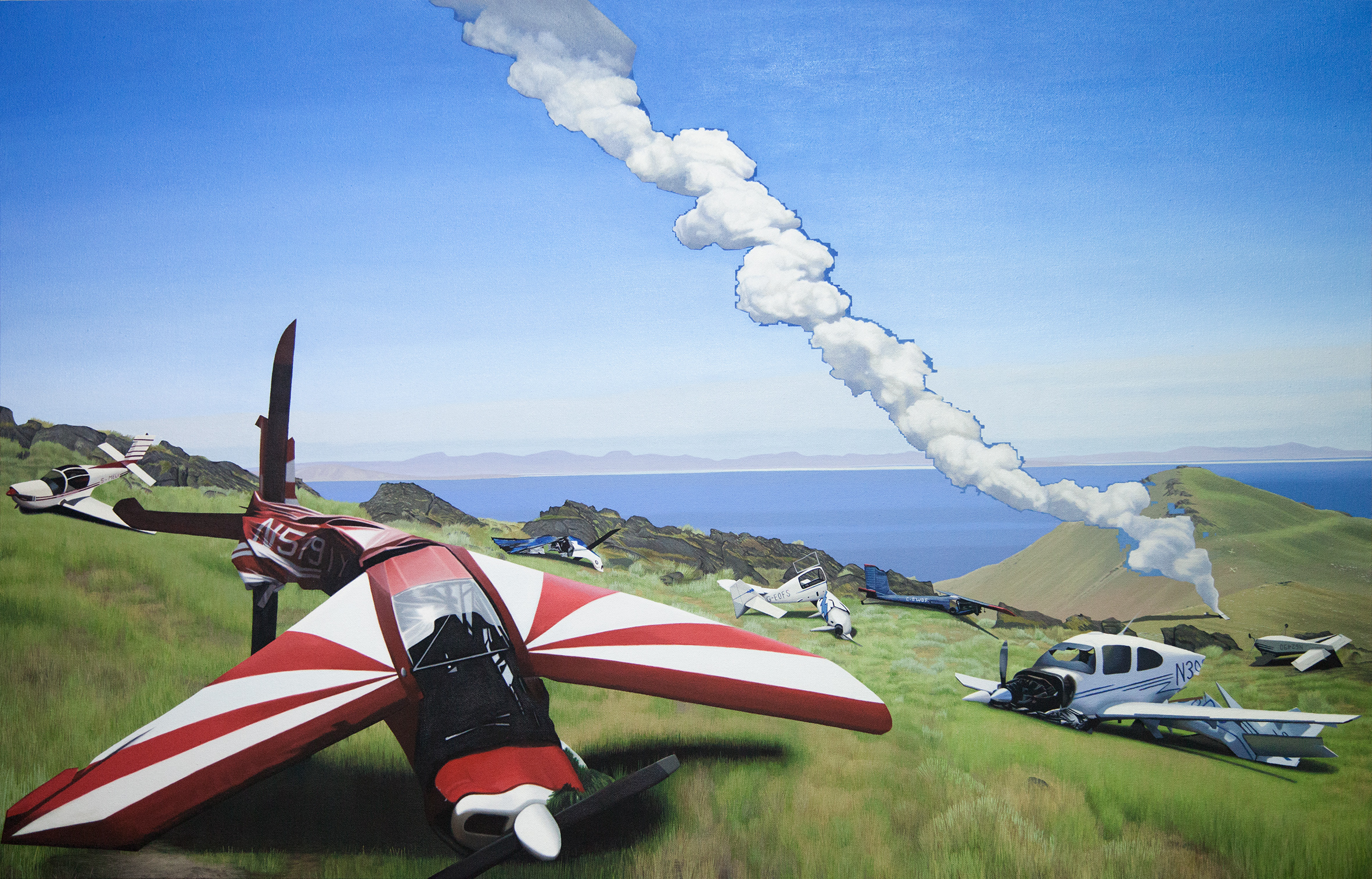
James Moore
Oil on canvas, 110 x 70 cm
Clare: Your work appears to be very carefully composed and researched. How much do you plan before you begin a painting? Could you talk us through the process of how you start?
James: I do quite a lot of planning before I start a painting. Most of the creativity happens during the planning phase – I tend to make a collage, either physically or in Photoshop, or sometimes I’ll make a 3D scene in a modelling programme and the resulting compositions form the source image for a painting. There’s a lot of play involved, and normally it revolves around trying to capture some kind of image that I have in my head. So, for me it’s a process quite close to surrealist dream image paintings – though I’m not specifically looking at oneiric content.
I do carry out a fair amount of research for some paintings – worryingly this seems to increasingly involve Wikipedia. However, as an artist I’m not seeking to present factual truths – I’m much more interested in invention than facts. With regards to research I also try to keep up with reading critical theory and philosophy as I see it as a really important aspect of a contemporary practitioner.
In terms of subject matter the starting point is somehow connected to a deep assignment that has been around for a long time in my work – there’s an intellectual aspect to my work, which is the development of a body of paintings that examine simulacra in one form or another, a sort of verification of inner space and visible fictions. There’s also a visual aspect which is connected to aesthetics and mimesis in philosophical terms, and also articulation of visual pleasure. These things are contingent on mood, memory, what’s going on in my life at the time and what’s going on in the world at the time. Also there might be a curatorial theme that I’m working within.
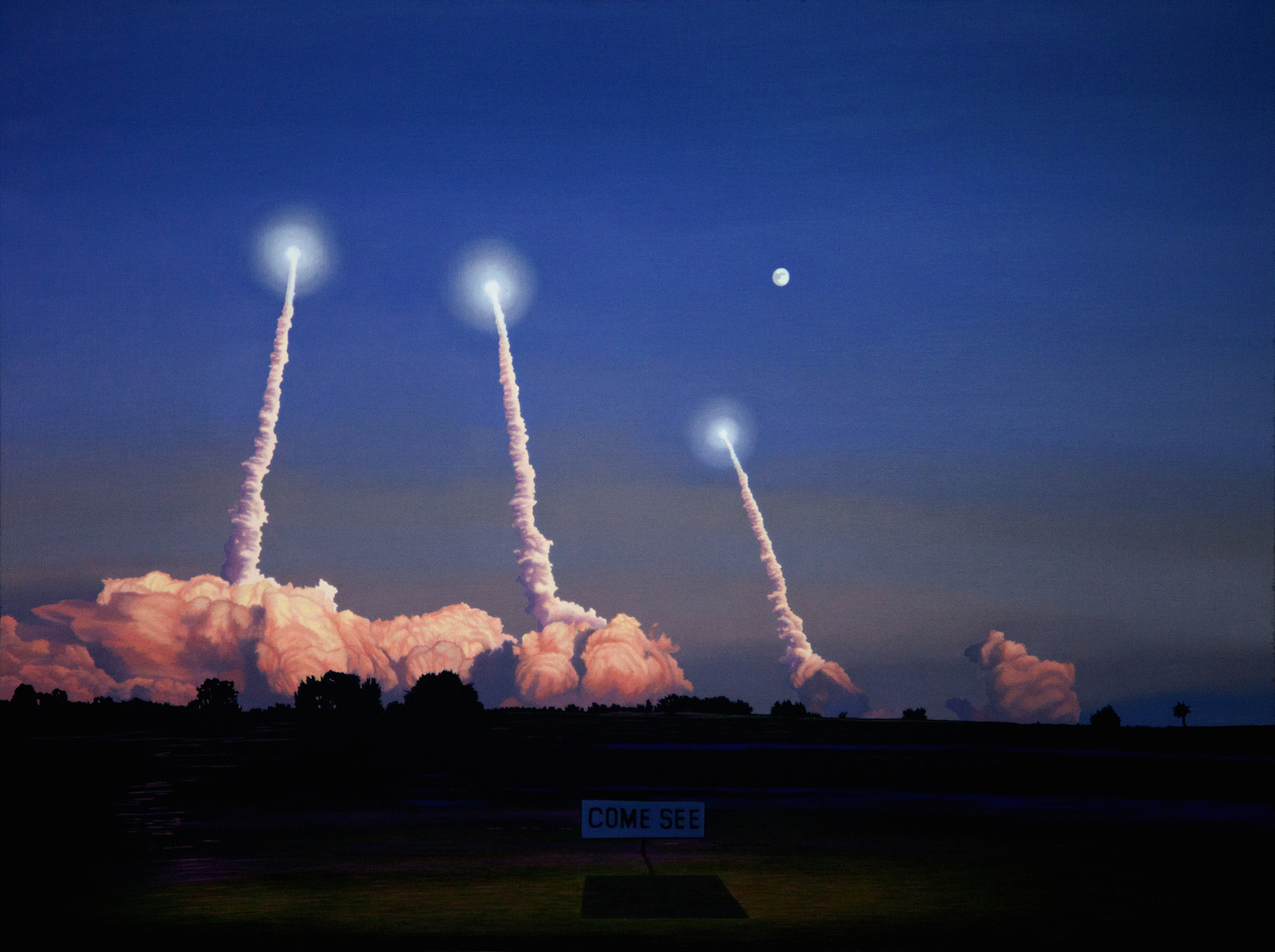
James Moore
Oil on Paper, 40 x 30 cm
Clare: You seem to use traditional landscape painting techniques to achieve depth ie. foreground, middle-ground, background, but the paintings also appear, intentionally, to be quite flat. How do you achieve this juxtaposition and how does it inform your work?
James: Pictorial space is one of the main things that I’m interested in. The stage-like box that exists virtually inside the picture frame is a fascinating convention. I’ve always been exploring that convention to some extent in my work – and sometimes I’ll make quite extreme separations between foreground, midground & background as a way of stripping the painting back to its essential space – moving it away from an illusionistic space towards something that plays with the artificiality of the illusion.
The flatness in my work comes from the photorealist style, which is very much a concern for the surface of the painting, and it also comes from the photo-collages that I work from. Collage is one of the great techniques of the surrealists & the dadaists, and they saw that it was a means of tapping into the power of mediated images & subverting the sign value of imagery. Collages give you a funny, flat, awkward kind of picture space, and I try to capture that in some of my paintings in a trompe-l’œil fashion.

James Moore
Oil on Paper, 40 x 30 cm
Clare: What are the three most essential colours to your palette? Also, can you tell us about your use of grey and how you create such a wide variety of hues?
James: Going by volume I mostly use Titanium White, Ivory Black & Yellow Ochre. Black is a big no no according to much painting lore, but I’ve always used it and seem to get on quite well with it. I rarely use straight black, it quite often has a fair amount of blue or red mixed into it. A friend recently bought me a tube of ‘Black 3.0‘, which claims to be the world’s blackest paint. It’s produced as a challenge to Vanta Black, which Anish Kapoor rather childishly monopolised for himself. I can confirm that ‘Black 3.0’ is extremely black and is available to all artists except Anish Kapoor.
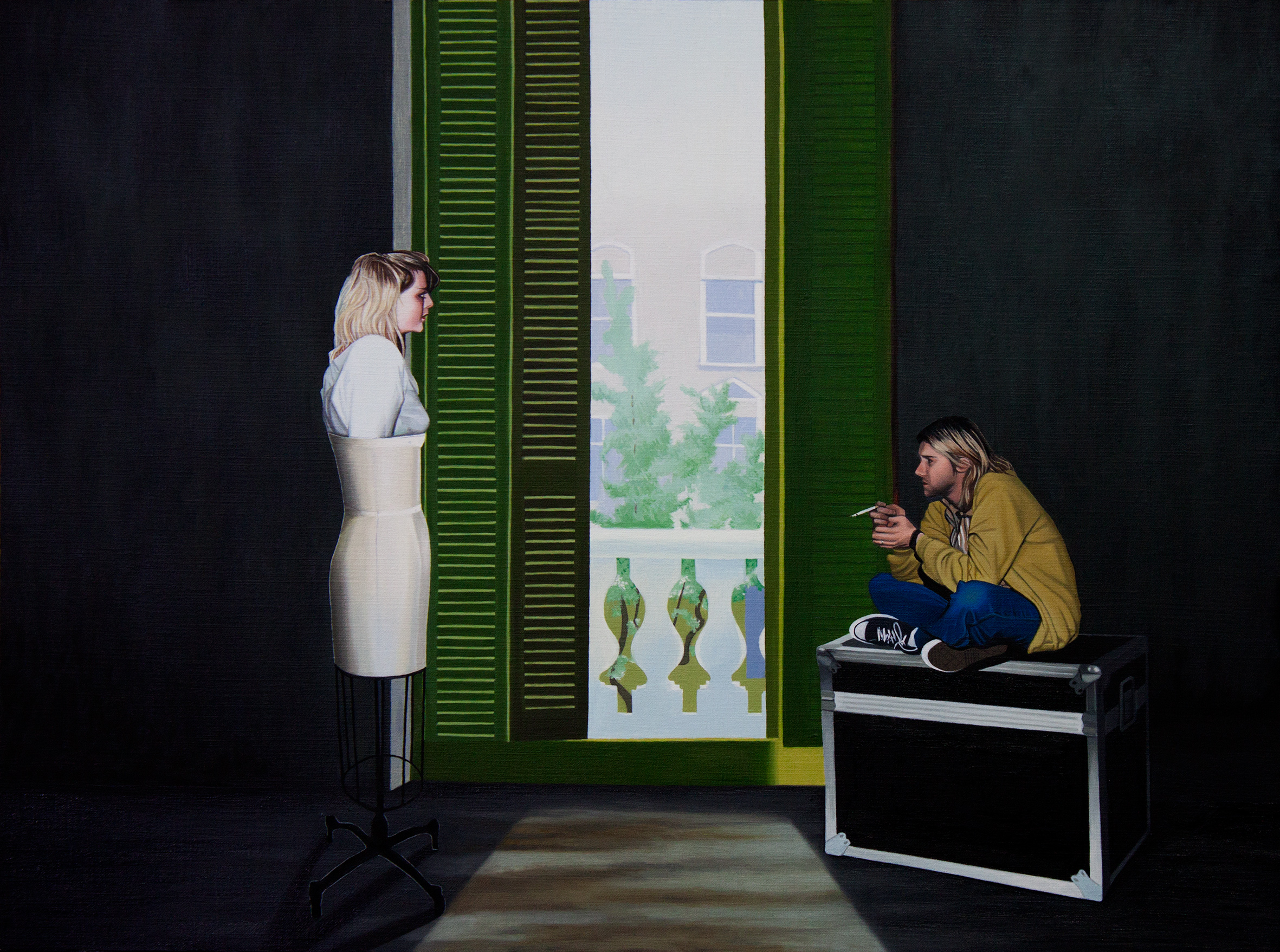
I worked on a series of paintings a few years ago where much of the source imagery I was working with depicted concrete and tarmac, the urban environment, where grey abounded. I always mix grey – I’ve never bought any grey’s in the tube such as Payne’s Grey. Within a landscape scene grey is never as simple as 50/50 black and white – as it’s so neutral it picks up the light and colours around it more than anything, so I often have a fair amount of blue or brown mixed in, or pinks and yellows. Painting something like a concrete floor really makes you look at the sheen of the material surface and try to figure out what’s going on with the light – smooth concrete can be quite reflective at sharp angles and so if you’re painting a pavement or a wall or something like that, it might actually be bright blue as it’s reflecting the sky.
James Moore
Oil on Paper, 30 x 20 cm
Clare: Do you maintain a practice of sketching or some other way of collecting imagery? If so, can you tell us about your approach and the materials you use?
James: I always have a sketchpad on the go, though it’s mostly for rough drawings of compositions for paintings – the drawings have a really economical quality and are quite poor by many people’s standards. Sometimes I flesh them out a bit with watercolour.
From time to time I go life drawing at a local class, just for fun more than anything – it’s not really connected to my painting practice. It’s just a way of keeping up the skills of translating the experience of looking into an image on a flat surface without the use of any complicated tools.
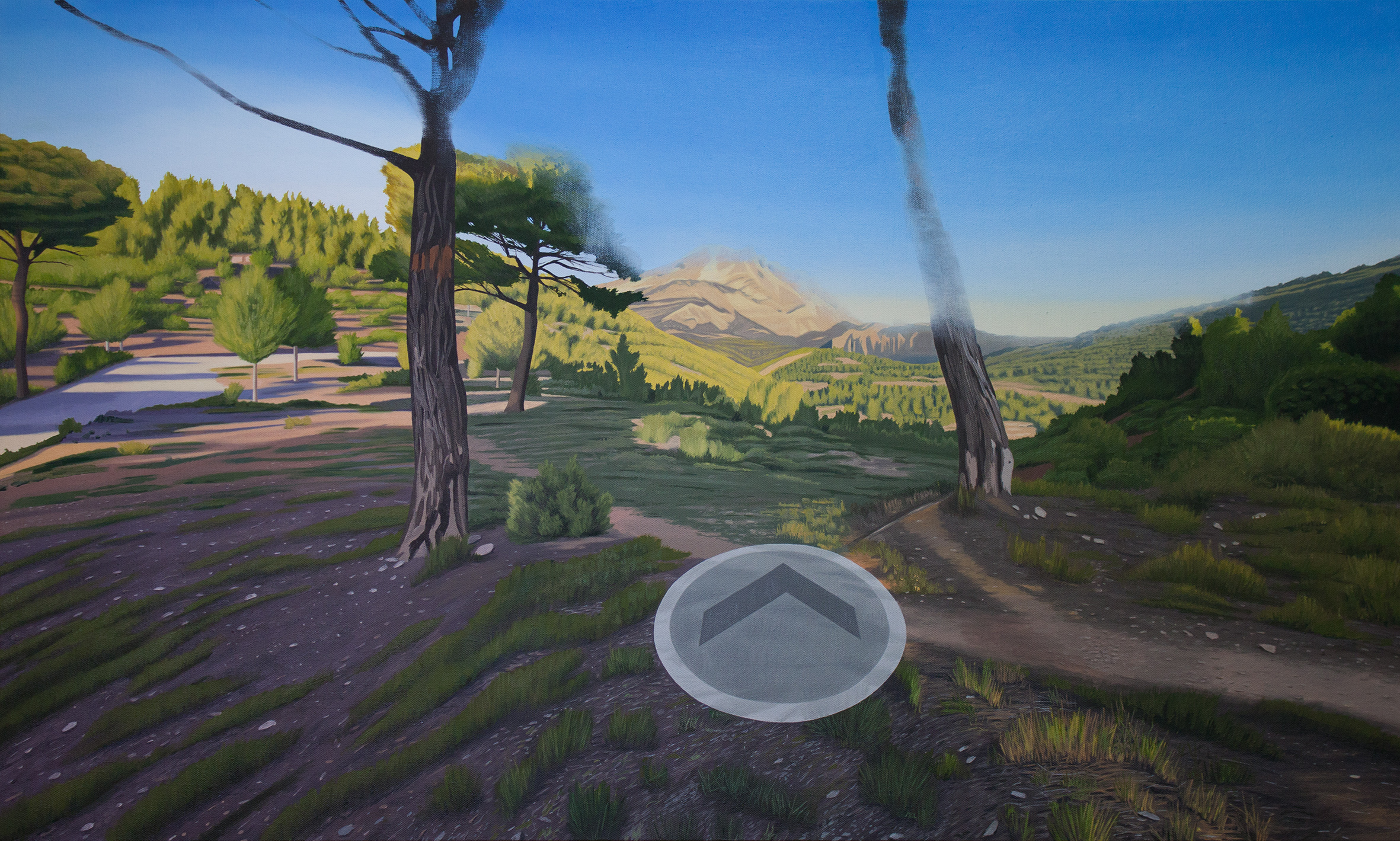
I have a burgeoning visual archive of photographs that numbers into 1000s of prints and digital images, a mixture of my own imagery and things I’ve downloaded or cut-out from other sources. These form the starting point for works from a technical point of view and I’ll usually develop a collage in Photoshop or construct a 3D model on the computer in Cinema 4D. In turn these form the reference image for a painting and during the painting process the materiality of paint, scale, colour and a characteristically indescribable feeling for the image inform and change the composition as I work on it.
James Moore
Oil on Paper, 40 x 30 cm
Clare: What are your most important artist’s tools? Do you have any favourites?
James: My main tools are my brushes, and I tend to stick to ‘Pro Arte Acrylix’ – they have a really nice feel to them and they do a super pointy ‘000’ size which is essential for me.
My favourite tool in the studio is a Mahl stick that I made from a broom handle with a ball of canvas on one end. I have one that I made as a student and it is still going strong.
An amazing tool for me on bigger paintings is my digital projector which I use to help me sketch in an initial pencil drawing on the canvas. It speeds my process up no end and is really just a contemporary version of the 1500’s camera obscura that artists used to project their images and scenes onto a canvas.
James Moore
Oil on canvas, 100 x 60 cm
Clare: What makes a good day in the studio for you?
James: Having a good 8 hour or more stretch in the studio is always great. A full uninterrupted day allows me to just totally enter the process of making a painting and it feels like I’ve gone to another world. It certainly doesn’t feel like I’ve just been sat working in the same old room for hours on end – it’s hard to describe, but it’s probably the most enjoyable thing about painting.
Finishing a painting is always a high too – there’s a point where you put the last brush stroke on and then that’s it, it takes on its own life after that, it’s out of your hands.
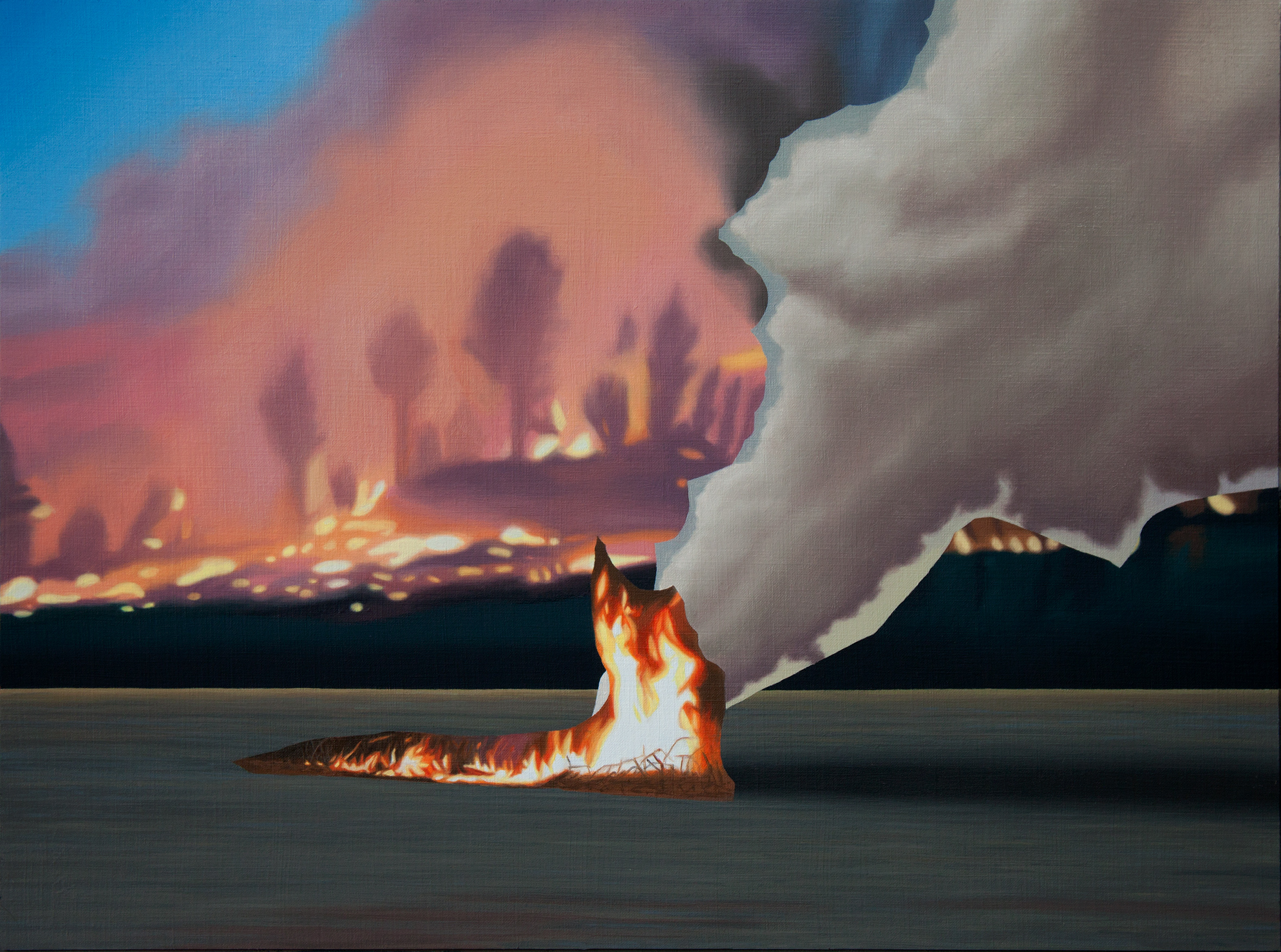
James Moore
Oil on Paper, 40 x 30 cm
Clare: What are your art influences? Who are your favourite contemporary or mythological artists?
James: I think my all time favourite artist is Dexter Dalwood. I came across his work as a student when he did some teaching on my BA Fine Art degree. As a young artist at the time I remember feeling it was difficult to justify painting as a valid practice within the critical contexts of art school, and it seemed to me that Dexter Dalwood had found a way of making painting easily stand up against calls for its redundancy and his work was just the coolest thing I’d ever seen.
I really like Sandra Gamara‘s paintings at the moment. She makes first person views of other paintings with an accompanying pointing hand entering the frame so that it looks like it’s your hand pointing at something inside the picture. They’re brilliant – using a method of embodiment straight from a gaming iconography. They depict pictures of galleries, people looking at paintings looking at paintings. They ask ‘how deep can you go in the never ending procession the gaze?’
Lisa Brice‘s paintings are also really amazing – she samples figures from famous old paintings and completely subverts them, the surrealist tendencies of collage leading to powerful works.
I’m massively into Tom LaDuke‘s paintings too – they have a really weird appearance, it’s quite hard to tell how he’s made them and that mysteriousness of how he uses the medium is totally compelling.
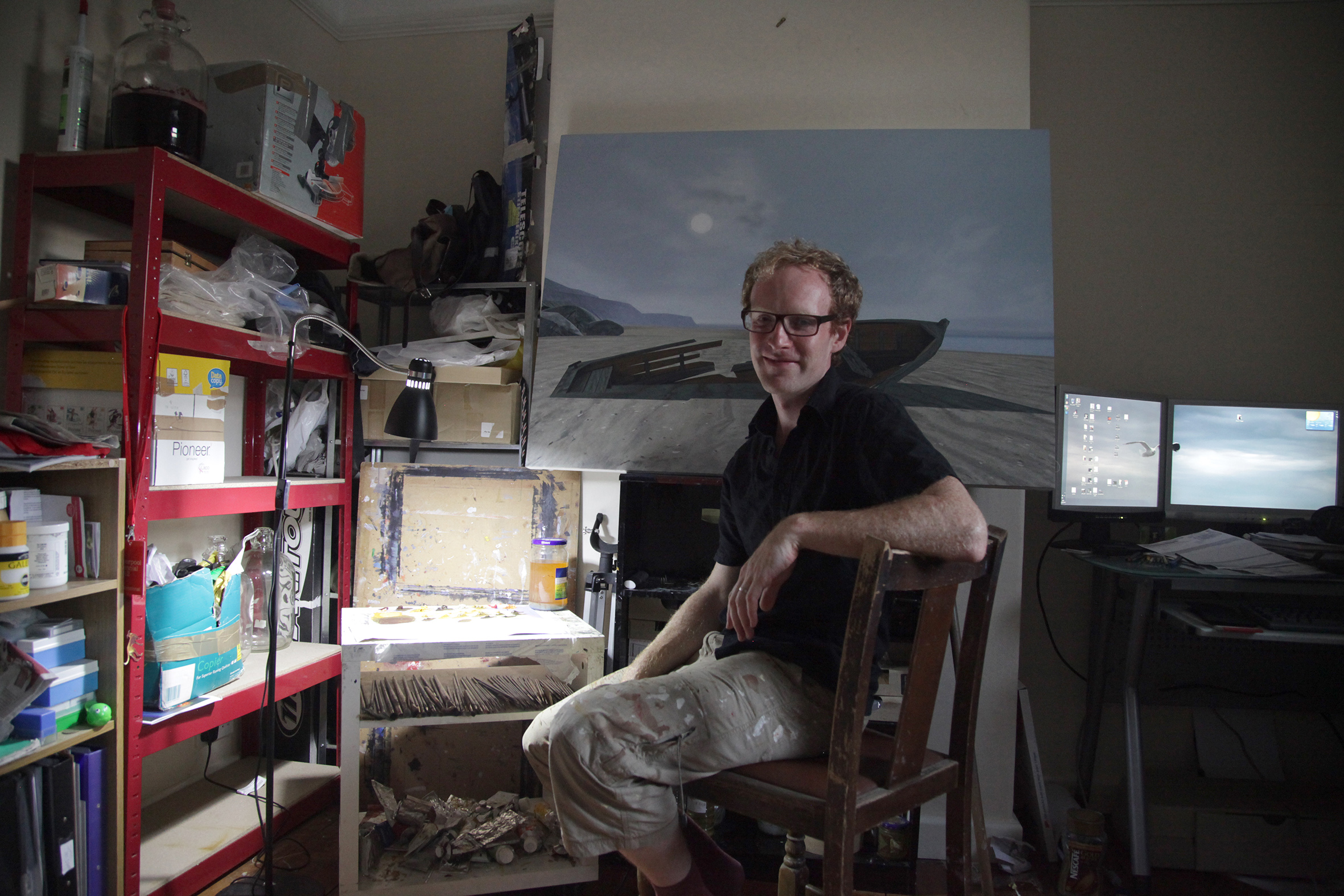
Clare: In the studio – music, audiobook, podcast, Radio 4 or silence?
James: Music! I will happily listen to almost any type of music, but my favourite is drum and bass and strange techno. I do listen to audiobooks too, but I find there’s a risk that my head drifts off into the story and I start to go on automatic pilot with my painting, so it depends what I’m working on. If it needs my full attention then I can’t listen to a book.
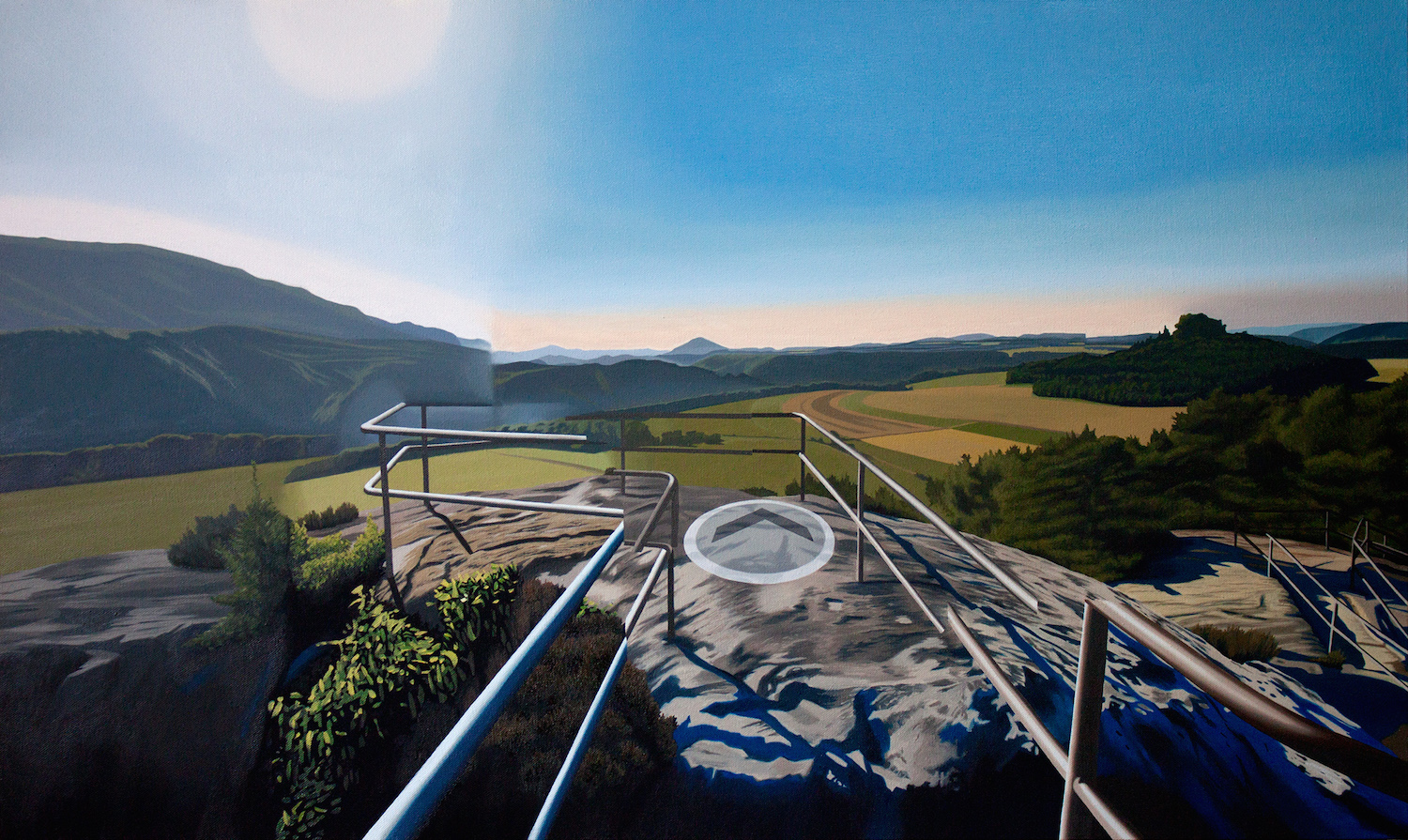
James Moore
Oil on canvas, 100 x 60 cm
Clare: What is coming up next for you and where can we see more of your art in the flesh or online?
James: I have a painting in the Sunny Art Prize – it opens on the 1st October at The Sunny Art Centre, Grays Inn Road, London.
Next year I’m taking part in the exhibition ‘Walking in Two Worlds’ which is part of BEEP painting biennial in Swansea after which it will tour to other galleries around the UK.
I exhibit with Paper Gallery in Manchester and am involved in their exhibitions now and again.
The best place to see my current work is on my Axis Art page.