



How does house paint differ from artist paint, and why shouldn’t I use it for my paintings? For this post I want to examine the characteristics of house paints, how they differ from artist paints, and explain why they are not directly interchangeable.
Can I Use House Paint For Fine Art?
There are two main reasons why you might use house paint for your art. One reason is to save money by using household emulsion paint to prime your canvas. After all, it’s paint and it’s white so why would it be any different to the primer or gesso we sell at Jackson’s? This post by Julie Caves explains why this is ill advised. The other reason is as an artistic statement – maybe you want to comment on high/low culture and juxtapose the mass-production aesthetic of lifestyle colours with your expression. You can use house paint for your art, but household paint and artist’s paint are by no means a direct match for one another.

Sarah Morris
Site Specific Installation
The Function of Paint
Let’s think about this logically. House paint is for painting domestic interiors and exteriors, while artist paint is for painting works of art. How they are made is specifically tailored for their intended use. So if you are going to start using house paint in your works of art, you need to be prepared for the fact that it will always possess the characteristics that painters and decorators seek. Characteristics such as flat, even colour in a range of pre-mixed hues. Colours that are easy to live with when applied on walls from floor to ceiling.
How Artists have used House Paint in the Past
When an artist such as Sarah Morris uses household gloss paint, she does so to reference contemporary culture – colours that reflect our lifestyles, advertising, and consumerism. She paints shapes onto canvas with crisp edges, stripes and shapes, that remind us of buildings, slogans, and machines.
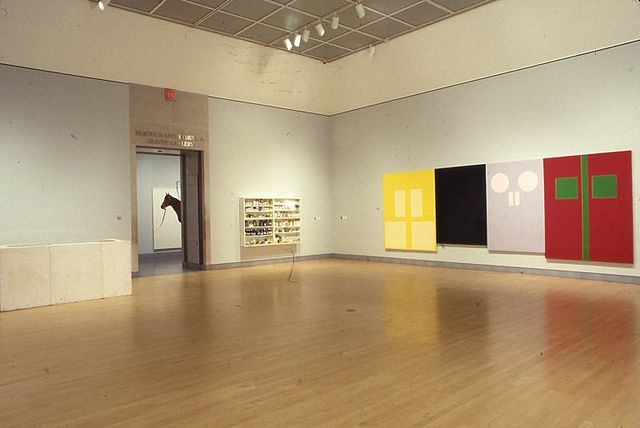
Gary Hume uses household enamel to paint his large-scale canvases. He does so in pursuit of the sublime. The work suggests that the artist is interested in combining the ‘lifestyle ideals’ that are suggested by house paints with an intuitive way of working. His painted lines are undeniably made by the artist’s hand. Combining expressive form with the beauty of mass-produced house paint is arguably Hume’s USP.
Another artist who springs to mind is Damien Hirst. His famous Spin Paintings are made by placing round canvases on a specially made spinning machine and then pouring household paint on them. Unlike Hume, there is no trace of the artist’s hand composing the image. The artist’s role is merely one of selecting colours and turning on the machine. The lack of control over the paint allows us to see how household paints behave with one another. When you look at a Spin painting you’ll notice there is hardly any evidence of colours bleeding into one another. Instead, each colour retains a purity that when thrown onto the substrate competes with the other colours, pushing them out of the way. It’s this quality that ensures an even application when you paint them on your walls. When worked with in spin paintings, the paint looks dramatic and chaotic. They always give me the sense that something has been broken, or gone wrong, like a malfunctioning computer screen.
House Paint Used Before the YBAs
It would be remiss of me not to mention 2 pioneers of using house paint in fine art: Jackson Pollock and Pablo Picasso. Jackson Pollock used very fluid enamel paint to create his drip paintings. He would do so by drawing in the air using a stick or hardened paintbrush loaded with paint, which would fall onto the canvas in dynamic ways. This process was termed ‘action painting’. For Pollock enamel paint was the perfect match for his approach. It was the perfect consistency for a start. Secondly, much like Hirst, Pollock enjoyed the characteristics of enamel paint. They did not bleed into one another too much, so the pure colours would sit alongside one another. Consequently, his drip paintings are each a sophisticated web of lines of paint in vivid colours.
Picasso and Ripolin
In 2013 X-rays confirmed that Pablo Picasso used ‘Ripolin’ enamel paint in some of his bolder, geometric paintings, such as his masterpiece ‘The Red Armchair’, painted in 1931 and now in the collection of the Art Institute Chicago. It is thought that Picasso favoured working with both Ripolin and oil paint on the canvas to stretch the variety of marks he could achieve. The Ripolin dried in uniform layers with crisp edges that contrasted dramatically with the slower drying, easily blended oil paint. However, the paint that Picasso used in the early 20th Century had more in common with artist oil paints than a lot of house paint available today, and is thought to have greater longevity.
What Is Paint Made Of?
The main components of all paint are pigment, binder, and additives. Let’s take a look at them each in turn to examine the differences between indoor paint, exterior paint and artist’s oil paint.

Pigment
Pigments are used to give paint its colour. Artist paints have a greater concentration of pigments in their formula than house paints because colour brilliance and lightfastness (the extent of how much a colour will fade over time) are a high priority for artists. Artist paints also need to possess the qualities to mix well. When colours are mixed pigments are combined and inevitably the strength of each colour used in the mix is weakened. For this reason, the best paints have maximum colour strength. Indoor house paints in comparison have a much lower level of pigment saturation.
Additives in Paint
Also, the paint tends to only contain organic pigments for health and safety reasons, and not all of them have the highest lightfastness levels. Exterior paints have similar pigment saturation to indoor paints, but their lightfastness levels are improved thanks to UV blockers and other additives used to make the paint weather-resistant. Because the majority of artist paints only use lightfast pigments, there is no need for such additives in their manufacture. The lightfastness ratings of oil paints are indicated on the labels of their tubes, or the manufacturer’s colour chart.
Longevity
The binders that are used in each of the types of paint reflect the purposes of the paint. In the case of indoor paints, the binder needs to be fast-drying and rigid. This helps the paint withstand the kind of wear and tear you might expect in a domestic interior, including scrubbing. As a result, the paint is durable but completely inflexible. If it were to be applied to a wall that was likely to experience fluctuations in humidity or extreme temperature changes, it would very likely crack or chalk the paint. Exterior paint is more flexible because it needs to be weatherproof; it needs to have the permeability required to absorb moisture from the brick wall it may be applied to.
Exterior paints need to withstand all weather conditions without cracking. The flexible binders of exterior paints emit VOCs (Volatile Organic Compounds) and are not suitable for use on indoor walls. Both indoor and outdoor paints will have colour shift – that means that how the colour looks from wet-dry will differ noticeably. In the case of artist’s oil paint, the binder (drying oil) needs to be clear, so that there is no influence on the appearance of the pigment and no colour shift.
Drying Times
There is also no fixed ‘ideal’ drying rate. Some painters want the paint to dry very slowly to allow for blending techniques, while others might add driers to speed up the process. If left to its own devices oil paint dries much more slowly than house paint. Linseed oil in oil paint is flexible while drying, but once dry it can be brittle, and doesn’t like big changes in humidity and temperature, which is why it can be important to keep your paintings in a fairly constant environment. In the short term, artists who use outdoor paint won’t need to worry about keeping conditions constant as the work will withstand changes in extreme temperature and humidity. However as previously stated, we do not recommend using outdoor paints indoors as they often emit gases that may be unhealthy to breathe in.
Household paints are designed to make even applications of colour easy. Exterior paints are designed to be resistant to chipping and peeling, even in extreme weather conditions. As a result, their characteristics are difficult to modify. They only do one thing well – that is to go on surfaces evenly. If you try to mix colours, blend or glaze with house paint, you may find that, compared with artist paints, it is difficult to achieve subtle effects. If you’re considering working with either indoor or outdoor paints, we suggest you think carefully about their characteristics before you do so, and use them to your advantage to avoid disappointment. Use them with intent, and not as a compromise, as you are guaranteed to experience disappointment.
Artist oil paints of any quality are designed to be mixed and blended, glazed and layered. They have the highest lightfastness levels and the greatest pigment strength. If you are looking for vibrant colour and paint that is easy to control and modify, there is no substitute.
Further Reading
A Guide to Watercolour Painting
The Difference Between Luminescent, Pearlescent, and Iridescent Paint
Choosing a Clear Primer for Oil Painting
Shop Art Materials on jacksonsart.com




89 thoughts on “Can I Use House Paint For Fine Art?”
Thankyou for this very interesting subject. I sometimes
have used domestic water based acrylic paint to prime MDF
boards or home made canvas covered boards. I have then
produce my paintings using artist quality oils. Should I stop
using household primers for under painting?
Hi Mr Roberts, thanks for your comment. Priming with house paints is not recommended for longevity. You might like to take a look at Julie’s article on priming with house paint to find out more. https://www.jacksonsart.com/blog/2018/08/04/priming-your-canvas-with-house-paint/
Many thanks
Lisa
hi Lisa.. I love experiments with
different material. Two questions
from ur article. I like the Picasso
example, but what is Ripolin? and
does Ripolin require oil or water based
indoor paints? thanks kindly.
Hello,
Ripolin was the first brand of enamel paints available. You can browse some modern day enamels here – https://www.jacksonsart.com/search/?q=enamel
It’s great for high gloss, self levelling colour, and is thinned with solvent.
Many thanks
Lisa
I agree, working at LACMA and MOCA
with the Conservation Dept, artworks
that were made with household paint
is a conservation nightmare. Painting
done in the 60’s and 70’s are falling
apart and fading might not last a
hundred years.
Dear Marc,
This is fascinating, thank you! So interesting the lifespan is so short.
Many thanks
Lisa
Extensive humidity may result to peeling
off of your entire work
I have been using high-quality art paint
student great paint house paint so I
wonder if there really are different you
can mix any paint if you really want to
do so I recently saw a painting I done in
1961 in Dulux paint it hasn’t changed
one bit so I don’t know what’s the big
story is about house paint or artist paint
Hi Deutscher
Your comment made my day. I always
wanted to try house paints and artists
paint.
I will give them a try now.
Can you also share that you also mix
all three for doing art work? Or you
just use house paints for background
and students paint as a base etc?
Regards
You forgot John Myatt who actually used
house paint in his famous fakes, they
were accepted as originals!
That is fascinating! Thanks Daniel.
The artits I know who use house paint do so to reduce paint
costs and for the convenience of thinnish paint in can
quantities for larger works. They would otherwise paint with
acrylics, not oil. And, they look for latex paint for better
quality. I aree that VOCs are an important consideration, but
I don’t get the impression that it’s a concern when weighed
with the cost and convenience of paint in cans.
Hi Donna, thanks for your comment. I hope to do another article addressing house paint vs. acrylic paint in the future. The bottom line is yes, you can paint with house paint instead of acrylics, but there will always be limitations when not working with a medium that was not intended for that purpose. I would argue that fine art painters generally seek the best possible colours, and may also seek paints that will stand the test of time. Artist paints are made with these two things in mind, and as a result working with them guarantees that results are consistent, colour matching and mixing is easier, and that your work will look as fresh as the day it was painted for decades to come (provided the surface was prepared properly etc). You might want to save money but the results of your work may not last, and you may find in the future that it was a bit of a false economy. There is always that risk.
Thanks
Lisa
Paint is paint whatever the artist does
with it and there is no guarantees a
painting will last forever. It depends
how it’s treated, how it’s stored and
where it’s hung. I know lots of people
who paint with oils, acrylics and
household products and make up their
own paints, gesso and textures and
have been doing it for years and fifty or
so years on the pictures are still going
strong. It’s definitely worth considering
cost, especially as there are so many
products out there all claiming to do
the same thing. My studio is full of
such items that I bought on whim and
never use.
Very true, thanks for your comments Sandra
I agree with you Sandra. I’ve been
using house hold paint and I’ve put
oil paint in top of house hold to
achieve the desired color the two
paints do not repel.
Using acrylic test pots from reputable
company’s to explore and enjoy your
creative journey instead of paying silly
prices for the amateur artist
I bought a painting that was painted
on Masonite and I believe that the
actual painting was acrylic paint. It
needs to be cleaned. What or who
should I find to clean it? Could I do it
myself?
Dear Catherine,
Thanks for your question. It really depends how much cleaning the painting requires. A soft cotton cloth with some lukewarm olive-oil soapy water can remove a good amount of grime, but if that doesn’t do the job entirely we would recommend seeking advice from your local picture restorer.
Always ensure when cleaning a work yourself that you dont get too heavy handed with your rubbing motion, as thick impasto brush marks can be fragile and susceptible to cracking.
Many thanks
Lisa
I used white enamel paint on y canvas, Instead of gesso,
I waited one day, and bingo it works well with another
paint mix on my Landscape painting,
The artits I know who use house paint do
so to reduce paint
costs and for the convenience of thinnish
paint in can
quantities for larger works. They would
otherwise paint with
acrylics, not oil. And, they look for latex
paint for better
quality.
It was a pleasure to find your article! Thanks
a lot, you put some very interesting points
here
Thank you for reading it!
My toddlers have painted a canvas with
our old tester pots and we are totally in
love with it. We want to preserve it but
not sure whether acrylic isolation coat
and varnish would be suitable for house
emulsion paint? Are you able to offer
some advice as we want it to last for
many years to come!
Hi Hanna
If the emulsion is water or acrylic based (rather than oil based) i.e., if it washes away with soap and water rather than white spirit, then you could definitely apply and acrylic isolation coat and UV varnish. That should go some way to protecting the painting! Good to keep it out of direct sunlight, as is the case with any painting.
Many thanks
Lisa
Hello I have recently started painting
and have been using white interior house
paint both on its own and to mix with
acrylic colours, Because of the corona
situation I could not find white acrilic
anywhere! I have since read online that it
can crack. Is this something that will
happen in the short term or over many
years?
Hi,
Thanks for your question – it’s impossible to say for certain I’m afraid. It all depends on the quality of the house paint and its compatibility with the other paints you were working with – there’s a chance it may not crack at all. If it’s on a rigid surface and is acrylic based (and not oil or waterbased) there may not be any problem. The main difference with using white artists acrylic paint would be the brightness of the colour, as there is almost certainly a lot less pure pigment in the house paint.
Hope this helps!
Best wishes
Lisa
I’ve used household paint in the past and
t15 years on have as yet not seen any
problems with the paintings. Of course I
would rather use artist quality paint all
of the time but hey it’s expensive! If it
was good enough for Picasso then it’s
good enough for me
A famous art forger used house paint mixed with ky jelly to create his imitation masterpieces that the critics thought were genuine.
That’s so interesting!
John Myatt, used house hold emulsion.
I know who you mean. His name is John
Myatt. He has done several TV
programmes on Sky Arts. I also saw a
documentary on how he and his accomplice were eventually caught. He served time in prison. He is a great artist in his own right and now paints under his own name, in the style of the contemporary masters.
https://www.google.com/search?q=john+myatt+art&newwindow=1&safe=strict&hl=en&sxsrf=ALeKk02adosLaLmZ5QvrVcu5gIRStxj9bA:1589389086589&source=
accomplice were eventually caught. He se
served time in prison. He is a great artist in
in his own right and now paints under his ow
own name, in the style of the co
contemporary masters.
https://www.google.com/search?
q=john+myatt+art&newwindow=1&safe=st
rict&hl=en&sxsrf=ALeKk02adosLaLmZ5Qv
rVcu5gIRStxj9bA:1589389086589&source
=lnms&tbm=isch&sa=X&ved=2ahUKEwiOv
Knfp7HpAhVLZcAKHb-JBu8Q_AUoAXoECB0QAw&biw=1280&bih=610
JBu8Q_AUoAXoECB0QAw&biw=1280&bih=6
610
This is so interesting!! Thanks so much Martin.
Best wishes
Lisa
I use mainly large area colours. I have some
nice black acrylic wall paint at the moment
and some neutral grey. I do not mix ‘art’
paint with household as it only sometimes
works with effects.
Yet on its own it is fine.
That is interesting, thank you for your comment!
Best wishes
Lisa
Yes also the house hold paints actually
crack, as in my experience.
Very interesting information
Always wondered why I suppose I now
know but I’ll admit it I’m going to have a
go just to find out and I have used white
undercoat with pvc glue as undercoat
interesting result waiting to see if it
cracks or yellows or something
It may be OK, but it’s safer to use artist gesso as it is purpose made.
Many thanks
Lisa
This information is very much
appreciated,thank you,I look forward to your
next one!
Thank you Judith!
” They really only do one thing well – that
is to go on surfaces evenly. If you try to
mix colours, blend or glaze with house
paint, you may find that it is difficult to
achieve subtle effects.”
Artists such as Mural Joe invalidate this
statement.
Hi Christopher,
Thanks for your comment. I will edit the article as my intention was to say it is more difficult than working with artist paints.
I enjoyed taking a look at Mural Joe’s work!
Many thanks
Lisa
Horse for courses if you know what i
mean.Do paint manufacturers make “Art
Paint”? We must appreciate the amount of
money put into Research and Development
by the Artists Paint Manufacturers. Use the
product SPECIFICALLY designed for our art
purpose. We do it with other needs for our
lives why not do it for them. We are putting a
very large amount of trust into the
manufacturers and i am showing my loyalty
to them until its proves otherwise.Integrity
needs to be earned and thats what they do
all the time.
I happened to notice the article about the
use of household paint v artists paint for
priming canvas. As someone who served
an Indentured Apprenticeship and gained
City & Guilds some sixty years ago.
I believe the observations and
photographic evidence may be misleading.
Cracks in walls are generally the result of
some structural movement, which may of
may not be a cause for concern.
However, in some photographs a
significant crack was shown where
perpendicular surfaces meet. This
particular crack would be worrying to a
householder. It might be due to structural
movement, ground shrinkage, inadequate
bonding (interlacing of brick/blockwork)
In some of the photographs the author
implies that paint failed because the wall
was damp. Dampness is walls usually
manifests itself in two ways,
efflorescence, and subsequently crypto-
florescence (flowers of salts) in the former
a white bloom is present and in the latter,
plaster is eventually forced away from the
wall.
The presence of efflorescence, and crypto-
florescence is nothing to do with paint. It’s
the product of mineral salts contained in
materials used in the construction. It’s not
uncommon to see efflorescence today,
especially in new brickwork.
These conditions should not be confused
with other symptoms such as mould of
varying degrees of black. It is true that this
is a result of dampness but it is a
symptom of inadequate or extremely poor
ventilation.
None of the forgoing should be attributed
to the failure of paint to do its job. The
world, his wife and their dog know that
thorough surface preparation is essential.
There has been seismic strides in paint
technology during my lifetime. From the
abolition of lead based paints e.g.
Cookson’s white lead paint, which was
eminently suitable for exterior decoration
to the initial appearance of thixotropic
paints where the pigment is in a state of
colloidal suspension. As a young decorator
I watched with amusement, many an old
timer stir these paints
I have not bothered mentioning paints
which had a short shelf life, due to their
removal by Health & Safety (yes it did
occasionally occur) because of fumes.
Manufactures always recommended their
use in well ventilated spaces, but and
unfortunately this was not always
possible.
So my defence of paint used by the
construction industry, decorators and
householders comes to an end. As the
saying goes, You pays your money and
takes your choice,
I’ve been using household paint in my
work for the past three years. I
completely agree it’s totally different to
acrylic but I love the flat solid colours.
They are bright and vibrant and I find
they work really well on good quality
300gsm paper. Great article thanks.
That’s so interesting! Do you have a website? Would love to see the work.
Best wishes
Lisa
Good for you Claire. I’m with you 100% t
there.
Hi Claire,
I am considering working an school art
project using household paints on paper.
I am somewhat uncertain on their
longlivity and archival qualities such as
lightfastness. Could you share any your
knowledge and experience with me.
Yours truly Roger Wagland
Thanks Roger for your question for Claire. Best wishes, Lisa
Thank you for writing this. I use
household paint in domestic scenes and
also for the flat consistent colour, which
allows me to use the colour as a
personality on the canvas rather than
the brush strokes Distracting from this. I
would like to know how to get this effect
with an artist’s colour. I also like the drip
consistency and lack of control to keep
it intuitive.
Any advice on artists paints for
longevity of the work to replicate this
characteristic in household paint would
be most welcomed . I am experimenting
with some acrylics and mediums but
nothing quite like the paint consistency I
want yet. Especially gloss
Kind regards
Baljit Balrow
Instagram
Hi, thanks for your comments. Have you tried self levelling gel medium https://www.jacksonsart.com/search/?q=self+levelling+gel – this would make your artist paint level out without brush marks. Clear tar gel – https://www.jacksonsart.com/golden-clear-tar-gel-473ml – would help give a drip consistency. Hope this helps! Best wishes, Lisa
An interesting article. It was a bit of a
surprise to see so many others on here
who also I also use “household” paints.
I’d go so far as to say that I have rejected
traditional artist materials altogether (
with the exception of brushes. I do like a
nice brush ). I thought this was my “USP” but I
but I’ll have to park that idea now. I paint on h
on hardboard ( which has a textured surf
surface a bit like canvas ), MDF or Plyw
Plywood. I like to recycle what I can find on a
on a skip or buy in large sheets from Wick
Wickes.
I discovered Emulsion by accident about 20
20 years ago. I was working on an acrylic pa
painting which I was keen to get finished, an
and I needed a quantity of white acrylic pa
paint to mix with some blues to cover a la
large area, only I had left the top off the po
pot of white and it had dried into an un
unusable lump of white plastic. Acrylic is wa
water soluble, and so was the pot of Em
Emulsion I luckily had in the shed. I te
tested it and it was completely co
compatible. The small pot of White acrylic I
I ruined was more expensive than the tub of
of Emulsion. I never bought white acrylic pa
paint again.
I’m contemporary post-pop and I love the
flat evenness that household emulsion
gives me. I sometimes apply it with a
roller as a decorator would. I also like the
colours to “pop” and there is an extensive ra
range of colours available. You can even ge
get it mixed to a specific colour if you ta
take a sample in at B&Q.
I completely get that it has different
properties to acrylics and oils and you
can’t work in the same way, but I don’t
want to work with acrylics or oils any
more. I’ve learned to love the medium and I
I work in a way that gets me the results I w
want.
Another artist who uses house paint is
Teddi Parker, you can find her
@teddiparkerart on Instagram.
Thanks for that, looking forward to checking out her work!
Best wishes
Lisa
I have used Dulux emulsion paint with all
my work for decades. They are quick
drying, retain the colour strength, even
when outdoors (admittedly sealed against
the weather with polyeurathane varnish). I
have never had any problems with
durability. The only drawbacks are that
subtle blending of colours is difficult,
which is fine for me because I paint in flat
blocks of colour, and emulsion paint is
quite abrasive on brushes.
I have recently started using a more
environmentally-friendly Finnish paint
which works even better for me.
Interesting! Thanks for sharing.
Best wishes
Lisa
Thank you so much, the timing for reading this could not have been better since I bought a couple of samples bottles of home paint last week to try in my paintings.
Also, I was moved to see that the spinning painting technique has been adopted! When I was ten (in 1972) I fell in love with a thing (a spinning machine, now I know the name) I had seen at a trade show with my dad, an engineer.It was in the kids department, where children played while adults worked the trade show. My father later on built it for me and I spent a summer throwing paint and making a mess. I am glad someone found a way to put it to better use!
Back to home painting, it was very useful to see described the characteristics of the paint as opposed to artist paint. I paint water colors, so glazing is essential but I can always use white for the occasional detail, and when doing mix media. The important thing is to know when and how and do not expect things which the paint can not provide.
Thank you!
Yes, exactly right, thank you for your comments.
Hi Lisa,
Could You please tell us the thread
size of most common paint tubes? Ive
tried buying wing nuts to run down
and clean the thread but the
commonest ones don’t fit.
Hi Bryan,
That sounds like a good idea! I’m afraid I don’t think there’s such a thing as ‘the most common paint tubes’ – I know my Jackson’s paint lids don’t fit my Winsor and Newton or Old Holland tubes or vice versa, and acrylic tubes seem to be another kettle of fish once again! I’m afraid it’ll have to be a case of buying a few wingnuts and hoping one fits…
Sorry I can’t be of more help.
Best wishes
Lisa
Do you sell semi gloss house paint if so
could i have a price please
Hi,
We do not sell house paint.
Many thanks
Lisa
Where can i buy oil based spray paint for
hydro dipping a canvas please
Hello,
I suggest looking to a DIY store.
Many thanks
Lisa
This is really useful thankyou, I’m
thinking of using household emulsion in
some paintings as I have a number of
tester pots that I don’t want to waste but
want to seal it… Could I use the same
sort of glaze that would go over acrylic
(my usual medium) do you think?
Hi Alicia,
This should be fine so long as the house paint is dry fully before you apply the coating.
Many thanks
Lisa
Rather than reading, a yes or no would
be good
The short answer I’m afraid is ‘it depends.’ Hoping you might have time to read the post at some point.
Many thanks
Ok Lisa I get your point but if it’s good
enough for great artists then what’s the
problem? I have to throw in the point
that although a very interesting post
could it be biased towards expensive art
materials because the author has a
vested interest in the art supply
company they are affiliated with? I must
also make the point that although I
wonder if the post is biased I am and
have been a customer of Jackson’s for
several years and cannot fault the
quality of the products or the service I
have received over the years. If
household paint was good enough for
Picasso it is certainly good enough for
me.
Hi Deborah,
Thanks for your comment. As I say in the article, many artists have used house paint in various ways in the past and there’s no right way to make art. I had hoped that in the article I would explain that all decisions have consequences, so if you use a paint that is not made for fine art purposes, then its suitability is not guaranteed. Will a Picasso painted with Ripolin last as long as a painting by Rubens created with pure linseed oil and pigment? I don’t know the answer for certain but I suspect not. If that’s not a concern and you’d prefer to use house paint then there is literally nothing stopping you. This post might be biased, but if it truly was why would I mention the Picasso, Hirst, Hume and Morris paintings? And why would anyone paint with anything other than house paint?
Many thanks
Lisa
Hello, now I’m really worried. I paint
large color block geometric paintings
and were having a really hard time
getting an even effect without the very
noticeable brush strokes I was getting
with artist paints. Interior house acrylics
solved this problem beautifully. Is there
a similar alternative with artist? Would
flow paint do the trick? What product
can I use to seal my already painted
canvases with house paint? Now I’m
worry about future cracking and posible
fading. Thank you for your help.
Hello,
In future you could try working with acrylic mixed with self levelling gel – https://www.jacksonsart.com/search/?q=self+levelling
It’s likely to be fine in our lifetime, you can add extra protection with a layer of acrylic varnish – https://www.jacksonsart.com/golden-polymer-varnish-water-soluble-matte-236ml-by-road-parcel-only – which will help to protect from dust, dirt and grease and also offer a degree of resistance to UV light.
Many thanks
Lisa
Very good discussion on the comments. It
a long read down. We love painting with
my sister and we are learning with our northern beaches painters on
how to use this house paint to a good
painting artworks. I’m glad I have gained
some insights in your article. The
discussions in the comments are great
info.
Had to use paints that were around the
house in March, when I started painting
for the first time at 63. Three thousand
paintings later, I have over 70 colors of
all types, water based, love crackling,
and black light paint, and effect all
paints have with the black light.
My daughter paints having done a fine
art degree over 10 years ago. I’m a
builder and she asked me about
domestic paints. This is my view of the
subject.
If you use acrylic there is a huge range
of acrylic exterior paint. White is
available in the more chalky ‘primer/
undercoat’ right through to an (almost)
full gloss. The colour fastness is
impressive its toughness when cured is
also impressive. Coloures do not readily
bleed but do easily mix and thin with
water. I won’t put any trade names up but
some top notch brands have impressive
amount of pigment in them. They are not
however available in the more buttery
‘texture’. The best quality primer
undercoat paints really require the
canvass to be lightly missed spreyed to
aid adhesion. The very best ‘satin’
exterior paints can be obtained in small
sized testers right up to 5 litre cans in a
vast range of colours. They are used on
external timber and have admirable
longevity. When using the best there is
little to be gained financially.
Thank you, it’s really interesting to read your take from your perspective.
Hello, how could I use additives with
gloss paints, to help prevent surface
wrinkling when using poured/puddle
techniques?
Hi Clive,
These pouring mediums are especially designed to help with levelling when working with pouring techniques – https://www.jacksonsart.com/search/?q=pouring+medium .
The Tri-Art liquid glass medium would be best for maintaining a high gloss finish.
The only thing is to make double sure the paint you are working with is acrylic based!
Thanks so much
Lisa
Exterior paints often have anti mold and
mildew ingredients including Mercury
and the Mercury gets in the air over the
years. Some of the most brilliant and
expensive artist paints still have toxic
metals in them.
Thanks Thomas. I would like to clarify that any toxic pigments used in artist paints are encased within the binder (oil or acrylic or gum based for watercolour) and so this toxicity will not leech into the atmosphere over time – it is only harmful if eaten or handled when the paint is wet without gloves or barrier cream.
Many thanks
Nice Article…Very interesting to read this
article. I have learned some new
information. Thanks for sharing.
Thank you!
Similar to one of the above commenters I
also paint large color block geometric
paintings. Brushstrokes aren’t an issue, but
I’m having difficulty mixing enough of an
acrylic colour for full application and was
considering switching to house paints. I
don’t want to lose longevity for my pieces
though. What kind of acrylic should I be
using to mix large single blocks of opaque
colour?
Hi,
May I suggest you take a look at the paints offered on this link here: https://www.jacksonsart.com/colour/acrylic/acrylic-paint/quality/good
500ml in Jackson’s or System 3 brands will cost around £11. That’s hopefully enough paint and within budget…and the quality of the paint is purpose made for fine art painting.
Hope this helps
Lisa
Thank you for your educational article on use of house paints in art.
I do wall murals using house paint, combining spraying, brushing, ragging, and other techniques used in faux finishing to produce some spectacular results. I don’t have a webpage so I can’t show you what I am talking about.
Acrylic house paints an acrylic artist
paints have the same chemistry, so
using house paints and artist paints
together shouldn’t cause difficulties.
Artist paints are usually accelerated age
tested to 75 years, house paints only to
25 years. There may be issues with
colour fading with house paints. All
acrylic paints,artist and house, are
slightly alkaline, so using to prime MDF,
Masonite and cotton canvas will help
create a barrier between those acidic
materials and the paint surface – which
is why acrylic primer is suitable for
priming under oil-based paints, too.
If using house paint gloss or emulsion, egg shell, satin wood, add
PVA or acrylic quick dry internal varnish , it dries clear ,so it is
great with hous paints ,I’ve painted large canvas and I have o
bleeding no mess , my paintings are vibrant and long lasting , I
seal my paintings with a glaze and top coat that car sprayers use ,
either gloss, satin ,or Matt , it dries clear and hard ,so n peeling or
cracking occurs , and long lasting , I all so use turpine if I am
using gloss paint to thin the paint , ask Sean scully what he uses
are you going to tell him he is wrong using house hold paints , i
think this is a marketing ploy so artists buy expensive art paints
Hi David,
This post lists a number of artists that use house paints for fine art, and it explicitly says it’s not wrong to use household paints, so I’m not sure how you have come to the conclusion this is a marketing ploy. House paints are different to fine art paints, they are forumlated to provide a smooth even coverage of colour, usually made from a number of pigments or dyes. Fine art paint is made with single pigments where possible, so artists have full control over how to mix them, as well as binders that optimise colour clarity, and the adaptability to thicken or thin the paint. There’s a difference that lies in their characteristics that depends on why they are made and who they are tailored for.
Many thanks
Lisa
Thanks Lisa for your explanations as well as patience with some of
the touchy and combative attitudes of artists here. There are no
rules in art, take what you will..do what you want!
Comments are closed.