




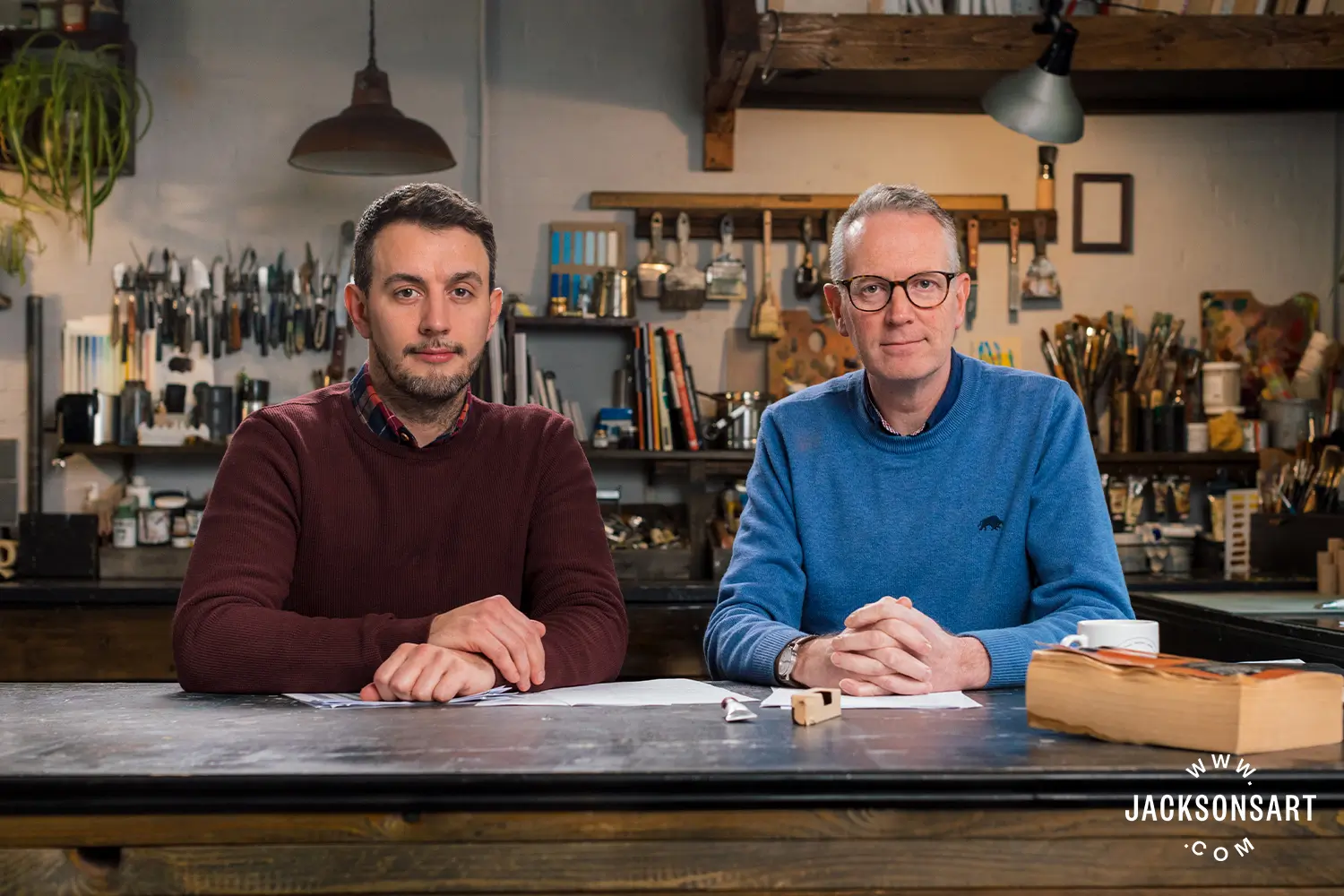
In this film, Michael Craine, Director at Cranfield, producer of artist paints and printmaking inks, and Paul Lee, Technical Director at Cranfield, discuss the subject of art materials toxicology.
Consideration of the dangers of the materials you work with and how to minimise risks with proper handling will help to keep you safe in the studio and give you peace of mind to create your artwork. Paul and Michael lay out key definitions relating to toxicity, including the definition of carcinogens and what is meant by acute and chronic effects of a substance. They describe the four ways toxic materials may enter the body and how to prevent this happening, and go on to explore the information offered by art material manufacturers on product labels and safety data sheets.
Paul and Michael also discuss the link between safety to us as individuals and our environment, both our immediate environs and the wider world, and offer advice on how to keep our art spaces safe, for ourselves, our neighbours, and even our oceans and waterways.
Contents – A Guide to Studio Safety
0:00 Introduction
0:29 How do you define toxicity?
3:33 How does a toxic substance enter the body?
3:56 Can a substance be harmful and hazardous?
8:26 How to keep yourself safe in an art studio
14:00 What is the ‘hierarchy of control?’
15:45 Why do some product labels advise you to ‘consult your doctor’?
18:24 What do the hazard symbols tell us?
23:00 Dangers associated with non-toxic art materials
24:38 Toxicology regulations around the world
27:21 Tips to keep your studio safe
32:00 Remember to ask questions
32:52 Credits
Further Reading
Solvent Safety Guide: Taking Care With Oil Paint Solvents
In Conversation With Michael Craine From Cranfield Colours




7 thoughts on “Film: A Guide to Studio Safety”
This video is DEFINITELY very important to
watch and understand. Most artists
probably already take these precautions,
and know the topics brought up, but it is
always a good thing to get reminded of
these facts. Great video! and an important
video!
Thanks. That was helpful and
interesting. Covers things I had never
even considered.
No discussion on what to do when your pet eats your cadmium yellow watercolor paint with cadmium, zinc, & aluminum tubing…bloodwork pending. 1994 tube!
Oh no ! That’s terrible, I hope your pet is ok.
Thanks very much for the video. Be careful
with industrial hand cleaners, as I have read
of potential links between these products
and diseases of the central nervous system.
We may want to just get on and paint, but
considering the health/environment risks is
important…whether we spend a lot of time in
the studio or paint en plein air. Thank you
for this comprehensive advisory video!
All material data safety sheets are available on the web. I highly urge folks to read them.
Example, E6000 contains two different potentially cancer causing chemicals. But Gorilla Clear Glue contains only one. Why buy a glue with two risks when I can get the same effect with only one risk? Never would have known if I hadn’t looked it up.
Comments are closed.