




Michael Harding developed Miracle Medium as a vegetable-based alternative to traditional oil painting solvents like turpentine and white spirit and can be used both as an oil paint diluent and as a brush cleaner. In this article and accompanying film, Michael Harding introduces Miracle Medium, describes how it differs from traditional solvents, and explains how artists can benefit from a solvent-free painting practice.
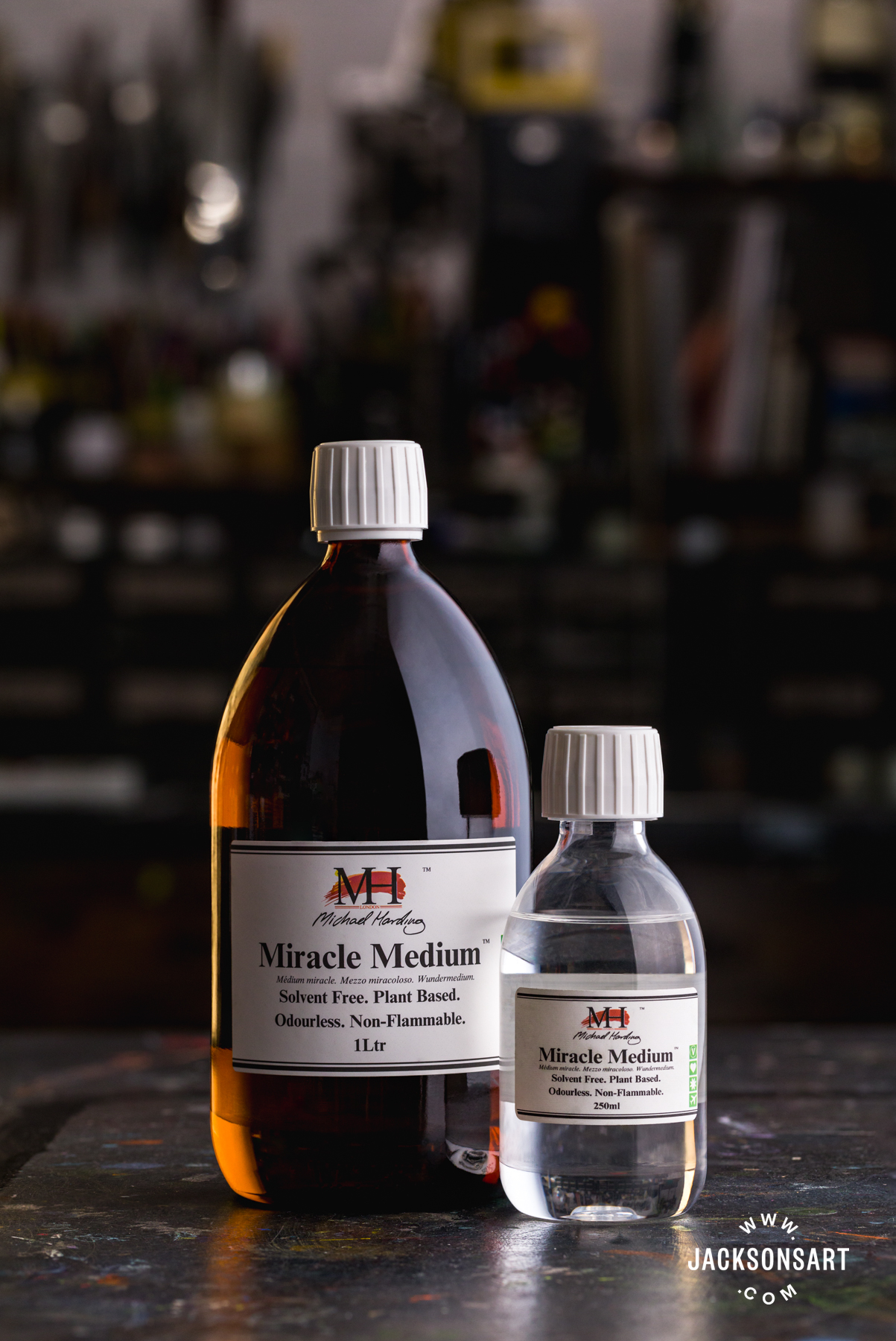
Editor’s note: Miracle Medium is described by Michael Harding as 100% vegetable-based. Environmental and biodegradability claims depend on the conditions and testing applicable to the material; we recommend referring to the manufacturer’s current technical information for these details.
Evie: Could you start by describing the difference between Miracle Medium and traditional solvents?
Michael: Not surprisingly, for artists there’s been a huge need for something that could work for them in the studio, or out in the field, in terms of a diluent – something that thins paint, but at the same time doesn’t have all the negatives of odours, headaches, is environmentally friendly, and non-toxic. We’ve been getting by on turpentine for generations, and other solvents have come along in the last few decades.
My main concern with solvents, particularly white spirit based solvents, is that I noticed that those cause the paint to be more crumbly and brittle. For example when you want to clean out a plastic painting bucket, and you put a dash of white spirit in it, and wipe it around, it’s going to leave marks. However, if you let it dry overnight you can easily wipe it off with a rag. I mentioned this to a painter friend of mine and he said “basically when you see linseed oil under a microscope, you can see the particles are made up of chains, and when you introduce solvent, it cuts the chains.” And of course you would assume that once the spirit had evaporated off, those chains would reform, but they don’t. Those chains are rendered permanently shorter, as if they’re cut. That’s where the tensile strength of linseed oil comes from. In a sense it’s a glue, and anything that compromises the strength of that glue is compromising the life expectancy of your painting.
Also, speaking to brush makers, they tell me that a lot of the solvents out there destroy the hairs of brushes by removing their natural oils. So there’s been a need for something on the market that ticks all the boxes for artists. We joked about it for ages, saying if we can find something, it’s going to be a miracle.
To the best of our knowledge this is 100% vegetable based, therefore 100% biodegradable, and it has no volatile evaporating gasses, no child labour, and no harm to animals involved in its making. The great thing is, that when you put it into paint, it behaves just like those other solvents, increasing flow, completely colourless, it has the faintest smell, but is virtually odourless. It 100% evaporates off eventually, leaving the paint behind as it were. It doesn’t change the speed of drying, nor does it affect lightfastness (although the more you dilute colour, the more vulnerable it is to light). You can fly with it (in the luggage hold of course since it’s a liquid), and you can clean your brushes with it. So it achieves everything we’ve been looking for, and it really is a miracle.
Evie: So if it thins the paint without compromising the flexibility, would this be ideal for underpainting?
Michael: Yeah, anything really. The choice is yours! To be honest, we can’t find anything negative about it.
Evie: How long did it take you to develop the Miracle Medium? How long have you had the idea for?
Michael: I’ve been searching for something like this for about 20 years. With the growth of the business, it was the first time I had the chance to sit down and think ‘wouldn’t it be fun to do this’. We only got our hands on it about five years ago, and started playing around with it.

Evie: I can see now why you’ve called it Miracle Medium. It’s not just a solvent alternative, but it does something different?
Michael: It is certainly a solvent alternative, but sometimes there is an assumption that if something is odourless, then it’s good, but if you read the fine print, they have all the ventilated studio warnings as well.
‘Medium’ has a number of contexts as a word. For example, the medium of collage, the medium of clay etc. and then there is the medium of something you put in paint. In a sense you might argue that linseed oil is not a medium because it’s a component of paint. A medium tends to be thought of as something that’s an additive, a balsam, a turpentine that we add to paint to give it some of the virtue that we can’t achieve with the paint neat. We looked at other terms we could use for it, but they were similar to names of existing products. It’s the one for us that ticks every single box. One thing we did discover is that it dissolves styrofoam/polystyrene. But how many artists would be using tools made out of polystyrene?
Evie: You’ve made versions of your existing mediums with the Miracle Medium. For people that already use those mediums, can they expect the same characteristics from them?
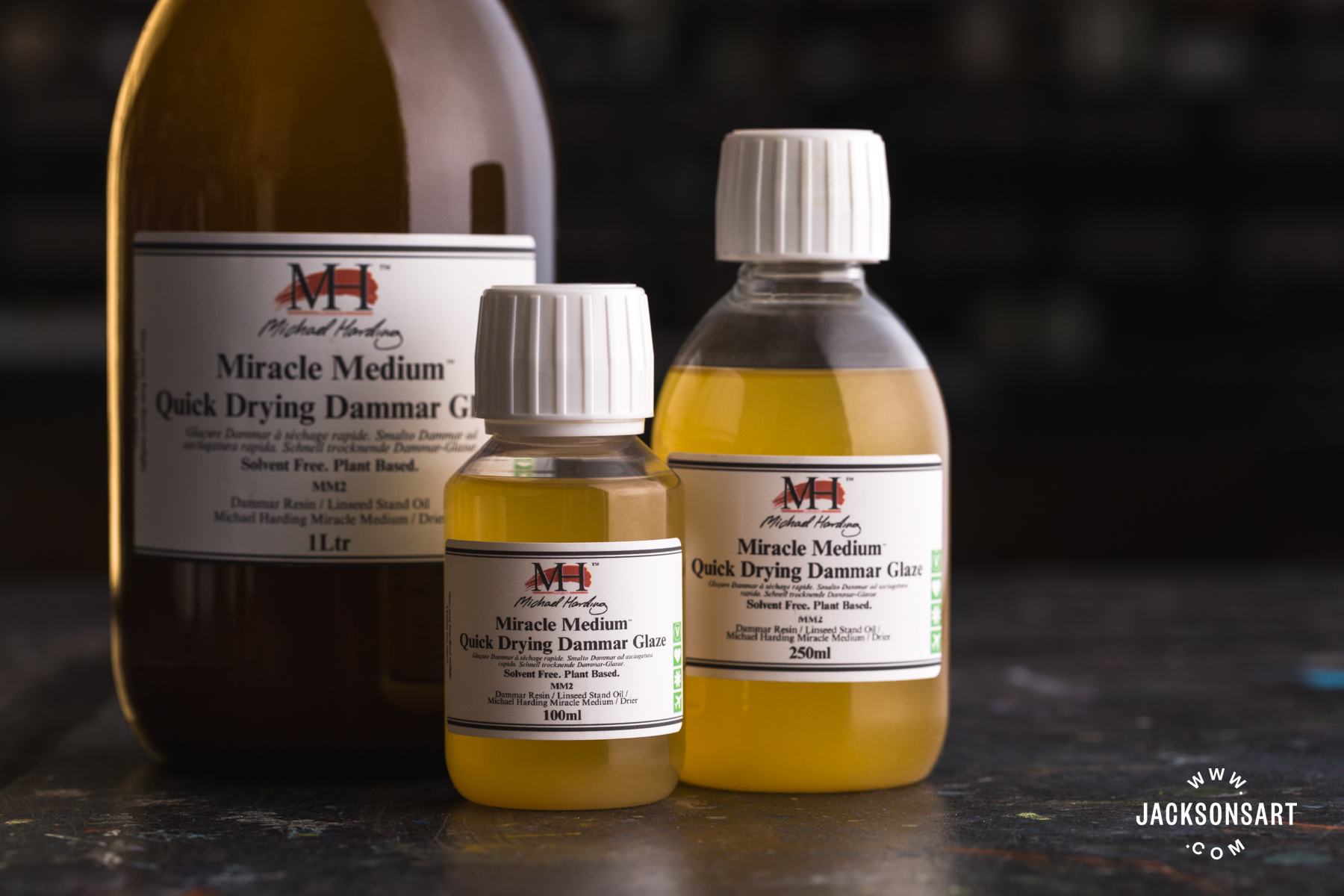
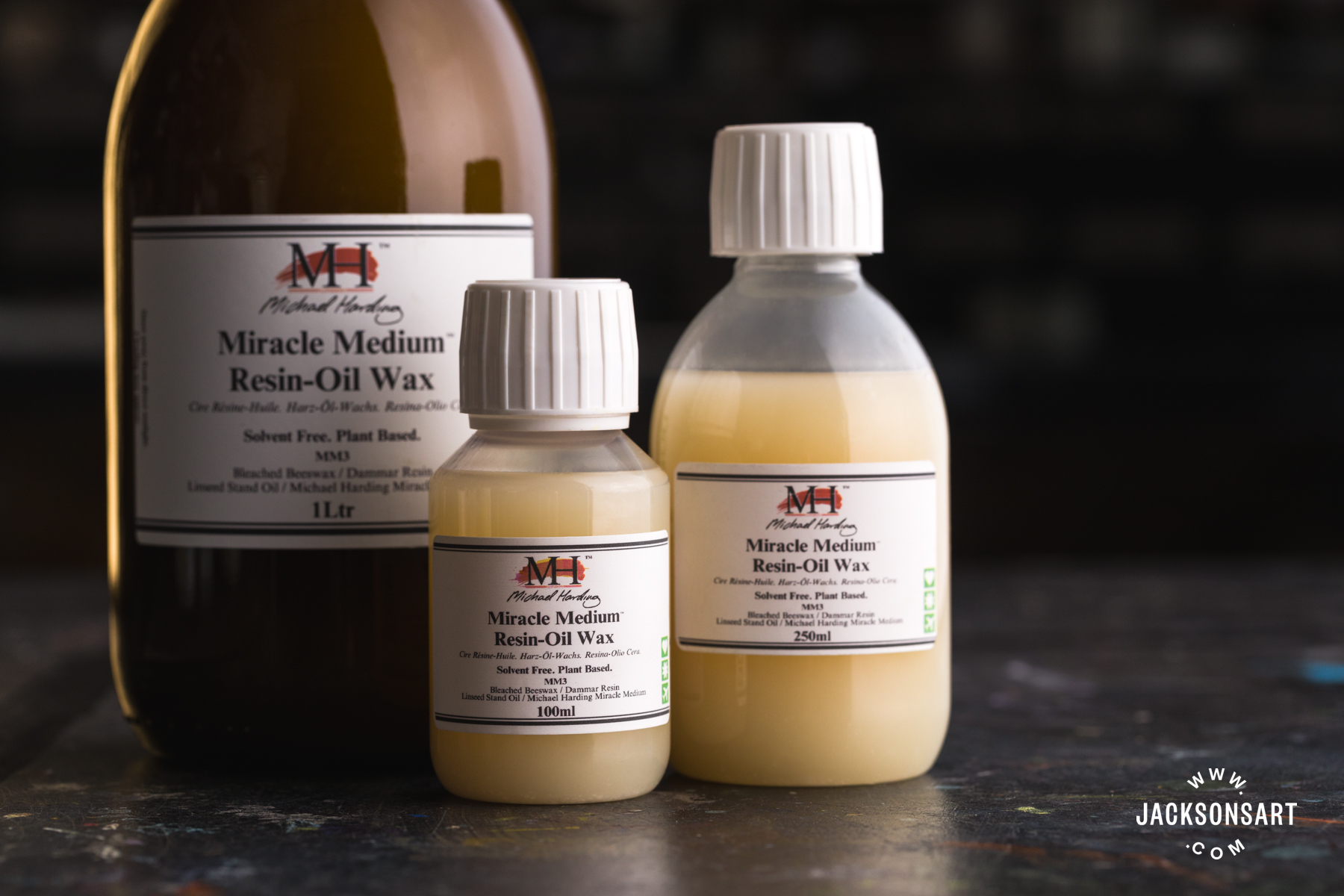
Michael: In the mediums that we had turpentine in, we literally swapped out the turpentine for the Miracle Medium. We found that it dissolves dammar crystals, so effectively it’s the same thing but without the turpentine. It gave us the ability to produce glaze mediums and painting mediums without the hindrance of having to worry about the toxic smells.

Evie: So you can use Miracle Medium to clean your brushes, in the same way you can with a traditional solvent. Do you have any other tips for a solvent free oil painting practice?
Michael: I was about to ask you that! I like playing around with sun-thickened linseed, which was practiced by the Dutch a lot, and it’s really fun. All you need to do is put the linseed oil in a baking tray, leave it on a window sill with a sheet of glass over the top (to keep the flies out), and transfer it to an empty bottle and shake it up each day to aerate it. After about 10 – 15 days it becomes more goopy. So just linseed oil aerated with sunlight, and it starts taking on different characteristics.
Evie: Are there any other mediums or oil painting products that you’d like to develop in the future?
Michael: Well we’re adding a considerable number of new oil colours, about 40. I will probably add some new watercolour colours. Mediums for watercolours are a bit hit and miss in a way, so unless I know I can really bring something to the party, I won’t do it. I’d rather give something really unique to artists that they can’t get anywhere else. That’s the whole purpose really.
Further Reading
A Guide to Mediums for Water-Mixable Oil Paint
Why is Oil Paint So Expensive?
In Conversation With Michael Harding About His Professional Watercolours
Acrylic Painting, Microplastics, and the Environment
Shop Michael Harding Miracle Medium on jacksonsart.com – Currently available to UK customers only



11 thoughts on “Michael Harding Explains His New Miracle Medium”
I’ve been afraid of trying oil paint because of
the solvent issue. This development is
exciting but I am a bit perturbed by some of
the language in the article:
“Michael Harding developed Miracle Medium
as a safer alternative” This suggests the
product isn’t “safe” but safer.
“To the best of our knowledge this is 100%
vegetable based.” Is MH not 100% sure of
the composition?
I think more clarification re testing for
toxicity would be helpful. Can artists use it
safely at home in an unventilated room? Can
they dispose rags with the product on in
ordinary general waste?
If this is truly a range of miracle mediums
this is wonderful news.
Hi Pauline, thanks for your comment! We think it’s more accurate to say ‘safer’ rather than ‘safe’, because all materials carry an element of risk. I asked Michael Harding for some more information, and he said that the toxicological testing they’ve done shows that the product is non-toxic, but that does not rule out the possibility of an individual having a reaction to it. Ideally, the room should ventilated in any case as many artists have toxic materials in their studio space. Rags should be disposed of in the usual way- because it is intended to be used with oil paint, the product could combust when combined with linseed oil and left on a rag.
I felt the same as you but discovered
Sennelier’s Green for Oil range and Gamblin’s
Solvent-Free range and haven’t looked back!
I do also have some MH Miracle Medium but
haven’t used it yet so can’t comment on this
specifically, but there is plenty out there for
you to try oils without the solvents involved
(be warned, it can get addictive!) 🙂
I read your article, watched the Harding interview and after I finish this comment, I am off to buy some of the Miracle Medium products.
Big thanks to Michael Harding, and to you, Evie for a very helpful article.
Great to hear, thank you Gina!
Hey, guys! I discovered I was severely
allergic to a soy based solvent called
methyl soyate. I just ordered some of
this stuff but it got me thinking. I’ll be
okay with this stuff right? Thank you
Hi Ian, I’ve checked this for you and have been advised that the product contains soya
would love to know how to use the new
mediums with the fat over lean principle
Hi Marilyn, thank you for your question. I checked this with Michael Harding and they said that because it is a liquid and it evaporates from the paint film, Miracle Medium should be categorised as fat, but they said that others might debate this.
Good day, I do color pencils and I use solvent
to smooth the color. Would Miracle solvent
be good for it!
Hi Carole, thank you for your question. Yes, I think Miracle Medium would work as a pencil blend in the same way traditional solvents do. I recommend you try it!
Comments are closed.